
In investment banking, someone is always going to ask for a data room. It might be a buyer's advisor requesting access during M&A due diligence. It might be a lead investor before committing capital. It might be a lender reviewing financials before a credit decision. It might be a client expecting secure delivery of a sensitive deliverable.
The problem is that most bankers and their clients build data rooms the wrong way, too late in the process, too disorganized, or using the wrong tool entirely.
This guide covers what a virtual data room actually is, how it works across investment banking deal types, what to look for in a platform, and how to avoid the mistakes that slow deals down.
What is a data room in investment banking?

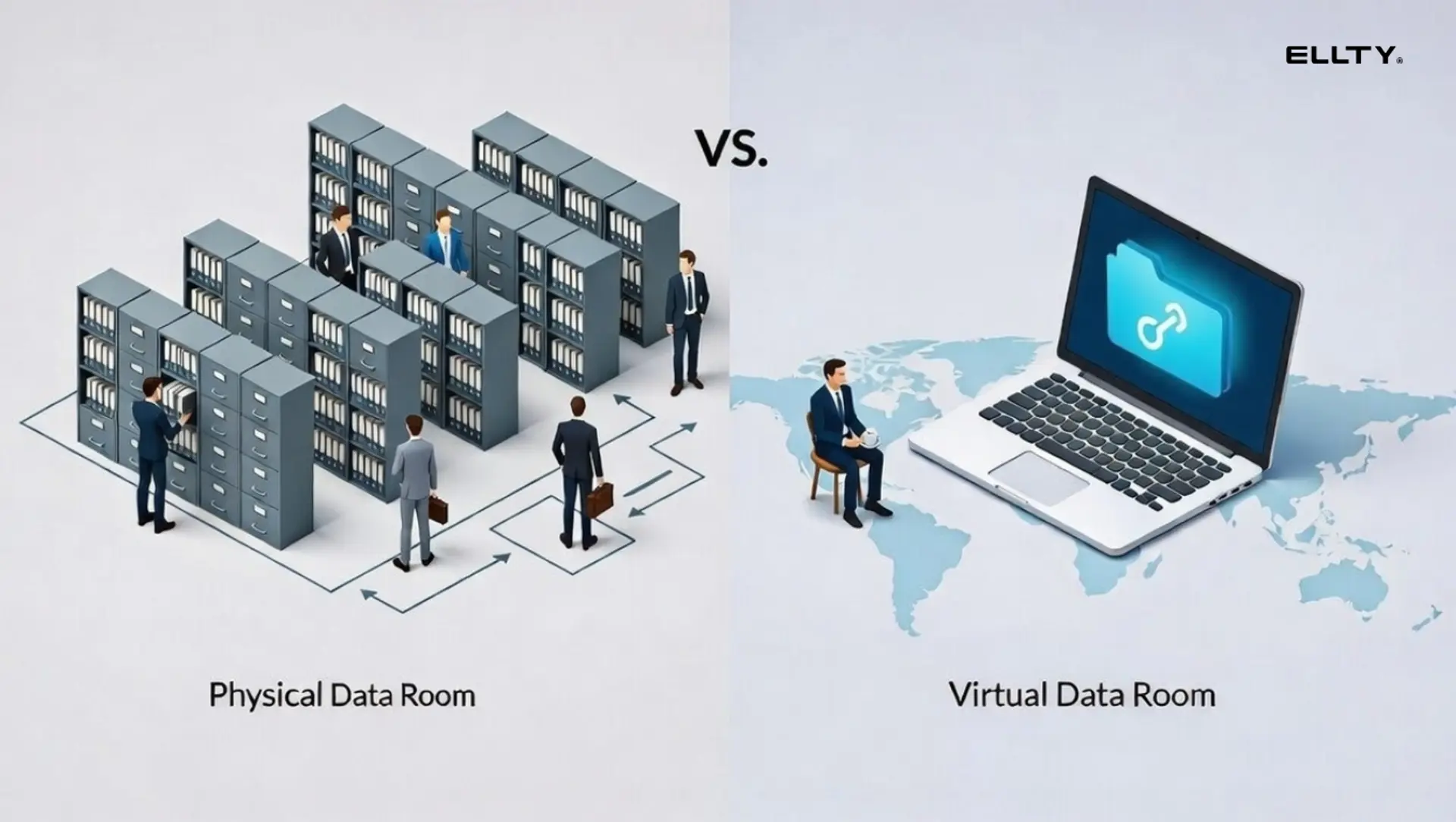
A data room is a secure environment where you share confidential documents with the other side of a transaction - buyers, investors, lenders, or their advisors. Before the internet, this was a physical room. Parties would fly in, sit under supervision, and review stacks of binders. That still happened well into the 2000s.
A virtual data room (VDR) does the same thing online. You upload documents, control who can access what, track every action taken inside the room, and protect sensitive information with watermarks, NDA gates, and download restrictions. The difference from a shared folder is control over access, over visibility, and over what happens to your documents after someone opens them.
In investment banking, data rooms show up across the full range of deal types:
M&A advisory - the sell-side banker organizes the target's financials, contracts, IP, and operational data for buyers and their due diligence teams. The data room is often the backbone of the entire process.
Capital raises - whether it's a growth equity round or a private placement, founders and their advisors share financial models, cap tables, and confidential information memorandums with prospective investors through a controlled data room.
Debt financing and leveraged buyouts - lenders and credit teams review financial records, covenant compliance data, and collateral documentation before committing capital. A clean, well-organized data room accelerates credit approval.
IPO preparation - companies working toward a public listing use data rooms to organize documentation for underwriters, legal counsel, and regulators as part of the registration process.
Restructuring - advisors managing distressed situations use data rooms to share sensitive financial and operational data with creditors, potential acquirers, or turnaround investors under strict confidentiality.

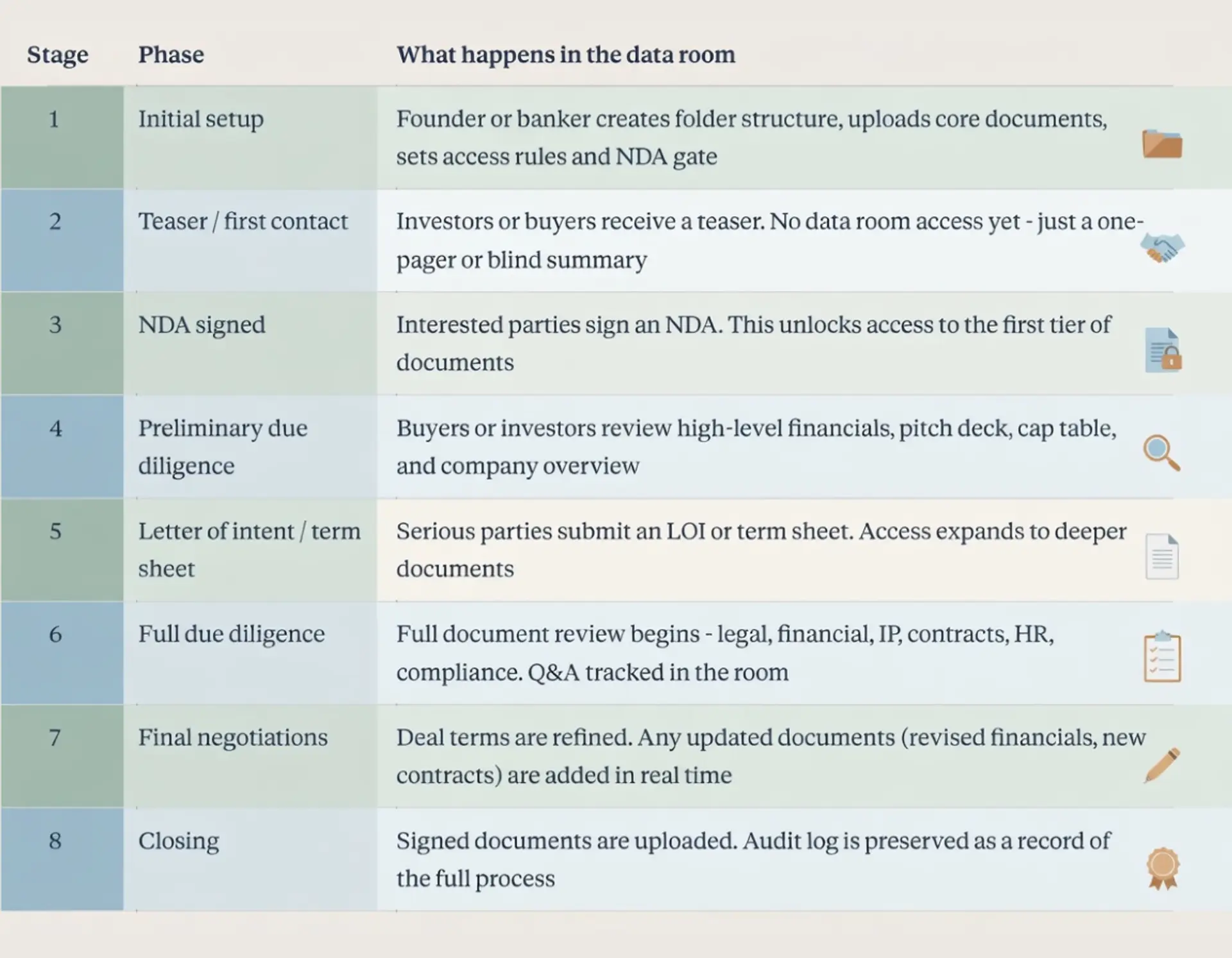
Why investment bankers rely on VDRs?
The short answer: any time confidential documents need to move between two parties in a live transaction, email and shared folders aren't good enough.
Control over who sees what. In a competitive M&A process, you might be running parallel due diligence with multiple bidders at different stages. You need folder and document-level permissions to manage what each party can access, and to make sure one bidder never sees what another is looking at.
A full audit trail. Every document view, download, and login is logged. For an investment banker managing a process, that data is valuable on two levels: it protects you if confidentiality is later disputed, and it tells you which buyers are actively engaged and where they're focused.
Deal process efficiency. A well-structured data room cuts the back-and-forth that kills momentum in a transaction. Everything lives in one place, organized by workstream. No chasing emails, no version confusion, no delays because someone can't find the right file.
Built-in Q&A. In a sell-side M&A process or a structured capital raise, buyers and investors submit questions through the platform rather than over email. Every question and answer is on the record, organized by topic, and visible to whoever needs to see it, keeping the process moving and protecting the banker's ability to manage information flow.
Credibility with counterparties. Walking into a deal with a clean, well-organized data room signals that the process is being run professionally. For an investment banker, that reflects directly on how counterparties perceive your client and by extension, on you.
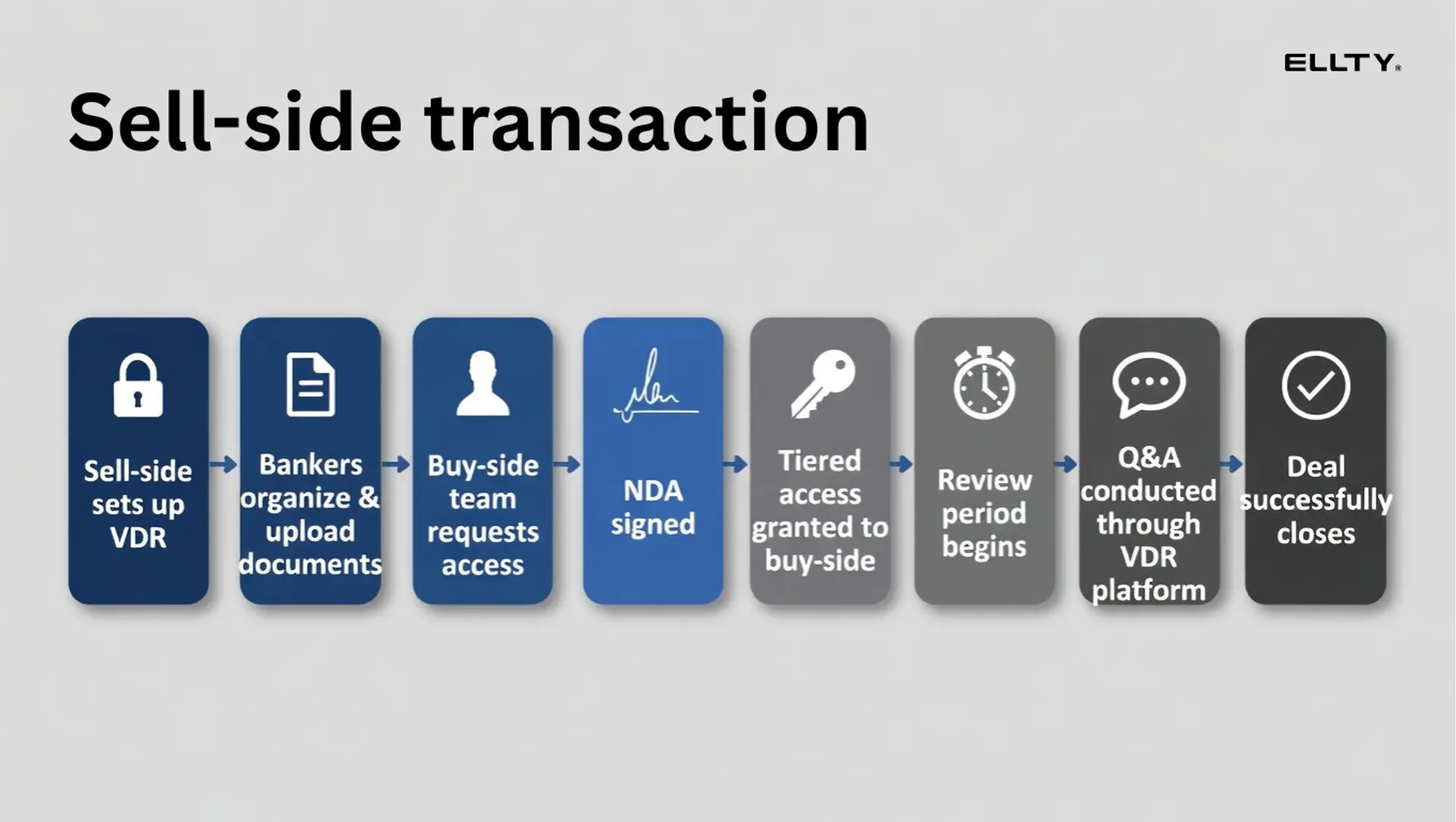
A platform like Ellty makes this accessible for everyone running a deal, not just large investment banks or enterprise legal teams. Whether you're a consultant sharing client deliverables, a real estate firm managing property sales, or a founder raising your first round, the need is the same: share documents securely, track engagement, and stay in control of who sees what. Ellty published pricing, fast setup, and flexible tiers mean you don't need a six-figure contract or a dedicated IT team to run a professional data room.

Data room checklist for investment banking: what to include
What goes into your data room depends on the deal type. Here's what a well-organized investment banking data room typically looks like across the most common transaction types.
M&A sell-side
This is the most document-intensive use case. Buyers and their advisors will go through everything, so organization matters as much as completeness.
- Financials - audited financial statements for the last three to five years, management accounts, monthly P&L, cash flow statements, working capital schedules, and financial projections with supporting assumptions
- Corporate and legal - certificate of incorporation, shareholder agreements, cap table, board minutes, any existing NDAs or exclusivity agreements relevant to the deal
- Commercial - customer contracts, key supplier agreements, pricing schedules, order backlog, pipeline data, and any distributor or reseller agreements
- People and HR - org chart, senior management bios, employment contracts for key people, any equity or bonus plans, and details of any ongoing disputes
- Operations - key operational processes, IT systems overview, any material third-party dependencies
- IP and technology - patents, trademarks, software licenses, any third-party IP used in the business
- Tax - tax returns for the last three to five years, any open tax positions or disputes, transfer pricing documentation if relevant
- Legal and compliance - any ongoing or threatened litigation, regulatory correspondence, material permits or licenses the business relies on
- Insurance - current insurance policies and any recent claims
- Real estate - lease agreements for all properties, any owned real estate documentation
Capital raises (equity)
Investors are evaluating the business and the team, not just the documents. Keep it tight and focused.
- Investor presentation or CIM
- Financial model with revenue build and assumptions
- Historical financials and management accounts
- Cap table showing current ownership and any option pool
- Term sheets or existing investor rights agreements
- Key customer contracts or LOIs if relevant
- Product or technology overview documentation
- Team bios and any relevant IP filings
Debt financing
Lenders want to get comfortable with repayment risk. They'll focus heavily on cash flow, existing obligations, and collateral.
- Audited financials and management accounts
- Detailed cash flow forecasts
- Schedule of existing debt and covenant compliance
- Collateral documentation
- Material contracts, especially anything with change-of-control provisions
- Corporate structure and ownership documentation
- Tax returns
IPO preparation
This is heavily driven by legal and regulatory requirements, but the data room serves the underwriters and counsel as much as anyone.
- Draft registration statement and supporting workpapers
- Historical audited financials
- Board and committee minutes
- Material contracts
- IP documentation
- Legal and regulatory correspondence
- Any prior financing documents, including convertible notes or preferred stock terms
What to actually look for in a VDR for investment banking
Investment banking deals move fast, involve multiple parties at different stages, and carry real legal exposure if information gets out to the wrong person. A generic file-sharing tool won't cut it. Here's what actually matters.
Granular permission controls
In a competitive M&A process, you might have three or four buyer groups in the room simultaneously, each at a different stage of diligence. You need to control access at the folder and document level, not just who's in the room, but who can see which sections, whether they can print or download, and whether they can forward links. Look for group-based permissions so you can manage multiple parties without reconfiguring everything manually.
A real audit trail
You need a log that tells you exactly who opened what, when, for how long, and from where. In investment banking, this matters for two reasons. First, if confidentiality is breached after a deal falls apart, you need a paper trail. Second, document analytics give you genuine deal intelligence, if a buyer's legal team is spending hours in your litigation disclosures while their finance team hasn't touched the model, that's information you can use.
NDA enforcement before access
Every party should be required to accept an NDA before they can view a single file. The best VDRs let you customize the NDA language and keep a timestamped record of every acceptance. In investment banking, where you're often sharing information with multiple competing parties, this is a basic legal protection you cannot skip.
Dynamic watermarking
Every document viewed should carry the viewer's name, email, and timestamp on every page. In a sell-side process where multiple buyers are reviewing the same confidential materials, watermarking is what makes people think twice before screenshotting a financial model or forwarding a sensitive contract.
Structured Q&A management
In a formal M&A process or a structured capital raise, you need to manage buyer or investor questions without letting communication spiral across email threads and inboxes. A built-in Q&A tool lets you receive questions, route them to the right person internally, and respond in one organized place. Every exchange is on the record, and you control what gets shared with whom.
Speed of setup and ease of use
By the time a data room is needed, a deal is already live. You're not going to spend a week learning a new platform. Look for drag-and-drop bulk uploads, folder templates, and batch permission settings. More importantly, it needs to be easy enough for your client's CFO and the buyer's legal team to use without a tutorial, because they won't read one.
Reliability and support
Deals don't respect business hours. If your data room goes down at 11pm the night before a bid deadline, you need someone to pick up the phone. Check what support is actually available before you commit to a platform, not after.
Best virtual data rooms for investment banking
1.Ellty - Modern document sharing & data room
Starting at - Free · $69/mo Standard

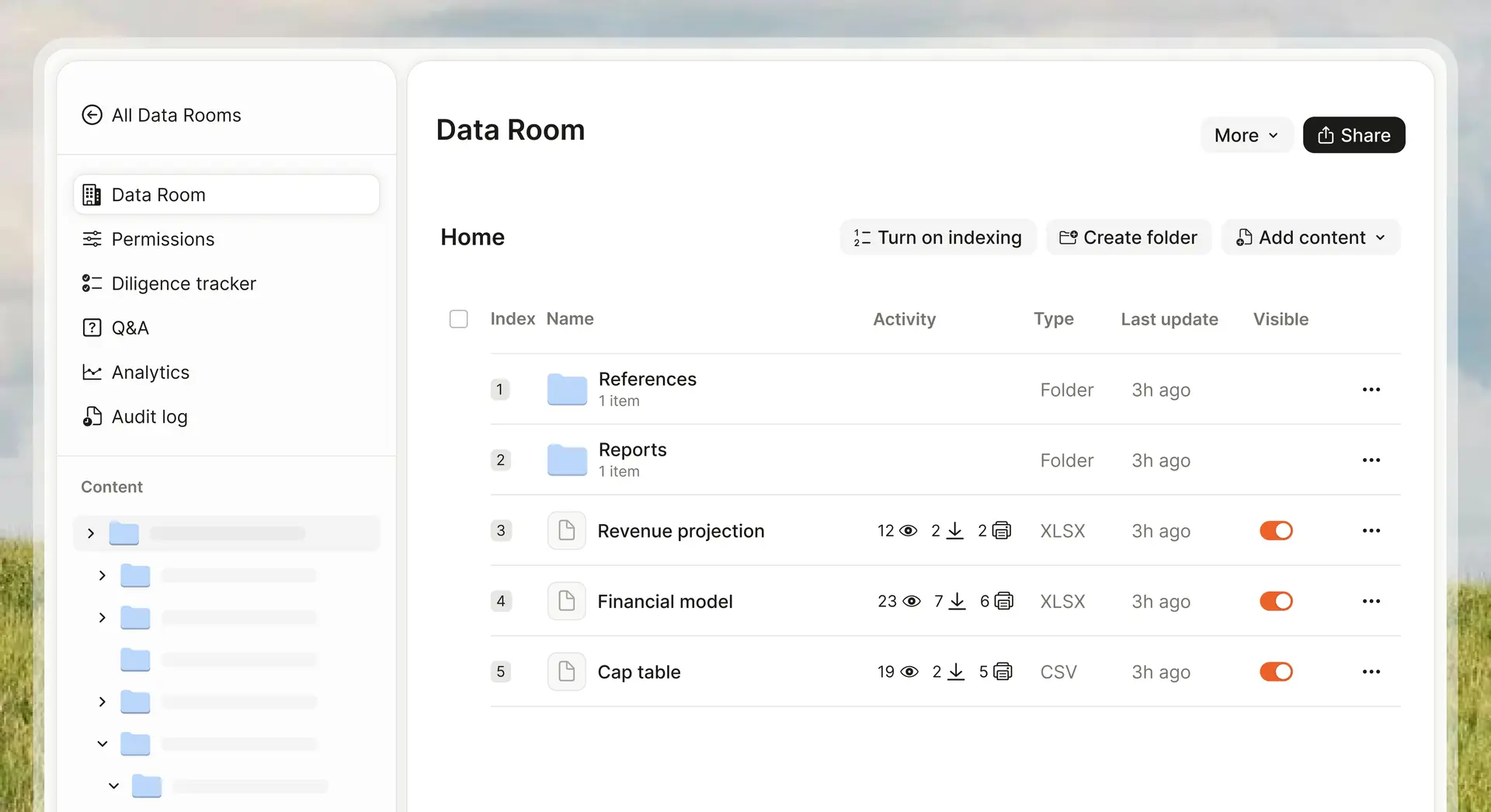
Ellty is a modern document sharing and data room platform built for anyone who needs to share sensitive documents professionally, without the complexity or cost of enterprise VDR software. Where most VDR tools are built around M&A dealmakers at large firms, Ellty is designed for a much wider range of users: startups raising their first round, consultants sharing client deliverables, real estate brokers managing property deals, or small businesses going through an acquisition. You get branded rooms with your own logo, granular access controls, document analytics showing who opened what and for how long, NDA gating, and a clean audit trail - all without a sales call. The free plan covers document tracking, real-time analytics, and secure sharing. Standard ($69/mo) adds unlimited documents, eSignatures, and custom branding. Data Room ($149/mo) is built for formal due diligence with dynamic watermarking and restricted visitor access. Data Room Plus ($349/mo) adds group permissions and up to 4,000 assets per room, no per-user fees at any tier. Ideal for seed through Series C, focused due diligence rooms, and ongoing investor communication.

2.Intralinks - Industry standard for large-scale M&A and capital markets transactions
Pricing - Custom · enterprise quote

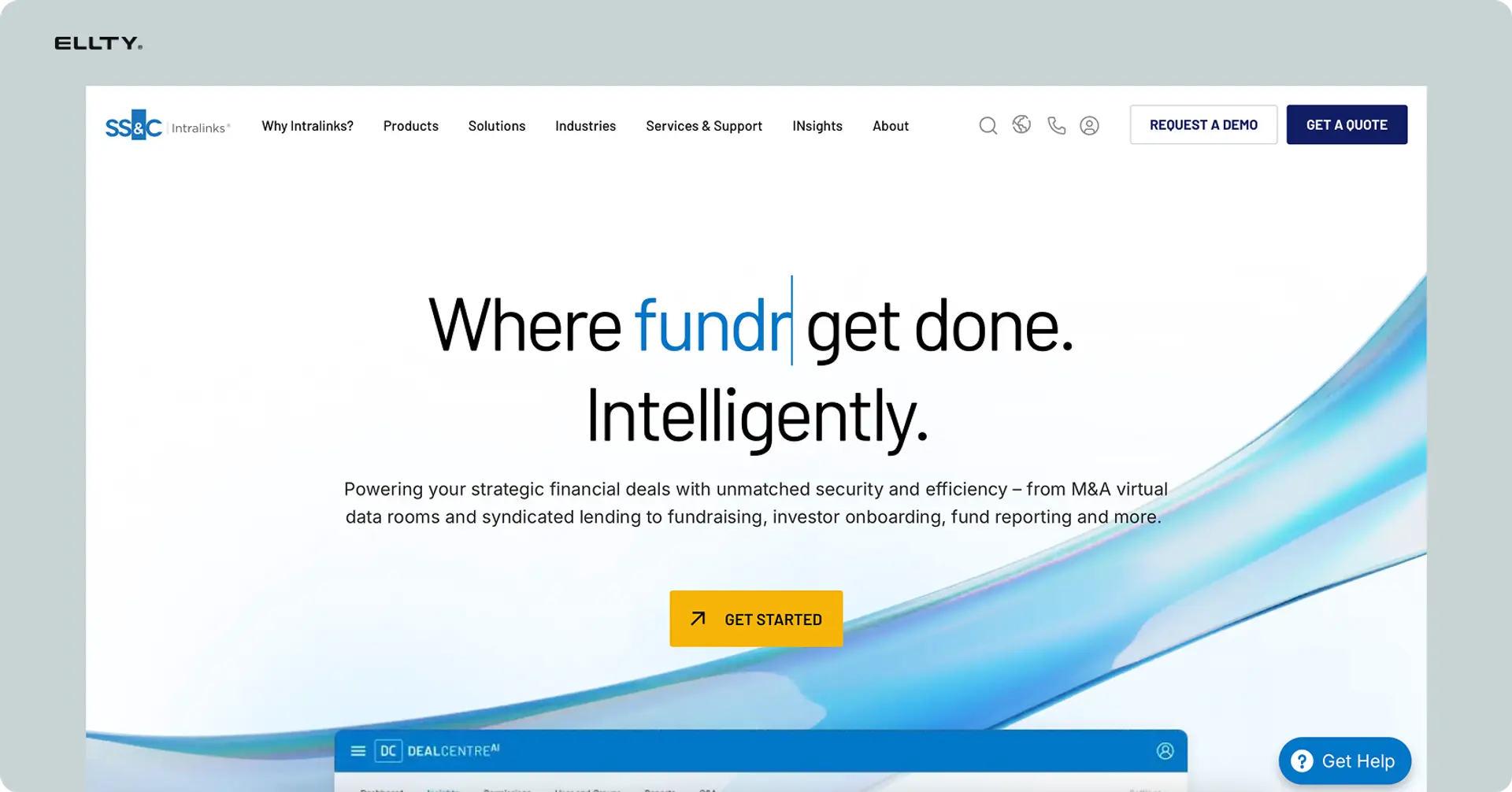
Intralinks is widely regarded as the gold standard for enterprise-grade virtual data rooms in investment banking. With decades of experience handling high-stakes M&A, IPOs, debt financing, and capital raises, it is the platform most often trusted by bulge-bracket banks, private equity firms, and Fortune 500 legal teams. Its platform is built to handle massive transaction volumes - rooms with millions of documents, thousands of concurrent users, and dozens of simultaneous bidders. Intralinks offers advanced Q&A workflow management, AI-powered document redaction, granular permission controls down to the page level, and deep integration with deal management systems. Security is enterprise-class, with SOC 2 Type II certification, GDPR compliance, and end-to-end encryption. The dedicated deal management and support teams available around the clock make it a reliable partner for time-sensitive cross-border transactions. The downside: pricing is opaque, implementation takes time, and it is overkill and prohibitively expensive for smaller deals, early-stage fundraising, or any team without a dedicated IT and legal department to manage it.
3.Datasite - Purpose-built for M&A deal lifecycle management from origination to close
Pricing - Custom · per-deal pricing

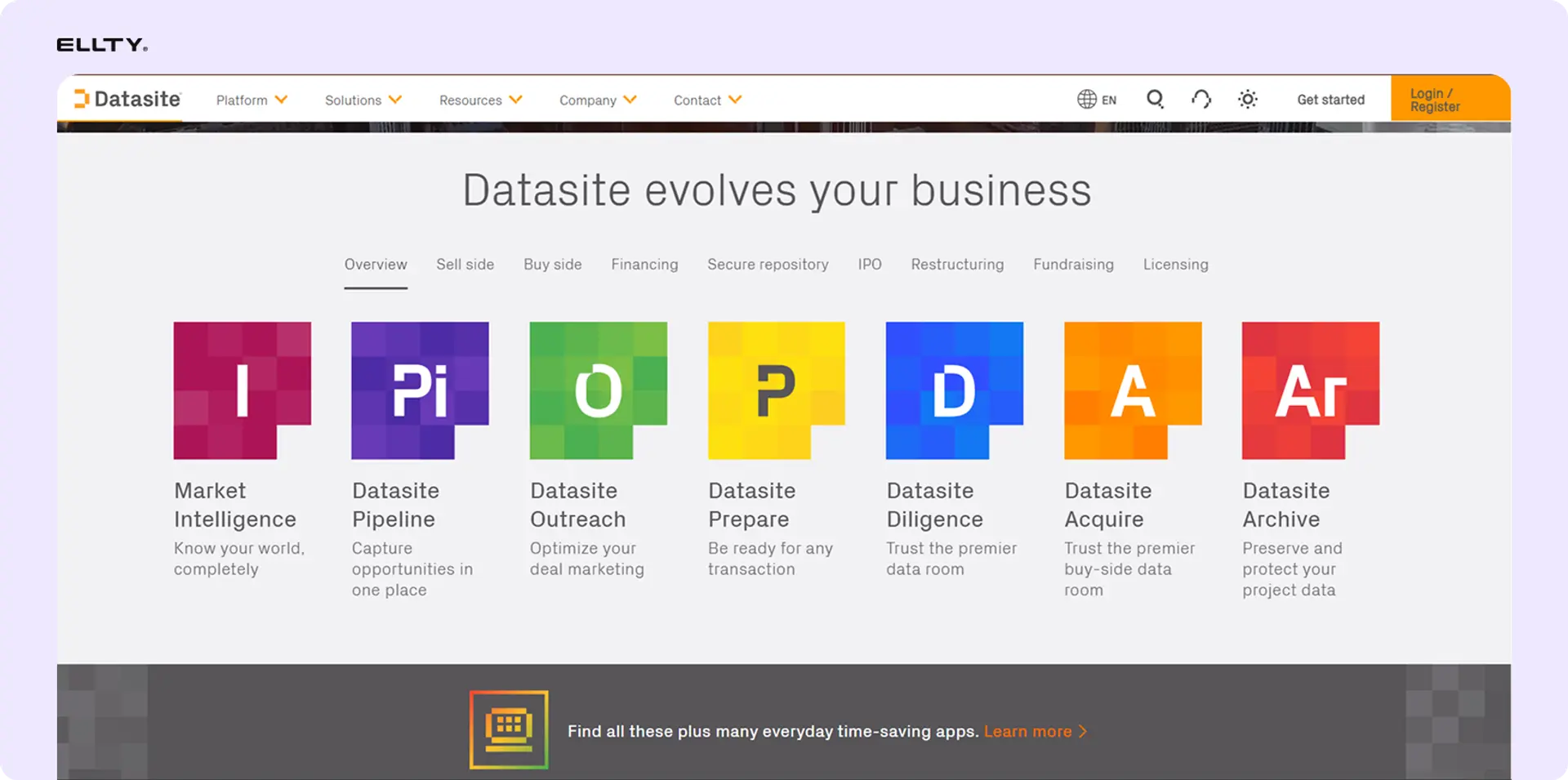
Datasite (formerly Merrill DataSite) is one of the most widely used enterprise VDR platforms in the M&A market, trusted by investment banks, law firms, and private equity shops for complex deal management. What sets Datasite apart is its end-to-end deal lifecycle approach — it is not just a document repository but a full transaction management suite. Features include AI-assisted document review and redaction, advanced Q&A management with multi-level reviewer workflows, real-time bidder engagement analytics, and integrated project management tools. Datasite's Prepare module lets sellers organize and structure the data room before launch, while the Acquire module gives buyers streamlined access with built-in NDA management. The platform handles everything from teaser distribution to final bid submission. Integration with third-party tools like Salesforce and Microsoft 365 makes it a natural fit for firms already operating in those ecosystems. Like Intralinks, it is designed for large, complex transactions - pricing is customized per deal and can be significant, making it ill-suited for startups or small-ticket transactions.
4.Ansarada - AI-driven deal intelligence platform with predictive readiness scoring
Starting at - ~$399/mo · deal-based tiers


Ansarada positions itself not just as a virtual data room but as a deal intelligence platform and the distinction is meaningful. Beyond secure document sharing and access controls, Ansarada uses AI to surface insights about deal readiness, buyer engagement, and transaction risk. Its proprietary Material Information Platform (MIP) scores how prepared a company is for a transaction, flagging gaps in documentation before diligence begins. This makes it particularly valuable for sell-side advisors who want to get ahead of buyer questions. The platform includes automated Q&A workflows, smart folder structures powered by AI categorization, and real-time engagement heatmaps showing exactly which documents buyers are focused on. Ansarada also provides board portals and governance tools, making it useful beyond individual transactions for ongoing boardroom use. Its pricing, while more transparent than Intralinks or Datasite, still sits at a mid-to-enterprise level, reasonable for mid-market M&A and PE-backed transactions, but above what early-stage companies would typically budget for a seed-round fundraise.
5.Firmex - Trusted mid-market VDR with flexible pricing and strong legal-sector presence
Starting at - ~$500/mo · per-project or annual
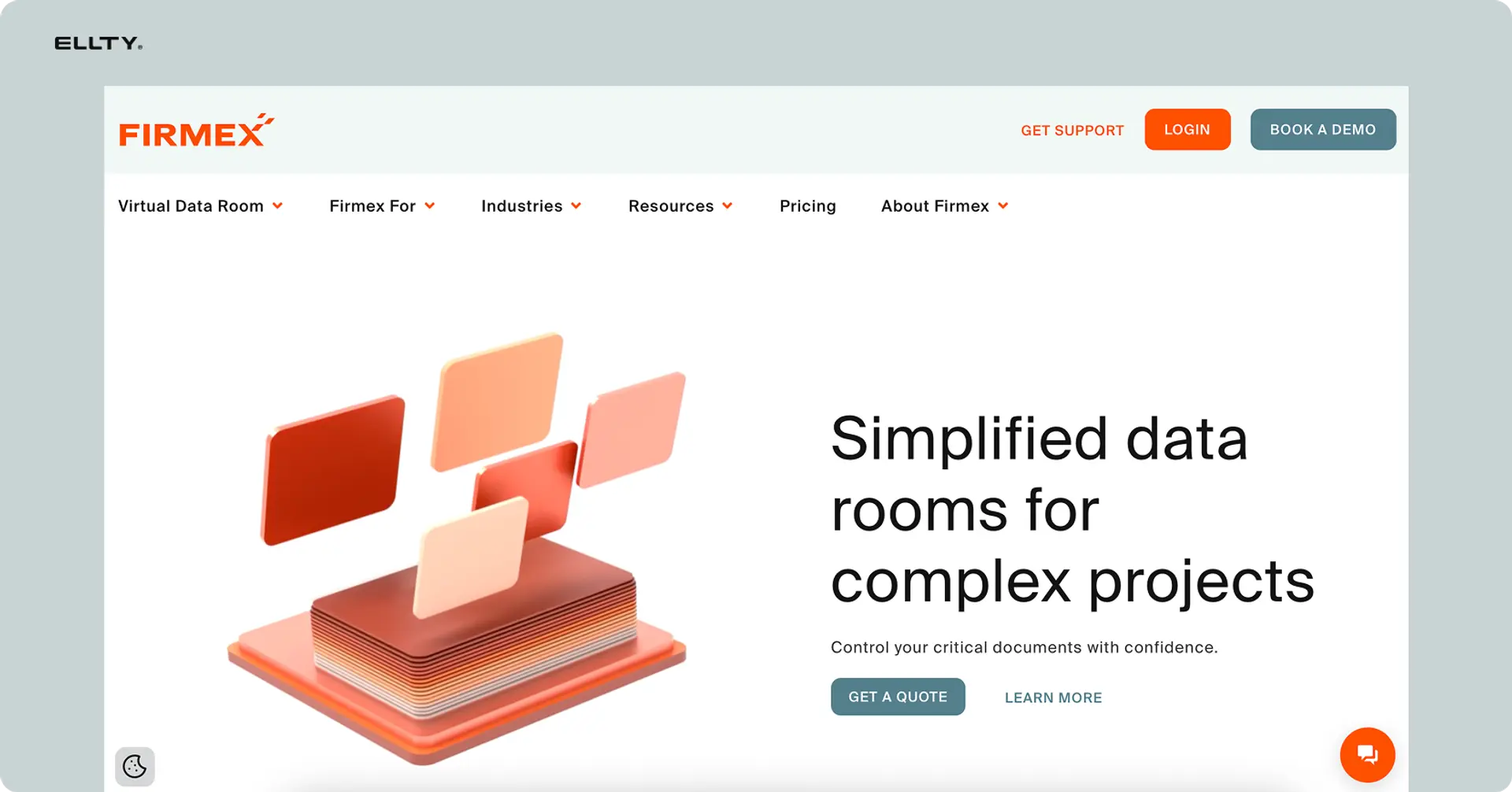
Firmex has carved out a strong position in the mid-market M&A and legal sectors, offering a robust virtual data room without the enterprise pricing overhead of Intralinks or Datasite. It is widely used by law firms, corporate development teams, and boutique investment banks for M&A transactions, restructurings, fundraising, and regulatory filings. The platform offers granular permission controls, bulk upload, full-text search, detailed audit trails, and dynamic watermarking - the full suite expected for serious diligence work. One of Firmex's differentiators is its dedicated client success team, which provides hands-on onboarding and support during active deals - a meaningful advantage when a deal is under time pressure and users need fast answers. Its per-project pricing model is predictable and appeals to advisors who run multiple transactions concurrently across different clients. It is not the most technologically sophisticated option on the market, it lacks the AI-powered features of Ansarada or Datasite. But for teams that want reliability, straightforward UX, and responsive support without a six-figure contract, Firmex delivers consistently.
6.iDeals - Flexible, user-friendly VDR for mid-market deals with transparent pricing
Starting at - ~$99/mo · subscription tiers


iDeals has grown steadily into a reputable mid-market virtual data room, particularly popular among private equity firms, corporate advisors, and legal teams in Europe and North America who need a capable platform without committing to enterprise-tier pricing. The platform covers all the fundamentals expected in serious M&A work: granular role-based access control, document-level permissions, fence-view mode to prevent screenshots, dynamic watermarking, and comprehensive audit logs. iDeals also offers a clean Q&A module that keeps buyer and seller communications organized and traceable throughout due diligence. Where iDeals stands out relative to competitors in its price range is in usability. The interface is considerably more intuitive than older enterprise platforms, reducing the learning curve for deal teams that don't use VDRs daily. Setup is fast, and the platform offers 24/7 multilingual customer support. It is not as feature-rich as Ansarada or Datasite on the AI and analytics front, but for straightforward M&A transactions, restructurings, and fundraising processes, it provides reliable infrastructure at a more accessible price point.
7.DealRoom - M&A project management platform with integrated VDR and task tracking
Starting at - ~$1,000/mo · per workspace


DealRoom takes a distinctly different approach from traditional VDRs, it leads with M&A project management and treats the data room as one component of a broader deal workspace. Rather than focusing purely on document storage and diligence access, DealRoom integrates task tracking, pipeline management, due diligence checklists, and request management alongside its VDR functionality. This makes it particularly well-suited for corporate development teams that run frequent acquisitions and want a single platform to manage deal flow from initial outreach through integration. Users can create structured due diligence request lists, assign tasks to team members, track completion status, and link deliverables directly to the corresponding documents, significantly reducing the email back-and-forth that plagues most diligence processes. The collaboration features are among the strongest in the market for internal deal teams. For buy-side advisory shops or corporate acquirers doing multiple deals per year, DealRoom can meaningfully compress deal timelines. The trade-off: it is priced at the high end for what it offers, and teams using it purely as a document-sharing VDR will find it over-engineered for that use case alone.
Here's a breakdown of what makes each platform worth considering:
Ellty sits at #1 for most deal teams that aren't running billion-dollar M&A processes. The combination of transparent pricing, no per-user fees, NDA gating, branded rooms, and same-day setup is genuinely hard to beat at that price point.
The tiers above it serve distinct needs. Intralinks and Datasite are the institutional choices for large-cap M&A where regulatory complexity, AI redaction, and enterprise-grade Q&A workflows are non-negotiable. Ansarada is the smart pick if deal readiness intelligence and AI-driven insights matter to your sell-side process. Firmex is the reliable workhorse for boutique banks and law firms who want enterprise features without enterprise pricing. iDeals punches above its weight on usability and is a solid choice for mid-market cross-border deals needing multilingual support. DealRoom is the outlier, less a traditional VDR and more a full M&A project management platform, best suited for corporate development teams running serial acquisitions.
The right choice comes down to deal size, team sophistication, and how much complexity you actually need.
How to set up your data room: a practical checklist
Here's a straightforward process you can follow regardless of which platform you use.
Step 1: decide what to include
Don't dump every file you've ever created into the data room. Only include documents that are relevant to the deal. Use the table above as a guide based on your stage.
Step 2: create a clear folder structure
Visitors and their teams will navigate your data room. Make it easy. A clean structure saves everyone time and makes you look organized.
Step 3: set permissions before sharing
Don't give everyone full access. Use your platform's permission settings to:
- Require NDA sign-off before accessing the room
- Restrict sensitive folders (like cap table or board minutes) to serious visitors only
- Set view-only access so documents can't be downloaded in early stages
- Enable watermarking so any leaked document can be traced
Step 4: create investor-specific links
If your platform supports it, create a separate link for each party or firm. This tells you exactly who's engaging and how, which helps you prioritize follow-ups.
Step 5: monitor and act on analytics
Check your data room activity regularly during a live process. If an viewer spent 45 minutes on your financial model, that's a signal. If they opened the deck once and never came back, that's a different signal. Use it to guide your conversations.
Common mistakes investment bankers make with their data rooms
Most data room problems are avoidable. These are the ones that come up again and again.
Setting it up too late
The data room should be ready before buyers are in the room, not while they're waiting for access. Building it in a rush, after due diligence has already started, leads to incomplete uploads, messy folder structures, and documents getting added piecemeal over days. Buyers notice. It signals a disorganized process and can shake their confidence in the business before they've read a single page.
Dumping documents without structure
A data room is not a filing cabinet you dump everything into. If a buyer's advisor has to dig through 400 unorganized files to find what they need, they'll either ask for everything over email anyway, creating the exact chaos you were trying to avoid, or lose patience with the process. Organize by workstream, use clear folder names, and make it obvious where everything is.
Giving everyone the same access level
Not every party in the room should see everything. In a competitive process, different buyers may be at different stages. Early-stage bidders shouldn't have access to the same level of detail as a party in exclusivity. Failing to manage this properly is both a security risk and a negotiating mistake.
Sharing sensitive documents before NDAs are in place
This sounds obvious, but it happens. In the rush to get a process moving, NDA gating gets treated as a formality rather than a prerequisite. If you're sharing financial projections, customer lists, or IP documentation, every party should have signed an NDA and accepted the data room terms before they can see a single file.
Using the wrong tool
A shared Google Drive or Dropbox folder is not a data room. It doesn't give you audit logs, watermarking, NDA enforcement, or granular permission controls. Using one for a live M&A process or capital raise creates legal exposure and looks unprofessional to any sophisticated counterparty. The cost of a proper VDR is negligible relative to the deal size, this is not the place to cut corners.
Ignoring document analytics
Most investment bankers set up a data room and then forget to look at what's happening inside it. That's a missed opportunity. Knowing which buyers are engaged, which sections they're spending time on, and which parties haven't opened the room at all is actionable intelligence during a live process. Check your analytics regularly and use what you see to inform how you manage buyer conversations.
Leaving the room open after a deal closes or falls apart
Once a transaction is complete, or a party drops out of the process, their access should be revoked immediately. Leaving a data room open with no active management means sensitive documents remain accessible long after they should. Set a process for access revocation at each stage of the deal, not just at close.
Frequently asked questions
What is a virtual data room in investment banking?
A virtual data room (VDR) is a secure online platform used to share and manage confidential documents during financial transactions. In investment banking, it's used primarily for M&A due diligence, capital raises, IPO preparation, and debt financing. The buy-side gets controlled access to the sell-side's documents, with full tracking of who views what.
What is the best virtual data room for investment banking?
It depends on the deal size. For large M&A transactions, enterprise platforms like Intralinks, Datasite, and Venue are the industry standard. For some deals, platforms like Ellty offer data room features including NDA gating, granular permissions, and document analytics at a lower cost - from $149/month for the Data Room plan. The best tool is the one that matches your deal complexity without overcomplicating your process.
What's the difference between a virtual data room and Dropbox or Google Drive?
Standard file-sharing tools don't give you the control features that due diligence requires. VDRs add things like view-only access, dynamic watermarking (which puts the viewer's identity on every page), NDA gating before access, per-user permissions by folder, detailed analytics on document engagement, and full audit logs. If a document leaks from a proper VDR, you can trace it. You can't do that with a shared Dropbox link.
When should I set up a data room?
Before you need it. Most teams scramble to build their data room when a party asks for it - which means they're building it under pressure, often missing things. Set up the basic structure during a quiet period, keep documents current, and you'll be ready to share within hours of any serious party request. It also signals maturity in sophisticated deals when you can say your data room is ready.
How do I control who sees what in a data room?
Most VDR platforms let you set permissions at the folder or document level. You can give different access groups different visibility - for example, a general investor group sees the pitch deck and basic financials, while a lead investor in final diligence sees the cap table and contracts. Features like NDA gating, view-only access, and dynamic watermarking add additional layers of control. On Ellty, you can create separate trackable links per visitor to monitor engagement individually.
What security features should I look for in a virtual data room?
At minimum: two-factor authentication, view-only and download restrictions, dynamic watermarking, NDA gating, and audit logs. For M&A-level security, add IP address restrictions, session time limits, and granular folder-level permissions. Also check whether the platform has relevant security certifications (SOC 2, ISO 27001) if your visitors or their counsel will ask about compliance. Don't pay for certifications you'll never be asked about.
The bottom line
In investment banking, a data room is never just a place to store files. It's the first thing a buyer's advisor, a credit committee, or a lead investor interacts with before they've had a single real conversation with your client. How it's organized and how it's managed tells the other side something about how the process is being run.
A clean, well-structured data room with proper NDA gating, tiered access controls, and current documents signals that the banker is in control of the process. A messy one, built in a rush after diligence has already started, does the opposite.
For large M&A mandates and multi-bidder processes, use a purpose-built enterprise VDR. The audit trail, structured Q&A, and permission controls justify the cost at that deal size. For smaller transactions, capital raises, and debt financing mandates, there are solid platforms in the $100–$400 per month range that cover everything you actually need without the enterprise overhead.
Whatever platform you use, the fundamentals don't change. Build the data room before the process launches, not during it. Keep documents current as the deal progresses. Review your analytics regularly, they'll tell you which parties are engaged and where their focus is. And revoke access the moment a party exits the process.
The data room reflects on you as much as it reflects on your client. Treat it that way.
Author

Anika Tabassum Nionta is a Content Manager at Ellty, where she writes about secure document sharing, virtual data rooms, M&A, due diligence, fundraising, and sales enablement. With over 6 years of writing experience, she helps professionals understand how to share confidential documents securely, track engagement, and manage deals more effectively. Anika holds both a BA and MA in English from Dhaka University. Outside of work, she enjoys reading, exploring new cafes in Dhaka, and connecting with entrepreneurs and dealmakers in her community.

