
Most guides about data rooms are written for founders. This one isn't.
If you're on the investor side - whether you're an angel reviewing a seed deck, a VC running a Series B process, or a PE firm coordinating buy-side due diligence - the criteria are different. You're not just trying to share documents. You're trying to evaluate companies fast, coordinate with co-investors or legal teams, maintain version control across a 300-document room, and keep the whole thing airtight.
The wrong tool at the wrong stage costs you time and credibility. This guide breaks down seven data rooms for investors, what stage each one fits, what it actually costs, and where it falls short.
First, understand what "investor data room" actually means
The term gets used loosely. In practice, investors use data rooms in at least three distinct ways:
Receiving rooms - A business owner gives you access to their data room to review during fundraising or M&A diligence. You're the guest. Your job is to navigate, read, and make notes fast.
Sending rooms - You're a fund sharing materials with LPs, co-investors, or portfolio companies. You control the room. You want to know who looked at what and for how long.
Working rooms - Both sides are active. Documents are uploaded, updated, Q&A threads are running, lawyers are commenting. This is full due diligence, and it requires a different class of tool.
Most lighter tools handle the first two well. The third demands purpose-built VDR infrastructure.
What investors specifically need from a data room
The founder checklist (price, analytics, ease of setup) isn't wrong - but it's incomplete for the buy side. Here's what actually matters if you're the one doing the evaluating:
Speed of navigation - When you're running parallel diligence on three companies simultaneously, a cluttered interface is a liability. You need fast full-text search, logical folder hierarchies, and the ability to get to a specific document in under 30 seconds.
Q&A management - Good diligence generates questions. A data room with a built-in Q&A module keeps everything organized and time-stamped. Without it, you're back to email chains.
Audit trails - For PE, legal compliance, and any deal involving fiduciaries, you need a record of who saw what and when. Not just for the deal - for the deposition six months later if something goes sideways.
Redaction - Sometimes a document has information a particular party shouldn't see. Redaction tools let you black out sections at the document level rather than creating separate versions of every file.
Multi-party access controls - You might have co-investors, legal counsel, financial advisors, and environmental consultants all needing access to different subsets of documents. Managing this cleanly is non-trivial.
Engagement analytics (if you're sending) - If you're sharing materials with LPs or co-investors, you want to see who read the deck, which sections they focused on, and whether they came back.
Best data rooms for investors
1. Ellty - best data rooms and analytics

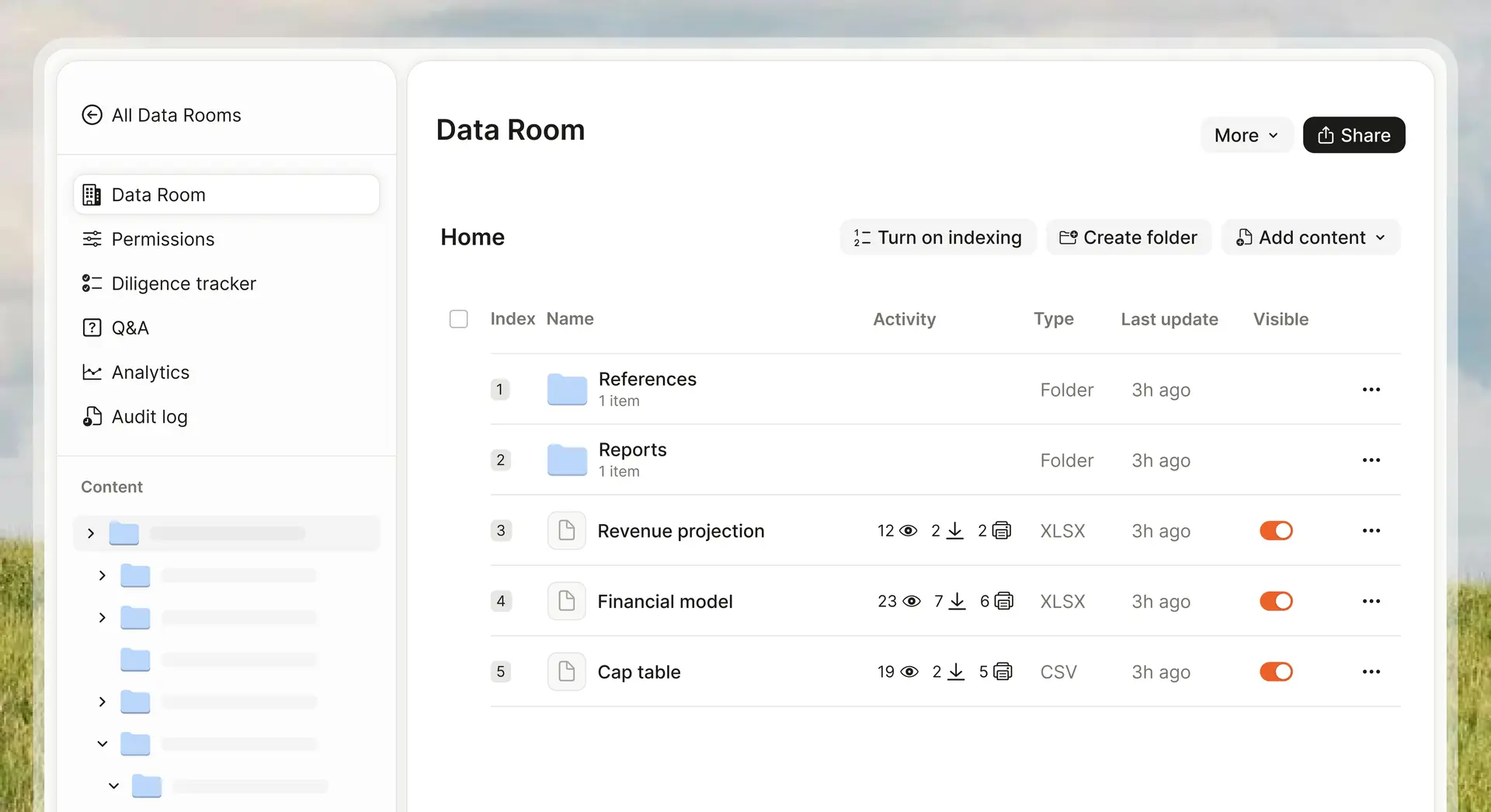
Ellty sits in a different category than the heavy-duty VDR platforms. It does two things really well: tracking who actually engages with your documents, and organizing materials into clean, professional data rooms that anyone can access without a tutorial.
For investors, that combination is more useful than it might sound at first.
If you're sending a deal memo, an LP update, or a portfolio company overview, Ellty tells you what happens after you hit send. Did your LP open the quarterly update? How long did they spend on the financials? Did they come back for a second look? You get page-level detail, not just a vague "opened" notification. That's the kind of signal that helps you follow up smarter or know when to stop chasing.
On the receiving end, when a team or advisor has set up their data room in Ellty, it's a clean, fast experience. No setup required, no learning curve. You click the link, you're in.
What works well for investors:
- Real-time notifications when someone opens your materials
- Page-by-page engagement tracking - useful for LP communications, co-investor pitches, and deal memos
- Trackable links with access controls and expiration dates
- Secure data rooms for organizing and sharing diligence documents
- No per-user fees
- Fast to set up, important when a deal is moving quickly
Where it falls short:
No Q&A module, no redaction tools, and it's not built for complex enterprise M&A. If you're running buy-side diligence on a large acquisition with legal teams across multiple jurisdictions, you'll need something heavier.
Who it fits:
Investors, angels, VCs, fund managers communicating with LPs, and businesses setting up a simple investor data room. Basically anyone who needs professional document sharing with real visibility into how people engage with it.
Pricing:


No per-user fees across all plans. At $69/month for the Standard tier, it's the most cost-accessible option on this list for teams that don't need enterprise-grade infrastructure.
2. Digify - best for secure document control during fundraising diligence


Digify's core strength is document security - specifically, control over what happens to documents once they leave your hands. The post-download access revocation feature is unique and genuinely useful: if a deal falls through, you can revoke access to every document you shared, even ones that have already been downloaded. That's not a feature you find on most platforms.
For investors coordinating early-stage diligence, Digify provides solid activity tracking, clean watermarking, and a permission structure that lets you manage multiple reviewer groups without things getting complicated.
It's also used heavily on the founder side - which means if a startup is already running Digify, the experience as a reviewer is consistent and familiar.
What works for investors:
- Post-download access revocation - shut down access even after files are saved locally
- Dynamic watermarking that includes viewer identity, date, and time
- Detailed activity logs: which documents were viewed, by whom, for how long
- Multiple data rooms per account for running parallel deals
- ISO 27001, SOC 2, HIPAA, and GDPR compliant - enough for most mid-market diligence
- Browser-based access for reviewers - no software install required
- 14-day free trial available on the Pro plan
Where it falls short:
No Q&A module. No redaction. For straightforward diligence where document security is the primary concern, this doesn't matter. But if your process involves back-and-forth question threads, document annotations, or sensitive data that needs to be selectively hidden from certain reviewers, you'll need a heavier platform.
Who it fits:
VC and angel investors running Series A-B diligence where document security and investor engagement tracking are the priorities. Also useful for fund managers sharing sensitive portfolio materials with limited partners.
Pricing:
Starts at approximately $140/month for the Pro plan. Annual billing saves around 30%. Enterprise pricing is available for larger teams.
3. Ansarada - best for AI-assisted due diligence and deal readiness scoring


Ansarada is the most interesting tool on this list from a technology standpoint. It's been building AI into its VDR since before AI became a buzzword, and the features are actually useful rather than cosmetic.
The standout capability: Bidder Engagement Score. The platform uses AI to analyze how bidders and investors are interacting with the data room - which documents they've opened, how long they've spent, whether their engagement patterns match those of serious buyers historically - and produces a predictive probability score for each party. For sell-side advisors and founders, this is powerful. For buy-side investors who've been invited to a room running Ansarada, you're the one being scored.
On the setup side, Ansarada's AI document organization tools automatically categorize and index documents, flag missing items for common deal types, and surface potential risks. If you're assembling a data room before going to market, this meaningfully reduces prep time.
What works for investors:
- AI-powered Q&A module that detects similar questions and groups them - reduces redundant responses during diligence
- Bidder Engagement Score - predictive analytics on deal probability based on behavior patterns
- Automatic document organization and deal readiness checklist
- Full audit trails with granular activity tracking
- Self-destruct files - access can be revoked regardless of where documents were saved
- ISO 27001, SOC 2, GDPR compliant
- Trusted in 180+ countries; used by Deloitte, Qantas, and major investment banks
- 14-day free trial available
Where it falls short:
Pricing is storage-based and adds up quickly. Monthly billing for 250MB storage starts around $399/month; a 4GB room on a 12-month plan runs approximately $2,499/month. For investors managing a single deal at a time, the cost-to-value ratio is good. For smaller funds running multiple small deals, Ansarada can feel expensive relative to what you actually use.
The Q&A module also has a known quirk: when parties bulk-upload questions, the sequence numbering can be non-linear, which makes it harder to track threads. This comes up consistently in user reviews.
Who it fits:
Mid-market M&A advisors, growth-stage VCs, and PE firms running structured diligence processes where AI-assisted efficiency and deal scoring provide real value. Also strong for sell-side teams using the deal readiness checklist.
Pricing:
Storage-based, starting around $399/month for 250MB (monthly billing). Annual plans reduce cost significantly - a 4GB annual room runs approximately $2,499/month vs. higher monthly rates. Free 14-day trial available with access to all features.
4. Firmex - best for mid-market M&A and repeat deal teams


Firmex has been opening more than 20,000 data rooms per year across 180+ countries for nearly two decades. That volume tells you something: it's reliable, it's trusted, and deal teams know how to use it without training.
The pricing model is unusual in the VDR market and genuinely useful for active deal teams. You can buy a single-project room (priced by data and duration) or an annual subscription with unlimited rooms, unlimited users, and no project deadlines. If you're a PE firm or M&A advisory shop running four or five deals concurrently throughout the year, the subscription model eliminates the per-room billing headaches that plague other platforms.
The interface isn't flashy. That's not a criticism - it's by design. Firmex is built for people who need to move fast through large document sets, not for people who want a beautiful product demo.
What works for investors:
- Q&A workflow with organized, timestamped question tracking
- Redaction for removing sensitive information at the document level
- Full audit trails meeting SOC 2, GDPR, and HIPAA compliance requirements
- Subscription pricing: unlimited rooms and users for a fixed annual cost
- Granular permission controls at folder, document, and user level
- 24/7 customer support - a real differentiator during time-sensitive deal closings
- Bulk upload, auto-indexing, and full-text search across documents
- DocuSign and Salesforce integrations
Where it falls short:
Pricing isn't public - you'll need to request a quote. Some reviewers note that Firmex's reporting is less robust than enterprise competitors like Datasite; if your deal requires detailed analytics exports, you may find the options limited. The mobile experience has also come up in reviews as less polished than the desktop version.
Who it fits:
PE firms, M&A advisors, investment banks, and law firms running multiple mid-market transactions per year. The subscription model makes the most sense if you're running more than two or three deals annually.
Pricing:
Quote-based. Two models: single-project pricing (determined by data and duration) and annual subscription (unlimited projects, unlimited users, fixed cost). Free trial available.
5. iDeals - best for enterprise-grade diligence with deep permission control

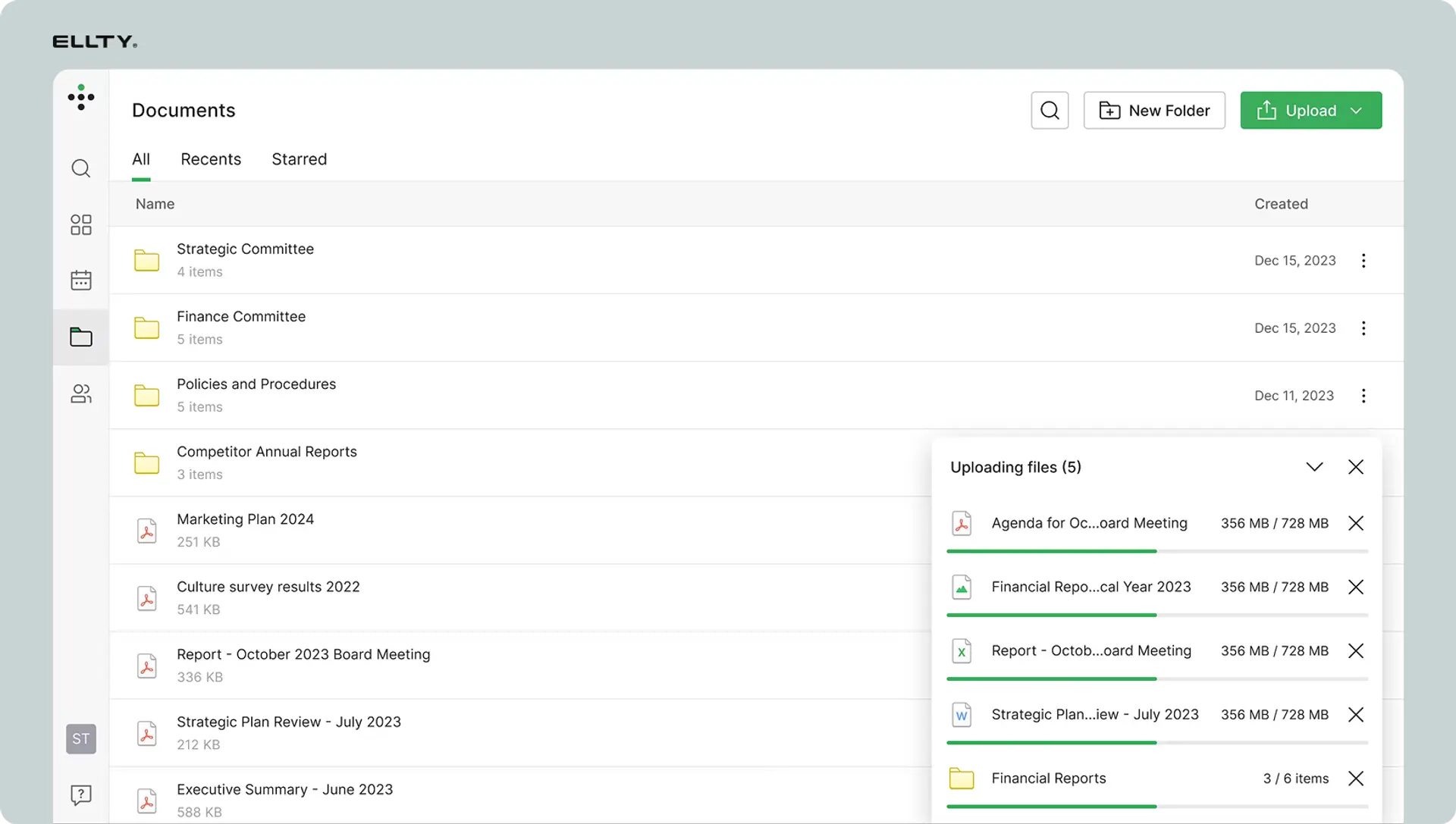
iDeals has been in the market since 2008 and has built a reputation around one thing: granular control. The permission architecture lets you set access at the individual document level, across multiple user groups, with different combinations of view, download, print, and edit rights for each. For complex multi-party transactions - think a competitive auction with six bidder groups, each with different information access - this level of control matters.
The platform also moves fast. iDeals claims setup in under 15 minutes, and users generally confirm the interface is intuitive enough that external parties don't require extensive onboarding. For sell-side teams giving bidders access, reducing friction for reviewers is important.
What works for investors:
- Document-level granular permissions across multiple user groups
- Fence view - restricts screen capture for sensitive documents
- Dynamic watermarking with user identity, IP, and timestamp
- Real-time activity dashboard with downloadable reports
- ISO 27001, SOC 2, GDPR, HIPAA compliant
- 24/7 multilingual support - relevant for cross-border transactions
- Q&A workflow for structured diligence communication
- Auto-indexing and bulk upload for large document sets
Where it falls short:
One persistent usability issue documented in user reviews: you can't click directly from the audit log to the specific document that was viewed. In an active deal, when you're trying to track what a bidder spent time on, having to navigate separately to find the document is a friction point. Pricing also requires a sales call - no public rates - and some smaller firms have flagged meaningful price increases at renewal.
Who it fits:
Growth-stage PE, institutional investors, investment banks, and any deal team running a competitive multi-bidder process where granular access control is non-negotiable. Less suited to small funds or early-stage diligence where that level of complexity isn't needed.
Pricing:
Not publicly listed. Third-party sources estimate $200 to $1,000+/month depending on storage, users, and deal scope. Contact sales for a quote.
6. Datasite - best for large-cap M&A and IPO preparation

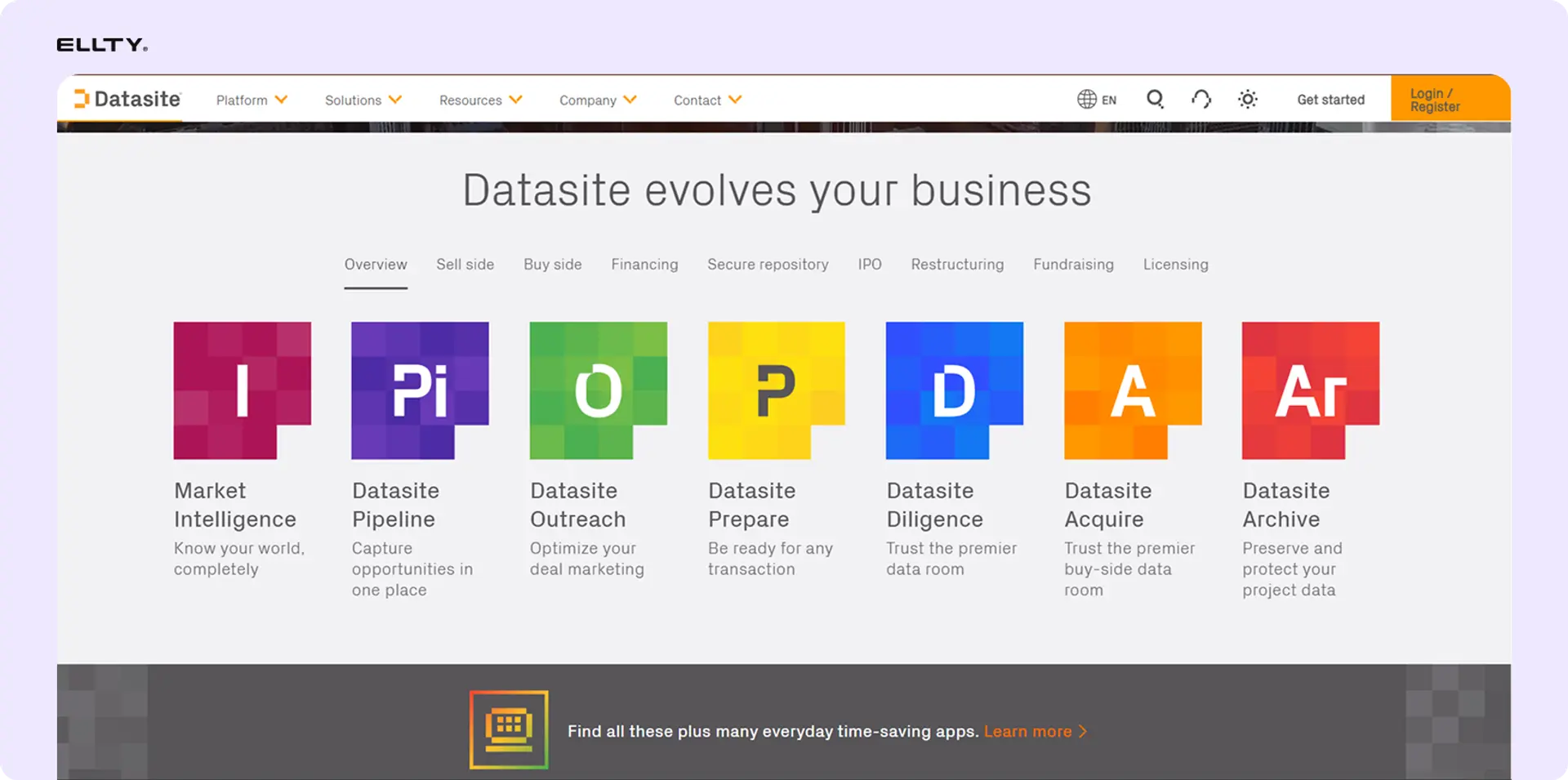
Datasite is the industry-standard platform for large, complex M&A transactions. It's used by Bulge Bracket banks, Big Four advisory firms, and Fortune 500 corporate development teams. If you're running a $500M acquisition or coordinating an IPO, Datasite is likely already in the conversation.
The platform's AI capabilities have moved well beyond marketing. The redaction tool automatically identifies personally identifiable information across a document set and flags it for review - useful when you're processing thousands of contracts in due diligence. Document translation, AI-powered Q&A assistance, and workflow automation tools are built in and genuinely save time at deal scale.
What works for investors:
- AI-assisted redaction across large document volumes - reduces manual review time
- Multi-language document translation for cross-border deals
- Deep analytics on bidder and reviewer behavior
- Enterprise-grade security with full compliance infrastructure
- Dedicated customer success manager for large deal teams
- Integration with Excel for financial document workflows - important for investment bankers
- Purpose-built for M&A lifecycle management, not just document storage
Where it falls short:
Cost. Datasite is at the premium end of the market, and pricing is custom-quoted. It's also more complex to configure than mid-market platforms - the onboarding process can take days for large deal teams. For anything below mid-market M&A, the capabilities exceed what you actually need and the cost won't be justified.
Who it fits:
Investment banks, large PE firms, corporate development teams at major companies, and advisors working on upper-middle-market to large-cap transactions. If you're doing a $50M growth equity deal, this is likely overkill. If you're running a $1B+ acquisition or a pre-IPO roadshow, it's appropriate.
Pricing:
Custom-quoted, enterprise-only. No public pricing. Expect premium rates commensurate with the deal sizes the platform serves.
7. Intralinks - best for cross-border transactions and regulated industries

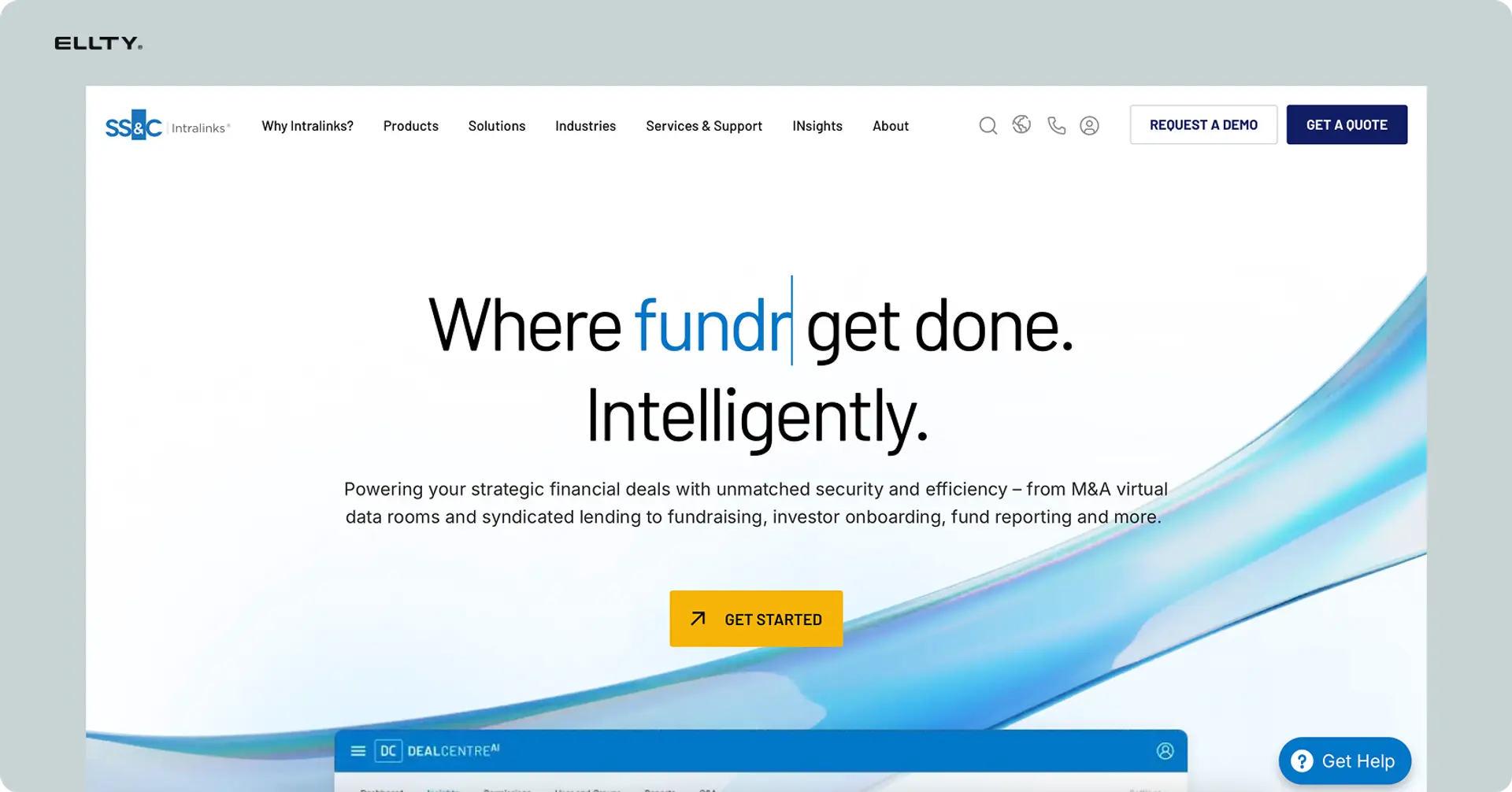
Intralinks has been in the virtual data room market since the 1990s and has a specific niche: high-volume, cross-border deals where regulatory compliance, multi-language support, and global infrastructure matter. It's heavily used in investment banking for M&A, capital markets transactions, and syndicated lending.
The global data center network provides better cross-border access speeds than platforms hosted from a single region. For deals where bidders are in three different time zones and regulators in two jurisdictions are reviewing the same documents, that infrastructure stability matters.
What works for investors:
- Global data center network with strong cross-border access performance
- Bank-grade encryption with comprehensive compliance certifications
- Full Q&A module with role-based assignment and audit logging
- Redaction and document protection tools
- Established brand trust - counterparties recognize and accept Intralinks in complex transactions
- Strong track record in regulated industries: pharma, energy, financial services
Where it falls short:
Intralinks is one of the legacy platforms, and some of the interface complexity reflects that. The user experience is functional but not modern. Pricing requires a sales engagement, and multiple reviews note a per-user and per-project pricing structure that becomes expensive as deal team size grows. Unlike Firmex's subscription model, you can't easily run multiple concurrent projects without costs multiplying.
Who it fits:
Investment banks, sovereign wealth funds, large PE firms, and corporate development teams running cross-border M&A, capital markets transactions, or deals in regulated industries (energy, pharma, financial services) where regulatory due diligence is extensive and counterparty trust in the platform is important.
Pricing:
Custom-quoted, enterprise-only. Per-user and per-project pricing can become expensive at scale; no flat-rate subscription option.
How to choose: match the tool to the deal stage
The biggest mistake investors make is defaulting to a heavy, expensive VDR for every situation. You don't need Datasite to evaluate a seed-stage pitch. You don't need Ellty to run a $300M PE buyout.
Here's how to think about it:
You're an angel or early-stage VC reviewing a pitch or sending LP updates - Ellty. Clean, fast, gives you visibility into who's engaging with what. Free to start, $69-$349/month for full features.
You're a VC running formal Series A or B diligence where document security is the main concern - Ellty Data Room tier or Digify. Granular permissions, NDA gating, dynamic watermarking, restricted visitor access at $149/month.
You're a mid-market PE firm or M&A advisor doing multiple deals per year - Firmex for predictable flat-rate pricing and reliable infrastructure. Ansarada if AI-assisted deal scoring and deal readiness tools are worth the premium.
You're running a large, competitive M&A auction with multiple bidder groups - iDeals for deep permission control. Ansarada if you want AI-assisted Q&A and engagement scoring.
You're a Bulge Bracket bank or large PE firm on a $500M+ deal - Datasite or Intralinks. Enterprise infrastructure, AI redaction, global compliance.
What belongs in an investor data room (when you're sending, not receiving)
If you're a fund manager, family office, or deal syndicator maintaining your own data room to share with LPs or co-investors, here's the standard structure:
Fund overview
- Fund pitch deck / investment memorandum
- LP presentation (latest version)
- Track record summary
Legal and compliance
- Fund formation documents (LP Agreement, PPM)
- Management company entity docs
- Regulatory filings (Form ADV, FOIA disclosures where applicable)
Portfolio reporting
- Portfolio company summaries
- Quarterly investor letters
- Audited financial statements
Deal-specific materials (for co-investor access)
- Company overview and pitch deck
- Financial model and projections
- Due diligence memos
- Key contracts and legal documents
Keep sections compartmentalized by access group. LPs don't need to see deal-specific materials. Co-investors don't need LP-level fund economics. Permissions matter.
FAQ
What's the difference between a data room for founders vs. investors?
Founders use data rooms to share materials outward - with investors, buyers, and advisors. Their priorities are ease of setup, analytics on who's viewing their documents, and professional presentation. Investors, particularly on the buy side, use data rooms to receive and review materials efficiently, manage multi-party access during due diligence, and maintain audit trails for compliance. The tools overlap, but the workflows are different.
Do investors need their own data room software, or do they just use what the founder provides?
Both. When receiving documents during diligence, investors navigate whatever room the founder or sell-side team has set up. But investors also maintain their own rooms for LP communications, co-investor deal sharing, and portfolio company reporting. For the latter, having a platform you control makes sense.
What is Q&A management in a data room and why does it matter?
During formal diligence, investors generate questions about the documents they're reviewing. A Q&A module lets both sides log, track, and answer questions within the platform - organized by topic, tagged by document, with timestamps and assignment tracking. Without it, questions go back to email chains, and you lose the audit trail. For PE and M&A deals, a structured Q&A log is often required by legal teams.
What's the cheapest data room option for investors?
Ellty Standard tier is the most accessible entry point. It includes unlimited documents, advanced analytics, eSignatures, data rooms, custom branding at $69/month. For more security-focused needs, Digify starts around $140/month. The full M&A platforms (Ansarada, Firmex, iDeals, Datasite, Intralinks) are all quote-based and price above $300/month for active deal use.
Are there free data rooms for investors?
Ellty offers a genuinely free plan with core features. Ansarada and Digify offer free trials (14 days and 7 days respectively) with full features before billing starts. None of the enterprise platforms (iDeals, Datasite, Intralinks) offer free tiers.
What security certifications should an investor data room have?
For early-stage diligence, ISO 27001 and SOC 2 Type II are the baseline. For transactions involving healthcare or financial data, HIPAA compliance matters. For cross-border deals in Europe, GDPR compliance is required. Enterprise M&A platforms (Datasite, Intralinks, iDeals) typically hold multiple certs across jurisdictions. Ellty and Digify are appropriate for deals where the compliance bar is lower.
How many data rooms do I need running at once?
Depends on deal volume. Angels might need one room per active deal. Active VCs running 5-10 diligence processes simultaneously need a platform that handles multiple concurrent rooms without per-room fees. Firmex's subscription model is built for this. Digify's Team plan allows 10 rooms. Ellty Standard Plan includes multiple rooms at flat pricing.
What's the risk of using Google Drive or Dropbox for investor due diligence?
No audit trail (you can't prove who saw what, or when), no granular permission controls, no watermarking, no Q&A infrastructure, and no ability to revoke access to already-downloaded files. For casual document sharing, they're fine. For formal due diligence with legal exposure, they're not appropriate.
Can investors revoke access to documents after a deal falls through?
With the right tool, yes. Digify's post-download access revocation lets you expire access to documents even after they've been saved locally - the viewer gets a "permission expired" message on next open. Ansarada's self-destruct feature works similarly. Standard VDRs let you revoke link access but can't control locally-saved files.
How do I evaluate whether a data room is right for my deal complexity?
Start with the questions. Do I need a Q&A module? Do I need redaction? Do I need multiple bidder groups with separate access? Do I need AI assistance to process large document volumes? If the answers are mostly no, a lighter platform handles it. If multiple answers are yes, you're in purpose-built VDR territory.
Bottom line
Not every deal needs Datasite. Not every LP update needs Firmex.
Matching the tool to the deal stage is how you avoid paying $1,200/month for a data room you use once a quarter, or under-equipping a $200M buyout process with a file-sharing tool that has no audit trail.
For early-stage diligence, LP communications, and deal tracking where engagement analytics matter, Ellty covers the workflow cleanly at $0 to $69/month. When security requirements step up and you're running formal fundraising diligence, Digify handles it. When you're in structured mid-market M&A, Firmex and Ansarada are the go-to options. And when the deal is large enough that compliance infrastructure, AI redaction, and multi-jurisdiction support become non-negotiable, iDeals, Datasite, and Intralinks are built for that work.
Use what the deal actually needs. Not what sounds most impressive.

Author

Anika Tabassum Nionta is a Content Manager at Ellty, where she writes about secure document sharing, virtual data rooms, M&A, due diligence, fundraising, and sales enablement. With over 6 years of writing experience, she helps professionals understand how to share confidential documents securely, track engagement, and manage deals more effectively. Anika holds both a BA and MA in English from Dhaka University. Outside of work, she enjoys reading, exploring new cafes in Dhaka, and connecting with entrepreneurs and dealmakers in her community.

