
The other party asks for your data room. You have 24 hours. This is exactly what should be in it - organized, ready, and nothing missing.
In this guide
- What is a data room
- What is included in a data room
- Data room document checklist for due diligence
- Venture capital fund due diligence checklist
- Fundraising data room document checklist
- Built-in Q&A management document checklist
- Real estate portfolio sales document checklist
- Initial public offerings (IPOs) document checklist
- Legal document management document checklist
- Strategic partnerships and joint ventures document checklist
- How to organize your data room
- What not to put in a data room
- Setting up your data room with Ellty
- Frequently asked questions
What is a data room
A data room or virtual data room (VDR) is a secure online space where you store and share confidential company documents. It's used during fundraising, due diligence, M&A, and any situation where sensitive information needs to go to an outside party in a controlled way.
Before data rooms existed, people would email PDFs around or hand over physical folders. Some still do. That's a mistake, you lose all visibility into who saw what, and you can't revoke access if a deal falls through.
A proper data room gives you access controls (who sees which documents), audit trails (who opened what and when), and security features like NDA gating and watermarking. Recipients expect this now. Not having one signals disorganization at exactly the wrong moment.
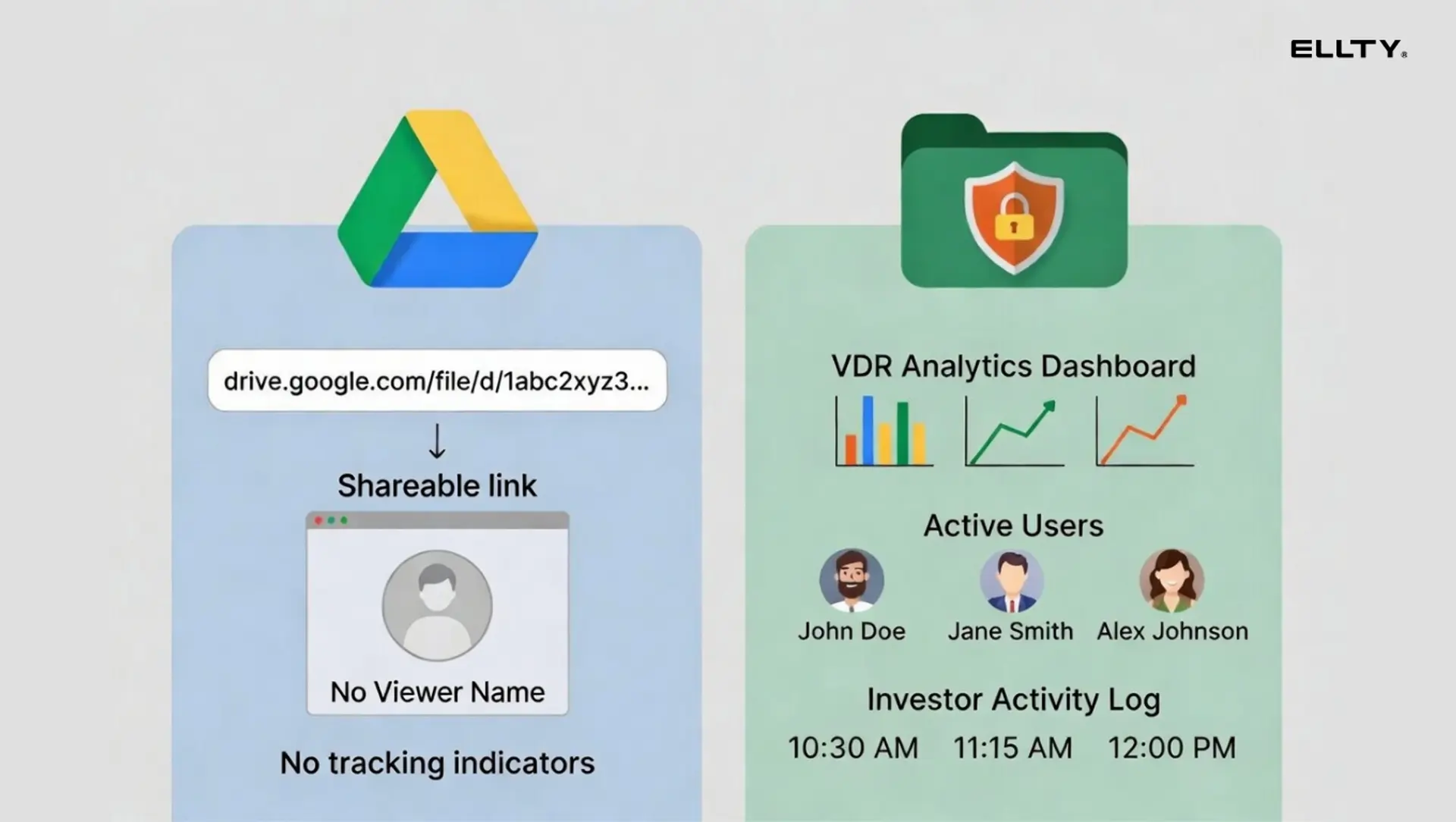
A data room is not the same as a Google Drive folder or a Dropbox link. Drive gives you file storage. A data room gives you controlled access, tracking, and security - which is what visitors and acquirers actually need when they're reviewing sensitive information.

What is included in a data room
Most data rooms cover ten core areas. Think of these as the folders inside your room. Some viewers will want to see all of them. Others will focus on two or three depending on stage. Either way, you want to have everything ready so you're not scrambling when they ask.
Here's what a complete data room includes:


You don't need every single document in this table for every situation. An early-stage room is lighter than a later-stage room. We'll cover that breakdown by use cases a bit further down.
Data room document checklist for due diligence
Due diligence is the process where an investor, acquirer, or lender goes through your company in detail before committing. Your data room is how you enable that process without sending 40 email attachments or giving everyone raw access to your Google Workspace.
The due diligence request list you'll typically receive will map to these five areas. Here's what each one actually means in practice.
1. Corporate and legal documents
This is the foundation. These documents prove your company is properly incorporated, equity is cleanly allocated, and there are no legal landmines.
- Certificate of incorporation
- Company bylaws or articles
- Shareholder agreements
- Board resolutions & meeting minutes
- Previous financing documents (SAFEs, convertible notes, term sheets)
- Any pending or past litigation
If your equity structure is messy, missing founder agreements, unclear IP assignments, or cap table errors, fix it before opening a data room. People find these things. It's better to know and fix than to have it surface mid-diligence.
2. Financial documents
This is usually where other parties spend the most time. Everything here should be accurate and internally consistent, meaning your P&L matches your cash flow, which matches what you said in your deck.
- Profit and loss statement (2-3 years or since founding)
- Balance sheet
- Cash flow statement
- Financial model (3-5 year projection)
- MRR / ARR breakdown if SaaS
- Bank statements (last 3-6 months)
- Revenue by customer or cohort
- Audited financials (if applicable)
3. Cap table and equity
Your cap table is the single document most likely to raise a question. Keep it clean and up to date. If you're using a cap table management tool like Carta or Pulley, export the current state before adding it to the room.
- Full cap table with ownership percentages
- SAFE agreements
- Option pool overview
- Warrants and convertible instruments
- 409A valuation report (if done)
- Vesting schedules for founders and key hires
4. Intellectual property and key contracts
IP assignments are the most commonly forgotten document in early-stage rooms. Every business should have signed one at company formation. If they haven't, fix it before diligence starts. This is non-negotiable for most parties.
- IP assignment agreements
- Patent filings or pending patents
- Trademark registrations
- Customer contracts (material ones)
- Vendor and supplier agreements
- Software licenses (in and out)
- NDAs with significant parties
- Regulatory approvals or licenses (if applicable)
5. People and team documents
This section confirms who's actually on board, how they're compensated, and whether key roles are filled.
- Org chart (current)
- Founder and key executive bios
- Employment agreements (key employees)
- Advisor agreements
- Compensation structure overview
- Open headcount plan (optional but useful)
Venture capital fund due diligence document checklist
If you're raising from VCs specifically, the checklist gets slightly more structured than angel-stage diligence. VCs typically run a formal process with a defined request list. Here's what a typical VC due diligence checklist covers, and roughly how each document maps to their decision-making process.


VCs move faster than people expect once they're in diligence. Have everything in the room before you share the link. Don't send a half-built room and say "more coming soon" - that erodes confidence at the worst time.


Fundraising data room document checklist
The depth of your data room should match the stage of the conversation. A seed round data room is lighter than a Series B room. Here's how to think about it.


For a seed round, you don't need 100 documents. A well-organized room with 20-30 accurate documents beats a bloated room with 80 outdated ones. Quality over quantity.
Built-in Q&A management document checklist
These are the documents you need to load into your VDR before opening the Q&A module. When bidders ask questions, you need to answer fast, meaning everything should already be in the room.
Company overview docs - so bidders stop asking the same basics
- Company overview / one-pager
- Org chart with names and roles
- Product or service brochure
- Customer segmentation summary
- Competitive landscape overview
Financial snapshot - most questions are about numbers
- Last 2–3 years P&L summary
- Revenue breakdown by channel
- Key financial KPIs dashboard
- Budget vs actuals (current year)
- Outstanding liabilities summary
Process and operations - answers operational questions upfront
- Standard operating procedures (SOPs)
- Technology stack summary
- Key supplier relationships list
- Pending issues or risks register
Q&A process docs - keeps the room organized and fair
- Q&A rules and timeline document
- NDA template for all bidders
- FAQ sheet (pre-loaded answers)
- Bid process letter
- Contact and escalation guide
Real estate portfolio sales document checklist
Selling a property or portfolio to investors means putting every document they'd want to see in one place, from the physical building details to the financial returns.
Property information - the basics every investor needs first
- Property title deeds and ownership docs
- Building plans and floor layouts
- Site survey reports
- Address and zoning classification
- Recent photos and drone footage
Lease and tenancy docs - the income picture for the asset
- All active lease agreements
- Tenant payment history
- Rent roll (all units, rents, expiry)
- Pending lease renewals or disputes
- Occupancy rate history
Environmental and compliance - often the most asked-about section
- Environmental impact assessment
- Soil and groundwater reports
- Energy performance certificate
- Building safety inspection reports
- Regulatory approvals and permits
Financial performance - what makes or breaks the deal
- Net operating income (NOI) history
- Operating expense breakdown
- Capital expenditure history
- Valuation / appraisal reports
- Existing mortgage or financing docs
Initial public offerings (IPOs) document checklist
During an IPO, your data room is shared with underwriters, legal counsel, and regulators. Everything in it will be scrutinized. Accuracy and completeness are not optional.
Regulatory filings - the core documents for the offering
- Draft prospectus (S-1 or equivalent)
- Registration statement drafts
- Comfort letters from auditors
- Legal opinions
- Underwriting agreement drafts
Audited financials - 3 years minimum, fully audited
- 3-year audited financial statements
- Auditor sign-off letters
- Revenue recognition policies
- Notes to financial statements
- MD&A (management discussion drafts)
Corporate governance - public companies are held to a higher bar
- Board composition and bios
- Committee charters (audit, comp)
- Director independence confirmations
- Insider trading policies
- Code of ethics and conduct
Risk and disclosure - disclose everything, it protects you
- Risk factors summary
- Material litigation disclosure
- Related party transactions
- Lock-up agreements (founders/execs)
- Use of proceeds plan
Legal document management document checklist
Law firms and in-house legal teams need a secure, organized way to store and share sensitive documents. This checklist covers what belongs in a legal VDR, whether for a matter, a client, or a department.
Client contracts - every engagement, cleanly filed
- Signed engagement letters
- Retainer and fee agreements
- Matter-specific NDAs
- Client authorization forms
- Conflict of interest waivers
Litigation documents - everything tied to active matters
- Case filings and pleadings
- Evidence and exhibit bundles
- Court orders and judgments
- Witness statements
- Discovery documents
IP and regulatory - filings with deadlines need a home
- Patent and trademark filings
- Copyright registration records
- Regulatory correspondence
- License agreements
- Compliance audit reports
Confidentiality controls - who sees what and proof of it
- Privilege log (attorney-client)
- Access permission matrix
- Document destruction policy
- Audit trail exports
- Data retention schedules
Strategic partnerships and joint ventures document checklist
When two companies collaborate, both sides need to share sensitive information while protecting their own. The VDR has to be structured so each party sees only what they're supposed to.
Partnership structure docs - sets the rules before any work begins
- Letter of intent (LOI)
- Mutual NDA (both parties signed)
- Joint venture agreement draft
- Governance and decision-making structure
- Exit and termination clauses
Product and technology - what each party brings to the table
- Product roadmap documents
- Technology architecture overview
- IP ownership and licensing terms
- Integration or API documentation
- Jointly developed IP agreements
Market and commercial data - the business case for working together
- Market research reports
- Customer data (aggregated only)
- Sales and revenue projections
- Pricing strategy overview
- Go-to-market plan draft
People and operations - who's running what, from each side
- Key personnel from each party
- Roles and responsibilities matrix
- Secondment or staffing agreements
- Reporting and milestone structure
- Dispute resolution process
How to organize your data room
A data room with 60 unorganized files is almost as bad as no data room. The other parties are probably looking through a lot of rooms. If yours is clean and logical, it signals the same about how you run the company.
Here's a folder structure that works for most data rooms:
01_Company overview
└─ Pitch deck (latest)
└─ Executive summary
└─ One-pager
02_Financials
└─ P&L 2022-2024
└─ Balance sheet (current)
└─ Cash flow statement
└─ Financial model (3-year)
└─ MRR tracker
03_Legal and corporate
└─ Certificate of incorporation
└─ Bylaws
└─ Board meeting minutes
└─ Prior financing docs (SAFEs)
04_Cap table and equity
└─ Cap table (current)
└─ Option pool summary
└─ Vesting schedules
05_Intellectual property
└─ IP assignment agreements
└─ Patent filings
└─ Trademark registrations
06_Customers and commercial
└─ Key customer contracts
└─ Revenue by customer
└─ Churn and retention data
07_Team
└─ Org chart
└─ Founder bios and LinkedIn
└─ Key employment agreements
08_Product and technology
└─ Product roadmap
└─ Tech stack overview
└─ Security and compliance docs
A few naming rules that save time: use dates in file names where relevant ("P&L_2022-2024" not "financials_final_v3"), number your folders so they stay in order, and don't use abbreviations that only make sense internally.
What not to put in a data room
People often over-share. Some documents create more risk than they're worth including, especially early in a conversation. Others are just unnecessary noise.


The rule of thumb: if sharing a document creates risk without meaningfully advancing the conversation, don't include it until the deal is further along.
Setting up your data room with Ellty

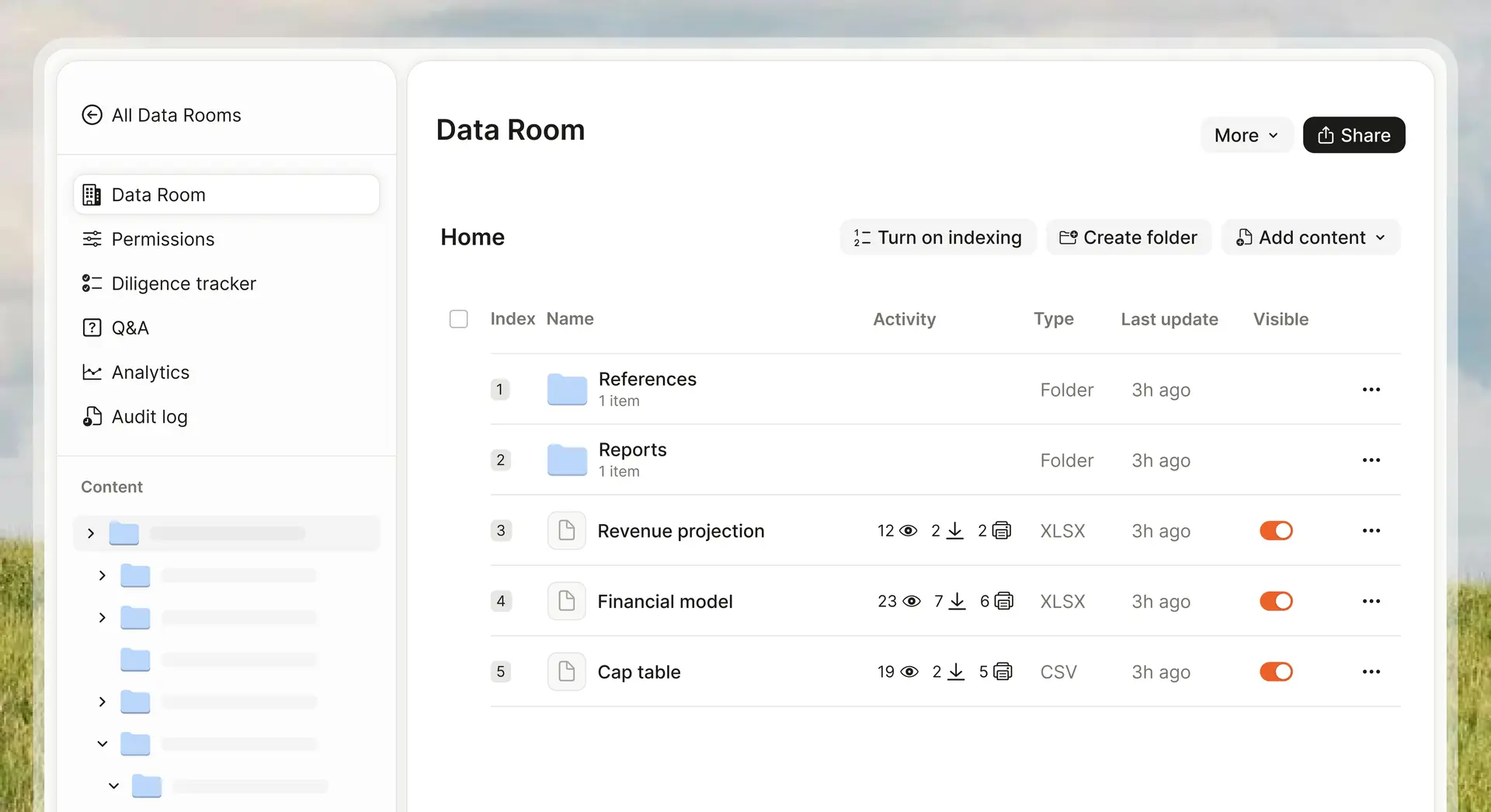
Once you know what documents go in your data room, you need a place to actually put them. Here's how Ellty fits into this.
Ellty is a virtual data room and secure file sharing platform built for all teams. It's not trying to be an enterprise M&A tool, it's designed to help you share sensitive documents securely, track engagement, and move faster during a deal.
You can set up a room in under an hour. No onboarding calls. No contract. No per-user fees eating into your budget as your visitor list grows.

Ellty works well when you need to share a core set of documents like a pitch deck, financial model, and supporting materials with multiple stakeholders in a structured way. The analytics are especially useful: seeing when a document was opened, how long someone spent on it, and which sections held attention gives you real signals to guide follow-ups.
It’s less suited to highly complex M&A transactions that require built-in Q&A modules, project management layers, or deeply customized enterprise security workflows. For most lean, fast-moving processes, that level of complexity isn’t necessary anyway.

What the analytics actually show you

This is where Ellty is different from just uploading files somewhere. When you share a data room link, you can see who accessed it, which documents they opened, which pages they spent the most time on, and when they came back.
If a viewer spent 18 minutes on your financial model and two seconds on the team page, that tells you something. You know exactly what to address on the follow-up call. That kind of signal is the difference between a reactive pitch process and a confident one.
Real-time notifications mean you know when someone is actively in your room, not three days later when you follow up and they've already moved on to something else.
Stop guessing which visitors are actually serious. Set up a trackable data room on Ellty and see exactly who's engaging with your documents - start free, no credit card needed.
Frequently asked questions
What is a data room in simple terms?
A data room is a secure online space where you store and share confidential company documents with investors, acquirers, or legal teams. Think of it as a controlled filing cabinet that tracks who accesses what, with features like NDA gating, access permissions, and document watermarking that normal cloud storage doesn't have.
What documents should go in a data room for due diligence?
The core documents are: corporate formation papers, financials (P&L, balance sheet, cash flow, financial model), cap table, IP assignments, key customer contracts, employment agreements for key people, and your pitch deck.
What is a due diligence request list?
A due diligence request list (sometimes called a diligence checklist or DDQ) is a document an investor or acquirer sends you listing every document and piece of information they need before closing a deal. Your data room is where you fulfill that request. Having your data room organized in advance means you can respond in hours instead of days.
Do I need a data room for a seed round?
Yes, but it doesn't need to be elaborate. At seed stage, a clean room with your pitch deck, basic financials, cap table, certificate of incorporation, SAFE documents, IP assignments, and founder bios is usually enough. The key is having it ready before an investor asks, not scrambling to build it mid-conversation.
What's the difference between a data room and Google Drive?
Google Drive is file storage. A data room is a secure sharing environment. Drive doesn't give you view analytics, NDA gating, watermarking, granular access permissions, or audit logs. For sharing sensitive financial and legal documents with external parties, those missing features create real gaps, especially if a deal falls through and you want to revoke access.
What is NDA gating in a data room?
NDA gating means that before anyone can access your data room, they must read and digitally accept a non-disclosure agreement. It's automated, you don't have to chase signatures manually. Ellty Data Room plan includes NDA gating as a built-in feature.
What are dynamic watermarks in a data room?
Dynamic watermarks automatically overlay each document with the viewer's name, email, and a timestamp. If someone screenshots or forwards a page, the watermark travels with it and identifies exactly who had access. This is a strong deterrent against unauthorized sharing of sensitive documents.
How much does a data room cost?
Pricing varies significantly. Enterprise platforms like Intralinks or Datasite don't publish pricing - expect $1,000-$3,000+ per month for large M&A deals. For most businesses, flat-rate platforms are more practical. Ellty offers a free plan for basic document tracking and secure sharing, with the core data room plan (NDA gating, granular permissions, watermarking) at $149/month with no per-user fees.
What's the difference between a pitch deck and a data room?
A pitch deck is a short visual presentation you use to generate visitor interest. A data room is a comprehensive document collection you share during due diligence. You share the deck first. You share the data room once a party is seriously interested. They serve different purposes at different stages of the process.
Author

Anika Tabassum Nionta is a Content Manager at Ellty, where she writes about secure document sharing, virtual data rooms, M&A, due diligence, fundraising, and sales enablement. With over 6 years of writing experience, she helps professionals understand how to share confidential documents securely, track engagement, and manage deals more effectively. Anika holds both a BA and MA in English from Dhaka University. Outside of work, she enjoys reading, exploring new cafes in Dhaka, and connecting with entrepreneurs and dealmakers in her community.

