
Most founders think the hard part of fundraising is the pitch.
It's not. The hard part is due diligence and a disorganized data room can kill a deal that a great pitch opened.
Investors are busy. If they open your data room and can't find what they need in two minutes, they move on. They're not going to email you asking for a better folder structure.
This guide covers exactly how to organize a startup data room for VC fundraising - what to include, how to structure it, what to leave out, and which tools make the process fast.


What is a data room?
A data room is a secure, organized online space where you share confidential company documents with potential investors, acquirers, or partners.
In the context of VC fundraising, your data room is what investors access during due diligence - after initial interest but before they write a check. It's where they verify everything you told them in the pitch.
A data room isn't just a folder of files. It's a curated, controlled environment that:
- Shows visitors the documents they need, organized logically
- Controls who has access to what
- Tracks engagement so you know who's actually reviewing your materials
- Protects sensitive information with access controls, NDAs, and watermarks
Early-stage founders often use a shared Google Drive and call it a data room. That works for very early conversations. But once a VC is seriously evaluating you, you need something that gives you visibility and control - not just a link that anyone can forward.
Set up your data room with Ellty - free plan, no credit card required
What VCs actually look for in a data room
Understanding what investors want before you start building saves you hours of rework.
VCs aren't looking for the most comprehensive data room. They're looking for a data room that is easy to navigate, complete for the stage you're at, and gives them confidence that you're organized.
Here's what most VCs will tell you they care about:
Speed of navigation
They want to find a document in under 30 seconds. If your folder structure requires clicking through five nested subfolders to find the cap table, that's a problem.
Freshness of documents
Outdated financials or a cap table that doesn't match what you said in the pitch creates doubt. Every document should be current.
Appropriate depth for the stage
A Series A VC expects audited financials and a detailed cap table. An angel at pre-seed doesn't expect audited accounts and uploading them won't help your round. Match document depth to stage.
Confidence in the founder
A clean, organized data room signals operational maturity. It tells investors that you know how to run a process. A chaotic one signals the opposite.

How to organize a data room for VC fundraising: folder structure
The best folder structure is numbered, consistent, and intuitive. Don't make investors guess where things are.
Here's a proven structure that works across seed through Series A:


A few rules on file naming:
- Use the company name and date in every file name: Acme_FinancialModel_2024.xlsx
- Never use 'final', 'v2', 'updated' - it signals disorder
- PDFs are preferred for most documents - they're harder to edit and display consistently
- Keep file names under 50 characters
Number your folders (01, 02, 03...) so they appear in order regardless of the platform's default sort. Without numbers, alphabetical sorting creates a random order that makes no logical sense.

What goes in each section: a VC fundraising data room example
Let's go through each folder in detail so you know exactly what belongs where.
01 - Company overview
This is where investors start. Put your current pitch deck here - the version you actually presented, not an older one. An executive summary (1-2 page document) is useful if you have one. Some founders include a company one-pager or a brief investment thesis document.
Don't put your entire history here. Keep it tight.
02 - Financials
This folder gets the most scrutiny. Include:
- Historical P&L (3 years if available, or since inception)
- Balance sheet
- Cash flow statement
- Financial model with projections (3-5 years)
- Monthly actuals vs budget for the current year
- Unit economics breakdown if relevant (CAC, LTV, payback period)
For pre-seed and seed rounds, management accounts are fine. Audited financials are expected at Series A+. Don't pretend to have audited accounts if you don't - investors will find out.
03 - Legal
This folder can make or break a deal if there are surprises. Include:
- Certificate of incorporation
- Cap table (fully diluted, with all options and warrants)
- Shareholder agreements and voting rights
- Option pool documentation (ESOP plan)
- IP assignment agreements for founders and employees
- Any existing investor rights or side letters
Cap table accuracy is critical. If your cap table doesn't match what you told investors in the pitch, that's a red flag that's very hard to recover from.
04 - Product
Keep this focused. Include a product roadmap, any demo recordings, and high-level technical architecture if it's relevant to the investment thesis. Investors investing in deep tech will want more here. Consumer app investors care less about architecture.
Don't dump your entire Notion or Confluence here. Curate.
05 - Market
Market sizing analysis, competitive landscape, any original research or customer surveys. If you've done TAM/SAM/SOM analysis, put it here with your methodology visible.
06 - Team
Founder bios, LinkedIn links or profiles, org chart showing current headcount, and a brief note on key open roles if relevant. Some founders include reference contacts here - that's optional.
07 - Customers
Evidence of traction. Key customer contracts (redacted where necessary to protect pricing and terms), letters of intent, case studies, or a simple reference list with contact details. If you have notable logos, a customer list overview helps.
Redact sensitive commercial terms from contracts. Share a summary page or a redacted version. Most investors understand and expect this.
08 - Operations
This section is usually thin at early stages. For seed rounds, you may not have much here. At Series A, include key vendor agreements, office lease, business insurance, and any regulatory or compliance documentation relevant to your industry.
Ready to build your data room?
Start with Ellty - organize, track, and share documents securely
How to organize a data room by funding stage
What belongs in a pre-seed data room is very different from what belongs in a Series A data room. Organizing to the wrong standard wastes your time and can look amateurish.


The practical rule: build the data room appropriate to the round you're running. Don't try to impress Series A investors with enterprise-level documentation when you're raising a $1M seed round. It's noise.
Free data room alternatives: what your options actually are
You don't need to spend money to get started. Here's an honest look at what free tools give you and where they fall short.
Google Drive
Free, universal, and everyone knows how to use it. The problem: no analytics, no access controls beyond basic sharing settings, no NDA gating, and no tracking. Fine for very early conversations with angels who already know you. Not suitable for a serious VC process.
Notion
Some founders build data rooms in Notion using shared pages. Flexible, but not designed for this use case. No document-level analytics, limited access controls, and no watermarking. Useful for organizing information - not for due diligence.
Ellty free plan
Ellty free plan gives you document tracking, real-time analytics, and secure sharing at no cost. You see who viewed your documents, which pages they spent time on, and when they accessed the room. You don't get custom branding or NDA gating on the free plan - those start at $69/month and $149/month respectively.
For a founder sharing a pitch deck or running early-stage conversations with angels, the free plan gives you real signal: is this investor actually reading your materials, or just clicking the link and closing it? That's genuinely useful information.
Try Ellty free - set up document tracking and analytics in minutes, no credit card needed
Best data room for VC fundraising: how to evaluate your options
There are dozens of data room providers. Here's how to cut through the noise and find what actually fits your situation.
What to look for
Trackable links with analytics - you need to know who's engaging with your materials. Page-level analytics are especially useful for pitch decks. Access controls and the ability to revoke links. NDA gating if you're running a Series A or beyond. Setup speed - you shouldn't spend days configuring a tool before you can share your first document.
What to ignore
Features that exist to justify enterprise pricing. Compliance certifications you don't need for your round. Per-user pricing that inflates your costs as your team grows.
Ellty pricing overview


Ellty offers data room features without per-user pricing. The Data Room plan at $149/month includes 3 users. If you need group permissions and full audit logs, that's the Data Room Plus plan at $349/month.
For context: enterprise data room providers typically charge $400-$1,500/month or more on annual contracts. That's appropriate for large M&A transactions. It's not appropriate for most startup fundraising rounds.

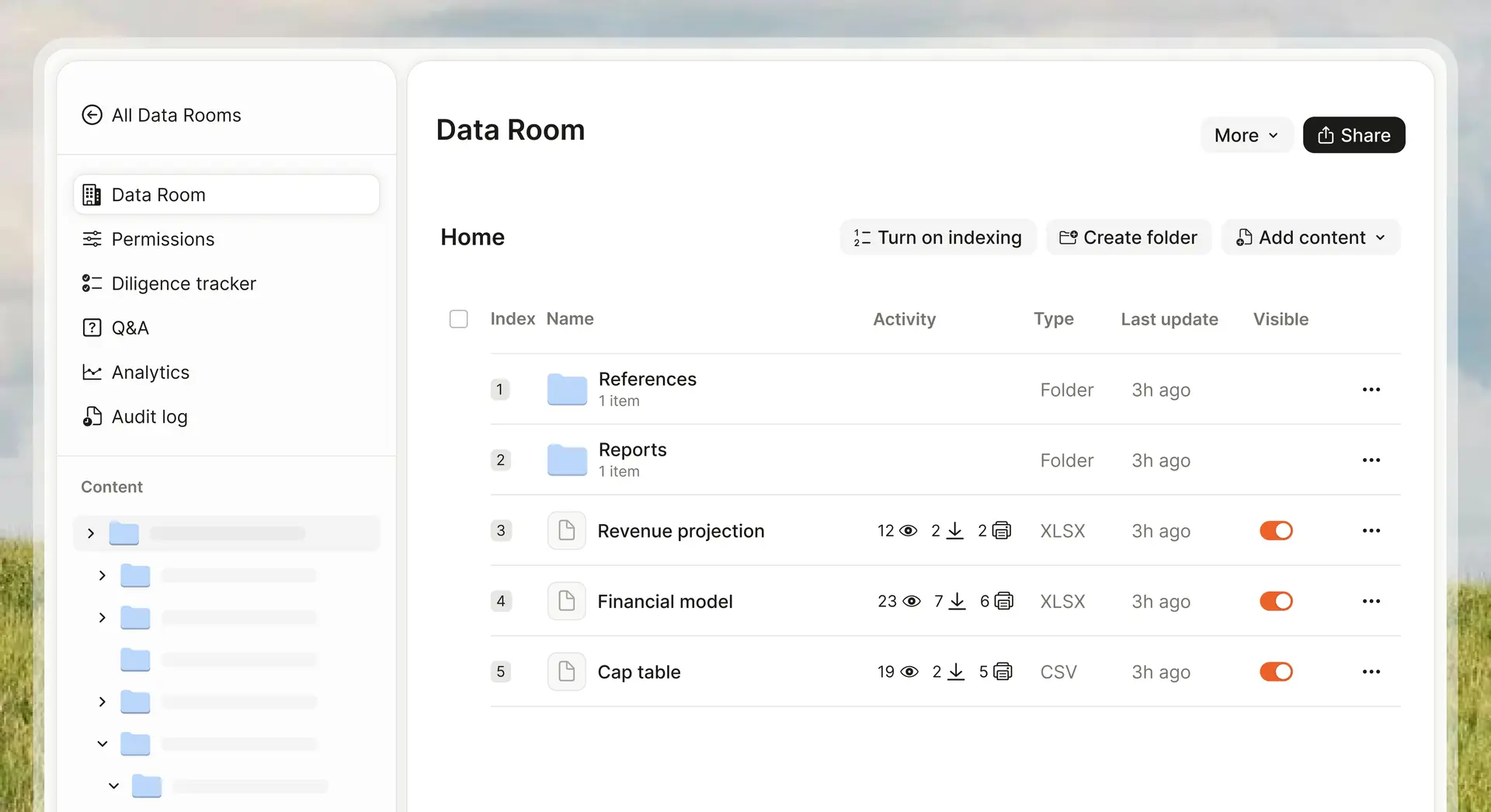
Who Ellty works well for
- You're fundraising and want to track exactly which investors are engaging with your documents in real time
- You want a branded, professional data room without a complex setup or a sales call to get started
- You're running a seed or Series A process with up to a few dozen investors
- You're a consultant, broker, or advisor who shares sensitive documents with clients regularly and wants something more professional than email attachments
- You need NDA gating and watermarking but don't want to pay enterprise prices to get them
- You're managing a real estate transaction and need to share property documents with multiple parties in a controlled, organized way
- You want one platform that handles both pitch deck sharing and full due diligence without switching tools
- You're a small or mid-sized business going through an acquisition and need a clean, organized room without the overhead of enterprise software
When to look elsewhere
- Large-cap M&A transactions requiring enterprise compliance features
- Regulated industries with specific VDR certification requirements
- Scenarios requiring hundreds of simultaneous users with complex hierarchical permissions
Common data room mistakes and how to avoid them

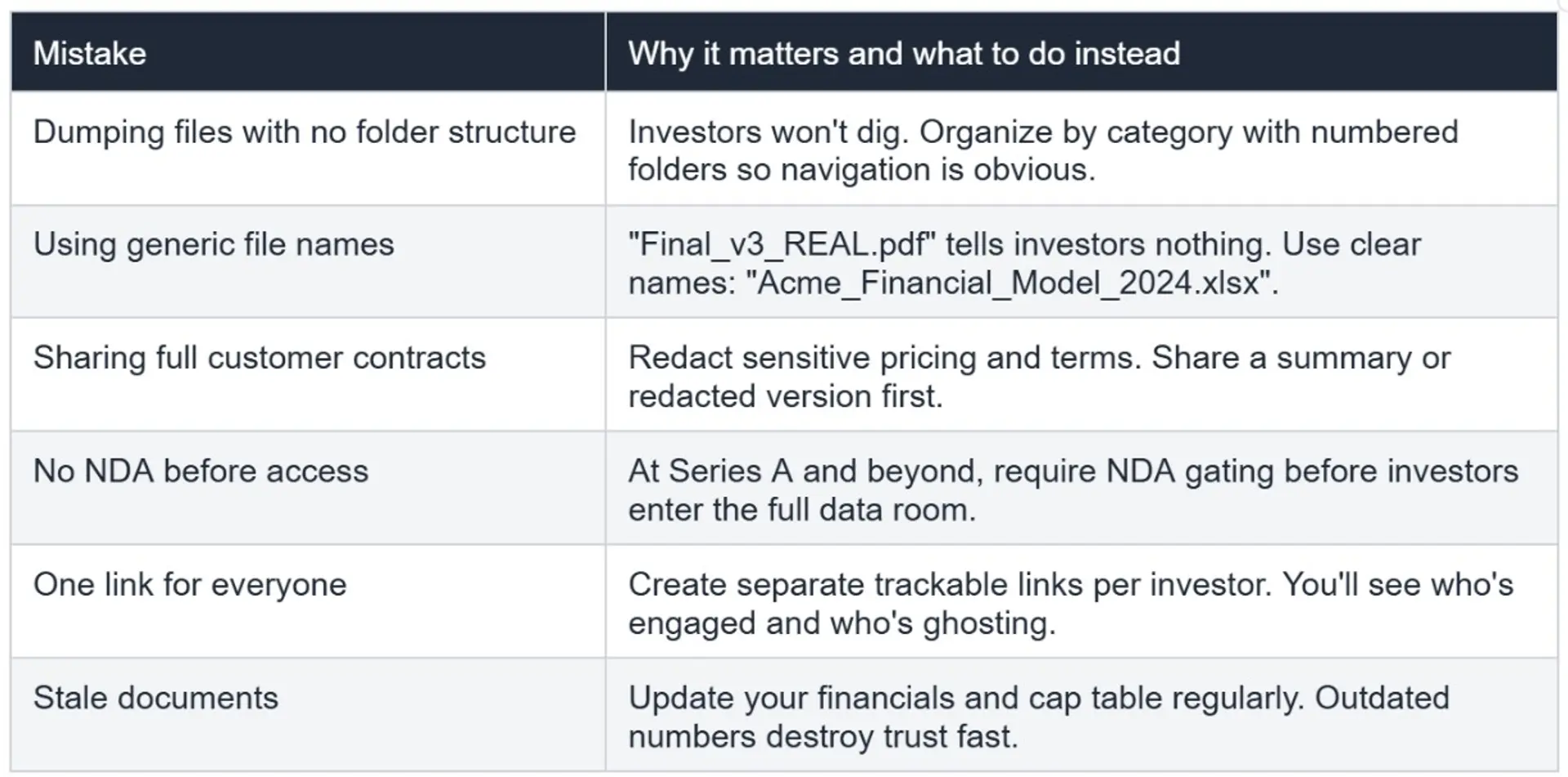
The most common underlying mistake is treating the data room as an afterthought. Founders spend 200 hours on the pitch and 2 hours on the data room. VCs spend 20 minutes on the pitch and 20 hours on the data room.
How to use analytics to manage your fundraising process
This is where a purpose-built data room pulls ahead of a Google Drive folder.
When you create separate trackable links for each investor, you can see exactly:
- Who opened your data room and when
- Which documents they spent time on
- Which pages of your pitch deck got the most attention
- Whether they came back for a second look
- How long they spent in total
This tells you a lot. An investor who spent 8 minutes on your financials and then came back the next day is a different signal than one who opened the room, spent 30 seconds, and never returned.
You can use this to time your follow-ups better. If someone just spent 15 minutes in your data room, that's a good moment to reach out. If they haven't opened it in two weeks, you know not to chase too hard.
Ellty sends real-time notifications when someone accesses your data room. You can see page-by-page engagement across all your documents. That visibility is worth a lot during a high-stakes fundraising process.
Get real-time investor engagement analytics with Ellty - start free
Setting up your data room with Ellty: the actual process
Here's how to go from zero to a working investor data room using Ellty:
Step 1: Prepare your documents first
Before you open any tool, get your documents in order. Name them clearly, convert to PDF where appropriate, make sure your cap table and financials are current. This step happens outside any platform.
Step 2: Create a data room in Ellty
Log in to Ellty, create a new data room, and name it clearly. You can set up a data room on the free plan to test the workflow.
Step 3: Build your folder structure
Create folders following the numbered structure above:
01 - Company overview,
02 - Financials, and so on.
Consistency matters here - use the same structure across all investor conversations so you can update centrally.
Step 4: Upload and organize documents
Upload your files into the appropriate folders. Use the final, current versions. Delete any old versions before sharing.
Step 5: Configure access settings
On the Data Room plan, set up NDA gating if required. Configure folder-level permissions if different visitors should see different sections. Enable dynamic watermarking for sensitive documents like financial models and cap tables.
Step 6: Create investor-specific trackable links
Generate a separate link for each investor or firm. This is how you track individual engagement. Label your links clearly in Ellty so you know which investor each link belongs to.
Step 7: Monitor and act on analytics

Watch your Ellty dashboard. Ellty sends real-time notifications when someone opens your data room. Use this to time follow-ups and understand which investors are genuinely interested. Total setup time: 20-45 minutes if your documents are already prepared. The document preparation step - organizing and naming files correctly - typically takes longer than the platform setup itself.
FAQ
What is a data room for startups?
A data room for startups is a secure online space where founders share confidential company documents with investors, acquirers, or partners during due diligence. It typically includes financial documents, legal documentation, product information, and team materials. Unlike a shared Google Drive, a purpose-built data room gives you access controls, analytics, and tracking.
How do I organize a data room for VC fundraising?
Use numbered folders in a logical sequence: Company overview, Financials, Legal, Product, Market, Team, Customers, Operations. Number them (01, 02, 03...) so they appear in order. Use clear file names with your company name and date. Create separate trackable links for each VC so you can monitor individual engagement.
What documents should be in a VC data room?
At seed stage: pitch deck, cap table, incorporation documents, financial model or basic P&L, product overview, team bios, and customer evidence. At Series A: all of the above plus audited or reviewed financials, detailed legal documentation, IP assignments, key customer contracts, and compliance documentation. Match document depth to your round stage.
Is there a free data room for startups?
Yes. Ellty offers a free plan with document tracking, real-time analytics, and secure sharing. You don't get NDA gating or custom branding on the free tier, but you do get the analytics features that tell you who's reading your documents and for how long. Other free options include Google Drive, but these don't offer tracking or access controls.
What's the best data room for startups?
It depends on your stage. For pre-seed and seed, a tool with good analytics and fast setup is usually enough - Ellty Standard plan works well here. For Series A and beyond where you need NDA gating, watermarking, and granular permissions, Ellty Data Room plan at $149/month covers most needs. Enterprise platforms like Datasite or Intralinks are built for large M&A transactions, not startup fundraising.
How long does it take to set up a data room?
On Ellty, the platform setup takes 20-30 minutes once your documents are ready. The more time-consuming part is preparing your documents - naming them correctly, making sure they're current, and converting to PDF. If you treat document prep as a separate step, data room setup is fast.
Should I use NDA gating in my data room?
At pre-seed and seed, it's optional - many founders skip it for early conversations. At Series A and beyond, NDA gating before data room access is standard practice. It creates a legal record of who agreed to confidentiality before viewing sensitive materials. Ellty offers NDA gating on the Data Room plan ($149/month).
How do I know if investors are actually reading my data room?
Use trackable links and analytics. Create a separate link for each investor in Ellty. You'll see when they accessed the room, which documents they opened, which pages they spent the most time on, and whether they came back. Real-time notifications let you know the moment someone opens your data room - which helps you time follow-ups.
Do I need a data room template?
A template is a good starting point, but you'll need to adapt it to your business. The numbered folder structure in this guide works for most seed and Series A data rooms. The key is consistency - use the same structure across all your investor conversations so you can update files centrally without recreating access links.
What's the difference between a data room and a pitch deck share?
A pitch deck share is typically a single document sent for initial review - it's the opening move. A data room is the full collection of documents used during due diligence - it comes after initial interest. Many founders use the same platform for both: share the deck first, then open the full data room once a VC is seriously evaluating the deal. Ellty supports both workflows.
Start building your data room today
Upload your documents, organize your documents, and track exactly who's reviewing your materials - all in one place. Free plan available.
Author

Anika Tabassum Nionta is a Content Manager at Ellty, where she writes about secure document sharing, virtual data rooms, M&A, due diligence, fundraising, and sales enablement. With over 6 years of writing experience, she helps professionals understand how to share confidential documents securely, track engagement, and manage deals more effectively. Anika holds both a BA and MA in English from Dhaka University. Outside of work, she enjoys reading, exploring new cafes in Dhaka, and connecting with entrepreneurs and dealmakers in her community.

