
If you're raising a funding round or going through any kind of deal process, you'll hear this term. An investor will ask for a data room. An acquirer will request access to one. A partner will want documents shared securely.
This guide explains exactly what a virtual data room is, what it's used for, how to set one up, what it costs, and which providers are worth looking at. No enterprise sales pitch, no jargon.
What is a virtual data room?

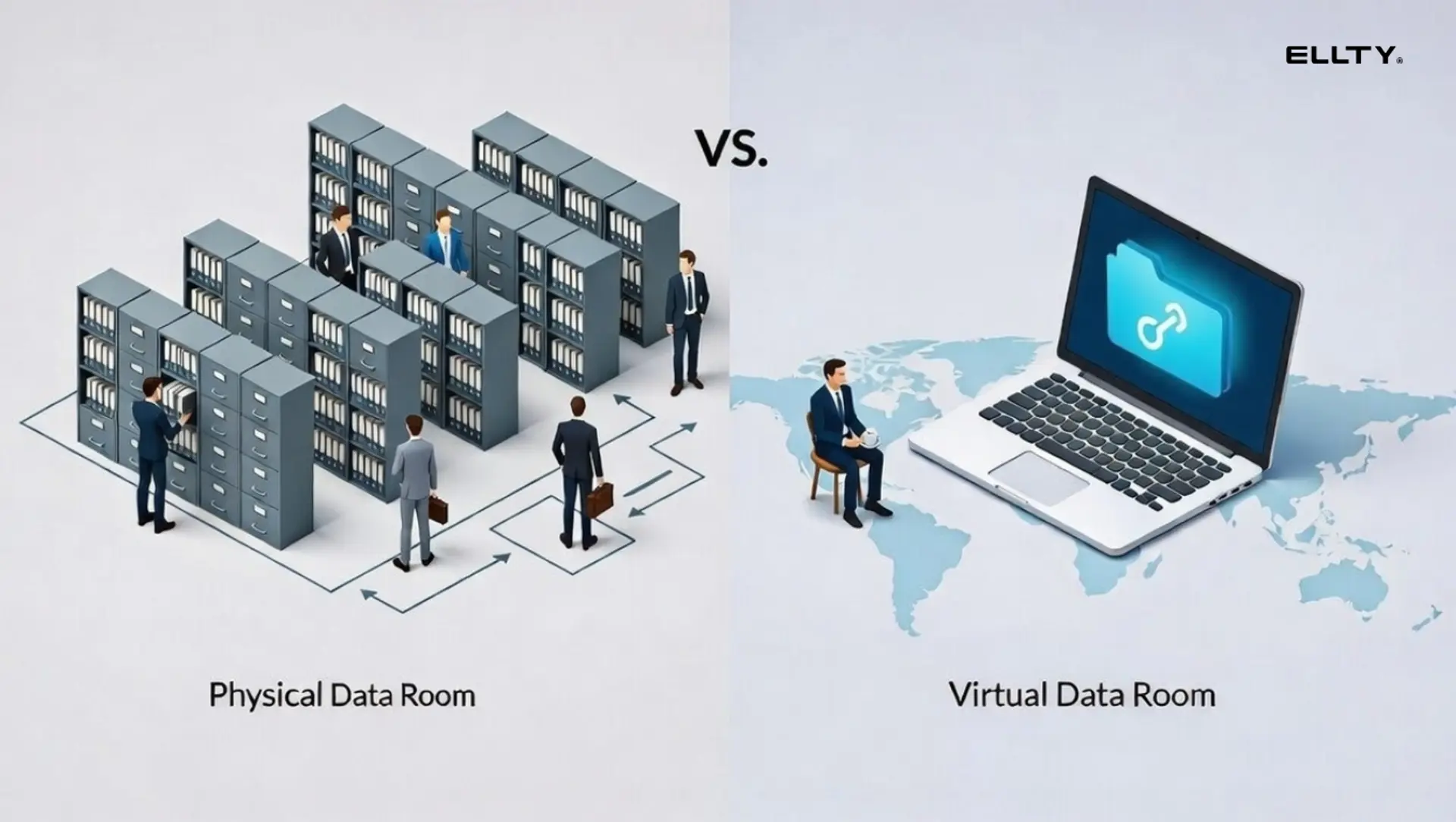
A virtual data room (VDR) is a secure, online repository where you store and share confidential documents with specific people - typically investors, acquirers, auditors, or legal teams.
Think of it as a shared folder, but with real security controls. You decide who sees what, you can track every view, you can revoke access instantly, and you have a complete audit trail of who accessed which document and when.
The "virtual" part distinguishes it from physical data rooms - which actually existed. Before the internet, parties in a major M&A deal would fly lawyers to a room full of filing cabinets to review documents under supervision. VDRs replaced all of that.
Today, a VDR is just software. You upload documents, set permissions, share a link, and monitor activity.
What is a virtual data room used for?
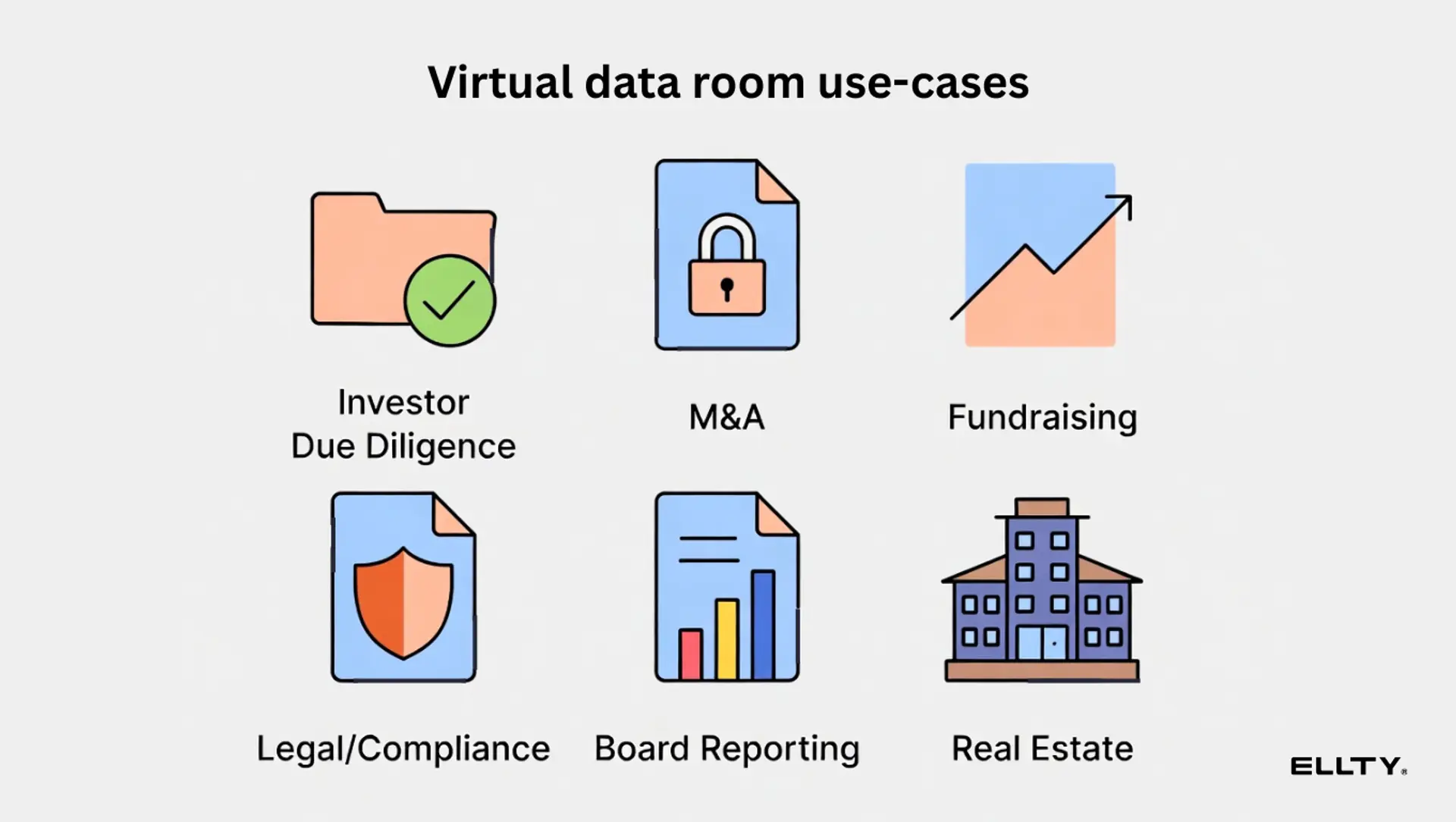
VDRs are used in any situation where you need to share confidential documents with multiple parties - but need to control who sees what and keep a record of it.
Investor due diligence
This is the most common use case for startup founders. When a VC or angel investor says they want to run due diligence, you'll share your data room with them. It'll contain your financials, cap table, contracts, IP documents, team information, and more.
A good data room for investor due diligence tells investors two things: what your business actually looks like, and how organized you are as an operator.
Mergers and acquisitions
M&A is where VDRs were built. When a company is being acquired, the buyer needs access to hundreds or thousands of documents - legal, financial, operational, HR. A VDR lets the buyer's team review everything in a controlled environment without the seller losing control of who sees what.
Fundraising rounds (seed through Series B+)
Beyond just due diligence, founders use VDRs throughout fundraising to share pitch materials, financial models, and supporting documents with a pipeline of investors. This is where analytics matter - you want to know who's actually reading your deck.
Legal and compliance processes
Law firms and compliance teams use VDRs for sharing documents in litigation, regulatory reviews, IPO preparation, and contract negotiations. Any process that requires a documented record of who saw which version of a document.
Board and investor reporting
Some companies use data rooms as a persistent repository for board materials - shareholder updates, board decks, financial reports. It keeps everything in one place and avoids the inbox chain.
Real estate transactions
Property sales, commercial leases, and real estate fund management generate a lot of documents. VDRs handle the due diligence side of these deals in the same way they handle M&A.
How a virtual data room works
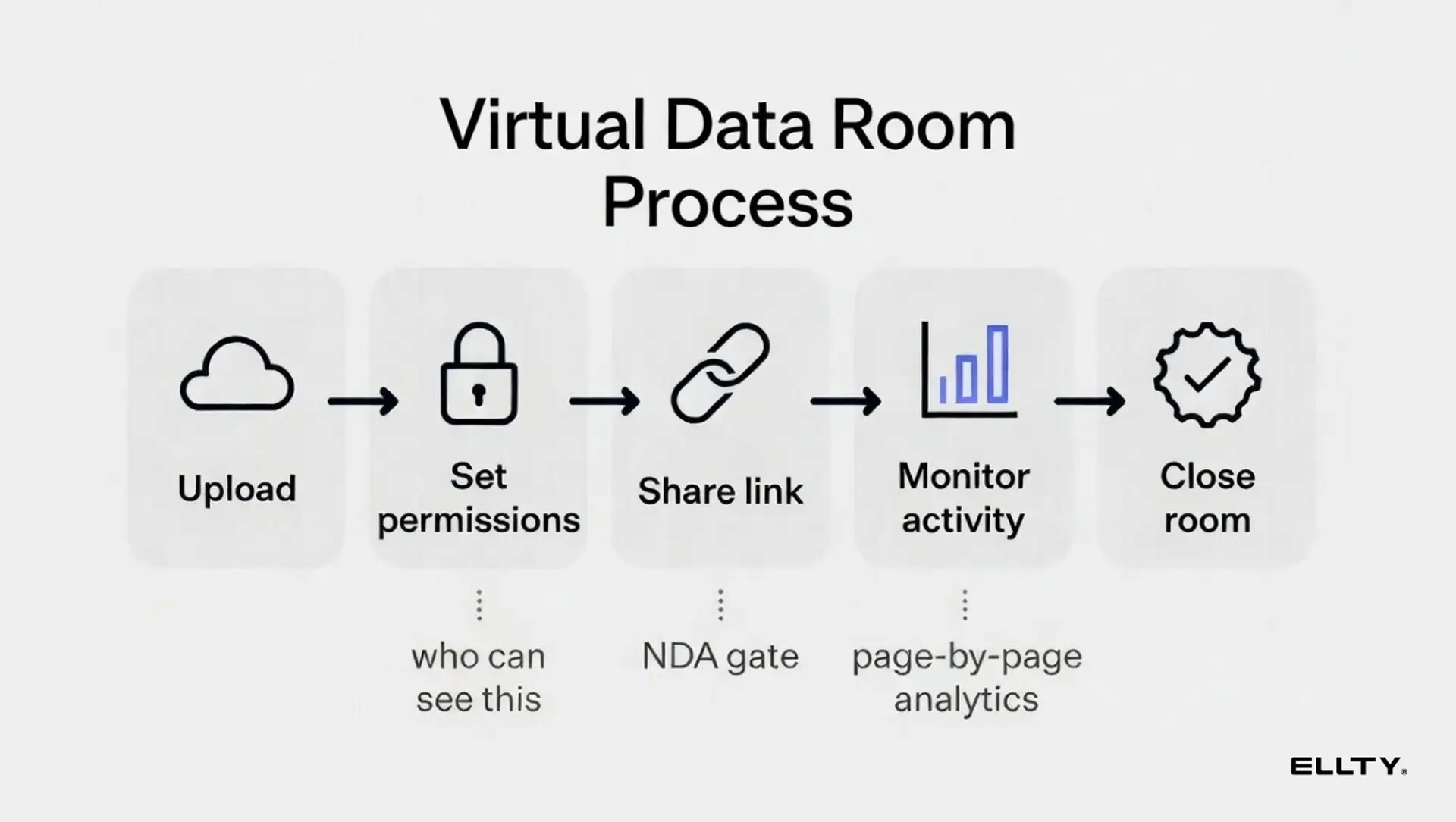
The mechanics are simpler than the terminology suggests. Here's how a typical data room process works:
1. You upload documents - organized into folders (financials, legal, team, cap table, etc.)
2. You set permissions - who can access which folders, whether they can download or just view, whether watermarking is applied
3. You create an access link - sent to specific people, often with an NDA requirement before they can enter
4. Visitors review documents - in a secure viewer, no downloading unless you allow it
5. You monitor activity - who opened what, how long they spent on each document, which sections they skipped
6. You manage access - add or revoke people, adjust permissions, close the room when the deal is done
The key difference from a regular shared folder is the control layer. A Google Drive link, once shared, is hard to fully control - you can't see if someone forwarded it, you can't watermark documents to identify leaks, and there's no audit log for a legal process.
Key features to look for in a VDR
Not all VDRs are built the same. Here's what the features actually mean - and which ones matter for your use case.


What is a VDR in finance?
In finance, "VDR" is standard terminology for the secure document-sharing platform used in any significant transaction. Private equity firms, investment banks, and M&A advisors use VDRs as a core part of their deal infrastructure.
In a leveraged buyout, the PE firm's deal team and legal counsel will access a VDR containing the target company's financial statements, debt agreements, operational data, and legal documents. The VDR becomes the official record of what was disclosed to whom during the transaction.
For financial due diligence specifically, auditors and financial advisors use the VDR to review:
- Historical financial statements (3-5 years)
- Management accounts and board packs
- Revenue and customer data
- Cost structure and margin analysis
- Financial forecasts and model assumptions
- Existing debt and financing agreements
The audit log functionality is particularly important in finance - it creates a documented record of what information was available and reviewed, which matters if the deal is later disputed.
What is a VDR in crypto?
In crypto and Web3 contexts, VDR sometimes refers to a "Verifiable Data Registry" - a blockchain-based system for storing and verifying credentials or identity claims. This is a different concept from a virtual data room.
A Verifiable Data Registry in the Web3/decentralized identity sense is a ledger where entities can publish and verify credentials without a central authority. Examples include blockchain networks used for self-sovereign identity (SSI) systems.
If someone in a crypto context mentions a VDR in the context of a fundraise, token sale, or investor process, they almost certainly mean a virtual data room in the traditional sense - not a blockchain registry. Businesses raising from Web3 VCs go through the same investor due diligence process as any other startup.
What is a data room for investors?
From an investor's perspective, a data room is how they verify everything you've told them. The pitch deck is the story. The data room is the evidence.
When investors access your data room, they're looking for three things:
- Accuracy - does the data match what you presented?
- Completeness - is everything they need actually there?
- Organization - does this founder know how to run a company?
A messy, incomplete, or hard-to-navigate data room slows down the process, increases legal costs, and - unfairly but honestly - signals something about how you operate.
What investors typically expect to find


Most VCs provide a diligence checklist. Build your data room to match their format and you'll save everyone time.
How to create a virtual data room

Setting up a data room isn't technically complex. The hard part is gathering and organizing the documents. Here's a practical process:
Step 1: Choose your tool
Pick a platform that fits your deal size and budget. More on this in the providers section below. For most cases, you don't need enterprise software.
Step 2: Set up your folder structure
Before uploading anything, define your folder structure. A standard structure:
- 01 - Company formation
- 02 - Cap table and equity
- 03 - Financial statements
- 04 - Financial model
- 05 - Legal and contracts
- 06 - Intellectual property
- 07 - Team and HR
- 08 - Customers and revenue
- 09 - Product and technology
- 10 - Board and investor materials
Numbering folders forces them into logical order. Otherwise most platforms sort alphabetically and the structure gets messy.
Step 3: Upload and name documents clearly
File names matter. Investors don't want to open 'final_v3_FINAL_USE_THIS.pdf' to figure out what it is. Use clear, consistent naming:
- 2024-Q4-Financial-Statements.pdf
- Cap-Table-Fully-Diluted-2025.xlsx
- IP-Assignment-Agreement-Jane-Smith.pdf
Step 4: Set permissions by user or group
Not every investor needs to see everything. Set up permission groups:
- Lead investor - full access
- Co-investors - financials and legal, no HR detail
- Legal counsel (investor's) - legal folder only
This is where per-user pricing stings on some platforms - the investor brings their legal team, their associates, their analyst, and suddenly you're paying for 8 users.
Step 5: Add NDA gating if needed
For anything beyond a pitch deck, you want investors to acknowledge confidentiality before accessing. Most VDR platforms let you add an NDA click-through at the access point.
Step 6: Share and monitor
Share access and then actually use the analytics. Which folders are getting the most views? Is the investor spending time on financials or skipping them? This tells you where to prepare for follow-up questions.
Virtual data room providers
The market ranges from enterprise software built for billion-dollar M&A to simple tools designed for early stage businesses. Here's an honest overview:


How to choose
Be honest about your deal size and complexity. A $1M seed round from two angels does not need Intralinks. A $50M Series C with 12 co-investors and two law firms on each side does not belong on Google Drive.
The main decision variables:
- Deal size and complexity - bigger deals justify bigger platforms
- Number of external users - per-user pricing changes the math significantly
- Feature requirements - do you need Q&A workflows and version control, or just permissions and analytics?
- Timeline - some enterprise platforms take days to set up; lighter tools are usually same-day
Virtual data room pricing
VDR pricing is one of the least transparent areas in B2B software. Here's how the models actually work:
Per-page pricing
Legacy enterprise VDRs charge per page uploaded. This made sense when VDRs were physical rooms with photocopying costs baked in. It makes no sense for software, but the model persists. At $0.40-$0.85 per page, a 500-document data room adds up fast.
Per-user pricing
Common across mid-tier platforms. You pay per person who accesses the room. Sounds reasonable until the investor brings their whole deal team - 4 associates, 2 partners, 3 lawyers. Now you're paying for 9 users you didn't budget for.
Flat monthly pricing
Newer platforms, especially those built for startups, charge a flat monthly fee regardless of documents or users. This is more predictable and often significantly more affordable for standard use cases.


For most businesses, flat monthly pricing is almost always the right model. You won't know how many people end up accessing the room, and you don't want a surprise bill after a deal closes.
Ellty pricing for data rooms

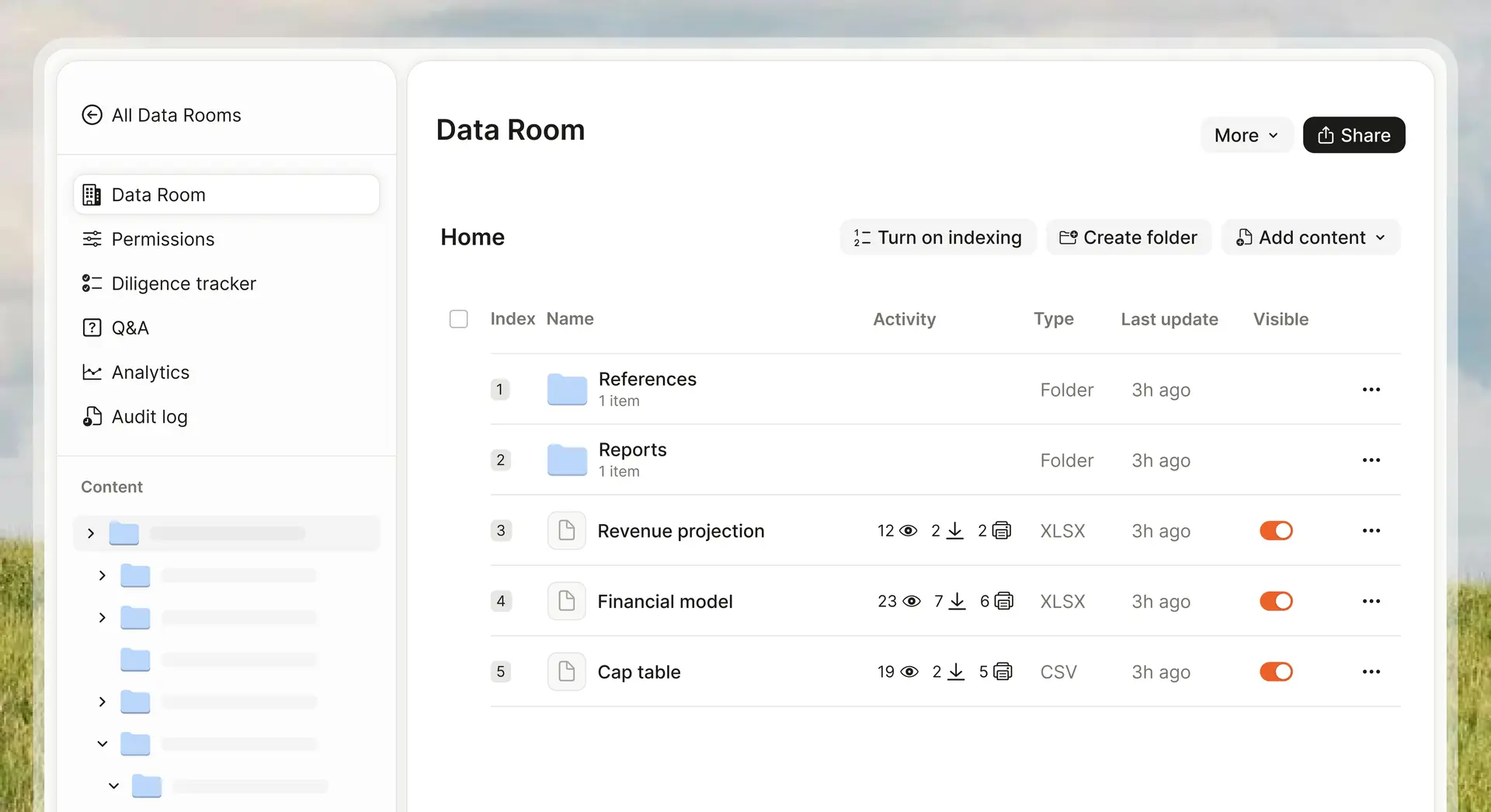
Ellty offers three plans relevant to data room use:
- Standard ($69/month) - includes data rooms alongside document tracking, analytics, and eSignatures
- Data Room ($149/month) - adds granular permissions, NDA gating, dynamic watermarking, restricted visitor access, and 3 users
- Data Room Plus ($349/month) - adds group visitor permissions, audit logs, and up to 4,000 assets per data room
Virtual data room examples
Abstract features are harder to understand than concrete situations. Here are some real-world scenarios:
Example 1: Pre-seed founder sharing with angels
A first-time founder has a pitch deck and a basic financial model. Three angels are interested and want to see supporting documents.
Docsend or Ellty free/standard plan works here. The priority is trackable link sharing and analytics, seeing whether the angel actually read the deck. A full data room setup is overkill. Google Drive is fine for the documents themselves at this stage, though a trackable link for the pitch deck is worth using regardless.
Example 2: Seed-stage SaaS startup raising a $1.5M round
A two-year-old SaaS company with $400K ARR is raising their first institutional check. A seed VC runs standard due diligence.
Their data room contains 28 documents across 7 folders. They use Ellty Data Room plan at $149/month, set up NDA gating before access, and apply view-only permissions on financial documents. The process takes 6 weeks. Analytics show the lead partner spent 40 minutes on the financial model and 12 minutes on the cap table, the founder knows exactly where to prepare for the next call.
Example 3: Series B company with multiple investors
A growth-stage company raising a $15M Series B with a lead VC and three co-investors, each with their own legal team. Total data room users: 14 people.
With per-user pricing at $40/user/month over a 3-month process, that's $1,680 in platform fees on top of the base cost. With flat pricing, it's a fixed monthly fee regardless. At this stage, a mid-market VDR with more advanced workflow features makes sense, Q&A threads and version control matter when 14 people are reviewing documents and asking questions at the same time.
Example 4: Consulting firm sharing deliverables with a client
A mid-size consulting firm is wrapping up a 3-month strategy engagement. They need to hand off 15 documents - reports, financial models, and implementation roadmaps - to stakeholders across the client's organization.
Instead of emailing attachments or dumping files in a shared folder, they set up a clean data room. The client team gets a single organized link. The consultants can see which documents got opened, which ones were ignored, and whether the right people actually reviewed the work. It also creates a clean record of what was delivered and when.
Example 5: Real estate transaction
A commercial real estate firm is selling a portfolio of three office buildings. The buyer's team - investors, lawyers, and property managers - needs access to leases, inspection reports, title documents, environmental assessments, and financial statements.
A data room keeps everything organized in one place with controlled access. Different parties get access to different folders based on what they need to see. The audit trail matters here too, knowing who reviewed which documents, and when, protects all sides if questions come up later in the process.
Example 6: Private equity firm running a portfolio company sale
A PE firm is running a structured sale process for one of its portfolio companies. They're managing three potential buyers simultaneously, each at a different stage of diligence, with separate legal teams involved.
This is where a more advanced VDR earns its place. The firm needs separate, isolated data rooms for each bidder group so no buyer sees what the others are asking. Q&A workflows keep hundreds of diligence questions organized and traceable. Version control matters because financials and legal documents get updated frequently. The audit log becomes part of the legal record.
Example 7: Companies being acquired
A 4-year-old company is in acquisition discussions with a strategic buyer. The buyer's deal team, M&A advisors, and three law firms need access. The process runs for 5 months.
This is where enterprise VDRs earn their fees. The audit log is critical for legal protection. Version control matters because documents get updated frequently. The Q&A workflow keeps hundreds of diligence questions organized. The per-page or per-user cost is noise relative to the deal value and advisor fees involved.
Example 8: Law firm managing a fundraising round for a client
A law firm is coordinating a $10M raise for a biotech client. They're managing document flow between the startup, three investor groups, and their own internal deal team.
They need a data room that gives them administrative control - setting permissions per user, tracking every document access for compliance, and keeping a clean log of what was shared with whom. A platform with strong access controls and a full audit trail is non-negotiable here, both for the client's protection and their own.
Common mistakes teams make with data rooms
Setting it up after an investor asks
The most common and expensive mistake. When an investor requests a data room and you don't have one, you spend the next week scrambling to gather documents, organize folders, and upload files - while the investor waits. Set it up before you need it.
Uploading everything with no permissions
Giving full access to all documents to every party is a security issue and a professionalism signal. Segment by role. Early-stage investors don't need HR compensation data. Co-investors don't need the same access as a lead who's driving diligence.
Using Google Drive for formal diligence
Google Drive works fine for sharing a pitch deck with a friend. It doesn't work for formal investor due diligence. No audit trail, no NDA requirement, no ability to restrict downloading, no view analytics. If a deal later requires legal documentation of what was disclosed, Google Drive won't give you that.
Not monitoring analytics
You pay for a tool with engagement analytics and then never look at them. Check who's actually reviewing documents. If a supposed lead investor hasn't opened your data room in 2 weeks, that's a signal. If they've spent 3 hours on your financials, that's a different signal.
Leaving the room open after a deal closes
Once a process is complete - deal done or deal dead - revoke access and close the room. Former investors in a failed deal don't need ongoing access to your confidential documents.
FAQ: virtual data rooms
What's the difference between a virtual data room and a shared folder?
A shared folder (Google Drive, Dropbox) gives basic file access. A VDR adds: access controls per folder and file, NDA agreements before entry, document watermarking, full audit logs, view analytics per page, and access revocation. For informal document sharing, a shared folder is fine. For formal due diligence, you need the control layer a VDR provides.
Do I need a virtual data room for a seed round?
For angel-led or friends-and-family rounds, probably not. For any VC-led seed round, yes - you'll be expected to have organized documents in a secure environment. It also just looks more professional. The cost of a basic data room tool is trivial compared to the legal fees you'll incur if documents are disorganized.
How long does it take to set up a virtual data room?
The setup process in the software itself takes 30-60 minutes. The real time is gathering and organizing the documents. If you're starting from scratch with unorganized documents, expect 10-20 hours of work. If your documents are already organized, a couple of hours. This is why building your data room early - not when an investor asks - matters.
How secure are virtual data rooms?
Purpose-built VDR platforms are generally very secure. Features like dynamic watermarking, access revocation, download restrictions, and NDA gating all contribute to document security. Enterprise platforms often hold ISO 27001 or SOC 2 certifications. For lighter tools, check what certifications they hold before assuming enterprise-grade security. Don't put highly sensitive material (personal employee data, unreleased product details) in a room unless you've verified the platform's security posture.
What is the average cost of a virtual data room?
Ranges from $0 (Google Drive, not recommended for formal diligence) to $10,000+/month for enterprise M&A platforms. For seed to Series A startups, the realistic range is $100-$600/month. Ellty Data Room plan is $149/month with no per-user fees. Enterprise platforms like Intralinks start at $2,000+/month and often add per-page or per-user fees on top.
Can investors download documents from a data room?
Only if you allow it. Most VDR platforms let you set download permissions per folder or per file. For sensitive documents like financial models or customer contracts, most teams set view-only access. You can allow downloading for documents that are less sensitive or that investors need to work with offline.
What happens to a data room after a deal closes?
You can archive it, close it, or convert it to ongoing investor reporting. In M&A, the VDR record is often retained as part of the legal transaction record. For fundraising rounds, it's common to either close the room or restructure it as an ongoing investor portal for reporting.
Is a virtual data room the same as a cap table?
No - these are different things. A cap table is a spreadsheet or software tool (like Carta or Pulley) that tracks your company's equity ownership. A virtual data room is where you store and share documents - including your cap table - during a due diligence process. Your cap table is one document that goes into your data room.
What is the best virtual data room for startups?
Depends on stage and deal complexity. For pre-seed and seed rounds: Ellty or Docsend work well and don't require enterprise contracts. For Series A with multiple investors: Ellty Data Room Plus or a mid-market platform. For Series B+ or M&A: consider Ansarada, iDeals, or DealRoom depending on workflow needs. Enterprise platforms (Intralinks, Datasite) are rarely appropriate for startup fundraising.
Do I need a VDR if I'm just sharing a pitch deck?
Not necessarily. For a pitch deck, a trackable link tool (which most VDR platforms and tools like Ellty also provide) is enough. You want to see who viewed it and which slides they spent time on - you don't need folder permissions and NDA gating for that. A full data room becomes necessary when the investor moves past the pitch and into actual diligence.
Summary
A virtual data room is a secure online document repository with access controls, audit logs, and analytics. It's not complicated software - it's the organized, controlled environment where deals get done.
If you're raising a VC-led round, you'll need one. If you're going through M&A, you'll definitely need one. If you're sharing a pitch deck with early angels, a trackable link tool covers it.
The main points to remember:
- VDRs are for controlled document sharing with multiple parties in a deal context
- Core features: permissions, NDA gating, watermarking, audit logs, analytics
- Pricing models vary significantly - per-page, per-user, and flat monthly
- Enterprise VDRs are built for billion-dollar deals - most companies don't need them
- Set your data room up before investors ask, not after
- The tool you choose should match your deal stage and complexity
Author

Anika Tabassum Nionta is a Content Manager at Ellty, where she writes about secure document sharing, virtual data rooms, M&A, due diligence, fundraising, and sales enablement. With over 6 years of writing experience, she helps professionals understand how to share confidential documents securely, track engagement, and manage deals more effectively. Anika holds both a BA and MA in English from Dhaka University. Outside of work, she enjoys reading, exploring new cafes in Dhaka, and connecting with entrepreneurs and dealmakers in her community.

