
You're about to share financials, cap tables, contracts, and your pitch deck with a stranger who might write you a check - or not.
How you share that information matters.
A virtual data room (VDR) gives you control: who sees what, when they saw it, and how long they spent on each file. That's the whole idea. The problem is that most founders either overpay for enterprise tools they don't need, or they use Google Drive and hope for the best.
This guide covers six data rooms for startups across every budget, from $0 to $400+/month. We'll cover what each one does well, where it falls short, and who it's actually built for.

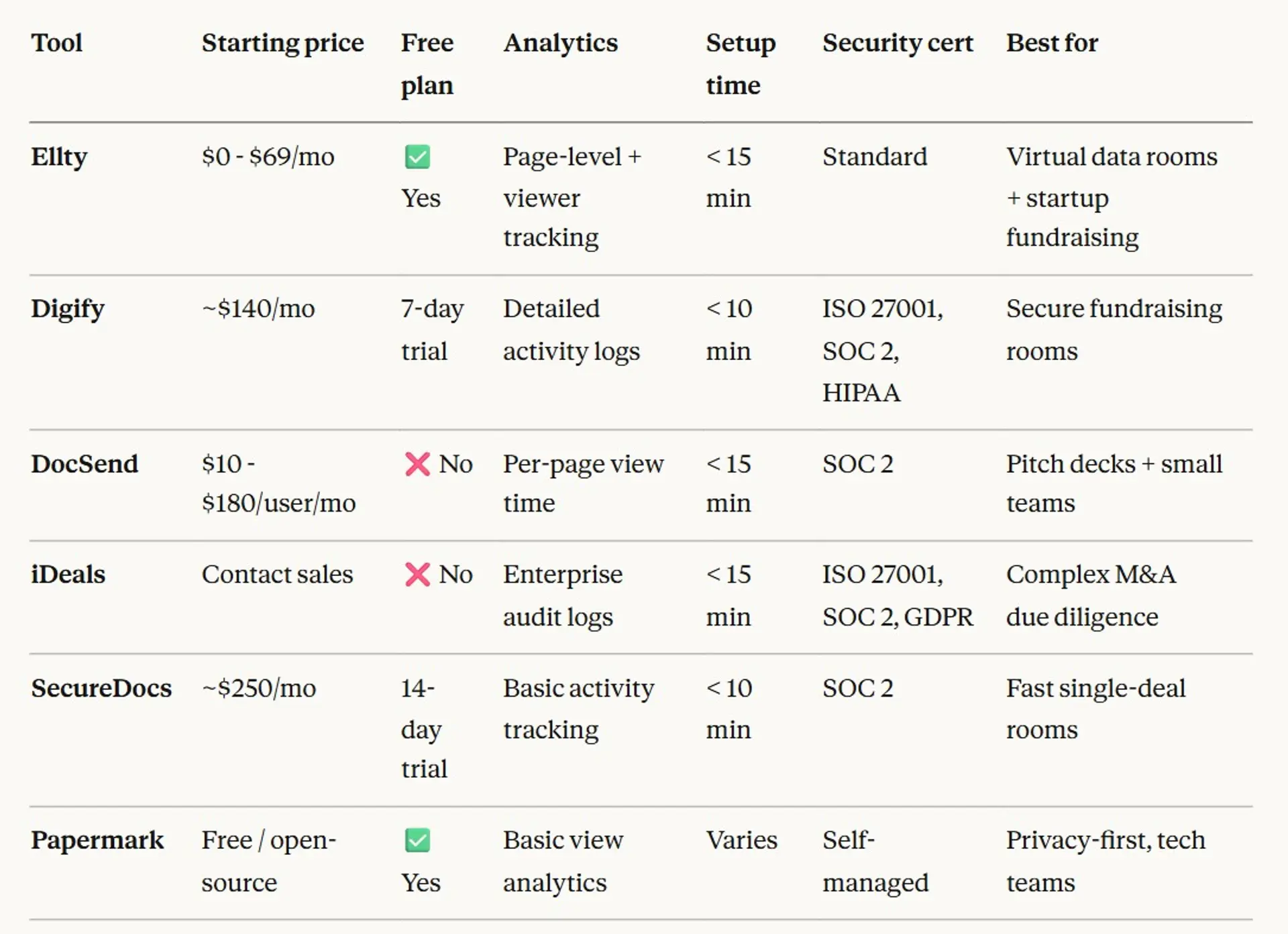
A few things worth noting from the table:
Pricing model matters more than the headline number. DocSend looks cheap at $10/user but scales fast. Ellty and SecureDocs are flat-rate, so costs stay predictable. iDeals requires a sales call before you even know the number.
"Free plan" isn't always equal. Ellty and Papermark have genuine ongoing free tiers. Digify and SecureDocs offer time-limited trials only - you'll need to pay after 7 or 14 days.
Analytics depth varies a lot. If investor engagement tracking is your main goal, Ellty and Digify give you the most useful signals (who viewed, which pages, how long). Papermark's analytics are more basic. iDeals is comprehensive but overkill for a fundraise.
What is a virtual data room and do you actually need one?
A virtual data room is a secure online space where you store and share confidential documents with controlled access. Think of it as a Dropbox with audit trails, view tracking, user permissions, and the ability to revoke access at any time.
For startups, the most common use cases are:
- Sharing documents during a fundraising round (Series A, seed, bridge)
- Running due diligence for a merger or acquisition
- Onboarding investors with controlled access to financials
- Sharing pitch decks and tracking investor engagement
- Legal and compliance document storage
Do you need one? If you're pre-product, probably not. If you're actively fundraising or entering due diligence, yes - a professional setup signals to investors that you take security seriously. Emailing a PDF with no tracking isn't ideal when you're trying to raise $2M.
The honest answer: for early-stage pitch sharing, a lighter tool with analytics works fine. For full M&A due diligence with lawyers and multiple stakeholders, you'll want something with granular permissions and a proper audit log.
What to look for in a data room for startups
Before diving into the tools, here's what actually matters when you're evaluating options:
Pricing model - Per-user fees add up fast once you're sharing with 10+ investors, advisors, and lawyers. Flat-rate plans are easier to budget.
Analytics - Can you see who opened the room, which pages they spent the most time on, and when they last visited? This information helps you prioritize follow-ups.
Access controls - Can you restrict downloading, set link expiration dates, and revoke access after a deal falls through?
Security certifications - For M&A and due diligence, ISO 27001 and SOC 2 certifications matter to the other side's lawyers.
Ease of setup - During a fundraise, you don't have time to learn a new platform for three days. Look for tools that get you live in under 30 minutes.
Storage limits - A seed round data room is different from Series B due diligence. Make sure you know the cap.
Best virtual data rooms for startups
1. Ellty - best data rooms and analytics

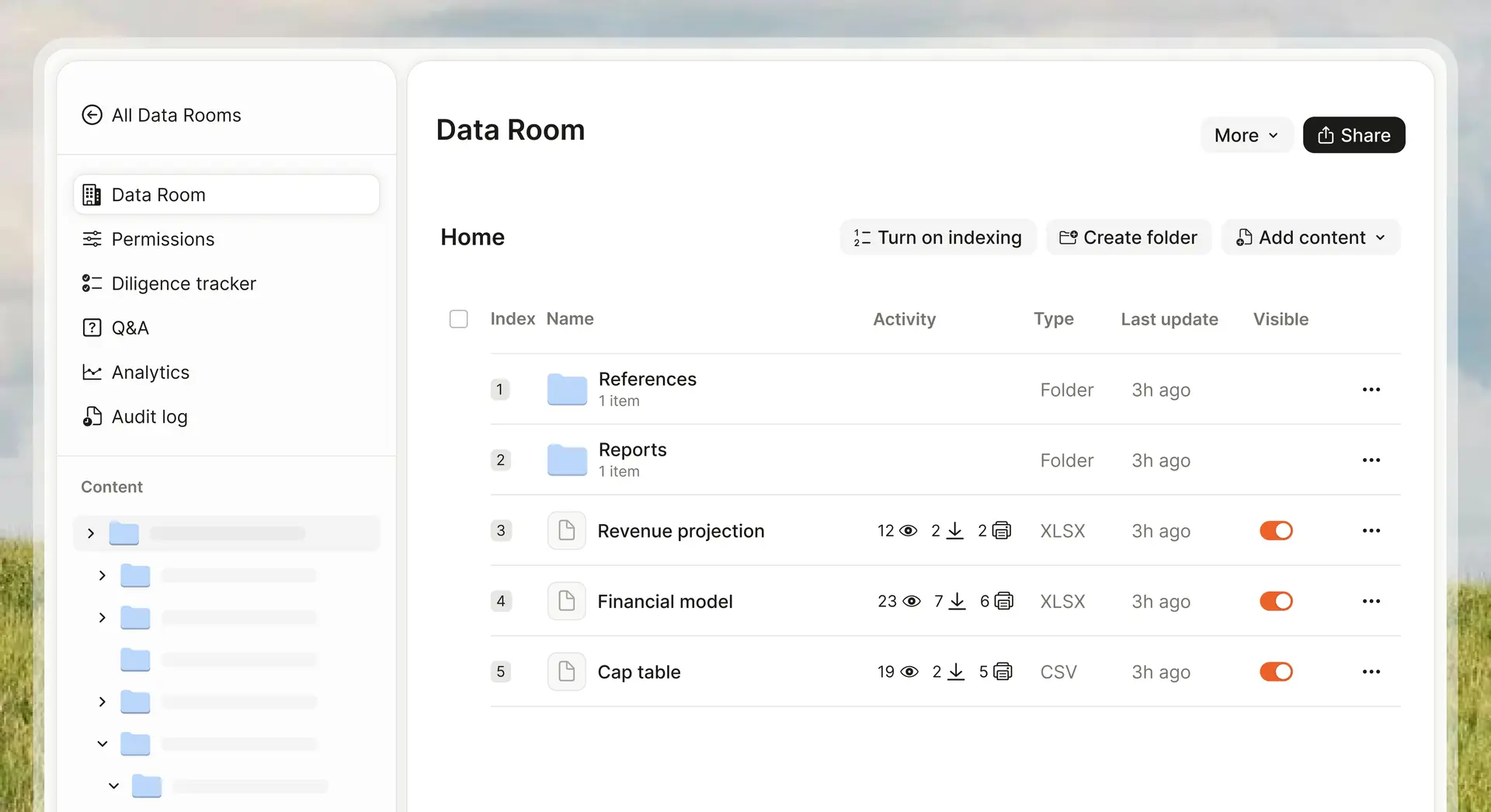
Ellty is a document sharing and analytics platform built for anyone who needs a professional, trackable data room without the enterprise price tag.
Whether you're raising a funding round, running a consulting engagement, closing a real estate deal, or managing an M&A process, the core problem is the same: you need to share sensitive documents with the right people and actually know what's happening after you hit send.
Ellty solves that. Upload your documents, generate a secure trackable link, and watch the analytics roll in. You'll see who opened it, which pages they spent the most time on, how many times they came back, and how long they stayed. Real-time notifications tell you the moment someone views a file.
That kind of visibility changes how you follow up. If a potential acquirer spent 12 minutes on your financial model but barely touched the operations section, you know exactly where to focus the next conversation. If a consulting client keeps returning to page 7 of your proposal, that's a signal worth knowing.
What Ellty does well:
- Secure data rooms for sharing due diligence, proposals, or deal documents
- Page-by-page engagement tracking - by viewer, session, and time spent
- Trackable shareable links with access controls
- Real-time notifications when someone opens your files
- Flat pricing - no per-user fees that balloon as more people get involved
- Fast to set up - you can be live in under 15 minutes
Who it's a great fit for:
Ellty works well for teams sharing investor materials, M&A advisors running early-stage deal processes, consultants sharing proposals and deliverables, real estate professionals managing transaction documents, and anyone who needs organized, professional document sharing with real engagement data - not just a link and a prayer.
Where it has limits:
Ellty isn't designed for highly complex, multi-party M&A processes with advanced Q&A workflows, multiple bidder groups, or heavy compliance requirements for enterprise buyers. For that level of deal complexity, a purpose-built enterprise VDR is the right call. But for most document sharing situations where you want professionalism, security, and visibility - Ellty covers the ground well.
Pricing:


At $0 to $149/month, Ellty offers data room features without the per-user fees which is practical as your deal process grows.
2. Digify - best for secure fundraising data rooms with strong document controls


Digify is a solid, affordable virtual data room that punches above its weight for startups. It's ISO 27001 certified, trusted by over 600,000 professionals across 138 countries, and has a clean track record of helping founders through fundraising rounds.
The platform's document security features are genuinely strong. You can prevent downloading and printing, apply dynamic watermarks, and - this is unusual - revoke access even after someone has downloaded a file. That last feature is particularly useful if a deal falls through and you want to make sure confidential documents don't circulate.
Digify has been used by startups including Museum of Ice Cream (raised $40M Series A), Flutterwave (raised $170M Series C), and Bolt (raised $68M Series B). So the credibility is there.
What Digify does well:
- Document access revocation - even post-download (patent-pending technology)
- Dynamic watermarking on all files
- Detailed activity logs: who viewed what, when, for how long
- ISO 27001, SOC 2, HIPAA, and GDPR compliant
- Multiple data rooms per account (Pro plan: 3 rooms, Team: 10)
- Built-in NDA terms of access
- No guest fees - invite investors without adding to your user count
Limitations:
The Pro plan only includes 1 data room (some sources note 3 on the updated plan - check current site). Once you're running parallel deals with different investor groups, you'll need the Team plan, which represents a significant price jump. Also, some enterprise buyers may push back on accessing documents via a third-party URL, which has come up in reviews.
Pricing:
Digify charges around $140/month for the Pro plan, with annual billing offering approximately 30% savings. Team and Enterprise plans are available at higher price points. They offer a 7-day free trial.
Best for: Startups in active fundraising or due diligence who need strong document security, access revocation, and solid compliance certifications at a founder-friendly price point.
3. DocSend (by Dropbox) - best for pitch deck sharing with CRM integrations

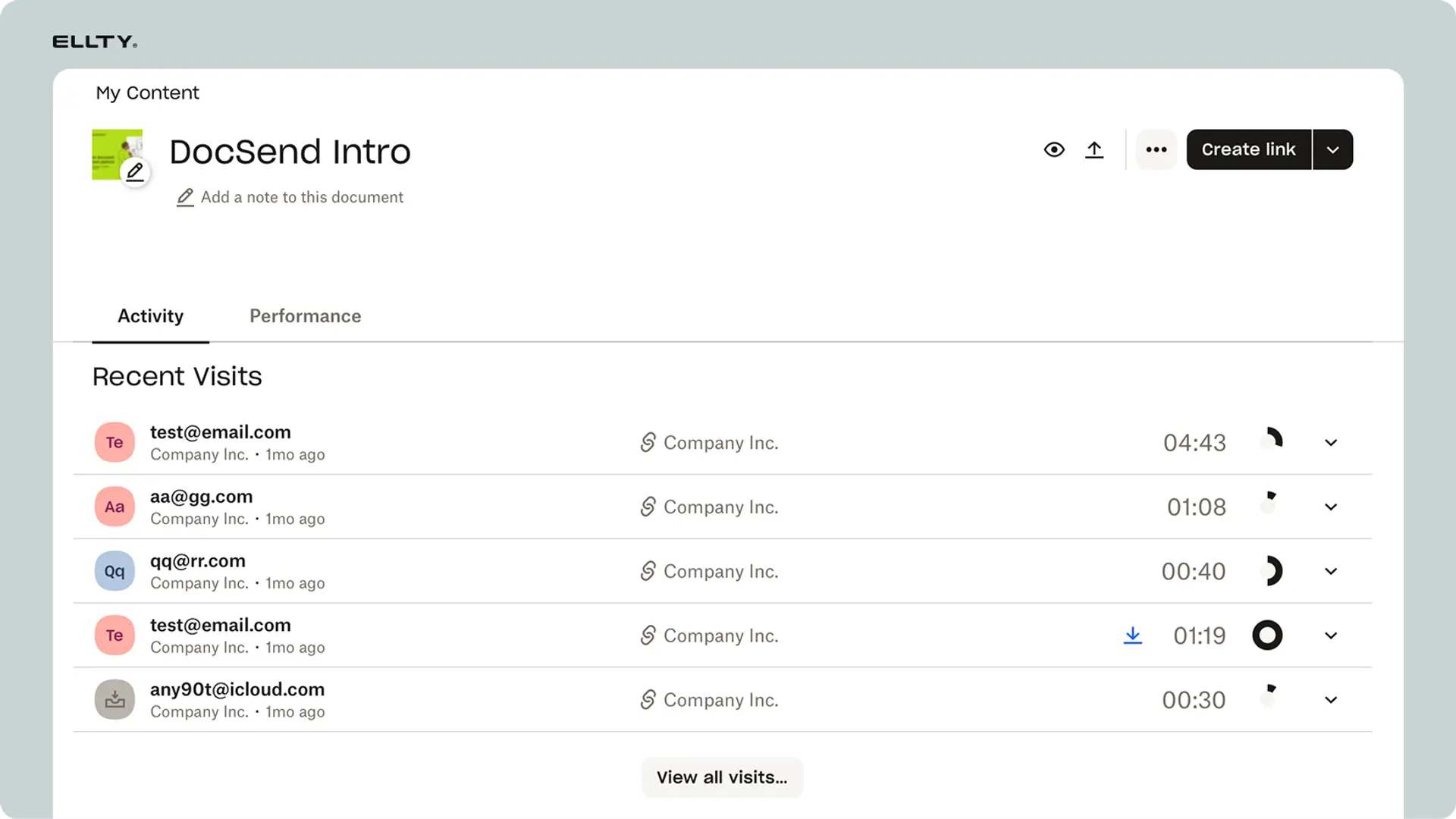
DocSend has been around since 2013 and is one of the most widely recognized pitch deck sharing tools in the startup ecosystem. Dropbox acquired it in 2021, which gave it more stability and broader integrations.
At its core, DocSend tracks how people engage with your documents: page-by-page view time, total sessions, return visits. For pitch deck sharing before a fundraise, it's highly functional. Plenty of YC and top-tier VC-backed founders have used it as their go-to for investor outreach.
The data room functionality is available on the Advanced and Advanced Data Rooms plans. However, it's worth knowing upfront that DocSend's pricing is per-user, and it escalates quickly as you add team members.
What DocSend does well:
- Polished, clean document sharing experience
- Strong per-page analytics on pitch decks
- Dropbox integration for teams already in that ecosystem
- Built-in eSignature (limited on lower plans)
- Known and trusted in the investor community
Limitations:
The per-user pricing is the main concern. A five-person team on the Standard plan ($65/user/month) runs $325/month. If you want watermarking and advanced permissions for a data room, you need the Advanced plan, which starts at $250/month for 3 users - but 10 users brings that to $2,500/month. For startups, that adds up.
Data room features are also only available on the higher tiers. On the $10/month Personal plan, you won't get multi-file data rooms at all.
Pricing overview:


Best for: Solo founders or very small teams who want professional pitch deck sharing and are already in the Dropbox ecosystem. Less ideal for growing teams where per-user fees become a real cost.
4. iDeals - best for complex M&A due diligence

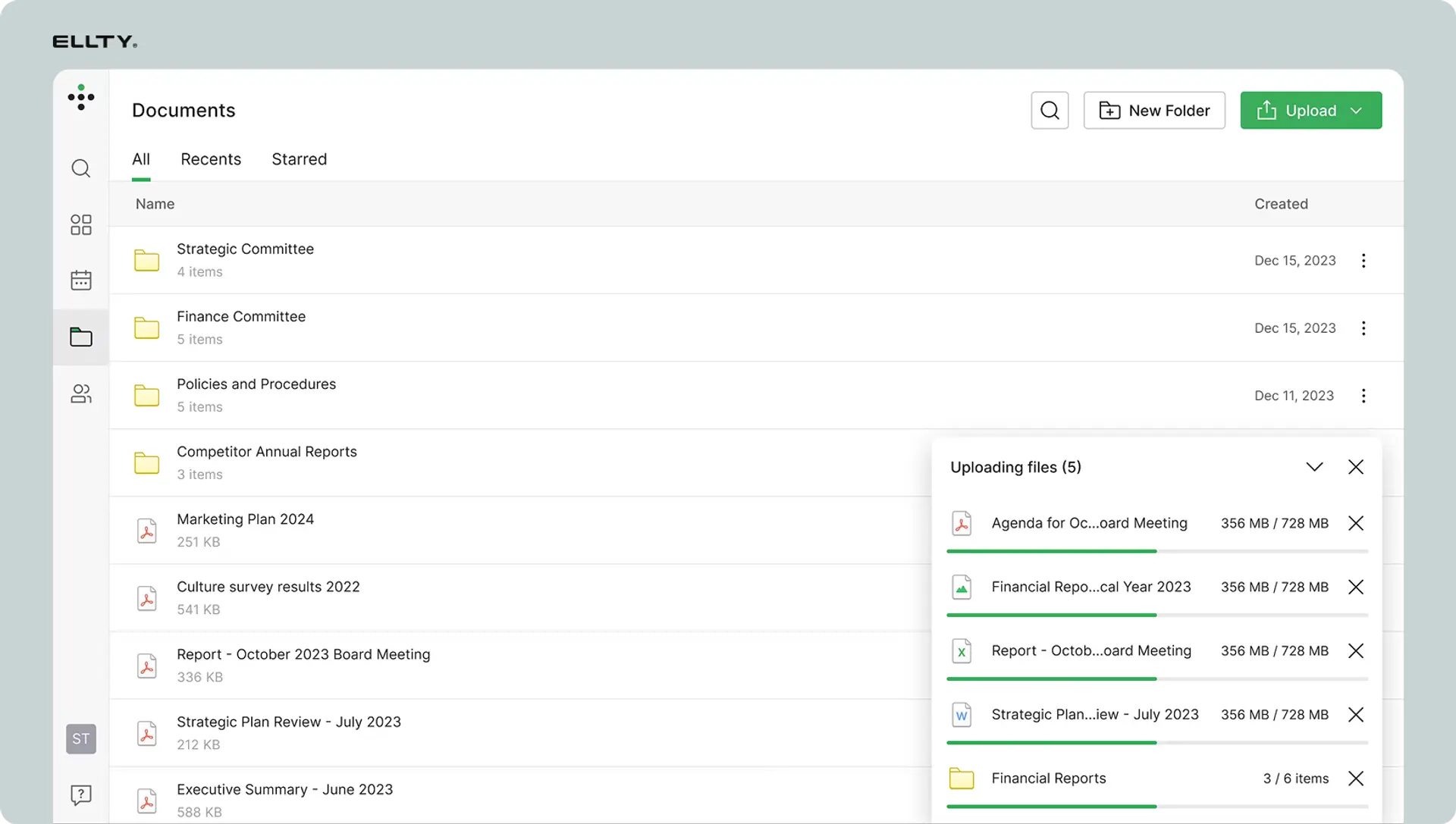
iDeals has been in the VDR market since 2008 and has built a strong reputation for enterprise-grade due diligence. It's used by investment bankers, M&A advisors, real estate professionals, and public institutions. If you're on the sell-side of an acquisition and the buyer's legal team is running a formal due diligence process, iDeals is a name they'll recognize and trust.
The platform's strengths are in the depth of its access controls, audit capabilities, and customer support. You can set granular permissions at the folder and document level, track every action across all users, and get 24/7 multilingual support - useful when you're closing a cross-border deal across time zones.
What iDeals does well:
- Granular user permissions and access controls
- Comprehensive audit logs for compliance
- Auto-indexing and smart search across documents
- Dynamic watermarking and fence view (restricts screen capture)
- ISO 27001, SOC 2, GDPR, and HIPAA compliant
- 24/7 multilingual support
- Fast setup (under 15 minutes per their documentation)
Limitations:
Pricing isn't public - you'll need to contact sales. Multiple reviews note the pricing can be significant for smaller firms, and some users have flagged unexpected price increases. For early-stage startups raising a seed round, iDeals may be more platform than you need - and more cost than you want.
One specific usability complaint that comes up in reviews: you can't click directly from the audit log to the document that was viewed, which slows down activity tracking.
Pricing: Not publicly listed. Estimates from third-party sources suggest anywhere from $200/month to $1,000+/month depending on storage, users, and project scope. Contact sales for a quote.
Best for: Startups in late-stage acquisition processes, Series C+ fundraises with institutional investors requiring formal due diligence, or any scenario where the counterparty expects enterprise-grade document management and audit trails.
5. SecureDocs - best for fast setup with flat-rate pricing

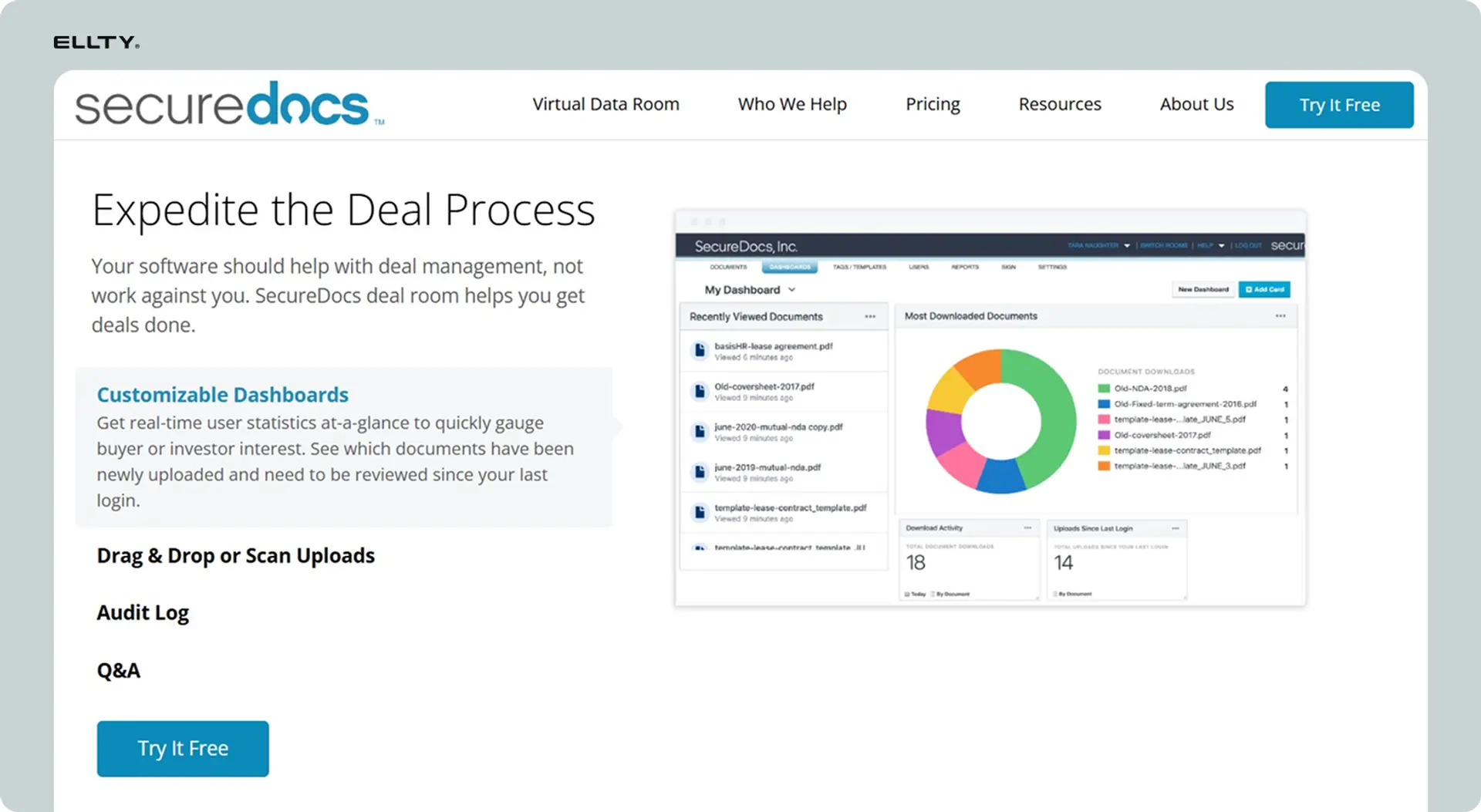
SecureDocs is built for speed and simplicity. The promise: get a data room live in under 10 minutes. No training required, no IT involvement, just drag-and-drop your documents and invite users.
The pricing model is straightforward: flat-rate, with no per-user fees and no per-page charges. You pay one price and get unlimited users on your plan. That makes cost predictable, which matters a lot when you're managing a deal timeline and don't want billing surprises.
SecureDocs is used by companies like Immunomic Therapeutics and StabiLux Biosciences. It's popular for SMBs and startups that want real VDR functionality without the complexity of enterprise platforms.
What SecureDocs does well:
- Genuinely fast setup - live in under 10 minutes
- Flat-rate pricing, unlimited users
- Multi-factor authentication
- Watermarking and role-based permissions
- Audit logs for full visibility
- Built-in eSignature for NDAs and deal documents
- 14-day free trial
Limitations:
SecureDocs sits in the middle ground - more full-featured than pitch-sharing tools, but less deep than iDeals or Digify on document controls like post-download revocation. It's best for straightforward due diligence scenarios, not highly complex M&A with multiple bidder groups. It's also at a higher price point than Ellty or Digify.
Pricing:
- Annual plan: ~$250/month
- Short-term (3-month project): ~$400/month
- 14-day free trial available
Best for: Startups and SMBs that need a full-featured data room fast, want predictable costs, and are running a single deal with a small-to-mid-size document set.
6. Papermark - best for privacy-focused teams who want control


Papermark is an open-source alternative to DocSend and traditional VDRs. You can self-host it on your own infrastructure, which means your documents never touch a third-party server. For founders handling highly sensitive IP, this matters.
It's not the most polished experience out of the box, and it requires technical setup if you're going the self-hosted route. But a cloud-hosted version is also available with a free tier, making it accessible even to non-technical teams.
What Papermark does well:
- Open-source and self-hostable - full data sovereignty
- Analytics on document views, page-level engagement
- Access controls and link management
- Free cloud version available
- Growing community and active development
- No vendor lock-in
Limitations:
Papermark is younger than other tools on this list, so the feature set is still maturing. If you need ISO 27001 certification, a formal audit log for legal purposes, or enterprise-level support, Papermark won't cover those bases today. Self-hosting also requires technical knowledge and infrastructure costs.
Pricing:
- Cloud version: Free tier available
- Self-hosted: Open-source (infrastructure costs only)
- Paid cloud plans available for teams needing more features
Best for: Technical founders, privacy-conscious teams, or startups in regulated industries who want full control over their data and don't mind a more hands-on setup process.
Which data room should you pick?
Here's the short version:
Pre-seed / active fundraising - Use Ellty Standard Plan. You get pitch deck analytics, trackable links, and a basic data room without paying per-user fees. The free plan covers most early needs, and $69/month gets you everything else.
Serious fundraising with security requirements - Ellty Data Room Plan or Digify. At $149/month, you get granular permissions, NDA gating, dynamic watermarking, restricted visitor access, 3 users included.
Pitch deck sharing for small team - DocSend works if you're solo or a two-person team. The per-user pricing becomes a problem at scale.
Full M&A due diligence - iDeals or SecureDocs. iDeals for complex deals with enterprise buyers. SecureDocs for faster-moving deals where you want a clean flat-rate.
Privacy-first, technical team - Papermark, self-hosted.
What should be in your startup data room?
If you're setting up a data room for investors, here's what they typically expect to see:
Company overview
- Pitch deck (latest version)
- Executive summary or one-pager
- Company overview memo
Financials
- Historical P&L (if available)
- Financial projections (3-5 year model)
- Cap table
- Current burn rate and runway
Legal
- Certificate of incorporation
- Shareholder agreements
- IP assignments
- Key contracts (customer, vendor, partnership)
- Employment agreements for founders
Product
- Product roadmap
- Technical architecture overview (for tech-heavy rounds)
- Demo video or product walkthroughs
Traction
- KPI dashboard or metrics summary
- Customer logos and case studies (if available)
- Letters of intent or LOIs
Don't dump everything in at once. Start with the essentials, share the room, and add documents as investors request them. It keeps the room clean and your due diligence process manageable.
FAQ
What is a virtual data room for startups?
A virtual data room (VDR) is a secure online platform where startups store and share confidential documents - typically during fundraising, due diligence, or M&A. It gives you access controls, activity tracking, and audit logs that standard file-sharing tools don't offer.
Do I need a data room for a seed round?
Not always. Many seed rounds happen through simple document sharing. But a data room signals professionalism and gives you visibility into investor engagement. Tools like Ellty let you do this at $69/month, so there's little reason not to use one once you're sending documents to multiple investors.
What's the cheapest virtual data room option?
Ellty offers a free starter plan with trackable links and analytics. Papermark also has a free cloud tier. For more security-focused tools, Digify starts around $140/month, which is low compared to enterprise VDRs that can run $500-$3,000+/month.
How is a data room different from Google Drive or Dropbox?
Google Drive and Dropbox are general file storage tools. They don't give you granular access controls, per-user tracking, view analytics, watermarking, or the ability to revoke access after a file is downloaded. For casual sharing, they work. For investor due diligence, they're not the right tool.
Can investors access a data room without creating an account?
It depends on the platform. Digify and Ellty allow browser-based access without requiring investor logins in some configurations. DocSend requires a link but not necessarily an account. iDeals typically requires user accounts for tracking purposes. Check the specific platform before sharing.
What security features should a startup data room have?
At minimum: encrypted file storage, access controls (view only, download, print), link expiration, and activity tracking. For M&A and formal due diligence, you'll also want dynamic watermarking, multi-factor authentication, and a full audit log. Certifications like ISO 27001 and SOC 2 matter when enterprise buyers are involved.
Is there a free data room for startups?
Yes. Ellty has a free starter plan. Papermark offers a free cloud tier and is open-source for self-hosting. Most paid platforms (Digify, SecureDocs) offer free trials ranging from 7 to 14 days.
How long does it take to set up a data room?
Simple rooms on platforms like Ellty or SecureDocs can be live in under 15 minutes. More complex rooms with folder structures, permission groups, and branded access portals take longer - typically a few hours to a day. The key is knowing your document structure before you start uploading.
What's the difference between a pitch deck sharing tool and a data room?
Pitch deck sharing tools (like Ellty core feature set) are optimized for sending a single document or small set of documents to investors and tracking engagement. Data rooms are organized repositories for dozens or hundreds of documents, structured for due diligence with folder hierarchies, multiple user groups, and formal audit trails. Many tools, including Ellty, offer both.
When should I upgrade from a free or basic plan?
When you're sharing sensitive legal or financial documents with multiple external parties who have different access levels, it's time to pay for a plan with proper access controls. Also consider upgrading if you're in active M&A talks where the counterparty has lawyers involved - enterprise buyers expect real VDR infrastructure, not a shared folder.
Bottom line
Most startups don't need a $500/month enterprise VDR. What they need is a tool that keeps documents organized and secure, tracks who's looking at what, and doesn't charge per-user fees as the investor list grows.
For the majority of fundraising founders, Ellty handles the whole job at a fraction of what traditional data rooms cost. For founders heading into serious due diligence, Ellty, Digify or SecureDocs cover the security and compliance requirements without the enterprise price tag.
Use the right tool for the stage you're at. Don't pay for features you won't use.
Ready to set up your first data room?

Ellty Standard Plan at $69/month includes trackable links, view analytics, and data room features.
Author

Anika Tabassum Nionta is a Content Manager at Ellty, where she writes about secure document sharing, virtual data rooms, M&A, due diligence, fundraising, and sales enablement. With over 6 years of writing experience, she helps professionals understand how to share confidential documents securely, track engagement, and manage deals more effectively. Anika holds both a BA and MA in English from Dhaka University. Outside of work, she enjoys reading, exploring new cafes in Dhaka, and connecting with entrepreneurs and dealmakers in her community.

