


Most SaaS companies are trying to serve everyone. That's a problem.
Generic software - your CRMs, your project management tools, your billing platforms - they solve surface-level problems. They don't speak the language of a cattle rancher, a physical therapist, or a commercial contractor. They don't know the workflows. They don't know the compliance requirements. They don't care.
That gap is exactly where vertical SaaS lives.
This guide breaks down what vertical SaaS actually is, why the market is exploding, which sectors are seeing real traction, and how founders operating in this space can raise capital and grow. If you're building sector-specific software, or thinking about it, this is the foundation you need.
What is vertical SaaS?
Vertical SaaS is software built for a specific industry or niche, not for everyone. Instead of adapting a general-purpose tool to fit a use case, vertical SaaS starts with the use case and builds outward.
The term comes from the idea of market segmentation. Horizontal SaaS (think Salesforce, HubSpot, Slack) sells broadly across every vertical - every industry. Vertical SaaS sells deep into one.
Think of it this way: horizontal SaaS builds a hammer. Vertical SaaS builds the exact tool a roofer needs to install a specific type of shingle - faster, with fewer mistakes, and with built-in compliance checks.
A vertical SaaS product for veterinary clinics won't try to serve law firms too. It'll handle appointment scheduling with animal-specific health record formats, drug dosage calculators, SOAP notes, vaccination tracking - features that only matter in that world.
That specificity is the product.
Horizontal vs. vertical SaaS - a quick comparison


The vertical SaaS market - size, growth, and what the numbers say
The vertical SaaS market isn't a niche anymore. It's a significant segment of enterprise software, and the numbers back that up.

According to Bessemer Venture Partners, vertical SaaS companies consistently achieve higher Net Revenue Retention than their horizontal counterparts - often exceeding 120%. That metric alone tells a compelling story: customers don't leave, and they spend more over time.
Why? Because switching costs in a vertical SaaS product are brutal. When your entire clinic runs on one platform - scheduling, billing, records, compliance - you don't casually switch to a competitor.
Key vertical SaaS market drivers
- Industry digitization - many sectors (construction, agriculture, healthcare) are only now moving from paper-based or legacy systems to software
- Regulatory complexity - sector-specific compliance creates moats that horizontal tools can't easily cross
- Workforce specialization - software that understands industry terminology reduces training time and improves adoption
- Post-pandemic digital urgency - sectors like telehealth, legal tech, and food service saw forced digitization that accelerated vertical SaaS adoption
- AI and automation - vertical SaaS companies can build AI models trained on highly specific domain data, giving them a meaningful edge over generic tools
Vertical SaaS market size by segment


Note: Specific market size figures vary by research source. We recommend sourcing current data from Gartner, IDC, or CB Insights for your investor presentations.
Vertical SaaS examples - real companies winning in their sectors
The best way to understand what vertical SaaS looks like in practice is to look at companies already doing it well. These aren't abstract case studies - they're businesses with real revenue, real customers, and clear proof that going deep beats going wide.
Procore (construction)
Procore is one of the most cited vertical SaaS examples in the construction industry. It replaced spreadsheets, disconnected email chains, and paper submittals with a single platform covering project management, financials, and field coordination. Construction teams don't need convincing that they have a software problem - they live it every day. Procore gave them language-native solutions.
Revenue: $1B+ annually. IPO'd in 2021. The vertical SaaS example for B2B enterprise.
Veeva Systems (life sciences)
Veeva built its entire platform on the specific regulatory and data requirements of pharmaceutical and biotech companies. CRM, content management, clinical data - all built to FDA and EMA compliance standards that a generic Salesforce instance would require years of customization to approximate. Veeva is now a $30B+ company.
Toast (restaurant & hospitality)
Toast took POS software and rebuilt it from the ground up for restaurants. It handles table management, kitchen display systems, online ordering, payroll, and supplier integrations - all in one platform. A generic POS doesn't care about 86'ing menu items or splitting checks by seat. Toast does.
ServiceTitan (home services)
ServiceTitan serves HVAC, plumbing, electrical, and other field service businesses. It handles dispatching, job tracking, invoicing, and customer history in a way that a general CRM never could. The company was valued at $9.5B+ at its IPO in late 2024.
Mindbody (wellness & fitness)
Mindbody targets gyms, yoga studios, spas, and salons. Scheduling, membership management, staff management, marketing tools - all built for the specific needs of wellness businesses. It's a textbook vertical SaaS example of owning a niche completely.
Compass (real estate)
Compass built a tech-forward real estate brokerage platform that integrates transaction management, marketing, and CRM in one place for agents. It's not a generic CRM with real estate fields bolted on - it's built around how a real estate deal actually flows.
Pattern89 / AgriWebb (agriculture)
AgriWebb, used widely in livestock farming, is a clean example of a sector that had virtually no software penetration and saw rapid adoption once purpose-built tools arrived. Farmers aren't a small market - they just needed software that understood their world.
What all of these vertical SaaS examples share: they replaced workarounds, not other software. Their customers were using Excel, paper, or nothing. That's the real opportunity in vertical SaaS - first mover advantage in a sector where the baseline is chaos.
Top companies in vertical SaaS
This isn't a comprehensive list. It's a reference point - the companies that prove the model works, and the ones currently defining the next phase of vertical SaaS growth.


A note on the emerging vertical AI layer
The companies at the bottom of this list represent a new generation - not vertical SaaS built on traditional software stacks, but AI-first companies that entered a vertical with a model trained on domain-specific data. Harvey and Legora in legal, Abridge in clinical documentation, OpenEvidence in medical search have all quietly crossed billion-dollar valuations not by being smarter models, but by going deeper into a niche than any horizontal tool ever could.
Why vertical SaaS companies grow faster (once they find fit)
Vertical SaaS growth looks different from horizontal SaaS growth. You won't hit 100k users in six months. But you will build something stickier, charge more per customer, and face less churn.
The land and expand model
Most vertical SaaS companies start by solving one core workflow for a specific role in the industry. Then they expand. Procore started with project management and added financials, workforce management, and a marketplace. Toast started with POS and added payroll. Veeva started with CRM and built a full platform.
This expansion is possible because once you're embedded in someone's operations, they trust you to solve adjacent problems. That trust is earned through industry-native design.
Why NRR is higher in vertical SaaS
Net Revenue Retention (NRR) measures revenue from existing customers over time. In horizontal SaaS, companies compete hard to prevent churn. In vertical SaaS, customers stay because switching is painful and the software is tied directly to daily operations. NRR above 120% means customers are spending more year over year. That's the growth engine.
The conference and community effect
This one's underrated. Every vertical has its trade conferences. HIMSS for healthcare IT. Promat for manufacturing and logistics. The National Restaurant Association Show for foodservice. Exhibiting at a vertical SaaS conference gives you concentrated access to your exact buyer in one room.
If you're building in a vertical, find the 2-3 conferences that matter and show up. The CAC (customer acquisition cost) relative to deal quality is often far better than digital ads.

Vertical SaaS funding - how to raise and what investors expect
Raising for a vertical SaaS company is different from raising for a horizontal one. Investors need to understand a market they've probably never operated in. Your pitch has to do more educational work.
Here's what that means in practice.
What investors want to see
- Total Addressable Market (TAM) - specific, credible, bottom-up. Don't say '$50B healthcare market.' Say how many dental clinics in the US, average revenue per customer, and what share is realistically addressable in 5 years.
- Deep domain expertise - do you or your co-founders have industry experience? Investors back operators in vertical SaaS, not generalists who studied the space for 6 months.
- Early traction with the right logos - 10 customers who are happy, paying, and expanding matters more than 100 pilot users.
- Proof of workflow integration - show that your product is part of daily operations, not a nice-to-have tool they log into once a week.
- Regulatory and compliance moat - if your product handles compliance requirements, explain why that creates a switching cost barrier.
- Path to platform - investors want to see that you can expand beyond the initial wedge. What does the full suite look like in 3-5 years?
How vertical SaaS valuations work
Vertical SaaS companies are generally valued on ARR multiples, similar to horizontal SaaS, but with some adjustments for market size constraints. A company serving 50,000 potential customers will face a ceiling that a company serving 5 million won't.
Investors compensate for that ceiling by looking hard at NRR, gross margins, and expansion revenue. If your NRR is 130%+ and gross margins are above 70%, you'll get strong multiples even in a narrow market.


Preparing your pitch materials
Your pitch deck for a vertical SaaS company needs to explain the industry before it explains the product. Investors who don't understand construction project management can't evaluate Procore. Investors who don't understand how veterinary practice billing works can't evaluate your vet clinic software.
Structure it roughly like this:
- Slide 1-2: The industry problem - in their language, with their numbers
- Slide 3-4: Why existing tools fail (horizontal SaaS limitations, legacy software gaps)
- Slide 5-6: Your solution and how it fits into their daily workflow
- Slide 7-8: Traction - ARR, NRR, logo count, usage data
- Slide 9-10: Market size - TAM/SAM/SOM built from the bottom up
- Slide 11-12: Business model, pricing, unit economics
- Slide 13-14: Team - why you're the right people for this specific vertical
- Slide 15: Ask and use of funds

Managing the fundraise process
Once you're sending decks to investors, you need to know who's reading them, which pages they're spending time on, and who's actually engaged vs. who's ghosting you.
This is where tools built for founders matter. Ellty is a virtual data room, and secure file sharing and analytics platform that lets you upload your deck, generate a trackable link, and see exactly who opened it, which slides they spent the most time on, and when they dropped off.

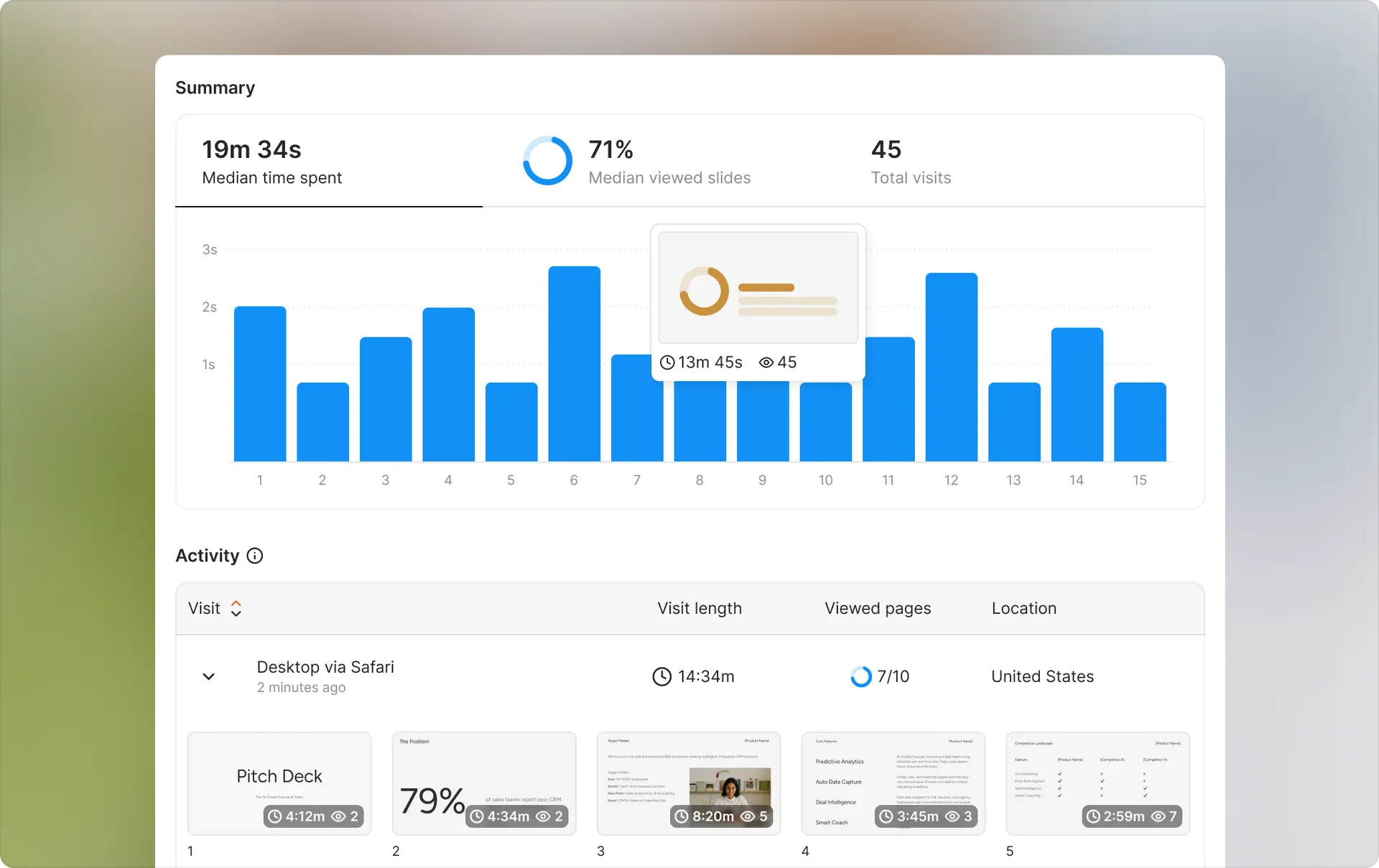
No per-user fees. Free to start at $0 on the starter plan, with the Pro plan at $24/month and Business at $50/month.


For a vertical SaaS founder sending decks to 30-50 investors, knowing that one partner viewed your market slide 4 times but didn't read past slide 8 tells you something. You can follow up with context, not guesses.
Ellty also provides secure data rooms for due diligence - you can share your financials, customer contracts, and legal documents in a controlled environment where you see who accessed what. For early-stage founders who don't need enterprise-grade data room pricing, it's a practical tool.
Vertical SaaS go-to-market - how to reach your exact buyer
Selling into a vertical requires a different GTM than horizontal SaaS. There's no 'grow by SEO and self-serve' playbook here. Your buyers are busy professionals who trust peer referrals and industry-specific channels.
Strategies that work
- Channel partnerships - partner with the associations, consultants, or distributors that already have trust in the industry. An HVAC software company that partners with HVAC equipment distributors gets warm introductions at scale.
- Trade conferences and vertical SaaS conferences - as mentioned above, the ROI is often better than digital. Build presence. Sponsor. Speak.
- Vertical-specific content - write the blog posts that answer real questions your buyers are searching for. Not generic SaaS content. 'How to reduce rework in commercial construction' outperforms 'project management best practices' every time.
- Customer referral programs - in tight-knit industries, word travels fast. One happy customer in a regional network can bring you 10 more if you make referrals easy and incentivized.
- Direct outbound - find the associations, LinkedIn groups, and forums where your buyers are active. Personalized outreach that proves you understand their world converts better than templated sequences.
Pricing in vertical SaaS
Don't undercharge. The irony of vertical SaaS is that founders who come from the industry often underprice because they know what the current workarounds cost. But your software is replacing $40k/year in wasted staff time. You can charge $500/month and it's still a bargain.
Common pricing models in vertical SaaS:
- Per seat - common, predictable, scales with the customer's team
- Per transaction or usage - aligns your revenue with customer success
- Flat platform fee - simpler, easier to budget, preferred by some buyers
- Tiered by feature set or business size - allows you to serve solo operators and multi-location enterprises
Building a moat in vertical SaaS - what makes you defensible
The biggest risk in vertical SaaS isn't competition from other startups. It's the risk that a large horizontal player (Salesforce, Microsoft, SAP) eventually builds or buys their way into your vertical.
Your moat needs to be real.
Data moats
Vertical SaaS companies accumulate industry-specific data that becomes increasingly valuable over time. Insurance underwriting data. Clinical outcome data. Construction cost benchmarking data. If you own proprietary data that makes your product smarter, competitors can't buy their way to your position quickly.
Workflow integration depth
The deeper you embed into daily operations - the more workflows depend on your system - the more painful you make it to leave. Integrations with third-party tools, custom workflows, historical data stored in your system: all of this raises switching costs.
Compliance and certification
If your product is HIPAA-compliant, SOC 2 certified, or meets industry-specific regulatory standards, that's a meaningful barrier. Getting certified takes time and money that most horizontal tools won't invest for a single vertical.
Community and network effects
Some vertical SaaS companies build features that create network effects between their customers. A marketplace connecting contractors with suppliers. A benchmarking tool that improves as more customers use it. A referral network built into the platform. These compound over time.
Managing your vertical SaaS investor relationships with better tools
Fundraising for a vertical SaaS company is a process, not an event. You'll pitch dozens of investors, run multiple concurrent conversations, share sensitive documents, and need to track where each relationship stands.
Most founders do this with email threads and a spreadsheet. That works until it doesn't.
What you actually need
- A way to share your pitch deck without it being forwarded untracked
- Analytics on investor engagement - who's reading, what's resonating
- A secure place to share due diligence documents
- A simple CRM to track investor status without enterprise software overhead
Ellty handles the first three. You upload your docs, share a trackable link, and get real-time notifications when an investor opens it. You see which slides they spent time on. For due diligence, you can set up a secure data room and control exactly who has access to which documents.
It's not a full investor CRM - for that you'd use something like Affinity or Notion. But for pitch deck sharing and document security in the fundraising process, Ellty offers those features without the per-user pricing that enterprise data rooms charge.
Free forever for core tracking and analytics; Standard from $69/month with unlimited documents, eSignatures, and data rooms; Data Room from $149/month with granular permissions, NDA gating, and dynamic watermarking.
Ellty works well when you're managing 20-50 concurrent investor conversations, sharing a deck weekly, and want to know who's actually engaged before you spend time following up.
Set up your pitch deck tracking in minutes - try Ellty free, no credit card needed
Vertical SaaS conferences worth knowing about
If you're building in a vertical, industry conferences are your best sales and fundraising tool. A few worth tracking:


Attending a vertical SaaS conference as a sponsor or speaker gets you access to buyers and press. Attending as a ticket-holder gets you conversations. Both are worth the cost if you're in the right vertical.
Common mistakes founders make in vertical SaaS
Going too broad too soon
You built software for dental clinics. Now a vet clinic wants to use it. Tempting, but dangerous. Every vertical exception you make fragments your roadmap, your support burden, and your brand positioning. Stay in your lane until you've dominated it.
Underestimating the sales cycle
Selling to small businesses in a vertical (single-location restaurants, solo law firms) is fast. Selling to mid-market or enterprise accounts in that same vertical can take 6-18 months. Know which segment you're targeting before you set revenue projections.
Ignoring the integration ecosystem
Every industry has legacy systems that aren't going away. Lab equipment that exports to specific formats. Accounting tools that are mandated by franchise agreements. Electronic health record systems that dominate 70% of a market. If you don't integrate with the systems your buyers already use, you'll face adoption friction no product quality can fix.
Confusing feature depth with customer value
More features don't always mean more value. In vertical SaaS, customers want software that solves their workflow reliably, not software that impresses them with every possible capability. Focus on the core 20% of features that drive 80% of adoption.
Hiring generalists for industry-specific sales
Your first few salespeople need to speak your industry's language. A great enterprise SaaS rep with no construction experience will struggle to sell Procore-like software to a general contractor. The domain credibility matters.
Where vertical SaaS is heading - trends to watch
AI as a vertical accelerant
Generative AI is making vertical SaaS more powerful because the training data can be industry-specific. A legal AI trained on case law outperforms a generic AI for legal research. A clinical AI trained on medical literature outperforms a generic chatbot for symptom triage. Founders who move fast on vertical AI features will extend their moats significantly.
Vertical SaaS meets embedded finance
The biggest vertical SaaS companies are adding financial services - payments, lending, insurance - directly into their platforms. Toast Capital lends to restaurant owners. ServiceTitan processes payments. Procore manages construction finance. This embedded finance layer is a second revenue stream and a deeper integration into operations.
Consolidation through M&A
As vertical SaaS matures, expect more acquisitions. Larger horizontal platforms (Salesforce, SAP, Oracle) will acquire vertical SaaS companies to add industry-specific depth. This is both an exit opportunity and a competitive threat. Founders need to build enough of a moat that acquisition is their choice, not a forced outcome.
International expansion of proven verticals
Many of the vertical SaaS examples above are US-first companies with massive international expansion opportunities. Construction, healthcare, legal, and agriculture are global problems. Founders who prove the model in one market have a clear path to geographic expansion.
Frequently asked questions about vertical SaaS
What's the difference between vertical SaaS and industry-specific software?
They're essentially the same thing, though 'vertical SaaS' implies a cloud-native, subscription-based delivery model. Traditional industry-specific software (often called legacy or on-premise software) predates the SaaS model. Vertical SaaS replaces both legacy on-premise tools and generic horizontal SaaS with purpose-built cloud software.
Is vertical SaaS harder to scale than horizontal SaaS?
In terms of market size, yes - you're working within a defined industry rather than selling to everyone. But in terms of growth efficiency, vertical SaaS often scales better because NRR is higher, customer acquisition costs are lower (word of mouth in tight-knit industries), and expansion revenue from upsells is more predictable.
What makes a vertical SaaS company defensible?
The best moats in vertical SaaS come from: deep workflow integration (painful to switch), proprietary industry data that improves the product, compliance certifications that take time to replicate, and a customer base that generates network effects through the platform.
What kind of investors fund vertical SaaS?
Seed-stage: generalist VCs who back strong founders in large markets, plus a growing number of sector-focused funds (healthcare VC, proptech VC, agtech VC). Series A and beyond: you'll see more specialist investors. Bessemer Venture Partners, a16z, Insight Partners, and Battery Ventures are well-known backers of vertical SaaS companies.
How do I find investors who understand my vertical?
Start with firm websites and portfolio pages. If a VC has backed 3 healthcare SaaS companies, they understand the market and will likely be faster to conviction on your pitch. AngelList, Crunchbase, and PitchBook can help you filter investors by sector focus.
Do I need industry experience to build vertical SaaS?
You don't technically need it, but founder-market fit matters enormously in vertical SaaS. Investors want to know why you're the right person to build for this specific industry. Direct experience, a co-founder with experience, or an advisory board of practitioners are all credible answers to that question.
How should I price a vertical SaaS product?
Start with value-based pricing - what is the problem you're solving worth to the customer in time saved, revenue generated, or risk reduced? Then benchmark against what customers currently pay for alternative solutions (even manual labor or legacy software). Most vertical SaaS founders underprice by 30-50% early on. Test higher pricing with your first 10-20 customers before you commit to a model.
What's a realistic timeline from launch to Series A in vertical SaaS?
Typically 18-36 months, longer than in horizontal SaaS with a pure self-serve model. The sales cycles are longer. But when you hit $1-2M ARR with strong NRR in a vertical market, you'll often find Series A interest faster than a horizontal SaaS company at the same ARR because the retention metrics tell a clearer story.
How important are trade conferences for vertical SaaS companies?
Very. Conferences compress the sales cycle. You get 3 days of concentrated access to your exact buyer, often at a fraction of the CAC of digital channels. Showing up consistently (sponsoring, speaking, running demos) builds brand recognition in industries where trust and familiarity drive decisions.
Can I use Ellty for vertical SaaS investor relations?
Yes, for the pitch process specifically. Ellty lets you upload your documents, share trackable links with investors, and see engagement analytics - which slides they viewed, how long they spent, when they dropped off. For due diligence, the data room feature lets you share sensitive documents securely with controlled access. It's built for founders who need these features without enterprise pricing. Free to start, $24/month for Pro.
Putting it all together
Vertical SaaS is one of the best business models available to founders right now. You're building for people who need you, charging prices that reflect real value, and creating switching costs that protect your revenue base.
But it's not easy. You need deep industry knowledge. A patient go-to-market motion. Investors who understand the market. And the operational discipline to stay focused on your vertical when horizontal opportunities tempt you away from it.
The companies getting this right - Procore, Veeva, Toast, ServiceTitan - aren't just SaaS companies. They're industry infrastructure. That's the play.
Start with one workflow, in one niche, for one clearly defined customer. Build that with obsession. Then expand from a position of dominance.

Managing your fundraise? Ellty tracks who reads your pitch deck, page by page.
About Ellty


Ellty is a secure sharing and analytics platform with virtual data room features. Upload your deck, share a trackable link, and see exactly who viewed it, which pages they spent time on, and when they were active - in real time. For due diligence, you can create secure data rooms with controlled document access.
Ellty is built for businesses who need professional tools without enterprise overhead. Pricing starts at $0 for the starter plan. Standard is $69/month. Data Room is $149/month.
Ellty works best for teams managing active fundraises, sharing pitch decks regularly, and wanting engagement data without complex setup.
Best practices for vertical SaaS success
Building a vertical SaaS startup isn't just about picking the right niche. Plenty of founders pick the right vertical and still fail. What separates the ones that scale from the ones that stall is execution discipline - specifically in a handful of areas that are uniquely unforgiving in vertical markets.
Start with one workflow, not the whole industry
The instinct to build a complete platform from day one kills more vertical SaaS companies than competition does. You can't out-resource a well-funded horizontal player by trying to do everything at once. Pick the one workflow that causes the most daily pain for your target customer and solve it completely. Procore started with project management. Toast started with POS. ServiceTitan started with job scheduling. None of them tried to do everything in year one.
A useful test: can you explain your core value prop in one sentence using your customer's exact language? "We help commercial roofing contractors track job costs in real time" is a core workflow. "We're a comprehensive platform for the roofing industry" is not.
Own the onboarding process
Onboarding in vertical SaaS is not a product problem - it's a trust problem. Your customer is a dentist, a contractor, or a livestock farmer. They're not a software person. They didn't choose your product because they love tech. They chose it because they hate the problem you solve.
The standard SaaS assumption - that users will figure it out through self-serve onboarding - doesn't hold in most verticals. You need white-glove onboarding, especially for your first 50 customers. Be in the room. Be on the call. Migrate their data. Train their team. The retention signal you build in months 1-3 will define your NRR story for years.
Build for the person who touches the product every day, not the buyer
In vertical SaaS, the person who signs the check and the person who uses the product are often different. A hospital administrator buys the EHR. Nurses and physicians use it. A general contractor signs the Procore contract. Project managers and foremen live in it.
If your product is painful for the daily user, they'll find workarounds. Enough workarounds and the software gets abandoned regardless of what the buyer thinks. Design for the daily user first. Win their loyalty. They'll make the renewal decision for you.
Treat compliance as product, not an afterthought
In regulated verticals - healthcare, legal, financial services, construction, agriculture - compliance requirements are table stakes, not differentiators. But how you implement them is. Compliance built deeply into the product (rather than bolted on as a checkbox) reduces friction for the user, lowers your customer's risk, and raises your switching cost.
If HIPAA, SOC 2, or any sector-specific regulation is relevant to your vertical, invest in those certifications early. They're expensive and slow. They're also barriers that protect you from faster-moving competitors who cut corners.
Instrument everything from month one
The best vertical SaaS companies know which features drive retention, which workflows are underused, and which customer segments expand vs. churn - before they hit $1M ARR. This isn't about having a fancy analytics stack. It's about defining your key metrics early and tracking them consistently.
At minimum: time to activation (first meaningful workflow completed), daily active usage by feature, NRR cohorted by customer size and segment, and support ticket volume by workflow area. These tell you whether your product is actually being used, or just being paid for.
Role of AI and embedded fintech in vertical SaaS
Two forces are currently rewriting the economics of vertical SaaS. Neither is optional to understand if you're building in this space right now.
AI is extending what vertical SaaS can do - and by how much
The old version of vertical SaaS automated workflows. You could book appointments, track inventory, generate invoices, and manage compliance documents - faster than before, with fewer humans in the loop. That was valuable. It's now table stakes.
The new version uses AI to automate judgment, not just tasks. And this is where vertical SaaS has a structural advantage over horizontal AI tools.
A generic AI like GPT-4 knows a lot about a lot. A vertical AI trained on 10 years of legal case data, clinical records, or construction cost benchmarks knows something that general-purpose models can't replicate: the specific patterns, terminology, exceptions, and risk signals that matter in one domain.
According to Bessemer Venture Partners, LLM-native vertical companies are growing at approximately 400% year-over-year while maintaining healthy 65% gross margins. That's not a SaaS metric - that's a new category of performance.
Real examples of vertical AI already deployed at scale:
Harvey AI (legal) - Harvey AI, built on OpenAI's GPT architecture but fine-tuned for legal workflows, has been deployed at prestigious firms like Allen & Overy and PwC. Early adopters report lawyers saving 20-30 hours per week on document review and research tasks. That's not a marginal improvement. That's a structural shift in how legal work gets done.
Abridge (clinical documentation) - Abridge records physician-patient conversations and generates clinical notes automatically. The documentation burden on doctors is one of the biggest drivers of burnout in healthcare. Abridge attacks it directly with AI trained exclusively on clinical language.
Tempus (oncology) - Tempus processes clinical and molecular data across cancer, cardiology, depression, and infectious diseases. The company went public in June 2024 with AI systems trained exclusively on medical data.
The pattern is consistent across sectors: vertical AI wins not by being a smarter general model, but by being the only model with the right training data for the domain. In the AI era, defensibility is likely to emerge from specialization and orchestration of AI agents, lending itself to verticalized solutions.
For founders building in vertical SaaS right now, the AI question isn't "should we add AI?" It's "which workflows in our vertical have enough domain-specific data to train something that outperforms ChatGPT?" Start there.
Embedded fintech is turning vertical SaaS into the financial infrastructure of entire industries
The embedded finance layer in vertical SaaS is no longer a feature - for some companies, it's the primary business. This started with payments and has expanded to lending, insurance, and even banking products.
Toast now earns 76%+ of revenue from fintech. Shopify? Over 80%. These aren't SaaS companies that added payments. They're fintech companies that used SaaS as the distribution mechanism.
How it works in practice:
Payments - Some vertical SaaS companies such as Toast are opting to register as payment facilitators themselves, which cuts out the middleman and allows them to capture more revenue from payments. By owning the payment rails, they capture a percentage of every transaction that flows through their platform.
Lending - Toast uses its insights into customer cash flow to assess risk and timing for offering working capital loans. Its embedded lending product, Toast Capital, helps restaurants that operate on thin profit margins cover costs when cash is tight. Toast can deliver funds within one business day. No bank can underwrite a small restaurant with that speed or that data quality.
Multi-product fintech - During his time at ServiceTitan, one leadership team launched nine fintech-adjacent products, which collectively grew to represent roughly one-third of total revenue.
Why does this matter for you as a vertical SaaS founder?
Because your platform sees operational data that no bank has. Restaurant systems like Toast track cover counts, menu-level margins, and hourly volatility. Field services platforms like ServiceTitan follow technician productivity and job success ratios as they happen. That real-time operational visibility is better underwriting data than any bank statement.
The embedded finance opportunity is estimated to reach $3.6T by 2030. More than half of Mindbody's revenue is now derived from embedded financial products.
You don't need to start with a full fintech stack. Most vertical SaaS companies add payments first, then watch adoption as a leading indicator for what to build next. The pattern is consistent: get embedded, capture transactions, then layer in lending, insurance, and banking products as the data and trust compound.
Funding trends in vertical SaaS
The funding environment for vertical SaaS has shifted meaningfully over the past two years. Here's what you actually need to know - not the optimistic version, the accurate one.
The overall picture: more money, fewer deals, bigger checks
There was $125 billion invested in software venture capital globally in 2024, up 28.8% over 2023. That sounds bullish. But deal count was down. There were 8,188 venture deals in 2024, down 18% from 9,944 in 2023. However, the average venture deal size was meaningfully larger ($15.3M in 2024 vs. $9.7M in 2023).
Translation: investors are concentrating bets. Fewer companies are getting funded, but the ones that do are getting larger checks. If you're at the median, this environment is harder. If you're in a hot vertical with strong metrics, it may actually be better.
AI is pulling capital away from traditional vertical SaaS - and toward vertical AI
This is the tension every vertical SaaS founder needs to understand right now. SaaS funding rounds exceeding $100 million have collapsed from 147 deals in 2021 to just 21 in the 12-month period through mid-2025.
Why? Capital has rotated into AI. AI captured close to 50% of all global funding in 2025, up from 34% in 2024. That's not temporary reallocation - that's a structural shift in investor priorities.
But here's the nuance: the vertical SaaS companies attracting capital in this environment are the ones adding AI to their core workflow. Pure-play traditional vertical SaaS without an AI story is competing for a shrinking pool. Vertical SaaS with a defensible AI layer - proprietary data, domain-trained models, measurable workflow automation - is getting investor attention.
PE offers are actively looking in hot verticals: healthcare IT, fintech, and cybersecurity. But classic SaaS companies without AI deeply integrated are finding far less interest than in 2023.
Valuations: realistic expectations for 2025-2026
In 2024, median revenue multiples for venture-backed SaaS companies remained steady around 10x ARR. Public market multiples are lower - the median revenue multiple of a publicly traded SaaS company is 7.5x as of early 2025, down from a peak of 18.43x in September 2021.
For early-stage vertical SaaS, valuations at seed and Series A have actually recovered. The median primary valuation for seed rounds raised by SaaS startups rose to $19.8M in Q3 2025, up from $14.7M a year prior. At Series A, the median primary valuation reached $60M, versus $44.5M in Q3 2024.
The bar to get there is higher. Strong NRR (110%+), founder-market fit, and a clear AI or embedded fintech angle are now table stakes for a competitive Series A in vertical SaaS.
What this means for how you fundraise
The pitch materials, the data you share, and the investor relationships you manage now carry more weight than they did in 2021. Investors are slower, more analytical, and reviewing more competing deals in your sector.
Your deck needs to work harder. And once it's out there, you need to know who's actually reading it. Ellty lets you see which investors opened your pitch, which slides they spent time on, and when they dropped off - in real time. When you know a partner re-read your market slide three times, you don't need to guess what to lead with in your follow-up. For the due diligence stage, Ellty data room gives you controlled document sharing with access tracking, without the per-user pricing that enterprise data room tools charge. Free to start, $69/month for Standard.


Ready to run a tighter fundraise? Try Ellty free - track your docs, manage your data room, and follow up with context, not guesses.
Top investors in vertical SaaS
Not all SaaS investors are the same. Some write checks first and figure out the vertical later. Others have deep sector expertise and can accelerate your growth through portfolio introductions and regulatory navigating. Knowing which investors are actually active in your vertical - and what they look for - saves you months of misaligned outreach.


How to find the right investor for your specific vertical
Generic VC outreach is one of the least efficient uses of a founder's time. Here's a faster approach:
Look at the portfolio pages of each firm above. If they've backed 2+ companies in your sector, they understand the buying cycle, the regulatory environment, and the customer archetype. They'll move faster and ask better questions. If they've never invested in your vertical, you're spending your first 3 meetings educating them before they can even evaluate you.
Crunchbase and PitchBook let you filter investments by sector and stage. LinkedIn shows you which partners at each fund have domain expertise in your vertical. Those are the specific people to target, not just the general fund email.
Prominent VCs like Bessemer Venture Partners and Accel focus on vertical SaaS companies' ability to address unique market needs, prioritizing scalability and the capacity to dominate underserved sectors. Strategic investors like Salesforce Ventures bring more than capital - they contribute deep domain expertise that enables startups to refine their offerings and accelerate growth.
Key industries benefiting from vertical SaaS
Every industry with operational complexity, regulatory burden, and under digitized workflows is a candidate for vertical SaaS disruption. Some are further along than others. Here's where the real traction is, and where the next wave of opportunity sits.
Healthcare and life sciences - the highest-stakes vertical
Healthcare runs on compliance. Every patient record, every billing code, every prescription, every clinical trial - all of it sits inside a regulatory framework that generic software can't navigate without significant customization. Vertical SaaS in healthcare handles that natively.
The global AI in healthcare market was estimated at $26.57 billion in 2024 and is projected to reach $187.69 billion by 2030, growing at a CAGR of 38.62%. That growth is being driven by EHR modernization, clinical AI tools like Abridge, telehealth infrastructure, and revenue cycle automation.
Epic Systems commands ~28% of the US EHR market. Veeva owns over 50% of the pharma CRM market. The incumbents are dominant but not immune - the AI layer is now being built on top of and alongside these legacy systems, and that's where the next generation of healthcare vertical SaaS is emerging.
Who's winning: Epic, Veeva, AdvancedMD, Kareo (now Tebra), Abridge, Nabla, Hippocratic AI.
Legal - language is the product, and AI is rewriting it
The legal market accounts for more than $300B in the U.S. alone. Large law firms have indicated they would spend up to seven figures annually for transformative AI software.
Legal is a uniquely strong vertical for SaaS because the core work product is language-heavy, document-intensive, and highly regulated. Vertical SaaS handles case management, billing, document review, and client communications. Vertical AI - Harvey, Casetext (acquired by Thomson Reuters for $650M), EvenUp - is automating the document-heavy work that previously required junior associates.
The disruption here is happening fast. If you're building in legal tech, the window to establish a position before incumbents fully integrate AI is real but not indefinitely open.
Who's winning: Clio, MyCase, Filevine, Harvey AI, EvenUp, Ironclad.
Construction - an industry built on workarounds
Construction has historically been one of the least digitized major industries. Projects run on email, phone calls, paper submittals, and Excel. The cost of that inefficiency is enormous - rework alone accounts for an estimated 5-15% of project value in large construction.
Procore essentially created the category and now owns it. But the construction tech ecosystem has expanded - Autodesk Construction Cloud, Fieldwire, Buildertrend, and others serve adjacent workflows and smaller market segments.
The AI opportunity in construction is still early. Job cost prediction, safety monitoring with computer vision, materials procurement optimization - these are active development areas that will likely produce the next generation of significant construction tech companies.
Who's winning: Procore, Autodesk Construction Cloud, Buildertrend, Fieldwire, Samsara (for fleet/equipment).
Restaurant and hospitality - POS was just the beginning
Toast proved that restaurants would pay for vertical software and pay again for financial services layered on top of it. In 2024, Toast ended the year with $706 million in subscription revenue and $4.1 billion in payments revenue, making payments 85%+ of total revenue.
The restaurant sector has now split into multiple SaaS sub-categories: front-of-house (ordering, reservations), back-of-house (kitchen management, inventory), workforce (scheduling, tip management), and financial services (payments, working capital). Most of these are still underpenetrated outside the US.
Who's winning: Toast, Square for Restaurants, 7shifts (workforce), Craftable (cost management), Resy (reservations).
Financial services and banking - compliance creates the moat
Banking is a sector where compliance requirements are so complex that generic software genuinely can't serve the need. Core banking systems, loan origination workflows, regulatory reporting, and risk management all require software that understands financial regulation natively.
nCino built the bank operating system and now processes hundreds of billions in loan volume through its platform. The emerging fintech-native vertical SaaS companies (Alloy for identity, Orum for payments infrastructure, Bond for card programs) are building the next layer.
Who's winning: nCino, Blend (mortgage), Alloy, Finicity, Duck Creek Technologies (insurance).
Real estate and property management - a market still mid-digitization
The real estate SaaS market is currently estimated at $15.9 billion, with a CAGR of 15.8%. Property management, transaction coordination, mortgage origination, and commercial real estate analytics are all verticals within the broader category, each with its own set of purpose-built tools.
Yardi and RealPage dominate property management. CoStar dominates commercial real estate data. The underserved segments are mid-market commercial brokers, short-term rental operators, and construction-to-leasing workflows.
Who's winning: Yardi, RealPage, Buildium, CoStar, Compass (brokerage tech).
Agriculture - the sleeping giant
Agriculture is one of the most underdigitized industries globally relative to its economic significance. The barriers have been real - connectivity in rural areas, low tech adoption rates, complex seasonal and regional variation. Those barriers are falling.
Agriculture and farming is projected to hold the fastest CAGR of 17.44% in the vertical software market. Precision farming, livestock management, supply chain traceability, and crop yield prediction are all seeing accelerating software adoption.
The opportunity here is particularly strong in markets where AgriWebb, Granular, and similar platforms are operating - but most of the world's agricultural land is still running on paper or spreadsheets.
Who's winning: AgriWebb, Granular (acquired by Corteva), Conservis, Farmers Business Network


Key takeaways
If you've read this far, you have a solid foundation. Here's what to actually do with it.
Vertical SaaS is a category, not a niche
The total vertical software market is on track to exceed $250 billion by 2030. The companies winning in this space aren't competing with Salesforce. They're replacing paper, spreadsheets, and legacy systems that have been tolerated for decades because no one built something better. That is still largely true across most of the world's industries.
The model works because of retention, not acquisition
Every metric that makes vertical SaaS attractive to investors - high NRR, strong gross margins, expanding revenue per customer - comes from the fact that purpose-built software is hard to leave. You earn that through genuine workflow integration, not through lock-in tricks. Solve the daily problem well, and retention takes care of itself.
AI and embedded fintech aren't optional trends - they're the next phase of the model
The most successful vertical SaaS companies are adding AI to automate judgment-heavy workflows, and financial services to capture a share of the money flowing through their platforms. Toast and Mindbody have shown that the SaaS subscription can be a minority of total revenue once the fintech layer matures. Vertical AI is showing that gross margins and growth rates can exceed anything traditional SaaS ever achieved.
Fundraising in this environment requires precision
Investors are writing bigger checks but to fewer companies. Generic outreach to generalist investors is the slowest path to a term sheet. Find the 10-15 investors who have already backed companies in your vertical, understand the market, and speak your language. Then run a tight process - know who's reading your deck, who's engaged, and where conversations stand.
Tools like Ellty exist specifically for this process. Upload your deck, get a trackable link, see real-time engagement data by slide and by investor, and manage your due diligence documents in a secure data room. Free to start at $0. Standard is $69/month. Data Room is $149/month. For founders managing 20-50 concurrent investor conversations, knowing what's resonating before you follow up changes how efficiently you run the process.
The window is open, but it won't stay open forever
Most industries are still early in their vertical SaaS adoption curve. Agriculture, construction, legal, and mid-market healthcare are all sectors where the dominant platform hasn't fully formed yet. Once a vertical SaaS company achieves critical mass - the data moat, the network effects, the compliance certifications - it becomes extremely difficult to displace.
The right time to build in a vertical is before that company exists. In most sectors, that time is now.
Start with a customer. Solve their daily workflow. Stay in your lane until you own it. Then expand.
That's the playbook. Everything else is execution.
Author

Anika Tabassum Nionta is a Content Manager at Ellty, where she writes about secure document sharing, virtual data rooms, M&A, due diligence, fundraising, and sales enablement. With over 6 years of writing experience, she helps professionals understand how to share confidential documents securely, track engagement, and manage deals more effectively. Anika holds both a BA and MA in English from Dhaka University. Outside of work, she enjoys reading, exploring new cafes in Dhaka, and connecting with entrepreneurs and dealmakers in her community.

