
You've probably landed on this page because someone told you to "set up a data room." You looked at a few providers, got sticker shock, and now you're trying to figure out what's going on.
Fair. Virtual data room pricing is confusing on purpose. This guide breaks it all down without the sales spin.
By the end, you'll know what a virtual data room actually is, why they cost what they cost, which pricing models to watch out for, and how to figure out your real budget before you talk to a single salesperson.
What is a virtual data room?

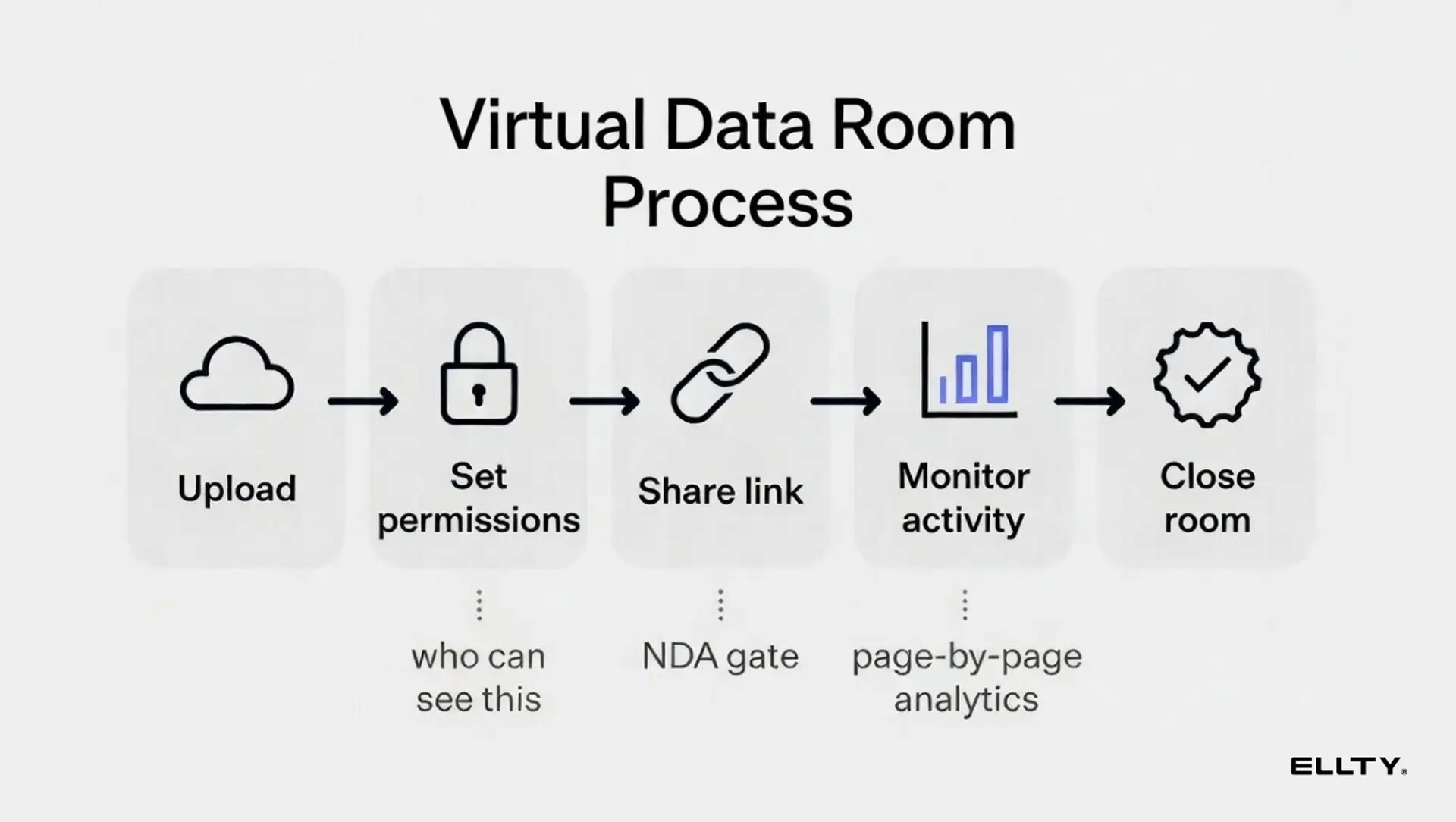
A virtual data room (VDR) is a secure online space where you store and share sensitive documents - usually for due diligence, M&A transactions, fundraising, or legal processes.
Think of it as a step up from Google Drive or Dropbox. It's not just storage. A proper VDR gives you:
- Granular access permissions (who can view, download, or print each file)
- Audit trails showing exactly who opened what and when
- Document watermarking, NDA gating, and link expiry controls
- Activity analytics broken down by viewer, page, and time spent
- Secure sharing without exposing your email or cloud storage
The core use case is simple: sharing sensitive documents with people who need to review them, without losing control. Whether you're closing a business acquisition, pitching investors, selling a property, or responding to a legal request, there's always a moment where someone needs to dig through your documents. And handing over PDFs by email just doesn't cut it.
A data room gives you a controlled space where the right people can access the right files and you can see exactly what they're looking at, pull access the moment a deal falls through, and keep a clean record of everything that was shared.
That's why data rooms are used across industries:
- M&A and acquisitions — Let buyers review financials, contracts, and legal documents without losing control of sensitive information
- Fundraising — Share your cap table, pitch materials, and business records with investors at any stage
- Real estate — Give buyers, lenders, and lawyers secure access to property documents and transaction records
- Legal and compliance — Manage document sharing for litigation, audits, or regulatory reviews
- Board and investor reporting — Keep stakeholders informed with organized, permissioned access
- IPO preparation — Maintain a clean, auditable record of everything shared with underwriters and regulators
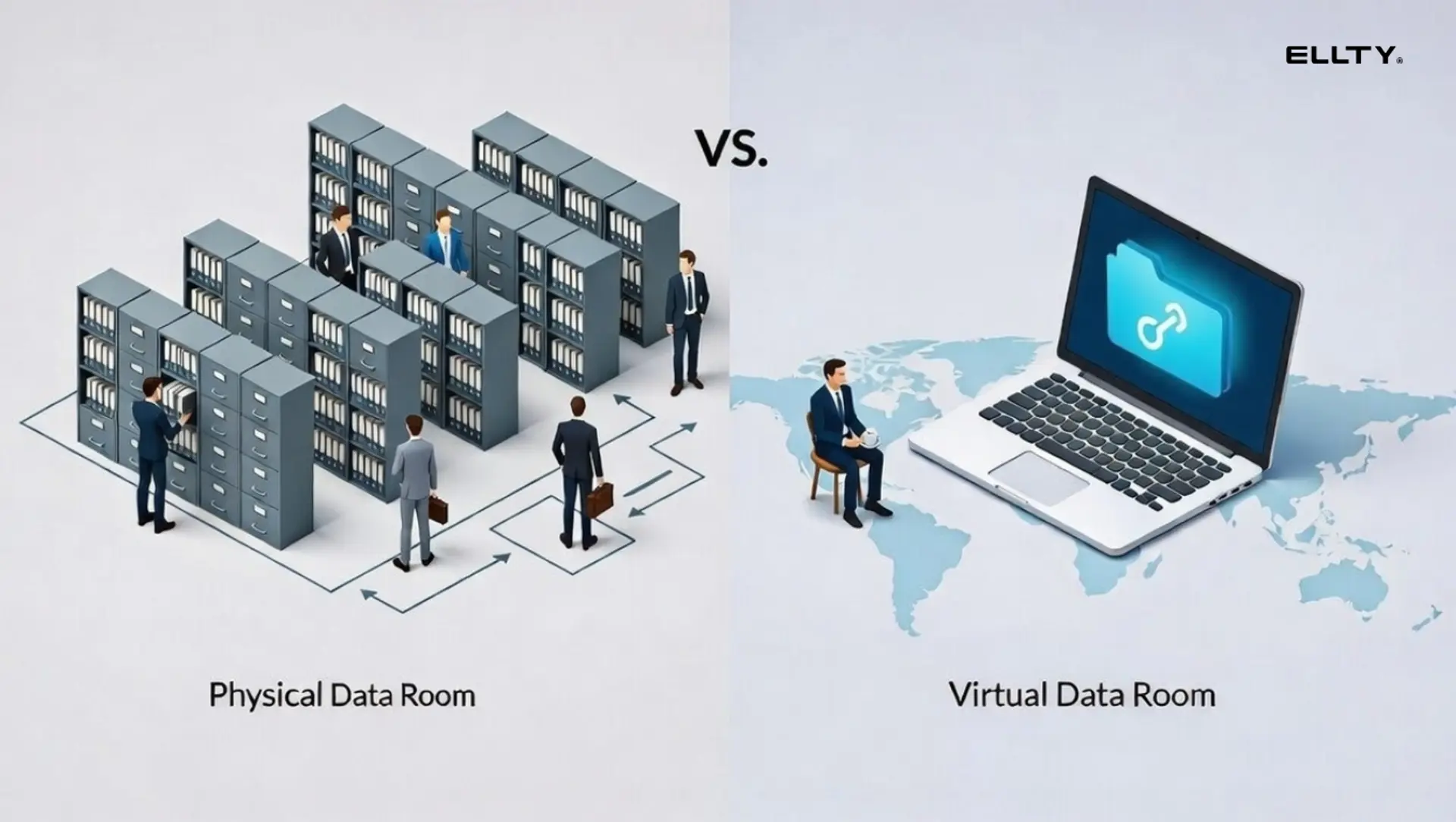
The term "data room" actually comes from a physical room, a place where companies would store boxes of paper documents for potential buyers to come and review in person. Virtual data rooms moved that process online. But the core idea hasn't changed: controlled, secure, audited document sharing, whenever the stakes are too high to just hit send.
How much does a virtual data room cost?
Short answer: anywhere from $0 to $200,000+ depending on the provider, the pricing model, and the size of your deal.
That's a huge range and the reason it varies so much isn't just the provider you pick. It's how they charge you. The pricing model often matters more than the headline price, because it determines what your final bill actually looks like.
The 4 pricing models you'll run into
1. Per-page pricing
You pay a fee for every page you upload. Rates typically run $0.40–$0.85 per page, which sounds small until you do the math. A 75,000-page deal at $0.50/page is $37,500 in upload fees alone.
The real problem is that this model punishes you for being organized. Every revision, duplicate, or reshuffled document adds to your bill. Most modern providers have dropped it, but Intralinks and Datasite still offer it. Unless your document set is tiny and won't change, avoid this one.
2. Per-user pricing
You pay a monthly fee for every person with access - your team, the other side, their lawyers, their advisors. Everyone's a line item.
Legacy providers like iDeals and Intralinks charge $100–$300 per user per month. A five-person deal team can run $1,500–$4,500/month before anything else. And due diligence deals always involve more people than you expect.
3. Storage-based pricing
You pay based on how much data you store, usually per GB. Overages typically cost $100–$300 per GB and the alert usually arrives when you're at 95% capacity, which is too late to renegotiate anything.
This model gets painful fast if your deal involves large files: financial models, property photos, engineering specs, video. What looked like enough storage at the start won't be by the time you're deep into the process.
4. Flat-rate / subscription pricing
A fixed monthly fee that covers a set number of users, a storage limit, and a defined feature set. This is where most modern providers sit, and for good reason, you know your cost upfront.
The catch: "flat rate" doesn't always mean unlimited. Many plans have caps on users, storage, or features, with overage charges that can quietly add up. Always read the fine print before you sign.
Most people running a fundraising round, a property transaction, or a mid-size M&A deal won't need a $200K enterprise platform. But you do need to understand these models before you commit because the wrong pricing structure can cost you more than a more expensive tool would have.


Virtual data room providers: what they cost and who they're for
Ellty

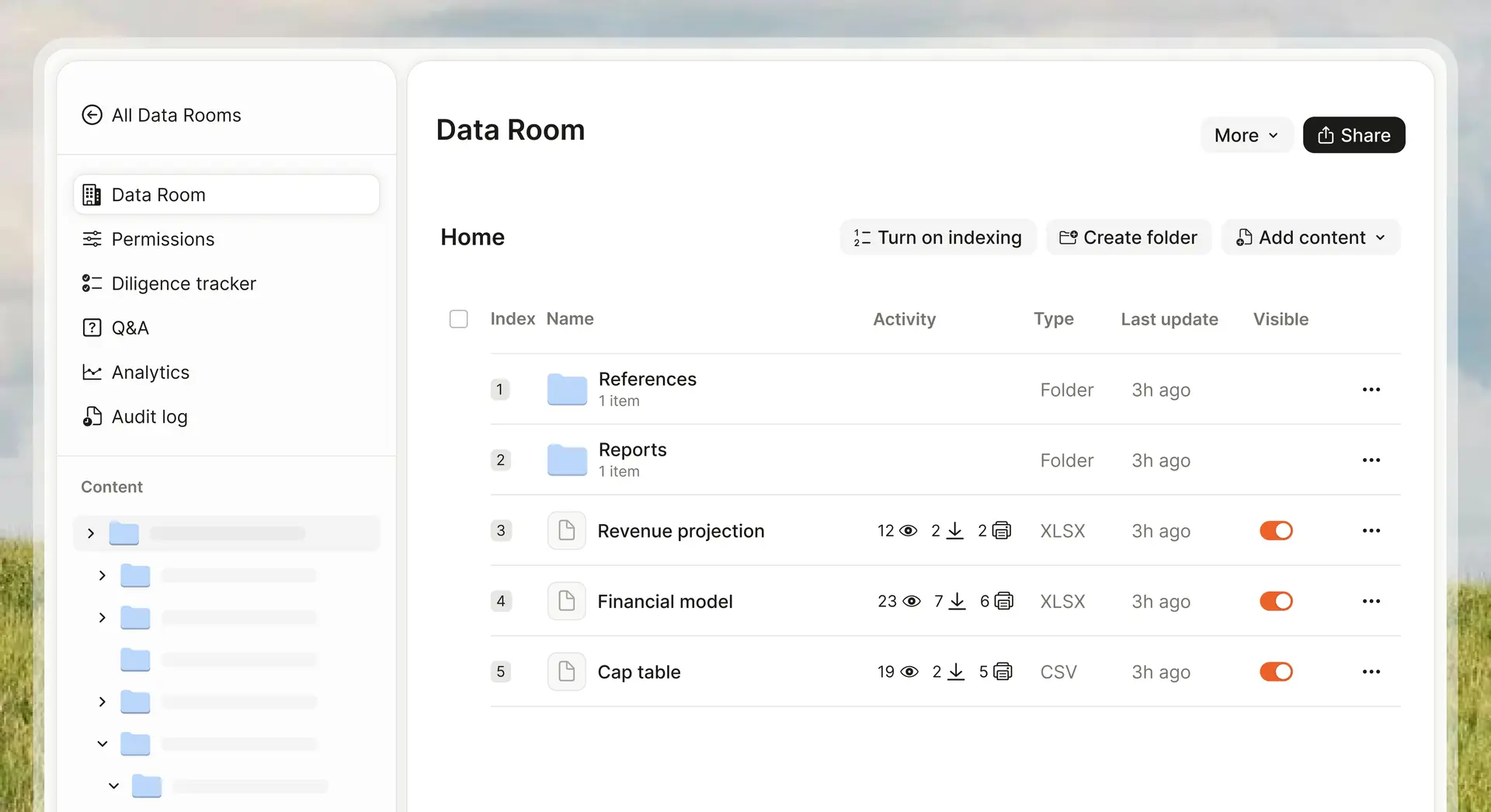
Ellty takes a different approach from most VDR providers, it starts free and scales to $149/month on the Data Room plan, making it one of the most accessible options in the market. The free tier lets you test the core functionality before committing anything. The Data Room plan unlocks the features that matter for real document sharing - access controls, activity tracking, viewer analytics, and the ability to manage who sees what.
Where Ellty differs from heavier platforms is in its simplicity. It's not trying to serve billion-dollar M&A processes, it's built for anyone who needs to share sensitive documents in a controlled, trackable way. Whether you're raising a funding round, closing a property deal, running a consulting engagement, or managing an acquisition, Ellty gives you the core tools that matter: access controls, real-time activity tracking, NDA gating, and a clean audit trail.
Pricing is flat and transparent, with no per-user fees and no surprise overages as your deal team grows.

Intralinks

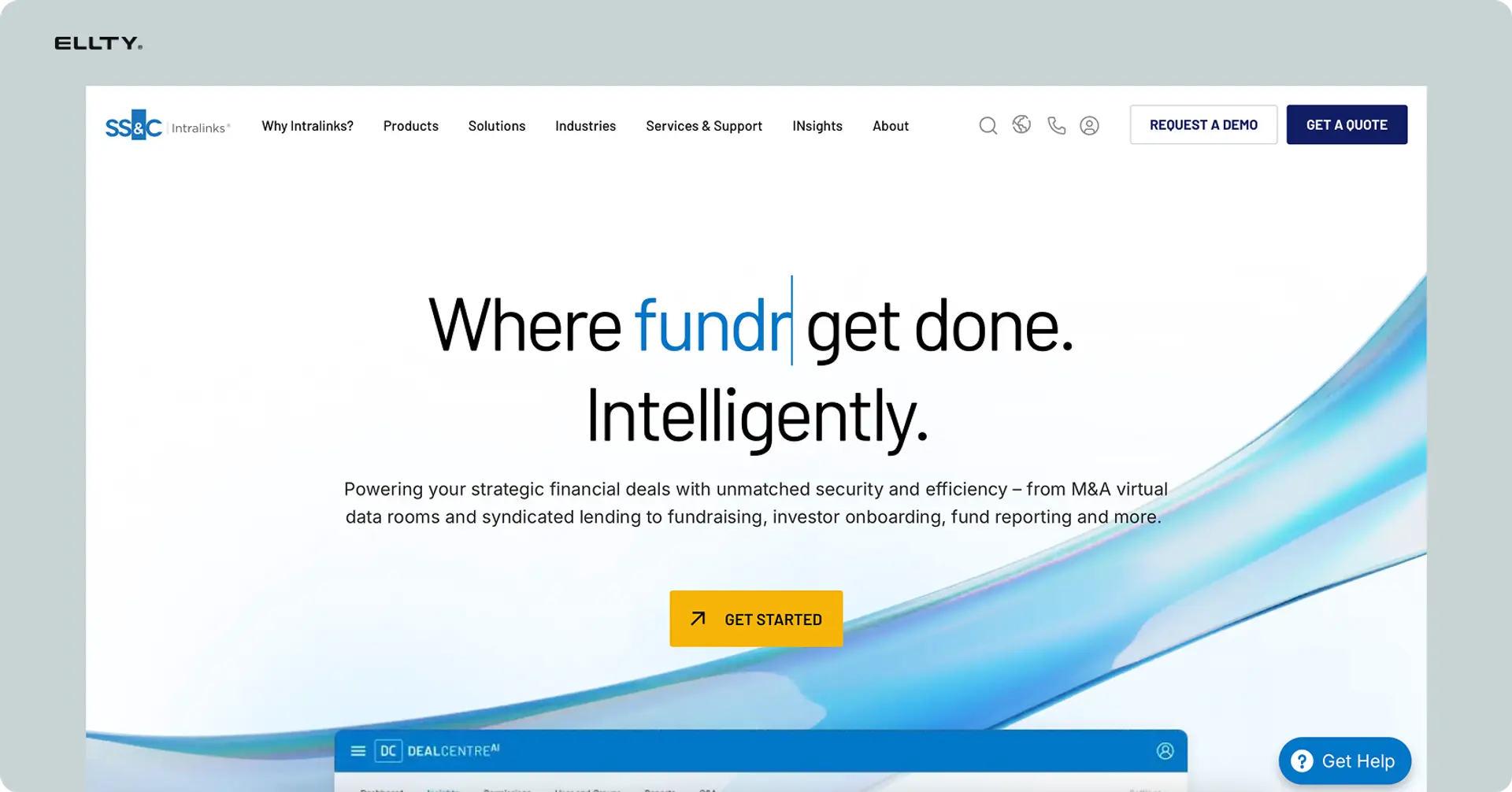
Intralinks is one of the oldest names in the VDR space, and it's built for serious enterprise deals - think cross-border M&A, private equity transactions, and anything north of $100 million. The platform is loaded with compliance features, deep permission controls, and audit trails that hold up in high-stakes legal and regulatory environments.
Pricing starts around $400/month but quickly climbs depending on deal size and structure. They also offer per-page pricing at roughly $7,500 per 10,000 pages, which can get expensive fast on large document sets. Most clients end up on custom quotes, and the sales process reflects that — expect demos, negotiations, and contracts rather than a self-serve signup.
Intralinks is not built for small deals. If you're running a seed round or a simple property transaction, you'll be paying for a lot of features you won't use. But if you're managing a complex, multi-party deal where security and compliance are non-negotiable, it's a proven choice.
Datasite

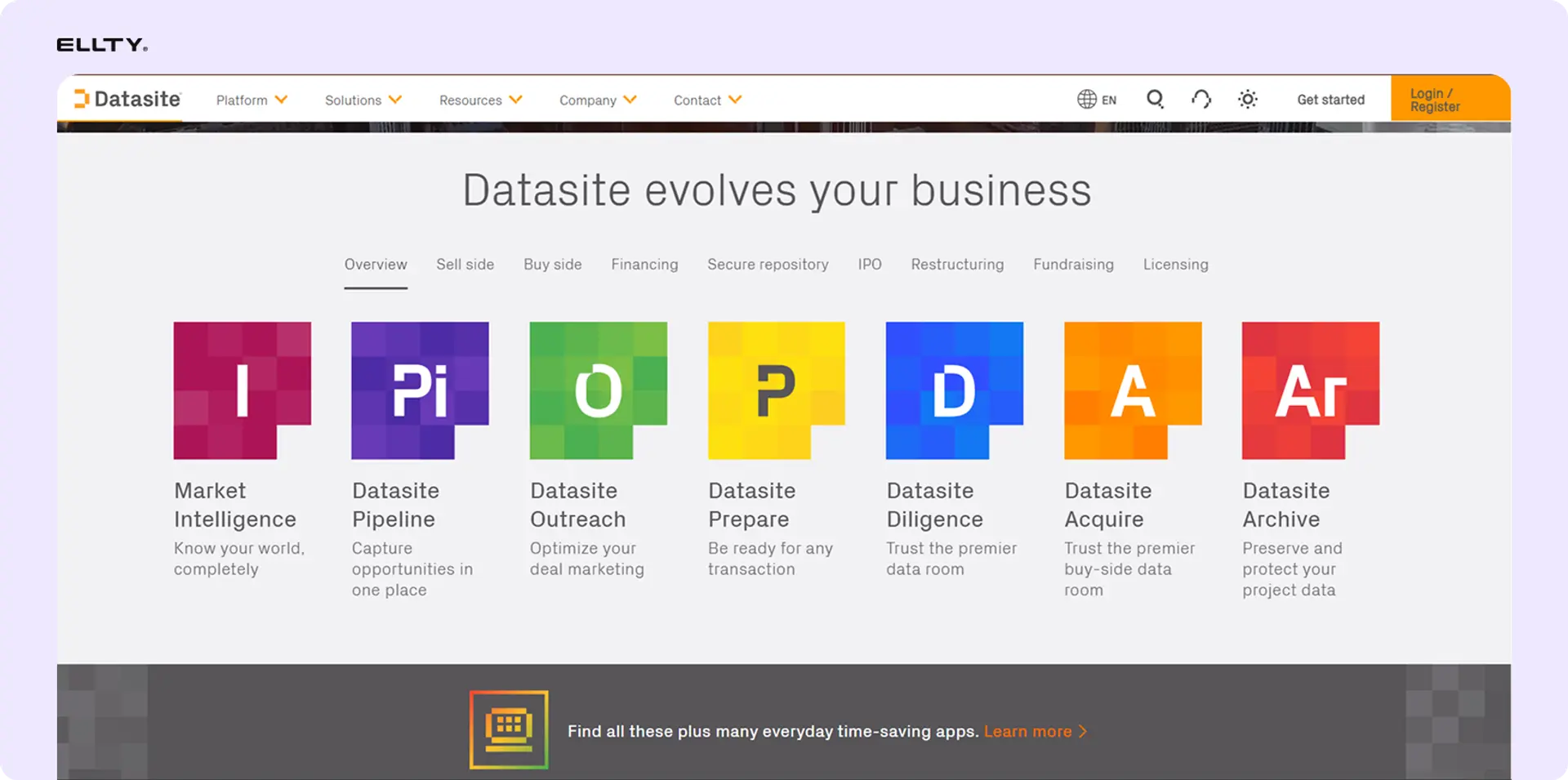
Datasite sits at the top of the market alongside Intralinks, it's the platform investment banks and M&A advisors reach for when the deal is big and the stakes are high. It's purpose-built for enterprise transactions, with features like AI-assisted document organization, automated redaction, and detailed buyer engagement analytics.
Pricing starts around $500/month, but real-world costs are almost always based on custom quotes. Per-page pricing runs about $7,000 per 10,000 pages, making it one of the more expensive options if your document volume is high. There's no meaningful self-serve tier, you'll go through a sales team, and pricing will depend heavily on deal complexity, duration, and user count.
For investment banking processes, large M&A auctions, or any deal where multiple bidders are reviewing documents simultaneously, Datasite's workflow tools genuinely earn their cost. For anything smaller, it's overkill.
iDeals


iDeals sits in the mid-market and is particularly popular with law firms, financial advisors, and companies running deals that are too complex for lightweight tools but don't need the full enterprise stack. It covers M&A, real estate, legal proceedings, and board reporting - essentially any professional context where secure document sharing matters.
The Pro plan starts at around $460/month on a tiered subscription model. Pricing scales based on storage, users, and features, so your final cost depends on how large your deal team is and how much you're uploading. It's not the cheapest option, but it's more predictably priced than per-page models.
Feature-wise, iDeals offers strong permission controls, document watermarking, Q&A workflows, and detailed activity tracking. The interface is cleaner and more modern than legacy platforms like Intralinks. For mid-sized deals where you need professional-grade features without a full enterprise contract, iDeals is a solid middle ground.
Firmex
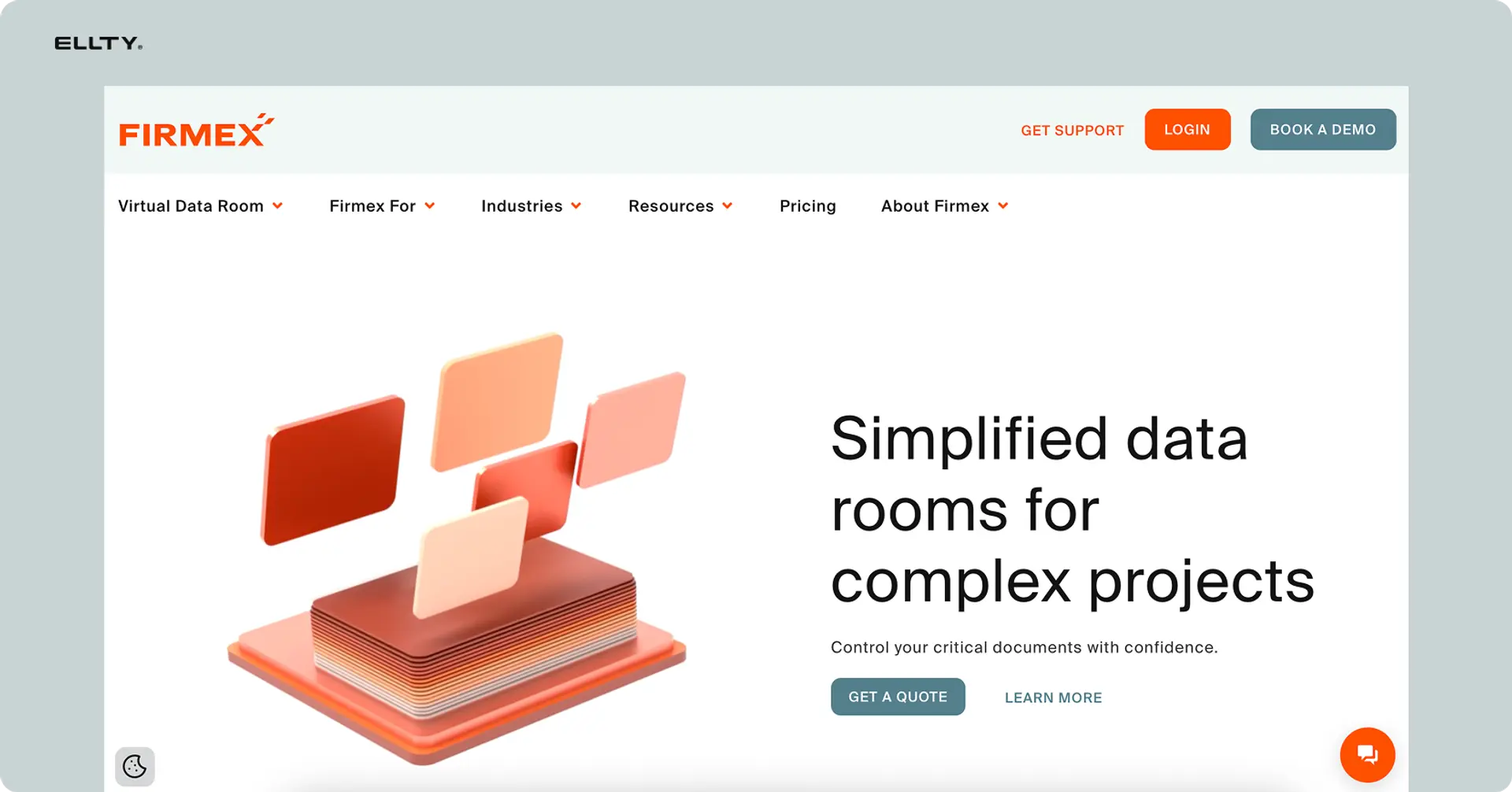
Firmex is a subscription-based VDR built for mid-sized businesses, and it's particularly strong in industries like investment banking, legal, and life sciences. It handles M&A transactions, regulatory filings, clinical trial documentation, and ongoing board reporting - use cases where you need a reliable, professional-grade room without the complexity of a full enterprise deployment.
Pricing is custom quote only, placing it in the mid-range of the market. There's no public pricing page, which means you'll need to go through a sales conversation to understand what you'd actually pay. Costs depend on deal size, document volume, and how long you need the room active.
What Firmex does well is simplicity at a professional level - the platform is straightforward to set up, document permissions are granular, and the audit trail is clean. It's not trying to be the biggest platform in the room. If you want something dependable, well-supported, and appropriately priced for deals that don't require an enterprise contract, Firmex is worth a look.
Ansarada


Ansarada is an Australian-founded VDR that's built a strong reputation in M&A, auctions, and competitive bid processes. Where it stands out is in deal analytics - the platform tracks how engaged each bidder is with your documents, giving sellers and advisors a read on buyer interest that most platforms don't offer.
Pricing is storage-based, starting around EUR 419/month at the entry tier. Your cost scales as your storage grows, which makes budgeting straightforward at the start but harder to predict if your document set expands mid-deal. Large file types - property photos, financial models, technical specs - can push you into higher tiers faster than expected.
Ansarada also includes AI-powered tools for document categorization and deal readiness scoring, which can save real time during preparation. It's best suited for structured sale processes, capital raises, and auction-style deals where buyer engagement data has strategic value. Less ideal for simple, one-on-one document reviews where those analytics features go unused.
SecureDocs

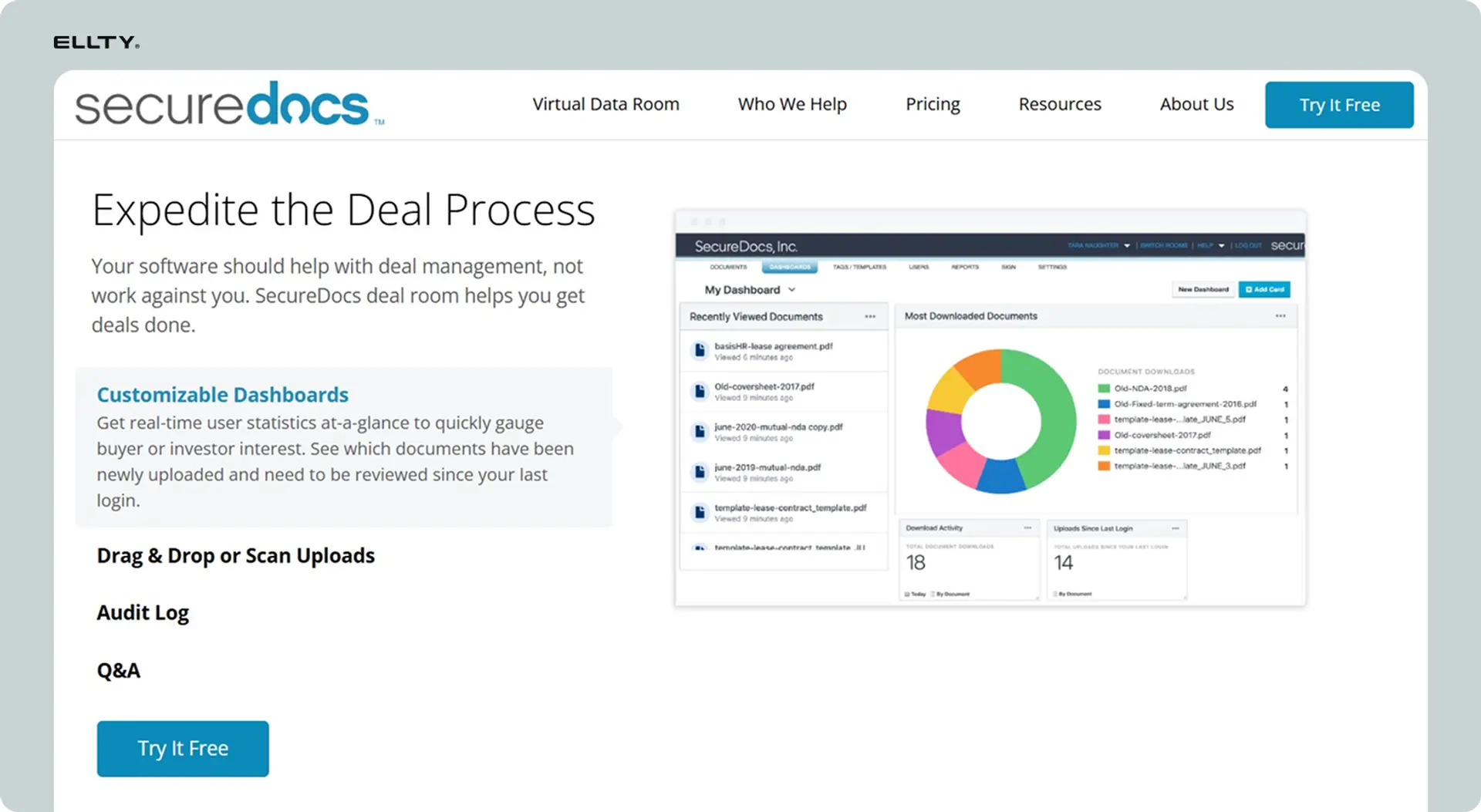
SecureDocs is a flat-rate VDR aimed at startups, small businesses, and anyone who needs a clean, professional data room without a complex pricing structure. At around $250/month, you get unlimited users, unlimited storage, and the core features most deals actually require - document permissions, activity tracking, watermarking, and NDA management.
That flat-rate model is the main selling point. You know exactly what you're paying from day one, and you don't get surprised by per-user fees as your deal team grows. For a founder sharing documents with a handful of investors, or a small company going through an acquisition, that predictability matters.
The trade-off is depth. SecureDocs doesn't have the advanced analytics, AI tools, or compliance features that enterprise platforms offer. For complex, multi-party deals with heavy regulatory requirements, it'll feel limited. But for simpler deals - a seed or Series A fundraise, a straightforward acquisition, basic investor reporting - it covers the essentials at a price that makes sense.
Citrix ShareFile VDR


Citrix ShareFile started as a file-sharing and collaboration tool and added VDR capabilities on top. That background shows - it's a practical choice for teams that need basic data room features without a dedicated VDR platform, particularly in professional services, legal, and financial advisory contexts.
Pricing runs $67.50–$75 per user per month with a minimum of five users, putting the floor around $337–$375/month. The per-user model means costs grow as your deal team does, which is worth factoring in if you're expecting a large reviewer group. It's not the most expensive option, but it's also not the most predictable as headcount scales.
Feature-wise, ShareFile covers the fundamentals: permission controls, audit logs, secure document sharing, and e-signature integration. It won't win on depth compared to purpose-built VDRs, but if your team already uses Citrix tools or you need something functional without a long onboarding process, it's a practical entry point for lighter due diligence needs.
Virtual data room pricing for M&A: what to expect
M&A due diligence is where VDR costs get serious. Deal size, document volume, number of parties, and timeline all affect what you'll pay.
For a small-to-mid-market deal (sub $50M), you're likely looking at $500-$3,000/month from a mid-tier provider like iDeals or Firmex. For large-cap transactions ($100M-$1B+), enterprise platforms can run $5,000-$20,000/month.
Research from SRS Acquiom across 3,800+ M&A deals found that actual VDR costs exceeded initial quotes by 2-10x in many cases. The culprits: storage overages, project extensions, add-on fees for support tiers, and charges for file types the base quote didn't cover.
One documented case showed an initial VDR quote of approximately $3,800 that resulted in a final invoice of approximately $38,168 - a 10x overrun driven by storage overages, project extensions, and add-on fees.
What to do before signing an M&A VDR contract:
- Get the storage overage rate in writing
- Ask what happens if the deal extends beyond the contract period
- Confirm whether all file types (including Excel and video) are included
- Ask about support tier pricing separately
- Check if annual pricing locks in rates or allows uplift
The more of those questions a provider dodges, the more you should push.
Why are virtual data rooms so expensive?
This comes up a lot. You're essentially paying for secure file storage and sharing - why does it cost thousands per month?
A few real reasons:
Security infrastructure is expensive. Enterprise-grade VDRs maintain ISO 27001 certification, SOC 2 compliance, GDPR and HIPAA adherence, 256-bit encryption, redundant data centers across multiple regions, and 99.95%+ uptime guarantees. That's not cheap to build or maintain.
Compliance and audit trails are complex. Generating court-admissible activity logs, tracking every document interaction per user, and maintaining those records for regulatory purposes requires serious engineering.
The customer base is high-stakes. M&A transactions are often multi-hundred-million dollar deals. If a document leak or access error derails a deal, the liability is enormous. Providers price to reflect that risk.
Legacy market structure. Intralinks, Datasite, and others built their businesses serving investment banks and law firms - buyers who didn't negotiate hard on price and valued relationships over cost. That pricing DNA persists.
That said, not every use case requires enterprise-level security infrastructure. If you're a seed-stage startup sharing your deck and financial model with 10 investors, you don't need what Intralinks is selling. Matching the tool to the actual risk level of your documents is how you avoid overpaying.
Virtual data room pricing calculator: estimate your real cost
Use this framework to estimate what you should actually budget.
Step 1 - document volume: how many files will you upload? Under 500 files is light. 500-5,000 is mid-range. 5,000+ is heavy. Storage-based plans start hurting at the heavy end.
Step 2 - user count: how many people need access? This includes your team, investors or acquirers, lawyers, and advisors on both sides. A typical seed fundraise might involve 5-20 investors with 1-3 people each. That's potentially 15-60 individual users.
Step 3 - timeline: how long will the room be live? A quick raise might run 60-90 days. A complex M&A process can stretch 6-12 months. Per-deal pricing can seem attractive early and become painful at month 9.
Step 4 - features needed: do you need NDA gating, watermarking, granular permissions, audit logs, or eSignatures? Some providers charge extra for each.
Estimated budget by use case:


These are estimates based on flat-rate providers. Legacy per-page pricing at the large M&A tier would be significantly higher.
Start with Ellty free plan and see what you actually need before committing to a paid tier.
Ellty pricing: what you get at each tier


Ellty is a secure document sharing and analytics platform with full data room functionality, built for anyone who needs to share sensitive documents in a controlled, trackable way. Whether you're raising a funding round, closing a property deal, running a consulting engagement, or managing an acquisition, Ellty gives you the core tools that matter: access controls, real-time activity tracking, NDA gating, and a clean audit trail.
Pricing is flat and transparent, with no per-user fees and no surprise overages as your deal team grows.
Free — $0/month. Document tracking, real-time analytics, and secure sharing. A good starting point if you're in early conversations and want to see who's opening what before setting up a full data room.
Standard — $69/month. Unlimited documents, advanced analytics, eSignatures, custom branding, and data room features included. Works well for smaller deals and ongoing client or investor communication where you need a professional, trackable experience.
Data Room — $149/month. This is where the core VDR features come in. Granular permissions, NDA gating, dynamic watermarking, and restricted visitor access - everything you need to run a controlled document review, whether that's a due diligence process, a property transaction, or a client deliverable that can't be forwarded around freely.
Data Room Plus — $349/month. Group visitor permissions, full audit logs, and support for up to 4,000 assets per data room. Built for heavier document loads and multi-party deals where you need structured access control across different groups of reviewers.
Where Ellty stands out against legacy platforms is the pricing model. There are no per-user charges, no per-page fees, and no custom quotes that take weeks to negotiate. You pick a plan, get set up quickly, and know exactly what you're paying - whether you're sharing documents with 3 people or 30. For anyone who needs a professional data room without an enterprise contract, Ellty is the place to start.

What are the hidden fees in virtual data room pricing?
This is where teams get burned most often. The headline price is rarely the real price.
Setup and onboarding fees: many enterprise providers charge $500-$2,500 upfront for configuration, custom branding, and data migration. iDeals can charge $1,000-$5,000 for extensive custom configuration. Firmex adds $500-$1,500 for custom branding.
Storage overage fees: exceed your plan's storage limit and you'll pay. Storage overages typically run $75-$300 per GB per month depending on the provider. FirmRoom charges around $150/GB/month.
User overage fees: add people beyond your plan limit and you're billed extra. Additional users beyond plan limits can cost $15-$90/user/month. Administrative access can run $100-$250/user/month on providers with tiered user models.
Project extension fees: if your deal runs longer than your contract covers, you pay for the extension. This catches a lot of M&A deals off guard when processes drag.
Support tier upgrades: basic support is usually included. 24/7 multilingual support with guaranteed response times costs more. Exact pricing is rarely disclosed upfront.
Special file handling: Datasite charges extra for Excel files and non-standard media types. Intralinks adds costs for certain file formats. These charges typically only appear on the invoice.
Contract escalations: Intralinks has been known to propose 10% annual uplift language in contracts. iDeals charges 20-40% more for month-to-month vs. annual billing.
The practical checklist before signing any VDR contract:
- What is the storage overage rate per GB?
- What happens if I exceed my user limit?
- Is there a setup or onboarding fee?
- What file types are included in base pricing?
- What support tier am I getting, and what does it cost to upgrade?
- Is there price uplift on annual contract renewal?
- What are the extension terms if my deal timeline shifts?
Secure data room features you actually need (vs. nice to have)
It helps to know what's table-stakes vs. what you're paying a premium for.
Features you need for most fundraising and light due diligence:
- Secure, password-protected or link-controlled access
- View analytics (who opened it, which pages, how long)
- Ability to revoke access instantly
- Basic permission levels (view only vs. download)
- NDA gating or terms of access before entry
Features you need for structured M&A due diligence:
- Granular folder-level permissions per user or group
- Full audit logs exportable for legal purposes
- Dynamic watermarking (personalized per viewer)
- Q&A workflow for managing buyer questions
- Bulk upload with folder structure preservation
Features that matter mainly for enterprise-scale deals:
- AI-powered redaction for large document volumes
- Single sign-on (SSO) integration
- Dedicated project manager
- 24/7 phone support with sub-30-minute response SLA
- Multi-deal management from one dashboard
Virtual data room provider checklist: 5 questions before you commit
- What is the total cost if my deal runs 6 months? Not the monthly rate - the actual projected total including overages and extensions.
- Can I revoke access to individual users instantly? This matters a lot if a deal falls through mid-process.
- What do the analytics actually show? Page-level engagement is useful. Just knowing someone "opened" the room isn't.
- Is the setup self-serve or do I need to talk to someone? Enterprise providers often gate setup behind a sales call. That means days before you can share anything.
- What happens to my data if I stop paying? How long do they retain it and what format can I export it in?
If you want to skip the sales call and get set up today, try Ellty free.
FAQ
How much does a virtual data room cost per month?
It depends heavily on the provider and pricing model. Light-use tools start from free or around $69-$149/month. Mid-tier providers like iDeals start around $460/month. Enterprise providers like Intralinks and Datasite don't publish standard rates - you'll get a custom quote that can run from a few thousand to tens of thousands per month depending on the deal size.
What is the cheapest virtual data room?
Several providers offer free entry-level plans with limited features. Ellty has a free plan that includes document tracking, real-time analytics, and secure sharing - which covers basic fundraising use cases. SecureDocs offers flat-rate plans around $250/month for unlimited users. The "cheapest" option depends on what you actually need - if you need NDA gating and audit logs, you'll need to step up to a paid tier.
Is there a free virtual data room?
Yes. Some providers offer free tiers that are genuinely useful for early-stage companies. Ellty free plan includes secure sharing and analytics. Ansarada has a free-until-live model where you pay only when you officially launch the data room. Most free tiers have document limits, user limits, or feature restrictions - make sure what's included covers your actual needs before you commit.
What is a virtual data room used for in M&A?
In M&A, a virtual data room is the central repository for all due diligence documents. The buyer's team (along with their lawyers and accountants) reviews financials, contracts, IP, regulatory filings, customer data, and anything else relevant to the deal. The seller controls who can access what, tracks engagement across every document, and maintains a complete audit trail. The VDR is also where Q&A between parties typically happens during diligence.
Why do some virtual data rooms cost $20,000+ per deal?
Enterprise pricing reflects several factors: 24/7 dedicated support, enterprise SLAs, AI-powered document processing, compliance with strict regulatory requirements (SOC 2, ISO 27001, HIPAA), and the reputational risk borne by providers serving high-stakes deals. Legacy providers also have pricing models established when their primary buyers were large investment banks with minimal price sensitivity. You only need to pay those rates if your deal complexity genuinely requires it.
What's the difference between a data room and document sharing on Google Drive?
Google Drive gives you storage and basic sharing. A virtual data room gives you access control at the document level, activity tracking down to which pages a viewer read and for how long, watermarking, NDA gating, audit logs, and the ability to revoke access remotely. For internal documents or low-sensitivity materials, Drive is fine. For investor due diligence or M&A, the control and visibility of a proper data room is worth it.
What security certifications should a virtual data room have?
For most use cases, you want 256-bit encryption at rest and in transit, two-factor authentication, and GDPR compliance if you're dealing with European data. For regulated industries (healthcare, financial services) or larger M&A transactions, look for ISO 27001 certification, SOC 2 Type II, and HIPAA compliance if applicable. Don't let a provider claim certifications you can't verify - ask for the audit report.
How long does it take to set up a virtual data room?
Modern platforms with self-serve onboarding can have you up and running in under an hour. Ellty, for example, is designed so you can upload your pitch deck, set permissions, and share a trackable link the same day without any training. Enterprise providers like Intralinks or Datasite often require an onboarding call and setup process that can take days. If you need something live today, check whether the platform is self-serve or sales-gated before you sign up.
Can I share a data room with unlimited investors?
It depends on the plan. Per-user pricing means every investor is a line item. Flat-rate plans often include a set number of users, with extras charged as overages. Ellty Data Room plan includes 3 users but allows you to control how visitors access the room without counting them as users in the same way. If you're sharing with a large number of limited partners or investors and don't want per-user fees, flat-rate platforms built for fundraising make more sense than traditional VDRs with enterprise user pricing.
What's the difference between Ellty and a traditional virtual data room?
Traditional VDRs like iDeals or Firmex are built primarily for M&A and legal due diligence - feature-heavy, typically more expensive, and designed for complex multi-party deal workflows. Whether you're raising a funding round, closing a property deal, running a consulting engagement, or managing an acquisition, Ellty gives you the core tools that matter: access controls, real-time activity tracking, NDA gating, and a clean audit trail.
The bottom line
Virtual data room pricing is all over the map - from free to six figures per deal. Most of that range is determined by who the provider built the product for, not by what you actually need.
If you're a team sharing documents with investors or running early-stage due diligence, you don't need what Intralinks is selling. You need secure access control, good analytics, fast setup, and a price that doesn't require a board approval to justify.
Match the tool to the actual complexity of your deal. Start lighter than you think you need. Upgrade if the process demands it.
See Ellty plans and start free - no sales call required.
Author

Anika Tabassum Nionta is a Content Manager at Ellty, where she writes about secure document sharing, virtual data rooms, M&A, due diligence, fundraising, and sales enablement. With over 6 years of writing experience, she helps professionals understand how to share confidential documents securely, track engagement, and manage deals more effectively. Anika holds both a BA and MA in English from Dhaka University. Outside of work, she enjoys reading, exploring new cafes in Dhaka, and connecting with entrepreneurs and dealmakers in her community.

