
In this guide
- How does a virtual data room work?
- Why compliance matters in a data room
- What is SOC 2 compliance?
- The 5 pillars of SOC 2
- What is ISO 27001?
- The 4 pillars of ISO 27001
- SOC 2 vs ISO 27001 - what's the difference?
- GDPR and data privacy in virtual data rooms
- The 7 principles of data privacy
- The 4 types of security
- The 4 types of audits
- Does ISO 27001 require DLP?
- What to verify in a VDR provider
- How Ellty approaches security
- FAQ
When a party asks if your data room is secure, "yes" isn't enough. They want to know what certifications your provider holds, what happens to their data after they exit the room, and whether the platform has been independently audited.
Most people don't know the difference between SOC 2 and ISO 27001. They don't know what GDPR actually requires of the tools they use. And they don't know which certifications to ask for before signing up with a VDR provider.
This guide fixes that. No jargon, no unnecessary detail. Just what you need to understand compliance in the context of virtual data rooms - so you can ask the right questions and make a confident choice.
How does a virtual data room work?

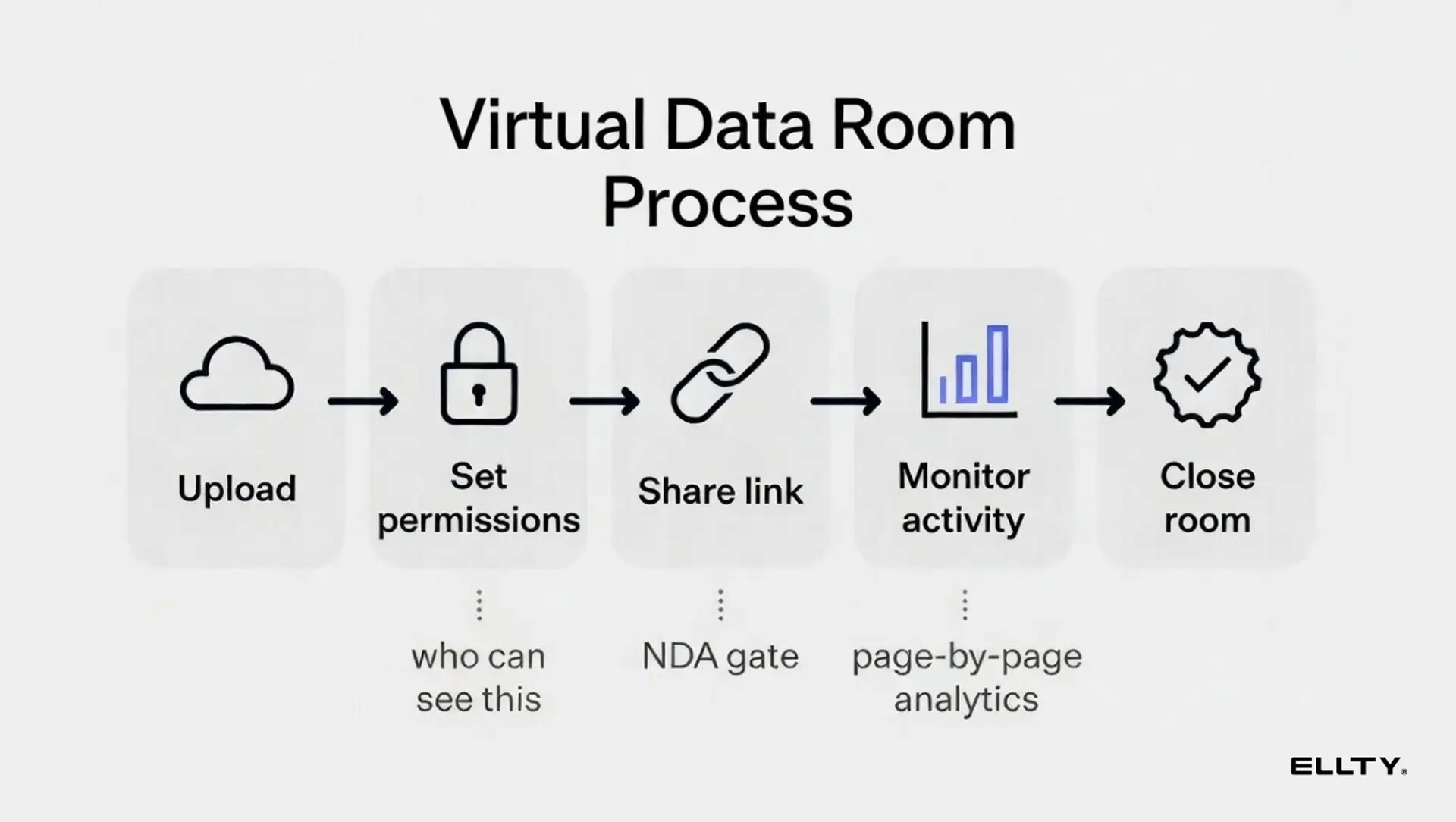
A virtual data room is a cloud-based platform for storing and sharing sensitive documents with controlled access. It's used primarily for investor due diligence, M&A transactions, audits, and legal reviews - situations where you need to share confidential information without losing control of it.
Here's the basic flow:
- You upload documents and organize them into a folder structure
- You set permissions: who can view, who can download, who needs to sign an NDA first
- You create a unique trackable link per recipient
- The recipient views documents inside a secure browser-based viewer
- You see real-time analytics: who opened what, which pages they read, how long they spent
- You can revoke access at any point with a single click
The security layer is what separates a VDR from a Google Drive folder. Every interaction in a VDR is logged. Access is gated. Documents can be watermarked and set to view-only. And the platform itself should be built on infrastructure that meets recognized security standards - which is where compliance certifications come in.


Why compliance matters in a data room
When you share a cap table, a financial model, or a customer contract through a data room, you're trusting that the platform handles that data responsibly. Compliance certifications are third-party validation that it does.
There are two reasons this matters for business owners specifically.
First, investors doing due diligence on your company will often ask about your tooling. If you're sharing sensitive financial data through a platform that has no security certifications and stores data in an unknown jurisdiction, that's a flag.
Second, if you're in a regulated industry - fintech, healthtech, legaltech - your investors or counterparties may explicitly require that you use a compliant platform. Some enterprise buyers require it as a procurement condition.
Security certifications aren't marketing. They're proof that someone independent checked the work.
What is SOC 2 compliance?
SOC 2 stands for System and Organization Controls 2. It's an auditing standard developed by the American Institute of Certified Public Accountants (AICPA). It defines how service providers - including software companies - should manage customer data to protect privacy and security.
Unlike some standards that are one-time checkboxes, SOC 2 is ongoing. It evaluates how a company's systems are designed and whether they operate as intended over time.
SOC 2 Type I vs SOC 2 Type II


SOC 2 Type II is the higher bar. It's what enterprise buyers and sophisticated investors look for. Type I is a starting point - it shows intent. Type II shows execution over time.
When evaluating a VDR provider, ask specifically for their SOC 2 Type II report, not just "are you SOC 2 compliant." Those two things are different.
The 5 pillars of SOC 2
SOC 2 is built around five Trust Services Criteria. Only security (the first one) is mandatory. The other four are optional depending on what's relevant to the service provider.


For a VDR provider, you'd expect Security and Confidentiality to be covered at minimum. Availability matters if the platform has any downtime guarantees. Privacy matters if the platform handles personal data covered by GDPR or CCPA.
What is ISO 27001?
ISO 27001 is an international standard for information security management, published by the International Organization for Standardization (ISO). It defines the requirements for establishing, implementing, maintaining, and continually improving an Information Security Management System (ISMS).
Unlike SOC 2, which is primarily a US-based standard, ISO 27001 is recognized globally. If your investors or counterparties are in the EU, Asia, or the Middle East, ISO 27001 is often more familiar to them than SOC 2.
A company gets ISO 27001 certified by going through an audit with an accredited certification body. The certification is valid for three years, with annual surveillance audits in between to verify continued compliance.
Key difference from SOC 2
SOC 2 is an attestation report - an auditor states that certain controls exist and work as intended. ISO 27001 is a certification - the organization is certified as meeting the standard. Both involve independent third parties, but the output and process are different.
The 4 pillars of ISO 27001
ISO 27001 is structured around four core pillars. These aren't labeled as "pillars" in the official standard, but they represent the four foundational areas the standard addresses.


Most modern SaaS VDR providers host on major cloud infrastructure (AWS, GCP, Azure), which handles the physical security layer. The people and process pillars are what differentiate providers at the organizational level.
SOC 2 vs ISO 27001 - what's the difference?
This is the question that comes up most often. Here's a direct comparison.


A VDR provider that has both SOC 2 Type II and ISO 27001 covers its bases globally. Either one alone is meaningful. Neither is meaningless - they're just different tools for different audiences.
In practice: if you're raising from US VCs, SOC 2 Type II is the certification they recognize. If you're dealing with European institutional investors or running an M&A process with international parties, ISO 27001 often carries more weight.
GDPR and data privacy in virtual data rooms
If your data room includes any personal data about EU residents - employee records, customer lists, contact information - GDPR applies. This isn't optional, and it extends to the tools you use to store and share that data.
Here's what GDPR means practically for VDR use:
- Your VDR provider must have a Data Processing Agreement (DPA) available to sign
- Data must be stored in the EU or in a country with an adequate data protection framework
- The provider must have documented procedures for responding to data subject requests
- You must be able to delete data and get confirmation it was deleted
- The provider should have a published breach notification process
Most enterprise VDR providers have this covered. The gap appears with lightweight tools and improvised solutions - shared Google Drive folders, Notion pages, or basic file sharing tools that weren't designed with GDPR in mind.
When signing up for any VDR platform, ask specifically: "Can you provide your Data Processing Agreement?" If they don't know what that is, that's your answer.
Don't just ask if a VDR is "GDPR compliant." Ask for the DPA, ask where data is stored, and ask how they handle deletion requests. Those three questions surface the real answer.
The 7 principles of data privacy
GDPR is built on seven core principles of data privacy. These aren't just regulatory requirements - they're a useful framework for evaluating whether any platform you use handles data responsibly.


These principles give you a useful lens for evaluating any tool you use to share sensitive information - not just VDRs.
The 4 types of security
Security in the context of VDRs and compliance typically operates across four distinct layers. Understanding these helps you ask better questions when evaluating a provider.


A compliant VDR provider should have all four layers documented and, ideally, independently verified. When a provider says "we're secure," ask which of these four layers they're referring to and what evidence they have for each.
The 4 types of audits
When a VDR provider says they've been "audited," it's worth knowing what kind of audit they mean. Not all audits are equal.


The most meaningful audit for VDR providers is the external third-party audit - specifically the SOC 2 Type II report or ISO 27001 certification. Penetration testing results are also worth requesting, especially for security-sensitive use cases.
Always ask: "Can you share your most recent audit report or certification?" If the answer is a marketing PDF with no third-party signature, keep looking.
Does ISO 27001 require DLP?
DLP stands for Data Loss Prevention - technology that detects and prevents unauthorized transmission of sensitive data outside an organization's network. The question of whether ISO 27001 requires it comes up often in enterprise contexts.
The short answer: ISO 27001 doesn't mandate any specific technology, including DLP. It requires organizations to implement controls appropriate to the risks they face. If the risk assessment identifies data exfiltration as a significant threat - which it typically does in a data room context - then DLP or equivalent controls should be implemented as part of the ISMS.
For VDR providers specifically, the equivalent of DLP at the application layer includes things like: view-only document modes that prevent download, dynamic watermarking that deters unauthorized screenshot distribution, session timeouts that limit access windows, and audit logs that detect and record unusual access patterns.
Practical note
When a VDR provider claims ISO 27001 certification, it doesn't mean they have DLP installed. It means they've assessed their risks and implemented controls appropriate to those risks. Ask what specific controls they use to prevent unauthorized data exfiltration - that's the real question.
What to verify in a VDR provider before you sign up
Here's the practical checklist. Don't rely on the marketing page. Ask directly and get documentation.


Print this table. Use it when evaluating any VDR. A provider that can't answer these questions clearly probably can't answer them to other parties either.


How Ellty approaches security

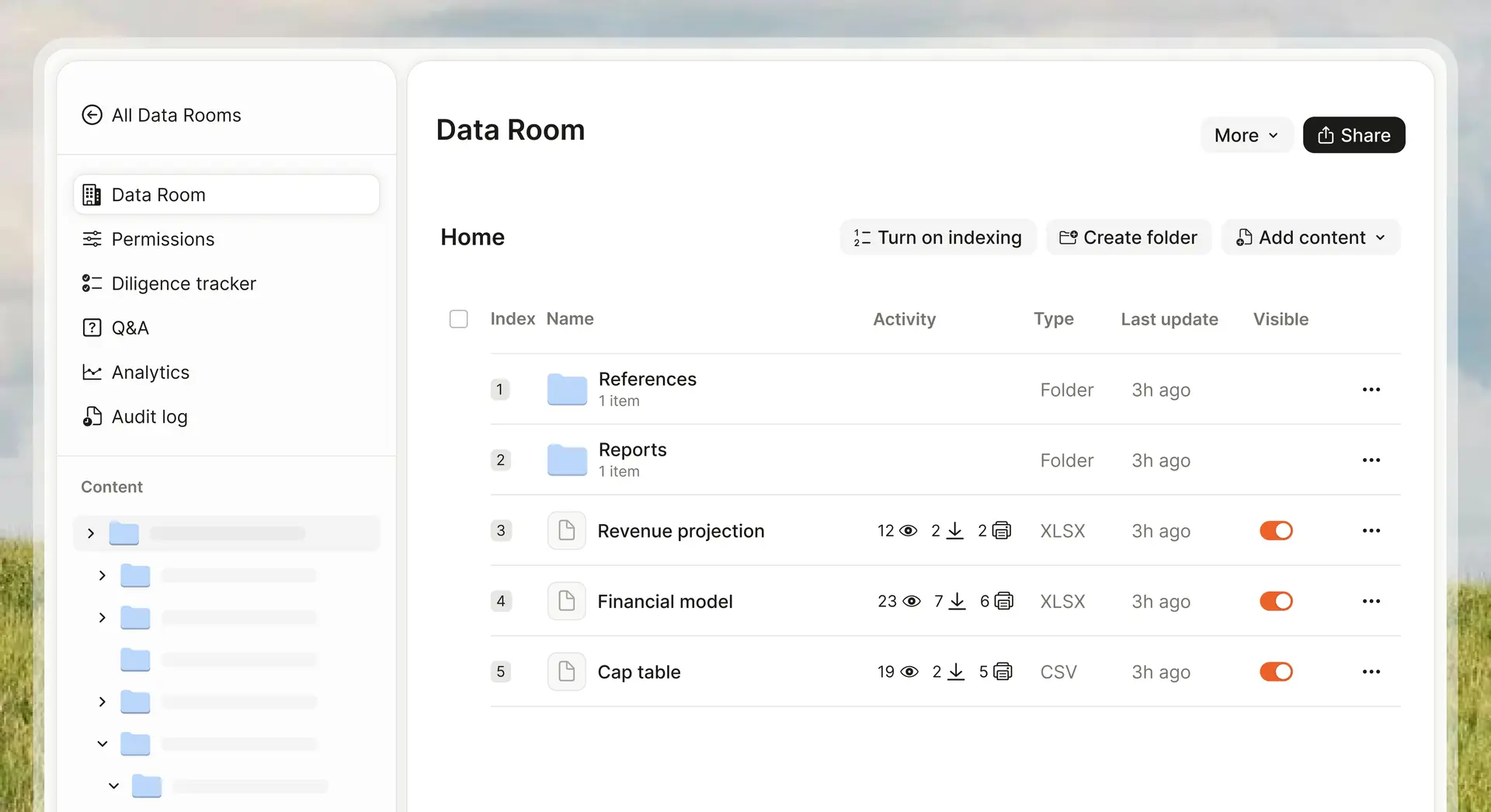
Ellty is built for teams who need professional document sharing and due diligence tools without enterprise complexity. Here's what Ellty offers from a security standpoint.
Ellty data room features include granular permissions at the folder and document level, NDA gating before access is granted, dynamic watermarking on documents, restricted visitor access, and audit logs (available on Data Room Plus). Documents are viewable inside a secure browser-based viewer without requiring a download.
The platform runs on AWS infrastructure, which handles the physical security layer including data center controls, redundancy, and network-level protections that come standard with AWS hosting.
The platform uses trackable links per recipient, which means each visitor gets a unique link and you can revoke access individually without affecting other recipients. Real-time notifications alert you the moment someone enters the room.
For specific certifications and technical security documentation, contact Ellty directly and request their current security docs. Don't rely on any third-party blog post or marketing page for certification claims - verify directly with the provider before sharing sensitive documents.
Ellty works well for businesses who need a clean, analytics-rich data room without per-user pricing or weeks of enterprise onboarding. For large M&A transactions with complex multi-party requirements and enterprise-grade compliance workflows, a dedicated M&A platform is more appropriate.


If you're evaluating Ellty for a compliance-sensitive use case, contact the team directly to request security documentation - don't rely on a features page alone when the stakes are high.
Frequently asked questions
What is SOC 2 compliance for virtual data rooms?
SOC 2 compliance means that a VDR provider has been independently audited against the AICPA's Trust Services Criteria - specifically around security, availability, confidentiality, processing integrity, and privacy. SOC 2 Type II is the more rigorous version, covering how controls perform over a 6-12 month observation period rather than just at a single point in time. For professionals, it's one of the most important certifications to ask for when evaluating a VDR provider.
What is the difference between SOC 2 and ISO 27001?
SOC 2 is a US-based standard (from the AICPA) that produces an attestation report from an auditor. ISO 27001 is an international certification from the ISO/IEC that certifies a company's entire information security management system. SOC 2 is more commonly recognized by US investors and enterprise buyers. ISO 27001 carries more weight internationally and in European contexts. A VDR provider holding both covers the broadest range of counterparties.
What are the 5 pillars of SOC 2?
The five Trust Services Criteria in SOC 2 are: Security (the only mandatory one), Availability, Processing Integrity, Confidentiality, and Privacy. Security covers unauthorized access controls. Availability covers uptime. Processing integrity covers whether data is processed accurately. Confidentiality covers protection of designated confidential information. Privacy covers how personal information is collected, used, and disposed of. For VDR providers, Security and Confidentiality are the most directly relevant.
What are the 4 pillars of ISO 27001?
ISO 27001 addresses information security across four key areas: People (training, roles, background checks), Processes (policies, risk management, incident response), Technology (encryption, access controls, monitoring), and Physical security (data center controls, hardware security). All four need to be addressed for an organization to achieve and maintain ISO 27001 certification.
Does ISO 27001 require data loss prevention (DLP)?
ISO 27001 doesn't require any specific technology, including DLP. It requires organizations to identify risks and implement controls appropriate to those risks. If data exfiltration is identified as a risk (which it almost always is in a data room context), then DLP or equivalent controls should be in place. For VDRs, the practical equivalents are view-only modes, watermarking, session timeouts, and audit logging - these serve the same purpose as DLP at the application layer.
What are the 7 principles of data privacy?
The seven principles from GDPR are: Lawfulness, fairness and transparency; Purpose limitation; Data minimization; Accuracy; Storage limitation; Integrity and confidentiality; and Accountability. These apply to how your VDR provider handles any personal data in your documents - and to how you, as the admin, share that data. Both you and your provider share responsibility for compliance with these principles.
What are the 4 types of security in the context of VDRs?
The four main security layers are: Physical security (data center controls), Network security (encryption in transit, firewalls), Application security (permissions, 2FA, watermarking, audit logs), and Operational security (employee training, incident response, vendor management). A well-secured VDR provider addresses all four. The application layer is where VDR platforms have the most direct control and where most of the differentiating features live.
What are the 4 types of audits relevant to VDR compliance?
The four main audit types are: Internal audits (self-assessments, low external credibility), External third-party audits (the basis for SOC 2 and ISO 27001, high credibility), Penetration tests (simulated attacks to find vulnerabilities, directly relevant for VDRs), and Compliance audits (regulatory-specific assessments like GDPR or HIPAA). When a VDR provider claims to have been "audited," always clarify which type - the answer makes a significant difference.
Does my startup need to care about VDR compliance?
Yes, for two reasons. First, the tool you use to share sensitive documents carries responsibility for how that data is handled. If the VDR provider has a breach, you're the one explaining it to outside parties. Second, sophisticated investors and enterprise counterparties will ask about your tooling during due diligence. Using a platform with no third-party certifications is a flag. You don't need the most enterprise-grade solution available - but you do need a platform that can answer basic security questions with evidence.
What encryption should a VDR use?
Look for AES-256 encryption for data at rest and TLS 1.2 or 1.3 for data in transit. These are the current industry standards. AES-256 means your documents are encrypted when stored on the provider's servers. TLS 1.2/1.3 means data is encrypted as it travels between the server and the user's browser. Both should be standard on any VDR that claims to handle sensitive documents. If a provider can't tell you which encryption standards they use, that's a problem.
The bottom line
Compliance certifications aren't just vendor marketing. They're independent verification that a platform handles sensitive data responsibly. When you share your cap table, your financial model, or your customer contracts through a VDR, you're trusting that platform with some of the most sensitive information your company has.
You don't need to become a security expert. You need to know the right questions: Is this SOC 2 Type II certified? Is there an ISO 27001 certificate I can see? Where is my data stored? Can you provide a DPA? What encryption do you use?
A provider that can answer those clearly deserves your trust. One that can't probably doesn't.
Author

Anika Tabassum Nionta is a Content Manager at Ellty, where she writes about secure document sharing, virtual data rooms, M&A, due diligence, fundraising, and sales enablement. With over 6 years of writing experience, she helps professionals understand how to share confidential documents securely, track engagement, and manage deals more effectively. Anika holds both a BA and MA in English from Dhaka University. Outside of work, she enjoys reading, exploring new cafes in Dhaka, and connecting with entrepreneurs and dealmakers in her community.

