
At some point in any deal, you have to open the door. You share your financials, your contracts, your IP, your cap table - with people you don't fully know yet. Some will move forward. Some won't. And a few may be fishing for competitive intelligence behind the cover of a due diligence process.
That's the moment security stops being a feature on a pricing page and starts being something with real consequences.
The problem with most guides on VDR security is that they're written by the vendors selling them. They lead with certification logos and feature checklists that are hard to evaluate without context. This guide is written for anyone on the other side of that - the founder sharing documents before a raise, the business owner going through an acquisition, the advisor managing sensitive client files - anyone who wants to understand what they're actually protected against, and where the real risks still live even when you're using the right tools.
Let's get into it.
What is a virtual data room and why does security matter so much
A virtual data room (VDR) is a secure online repository used to store and share confidential documents - typically during due diligence, fundraising, M&A, legal proceedings, or board reporting.
The reason security is the main event here (not storage, not UI, not integrations) comes down to what you're sharing inside these rooms. It's not blog posts or marketing decks. It's things like:
- Audited financials and projections
- Cap tables and shareholder agreements
- Customer contracts with pricing details
- Intellectual property filings
- Employee agreements and compensation data
- Partnership and licensing agreements
A single breach or unauthorized screenshot of that content can cost you a deal, expose trade secrets, violate NDAs, or put you in a legal problem you didn't budget for. That's why the security layer of a VDR isn't a nice-to-have. It's the product.


The main security threats virtual data rooms are built to stop
Before you evaluate any provider, it's worth understanding what you're actually protecting against. There are three categories of threat that come up again and again in due diligence scenarios.
The first is unauthorized access. Someone who shouldn't be in your data room gets in - either because you sent a link incorrectly, because a user shared their credentials, or because the platform itself has a vulnerability. Proper access controls, user-level permissions, and link expiry settings address this.
The second is authorized but uncontrolled sharing. This is more common than people admit. An viewer is legitimately in your data room, downloads your financial model, and sends it to a colleague at another firm. Nothing you did was wrong. The information still left your control. Watermarking, download restrictions, and print disabling exist specifically for this.
The third is post-access exposure. The deal falls through. You thought the visitor's access expired. Did it? Do you know who still has your documents stored locally? Audit logs, granular access revocation, and session tracking help here.
Most breaches aren't dramatic hacks. They're a forwarded link or an unrevoked login. The security features that matter most are the ones that limit what happens after someone already has access.
You can have a working data room live today. Ellty Data Room plan sets up in under an hour with NDA gating, granular permissions, and analytics included. Start at Ellty.
Virtual data room security certifications: what they mean and which ones to look for
This is the section most vendors use to confuse buyers. Here's the plain-language version.
SOC 2 Type II
This is the most important certification to look for in a VDR provider. SOC 2 Type II means an independent auditor has reviewed the company's security controls over a period of time (usually 6-12 months) and confirmed they work as described. It covers security, availability, processing integrity, confidentiality, and privacy. Type II is more rigorous than Type I, which only verifies controls exist at a single point in time.
If a provider only has SOC 2 Type I, it's not nothing - but it's less meaningful. Ask specifically for Type II.
ISO 27001
ISO 27001 is an international standard for information security management systems. It means the company has documented policies for managing sensitive data and has been independently certified. It's particularly relevant if you're working with European investors or partners, where this certification is more commonly expected.
GDPR compliance
If you're sharing data with EU-based parties, GDPR compliance isn't optional - it's a legal requirement. This covers how personal data (including investor and employee data within documents) is collected, stored, processed, and deleted. A provider can claim GDPR compliance through technical controls, data processing agreements (DPAs), and data residency options.
HIPAA
Relevant only if you're in healthcare or life sciences and your data room contains protected health information. Most businesses don't need to prioritize this, but if you're running a health tech company sharing clinical data, it becomes critical.
256-bit AES encryption
This is the encryption standard used by banks and governments. Data encrypted with AES-256 at rest and in transit is, for practical purposes, unbreakable with current technology. Any reputable VDR should offer this. If a provider doesn't mention their encryption standard, ask.
Here's a quick reference table:


Core security features every virtual data room provider should have
Certifications tell you about the infrastructure. Features tell you what you can actually control. Here's what matters.
Granular user permissions
You should be able to control what each user or group can see, download, print, and forward. Not just "viewer" vs "admin" - but document-level or folder-level permissions.
Dynamic watermarking
Every document viewed or downloaded should automatically include the viewer's name, email, IP address, and timestamp. This doesn't prevent someone from taking a screenshot, but it creates accountability and discourages casual forwarding. It's also useful evidence if you ever need to trace a leak.
NDA gating
Before a user can access the data room, they must sign an NDA electronically. This creates a legal record of consent before any document is viewed. This matters because you want a paper trail showing who agreed to what before seeing your confidential information.
Audit logs and activity tracking
You should be able to see every action taken inside your data room - who logged in, what they opened, how long they spent on each document, what they downloaded, and when they left. This data is useful in two ways: as a security record, and as an intelligence tool.
Access revocation
You should be able to remove a user's access instantly, without needing to contact support or wait for a process. If a deal falls through at 11pm on a Friday, you should be able to lock that person out immediately.
Two-factor authentication (2FA)
Any platform that doesn't support 2FA for data room access is a security risk. Full stop. This is table stakes, not a differentiator.
Session timeouts and link expiry
Links should expire after a set time or number of views. Sessions should time out after inactivity. These are small controls that prevent a lot of the "authorized but uncontrolled" sharing problem described earlier.
Download and print restrictions
You should have the option to prevent downloading or printing entirely, or restrict it to specific users. Viewing-only access with watermarking is often the right configuration for early conversations with visitors who haven't yet signed deeper NDAs.

Virtual data room security tiers: what you get at each level
Not all use cases need the same security depth. Here's an honest breakdown by stage:


What virtual data room providers won't always tell you
There are a few things that don't show up in the feature comparison tables.
Certification doesn't equal configuration. A provider can be SOC 2 certified but still allow you to misconfigure your data room completely. The certification covers their infrastructure. What you do with the settings is still your responsibility. This is especially true with watermarking (off by default in many platforms), NDA gating (often opt-in), and download permissions (usually too permissive unless you actively change them).
"Secure" links aren't always secure. Some platforms generate trackable links that are technically accessible to anyone who has the URL. Without email verification or password protection layered on top, a forwarded link is an open door.
Audit logs can be incomplete. Some providers only log certain actions, or only retain logs for 30-90 days. If you ever need to prove what happened during a due diligence process, incomplete logs are a real problem. Always check the retention period.
Per-user pricing changes your behavior. If you're paying $25-40 per user per month, you'll think twice before inviting a third visitor for a quick look. That pricing structure inadvertently encourages you to reuse logins or share access in ways that undermine the security model.
Start your data room today - free forever on the basic plan, $149/month when you're ready for full due diligence features. No sales call, no setup fee, live in under an hour.
How Ellty approaches virtual data room security

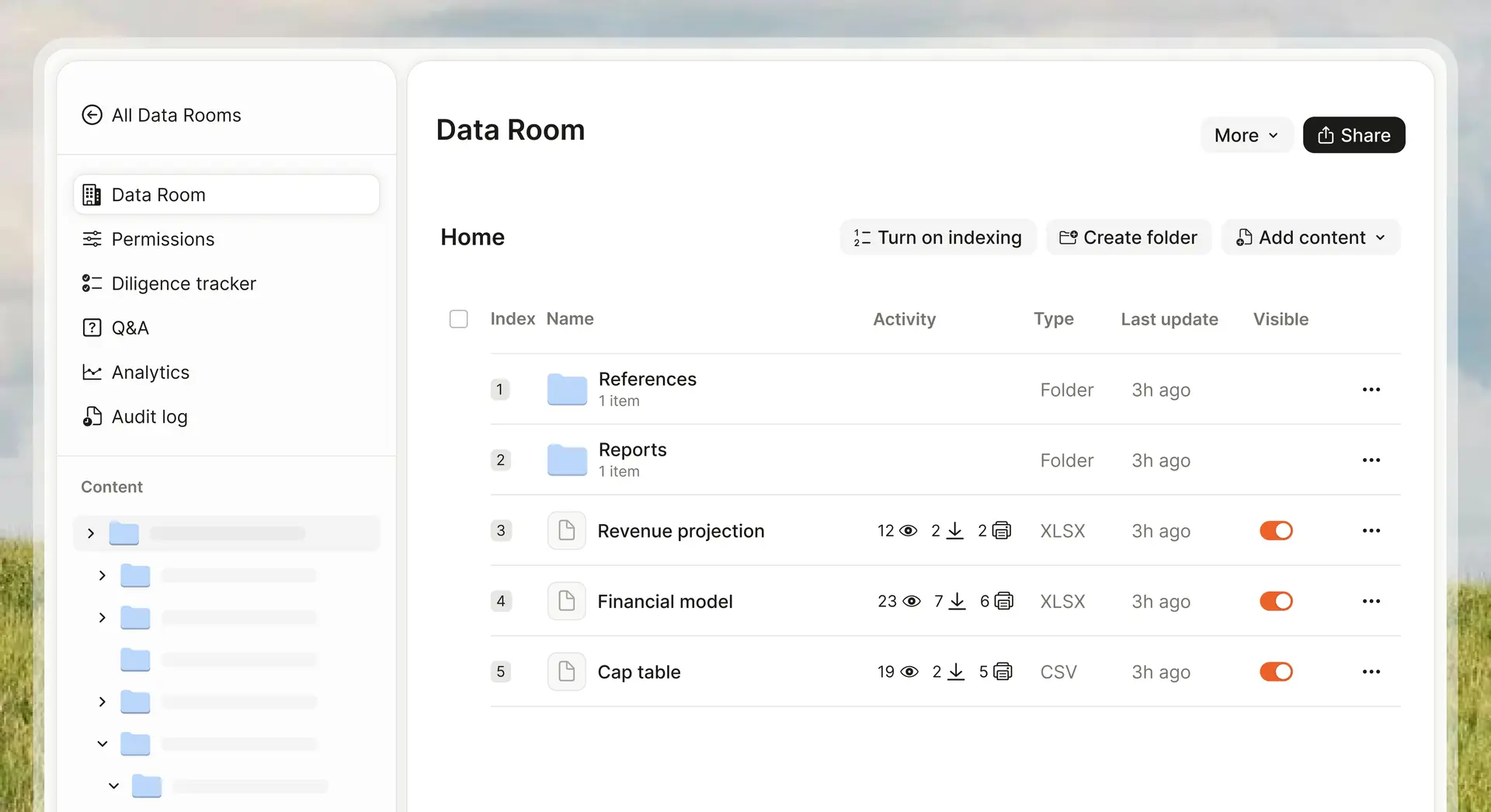
Ellty is built for businesses who need secure document sharing without the enterprise overhead. It's well-suited for anyone who needs to share sensitive documents in a controlled, trackable way.
Here's what the data room features look like across Ellty plans:


Where Ellty works well: Ellty is a modern document sharing and data room platform built for anyone who needs to share sensitive documents professionally without the complexity or cost of enterprise VDR software. Where most VDR tools are built around M&A dealmakers at large firms, Ellty is designed to be accessible to a much wider range of users: startups raising their first round, consultants sharing client deliverables, real estate brokers managing property deals, or small businesses going through an acquisition.

Setting up a secure data room: a practical checklist
Before you invite your first visitor or counterparty, run through this list.
Before you create the room:
- Define who needs access to what - don't default to giving everyone full access
- Organize documents into folders by sensitivity level
- Prepare your NDA if you want NDA gating enabled
When you configure the room:
- Enable watermarking (dynamic, not static)
- Set download permissions per folder or document
- Turn on NDA gating for full data room access
- Activate 2FA requirements for all users
- Set session timeouts and link expiry dates
When you invite users:
- Use individual email invitations, not shared links, wherever possible
- Assign permissions by role, not by person (easier to manage as the list grows)
- Document who was invited and when
Ongoing:
- Check audit logs weekly
- Revoke access immediately when a party is no longer in the process
- Archive the room with logs intact when the process closes
How to compare virtual data room providers on security
When you're evaluating options, here are the questions that actually matter. Don't let a vendor skip any of them.
- What certifications do you hold? (Ask specifically for SOC 2 Type II, not just "SOC 2")
- What encryption standard do you use at rest and in transit?
- How long are audit logs retained?
- Can I revoke access instantly without contacting support?
- Is dynamic watermarking available, and is it on by default?
- How is NDA gating implemented - is it legally enforceable?
- What is your incident response process and SLA for security events?
- Where is data stored, and do you offer regional data residency?
- What is your pricing model - per user, per document, flat fee?
- What happens to my data when I close my account?
If a vendor is vague on any of these, treat it as a signal.
FAQ
What is a virtual data room used for?
A virtual data room is used to securely store and share confidential documents during high-stakes business processes. The most common use cases are fundraising and investor due diligence, mergers and acquisitions, legal proceedings, board reporting, and IPO preparation. The defining characteristic is that access is controlled, tracked, and time-limited - unlike a shared Google Drive folder or Dropbox link.
What security certifications should a virtual data room provider have?
At minimum, look for SOC 2 Type II certification. This means an independent auditor has verified the provider's security controls over time, not just at one snapshot. ISO 27001 is important if you're working with European parties. For any data touching EU residents, GDPR compliance is legally required. Beyond certifications, verify that the platform uses AES-256 encryption both at rest and in transit.
Is a virtual data room more secure than Google Drive or Dropbox?
Yes - significantly. The difference isn't just encryption (which Dropbox and Google Drive also offer). It's the control layer on top: granular permissions, audit logs that track every view and download, NDA gating before access is granted, watermarking, and the ability to revoke access instantly. You can't configure a shared Google Drive folder to auto-watermark documents with viewer email addresses. That's the gap VDRs fill.
What is dynamic watermarking in a virtual data room?
Dynamic watermarking means every document a user views or downloads is automatically stamped with their identifying information - typically their name, email address, IP address, and a timestamp. Unlike a static watermark that's added manually before uploading, dynamic watermarks are applied by the platform in real-time and are unique to each viewer. They don't prevent screenshots, but they create a strong deterrent and a traceable record if information leaks.
What are audit logs in a virtual data room and why do they matter?
Audit logs are a complete record of every action taken inside a data room - who accessed it, which documents they opened, how long they spent on each file, what they downloaded, and when they left. They matter for two reasons. First, they're a security and compliance record. If something goes wrong during due diligence - a leak, a breach, a dispute - you have documentation. Second, for fundraising, audit logs function as engagement analytics. Knowing that an viewer spent 40 minutes on your financial model but skipped your team slide tells you something useful.
How much does a virtual data room cost?
It depends entirely on the provider and what you need. Enterprise-grade VDRs used for M&A processes can cost thousands per month, often priced per page, per user, or per GB. Ellty Data Room plan starts at $149 per month and includes granular permissions, NDA gating, dynamic watermarking, and restricted visitor access - with 3 users included and no per-viewer pricing. The Data Room Plus plan at $349 per month adds group permissions, audit logs, and up to 4,000 assets per room.
What is NDA gating in a virtual data room?
NDA gating means a user must electronically sign a non-disclosure agreement before they can access any documents in the room. The signature is time-stamped and stored as part of the room's records. This is important because it creates a legal paper trail showing that every person who saw your confidential materials explicitly agreed to keep them confidential - before seeing anything. It's a lightweight but meaningful legal protection.
Can visitors download documents from a virtual data room?
That depends on how you configure it. Most VDR platforms let you control download permissions at the folder or document level. You can allow viewing only, allow downloading for specific users, or block printing and downloading entirely. For early-stage conversations and deals with visitors you don't know well yet, view-only with watermarking is a reasonable default. You can unlock download access later once NDAs are signed and the conversation is more serious.
What happens to my data room documents if I cancel my subscription?
This varies by provider and you should ask explicitly before signing up. Some platforms give you a grace period to export everything. Others lock you out immediately. Some retain your data for a set period after cancellation; others delete it. Before using any VDR for a live due diligence process, confirm the data portability and deletion policy in writing. This is especially important if your data room documents are needed as a legal record after the deal closes.
How do I know if my virtual data room has been breached?
A well-configured VDR will alert you to suspicious activity in real time - multiple failed login attempts, access from unusual locations, or a single user downloading large volumes of documents rapidly. Audit logs give you visibility into normal behavior patterns so anomalies stand out. Real-time notifications for access events mean you'll know immediately when someone enters your room. The combination of notifications, audit logs, and activity analytics is your detection layer - it won't prevent a determined insider threat, but it gives you the visibility to catch and respond quickly.
Wrapping up
Know where you are. Choose accordingly.
Ellty is built for teams who want the security features that actually matter in businesses - without the pricing model that penalizes you for inviting one more visitor. Set up a secure data room in minutes and see exactly who's reading your documents, which pages they're spending time on, and when they've looked.
Try Ellty free - no credit card required. Start sharing smarter.
Author

Anika Tabassum Nionta is a Content Manager at Ellty, where she writes about secure document sharing, virtual data rooms, M&A, due diligence, fundraising, and sales enablement. With over 6 years of writing experience, she helps professionals understand how to share confidential documents securely, track engagement, and manage deals more effectively. Anika holds both a BA and MA in English from Dhaka University. Outside of work, she enjoys reading, exploring new cafes in Dhaka, and connecting with entrepreneurs and dealmakers in her community.

