
You're about to share sensitive documents with people outside your organization. Before you do, you should understand exactly what's protecting those files and what isn't.
When someone requests access to a data room, they're not just asking for a folder of files. They want a controlled, auditable environment where confidential documents can be reviewed without ending up in the wrong hands.
Most virtual data room platforms say they use "military-grade encryption." That phrase gets thrown around a lot. Let's unpack what it actually means, how AES-256 works in practice, how secure a virtual data room really is, and whether the investment is worth it for your needs.
What is a virtual data room?
A virtual data room (VDR) is a secure online space for storing and sharing confidential documents. It's used across industries and situations - M&A due diligence, legal transactions, board reporting, clinical trials, real estate deals, fundraising, and any process that requires controlled document sharing between multiple parties.
The key difference between a VDR and a regular cloud drive like Google Drive or Dropbox is control. With a VDR, you decide who sees what, for how long, and under what conditions. You can track every view, set expiry dates on access, require NDAs before entry, and revoke permissions at any time.
At its core, a VDR is a document control system with a security layer built on top. Encryption is a critical part of that security layer.


What is AES-256 and why does it matter?
AES stands for Advanced Encryption Standard. The 256 refers to the key length - 256 bits. This is the same standard used by the U.S. government to protect classified information, and by banks to protect financial transactions.
To put that in perspective: breaking a 256-bit AES key by brute force would require more computational energy than currently exists on Earth. It's not crackable with today's technology, and likely won't be for decades.
Here's the short version of how it works:
- 01. Your file gets encrypted before it leaves your browser. AES-256 transforms your document into an unreadable string of characters using a secret key.
- 02. The encrypted file travels over TLS (HTTPS). Even if someone intercepts the connection, they see meaningless noise - not your document.
- 03. The file sits on the server in encrypted form. The server stores the cipher, not the plaintext. Even the storage provider can't read your files without the key.
- 04. When an authorized viewer opens the file, it decrypts in real time. The key is used to reverse the process, rendering your document readable only to that authorized session.
Key concept
There are two states where your file needs protection: at rest (when it's sitting on a server) and in transit (when it's moving from server to browser). A properly configured VDR encrypts both. If a platform only mentions one, ask about the other.
At-rest vs. in-transit encryption: why both matter
This distinction trips up a lot of people. Here's a quick breakdown:


Most enterprise VDRs offer both at-rest and in-transit encryption. End-to-end encryption is rarer and usually reserved for messaging apps or extremely high-security environments. For the vast majority of VDR use cases such as due diligence, legal reviews, board documents, regulatory submissions, at-rest and in-transit AES-256 encryption is more than sufficient.


How secure is a virtual data room, really?
Encryption is the foundation, but it's not the whole picture. The real security of a VDR comes from the access control layer built on top of it.
Here's what a well-configured VDR does beyond just encrypting files:
Granular permissions let you control access at the folder or document level. You can give one visitor read-only access to the financials and block them from the legal section entirely. You can restrict downloading, printing, or copy-paste.
Dynamic watermarking overlays the viewer's email address or IP onto each page in real time. If a document leaks, you know exactly who it came from.
NDA gating requires visitors to accept a non-disclosure agreement before they can view anything. This creates a legal layer on top of the technical one.
Audit logs record every action: who opened which document, which pages they spent time on, when they last accessed the room. This is essential for due diligence - it shows visitors are actually reviewing your materials, not just rubber-stamping.
Link expiry and access revocation mean you can cut access immediately after a deal closes or falls through. No more documents floating around in someone's inbox indefinitely.
Encryption protects your files from external attackers. Access controls protect them from authorized users who go out of bounds. You need both.
What is a VDR used for?

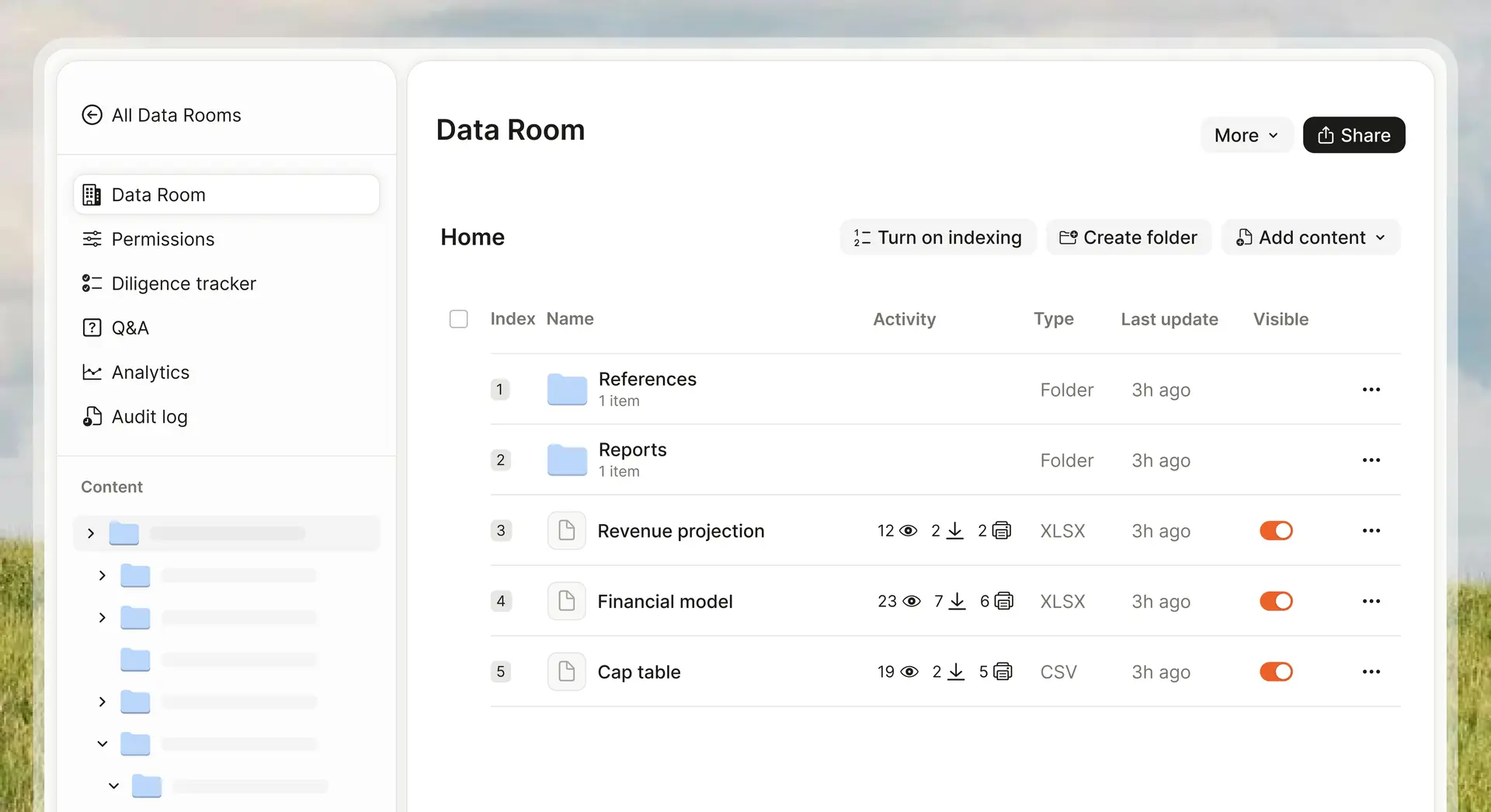
This question comes up a lot, especially for teams who are new. VDRs aren't just for massive M&A deals. Here's where they actually show up in the business lifecycle:


VDRs are used whenever organizations need to share sensitive documents with outside parties in a structured, trackable way. Some common examples include:
- Mergers and acquisitions - sharing financials, contracts, and operational data with buyers or their advisors
- Legal proceedings - exchanging evidence, case files, or discovery documents between legal teams
- Real estate transactions - managing property records, lease agreements, and due diligence materials
- Life sciences and clinical research - sharing trial data, regulatory filings, and IP documentation
- Board and investor reporting - distributing financial updates and strategic materials to stakeholders
- Fundraising and investment rounds - providing potential investors with the documents they need to evaluate a deal
- Audits and compliance reviews - giving auditors or regulators controlled access to records
The common thread: documents that can't afford to end up in the wrong hands. That's when you need a VDR.

Essential security features to look for in a VDR
Not all VDRs are built the same. When evaluating one, these are the core security features that actually matter:
Encryption. A good VDR encrypts your files both when they're stored (at rest) and when they're being shared (in transit). AES-256 is the standard to look for. It's the same encryption used by banks and governments, and it's essentially unbreakable with current technology.
Two-factor authentication (2FA). Passwords alone aren't enough. With 2FA, users need a second verification step, like a code sent to their phone, before they can log in. Even if someone's password gets stolen, they still can't get in.
Access controls and permissions. You should be able to decide exactly who can see, download, or edit each document. A well-built VDR lets you set different permission levels for different users, for example, one party can only view, while another can also download.
Audit logs. Every action inside the VDR should be tracked - who opened a file, when, and for how long. This gives you a full record of document activity and helps you spot anything suspicious.
Data backup and disaster recovery. Reputable providers automatically back up your data and store it across multiple locations. If something goes wrong like a server failure, a cyberattack, your documents can be restored quickly with minimal disruption.
Compliance certifications. Look for providers that carry recognized certifications like ISO 27001, SOC 2, GDPR compliance, or HIPAA (for healthcare). These aren't just badges, they mean the provider has been independently audited against strict security standards.


How virtual data rooms prevent data breaches
The three most common cyber threats that target document-sharing environments are malware, phishing, and man-in-the-middle attacks. Here's how a good VDR protects against each one:
Malware
Malicious software can sneak in through a bad link or email attachment and try to access or corrupt your files. VDRs defend against this with strong encryption (which makes stolen files unreadable), real-time threat monitoring, and regular security updates that patch known vulnerabilities before they can be exploited.
Phishing
This is when someone pretends to be a trusted contact to trick users into giving up their login credentials. VDRs counter this with two-factor authentication, so even if someone falls for a phishing attempt and hands over their password, the attacker still can't access the data room without the second verification step. Some platforms also offer user training and email filtering to catch phishing attempts early.
Man-in-the-middle attacks
This is when an attacker secretly intercepts data as it travels between two parties. VDRs prevent this through Transport Layer Security (TLS) and end-to-end encryption, which scramble the data in transit so that even if it's intercepted, it's completely unreadable.
Together, these protections make a properly configured VDR significantly more resilient than regular file-sharing tools.
Common VDR vulnerabilities and how to avoid them
Even with strong platform-level security, vulnerabilities often come from how the VDR is set up and used. Here are the most common issues and how to prevent them:
Weak passwords.
Simple or reused passwords are one of the easiest ways for attackers to get in. Enforce strong password policies: a mix of letters, numbers, and symbols. Consider recommending a password manager to users.
Sharing files outside the VDR.
If someone exports a document and sends it via regular email or a personal cloud drive, all the VDR's protections become irrelevant. Make sure your team understands that sensitive files should only be shared through the VDR itself.
Overly broad access permissions.
Giving everyone access to everything is a common mistake. Set permissions based on what each person actually needs to see, nothing more. Review and update access levels regularly, and revoke them immediately when someone's involvement ends.
No activity monitoring.
Without audit logs, you have no way of knowing if something suspicious is happening. Always use a VDR that tracks user activity, and check those logs periodically, don't just set it and forget it.
No backup plan.
If your provider doesn't have solid backup and recovery systems, a technical failure could mean lost documents at a critical moment. Confirm that your VDR provider runs regular automated backups and has a documented disaster recovery process.
Industry-specific security needs
While the core security features of a VDR apply across the board, different industries have specific requirements that go beyond the basics:
Finance and M&A
Financial transactions involve highly sensitive data such as valuations, contracts, client records etc. These are prime targets for leaks and insider threats. VDRs used in these contexts need robust encryption, granular permissions, and real-time audit trails. Compliance with regulations like the Sarbanes-Oxley Act is also essential for publicly traded companies.
Legal
Law firms and legal teams deal with privileged communications and confidential case materials. A breach here doesn't just expose data, it can compromise an entire legal strategy. VDRs for legal use need role-based permissions, document watermarking, and redaction tools to protect sensitive content.
Healthcare
Patient records and medical data are among the most regulated types of information in the world. VDRs used in healthcare must comply with HIPAA (in the US) and similar frameworks elsewhere. This means strict access controls, detailed audit trails, and encryption at every level.
Real estate
Large real estate transactions involve layers of documentation - title records, lease agreements, financial disclosures. They are shared between multiple parties. VDRs here need to handle large document volumes securely while giving different stakeholders controlled, time-limited access.
Life sciences and clinical research
Trial data, regulatory submissions, and intellectual property in this space are extremely sensitive. VDRs must support secure collaboration across international teams while maintaining compliance with regulatory bodies.
When choosing a VDR, think about the compliance requirements specific to your industry and confirm that the provider can meet them.
How Ellty handles encryption and document security

Ellty uses AES-256 encryption for files at rest and TLS for files in transit - the same standard applied across the platform whether you're on the free plan or Data Room Plus.
Beyond encryption, here's what the data room features actually include:
On the Data Room plan ($149/month), you get granular permissions to control access at the document level, NDA gating so visitors must agree to terms before entering, dynamic watermarking that stamps the viewer's identity on every page, and restricted visitor access so you control exactly who gets in.
On Data Room Plus ($349/month), you add group visitor permissions for managing multiple parties efficiently, full audit logs for every action taken in the room, and capacity for up to 4,000 assets per data room - suitable for complex due diligence with heavy document loads.
Ellty works well when you need a clean, fast setup for sharing a core set of documents like a pitch deck, financial model, and supporting materials with multiple stakeholders in a structured way. It's not built for massive M&A transactions involving hundreds of parties and terabytes of data. If that's your scenario, you'll likely need an enterprise VDR. But for most businesses, it's the right fit without the enterprise overhead.


What to look for when evaluating VDR security
Not all platforms are equally transparent about their security setup. When you're evaluating a VDR, here are the questions worth asking:


One thing to note on certifications: SOC 2 and ISO 27001 are the gold standard for VDR security validation. They require third-party audits of security controls, not just self-reported practices. If you're in an industry with strict compliance requirements (fintech, healthtech, legal), ask specifically about certifications before signing up.
Before committing to a provider, here's a straightforward process to assess whether their security is actually up to standard:
Check for certifications. Ask whether the provider holds ISO 27001, SOC 2, GDPR compliance, or other relevant certifications. These mean a third party has independently verified their security practices, not just the company's own claims.
Review their encryption standards. Confirm they use AES-256 for data at rest and TLS for data in transit. If a provider can't clearly answer this question, that's a red flag.
Request a demo. Don't just read the feature list, actually use the platform. Pay attention to how easy it is to set permissions, whether the audit logs are detailed and readable, and how intuitive the access controls are.
Ask about incident response. What happens if there's a breach? A trustworthy provider will have a clear, documented process for detecting incidents, notifying affected users, and resolving the problem quickly. If they're vague on this, look elsewhere.
Read independent reviews. Check what real users say on third-party review platforms. Look specifically for comments about data security, uptime reliability, and how the support team handles problems, not just general satisfaction scores.
Running through these five steps will give you a much clearer picture of whether a VDR's security can actually hold up when it matters.
Practical tip
Before you open your data room to investors, do a test run. Create a guest account with limited access and walk through the experience yourself. Check what's visible, what's blocked, and whether the watermark and NDA gate work as expected. Five minutes of testing can prevent a serious mistake.
Frequently asked questions
How secure is a virtual data room?
A properly configured VDR is very secure for document sharing purposes. AES-256 encryption protects files at rest, TLS protects them in transit, and access control layers (permissions, watermarks, NDAs) protect against misuse by authorized parties. The biggest security risks in practice are configuration errors - giving too-broad access, not using watermarking, or leaving rooms open after deals close - not the encryption itself.
What does AES-256 encryption actually mean?
AES-256 is an encryption algorithm that scrambles your file using a 256-bit key - the same standard used by governments and financial institutions. Breaking it by brute force is computationally infeasible with current or near-future technology. When a VDR says it uses AES-256, it means files stored on their servers can't be read even if someone gains unauthorized access to the storage infrastructure.
What is a VDR used for?
VDRs are used anytime confidential documents need to be shared with external parties in a controlled, auditable way. Most common use cases: startup fundraising (sharing pitch decks and financials with VCs), M&A due diligence, board reporting, legal transactions, and real estate deals. Essentially, anywhere a shared Dropbox folder feels too risky and email attachments are too hard to control.
How much does a VDR cost?
It varies widely. Enterprise platforms like Intralinks or Datasite can run $500 to $2,000+ per month - they're priced for large M&A transactions. Ellty Data Room plan starts at $149/month and includes granular permissions, NDA gating, and dynamic watermarking, with no per-user fees. A free plan is also available for basic secure sharing with document analytics.
Do I need a VDR for a seed round, or is a shared drive enough?
For very early conversations, a shared folder may be fine. But once you're sharing detailed financials, cap tables, or term sheets with multiple parties, a VDR gives you meaningful control: you can track who viewed what, revoke access after a deal, require NDAs, and prevent downloading. A shared drive can't do any of that. The $149/month for a proper data room is usually worth it once you're in active due diligence.
What's the difference between encryption at rest and in transit?
At-rest encryption protects files while they're stored on a server - so if someone breaks into the data center or cloud storage, they can't read your files. In-transit encryption (via TLS) protects files as they travel between the server and the user's browser - so if someone intercepts your internet connection, they get gibberish. Both are necessary. Most reputable VDRs offer both; confirm before signing up.
What is dynamic watermarking and why does it matter?
Dynamic watermarking overlays identifying information - typically the viewer's email address or IP - on every page of a document in real time. The viewer doesn't add the watermark; the platform does it automatically when the document is rendered. If that document gets photographed or forwarded, the watermark traces it back to the source. It's a deterrent and a forensic tool in one.
Can I use a VDR for pitch deck sharing before I set up a full data room?
Yes, and it makes sense to. Sharing a trackable pitch deck link gives you analytics on investor engagement - which slides they viewed, how long they spent, whether they came back - before you've opened a full due diligence room. Ellty supports this use case: trackable links and page-level analytics are available on the free and standard plans, and you can upgrade to full data room features when you need them.
How quickly can I set up a virtual data room?
With modern platforms, a basic data room can be configured in under an hour. You upload your documents, organize them into folders, set permissions per viewer or group, configure NDA gating if needed, and send links. Enterprise platforms with complex admin setups can take longer. Ellty is designed specifically for this - minimal configuration overhead, functional out of the box.
What security certifications should a VDR have?
SOC 2 Type II and ISO 27001 are the most recognized. SOC 2 Type II means an independent auditor has verified the platform's security controls over a sustained period - not just a point-in-time snapshot. ISO 27001 is an international standard for information security management. If you're in a compliance-heavy industry, ask specifically which certifications a provider holds before committing. Don't rely on marketing claims - ask for documentation.
Author

Anika Tabassum Nionta is a Content Manager at Ellty, where she writes about secure document sharing, virtual data rooms, M&A, due diligence, fundraising, and sales enablement. With over 6 years of writing experience, she helps professionals understand how to share confidential documents securely, track engagement, and manage deals more effectively. Anika holds both a BA and MA in English from Dhaka University. Outside of work, she enjoys reading, exploring new cafes in Dhaka, and connecting with entrepreneurs and dealmakers in her community.

