
You're preparing to go public. Underwriters, lawyers, auditors, and regulators are all asking for documents - at the same time, from different locations. A virtual data room is how you handle that without losing control of your most sensitive information.
This guide covers everything: what a VDR actually is, which documents go in it, how much it costs, how to set one up, and how to pick the right one for your stage. No fluff, no jargon, just what you need.
What is a virtual data room?
A virtual data room (VDR) is a secure online space where you store and share confidential company documents with authorized parties - underwriters, legal counsel, auditors, and investors - during sensitive transactions like IPOs, M&A deals, or fundraising rounds.
Before VDRs existed, companies used physical data rooms: actual rooms filled with filing cabinets, where authorized people had to fly in to review documents under supervision. That worked, but it was slow, expensive, and deeply inconvenient. Today, everything happens online, with much better access controls and a complete audit trail of who looked at what.
What sets a VDR apart from just sharing a Google Drive folder:

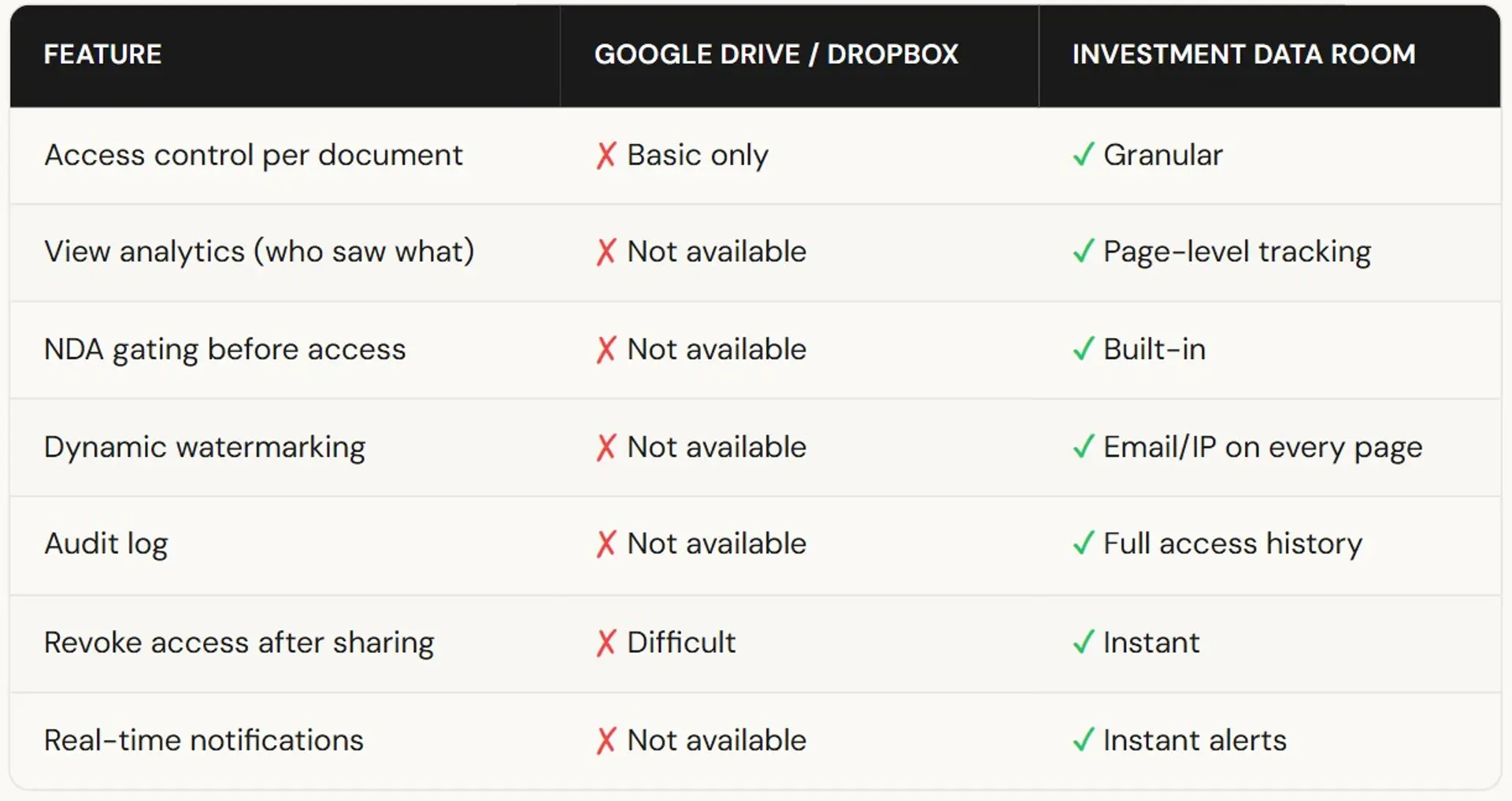
For an IPO, regulators and underwriters expect a VDR. Sharing a Dropbox link is not a serious option at that stage.
Why do you need a virtual data room for an IPO?
Going public is probably the most document-heavy process your company will ever go through. You're dealing with underwriters reviewing your financials, legal teams checking contracts, auditors verifying records, and regulators scrutinizing governance - all at once, often across different time zones.
A VDR solves a few specific problems here.
First, it keeps everything in one place. You don't want your CFO emailing the latest financials to six different parties in separate threads. Version control becomes a nightmare fast. A VDR gives everyone a single source of truth.
Second, it controls who sees what. Your underwriters don't need to see every employment contract. Your potential visitors don't need your internal legal memos. Granular permissions let you show the right documents to the right people.
Third, it creates a legal record. During an IPO, you need to prove that sensitive data was shared appropriately, with the right people, at the right time. The audit trail in a VDR does that automatically.
Fourth, it saves time. PwC notes that companies typically spend three to six months preparing IPO materials. Having everything organized in a VDR from the start keeps that timeline from running long because someone can't find a document or a wrong version gets sent.
You don't need to wait until your IPO to start building your data room. Start organizing your documents now on Ellty free plan. No credit card, no demo call, just sign up and go.
Is a VDR mandatory for an IPO?
Technically, no specific law says you must use a virtual data room. But practically, yes, you'll need one. Here's why.
Underwriters require organized, controlled access to hundreds of documents. Regulators like the SEC expect transparent, well-structured document disclosure. Your legal team needs audit logs showing what was shared and when. All of that is nearly impossible to manage manually at IPO scale.
If you try to handle an IPO without a VDR, using email attachments and shared folders, you'll slow down the process, create compliance risks, and signal to visitors that your internal processes aren't ready for public company standards. That's not a great look right before your listing.
So while it's not legally required in name, every serious IPO uses one. Think of it less as mandatory and more as table stakes.
What documents go in an IPO data room?
This is where most teams get overwhelmed. The document list for an IPO is long. Here's a practical breakdown of what underwriters, regulators, and investors will expect to find.

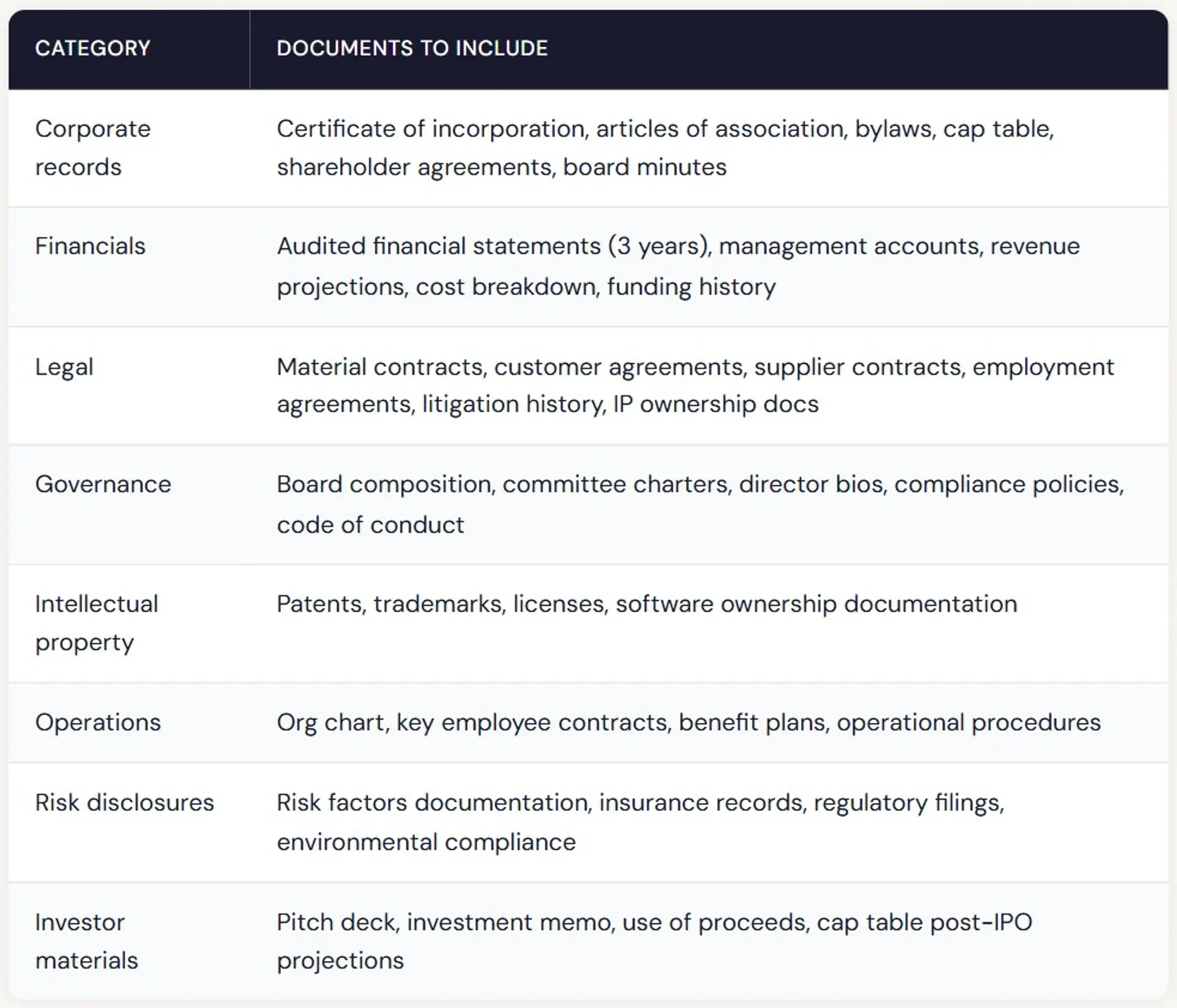
Don't dump all of this into one folder. Organize it with clear categories and consistent naming. Something like "01_Financials / 1.1_Audited_Statements_2026" is far more useful than "Final_FINAL_v3.pdf."
A few practical rules for your document list:
- Keep financials current. If your P&L in the data room is six months old, that's a problem. Update it as your books close.
- Use clear file names with dates. "Audited_Financials_FY2025.pdf" beats any version that ends in "final."
- Clean up metadata. Remove internal comments, tracked changes, and anything you wouldn't want a regulator to read.
- Test access before you go live. Create a test user and walk through the experience a potential reviewer would have.
How to create a virtual data room for an IPO
Setting up a VDR doesn't have to take weeks. Here's the process, step by step.
- Pick a platform that fits your stage and deal complexity. For early IPO prep, you don't need a $3,000/month enterprise platform. A tool with granular permissions, NDA gating, audit logs, and watermarking covers the core needs. Ellty Data Room plan starts at $149/month and includes all of those features with no per-user fees.
- Define your user groups before uploading anything. Who needs access to what? Underwriters need financials and governance. Legal counsel needs contracts and litigation history. Auditors need financial records. Investors need the investor materials folder. Map this out first, then build the permission structure around it.
- Build your folder structure. Use the category breakdown from the section above. Number your folders (01, 02, 03...) so they stay in order. Create sub-folders for each document type within each category. Don't put everything at the top level.
- Upload and organize your documents. Use consistent naming with dates. Remove draft versions - only upload final, clean files. If you're uploading PDFs, make sure they're text-searchable, not just scanned images.
- Set permissions per user group. Give each group access only to what they need. Set view-only permissions on sensitive documents you don't want downloaded. Enable watermarking on financial statements and legal documents.
- Gate the room with an NDA. Before anyone can access the data room, they should agree to an NDA digitally. This is legally timestamped and logged. It's standard practice for any serious due diligence process.
- Run a test before sharing. Create a dummy reviewer account and walk through the whole experience. Check that permissions work as intended, that documents open correctly, and that the NDA gate functions.
- Enable notifications and analytics. You'll want to know when underwriters or investors access the room, which documents they spend time on, and what they're skipping. This tells you where questions are coming from before they arrive.

How much does a VDR cost?
VDR pricing is one of the least transparent areas in software. Enterprise providers don't publish prices. They quote based on deal size, page count, and user count and the numbers can surprise you.
Here's a practical breakdown of what to expect:

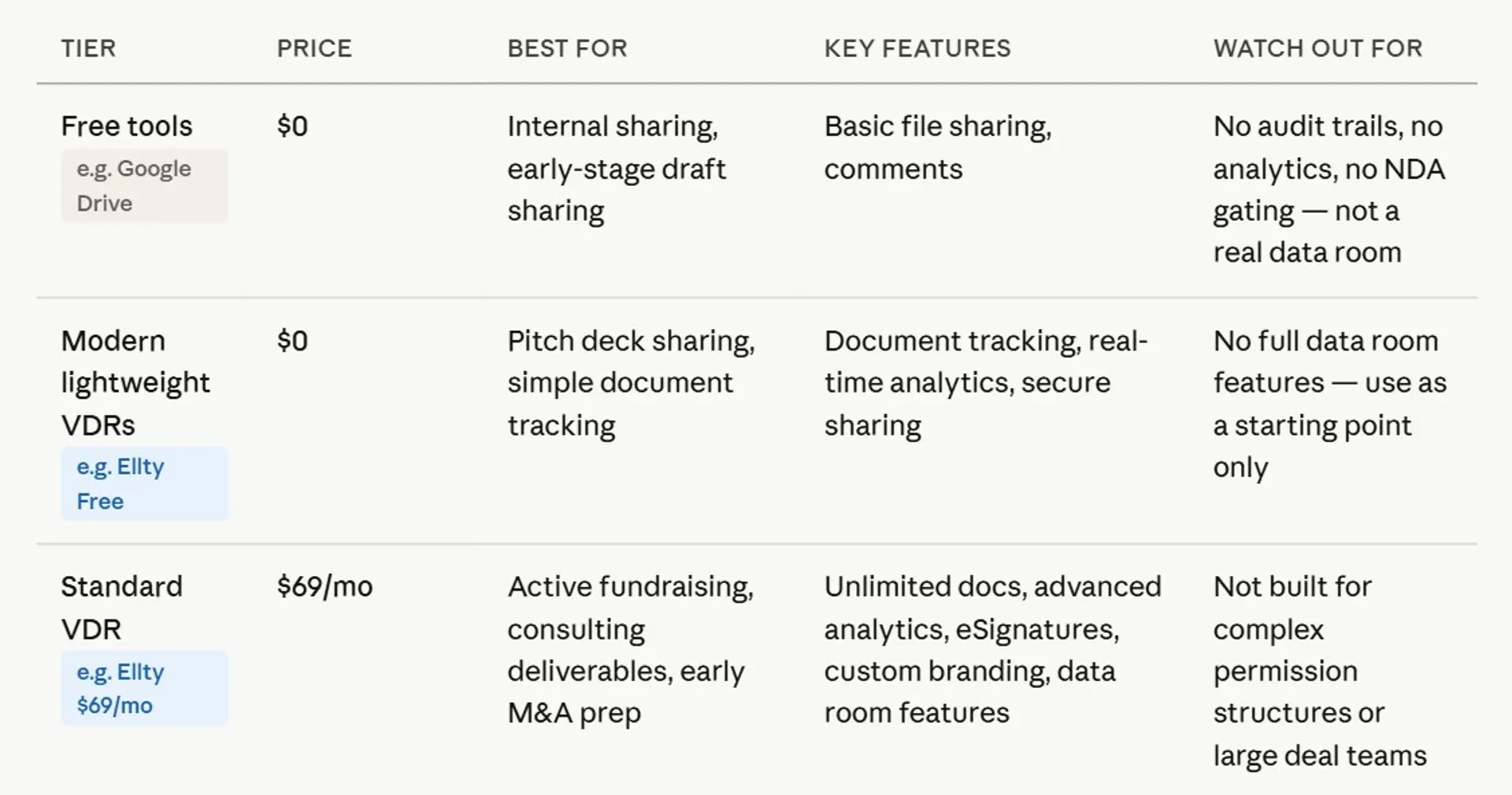

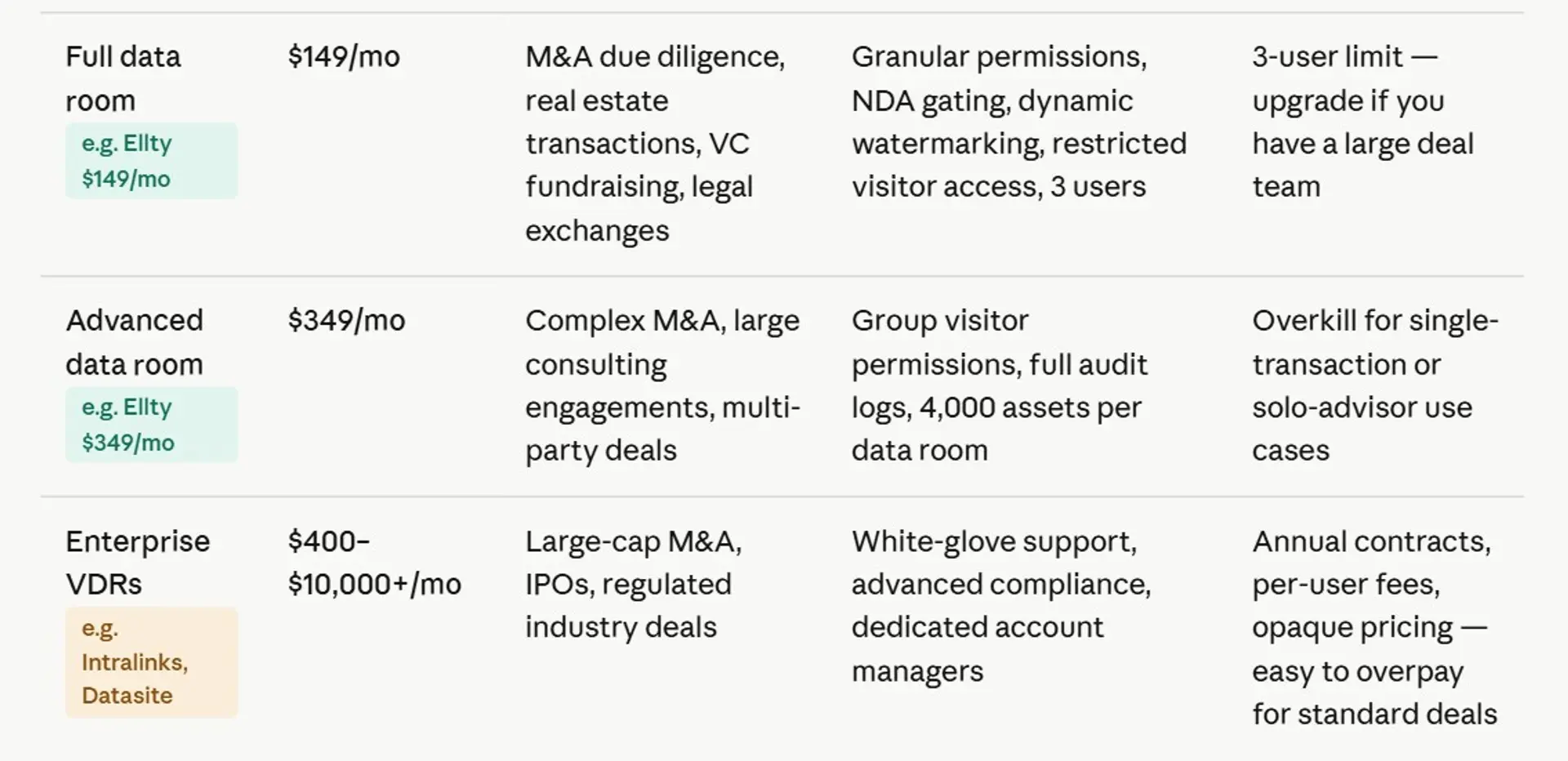
Ellty published plans, for reference:


No per-user fees at any tier. That matters when you're sharing with 15 people across your legal team, underwriters, and investors. Per-seat pricing at that scale adds up fast with other providers.
6 best virtual data rooms for an IPO
1. Ellty

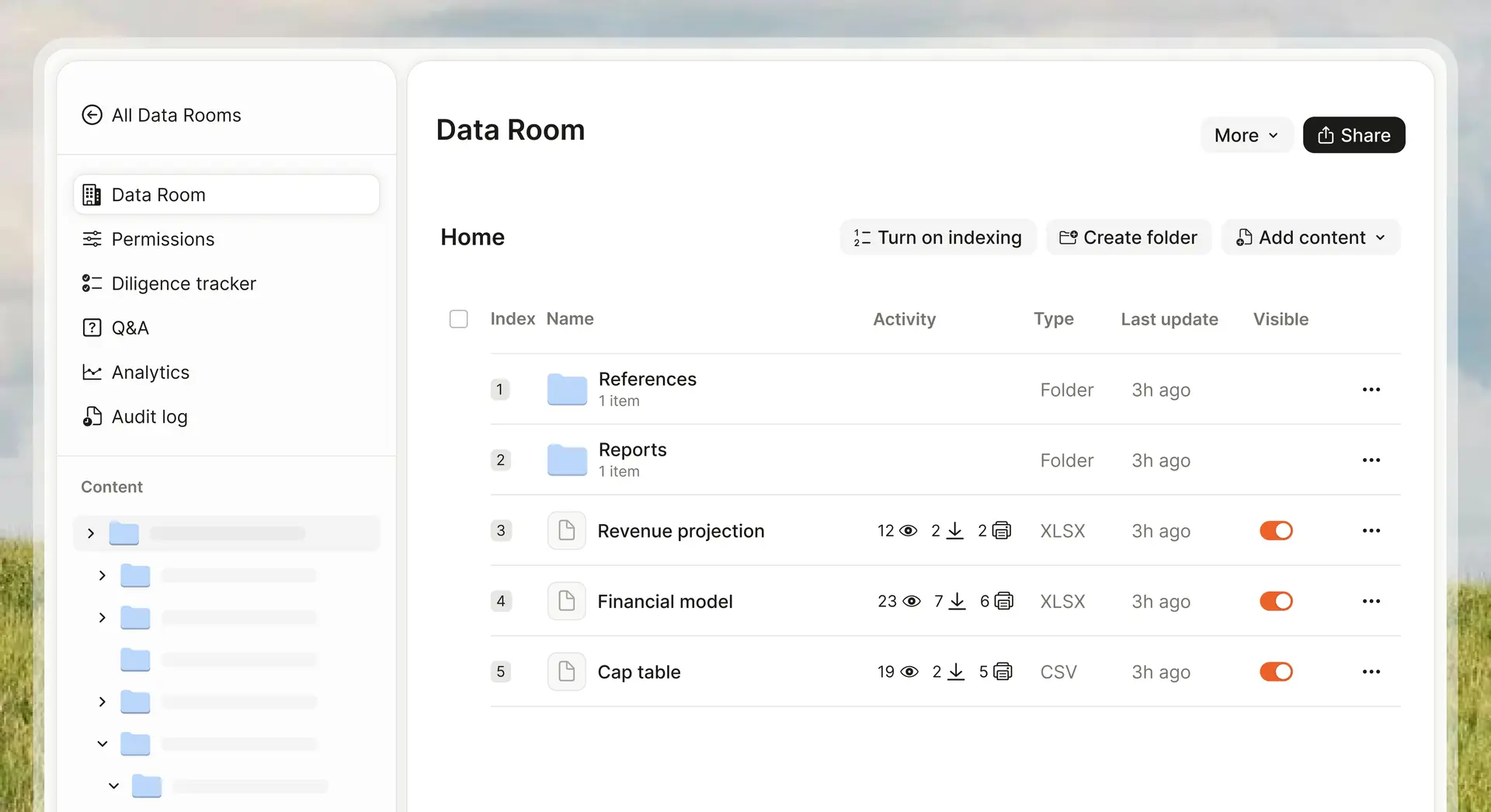
Ellty is a secure document sharing and analytics platform built for anyone managing high-stakes transactions, including IPO preparation. When you're coordinating between legal teams, underwriters, auditors, and regulators, you need more than a shared folder. Ellty gives you granular access controls, NDA gating, dynamic watermarking, real-time activity tracking, and a clean audit trail - everything required to run a controlled, compliant document review process.
What makes Ellty stand out for an IPO is the pricing model. There are no per-user fees, no per-page charges, and no custom enterprise quotes that take weeks to negotiate. The Data Room plan at $149/month covers the core VDR features, and Data Room Plus at $349/month adds group permissions, full audit logs, and support for up to 4,000 assets - more than enough for a heavy IPO document load. You get set up quickly, know exactly what you're paying, and can scale access across dozens of reviewers without the bill ballooning. For companies moving toward a public offering who want a professional, secure data room without locking into a legacy enterprise contract, Ellty is the most practical and cost-transparent starting point available today.


2. Datasite

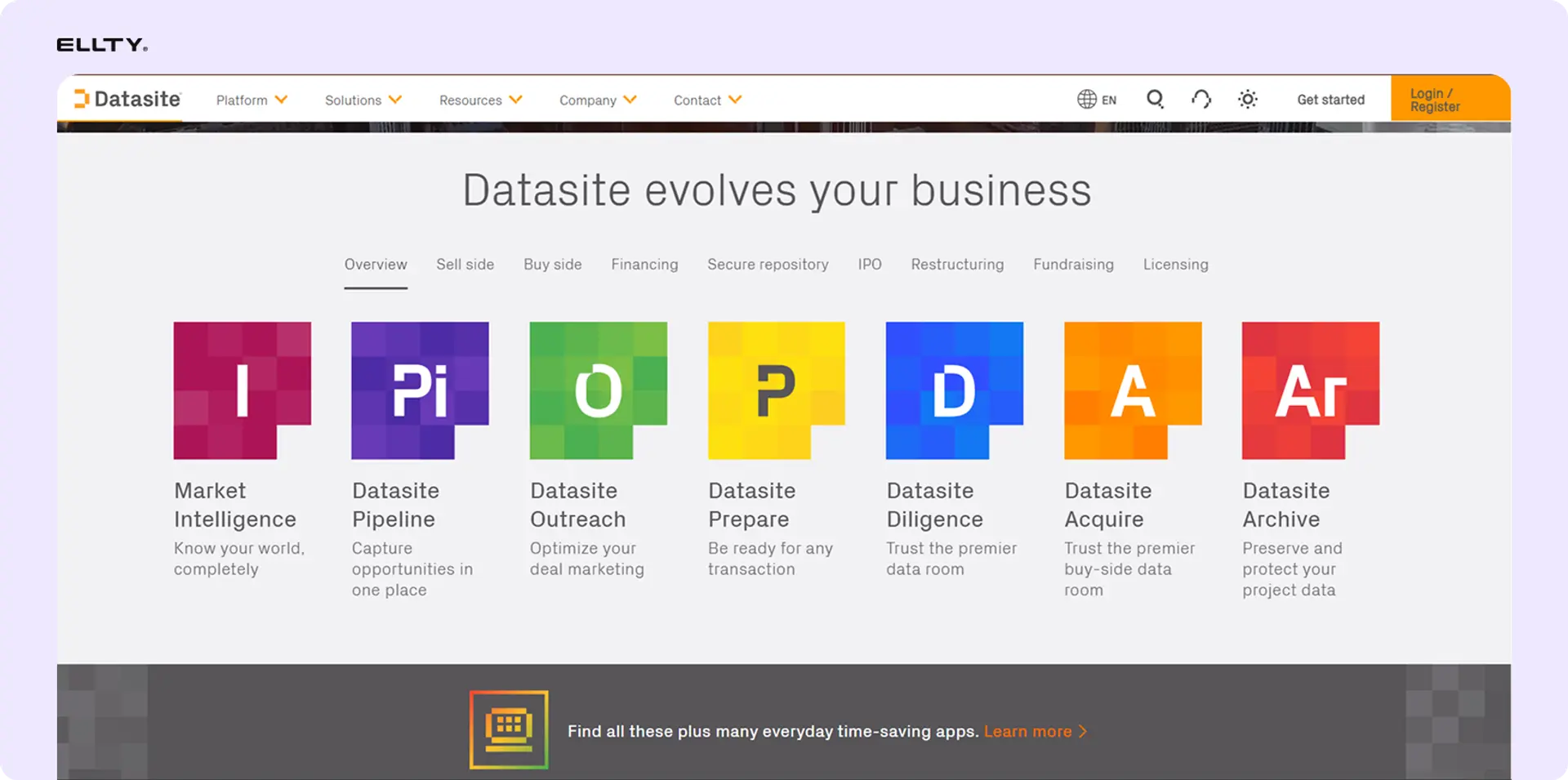
Datasite is one of the most recognized names in enterprise VDR, used extensively in M&A and IPO transactions globally. It offers a robust set of features built specifically for complex, multi-party deals, bulk document upload, AI-assisted redaction, granular permission settings, and a detailed audit trail that satisfies even the most demanding legal and compliance teams. The platform is designed to handle large document volumes without breaking a sweat, making it a reliable choice when your IPO data room needs to support hundreds of files across multiple reviewer groups.
Datasite also includes built-in Q&A functionality, which is particularly useful during due diligence when underwriters and legal counsel are submitting questions simultaneously. The interface is professional and the support team is experienced with high-pressure deal timelines. The main downside is cost. Datasite operates on custom enterprise pricing, and quotes can be expensive, especially for smaller companies approaching their first public offering. If budget is a concern, it's worth comparing against newer, flat-rate alternatives before committing. That said, for large-scale IPOs where the deal team is experienced with enterprise software and the transaction size justifies the cost, Datasite remains one of the most trusted and fully-featured platforms in the market.
3. Intralinks

Intralinks has been a staple of investment banking and capital markets for decades, and its reputation in IPO transactions is well established. The platform is built to handle the complexity of a public offering, large document libraries, multi-group access permissions, strict security controls, and a comprehensive audit trail that holds up under regulatory scrutiny. It integrates well with the workflows of legal advisors, investment banks, and compliance teams who are already familiar with the platform.
Intralinks also offers AI-powered document analysis features that can help teams organize and review materials faster during a demanding IPO timeline. The Q&A module is structured and trackable, which keeps communication between management and reviewers clean and documented. Like most legacy enterprise VDR platforms, Intralinks comes with custom pricing and the costs can be significant. Implementation can also take longer than newer cloud-native alternatives. It's best suited for large companies running complex IPO processes where the deal team has prior VDR experience and the transaction size supports the investment. For mid-market companies or first-time issuers looking for speed and simplicity, the platform may feel heavier than necessary.
4. Ansarada


Ansarada is an AI-powered deal platform that has built a strong reputation in M&A and capital markets, including IPO preparation. The platform goes beyond basic document storage. It uses AI to assess deal readiness, flag missing materials, and guide teams through the preparation process with structured checklists and progress tracking. For a company approaching an IPO, this kind of structured guidance can be genuinely valuable in keeping preparation on track across legal, financial, and compliance workstreams.
Ansarada's security features are solid, they include role-based permissions, dynamic watermarking, and full activity logs. The Q&A tool is well-designed for managing reviewer questions during due diligence. One of the more distinctive features is the deal readiness score, which gives management and advisors a clear view of how prepared the data room is at any given point. Pricing is subscription-based with tiered plans, and there is a free trial available, though full IPO-grade functionality sits in the higher tiers. It can feel more complex to set up than simpler platforms, but the additional structure is well suited to teams that want active guidance through the preparation process rather than just a place to store documents.
5. iDeals


iDeals is a well-regarded VDR platform used across M&A, real estate, and capital markets transactions including IPOs. It offers a clean, intuitive interface that makes it easier to onboard team members and external reviewers without extensive training, a practical advantage when deal timelines are tight. Security features are comprehensive: fence view, dynamic watermarking, granular access permissions, and a full audit log covering every document interaction. The Q&A module supports threaded communication between the deal team and reviewers, keeping all questions and responses organized and documented in one place.
iDeals is also available in multiple languages, which is useful for cross-border IPO processes involving international underwriters, legal advisors, or regulators. Customer support is available around the clock, which matters when a deal is moving fast across different time zones. Pricing is subscription-based and generally considered competitive relative to the older enterprise platforms, though it still operates on a per-user or tiered model rather than the flat-rate structure offered by newer platforms like Ellty. For teams that need a polished, reliable, full-featured VDR and are comfortable with traditional pricing models, iDeals is a strong and well-tested choice.
6. Firmex
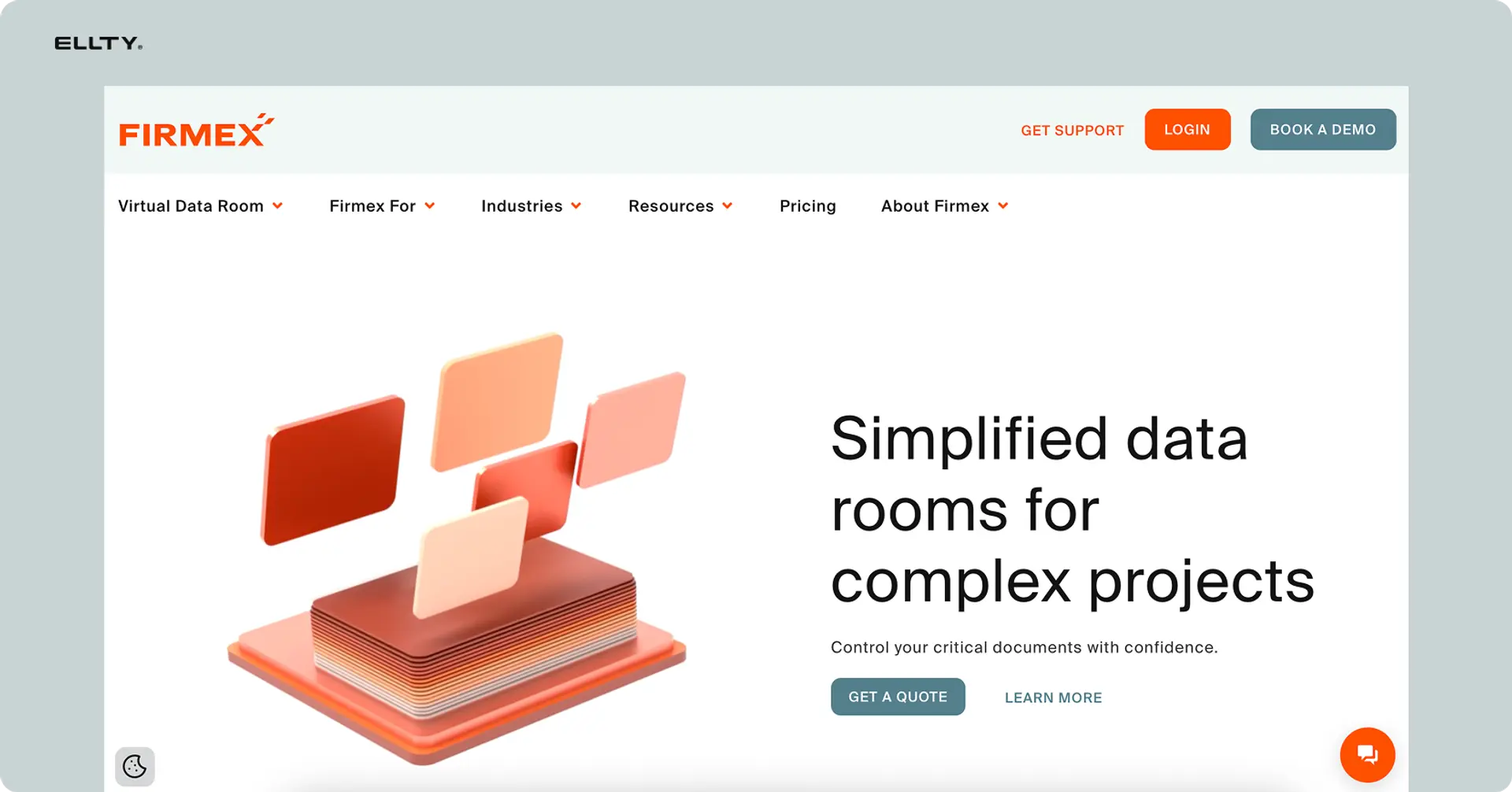
Firmex is a Canadian VDR provider with a long track record in capital markets, M&A, and regulatory transactions. It is widely used by investment banks, law firms, and corporate finance teams, making it a familiar platform for many of the advisors a company will work with during an IPO. The platform offers strong document security features including watermarking, granular permissions, restricted viewing modes, and a comprehensive audit trail. Setup is straightforward compared to some of the larger enterprise platforms, and the interface is clean enough that external reviewers can navigate it without much hand-holding.
Firmex supports large document volumes and includes a Q&A module for managing reviewer questions in an organized way. Customer support is a consistent highlight in user reviews, responsive and knowledgeable, especially during high-pressure deal periods. Pricing is project-based or subscription-based, and Firmex is often regarded as more affordable than the top-tier legacy platforms without sacrificing the core features that matter for a compliance-sensitive transaction. For mid-market companies preparing for a public offering who want a reliable, advisor-familiar platform at a more accessible price point, Firmex is worth serious consideration.
Virtual data room for M&A vs IPO - what's the difference?
The core setup is similar, but the use cases have meaningful differences.
In M&A, the VDR is primarily for the buyer's team to review the target company. The seller controls access, and the room is typically open for a defined due diligence window. The document focus is on financials, contracts, IP, and operational data. Multiple buyers may have access to separate rooms or separate permission levels within one room (a clean room setup).
For an IPO, the audience is broader: underwriters, legal counsel, auditors, regulators, and eventually investors. The timeline is longer, often six to twelve months. The compliance requirements are stricter because you're dealing with securities regulation. And the document set is more structured because it feeds directly into registration statements and prospectus filings.
Both need the same core features: granular permissions, NDA gating, audit logs, and watermarking. The scale and compliance complexity is higher for IPOs, especially large-cap listings. For most businesses going through Series A/B or an early IPO process, the same platform covers both use cases well.
Whether you're running an M&A, or preparing for an IPO, Ellty Data Room plan gives you the core features you need without locking you into a long-term enterprise contract. Try it free, no credit card required.
Frequently asked questions
Is a VDR mandatory for an IPO?
Not legally mandatory by name, but practically essential. Underwriters, regulators, and legal counsel all expect organized, controlled, auditable document access during an IPO. Managing that without a VDR is nearly impossible at scale. Every serious IPO uses one.
How much does a virtual data room cost?
Pricing ranges widely. Free plans cover basic secure sharing and analytics. Modern VDR plans with NDA gating and granular permissions typically run $100-$400/month. Mid-market tools range from $400-$800/month. Enterprise platforms like Intralinks and Datasite don't publish pricing - they quote by deal size and can run $1,000-$5,000/month or more. Ellty Data Room plan starts at $149/month with no per-user fees.
What documents should be in a virtual data room for an IPO?
The core categories are: corporate records (incorporation docs, cap table, bylaws), financials (audited statements, projections, funding history), legal documents (material contracts, IP ownership, litigation history), governance records (board minutes, compliance policies), and investor materials (pitch deck, investment memo, use of proceeds). Organize everything into clearly numbered folders before sharing.
How do I create a virtual data room?
Sign up for a VDR platform, define your user groups and what each needs access to, build a clear folder structure with numbered categories, upload your documents with clean file names, set permissions per group, enable NDA gating, run a test with a dummy account, then share the link. With a tool like Ellty, you can have a data room live in the same day without a sales call or implementation process.
What's the difference between a data room for IPO vs M&A?
Both use the same core setup: granular permissions, NDA gating, audit logs, watermarking. For M&A, the room is typically used by the buyer's team during a defined due diligence window. For an IPO, the audience is broader (underwriters, auditors, regulators, investors) and the timeline is longer. IPO data rooms also have stricter compliance requirements because they feed directly into securities filings.
Can I use Google Drive or Dropbox as a data room?
No - not for anything serious. Google Drive and Dropbox don't have audit trails, NDA gating, watermarking, or granular download controls. There's no way to see who viewed what, and you can't revoke access reliably after the fact. For everyday internal collaboration they're fine. For due diligence, fundraising, or IPO preparation involving sensitive documents, they're not appropriate.
How many users can access a data room?
It depends on the platform. Enterprise VDRs often charge per user, which is why costs can escalate quickly when you add 15 lawyers, 8 underwriters, and 20 potential investors. Ellty Data Room plans don't charge per user - the Data Room plan includes 3 users on the admin side, and visitor access (the investors and reviewers you share with) doesn't add per-seat costs.
When should I start setting up my IPO data room?
Earlier than you think. IPO preparation typically starts six to twelve months before listing. You want your data room built and organized well before underwriters and regulators start asking for documents. Setting it up under pressure leads to disorganized uploads, permission mistakes, and outdated files. Start building the structure as soon as you know an IPO is on the roadmap.

Author

Anika Tabassum Nionta is a Content Manager at Ellty, where she writes about secure document sharing, virtual data rooms, M&A, due diligence, fundraising, and sales enablement. With over 6 years of writing experience, she helps professionals understand how to share confidential documents securely, track engagement, and manage deals more effectively. Anika holds both a BA and MA in English from Dhaka University. Outside of work, she enjoys reading, exploring new cafes in Dhaka, and connecting with entrepreneurs and dealmakers in her community.

