
You're about to share sensitive company information with someone who could change your trajectory. Here's how to do it without chaos and without overpaying for software you don't need.
In this guide
- What is a data room
- What is the purpose of a data room
- Why strategic partnerships need one
- What should be included in a data room
- How much does a VDR cost
- Data rooms for strategic partnerships
- How to set one up (step by step)
- How to select a data room provider for strategic partnerships
- Key features to look for in a partnership data room
- Common data room mistakes in strategic partnerships
- FAQ
What is a data room for strategic partnerships
A data room is a secure, organized environment where you share confidential company documents with a defined group of external stakeholders. In the context of strategic partnerships, that typically means the business development team, legal counsel, and technical leads on the other side of the table. People who need to review your materials before a partnership agreement can move forward.
The term comes from the pre-internet era when companies would literally reserve a physical room, fill it with filing cabinets, and have reviewers travel in to examine documents in person. Today it's entirely digital. A virtual data room replaces that room with a cloud-based repository that comes with access controls, audit logs, permission settings, and analytics - all accessible from anywhere.
In a partnership context, a data room is how you make your business verifiable. When a potential partner's team says they need to "do their diligence," what they mean in practice is: they want to look at your financials, understand your legal structure, review relevant contracts, and assess whether your product and operations hold up to scrutiny. A data room is where all of that happens in a controlled, trackable way.
Quick definition
A virtual data room (VDR) is a secure online platform where you upload, organize, and share confidential company documents with specific external parties. In strategic partnerships, it's used to support mutual diligence, manage staged disclosure, and maintain a clean record of what was shared and with whom.
What is the purpose of a data room in a strategic partnership
The core job of a data room is straightforward: let the right people see the right documents, and keep everyone else out.
But in a strategic partnership process specifically, it does several other things that matter:
It gives you control over what gets shared and when. Strategic partnerships often involve staged disclosure. You share high-level commercial information early, and progressively unlock more sensitive materials as discussions advance. A data room makes that structure easy to enforce without requiring manual coordination every time a new document needs to go out.
It creates a traceable record. You can see who accessed which documents, which sections they spent time on, and when they stopped engaging. In a partnership context, this is more than just useful, it tells you which stakeholders on the other side are actually driving the conversation internally, and where their attention is focused.
It signals that you run a serious process. Sending a Google Drive folder to a prospective enterprise partner looks disorganized. A structured data room with proper access controls and a clean document hierarchy communicates that you handle sensitive information professionally, which matters to partners whose legal and compliance teams will be involved.
It protects both sides legally. Most data room platforms let you require NDA acceptance before anyone accesses materials. Dynamic watermarking creates accountability for every document that enters the partner's hands. These aren't just formalities, they're protections that matter if the partnership doesn't proceed and sensitive information is already out in the world.
It shortens the process. When all materials are in one place, organized logically, reviewers on the partner side can move through their diligence faster. Fewer back-and-forth requests. Fewer "can you resend that file" emails. A shorter review cycle means a shorter path to a signed agreement.
Why strategic partnerships specifically need a data room
Strategic partnerships are fundamentally different from other business relationships. You're not just exchanging contracts, you're often sharing customers, aligning product roadmaps, coordinating go-to-market motions, or integrating systems at a technical level. The information being exchanged is commercially sensitive in both directions, and the review process typically involves multiple stakeholders on each side with different information needs.
That last point is where things get complicated without a data room. A partnership involving an enterprise counterparty might mean their VP of Partnerships needs your commercial overview, their legal team needs your key contracts and corporate documents, and their CTO needs your technical architecture. These are three different people who should see three different subsets of your materials and none of them should be forwarding documents to people who weren't supposed to receive them.
Without a proper data room, you end up managing this over email. You resend files. Someone reviews an outdated version of the financial model. A document gets forwarded outside the agreed scope. Threads multiply. Control disappears.
A data room solves this structurally. You set permissions once per person or group, share a single access link, and the platform enforces the rest. You maintain a full audit trail of everything that was viewed. And you stay in control of the materials throughout the process, not just at the moment you send them.
There's also a strategic dimension worth naming. When you're in active conversations with more than one potential partner simultaneously, document analytics give you real intelligence. You know which organization is genuinely engaged with your materials and which one has gone quiet. That changes how you prioritize your time and how you approach each conversation.
Real scenario
You're in parallel partnership discussions with two large enterprise companies. One has had three of their team members reviewing your go-to-market materials and commercial model over the past week. The other opened your data room once and hasn't returned. With a data room, you know this. You can follow up with the first partner while they're warm, and decide whether the second is worth continued investment of your time. Without it, you're making those calls blind.

What should be in a strategic partnership data room
The right answer depends on how far along the partnership conversation is and what the partnership actually involves. A distribution partnership requires different documentation than a technology integration or a joint venture. But the underlying logic is consistent: share enough to build confidence and move the process forward, without disclosing more than the relationship warrants at that stage.
A practical way to think about it is in three tiers: what you share at the start of conversations, what you unlock when things get serious, and what stays protected until you're close to signing.
Tier 1 - Share at the start of discussions
These are the materials that establish credibility and give the partner enough context to decide whether deeper conversations are worth their time. Nothing here should be so sensitive that you'd regret sharing it if the partnership doesn't proceed.
- Company overview or executive summary (one to two pages, partnership-focused)
- Partnership-oriented deck covering your value proposition, customer base, and the opportunity you're bringing to the table
- Product overview or demo - video, interactive demo, or both
- High-level financials - revenue, growth trajectory, and relevant unit economics
- Team overview and organizational structure
- Company registration and basic corporate documents
Tier 2 - Unlock for serious, active discussions
Once both sides have established genuine mutual interest and an NDA is in place, you can open access to materials that support a more substantive review. This is where the partner's legal and finance teams typically get involved.
- Detailed financial model - historical actuals and a forward-looking forecast
- Customer references or representative accounts, shared with appropriate permissions
- Product roadmap at a level of detail relevant to the partnership
- Technical architecture overview, particularly for integrations or technology partnerships
- Key commercial contracts, redacted where third-party confidentiality applies
- Cap table summary
- Intellectual property documentation relevant to the partnership scope
Tier 3 - Reserve for the final stage, near signing
This tier contains the most sensitive materials, the kind that you only share when there's a high degree of confidence the partnership will close and legal teams are working through final terms.
- Full customer contracts
- Complete cap table with all shareholders
- Employment agreements relevant to the partnership
- Audited financials and tax returns
- Full IP assignments and patent filings
- Any pending or historical litigation disclosures
The tiered approach isn't just about protecting sensitive information, it also keeps the process moving at the right pace. Flooding a new potential partner with Tier 3 materials on the first conversation creates unnecessary friction and signals poor judgment. Holding Tier 1 materials back too long slows momentum. The structure maps naturally to where trust actually sits at each stage of the relationship.
How much does a data room cost for strategic partnerships
Pricing varies significantly depending on the platform, and it's one area where first-time buyers frequently get caught off guard.
Enterprise platforms like Intralinks and Datasite don't publish their pricing publicly. You request a quote, and rates typically start around $400–$600 per month for a basic setup, climbing into the thousands for larger transactions with many users and complex permission structures. These platforms are built for institutional M&A workflows, and the pricing reflects that. For most strategic partnership processes, that level of infrastructure is more than you need.
Mid-tier tools like DocSend charge on a per-user basis. That model works fine when it's just you, but partnership processes routinely involve multiple people on your side - a business development lead, a lawyer, a finance contact, and the cost scales with every seat you add.
Ellty takes a different approach. Pricing is flat and plan-based, with no per-user charges, which makes the cost predictable regardless of how many people on your team need access. Here's what each tier covers:


The practical comparison: if you're running DocSend with a three-person internal team, you're already looking at $147 or more per month in seat fees alone, before NDA gating or granular permissions are factored in. Ellty Data Room plan at $149 includes all of that with multiple users already within the plan cost.
For most strategic partnership processes at the early to mid stage, the Data Room plan covers everything you actually need. The Data Room Plus tier makes sense when you're managing parallel conversations with multiple enterprise partners simultaneously, each with their own stakeholder groups requiring different access levels.
What drives VDR pricing
Understanding what you're actually paying for helps you avoid overspending on features that don't apply to your situation.
Most pricing differences between platforms come down to a few variables: the number of users permitted under the plan, storage limits, security and compliance certifications such as SOC 2 or ISO 27001, the depth of audit logging, and the level of customer support included.
For a strategic partnership data room, the first three matter. You need enough user capacity for your internal team and external reviewers, reasonable storage for the document set, and a baseline security certification that enterprise partners will ask about during their own compliance review. Deeper audit logging and dedicated support response times matter more in formal M&A contexts where legal teams require exhaustive documentation of every access event.
If your partner is an enterprise company with a procurement or information security team, confirming the platform's certification status before you share anything is worth doing. Some enterprise partners have policies around which platforms they'll accept documents from.
Data rooms for strategic partnerships
1. Ellty

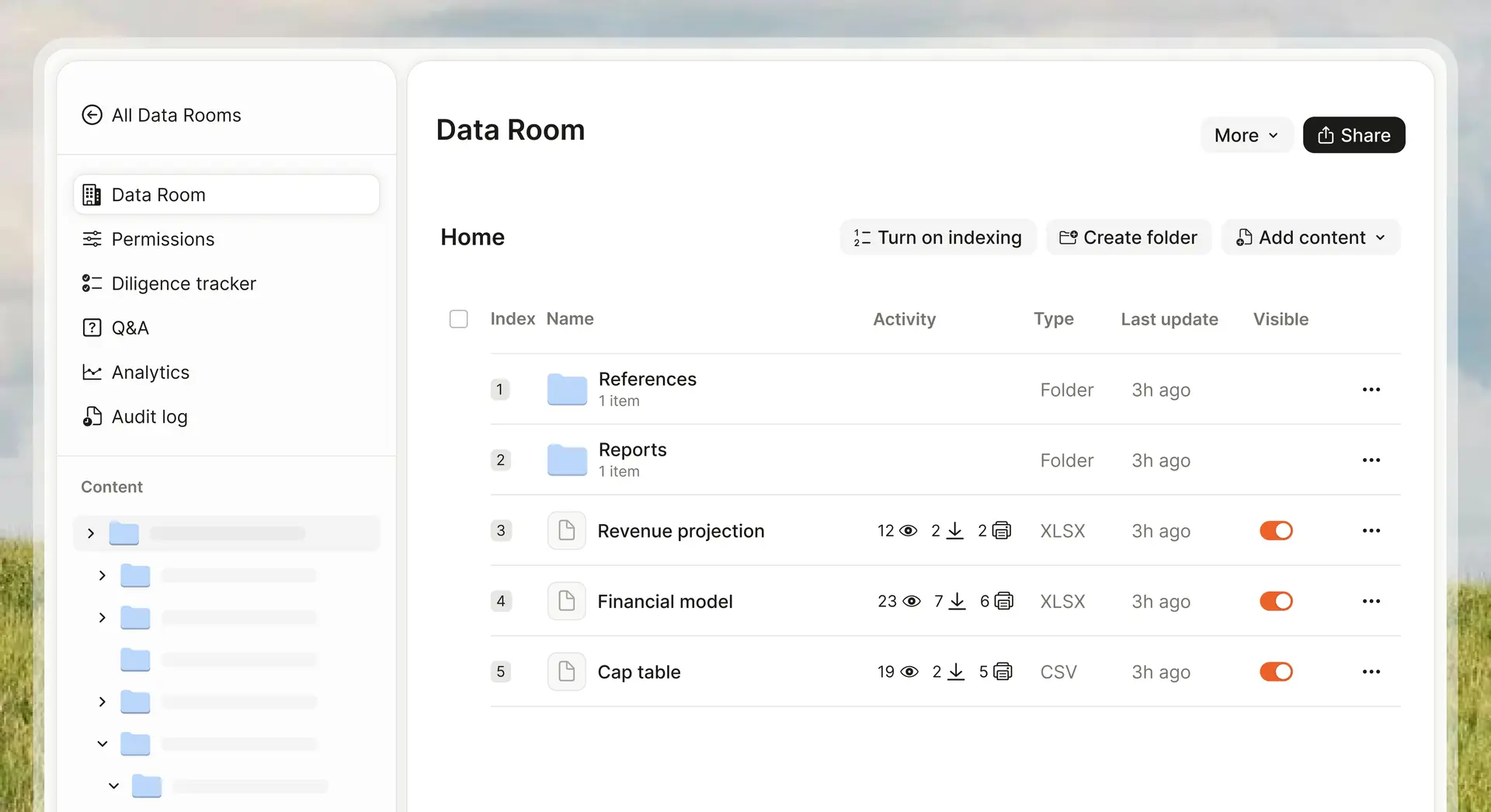
Ellty is a secure document sharing and analytics platform that works particularly well for strategic partnership processes, where you need to share sensitive business information with a counterparty without losing control of how it circulates. When entering a partnership, you're typically sharing things like commercial agreements, financial performance data, product roadmaps, or operational playbooks with people outside your organization. Ellty gives you the structure to do that cleanly: NDA gating before anyone accesses materials, granular permissions so different contacts see only what's relevant to them, and dynamic watermarking to discourage unauthorized sharing.
The analytics are especially valuable in a partnership context. Knowing which documents a potential partner has reviewed, how long they spent on your financials or product overview, and which sections held their attention helps you walk into conversations better prepared. There are no per-user fees, which matters when a partnership involves multiple stakeholders on both sides. Plans start free, with the Data Room tier at $149/month covering everything most partnership processes need. Setup takes minutes, and the interface is clean enough that external partners won't need a tutorial to navigate it.

2. Docsend

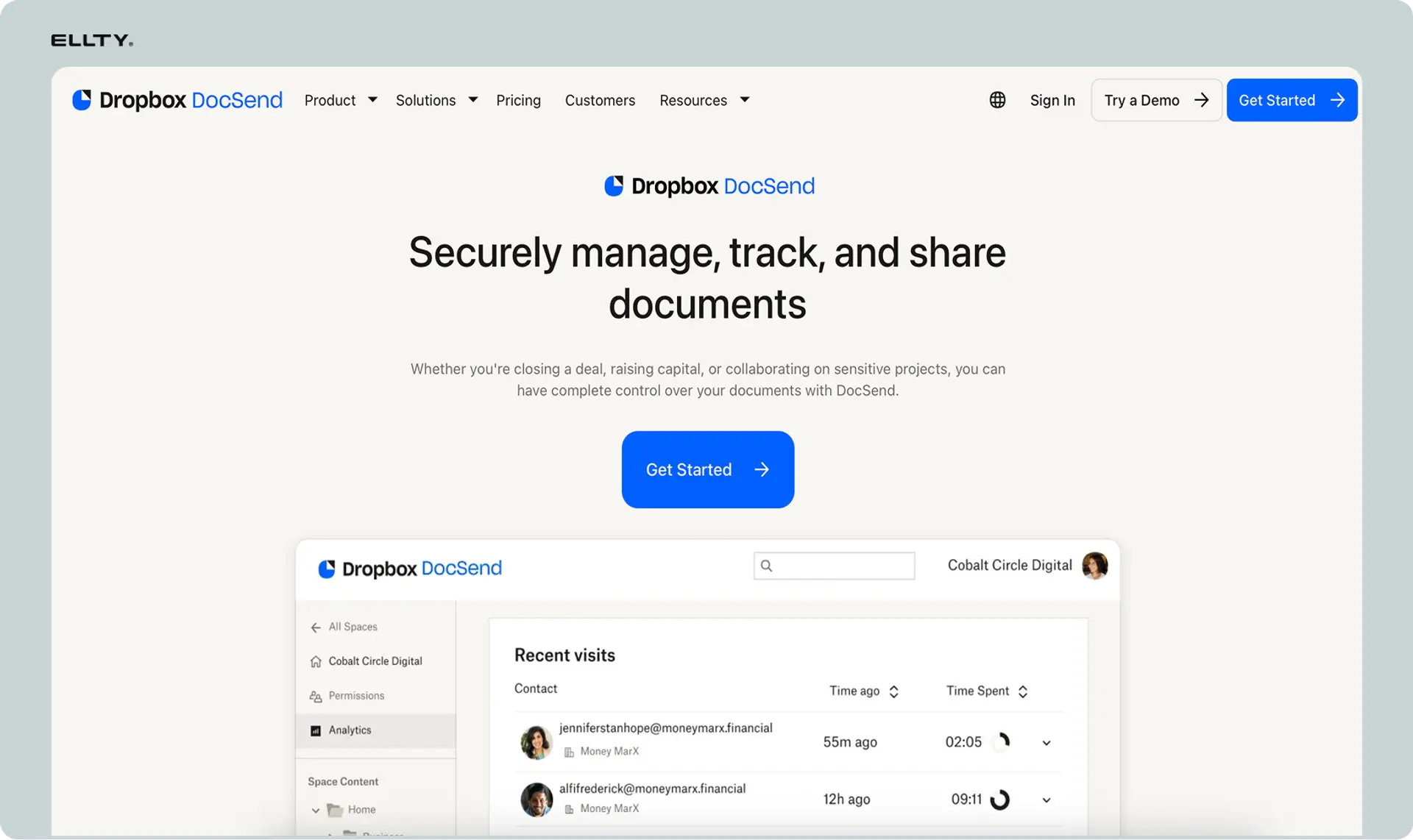
DocSend is a lightweight document sharing platform that handles the early stages of a strategic partnership process well - particularly when you're sharing introductory materials, executive summaries, or commercial proposals with potential partners before formal diligence begins. Its link-based sharing model means you can send a curated set of documents without email attachments, and the per-recipient analytics tell you exactly who opened what and how thoroughly they reviewed it.
For strategic partnerships, this visibility is useful. If a prospective partner's business development team opens your partnership proposal but spends no time on the commercial terms, that's a signal worth acting on before your next conversation. DocSend supports NDA collection at the point of access and allows you to update or revoke document links after sharing, which helps maintain control as partnership discussions evolve. Folder-based organization works for structured document sets, though it's less suited to complex multi-workstream diligence. Pricing starts around $65/month. It's best used as the outreach and early-stage sharing layer of a partnership process, rather than a full due diligence environment for deeper commercial or legal review.
3. Notion

Notion is a flexible workspace platform that many teams adapt into a lightweight partnership data room, particularly for ongoing strategic relationships rather than one-time transactions. For partnerships where both sides need to collaborate on shared materials, track joint workstreams, and maintain a living repository of agreements, roadmaps, and meeting outputs, Notion provides a familiar and easy-to-navigate environment that most counterparties can use without friction.
In a strategic partnership context, Notion works well for organizing the operational layer: storing signed agreements, maintaining a shared project tracker, documenting integration specs, or housing co-marketing materials that both teams reference regularly. Access can be controlled at the page level, and you can share specific sections with external partners without exposing your internal workspace. The tradeoff is that Notion is not purpose-built for secure document transactions. It lacks VDR features like NDA gating, dynamic watermarking, granular audit logs, and download restrictions that matter when sharing commercially sensitive materials. It's best suited for partnerships that have already been formalized and where the priority is collaboration and shared documentation rather than controlled initial disclosure of sensitive business information.
4. Ansarada


Ansarada is a purpose-built virtual data room platform with transaction management features that extend naturally into complex strategic partnership processes. Where most partnerships involve more than just sharing a folder of documents - staged disclosure, structured Q&A between teams, coordinated review across legal, commercial, and technical workstreams - Ansarada provides the workflow infrastructure to manage that complexity in one place. Its AI-powered deal readiness tools can also help sellers and partnership leads organize materials in a way that's coherent and complete before sharing with a counterparty.
For strategic partnerships involving significant commercial commitments, IP licensing arrangements, or joint venture structures, the platform's granular permission controls and comprehensive audit logging add a layer of legal certainty that lighter tools can't match. You can manage different access levels for different teams on the partner side - legal reviewing contracts, finance reviewing commercial models, technical teams reviewing integration documentation without cross-contaminating what each group sees. The tradeoff is cost and setup complexity, which can be disproportionate for simpler partnership engagements. Ansarada is best suited for high-stakes strategic partnerships where process rigor and institutional-grade documentation controls genuinely justify the investment.
5. ShareVault


ShareVault is a virtual data room platform with a focus on security and compliance, making it a solid fit for strategic partnerships in regulated industries like healthcare, financial services, life sciences, or any sector where information sharing between organizations carries legal or compliance obligations. The platform supports granular access controls, automatic watermarking, detailed audit trails, and expiring document links, all of which help partnership teams maintain clear accountability over what was shared, with whom, and when.
For strategic partnerships specifically, ShareVault's permission architecture works well when you're managing a phased disclosure process. Sharing high-level commercial information early in discussions, then progressively unlocking more sensitive operational or technical materials as the partnership advances toward execution. This staged approach is common in partnerships involving IP licensing, technology integrations, or joint go-to-market arrangements where both sides are cautious about premature disclosure. The interface is functional rather than modern, and setup requires more configuration than lightweight tools. Pricing is available on request and tends to reflect its enterprise positioning. ShareVault is most appropriate when your partnership process involves regulatory sensitivity or when your legal team requires a documented chain of custody for all shared materials.
6. DealRoom


DealRoom combines a virtual data room with project management functionality, making it particularly useful for strategic partnerships that involve multiple workstreams running in parallel. Rather than managing document sharing in one tool and deal coordination in another, DealRoom brings both together, so you can track open diligence items, assign tasks to internal team members, manage requests from the partner side, and maintain the shared document repository in a single environment. For complex partnerships where legal, commercial, and technical teams are all involved simultaneously, this consolidation reduces coordination overhead.
The platform includes structured folder templates built around typical diligence and disclosure categories, which helps partnership leads present materials in an organized, professional format from day one. Q&A workflow tools allow partners to submit questions directly within the platform, keeping communication traceable and organized rather than scattered across email threads. Granular permissions support different access levels for different contacts on the partner side. DealRoom is best suited for strategic partnerships with a defined deal structure and a clear process - joint ventures, commercial agreements with complex terms, or technology partnerships requiring staged technical disclosure. For simpler partnerships, the added workflow layer may be more than necessary.
7. Digify


Digify is a document security and sharing platform that covers the essential data room needs for strategic partnership processes - access controls, NDA gating, watermarking, download restrictions, and real-time engagement analytics without the overhead of a full enterprise transaction platform. For partnerships where your primary concern is maintaining control over sensitive materials while tracking genuine engagement from a counterparty, Digify delivers those capabilities in a clean and straightforward interface.
In a partnership context, the document-level analytics are directly actionable: you can see which team at the partner organization accessed your commercial proposal, how long they spent reviewing your pricing structure or integration documentation, and whether materials were accessed multiple times. These are signals that help you gauge seriousness and time your follow-up conversations effectively. Digify also supports auto-expiring links and remote file deletion, which is useful when sharing preliminary materials with a partner whose commitment level is still being assessed. It's not built for complex multi-party workflow management or Q&A processes, but for partnership processes where document security and engagement visibility are the priority, it performs reliably at a transparent, modestly priced subscription that doesn't require a sales conversation to access.
How to set up a data room step by step
You don't need a two-week project to get a data room live. Here's the actual process for a team setting one up for a strategic partnership conversation.
Step 1 - gather and organize your documents
Before you touch any software, decide: who is this data room for, and what's the scope? An early-stage partner conversation has different documents than a Series A investor doing legal diligence. Write a short list of what goes in and who gets access to what. Pull together the files you need.
Step 2 - choose your platform and set up the room
Pick a platform that fits your stage. If you're doing early-stage partnership conversations, Ellty data room features let you get set up quickly without a long onboarding process. Create the room, set up your folder structure, and configure your branding if you want it to look like your company.
Step 3 - set up your folder structure
Before uploading a single file, plan your structure. Use the framework from the section above - Company Overview, Financials, Legal, Product, Team, Traction. Visitors scan the folder list before they open anything.
Step 4 - upload documents and name them
Upload your documents tier by tier. Don't add everything at once. Start with the documents you're comfortable sharing at this stage. Name them clearly. "Financial Model v3 FINAL FINAL" is not a document name - "Financial model - Q1 2026 actuals" is. Create a folder structure before you upload anything. A typical structure looks like: Overview / Financials / Legal / Product / Team. Keep it flat, too many subfolders slow reviewers down.
Step 5 - configure permissions, add NDA gating if required
Set permissions per document or per folder so different visitors see different content if needed. If you're sharing sensitive financials or customer information, add an NDA gate. The reviewer agrees to terms before they access anything. This is a basic protection that takes two minutes to set up and matters significantly if you ever have a confidentiality dispute.
Step 6 - generate your link and test it
Create a trackable link. In Ellty, this generates a unique URL that logs every interaction. Share it directly - email, LinkedIn message, wherever the conversation is happening. Don't send attachments. A link is cleaner and you keep control.
Step 7 - monitor activity and follow up intelligently
Now the interesting part. Watch who opens it, what they look at, and for how long. If someone spent 15 minutes on your financial model and 30 seconds on your team page, you know what they care about. Time your follow-up around their activity, not your own anxiety about the deal.

Total realistic time to launch: half a day, assuming your documents are already prepared. If you're starting from scratch on the documents themselves, add a few days for that.
How to select a data room provider for strategic partnerships
Choosing a data room platform for a partnership process is a different decision than choosing one for fundraising or M&A. The dynamics are different. You're often sharing materials with a counterparty who is simultaneously a potential collaborator and a potential competitor. The process is less standardized than a capital raise. And the people reviewing your documents - a VP of Partnerships, a CTO, a legal team - have different expectations and different levels of patience for clunky software.
Here's how to think through the selection properly.
Start with the complexity of your partnership process
Not every partnership requires the same infrastructure. A straightforward commercial agreement between two mid-sized companies needs clean access controls, an NDA gate, and basic analytics. A joint venture involving shared IP, integrated technology, and multiple stakeholder groups on each side needs group-level permissions, structured folder hierarchies, and a full audit trail.
Before evaluating platforms, be honest about where your process actually sits. Overbuilding and paying for enterprise-grade transaction management when you're running a two-person business development conversation, wastes money and slows you down. Underbuilding and sharing sensitive commercial materials over email or an uncontrolled Drive folder, creates real legal and reputational risk. Match the platform to the process.
Evaluate who is on the other side of the table
The counterparty matters. If your potential partner is a large enterprise with an internal information security team, they may have policies about which platforms they'll accept documents through. SOC 2 certification and clear data residency policies become relevant in those situations, not just as nice-to-haves, but as procurement requirements. If your partner is a mid-sized company or a startup, those concerns are typically less formal, and ease of access and clean interface matter more.
Think about the reviewers specifically. A data room that requires a multi-step registration process or looks confusing to navigate creates friction for people on the partner side who are already busy. The less time they spend figuring out how to use the platform, the more time they spend actually reviewing your materials, which is what you want.
Check whether the pricing model fits your deal structure
Per-user pricing sounds reasonable until you count the actual number of people involved in a typical partnership review. Your side alone might include a business development lead, a lawyer, a CFO, and a founder. The partner's side might add another four to six reviewers across business, legal, and technical functions. On a per-seat model, that adds up before the partnership has generated a single dollar.
Flat-rate pricing, where you pay for a plan rather than per person, is generally more predictable and better suited to partnership processes where the reviewer count is hard to predict in advance. Confirm also whether there are storage caps, overage charges, or feature restrictions that only become visible once you're mid-process.
Treat setup speed as a real variable
Partnership conversations move on their own timeline, not yours. When a counterparty's team is ready to review materials, having to spend two days configuring an enterprise platform or waiting for a sales call to unlock features is a genuine problem. Platforms that let you go from signup to a live, access-controlled data room in under an hour give you the flexibility to respond to deal momentum rather than fight it.
Ask whether the analytics are actually actionable
Most platforms advertise document analytics, but the quality varies. What you want for a partnership process is specific: which individual reviewed which document, how long they spent on it, which sections held their attention, and when they last accessed the room. That level of granularity tells you something useful, who is driving the internal conversation on the partner side, where their concerns or interests are concentrated, and when to follow up. Aggregate view counts without individual-level detail are much less useful in practice.
Key features to look for in a partnership data room
Not all data room features matter equally in a partnership context. Here's what actually earns its place.
NDA gating
In a partnership process, you're often sharing commercially sensitive information with an organization that operates in an adjacent or overlapping market. NDA acceptance before access is not a formality, it's a basic legal protection. The platform should enforce this automatically, requiring each reviewer to accept the terms before any documents become visible, and logging that acceptance with a timestamp for your records.
Granular, role-based permissions
A single partnership conversation typically involves reviewers with different information needs. The partner's business development lead needs your commercial overview and go-to-market materials. Their legal team needs corporate documents and key contracts. Their technical team needs architecture documentation. These groups should not see each other's designated materials, and they definitely shouldn't see materials reserved for a different partner organization entirely.
Look for a platform that lets you set permissions at the folder or document level, assign different access profiles to different individuals or groups, and adjust those permissions in real time as the conversation progresses without having to rebuild the entire room.
Dynamic watermarking
Any document that leaves your data room and enters the partner's hands should carry a visible or embedded identifier linking it to the specific reviewer who accessed it. Dynamic watermarking does this automatically - the viewer's name, email address, or access date is stamped onto the document at the point of viewing. This creates accountability and significantly reduces the likelihood of unauthorized redistribution, particularly for sensitive financial or commercial materials.
Granular audit logs
An audit log that tells you "someone accessed the room" is not particularly useful. What you need is a log that tells you which specific individual accessed which specific document, at what time, from which device, and for how long. In a partnership context, this level of detail serves two purposes: it gives you negotiating intelligence during the live process, and it gives you a defensible record if a dispute arises later about what was disclosed and to whom.
Access revocation
Circumstances change. A partnership conversation ends. A reviewer leaves the counterparty organization. A document is shared with someone it shouldn't have been. The ability to revoke access immediately, for a single individual, a specific document, or the entire room, is a basic requirement. Confirm that revocation works in real time and that it applies retroactively to any previously shared links, not just future ones.
Clean, frictionless interface for external reviewers
Your data room is a reflection of how you operate. A platform that is confusing to navigate, slow to load, or requires a lengthy registration process before reviewers can access anything creates a poor first impression and slows down the review. The interface should be clean enough that someone on the partner side, who may have never used the platform before, can find what they need without asking you for help.
Viewer-level engagement analytics
As covered above, the analytics need to be specific enough to be actionable. Knowing that a document was opened 14 times is less useful than knowing that the partner's CFO spent 22 minutes on your financial model last Tuesday. Viewer-level detail, broken down by document and by time spent, is what lets you run a genuinely informed follow-up process.
Stable, predictable pricing
A feature worth including in your evaluation criteria rather than just your budget conversation. Platforms with per-user fees, per-page storage charges, or custom quotes that take a week to arrive introduce uncertainty into your planning. For a partnership process where reviewer counts and document volumes are hard to predict upfront, flat and transparent pricing removes one variable from an already complex process.
Common data room mistakes in strategic partnerships
Most data room mistakes in partnership processes are not technical. They're process failures, decisions made too early, too late, or without enough thought about what the other side actually experiences. Here are the ones that come up most often.
Sharing everything at once
Uploading your entire document library into a single folder and granting full access from day one is one of the most common mistakes in partnership data rooms. It overwhelms reviewers, signals poor judgment about what's appropriate to disclose at each stage, and gives away negotiating leverage before trust has been established.
Strategic partnerships involve a natural progression of disclosure. Sharing your full cap table, detailed IP filings, and complete customer contracts with a potential partner you've spoken to twice is neither necessary nor wise. Structure your data room in tiers and release access progressively as the relationship develops and mutual commitment deepens.
Using a generic folder structure
Organizing documents by your internal naming conventions, the way your own team files things, rather than by how a reviewer will want to navigate them is a slow-down that most people don't notice they've created. A folder called "Legal — Internal v3 Final" means something to your operations team. It means nothing to a partner's legal counsel who is trying to locate your key commercial contracts quickly.
Organize your data room from the reviewer's perspective. Use clear, descriptive category names. Group related documents logically. Make it easy for someone who has never seen your company before to find what they need without having to ask.
Waiting until you're in active diligence to set it up
Building your data room reactively, after a partner's team has asked to review materials, means you're configuring it under time pressure, which almost always results in a disorganized structure and missing documents. It also creates a delay at a moment when the counterparty's attention is at its highest.
Your data room should be ready before you need it. That means having your Tier 1 documents organized, access controls configured, and an NDA in place before substantive conversations begin. When the other side is ready to move, you should be able to send a link the same day.
Treating all reviewers as a single audience
A partner organization is not a monolith. The business development lead, the legal team, the CTO, and the CFO all have different information needs and different levels of clearance for sensitive materials. Sending a single link with identical access to all of them means everyone sees everything, including materials that weren't meant for their role at that stage of the process.
Set up separate permission profiles for different reviewer types from the start. It takes a small amount of additional setup time and saves significant risk and confusion throughout the process.
Ignoring the analytics entirely
Setting up a data room and then never checking the engagement data is a missed opportunity. The analytics exist to tell you something useful: which contacts are active, which documents are drawing attention, and where in the review process the other side actually is. Founders and partnership leads who ignore this information make follow-up decisions based on instinct rather than evidence, and often invest time in conversations that have already gone cold without realizing it.
Build a habit of checking your data room analytics before any significant conversation with a potential partner. What you find there should shape how you approach the meeting.
Forgetting to revoke access when conversations end
When a partnership discussion doesn't proceed, the data room access associated with that organization should be closed immediately. This is easy to forget in the middle of an active deal pipeline, but leaving access open, even passively, means a former prospect can continue viewing your sensitive materials indefinitely. Most platforms make revocation straightforward. Build it into your standard process for closing out a conversation, regardless of how it ends.
Using the wrong platform for the stage you're at
Paying for an enterprise VDR with complex workflow features when you're in early exploratory conversations is unnecessary overhead. Equally, trying to run a serious multi-party partnership diligence process through a basic file-sharing tool creates risk and looks unprofessional to enterprise counterparties. Match the platform to the actual complexity and stage of your process, and be willing to upgrade as the partnership progresses and the stakes increase.
Frequently asked questions
Do both sides of a partnership need access to the data room?
Not necessarily. In most partnership processes, one side (typically the company initiating the partnership) sets up and controls the data room, and the counterparty accesses it as a reviewer. That said, some partnerships involve mutual disclosure, particularly where both sides are sharing sensitive commercial or technical information. In those cases, both organizations may set up their own data rooms and exchange access, or use a shared environment with separate permission groups for each side.
When in a partnership process should you set up a data room?
Before you enter substantive diligence conversations, not after. A data room should be ready by the time the other side's legal, finance, or technical team asks to review materials. Setting it up reactively, under time pressure, usually results in a disorganized document structure that slows the process down and signals poor preparation. Having a clean, access-controlled environment ready before it's needed is part of running a professional process.
What's the difference between a data room and just sharing a Google Drive folder?
Google Drive can store and share documents, but it lacks the controls that matter in a partnership context. There's no NDA gating before access, no dynamic watermarking, no audit trail showing who viewed which documents and for how long, and limited ability to revoke or restrict access granularly once a link has been shared. For early internal collaboration, Drive is fine. For sharing sensitive commercial, financial, or legal materials with an external counterparty in a formal partnership process, it introduces real risk and looks unprofessional to enterprise reviewers.
Can you use the same data room for multiple partnership conversations simultaneously?
Yes, and most platforms support this through group-level permissions. You can create separate access groups for each potential partner, ensuring that Company A's team can only see their designated materials and Company B's team sees theirs, even if both groups are reviewing documents within the same data room environment. This is particularly useful when running parallel conversations and wanting to maintain a single organized document repository rather than managing multiple separate rooms.
What happens to data room access if a partnership conversation doesn't proceed?
One of the core advantages of a virtual data room over informal sharing methods is that access can be revoked immediately and completely. If a partnership discussion ends, you can deactivate access for all contacts on the counterparty side in seconds, regardless of whether they've already downloaded any permitted files. Dynamic watermarking also means that any documents already in their possession carry identifiable markers linking them back to that specific reviewer, which creates accountability even after access has been closed.
How should you organize documents in a partnership data room?
Organize by the reviewer's perspective, not your internal filing structure. Group documents into clear categories that match how the other side will want to review them - commercial and financial materials together, legal and corporate documents together, product and technical information in its own section. Use a tiered access structure so that sensitive materials are only visible to contacts who have reached that stage of the process. Avoid vague folder names, version-confused file names, or dumping everything into a single directory. A clean, navigable structure reduces back-and-forth questions and keeps the review process moving.
Is a data room necessary for early-stage partnership conversations, or only once things get serious?
A full data room with NDA gating and granular permissions is most important once substantive diligence begins, typically when the other side's legal or finance team gets involved. In very early exploratory conversations, a lighter setup is often sufficient: a tracked link to your partnership deck with basic analytics, so you can see whether the right people are actually engaging before investing more time in the relationship. Platforms like Ellty let you start at that level for free and step up to full data room functionality once the conversation warrants it, which means you're not over-investing in infrastructure for conversations that may not progress.
Final thoughts
A data room is not optional once you're in serious partnership discussions. It's the infrastructure that makes a professional process possible: one where the right people see the right materials, sensitive information stays under your control, and you have clear visibility into who is actually engaged and where their attention is focused.
You don't need to spend thousands a month to run that process well. What you need is a platform that gives you clean access controls, NDA gating, reliable analytics, and a document structure that your counterparty can navigate without friction. Start with what fits your current stage, keep the document organization logical and consistent, and use the engagement data to guide your conversations rather than guessing at where interest actually sits.
The partnership teams that move fastest are usually the ones who know exactly who has reviewed what and build their outreach around that.
Author

Anika Tabassum Nionta is a Content Manager at Ellty, where she writes about secure document sharing, virtual data rooms, M&A, due diligence, fundraising, and sales enablement. With over 6 years of writing experience, she helps professionals understand how to share confidential documents securely, track engagement, and manage deals more effectively. Anika holds both a BA and MA in English from Dhaka University. Outside of work, she enjoys reading, exploring new cafes in Dhaka, and connecting with entrepreneurs and dealmakers in her community.

