


Alternative investments span private equity, venture capital, hedge funds, real assets, and more. Whatever side of the table you're on, a well-organized data room is how serious transactions get done.
If you work in alternative investments, you already know the drill.
At some point in any deal, whether you're a fund manager raising capital from LPs, a portfolio company going through diligence, a GP closing on a real estate acquisition, or a lender evaluating a private credit opportunity, someone is going to ask for a data room.
This guide covers what alternative investments actually are, why they create specific and demanding needs for secure document sharing, what a data room should contain depending on the use case, and how to set one up without overcomplicating it.
What is an alternative investment?
An alternative investment is any financial asset that isn't stocks, bonds, or cash. The category is broad and covers anything from private equity and hedge funds to real estate, commodities, venture capital, collectibles, and increasingly - digital assets.
The term makes more sense when you compare it to what it's not.
Traditional investments, publicly listed stocks and bonds, are regulated, relatively liquid, and easy to price. Alternatives are everything outside that. They're typically illiquid, less regulated, harder to value, and often involve direct negotiations between parties rather than open markets.
The category includes:
- Private equity - buyouts, growth equity, and venture capital
- Hedge funds - pooled capital using diverse and often complex strategies
- Private credit - direct lending, mezzanine debt, distressed debt
- Real assets - real estate, infrastructure, timberland, commodities
- Fund of funds - capital pooled across multiple alternative fund managers
The global alternative investment market has crossed $33 trillion in assets under management, making up roughly 15% of the total financial asset universe. Institutional investors, pension funds, endowments, sovereign wealth funds, routinely put 20–30% of their portfolios into alternatives. It's no longer a niche corner of finance.
Each of these asset classes has its own deal flow, its own investor base, and its own documentation requirements. That's exactly why a standard document-sharing setup doesn't cut it and why purpose-built data rooms exist.
What are the 4 types of alternative investments?
The categories overlap and evolve, but here are the four types most commonly referenced and what each one means for the companies involved:
Private equity and venture capital
Investment in private companies in exchange for equity. PE typically targets established businesses needing restructuring or growth capital. VC focuses on early-stage businesses with high growth potential. This is the category most parties are actively engaging with.
Hedge funds
Pooled investment vehicles that use flexible strategies - long/short equity, derivatives, arbitrage, global macro - to generate returns regardless of market direction. They're only accessible to institutional investors and high-net-worth individuals. They're sophisticated buyers who expect sophisticated sellers.
Real assets
Physical or tangible assets: real estate, infrastructure, commodities, timberland, farmland. Real estate is the largest category by volume. These investments tend to behave differently from financial markets and are popular for inflation protection and stable income.
Private credit and private debt
Loans and debt instruments that aren't bank-issued or publicly traded. A private credit fund might lend directly to a growing company that doesn't want to go to a bank. After 2008, this category expanded significantly as banks pulled back from certain types of lending.
What is an investment data room?
A data room or virtual data room (VDR) is a secure, access-controlled online environment where confidential documents are stored and shared with authorized parties during a transaction, fundraise, or due diligence process.
The name comes from a real practice. Before cloud-based tools existed, parties in a deal would literally set up a physical room full of binders and files for the other side to review, under supervision, for a limited window of time. The virtual version replaced that entirely. Today it refers to any document environment that is secure, auditable, and permission-controlled.
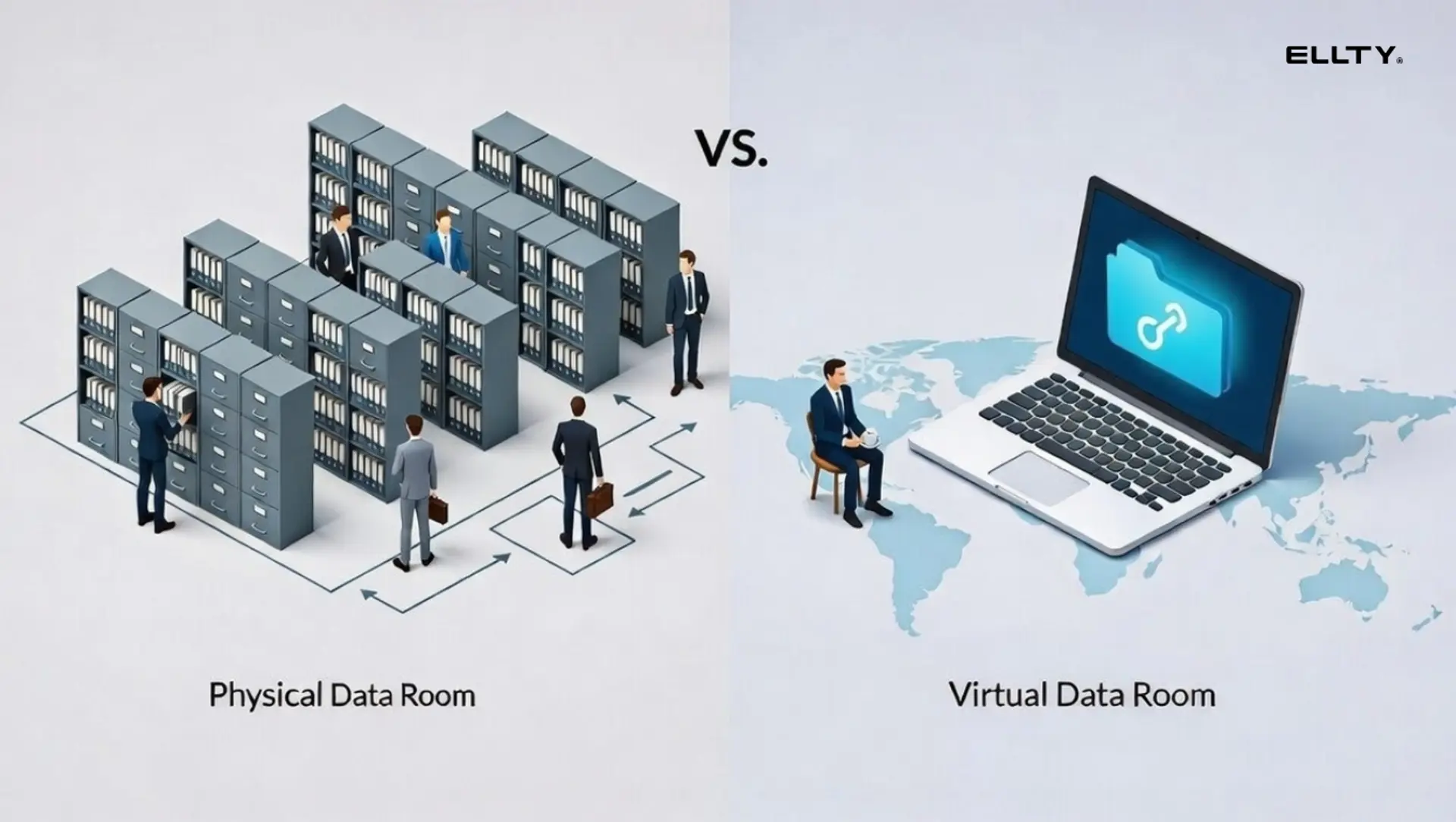
In alternative investments specifically, data rooms serve multiple distinct purposes depending on who's using them and why:
- A fund manager uses a data room to share fund documents, track records, and due diligence materials with prospective limited partners
- A portfolio company uses one when going through a PE-led acquisition or secondary transaction
- A real estate sponsor uses one to share property financials, legal docs, and rent rolls with equity investors or lenders
- A private credit lender uses one to collect and review borrower documentation before committing capital
- A secondary buyer uses one to evaluate an LP stake or portfolio of assets they're considering purchasing
The common thread: sensitive documents, multiple parties, controlled access, and a transaction on the line.
"If you don't have a data room ready when the other party asks, it signals disorganization. It costs you momentum during a process that moves fast."
An investment data room is different from a shared Dropbox folder or a Google Drive link in a few specific ways:

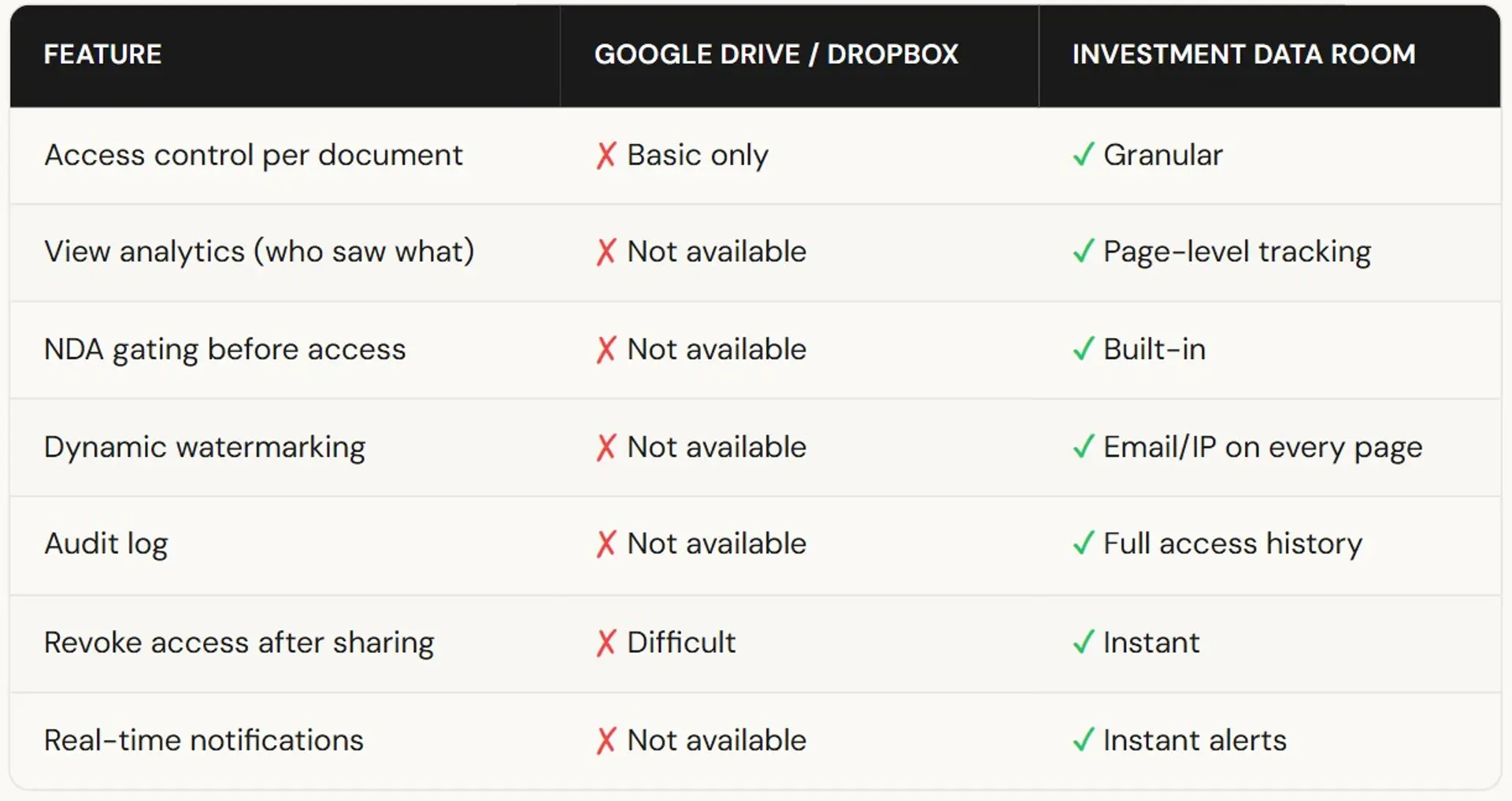
For most internal work and team collaboration, Google Workspace is fine. For external, high-stakes sharing, especially in alternative investments where deal sizes, legal exposure, and confidentiality expectations are all elevated, you need something built for it.
What goes in an alternative investment data room?
There's no single universal checklist because the right contents depend heavily on the asset class, deal type, and stage of the transaction. A fund manager preparing for an LP roadshow needs different documents than a real estate GP closing on an asset acquisition, or a private credit borrower going through lender diligence.
That said, most alternative investment data rooms are organized around a few core categories.
01. Overview and summary materials
The documents that orient a new reviewer before they go deeper. This typically includes an investment memo or executive summary, a pitch deck or fund presentation, and a concise description of the opportunity, strategy, or entity. This section answers the "what is this and why should I care" question before anyone opens a spreadsheet.
02. Financial information
The numbers that underpin the deal. Depending on the context, this might include historical financial statements, audited accounts, management accounts, revenue or income breakdowns, cash flow data, and forward-looking projections or models. For funds, this section would include performance track records, NAV statements, and fund-level financial reporting. For real assets, it might include rent rolls, operating statements, or infrastructure revenue data.
03. Legal and structural documents
Whatever establishes the legal foundation of the entity or transaction. This covers entity formation documents, ownership structures, shareholder or LP agreements, existing contracts or obligations, regulatory filings, and anything related to past or pending litigation. Investors and counterparties use this section to confirm that what they're being told matches how things are actually set up.
04. Deal-specific or asset-specific documentation
The documents unique to what's actually being transacted. For a fund, this includes the Limited Partnership Agreement, PPM, subscription documents, and side letter terms. For real estate, it includes property appraisals, title documents, environmental reports, and lease agreements. For a private company in a buyout or growth equity deal, it includes cap table details, past term sheets, and customer or revenue documentation. This section changes the most depending on what kind of alternative investment is involved.
05. Operational and management information
How the entity actually runs. Organizational structure, key team bios, operational processes, technology infrastructure (where relevant), and any third-party service provider relationships. For funds, this might include information about the GP team, investment committee structure, and compliance setup. For operating businesses, it covers key personnel, org charts, and HR agreements.
06. Risk and compliance
Material risks, regulatory status, compliance frameworks, and any known liabilities. In regulated environments and many alternative investment structures are regulated to some degree, investors will specifically look for evidence that compliance obligations are being taken seriously. ESG documentation is increasingly part of this section as well, particularly for institutional LPs.
A practical note on what to share and when
Not everything should be in the data room from day one, and not everyone should have access to everything. A well-run data room uses permission tiers, some documents visible to all reviewers, others only unlocked once an NDA is signed or a term sheet is exchanged.
Sensitive information like full counterparty lists, detailed employee compensation, complete proprietary models, or specific LP terms typically stays gated until there's a higher degree of commitment on both sides. The goal at the early stage is to share enough to build confidence and move the conversation forward, not to hand over everything before you know if the deal is real.

Why alternative investments specifically need a data room
This is worth understanding clearly, because it's easy to treat a data room as just a formality, a box to check before a meeting. It isn't.
Public market investing happens in the open. Prices are public. Regulatory filings are public. Performance history is available to anyone who knows where to look. Private market investors have none of that. They're making decisions based entirely on what you put in front of them and they know it.
That creates three specific dynamics that don't exist in public markets:
Diligence is longer and more document-intensive. Whether it's an LP evaluating a fund, a PE firm reviewing an acquisition target, or a private lender assessing a borrower, the review process involves a lot of documents. Often dozens, sometimes hundreds. Those documents need to be organized, easy to navigate, and fast to access. A messy or incomplete data room slows down the process and quietly signals that the people running it aren't organized either.
The information is genuinely sensitive. Cap tables, fund terms, key contracts, borrower financials, property details - none of this should live on a shared drive link you can't control. If a deal falls through, you need to be able to cut access immediately and know exactly what was viewed and by whom. Standard file sharing tools don't give you that. A proper data room does.
Investor behavior inside the room tells you something. If a prospective LP opens your track record document and spends 40 minutes in it, that's a signal. If they open the overview deck and close it after a minute, that's also a signal. Data rooms give you visibility into engagement that no email thread or Dropbox folder can provide. In a process where you're often managing multiple parties at once, that information matters.
7 best alternative investment data rooms
01. Ellty

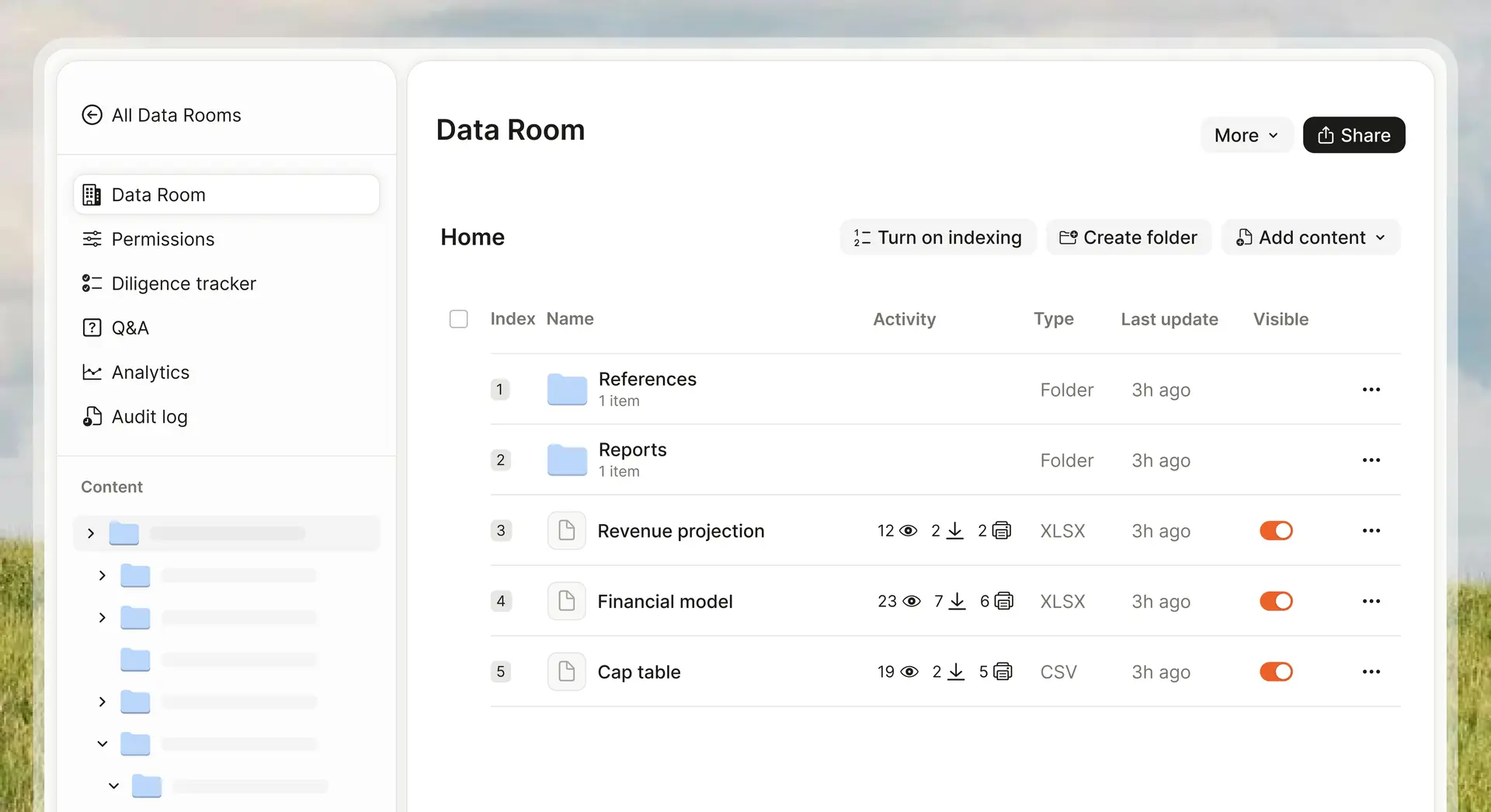
Ellty is built for the realities of private market transactions, clean, fast to set up, and genuinely useful for teams that don't have a dedicated IT department or a six-figure software budget. For alternative investment use cases, it covers the core requirements well: granular permission controls, document-level access tracking, NDA gating before entry, and real-time activity monitoring that tells you who opened what and for how long.
Where Ellty stands out is in its usability and pricing model. You're not paying enterprise rates for features you'll never use, and you're not spending a week getting the room configured. Fund managers, sponsors, and deal teams can get a professional data room live quickly, without needing a vendor implementation call. The platform supports multi-party access, useful when running a process with multiple LP prospects or lenders simultaneously, and keeps the document organization straightforward enough that reviewers can actually navigate it. For teams raising from LPs, managing a portfolio transaction, or running a structured lender process, it hits the right balance of functionality and simplicity.

02. Datasite

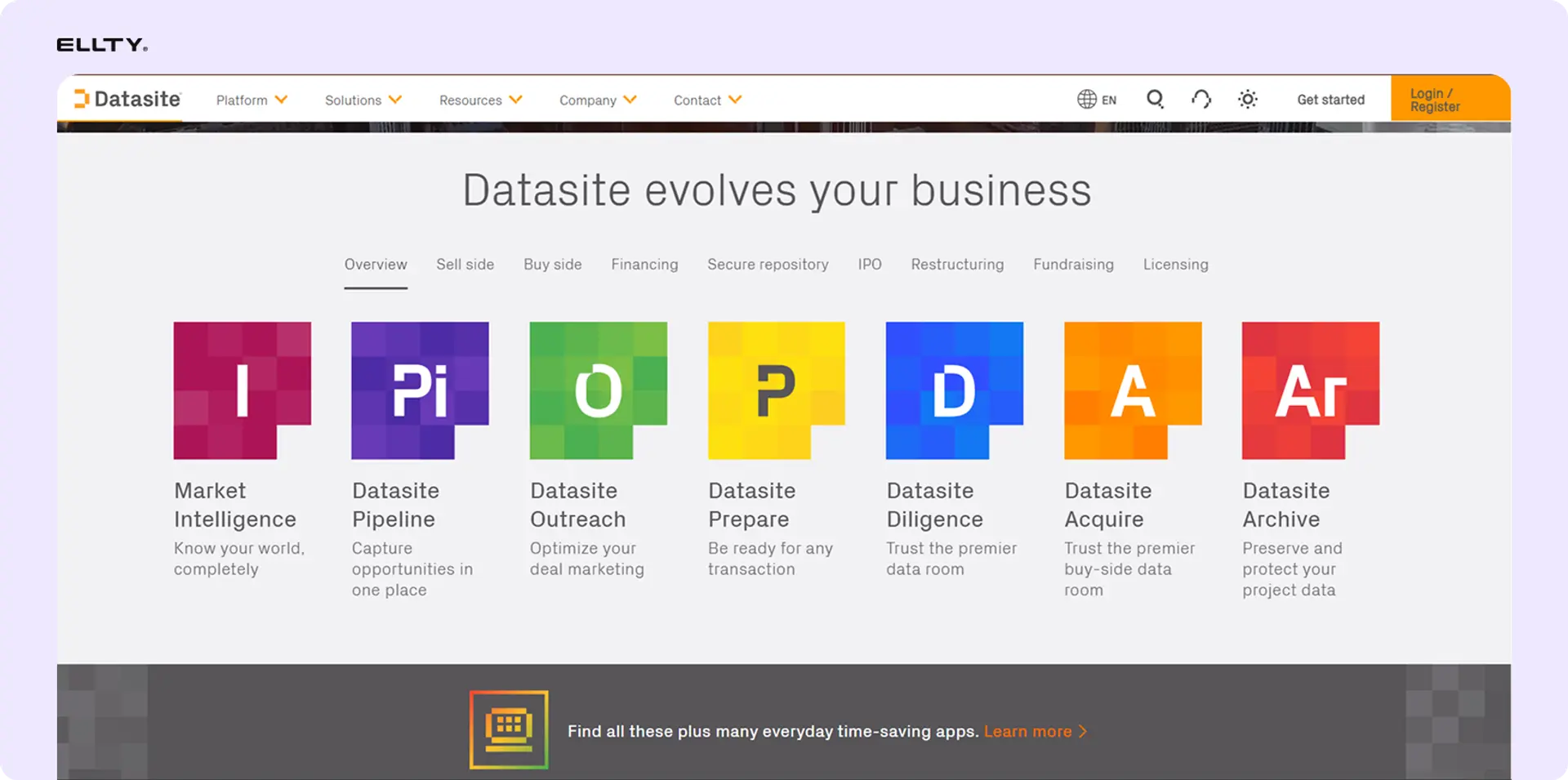
Datasite is a well-established platform built primarily around M&A transactions, but it's used across private equity and alternative investment processes as well. It handles high-volume, high-complexity diligence environments well, large document sets, multiple reviewer groups with different permission levels, and processes that involve legal and financial advisors alongside direct investors.
The platform includes AI-assisted document organization, redaction tools, and detailed audit trails, which matter in complex transactions where version control and access records have legal significance. Datasite's reporting capabilities are strong, giving deal teams clear visibility into reviewer engagement at a document and user level. The trade-off is that it's built for larger, more formal processes, typically investment banking-led M&A or sizable PE transactions. For smaller fund raises or early-stage LP processes, the platform can feel heavier than the situation requires, and the pricing reflects its enterprise positioning. Teams running straightforward LP roadshows may find it over-engineered for the job.
03. Intralinks

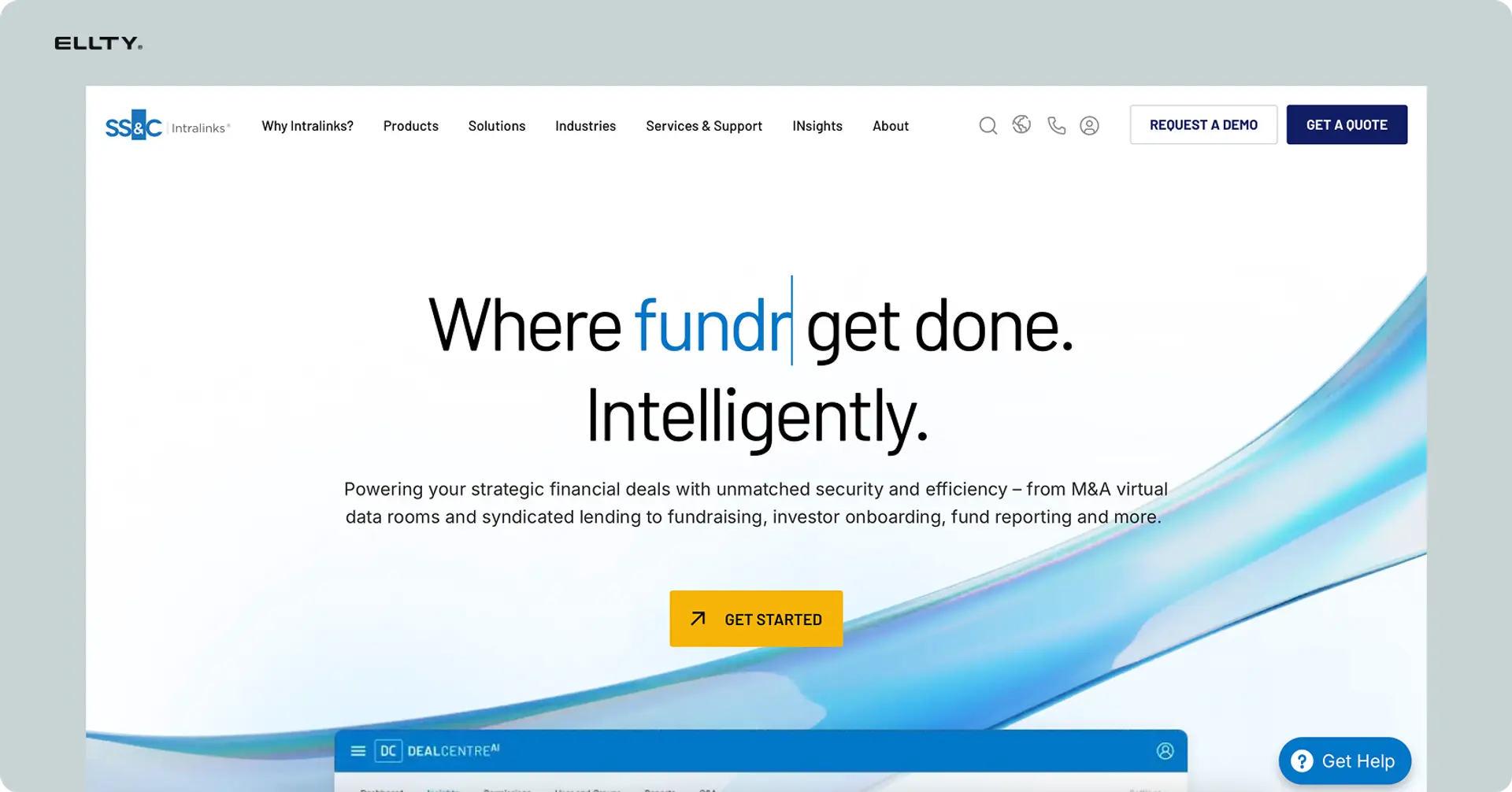
Intralinks is one of the older names in the virtual data room space and has a long track record in financial services, particularly in M&A, leveraged finance, and syndicated lending. For alternative investment use cases, it's most relevant in private credit transactions, large-scale real estate deals, and institutional PE processes where compliance and audit trail requirements are strict.
The platform is secure, well-supported, and built to handle cross-border transactions involving multiple legal jurisdictions, a real consideration for alternative investment funds operating internationally. It includes document watermarking, granular access permissions, and detailed activity logs. The downside is that Intralinks carries the pricing and complexity of a platform designed for institutional deal flow. Onboarding takes time, and the interface reflects years of iteration rather than a modern design philosophy. For teams running a contained LP process or a single-asset transaction, there are leaner options. Where Intralinks earns its place is in structured, large-scale processes where institutional-grade controls and a recognizable brand matter to the parties involved.
04. iDeals


iDeals is a virtual data room platform used across M&A, private equity, real estate, and fundraising processes. It positions itself as a mid-market option, more capable than basic file-sharing tools, but more accessible than the largest enterprise platforms. For alternative investment use cases, it works well for fund managers running LP due diligence, real estate sponsors sharing deal materials, and growth-stage companies going through PE or growth equity diligence.
The platform includes the standard VDR features - access controls, activity tracking, NDA workflows, and document watermarking along with bulk upload tools and a reasonably clean interface. Customer support is frequently cited as a strength, which matters when you're mid-process and something needs fixing quickly. iDeals offers per-project pricing, which can make it more predictable for teams running discrete deal processes rather than ongoing fund operations. It won't be the cheapest option for a simple LP raise, but for teams that need a reliable, full-featured platform without committing to enterprise-level spend, it's a solid middle-ground choice.
05. Ansarada


Ansarada started as an M&A data room but has broadened its focus to include fundraising, Board governance, and ongoing business readiness. It is a positioning that makes it relevant for alternative investment managers thinking beyond a single transaction. For LP-facing processes, the platform offers the standard access control and activity tracking features, alongside what it calls "deal scoring", an AI-driven read on how engaged reviewers are and how complete the data room is relative to deal best practices.
This readiness framing is either useful or unnecessary depending on how you work. For a first-time fund manager preparing for an institutional LP process, the guided structure can help ensure nothing important is missing. For experienced deal teams who know exactly what they need, it can feel like extra friction. Ansarada's pricing is tiered by deal size and duration, and it includes unlimited users on some plans, relevant when a process involves many reviewers. It's worth evaluating for teams that want more than just a document repository and are open to a more structured approach to how a data room gets built and run.
06. Firmex
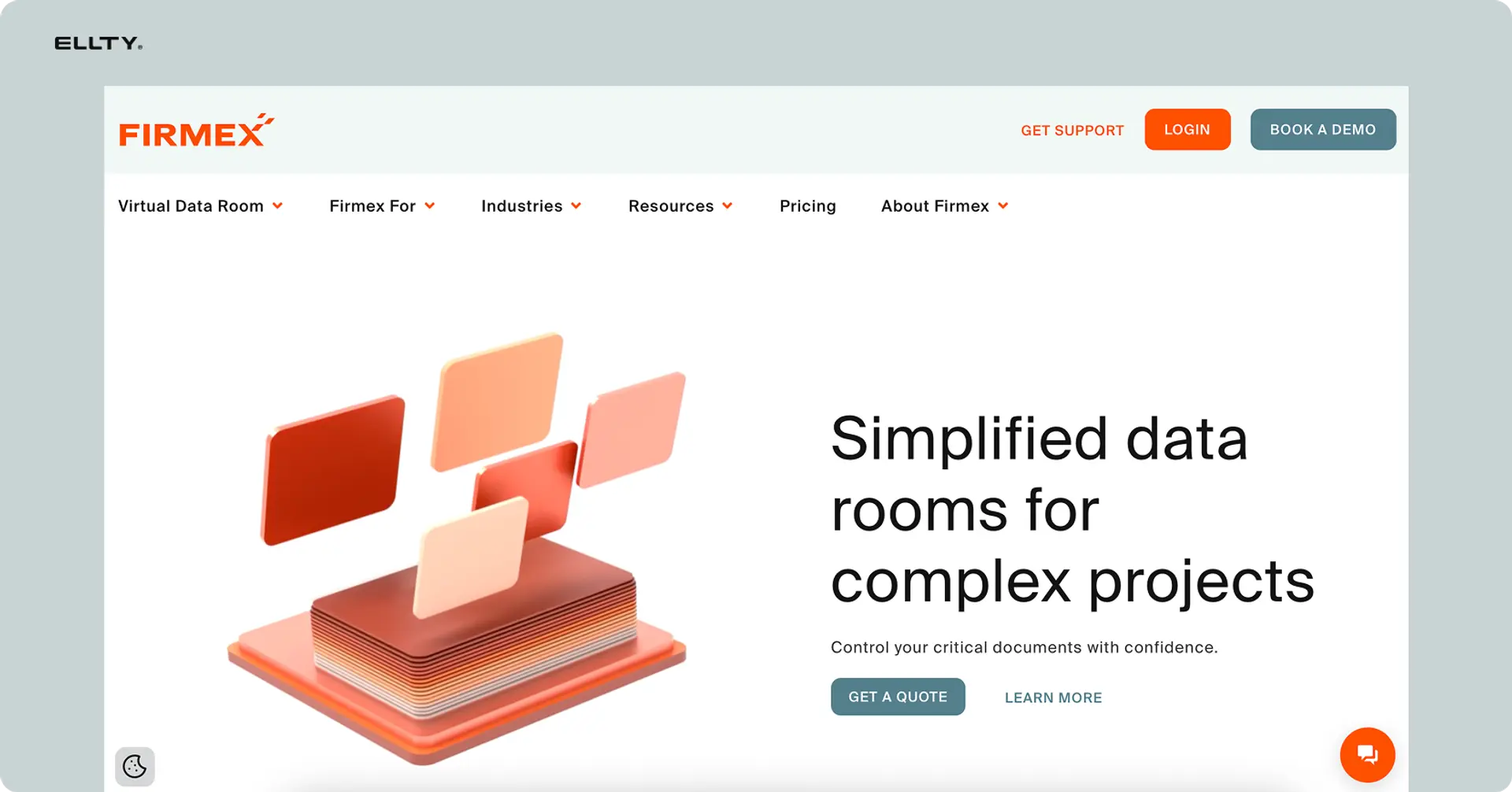
Firmex is a virtual data room platform with a strong foothold in financial services, legal, and private markets. It's used across M&A advisory, private equity, real estate transactions, and fund administration, making it a reasonable fit for alternative investment use cases where the document review process is formal and ongoing rather than a one-time deal event.
The platform supports unlimited users on its subscription plans, which matters for fund managers who are regularly onboarding new LP prospects or running multiple concurrent processes. It includes the core VDR capabilities such as permission tiers, activity reporting, Q&A workflow, and secure document viewing along with strong customer support infrastructure. Firmex doesn't chase the cutting-edge product features that some newer platforms tout, but it's dependable and well-suited to teams that need a data room as part of a repeatable operational process rather than a one-off transaction. For fund administrators, IR teams, and deal teams that are in the market continuously, the subscription model and multi-project support make practical sense.
07. ShareVault


ShareVault is a straightforward virtual data room built around security and ease of use. It serves life sciences, legal, and financial services clients, and for alternative investments it's most relevant in smaller PE transactions, private credit processes, and fund raises where the priority is controlled document sharing without a lot of platform complexity.
The standout feature is its document security model, ShareVault supports dynamic watermarking, remote document shredding (the ability to revoke access to a document even after it's been downloaded), and strict view-only permissions that prevent printing or saving. For deal teams handling genuinely sensitive materials, detailed financial models, borrower information, proprietary fund terms, that level of control is meaningful. The interface is functional rather than polished, and the feature set is narrower than platforms like Datasite or Intralinks. But for teams that prioritize security above all else and want a data room that's fast to set up and simple to operate, ShareVault is worth considering as a focused, lower-cost option.
How to set up an alternative investment data room step by step
Here's a practical process that works for most alternative investment scenarios. Don't overcomplicate it.
Choose your platform
Match the tool to your deal complexity. You don't need an enterprise VDR. A platform like Ellty gives you NDA gating, granular permissions, watermarking, and analytics at a flat monthly rate with no per-user fees.
Structure your folders before uploading anything
Create a clear folder structure: Company overview, Financials, Legal, Product, Customers, Team. Consistent naming saves a lot of confusion later. Use a format like "1.1_Financial_Model_Q1_2026" not "Final_FINAL_v3".
Set permissions before inviting anyone
Decide what each group of reviewers can see before they get access. Early-stage visitors typically see financials, cap table, and legal structure. Later-stage or lead visitors might get access to customer contracts and detailed product documentation.
Enable NDA gating
Anyone accessing your room should accept an NDA before seeing documents. This is built into platforms like Ellty at the Data Room plan. It's a basic legal protection and creates a record of who accepted what terms.
Turn on watermarking
Dynamic watermarking puts the viewer's email and IP address on every page of every document. This isn't about distrust, it's about accountability. Most professional visitors understand and expect it.
Run through it yourself before inviting viewers
Access the room as if you were a visitor. Is it easy to find the financials? Do the folders make sense? Does the NDA flow work? Fix issues before the first external viewer arrives.
Enable real-time notifications
Know immediately when a key visitor opens your documents. This lets you follow up at the right time, not three days later when the conversation has cooled.
Monitor engagement and adjust
If visitors are consistently skipping the financial model or spending ten minutes on the cap table, that tells you something. Good platforms show you page-level analytics so you can read the room and prepare for conversations accordingly.
If your documents are ready, you can complete steps 1 through 6 in under an hour. Most delays come from not having documents ready, not from platform setup.
Common mistakes people make with alternative investment data rooms
Sharing too early
Don't send your full data room at the first meeting. Share a pitch deck first. Reserve the data room for when a visitor has expressed real interest. Sharing sensitive financials and legal documents at the intro stage is a mistake most experienced teams don't make twice.
Over-sharing sensitive information
Your full customer list, detailed employee compensation, and complete IP documentation can wait until you've signed a term sheet. You want to build confidence, not create unnecessary exposure if the deal doesn't close.
Using generic file storage for formal diligence
A Google Drive link is not a data room, and experienced visitors know the difference. It signals that you haven't done this before or don't take document security seriously. Both are signals you don't want to send.
No NDA before access
Always gate your data room behind an NDA. It doesn't need to be complicated, but it needs to exist. A platform with built-in NDA gating automates this - the viewer accepts before they see a single document.
Poor organization
If a visitor can't find your financial model in 30 seconds, you've made their job harder and your company look less organized. Clean folders, logical naming, and a clear hierarchy are basics that go a long way.
Ignoring analytics
You built a data room and sent the link. That's not the end, it's the beginning. Monitor who opened what. Notice if a lead investor spent three minutes in your financials or three seconds. Use that signal in follow-up conversations. It's some of the most valuable investor intelligence available to you.
Frequently asked questions
What is an alternative investment data room?
An alternative investment data room is a secure, access-controlled online environment where confidential documents are shared with investors, lenders, or acquirers during a transaction. In the context of alternative investments - private equity, venture capital, hedge funds, real assets, and private credit - it's the structured document environment used during due diligence. Unlike simple file sharing tools, data rooms track who views what, enforce NDA acceptance, apply watermarks, and log all access activity.
What are the 4 main types of alternative investments?
The four main types are private equity and venture capital (equity in private companies), hedge funds (pooled vehicles using flexible trading strategies), real assets (real estate, infrastructure, commodities), and private credit or private debt (direct lending outside of banks).
Is Google Drive a virtual data room?
No. Google Drive is a file storage and collaboration tool. A virtual data room is purpose-built for secure external sharing with access control, NDA gating, dynamic watermarking, page-level analytics, and audit logs. Google Drive doesn't offer any of these. For internal work, Google Workspace is fine. For due diligence in an alternative investment context, you need a purpose-built data room.
What does alternative investment data include?
It depends on the investment type, but generally covers financial records, cap table, legal documents, customer contracts, product and technology documentation, and team information. For private equity and venture capital specifically, visitors want to see financials, growth metrics, legal structure, IP ownership, and key customer agreements. The common thread is that this information is confidential and not available from any public source.
How much does an alternative investment data room cost?
It ranges from free to thousands per month depending on the platform and deal complexity. Purpose-built platforms like Ellty offer data room features starting at $149/month with no per-user fees. Enterprise platforms like Intralinks and Datasite cost $7,000 to $7,500 or more per deal and are built for large M&A transactions.
What security should an alternative investment data room have?
At minimum: encrypted storage (AES-256 at rest, TLS in transit), NDA gating, dynamic watermarking, granular access control, and audit logs. For early-stage due diligence, SOC 2 Type II compliance is the baseline security certification to look for. For regulated industries or larger transactions, ISO 27001 certification may be required by investors or legal teams. Ellty holds SOC 2 certification.
Can I use Ellty for alternative investment due diligence?
Yes, Ellty covers the core requirements: NDA gating, granular permissions, dynamic watermarking, restricted visitor access, and page-level analytics. The Data Room plan at $149/month includes 3 users and no per-user fees for additional reviewers. For large M&A transactions with complex legal requirements or hundreds of parties, enterprise-tier platforms are more appropriate and Ellty is upfront about that.
What's the difference between a pitch deck and a data room?
A pitch deck is a short visual presentation used to generate interest - it's what you share at the first or second meeting. A data room is a comprehensive document environment used during formal due diligence. You create the deck first to get interest. You open the data room once a visitor has expressed serious intent. Sharing your full data room before there's genuine interest is a common early-stage mistake.
How long does it take to set up an alternative investment data room?
If your documents are organized and ready, setup takes under an hour on most modern platforms including Ellty. The time-consuming part is always document preparation - gathering, organizing, and naming files properly. The platform setup itself is fast. You don't need to talk to a sales team, go through an onboarding call, or wait for a project manager. You create an account, structure folders, upload documents, set permissions, and send the link.
The bottom line
Alternative investments across venture capital, private equity, hedge funds, private credit, and real assets, require more from everyone involved than public markets do. There's no public price, no regulatory filing, no market history to rely on. Every party to a transaction has to do the work, and a data room is how the party sharing information controls that process.
A well-run alternative investment data room doesn't need to be complicated. It needs to be organized, secure, and access-controlled. It should require an NDA before anyone gets in. It should track who looks at what, and for how long. It should let you cut access the moment a deal falls through and give you a clean record of everything that was seen before it did.
The right platform for most alternative investment use cases isn't an enterprise tool built for billion-dollar M&A auctions. It's something that handles the core job well, gets set up quickly, and works whether you're running a fund LP process, a real estate deal, a private credit transaction, or a PE-backed acquisition.
That's the platform worth building your process around and for most teams, Ellty is where that starts.
Author

Anika Tabassum Nionta is a Content Manager at Ellty, where she writes about secure document sharing, virtual data rooms, M&A, due diligence, fundraising, and sales enablement. With over 6 years of writing experience, she helps professionals understand how to share confidential documents securely, track engagement, and manage deals more effectively. Anika holds both a BA and MA in English from Dhaka University. Outside of work, she enjoys reading, exploring new cafes in Dhaka, and connecting with entrepreneurs and dealmakers in her community.

