
Most pitch decks fail before the investor even reads slide three.
Not because the startup is bad. Not because the idea doesn't work. Because the deck is built the wrong way - wrong structure, wrong story, wrong information at the wrong time.
This guide fixes that. You'll walk away knowing exactly what to include, what to cut, how to design it, how to share it, and how to know if anyone is actually reading it.
Whether you're raising a pre-seed round, pitching a client, or applying to an accelerator - this is the process that works.
What a pitch deck actually is (and what it isn't)
A pitch deck is a short presentation - usually 10 to 20 slides - that explains your startup to someone who doesn't know it yet.
Its job isn't to close a deal. Its job is to get a meeting.
That's an important distinction. You're not trying to answer every question. You're trying to make the reader curious enough to want to talk. Every slide should serve that goal.
What a pitch deck is NOT:
- A business plan
- A product manual
- A 40-slide deep-dive into your tech stack
- A document full of caveats and asterisks
Keep it focused. You'll have time to go deep in the meeting.


Two types of pitch decks you need to know
Before you open any design tool, understand that there are two different pitch decks with two different jobs.
The email deck (read-only)
This one gets sent to investors before you've ever spoken to them. It needs to stand completely on its own. No you in the room to explain things. No voiceover. Just slides and text.
Rules for email decks:
- More text than you'd think (but still tight)
- Every slide must be self-explanatory
- Clear flow from problem to solution to ask
- No cliffhangers between slides
The presentation deck (live version)
This one you present in person or on a call. Visuals carry more weight here. You're the narrator - slides are your backdrop.
Rules for presentation decks:
- Minimal text on slides
- Big visuals, strong headlines
- Designed to support what you're saying, not repeat it
Most founders only build one. You should build both. Start with the email version, then strip it down for live presentation.
The 12 slides every investor pitch deck needs
There's no single perfect structure, but there is a structure that works. Every successful pitch deck covers the same core territory. Here's the order that makes sense.

Slide 1: Cover
Simple. Clean. Includes:
- Company name and logo
- One-line tagline (what you do, for who)
- Your name and contact info
- Date (important for version tracking)
Your tagline should pass the "dinner table test." If you said it to a non-technical family member, would they get it? Good.
Bad tagline: "AI-powered B2B SaaS workflow automation platform" Better tagline: "We help logistics companies reduce delivery delays by 30%"
Slide 2: Problem
This is your first real slide and one of the most important. You're setting up the entire story here.
A good problem slide does three things:
- Describes a real, painful problem
- Shows who has it (your target customer)
- Makes the reader feel the pain, not just understand it
How to structure it:
- Start with a stat or specific scenario
- Name the customer clearly
- Quantify the pain if you can (time, money, frequency)
Bad problem slide: "Businesses struggle with inefficient processes" Good problem slide: "Mid-size logistics companies lose an average of 12% of revenue to delivery errors. Their dispatchers spend 3 hours a day manually tracking shipments in spreadsheets."
One problem. Focused. Specific.

Slide 3: Solution
Now you introduce your product. Keep it simple. You're not doing a feature tour. You're showing how you eliminate the problem on the previous slide.
Format that works:
- One headline: "We do X so that Y no longer happens"
- 2-3 bullet points of how it works at a high level
- One screenshot or visual if your product is visual
Resist the urge to list every feature. If you have 12 things your product does, pick the 3 that directly connect to the problem slide.
Slide 4: Product (demo or visuals)
If your product is built, show it. This is where investors decide whether to keep reading.
What to show:
- Actual product screenshots (not mockups, unless pre-product)
- A before/after workflow
- A short screen recording gif if you're sharing digitally
If you're pre-product:
- High-quality mockups are fine
- Walk through the user journey visually
- Label it clearly as mockups
Investors have seen hundreds of decks. A real product screenshot beats a perfect mockup every time.
Slide 5: Market size
This is where you prove there's a real business to build - not just a cool product.
The three numbers investors look for:


Most founders make two mistakes here:
- Using a TAM number so big it's meaningless ("the global cloud market is $500B")
- Using a SOM number so small it's not interesting
Aim for a SAM in the $1B-10B range for VC-backable businesses. Build the number bottoms-up so you can defend it.
"There are 45,000 logistics companies in North America with 50-500 employees. At $18,000 ARR per customer, our SAM is $810M."
That's defensible. That's what you want.
Slide 6: Traction
Traction is proof that real humans care. Show whatever you have.
Early stage traction that matters:
- Revenue (MRR, ARR, growth rate)
- Customers and logos (even pilot customers)
- User numbers and engagement metrics
- LOIs or signed letters of intent
- Waitlist signups
- Notable partnerships
Zero traction? That's fine if you're pre-launch. Be honest about where you are. Show momentum instead - MVP completion, pilots in progress, strong user interviews.

What to avoid:
- Vanity metrics (page views, social followers)
- Misleading growth charts (starting from a base of 2 users)
- Made-up projections presented as traction
Slide 7: Business model
Explain how you make money. Sounds obvious. Founders still mess this up.
Cover:
- Pricing structure (per seat, usage-based, flat fee)
- Average contract value or ARPU
- Who pays (is there a buyer vs. user distinction?)
- Revenue model (subscription, transaction, services)
Example table:


Simple, scannable. Investors don't want to work hard to figure out how you make money.
Slide 8: Competition
Every investor will ask about competitors. If your deck doesn't address it, you look naive.
Don't write "We have no competitors." You do. Even if it's Excel and email.
Two formats that work:
Option A: 2x2 positioning matrix Put your company in the top-right. Show why competitors are in different quadrants. Simple, visual, effective.
Option B: Feature comparison table List 4-5 competitors, check off features. Only do this if you genuinely win on features.

Be honest. Don't show Salesforce as a competitor if you're a niche tool. Pick the 3-4 most relevant alternatives your prospects actually compare you to.
Your differentiation should be clear in one sentence: "Unlike [X], we do [Y] without [Z]."
Slide 9: Team
Investors bet on people as much as ideas. This slide needs to earn trust quickly.
What to include for each founder:
- Name and role
- 1-2 lines of relevant background
- Past company logos if recognizable
- Specific proof points (not just job titles)
What "proof points" look like:
- "Built and sold [X] company"
- "7 years leading growth at [recognizable company]"
- "PhD in ML, 12 published papers on NLP"
- "Previously responsible for $40M revenue at [Y]"
If your team has gaps (and most early teams do), acknowledge what you'll hire for with the funding. Don't try to hide it.
Advisors: add them if they're genuinely active and credible. Skip them if they just lent their name.
Slide 10: Financials
For early-stage decks, you don't need a full P&L. But you do need to show you've thought about the numbers.
What to include:
- Revenue projections for 3 years (with key assumptions)
- Current burn rate (if you have revenue/expenses)
- Path to profitability (or next fundraise milestone)
- Unit economics: CAC, LTV, LTV/CAC ratio
Projection format:


Keep projections realistic. Investors know you're guessing. What they're evaluating is whether your assumptions are logical.
Slide 11: The ask
This is why you're here. Say it clearly.
Include:
- How much you're raising ("We're raising $1.5M")
- What type (SAFE, convertible note, priced round)
- What you'll spend it on (3-4 categories with rough %)
- What milestones this gets you to ("18 months of runway, $1M ARR")
Spending breakdown example:


Don't be vague. "We'll use funds to grow the business" tells investors nothing.
Slide 12: Closing slide
Don't end on "Thank you." End on a call to action.
Good closing slides include:
- Your contact info (email, LinkedIn, phone)
- A one-sentence reminder of your value prop
- A specific next step ("We'd love to schedule a 30-min call this week")
Optional but effective: a strong quote from a customer or a key metric that sticks.
How to create a pitch deck for clients (not investors)
The structure above is built for fundraising. Client pitch decks work differently.
You're not talking about market size and burn rate. You're talking about their problem and your solution to it.
Client pitch deck structure:
- Who you are (brief - 1 slide)
- Their specific situation/problem (show you've done your homework)
- Your solution for them
- How it works / process
- Case studies and results (social proof)
- Pricing and packages
- Next steps
Key differences from investor decks:
- Way more specific to their company and pain
- Case studies matter more than market size
- Pricing is front and center, not hidden
- Shorter is usually better (6-10 slides)

Personalization is the most underrated weapon in client decks. Reference their company name, industry, and specific problem throughout. A generic deck gets ignored. A deck that feels like it was made for them gets a response.
Pitch deck design: what actually matters
Your content is the priority. But design can undermine great content - or make it land harder.
Core design principles
Consistency over creativity. Pick one font. Use it everywhere. Pick 2-3 colors. Use them consistently. A consistent deck looks professional. An "expressive" deck looks amateur.
One idea per slide. If a slide has three main points, it should probably be three slides. Cluttered slides force the reader to work. They won't.
Text hierarchy. Headline first. Supporting detail below. Never the reverse. Investors skim before they read.
White space is not wasted space. Crowded slides signal that you don't know what's important. Give your content room.
Fonts that work for pitch decks


Stick to one primary font. Use weight (bold, regular, light) for hierarchy instead of switching fonts.
Colors
Your brand colors are fine if you have them. If not:
- Background: white or very dark (near-black)
- Primary text: high contrast (black on white, white on dark)
- Accent: one brand color for highlights, buttons, data viz
Avoid gradients unless they're subtle. Avoid color combinations that look like a '90s website.
Slide dimensions
Use 16:9 (widescreen) for all digital pitch decks. It fills modern screens without black bars. 4:3 looks dated.
Tools for building pitch decks


Pick the tool you'll actually finish in. A "good enough" deck you ship beats a "perfect" deck you're still designing.

The storytelling framework that makes decks work
Here's what separates good decks from forgettable ones: story structure.
Investors read hundreds of decks. What they remember is narrative, not data.
Use this framework:
The problem-agitate-solve structure:
- Problem - Here's what's broken in the world
- Agitate - Here's how painful it is (make it real)
- Solve - Here's what we built to fix it
Layered over a 12-slide deck, it looks like this:
"Every day, 40,000 logistics dispatchers in North America manually track deliveries in spreadsheets. It takes 3 hours. It causes errors. Last year, those errors cost their companies $4.2B in delays and customer refunds. We built TrackMate - a real-time delivery intelligence platform that cuts manual tracking to 12 minutes a day and reduces errors by 78%."
That's six sentences. It covers slides 2, 3, and 4. It's a story.
Most decks say: "We are a logistics optimization platform. Our features include real-time tracking, error detection, and analytics."
That's not a story. That's a product spec.
The key insight: Investors don't fund features. They fund problems worth solving and teams capable of solving them.
Common pitch deck mistakes (and how to fix them)
These aren't edge cases. These are patterns that show up in almost every first-draft deck.
Mistake 1: Starting with the solution instead of the problem
Why it fails: The investor doesn't have context yet. Your solution sounds like noise.
Fix: Always lead with the problem. Make them feel it before you solve it.
Mistake 2: Market size pulled from the top of the air
Why it fails: "The global logistics market is $12 trillion" is meaningless if you're a niche tool for dispatchers.
Fix: Build your SAM from the bottom up. Show your math.
Mistake 3: 30+ slides
Why it fails: You're not writing a report. Investors will not read 30 slides cold.
Fix: 12-15 slides. Cut everything that doesn't answer "so what?"
Mistake 4: Financials with no assumptions
Why it fails: Projections without assumptions look made up. Because they are.
Fix: Add a slide or footnote explaining your key assumptions (growth rate, CAC, conversion %).
Mistake 5: Burying the ask
Why it fails: If an investor has to search for how much you're raising, you've already lost them.
Fix: Slide 11 or 12. Clear amount. Clear use of funds. Clear milestone.
Mistake 6: No competitive slide
Why it fails: You look naive. Every investor will ask.
Fix: Add a competitive positioning slide. Be honest about where you win and lose.
Mistake 7: Team slide with just job titles
Why it fails: "CEO, 5 years experience" tells an investor nothing.
Fix: Include specific proof points. Past exits, relevant domain expertise, metrics you've owned.
Mistake 8: No traction at all
Why it fails: Even early traction signals momentum. If there's nothing to show, investors question whether you've tested the idea.
Fix: Show what you have - even 5 paying beta users, 200 waitlist signups, or a signed LOI.
Mistake 9: PDF password protection that blocks sharing
Why it fails: Investors forward decks to partners. If it can't be opened, it doesn't get seen.
Fix: Use a trackable link instead of a locked PDF. You keep control without blocking access.
Mistake 10: No follow-up system
Why it fails: You send the deck. Nothing. You don't know if they opened it, which slides they spent time on, or when to follow up.
Fix: Track your deck with analytics. Know who opened it and when.
How to share your pitch deck (and track what happens after)
Most founders treat deck sharing as an afterthought. It's not.
How you share determines who reads it, when, and whether you get a follow-up.
The problem with email attachments
When you email a PDF:
- You have no idea if it was opened
- You don't know which slides got attention
- The file gets forwarded without your knowledge
- You can't update it after sending (outdated deck = bad look)
- You can't control access if the relationship goes cold
The smarter approach: trackable links
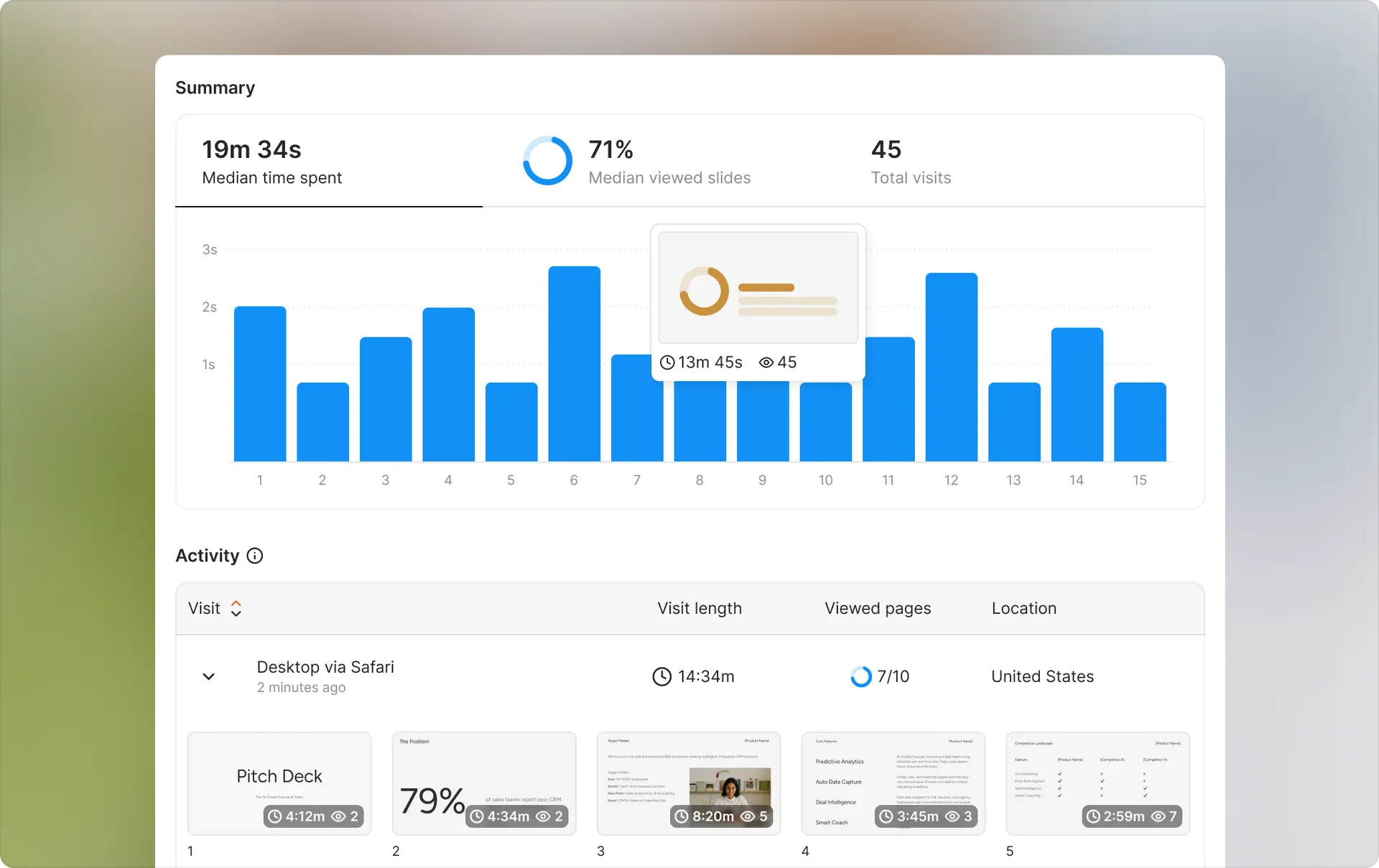
Instead of attaching a PDF, you share a link. When the investor clicks it, you know:
- Exactly when they opened it
- Which slides they spent time on
- How many times they came back
- Whether they forwarded it to a partner
This changes your follow-up game completely.
If an investor opened your deck three times and spent 4 minutes on slide 5 (your traction slide) - that's a warm signal. Follow up.
If they opened it once for 12 seconds - they probably skimmed it. Different message.


Using Ellty to share and track your pitch deck


Ellty is a virtual data room and pitch deck sharing platform built for exactly this. You upload your deck, create a trackable link, and get real-time analytics on who's viewing it and how.
Here's what it gives you:
- Trackable links - Create unique links per investor so you know exactly who's viewing
- Page-by-page analytics - See which slides get attention and which get skipped
- Real-time notifications - Get alerted the moment someone opens your deck
- Access control - Require email capture before viewing, or set expiration dates
- Data rooms - For due diligence, you can share sensitive documents securely with specific parties
Ellty works well when you're actively fundraising and want to manage multiple investor conversations without losing track of who's engaging. You can create separate links for each investor, add notes, and follow up based on actual behavior - not guesses.
Pricing is straightforward: Free forever for core tracking and analytics; Standard from $69/month with unlimited documents, eSignatures, and data rooms; Data Room from $149/month with granular permissions, NDA gating, and dynamic watermarking.
No per-user fees on the shared links. Investors click through without needing to create accounts.
To get started:
- Create an account at Ellty (free, no credit card for starter)
- Generate a trackable link
- Share data rooms with clients
- Watch the analytics come in
Virtual data rooms: what they are and when you need one
Once an investor says "we're interested in moving forward," the conversation changes. They want documents - financials, cap table, legal agreements, IP filings, employment contracts.
This is due diligence. And it needs to be organized.
A virtual data room (VDR) is a secure, organized online space where you share sensitive documents with investors during due diligence. It replaces the old model of emailing zip files of PDFs back and forth.
What goes in a data room
Standard due diligence document list:


You don't need all of this at pre-seed. But you should have the basics organized before any investor asks.
When to set up a data room
As soon as you have a serious conversation. Don't wait until an investor asks for documents and then scramble to find them. Set it up once, keep it current.
Ellty includes data room functionality at the Standard tier ($69/month), which covers document organization, access control, and tracking for due diligence. For simpler use cases - one or two investor conversations with light document sharing - the Pro plan covers most of what you need.
If you're managing a complex raise with many investors and massive document sets, enterprise VDR tools exist. But for most early-stage founders, Ellty provides data room features without the enterprise setup complexity and pricing.
Pitch deck examples: what good looks like
Learning from examples is faster than learning from theory. Here's a breakdown of famous decks and what made them work.
Airbnb (2009 seed deck)
One of the most referenced pitch decks in startup history. What made it work:
- Crystal-clear problem framing ("Price is an important factor for customers booking travel online")
- Simple solution in one line ("A web platform where users can rent out their space")
- Honest market size (didn't overclaim)
- Strong use of the "why now" argument (the rise of sharing economy)
Lesson: Simplicity beats sophistication every time at seed stage.
Uber (2008 pitch deck)
Uber's early deck was notable for its market insight:
- Led with a specific customer pain point (can't get a cab in SF)
- Made the business model obvious (take a cut of every ride)
- TAM calculated specifically and defensibly
Lesson: Ground the story in a real customer moment, not an abstract market problem.
Sequoia's pitch deck framework
Sequoia Capital has published their recommended pitch deck structure. It's worth knowing:
- Company purpose
- Problem
- Solution
- Why now
- Market size
- Competition
- Product
- Business model
- Team
- Financials
You'll notice "Why now" as a separate slide - many founders skip this. It's a powerful frame. Why does this problem need solving today? What's changed in the world that makes your solution possible or urgent now?

Pitch deck checklist before you send
Run through this before sharing with any investor.
Content:
- Cover slide with tagline and contact info
- Problem is specific and quantified
- Solution directly addresses the problem
- Market size is calculated bottom-up
- Traction slide with real data
- Business model is clear (how you make money)
- Competition slide with honest positioning
- Team slide with proof points, not just titles
- 3-year financial projections with assumptions
- Ask is clear: amount, use of funds, milestone
- Closing slide with specific next step
Design:
- Consistent fonts (1-2 max)
- Consistent color scheme
- 16:9 slide format
- No slides with more than 50 words of body text
- All charts labeled clearly
- No spelling or grammar errors
Sharing:
- Using trackable link, not PDF attachment
- Analytics enabled to see who views it
- Deck is accessible without account creation
- You have a follow-up plan based on view data
- Data room ready if investor asks for documents
Frequently asked questions
Q: How long should a pitch deck be?
10-15 slides for most situations. 12 is a good default. If you can't tell your story in 15 slides, the story needs work - not more slides. Investors don't read 30-slide decks cold.
Q: Should I include financial projections if I'm pre-revenue?
Yes. Show that you've thought through the unit economics and growth assumptions. Pre-revenue projections won't be precise - investors know that. What they're evaluating is whether your logic makes sense. Include key assumptions explicitly.
Q: What's the difference between a pitch deck and an investor presentation?
Usually the same content - different delivery context. A pitch deck is typically the document version (sent via email or shared link). An investor presentation is the live version you walk through in a meeting. The live version usually has less text and leans on you to narrate. Build both from the same source material.
Q: Do I need a pitch deck to raise a pre-seed round?
Almost always yes. Even at friends-and-family stage, a deck shows you've organized your thinking. It also forces you to articulate your story clearly - which you'll need to do in every investor conversation anyway. Think of building the deck as preparation, not just a deliverable.
Q: How do I know if investors are actually reading my deck?
With a PDF attachment, you don't. With a trackable link (via Ellty or similar tools), you get page-by-page view data, open timestamps, and notification when someone returns to the deck. This is how you follow up with precision instead of guessing.
Q: Should I password-protect my pitch deck?
No. It blocks sharing, and investors forward decks to partners and other decision-makers. If you want control, use a trackable link with optional email capture - that gives you visibility without blocking access. You can revoke access on a link level any time.
Q: How do I handle the competition slide if there are big incumbents in my space?
Don't avoid the question. Acknowledge the incumbents, then define your specific differentiation clearly. "We do X for [specific customer segment] that [incumbent] doesn't serve well" is a better answer than pretending the competitor doesn't exist. Investors respect founders who know their competitive landscape.
Q: When should I set up a data room?
Before you need one. Set it up when you start actively fundraising, even if investors haven't asked for documents yet. Scrambling to organize due diligence documents after an investor says "we're interested" wastes time and creates a bad first impression. Have it ready.
Q: How often should I update my pitch deck?
Every time something meaningful changes - new customers, new revenue milestones, key hires, pivots. Also update it every 4-6 weeks during an active raise. Sending an outdated deck to a new investor you met last month is avoidable with trackable links, since you can update the source file without changing the link.
Q: What format should I send my pitch deck in?
Don't send a PDF attachment. Upload your deck to a platform that generates a trackable link. The investor gets easy access (no download needed), you get analytics, and you maintain control. If someone specifically requests a PDF, send it - but try the link first.
Building your pitch deck: where to start today
Here's the practical starting point if you're staring at a blank slide.
Step 1: Write before you design. Open a Google Doc. Write one paragraph per slide. Get your thinking clear before you touch any design tool. Most founders do this backwards and wonder why their deck feels off.
Step 2: Start with the problem. Write the clearest, most specific version of your problem statement you can. One paragraph. If you can't do this clearly in writing, you can't do it clearly in a deck.
Step 3: Draft all 12 slides in writing first. Bullet points per slide. The structure before the design. This takes 2-3 hours. It's the most valuable work you'll do.
Step 4: Build in your tool of choice. Take your written draft into Canva, PowerPoint, Google Slides, or wherever you work best. Don't start with a blank template - find a clean, minimal template and replace the content.
Step 5: Get outside feedback. Share with 2-3 people who don't know your company. If they can explain your business back to you after reading it, the deck works. If they can't, something's not clear.
Step 6: Set up sharing before you start reaching out. Upload to Ellty. Create your trackable link. This takes about 5 minutes. Now every send includes analytics. You'll know immediately who's engaging.
Step 7: Reach out with the link, not the attachment. In your investor email, link to the deck. "I've attached our deck below" becomes "Here's a link to our deck." Same effort. Much more information.
Ready to share your deck smarter?
Upload your pitch deck to Ellty, create a trackable link, and know exactly who's reading it - and what they're spending time on. Starter plan is free. No credit card needed.
How to write an investor email that gets your deck read
You've built the deck. Now you need someone to open the link.
Cold investor outreach is its own skill. Most cold emails get deleted in two seconds. Here's how to write one that doesn't.
The anatomy of a good investor email:
Subject line options that work:
- "[Your company] - [one-line description] - deck inside"
- "Intro: [Company name] - [specific traction signal]"
- "Warm intro from [mutual contact] - [Company name]"
Keep subject lines specific. "Exciting startup opportunity" is deleted. "[Founder name] - $40K MRR logistics tool - deck" gets opened.
Email body structure:
Paragraph 1 (2 sentences max): Who you are and what you do. One specific, credible signal.
Paragraph 2 (2-3 sentences): The problem you're solving and the market you're going after. Be specific.
Paragraph 3 (1-2 sentences): Your ask. What you're raising and what you want from this email (a 20-minute call).
Link to your deck. Sign off.
Example email:
"Hi [Name],
I'm [founder name], co-founder of TrackMate. We help logistics dispatchers eliminate manual delivery tracking - we're at $42K MRR, growing 22% month-over-month.
The logistics space has a massive manual work problem. 40,000 dispatchers in North America spend 3+ hours per day in spreadsheets. We've cut that to under 15 minutes for our current customers.
We're raising a $1.5M pre-seed and would love 20 minutes to share more. Here's our deck: [link]
Best, [Name]"
That's it. Under 100 words. Every sentence earns its place.
What to do when they open the deck but don't reply:
This is where analytics change everything. If you can see they opened your deck twice and spent 3 minutes on slide 6, that's engagement. Follow up within 24-48 hours with a specific reference:
"Hi [Name] - wanted to follow up on the TrackMate deck I sent last week. Happy to answer any questions or schedule time if it's worth exploring."
Don't mention that you saw them open it. Just follow up while you're fresh in their mind.
If they didn't open it after 5-7 days, send one follow-up. If still nothing, move on. A non-response is feedback too.
How to pitch in person: taking your deck into the meeting
Getting the meeting is step one. Now you need to deliver.
A lot of founders build their deck for email sharing and then show up to present it with all that text on screen. It's awkward. Here's how to handle the transition.
Two-deck strategy
Keep your detailed email deck as your leave-behind document. Build a separate version for live presentations with:
- Headlines only (no body text)
- Large visuals
- One data point per slide where numbers appear
- White space to breathe
The live version is a backdrop. You're the content.
Meeting structure that works
Most investor meetings run 30-45 minutes. Here's a rough breakdown:
First 5 minutes: Introductions, rapport. Don't rush into the deck.
Next 20-25 minutes: Your presentation. Don't go slide-by-slide robotically. Tell the story. Let slides support you.
Last 10-15 minutes: Q&A. This is often where investors are really evaluating you.
The questions they ask will tell you a lot. Questions about your team or market usually signal interest. Questions about why you're better than incumbents are worth preparing for specifically.
Common investor questions - with honest answers
"What's your moat?" Don't panic. Most early-stage companies don't have a deep moat yet. Be honest: "Right now, our moat is execution speed and deep domain knowledge. As we grow, we expect the moat to deepen through data network effects / switching costs / brand."
"Why you?" This is a team question in disguise. Answer it directly. What gives you the right to solve this problem? Domain expertise, personal experience with the problem, specific technical advantage.
"What happens if [Big Company] builds this?" Acknowledge it's possible. Then explain why you'll win anyway - distribution already built, switching costs, specific customer relationships, speed of iteration.
"What keeps you up at night?" Answer honestly. This is a test of self-awareness and realistic thinking. "Customer acquisition cost is higher than we'd like - we're working on reducing it through [specific initiative]" is a great answer. "Nothing" is a terrible answer.
"What's your ask?" Have a crisp answer ready: amount, type (SAFE, priced round), lead investor status, how much you've already committed. Never fumble this.
After the meeting
Send a follow-up email within 24 hours. Include:
- Thank you (brief - one sentence)
- Link to your deck again in case they want to share
- Any materials you promised to send
- A specific next step suggestion
If they expressed interest, suggest a second meeting or next step timeline. Don't be vague.
"I'll follow up in a few weeks" is worse than "Would Thursday or Friday next week work for a follow-up call?"
Pitch decks for different funding stages
The pitch deck you need at pre-seed is different from what you need at Series A. Here's what changes as you grow.
Pre-seed deck (idea to $500K raise)
What investors are buying at this stage: the team, the problem thesis, and the market potential.
What you can get away with:
- Little or no traction
- Prototype or even just mockups
- Smaller, more speculative market analysis
What matters most at this stage:
- Team background and why you're the right people
- Problem clarity and insight (your unfair view)
- Early validation (user interviews, waitlist, pilots)
Deck length: 10-12 slides. Keep it tight.
Seed deck ($500K to $3M raise)
What investors are buying: early validation that the product works and the market cares.
What you need to show:
- Product that exists and works
- Some paying customers or strong pilot signals
- Early metrics (retention, engagement, initial revenue)
- Clear go-to-market plan
The team still matters enormously. But now you need evidence the idea works, not just that it could.
Deck length: 12-15 slides.
Series A deck ($3M to $15M raise)
What investors are buying: proof that you've found product-market fit and a repeatable go-to-market.
What you need to show:
- $1M+ ARR or strong equivalent traction
- Defined ICP with proven acquisition channels
- Unit economics that work (or a clear path there)
- Team scaled with key hires in place
- Detailed 3-year financial model
The story becomes about execution and scale, not concept validation. Your slides need to reflect that shift.
Deck length: 15-20 slides. More depth on financials and go-to-market.


How to customize your pitch deck for different audiences
Not every investor is the same. Your deck shouldn't be either.
Angel investors vs. VCs:
Angels often have personal connections to the problem space. Lead with the story and the human element more than the market size math.
VCs are evaluating fund fit first. Is this the stage they invest in? The sector they understand? The market size they need? Make sure your deck answers their portfolio-level questions.
Sector-specific investors:
If you're pitching a fintech-focused fund, you can assume more background knowledge. You don't need to explain what open banking is. Adjust accordingly.
Corporate VCs:
Corporate investors (like Google Ventures, Salesforce Ventures, etc.) care about strategic fit as much as financial return. Add a slide or at least a talking point about how your company's growth serves their parent company's ecosystem.
Accelerators:
Y Combinator, Techstars, and similar programs care a lot about the founders. Team slides and founder background matter more than almost anything else. They're early - they know the product will change.
Pro tip: Create a "master deck" with 20+ slides that covers everything. Then create shorter, customized versions for each audience by pulling the right subset of slides. This is much easier to manage than building separate decks from scratch.
Pitch deck analytics: knowing when and how to follow up
Most founders send their deck and wait. Passive. Hoping for a response.
The founders who close rounds faster treat deck sharing as a data source, not a one-way broadcast.
What you can track with a tool like Ellty
When you share a trackable link instead of a PDF:
Open events: You know the exact moment someone opens your deck. The time, date, and how many times they've returned. If an investor opens your deck three times in one day, that's a hot signal - follow up immediately.
Page-level time: You know which slides get attention. If 80% of viewers bail on slide 4 (your market size slide), there's a problem with that slide. Fix it.
Viewer identity: With email capture enabled, you know exactly who's viewing - not just that someone did.
Link-level control: You can send different links to different investors and track them separately. If an investor at a specific firm is viewing the deck, you know. If they forwarded it to a partner, you know when that partner opens it too.
The follow-up framework based on analytics


You can't get any of this information from a PDF attachment. This is why smart founders stopped sending attachments.
Ellty for active fundraising
If you're actively running a fundraising process - multiple conversations happening simultaneously - Ellty dashboard shows you all your links and their engagement in one place. You can see at a glance which investors are engaged, which are cold, and where to focus your energy.
The Standard plan ($69/month) gives you full analytics. For a $1.5M raise where your time is your most valuable resource, knowing who's reading your deck isn't optional - it's how you run the process efficiently.
Final thoughts
A pitch deck won't raise your round for you. Investors fund people. But a bad deck will kill conversations before they start, and a good one opens doors.
The formula isn't complicated:
- Clear problem
- Specific solution
- Real market
- Credible team
- Honest traction
- Clear ask
Tell the story simply. Design it cleanly. Share it smartly. Follow up based on what you know, not what you guess.
Building a pitch deck is one of those things where the first version is almost always wrong. That's fine. The founders who raise don't have the perfect deck from day one - they have a deck they improve based on feedback and analytics, send it smart, and follow up with precision.
That's the real edge. Now go build it.
Author

Anika Tabassum Nionta is a Content Manager at Ellty, where she writes about secure document sharing, virtual data rooms, M&A, due diligence, fundraising, and sales enablement. With over 6 years of writing experience, she helps professionals understand how to share confidential documents securely, track engagement, and manage deals more effectively. Anika holds both a BA and MA in English from Dhaka University. Outside of work, she enjoys reading, exploring new cafes in Dhaka, and connecting with entrepreneurs and dealmakers in her community.

