
Energy deals are complicated. You're dealing with large capital requirements, multiple stakeholders, investors, regulators, lenders, operators and documents that can't afford to leak. A virtual data room (VDR) is how serious energy companies manage all of that.
This guide covers everything: what a VDR actually does in the energy sector, what it costs, how to set one up, and which platforms to consider. No fluff. Just what you need to know.
What is a virtual data room used for?
A virtual data room is a secure online space where you store and share confidential documents with a controlled group of people. It's not just file storage. It's access control, document tracking, permissions management, and audit trails - all in one place.
In plain terms: you upload your documents, decide who can see what, and track exactly what they do with it.
The energy and natural resources sector has become one of the heaviest users of VDRs. That's not surprising. Energy projects are capital-intensive, involve multiple parties across different countries, and generate enormous volumes of sensitive documentation. Secure information exchange isn't optional in this industry, it's required.
Here's what energy companies use data rooms for most often:
Deal governance - managing documents, negotiations, and stakeholder activity before, during, and after M&A deals. This includes project development agreements, permits, land rights, and environmental assessments.
Due diligence - when a buyer wants to review your assets, they need organized access to financial models, operational data, regulatory filings, and contracts. A VDR keeps everything in one place with full visibility into who looked at what.
Fundraising and investor relations - energy companies and project developers use data rooms to share pitch materials, feasibility studies, and financial projections with potential investors in a controlled way.
Regulatory compliance - in regulated sectors like energy and utilities, VDRs serve as a central hub for compliance documentation that auditors and regulators need to access remotely.
Joint ventures and partnerships - energy projects often involve multiple parties sharing sensitive IP, technical data, and project plans. A VDR lets you control exactly what each party sees.
Asset sales and divestitures - when selling an asset, you need a clean, organized data room that allows bidders to complete diligence efficiently without leaking information between competing parties.

Why the energy sector specifically needs a VDR
Energy transactions are different from a typical startup fundraise. Here's what makes them unique:
The documents are more complex. Energy deals involve geological surveys, environmental impact assessments, land rights documentation, grid interconnection agreements, power purchase agreements (PPAs), permitting records, and detailed financial models. A single renewable energy project can generate hundreds of documents.
The security stakes are higher. The energy and power sector spends an average of $4.78 million per data breach. The industry's mix of physical infrastructure and software creates a large attack surface. Sensitive project data in the wrong hands isn't just a legal problem, it's a competitive one.
Multiple parties need access at the same time. A typical energy deal involves the seller, the buyer, legal teams, technical advisors, financial advisors, lenders, and sometimes government agencies. Managing access across all of these parties without a VDR is a documentation nightmare.
Deals take longer. An energy M&A process can run 6-12 months. That's a long time to manage document access via email.


Virtual data room for energy M&A
Energy M&A has stayed remarkably consistent. The EU and renewables sector has averaged around 2,500 deals per year for the past five years. The pace of digitalization in deal processes has accelerated sharply. Most energy M&A teams now expect a properly configured data room before due diligence even starts.
In energy M&A specifically, a VDR needs to handle:
Full audit trails
Every file view, every login, every permission change gets logged. This matters when you have legal exposure and multiple parties in the room simultaneously.
Granular access control
Different parties see different documents. Your lender sees financial models. Your technical advisor sees the engineering reports. Your lawyers see everything except what they don't need to. You set those rules in advance.


NDA gating
No one gets into the room until they've accepted an NDA. This creates a legally binding record of who agreed to confidentiality before seeing anything.
Dynamic watermarking
Every document a reviewer sees is watermarked with their name and access details. This deters screenshots and unauthorized sharing.
Activity reporting
Deal teams need to know who's engaged and who isn't. An activity dashboard showing which bidders are spending time on financial models versus skimming the executive summary is genuinely useful deal intelligence.
The most important thing to get right in energy M&A is document organization. Buyers are moving fast. If your due diligence room is hard to navigate, it slows the deal and creates a bad impression.
How much does a VDR cost?
This is where the range gets wide.
The legacy providers - Intralinks, Datasite - price per page or per project and don't publish standard rates. Intralinks charges around $7,500 for 10,000 pages. Datasite is slightly lower at around $7,000 for the same volume. For a large energy M&A deal with thousands of documents, costs can easily exceed $20,000-$50,000 per transaction.
Modern flat-rate platforms are a different story. They charge monthly subscription fees with no per-user surcharges, which keeps costs predictable regardless of how many reviewers you add to the room.
Here's a pricing comparison of the main tiers:


For energy companies and smaller project developers running lighter deal processes or early-stage due diligence, the $0-$200/month range covers everything you need. For large energy M&A with multiple bidder groups and complex regulatory requirements, enterprise platforms become worth the cost.
If you're unsure where you fall, start with a flat-rate platform. You can always scale up if the deal demands it.
7 virtual data rooms for energy companies
Here's a practical breakdown of 7 options, who they're built for, and what they actually cost.
1. Ellty
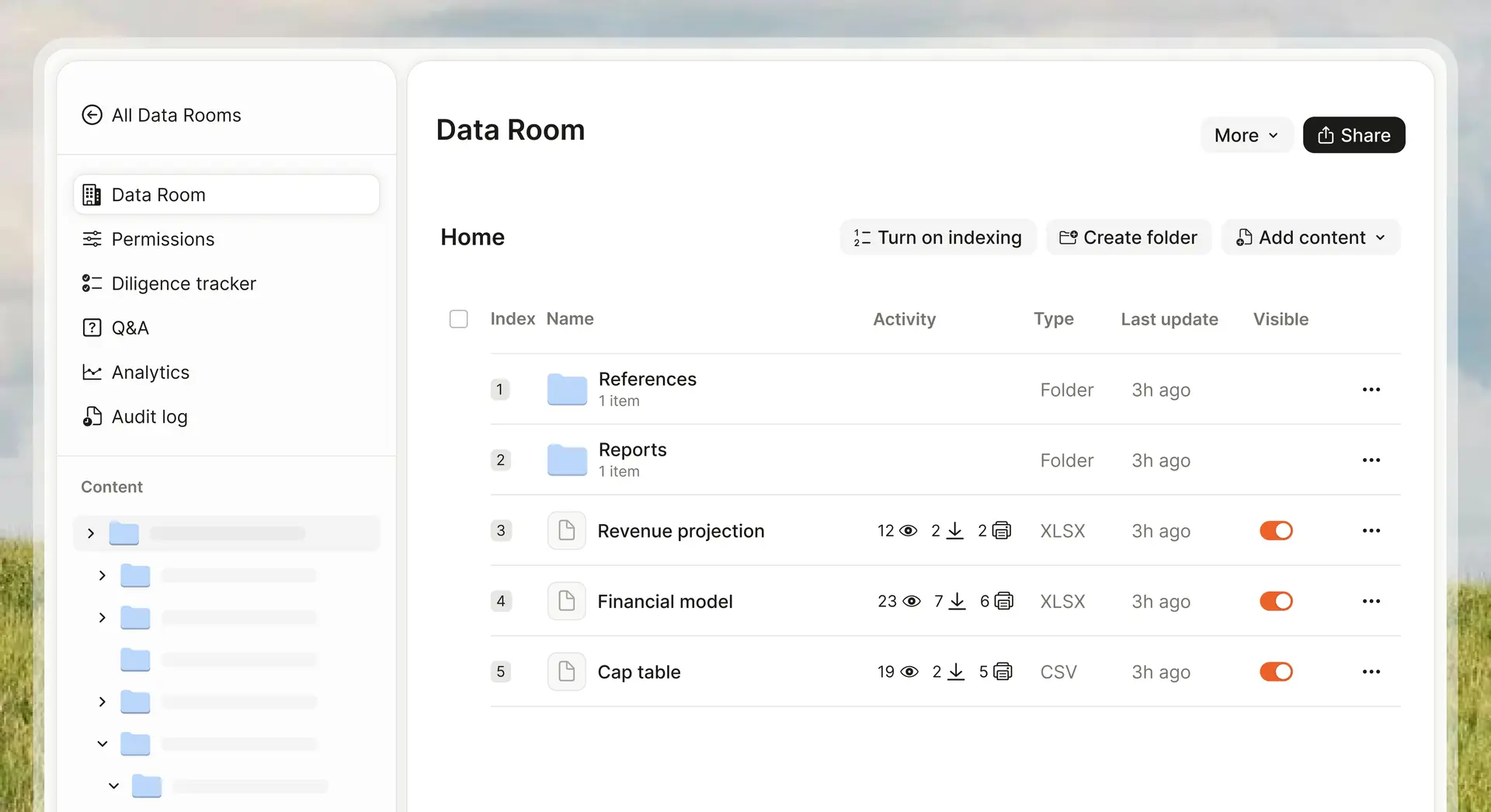
Ellty is a virtual data room, confidential document sharing, and document analytics platform built for anyone who needs to share sensitive documents in a controlled, trackable way. Whether you're raising a funding round, closing a property deal, running a consulting engagement, or managing an acquisition, Ellty gives you the core tools that matter: access controls, real-time activity tracking, NDA gating, and a clean audit trail.
For energy companies, Ellty works well when you're raising capital for a project, running a diligence process with a defined set of investors or lenders, or sharing technical documents with project partners under controlled access.
Ellty offers data room features without per-user pricing. If you're sharing with 15 visitors or technical reviewers, you don't pay 15x the base price. That keeps costs predictable as your reviewer list grows.
Pricing:
- Free: document tracking, real-time analytics, secure sharing
- Standard ($69/month): unlimited documents, advanced analytics, eSignatures, custom branding, data room features
- Data Room ($149/month): granular permissions, NDA gating, dynamic watermarking, restricted visitor access, 3 users
- Data Room Plus ($349/month): group visitor permissions, audit logs, up to 4,000 assets per data room
What Ellty is honest about: It's not trying to replace Intralinks for a $500M energy acquisition. It doesn't have built-in Q&A workflows or the enterprise compliance certifications that large institutional investors sometimes require. For those use cases, you'll need an enterprise platform.
Where it fits energy specifically: energy businesses raising from climate tech VCs, project developers sharing feasibility documents with other parties, and smaller asset transactions where a fast, trackable, secure data room is what you need.

2. iDeals


iDeals is a well-established mid-market VDR with a strong track record in energy, infrastructure, and natural resources deals. Entry-level pricing starts around $460/month, with Business and Enterprise plans requiring a sales conversation to get a number.
The platform is genuinely solid - clean interface, reliable infrastructure, good permission controls, and 24/7 support. It's used by structured M&A teams where counterparties expect a professionally configured room, not a startup-friendly link-sharing tool. For energy companies running a formal diligence process with multiple advisors and institutional reviewers, iDeals fits that workflow well.
Where it's overkill: if you're a seed-stage energy startup sharing documents with 5-10 investors, the pricing and setup complexity don't match the use case. It's built for deals with real transaction weight behind them - project acquisitions, asset sales, and fund-level due diligence where the platform needs to hold up under scrutiny from lawyers and financial advisors on both sides.
3. Ansarada


Ansarada is ISO 27001-certified and built specifically for complex deal workflows. Beyond standard VDR features, it adds AI-assisted diligence tools, engagement scoring, and deal readiness assessments that give sell-side teams a clearer picture of how prepared they are before a process goes live.
For energy companies, this is relevant when you're running a competitive process - multiple bidders, structured information releases, and a need to understand which parties are genuinely engaged versus just collecting documents. The AI-assisted Q&A and document analysis tools reduce the manual work that normally falls on advisors during a busy process.
Pricing isn't published. You go through their sales team. Setup is more involved than modern flat-rate tools, which reflects the platform's orientation toward deal teams with dedicated advisors. If you're running a renewable energy portfolio sale or a large project M&A with an investment bank, Ansarada is worth evaluating alongside Datasite and Intralinks.
4. Datasite

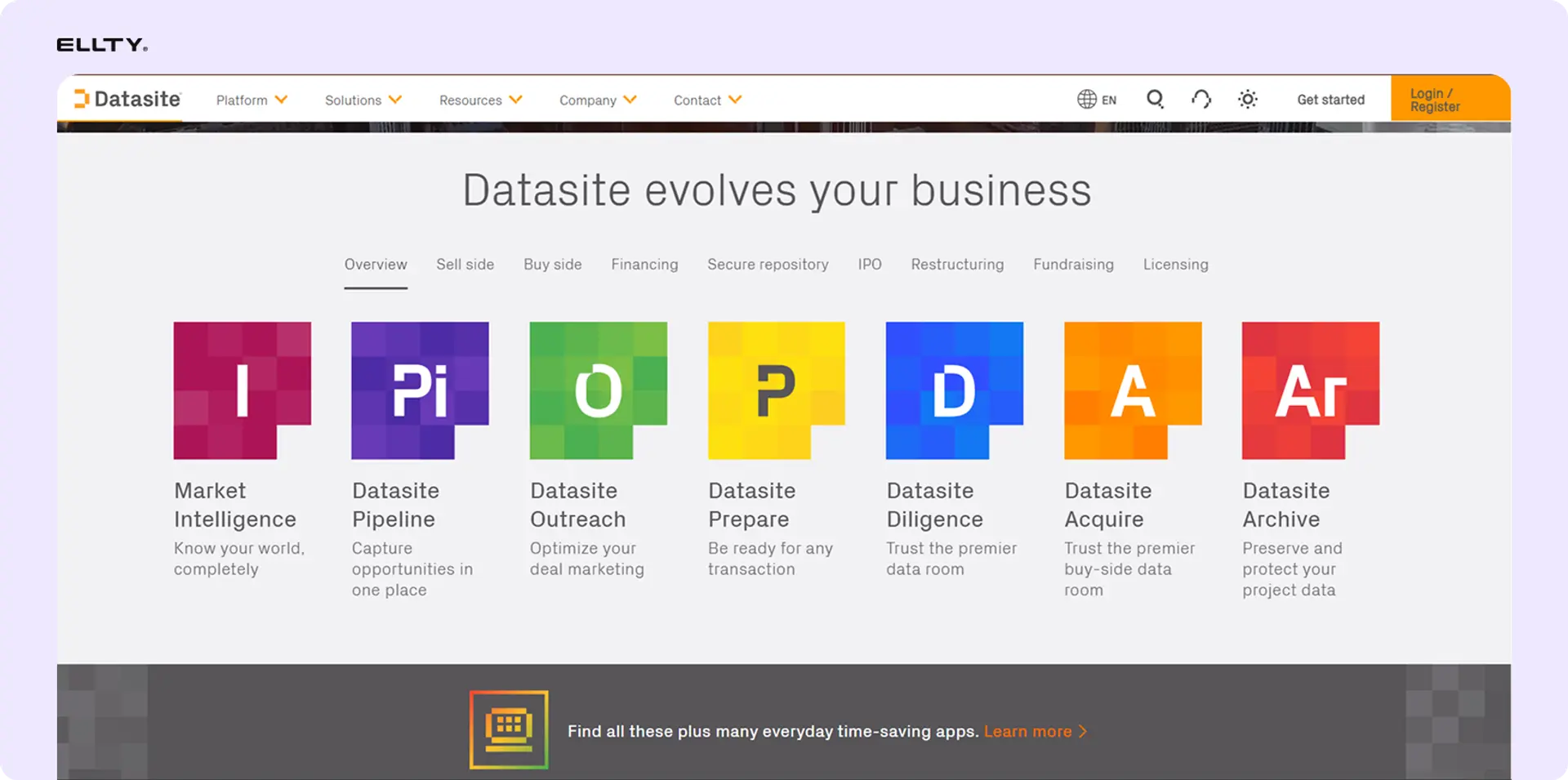
Datasite is an enterprise VDR platform widely used by investment banks and M&A advisors on significant energy transactions. It's purpose-built for the sell-side process - managing large document volumes, multiple bidder groups, and the kind of structured information disclosure that major deals require.
Pricing runs around $7,000 for 10,000 pages, with larger deals scaling well above that. Per-page pricing is the model, which means costs can move significantly once technical documentation, environmental reports, and financial models all go into the room.
It's not a tool for startups or small project developers. But for an energy company running a proper competitive M&A process - an oil and gas divestiture, a large solar portfolio sale, or an infrastructure fund exit - with institutional advisors who expect enterprise-grade infrastructure, Datasite is the kind of platform those counterparties are used to seeing. The setup process involves their team, which adds time but also support.
5. Intralinks

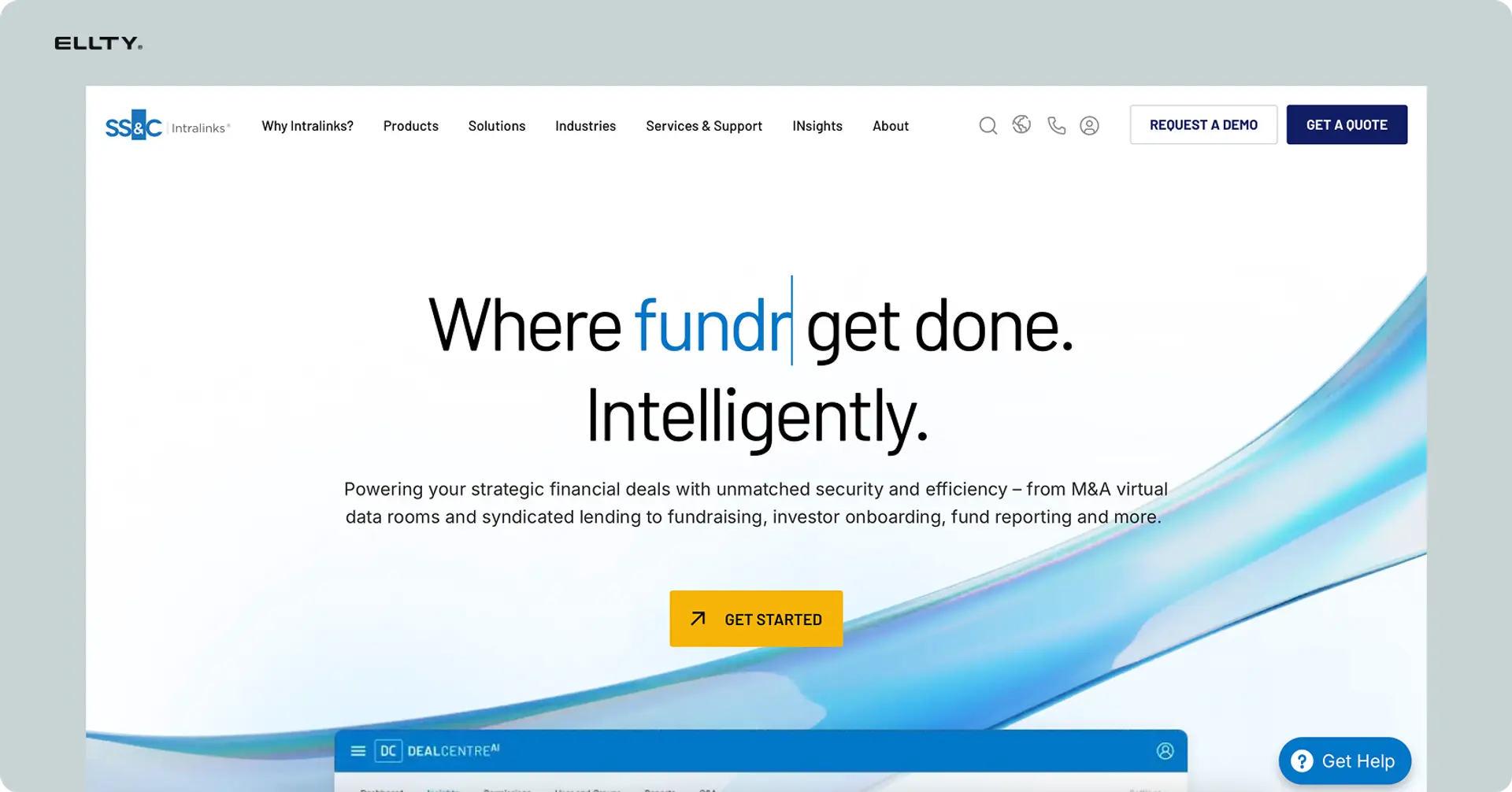
Intralinks is the longest-standing enterprise VDR provider in the market. It's used on some of the largest and most complex energy deals globally - oil and gas divestitures, major renewable energy acquisitions, cross-border infrastructure transactions, and energy fund portfolio sales where multiple jurisdictions and legal teams are involved simultaneously.
Pricing is deal-based and starts around $7,500 for standard deal volumes. For large deals, it scales considerably from there. The platform includes advanced security features, detailed audit capabilities, and the kind of compliance infrastructure that major institutional buyers and their legal teams expect on high-value transactions.
Like Datasite, this is not the right tool for an energy startup. The setup involves dedicated deal support, the pricing reflects transaction scale, and the feature set is built for teams of advisors managing multi-month processes. If your deal justifies it, Intralinks has the infrastructure to support it.
6. DealRoom


DealRoom positions itself as a full deal management platform, not just a VDR. It has a specific focus on the energy sector - renewable energy M&A in particular - and includes pipeline management, due diligence workflows, and project tracking tools alongside standard document sharing features.
The distinction from pure-play VDRs is that DealRoom tries to manage the whole deal process in one place, not just the document repository. For energy companies running multiple transactions or project development pipelines simultaneously, that broader workflow capability can reduce the coordination overhead across tools. It's used by energy M&A teams and advisors who want deal management and data room functionality in a single platform rather than stitching together separate tools.
Pricing is quote-based for active deal use. It's worth evaluating alongside iDeals and Ansarada if you're a mid-market energy company doing regular transactions rather than a one-off deal.
7. Firmex


Firmex uses a subscription pricing model rather than per-deal or per-page pricing, which is a meaningful difference if you're running multiple energy transactions in a year. You pay a predictable monthly rate regardless of deal count or document volume, which makes the economics work for advisory firms and PE companies with ongoing deal flow rather than a single fundraising process.
The platform covers the core VDR requirements - granular permissions, NDA enforcement, audit logs, watermarking, and secure document sharing - with a clean interface that doesn't require extensive onboarding. No per-user fees, which matters when you're managing rooms with multiple advisors, lenders, and technical reviewers who need temporary access.
For energy advisory firms, independent sponsors, or PE funds with consistent deal activity in the energy sector, Firmex's flat subscription model makes more financial sense than platforms that charge per transaction. The per-deal pricing model becomes expensive fast when you're doing four or five deals a year.


How to create a virtual data room for energy companies
Setting up a data room isn't complicated if you're prepared before you start. Here's how to do it properly.
Step 1 - choose your platform based on deal complexity. Pick a tool based on your use case. We have covered the top tools above.
Step 2 - plan your folder structure before uploading anything. Energy data rooms typically follow this kind of structure:
01 - Company overview
- Executive summary
- Corporate structure
- Team and organizational chart
02 - Financial information
- Financial statements (3 years)
- Financial model and projections
- Cap table or ownership structure
03 - Technical and operational
- Project technical reports
- Feasibility studies
- Operational data and performance records
04 - Legal and compliance
- Key contracts (PPAs, offtake agreements, land rights)
- Permits and regulatory approvals
- Environmental assessments and EIA reports
- Insurance documentation
05 - Market and commercial
- Market analysis
- Customer contracts or pipeline
- Competitive landscape
06 - Risk factors
- Known issues and pending litigation
- Regulatory risks
Step 3 - set up access permissions before inviting anyone. Decide who sees which folders. Your financial advisors might need everything. Potential buyers might get executive summary and high-level financials first, with full access unlocked after they sign an NDA.
Step 4 - enable NDA gating before sharing any links. Anyone who clicks the link should be required to accept your NDA before seeing anything. This is a non-negotiable step for sensitive energy documents.
Step 5 - add dynamic watermarking on sensitive documents. Your financial models, technical reports, and permitting documentation should all carry watermarks showing the viewer's identity. This deters unauthorized sharing.
Step 6 - test the room as a viewer before you invite anyone. Walk through the experience from the other side. Check that permissions are working correctly and documents are loading properly.
Step 7 - invite reviewers and monitor engagement. Real-time notifications tell you when someone accesses the room. Activity reports show you which documents are getting attention. In energy business, knowing which technical reports or financial scenarios visitors are spending time on is useful signal.
For simple use cases, tools like Ellty are built so you can get through all of these steps in under an hour if your documents are prepared. No account manager calls required.
If you're tired of sending documents over email and having no idea what happens next, set up a trackable data room on Ellty and get real-time visibility into exactly who's engaging with your materials.
FAQ
What documents go in an energy data room?
The core documents for an energy data room include: company financials (3 years of statements plus a financial model), corporate structure and cap table, key contracts (PPAs, offtake agreements, land rights, construction contracts), permits and regulatory approvals, environmental impact assessments, technical reports and feasibility studies, project performance data, insurance documentation, and any pending or known legal issues. For M&A specifically, you'll also include an executive summary and an information memorandum.
How much does a virtual data room cost for energy companies?
It ranges from free to $50,000+ per deal depending on the platform and deal size. Modern flat-rate platforms charge $0-$349/month for most SMB use cases. Mid-market platforms run $400-$1,000/month. Enterprise platforms used in large energy M&A charge $7,000-$15,000+ per transaction based on page count or deal volume.
What is a virtual data room used for in energy M&A?
In energy M&A, a virtual data room is used to share sensitive deal documents with potential buyers, lenders, and advisors under controlled access. It manages due diligence document requests, tracks bidder engagement, enforces NDA agreements, maintains an audit trail of who saw what, and protects sensitive technical and financial data from leaking to competitors or unauthorized parties.
Can I use Google Drive instead of a VDR for energy due diligence?
Technically yes, practically no. Google Drive doesn't give you NDA gating, dynamic watermarking, granular permission controls per document, an audit trail of who viewed what, or the ability to revoke access to already-viewed documents. For early conversations and sharing non-sensitive materials, Drive works fine. For formal due diligence with legal exposure, it's not appropriate.
How long does it take to set up a virtual data room for an energy deal?
On modern flat-rate platforms, you can have a basic data room live in under an hour if your documents are prepared. The time-consuming part is organizing your documents properly before you upload, not the setup itself. Enterprise platforms can take days to configure with a project manager. For most energy company use cases, fast setup is one of the main reasons to choose a modern platform over a legacy one.
What security features should an energy VDR have?
At minimum: AES-256 encryption at rest, TLS encryption in transit, multi-factor authentication, granular access controls, NDA gating before document access, dynamic watermarking showing the viewer's identity, full audit logs, and the ability to revoke access instantly. For regulated industries or institutional investors, ISO 27001 and SOC 2 Type II certification are often expected.
How do I know if my energy deal needs an enterprise VDR or a simpler platform?
A few questions to ask: How many parties will need simultaneous access? If it's under 20-30 reviewers in a structured process, modern flat-rate platforms handle it fine. Are your investors or buyers institutional funds that require specific certifications? If yes, check what they expect. Is the deal over $50M with investment bank advisors? If yes, enterprise platforms are usually worth it. Are you sharing thousands of technical documents with complex redaction requirements?
Author

Anika Tabassum Nionta is a Content Manager at Ellty, where she writes about secure document sharing, virtual data rooms, M&A, due diligence, fundraising, and sales enablement. With over 6 years of writing experience, she helps professionals understand how to share confidential documents securely, track engagement, and manage deals more effectively. Anika holds both a BA and MA in English from Dhaka University. Outside of work, she enjoys reading, exploring new cafes in Dhaka, and connecting with entrepreneurs and dealmakers in her community.

