
If you're a biotech company owner, you already know that sharing sensitive data is part of the job. Clinical trial results, IP filings, regulatory documents, manufacturing processes - this stuff can't just sit in a Google Drive folder with a shared link.
That's where a virtual data room comes in.
But VDRs can be confusing. Some cost $500/month. Some cost $30,000/year. Some are built for M&A lawyers. Some are built for startups doing a Series A. And most VDR providers don't make it easy to figure out which one actually fits your situation.
This guide breaks it all down simply. What a biotech VDR actually is, what features matter, what things cost, how to build one, and how to pick the right tool for your stage.
What is a virtual data room for biotech?
A virtual data room (VDR) is a secure online space where you store and share confidential documents with specific people - investors, acquirers, partners, or regulators.
In biotech, you're dealing with documents that are both highly sensitive and highly regulated. Patents, preclinical data, clinical trial protocols, CMC files, regulatory submissions - these aren't things you can email around or share through consumer file-sharing tools.
A VDR gives you control over who sees what, tracks every action taken on every document, and keeps a full audit trail. When a pharma company is doing due diligence before a $200M acquisition, they need to know that what's in the data room is secure and traceable.
That's the core job of a VDR.


Why biotech specifically needs a VDR
Not every industry needs a VDR the same way. Biotech is different for a few reasons.
You're managing IP that took years and millions of dollars to generate. One leak of unpublished research could kill a patent application or hand a competitor your roadmap.
You're working with regulated data. Clinical trial data, patient information (even de-identified), and CMC data all have compliance requirements around how they're stored and shared.
You go through multiple high-stakes transactions. Fundraising rounds, licensing deals, partnerships, acquisitions - biotech companies go through these repeatedly, and each one requires a clean, structured data room.
You work with large international teams. Contract research organizations, CDMOs, regulatory consultants across different countries all need access to specific slices of your documentation. Giving everyone access to everything is not an option.
A consumer file tool simply won't cut it here.
What documents go in a biotech data room?
Here's a practical breakdown of what typically goes into a biotech VDR at different stages.


You won't have all of this at seed stage. Early on, it might just be your pitch deck, cap table, and some scientific data. That's fine. The structure scales as you grow.
Key biotech VDR features you actually need
Not every VDR feature list is created equal. Some features are genuinely critical for biotech. Others are nice-to-have. A few are just marketing fluff.
Here's what actually matters.
Granular permissions
You need to control access at the folder and document level. An investor should see financials. A CDMO should see CMC docs. Nobody should see everything unless you've explicitly decided that.
NDA gating
Before someone can access your data room, they should have to sign an NDA or confirm they've reviewed one. This is standard practice for serious biotech transactions.
Audit logs
A full, timestamped record of who logged in, which documents they opened, how long they spent, and what they downloaded. This is critical for both legal protection and deal management.
Dynamic watermarking
Any document viewed or downloaded gets automatically watermarked with the viewer's name, email, and timestamp. This deters leaks and creates accountability.
Secure document viewing
The best VDRs prevent downloading, printing, or screenshotting of documents. This matters especially for unpublished research.
Version control
Science changes. Regulatory docs get updated. You need to be able to replace documents without breaking the file structure or confusing reviewers.
Activity analytics
Know in real time which visitors are actually engaging with your deck, which sections they're spending time on, and who hasn't opened anything yet. This directly improves how you manage a raise.
Q&A management
For M&A specifically, buyers ask a lot of questions. A built-in Q&A function routes questions to the right team member and keeps a record of all answers.
eSignatures
For NDAs, term sheets, or other documents that need signing, built-in eSignatures keep the process inside the secure environment.
Data room examples: what a biotech VDR looks like in practice
Not all data rooms are built the same. Some are designed for billion-dollar M&A deals. Some are built for early-stage companies who just need to share a deck securely. Here are 6 real platforms biotech teams actually use, starting with the most practical options.
Ellty

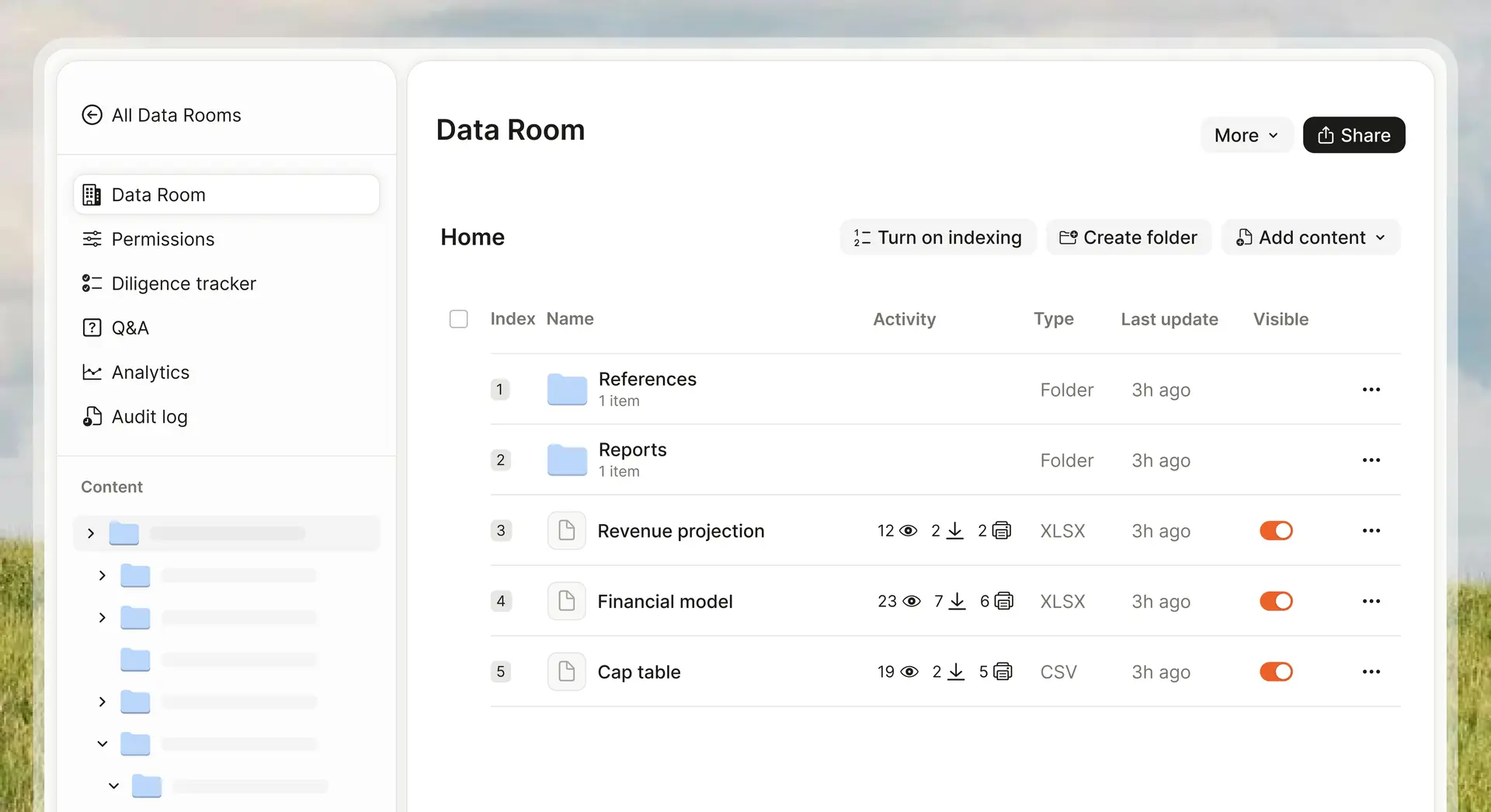
Ellty is a document sharing and virtual data room platform built for anyone who needs to share sensitive documents in a controlled, trackable way. Whether you're raising a funding round, closing a property deal, running a consulting engagement, or managing an acquisition, Ellty gives you the core tools that matter: access controls, real-time activity tracking, NDA gating, and a clean audit trail.
You can set up a data room in hours, not days. Granular permissions let you control exactly who sees which folders. NDA gating means nobody gets in without acknowledging the agreement first. Dynamic watermarking applies automatically to every viewed or downloaded document, with the viewer's name and timestamp. Audit logs track every action inside the room.
Where Ellty stands out is analytics. You can see who opened your documents, which pages they spent the most time on, and when they came back. For biotech teams managing a fundraising round or a licensing discussion, that real-time visibility is genuinely useful. Pricing starts at $149/month for the core data room plan, with no per-user fees.

Datasite

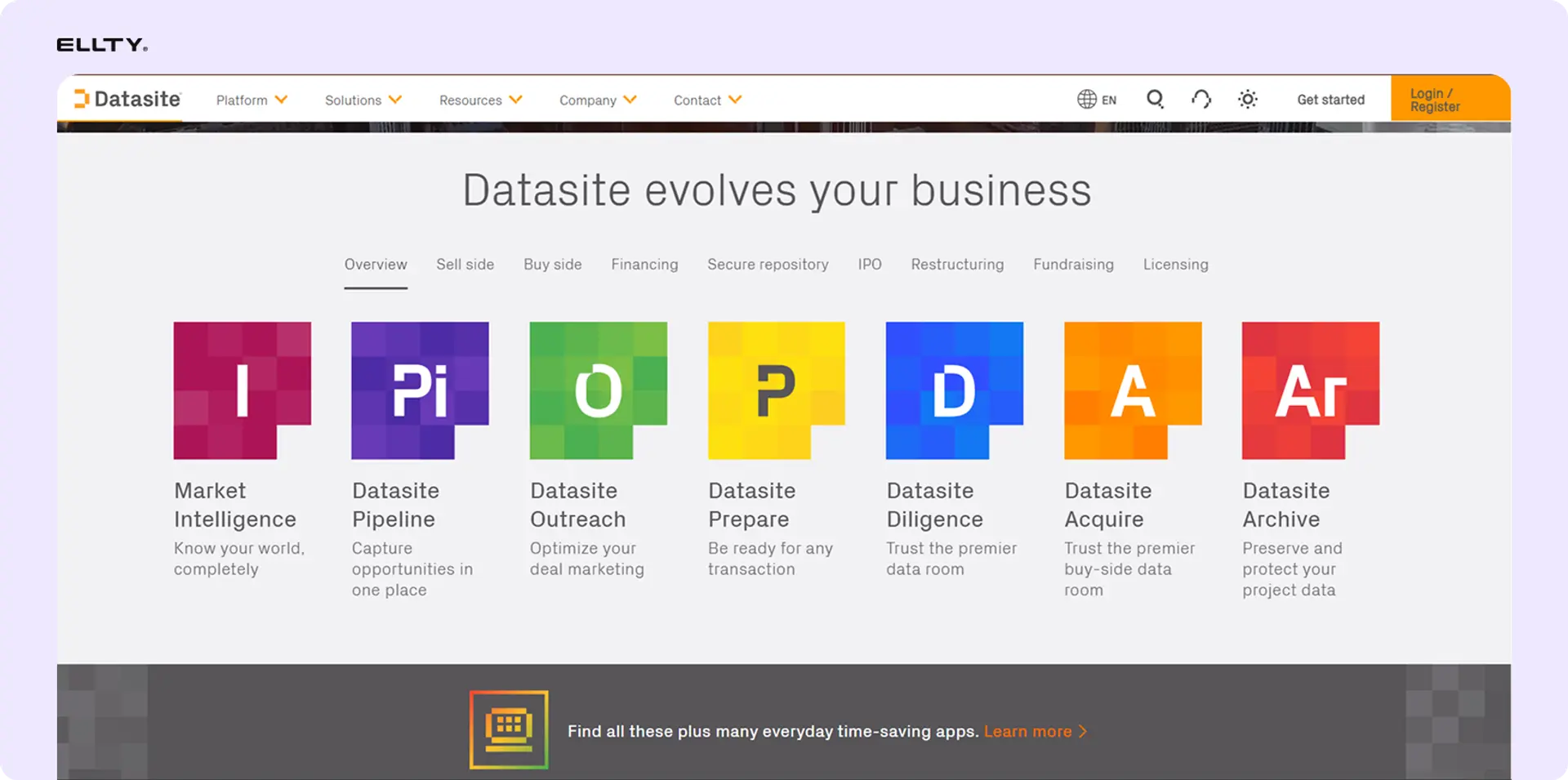
Datasite is one of the most widely used enterprise VDR platforms, particularly for M&A transactions. It's built for deal teams running complex, multi-party due diligence processes - think large pharma acquisitions, IPO prep, and strategic partnerships involving investment banks.
The platform includes advanced Q&A management, AI-assisted document redaction, bulk document upload, and deep permission controls. It integrates with the tools that enterprise deal teams already use. The tradeoff is cost and complexity. Datasite is priced for large transactions and typically requires a sales conversation to even get a quote. For early-stage biotech startups, it's almost certainly more than you need. But if you're a late-stage company running a $300M+ acquisition process, Datasite is one of the go-to choices on the acquirer's side.
Intralinks

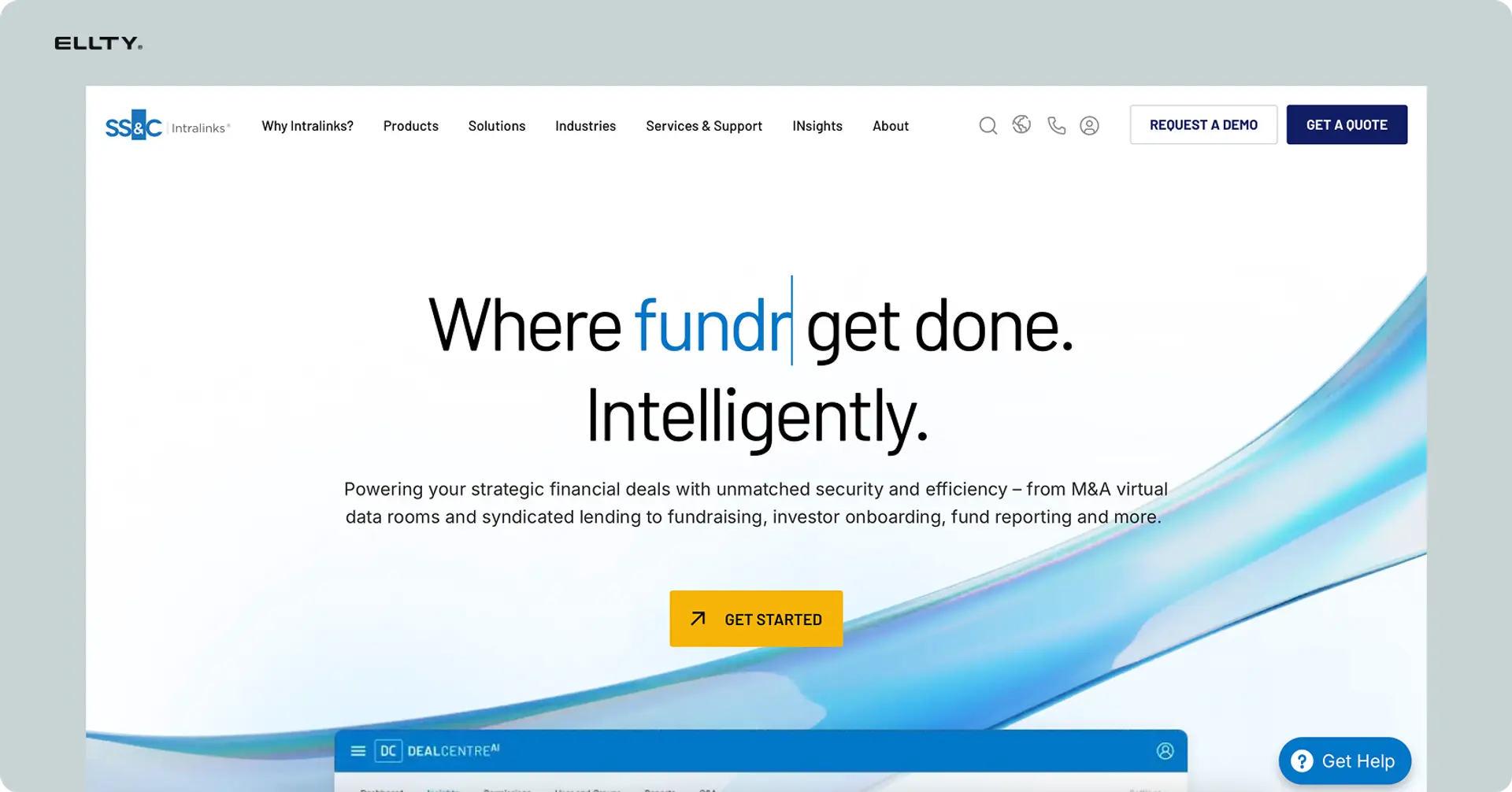
Intralinks has been around since the late 1990s and is deeply embedded in the enterprise deal market. It's used heavily in life sciences M&A, licensing deals, and large-scale clinical partnerships. The platform offers strong compliance features, ISO 27001 and SOC 2 certifications, advanced permission controls, and dedicated deal support teams.
Intralinks is built for situations where the deal is large enough that the VDR cost is a minor line item. Major pharma companies and their legal teams often have existing relationships with Intralinks, which means showing up with it in an acquisition process can remove friction on the buyer's side. For a Series A biotech fundraising round, it's overkill. For a licensing deal with a top-10 pharma - it's a legitimate option worth knowing about.
Ansarada


Ansarada positions itself as an AI-powered deal management platform. Beyond standard VDR features, it offers deal readiness scoring - essentially telling you how prepared your data room is based on what documents are present versus what's typically expected for your deal type. For biotech founders who haven't done many deals before, this kind of structured guidance can be genuinely helpful.
It supports M&A, fundraising, and IPO processes, and includes features like automated redaction, Q&A workflows, and integration with major enterprise tools. Pricing is more accessible than Intralinks or Datasite, though it still skews toward mid-market and enterprise. The deal readiness feature is one of the more unique offerings in the VDR space and worth exploring if you want guided support building out your first serious data room.
Firmex


Firmex is a mid-market VDR that's popular in life sciences, legal, and financial services. It offers a clean interface, solid permission controls, audit trails, and document analytics. It's less complex than Intralinks or Datasite, which makes it easier to get set up without a long onboarding process.
Firmex has a flat-rate pricing model for some plans, which is useful for people who want predictable costs. It supports unlimited users on certain plans, which can be cost-effective if you're running a process with many reviewers. It doesn't have the AI features of Ansarada or the deal-team infrastructure of Datasite, but for a straightforward biotech licensing deal or a Series B fundraising process, it covers what you need without requiring an enterprise contract.
iDeals


iDeals is a well-regarded VDR provider used across life sciences, banking, and legal. It's known for strong security certifications (SOC 2 Type II, ISO 27001, GDPR compliance), a clean user interface, and responsive support. It supports features like fence view (preventing screen capture), dynamic watermarks, granular permissions, and detailed audit logs.
iDeals sits in the mid-to-enterprise tier in terms of both features and pricing. It's a practical choice for biotech companies at Series B and beyond running structured due diligence, particularly when international data residency requirements matter. European biotech companies dealing with GDPR-sensitive data often find iDeals a comfortable fit. Support is available 24/7, which matters when you're running a time-sensitive deal across multiple time zones.
How to build a virtual data room for biotech

Building a VDR doesn't have to be complicated. Here's a simple process.
Step 1 - Choose your tool
Pick a platform that fits your stage. Early-stage companies don't need the same tool as a company running a $500M M&A process.
Step 2 - Map your documents
Before you upload anything, make a list of every document that needs to go in. Group them by category. Decide who needs access to each group.
Step 3 - Build your folder structure
Set up folders before you start uploading. A clean structure means reviewers find what they need faster, and you look more professional.
A typical biotech folder structure looks like this:
01 - Corporate
02 - Financials
03 - Intellectual Property
04 - Scientific Data
05 - Regulatory
06 - Manufacturing (CMC)
07 - Team
08 - Commercial
09 - Pipeline overview
Step 4 - Upload and organize your documents
Use consistent naming. Avoid vague names like "final version 3 REVISED." Use dates in file names where relevant.
Step 5 - Set permissions
Define which users or groups can access which folders. Turn on NDA gating if you need it. Set download restrictions on sensitive documents.
Step 6 - Test before you share
Log in as a guest user and see exactly what your reviewer will see. Check that permissions work correctly.
Step 7 - Send invites and track engagement
Share access via a trackable link or direct invite. Then actually watch the analytics. Who opened it? Which documents are they spending time on? This data drives your follow-up strategy.
How much does a virtual data room cost?
This is the question everyone asks. And the honest answer is: it varies a lot.
Traditional enterprise VDR providers charge based on deal size, data volume, number of users, and feature tiers. Costs can run anywhere from a few hundred dollars a month to tens of thousands of dollars for a large M&A transaction.
Here's a general breakdown of what you'll typically find:


The pricing gap between startup and enterprise tools is genuinely large. An early-stage biotech sharing a pitch deck and a cap table with a handful of visitors does not need a $3,000/month platform.
Ellty pricing, for reference: Free plan includes document tracking and real-time analytics. Standard is $69/month and includes unlimited documents, advanced analytics, eSignatures, custom branding, and data room features. The Data Room plan is $149/month and includes granular permissions, NDA gating, dynamic watermarking, and restricted visitor access (3 users included). Data Room Plus is $349/month and adds group permissions, audit logs, and up to 4,000 assets per data room.

Why are VDRs so expensive?
If you've ever gotten a quote from Intralinks, Datasite, or Donnelley Financial Solutions, you've probably wondered why VDRs cost so much.
There are a few real reasons.
Enterprise compliance and security - Full SOC 2 Type II certification, ISO 27001, data residency requirements, and enterprise-grade encryption infrastructure all cost money to build and maintain. These certifications matter for large M&A processes where legal teams will audit your security posture.
Dedicated support - High-end VDRs come with dedicated deal teams, 24/7 live support, and hands-on setup assistance. For a $1B acquisition, this support has real value.
Regulatory and legal requirements - VDRs used by investment banks and law firms in regulated transactions need to meet strict standards. Compliance is expensive.
Pricing leverage - Honestly, part of it is just pricing power. When the deal is $500M and the VDR is $15,000, nobody pushes back on the VDR cost. Enterprise software vendors price to what the market will bear.
For most biotech companies, this means you're often being asked to pay enterprise prices for features you don't need yet. It's worth being honest about what your actual situation requires.

Security in a biotech VDR: what you should verify
Security is not a feature you can skip in biotech. Here's what to actually check when evaluating any VDR.
Encryption at rest and in transit - Your documents should be encrypted both while stored and while being transferred. AES-256 at rest and TLS in transit are standard.
Access controls - Role-based permissions, two-factor authentication, and session timeouts are baseline requirements.
Audit logs - Every action should be logged: logins, document views, downloads, link shares. You need this for both legal protection and deal management.
Watermarking - Dynamic watermarks trace any leak back to a specific user.
SOC 2 compliance - SOC 2 Type II certification means the provider has been independently audited on security, availability, and confidentiality. For enterprise deals, buyers and their legal teams will ask about this.
Data residency - Some deals require data to stay within specific geographies (EU, US). Know where your data is stored.
Don't take security claims at face value. Ask for documentation. For high-stakes biotech transactions, have your legal team review the data room provider's security posture.
Common mistakes biotech teams make with VDRs
Setting up the data room too late
Other parties do ask for a data room on short notice. Having a half-built one when you get that call from a partner at a major VC is not a good look. Set it up before you need it.
Uploading everything at once with no structure
A dump of 200 unorganized files is worse than a small, well-organized data room. Start with clean structure even if it's incomplete.
Giving everyone the same access level
Not everyone reviewing your data room needs to see your full IP portfolio. Set permissions intentionally.
Skipping the NDA gate
Even if you trust the people you're talking to, having a formal NDA confirmation step creates a paper trail. Don't skip it.
Not tracking engagement
If your VDR analytics are telling you a visitor hasn't opened a single document in two weeks, that's a signal. Use the data.
Picking enterprise tools at seed stage
You don't need a $2,000/month platform when you're sharing a pitch deck and a cap table with 10 angels. Match the tool to your actual needs.
FAQ
What is a virtual data room in biotech?
A virtual data room in biotech is a secure online platform where companies store and share confidential documents - like clinical data, IP filings, and financial records - with specific parties during fundraising, M&A, licensing deals, or regulatory processes. It gives people control over who sees what and keeps a full record of every access.
What documents should a biotech data room include?
At minimum: corporate docs (cap table, incorporation), financial records, IP portfolio, key scientific data, and team information. For later-stage deals, you'd also include regulatory filings, CMC documentation, and commercial data. The exact list depends on your stage and what the transaction requires.
Why are VDRs so expensive?
Enterprise VDRs charge for compliance certifications (SOC 2, ISO 27001), dedicated support teams, and the pricing power that comes from being involved in high-value deals. For businesses at earlier stages, it often means paying for features you don't need. There are now more affordable options built specifically for early-stage companies.
What features should a biotech VDR have?
The non-negotiables are: granular permissions, NDA gating, audit logs, dynamic watermarking, document analytics, and secure viewing. For M&A, Q&A management and version control matter too. For most deals, engagement analytics (who viewed, which pages, time spent) is one of the most practical features.
Is Ellty suitable for biotech due diligence?
Ellty works well for biotech teams running investor due diligence, licensing discussions, and structured document sharing with defined groups. It includes NDA gating, granular permissions, dynamic watermarking, audit logs, and real-time analytics. It's not designed for large M&A transaction management with enterprise compliance requirements. For those situations, a dedicated enterprise VDR may be more appropriate.
Can I use a free VDR for biotech?
For very early-stage sharing - like sending a pitch deck to a few angels - a free plan with basic tracking and analytics can work. For any serious due diligence with sensitive IP, clinical data, or regulatory documents, you need proper permissions, NDA gating, and audit logs. Most free plans don't include those features.
What's the difference between a virtual data room and a file-sharing tool like Google Drive?
Google Drive and Dropbox are built for general file access. VDRs are built for controlled, audited, high-stakes document sharing. The key differences: VDRs give you per-document permissions, NDA gating, dynamic watermarking, full audit logs, and engagement analytics. You also can't easily restrict downloading or track time spent per page in consumer file tools. For biotech documents with IP sensitivity, this difference matters a lot.
How do I know if visitors are actually reading my documents?
A good VDR gives you real-time analytics on every viewer. You can see when they logged in, which documents they opened, how long they spent on each page, and whether they came back. If you're not tracking this, you're flying blind on deal engagement. Ellty analytics dashboard shows this data for every person you've given access to, updated in real time.
Know exactly who's reading your documents and which pages they're spending time on - start your Ellty data room today and stop following up blind.

Wrapping up
A virtual data room isn't just a nice-to-have for biotech businesses. When you're sharing IP, clinical data, and financial records with investors, partners, and acquirers, you need real control over who sees what and a record of every interaction.
The good news is you don't need to spend enterprise money to get enterprise-level security for most early to mid-stage use cases. Match the tool to your actual stage. Set it up before you need it. Use the analytics.
For teams who want to get set up fast without a sales process, Ellty data room plans start at $149/month and include the core features - NDA gating, permissions, watermarking, audit logs, and engagement analytics - that cover most biotech deal scenarios.
Author

Anika Tabassum Nionta is a Content Manager at Ellty, where she writes about secure document sharing, virtual data rooms, M&A, due diligence, fundraising, and sales enablement. With over 6 years of writing experience, she helps professionals understand how to share confidential documents securely, track engagement, and manage deals more effectively. Anika holds both a BA and MA in English from Dhaka University. Outside of work, she enjoys reading, exploring new cafes in Dhaka, and connecting with entrepreneurs and dealmakers in her community.

