
You've had the first call. The investor liked what they heard. They asked for your data room. Now what?
Most teams scramble at this point - throwing documents into a shared Google Drive folder, sending a Dropbox link with no structure, or worse, emailing attachments. That's a bad look. Not because it's messy, but because a data room is the first real test of how you operate.
This guide covers everything you need to know: what a data room is, what goes in it, how investors actually read through it, and how to set one up without spending weeks on it.
In this guide
- What a data room actually is
- What investors look for the moment they open it
- The 4 P's of due diligence explained
- What to include in a data room for investors
- How to structure and organize it
- How investors actually review a data room - step by step
- How investors review a data room in M&A deals
- Data room best practices
- Self-hosted data room vs. SaaS VDR
- Virtual data room comparison
- Where Ellty fits in
- FAQ
What a data room actually is
A data room is a secure, organized collection of documents that investors review during due diligence. It's where you prove that everything you said in your pitch deck is real.
Traditionally, data rooms were physical rooms - literally a locked room full of binders. Banks and law firms would control access. Investors flew in to review documents in person.
Today, a virtual data room (VDR) is a secure online space where you upload documents and control who sees what. Investors access it remotely. You can track who opened what, which pages they read, and how long they spent on each section.
A pitch deck is a sales tool. A data room is a verification tool. You use your deck to get the meeting. You use your data room to close the round.
There are two main contexts where data rooms come up:
- Venture fundraising - when a VC or angel wants to do diligence before writing a check
- M&A due diligence - when a buyer wants to verify everything before acquiring your company
The core principle is the same. The documents differ a bit, and the depth of scrutiny in M&A is usually much higher.
What investors look for the moment they open it
Before they read a single document, investors are already forming an opinion. Here's what they notice immediately:
01. Is it organized?
Clear folder structure, logical naming, no duplicates. If they can't find the cap table in 30 seconds, that's a red flag.
02. Is it complete?
Missing documents get flagged. "We're working on it" wastes everyone's time and signals that you weren't ready for diligence.
03. Is it current?
A financial model that's 18 months old tells them you don't maintain your numbers. Every key doc should be dated and up to date.
04. Is access controlled?
A properly set up VDR with permissions shows operational maturity. A Google Drive link with "anyone can view" does not.
"How a founder runs their data room tells you a lot about how they'll run the company."
Investors see hundreds of data rooms per year. The ones that stand out aren't flashy - they're easy to navigate, complete, and clearly maintained by someone who knows what they're doing.
The 4 P's of due diligence
Due diligence follows a pattern. Most experienced investors and M&A advisors think about it through four dimensions - commonly called the 4 P's.


Every document in your data room fits into one of these buckets. When you're deciding what to include, run it through this filter: which P does this address?
If a document doesn't clearly address at least one P, you probably don't need it in the room.
What to include in a data room for investors
Here's the practical list. Not every document is required at every stage - use your judgment. An early seed deal has a lighter checklist than a Series B with a 12-week diligence process.
Company and legal


Financials


Product and technology


Team


Market and business


Common mistake
Don't upload everything you have. A bloated data room with 200 documents makes investors suspicious - either you're hiding something in the noise, or you don't know what matters. Be selective. 40-60 focused documents is almost always better than 200.
How to structure and organize it
Structure is underrated. Investors open your room and start navigating. If they can't find what they want in two clicks, they lose patience.
Use this folder structure as a starting point:
📁 01 - Overview
Pitch deck (current)
Executive summary
Investment thesis one-pager
📁 02 - Legal
Certificate of incorporation
Articles and bylaws
Cap table (fully diluted)
Prior investment docs (SAFEs, term sheets)
IP assignments
📁 03 - Financials
Financial model
Historical P&L
Unit economics
Burn and runway summary
📁 04 - Product
Product demo link or screenshots
Roadmap
Tech stack overview
📁 05 - Team
Founder bios
Org chart
Hiring plan
📁 06 - Market
TAM analysis
Competitive landscape
📁 07 - Customers
Customer list (anonymized or disclosed)
Case studies
Key contracts
📁 08 - Metrics
MRR/ARR dashboard
Churn analysis
NPS or CSAT data
Number your folders so they sort predictably. Use consistent file naming - include dates where relevant. Don't use abbreviations that only make sense internally.
Naming files correctly


How investors actually review a data room - step by step
Here's what typically happens after an investor gets access to your room. It's not random.


Pass 1: the context pass (minutes 1-10)
They re-read the deck to refresh context. They're not reading for new information - they're orienting themselves before diving into documents. If your deck is in the room and well-organized, this goes smoothly.
Pass 2: the legal and ownership check (minutes 10-30)
Cap table is always early. They want to know who owns what, whether there are any weird terms, and if the equity structure is clean. Red flags here: too many tiny shareholders, unusual veto rights, founder shares without vesting, prior investors with blocking rights.
Pass 3: the numbers deep-dive (30-90 minutes, sometimes more)
This is where analysts spend most of their time. They'll open your financial model and start poking at assumptions. They cross-check your metrics against your bank statements. They calculate your burn independently. They look at cohort data if you have it.
If your numbers don't reconcile across documents, they notice. If your financial model's revenue assumptions don't match your actual reported MRR, they'll flag it.
Pass 4: product and team verification
They verify that the team actually exists and has the background you claim. They'll Google founders, check LinkedIn, and sometimes call references before you even know it's happening. On product, they want to see it - either a live demo link or screenshots. The roadmap gets scanned but not analyzed in depth unless the product is the core of the thesis.
Pass 5: the question list
After the initial review, most investors send a list of follow-up questions. This is normal. A long list doesn't mean they're skeptical - it means they're doing real work. A short list or no list often means they weren't that interested.
If you're using a VDR with analytics
You'll be able to see exactly which documents they spent time on, which pages they returned to, and how long each session lasted. This is valuable. If they spent 40 minutes on your financial model and only 2 minutes on your team bios, you know where the interest (or concern) is. Prepare for questions accordingly.


How investors review a data room in M&A deals
M&A due diligence is a different beast from VC fundraising diligence. The intent is different (buying vs. backing), the timeline is longer, and the depth of scrutiny is significantly higher.
Key differences


In M&A, the buyer's legal team will review every customer contract for change-of-control clauses. Their finance team will rebuild your model from scratch and test it against actual bank statements. Their technical team may do a code audit. Their HR team will look at employment agreements, benefits, and key-person risk.
This is why M&A data rooms often require features like:
- Granular access permissions (which user sees which folder)
- Dynamic watermarking on every document
- NDA acceptance before access is granted
- Full audit logs of every action taken in the room
- Q&A management tools for coordinating questions across multiple workstreams
If you're going through M&A, a basic file-sharing tool won't cut it. You need a proper VDR with the right permission controls.
Data room best practices
These are the things experienced teams do that most first-timers skip.
Keep it updated continuously
Don't build your data room when you start fundraising. Maintain it as a living resource. Update financials monthly, keep contracts current, and refresh the deck whenever you make major changes. That way, when an investor asks for access, you can share it same day.
Don't share it too early
Some teams share their data room at the first sign of interest. That's premature. Share your pitch deck first. Only open the data room when there's a real signal - a verbal indication of interest or a term sheet in play. Sharing too early devalues it.
Use separate access levels
Not everyone needs to see everything. Give a potential investor early access to your deck, market analysis, and team bios. Only unlock financials and legal when you're further along in the conversation. This is especially important if you're talking to multiple investors simultaneously and some are competitors of each other.
Track engagement - and use it
If you're using a VDR with analytics, treat the data as signal. If an investor hasn't opened your room after 5 days, follow up. If they spent 45 minutes on your unit economics and went quiet, offer a call to walk through the assumptions. The analytics give you information - use it.
Have a Q&A process ready
When follow-up questions come in, respond quickly and thoroughly. Create a running Q&A document and add every answered question to it. If one investor asks something, others likely will too.
Remove documents investors don't need
An overfull data room is as bad as an empty one. Cut anything that's outdated, redundant, or irrelevant to the investment decision. Less is more. Investors appreciate founders who know what matters.
Checklist before sharing
All documents are dated and current. Folder structure is logical with numbered folders. File names are clean and descriptive. Cap table is fully diluted and up to date. Financial model has documented assumptions. Access permissions are set correctly per investor. NDA is required if sensitive content is included.
Self-hosted data room vs. SaaS VDR
Some teams try to self-host their data room - usually using a combination of Google Drive, Notion, or even a password-protected section of their own website. Here's an honest look at both approaches.

A self-hosted data room can work for a pre-seed round with two friendly angels. But once you're dealing with institutional investors, a formal Series A, or any M&A process, the lack of controls and analytics becomes a real liability.
You won't know if your lead investor spent 3 minutes or 3 hours in your room. You can't see if they forwarded the link to someone outside the firm. You can't watermark documents to trace leaks. And you'll spend time manually managing access instead of fundraising.
Virtual data room comparison
There are a lot of VDR options. Here's how the main categories break down.

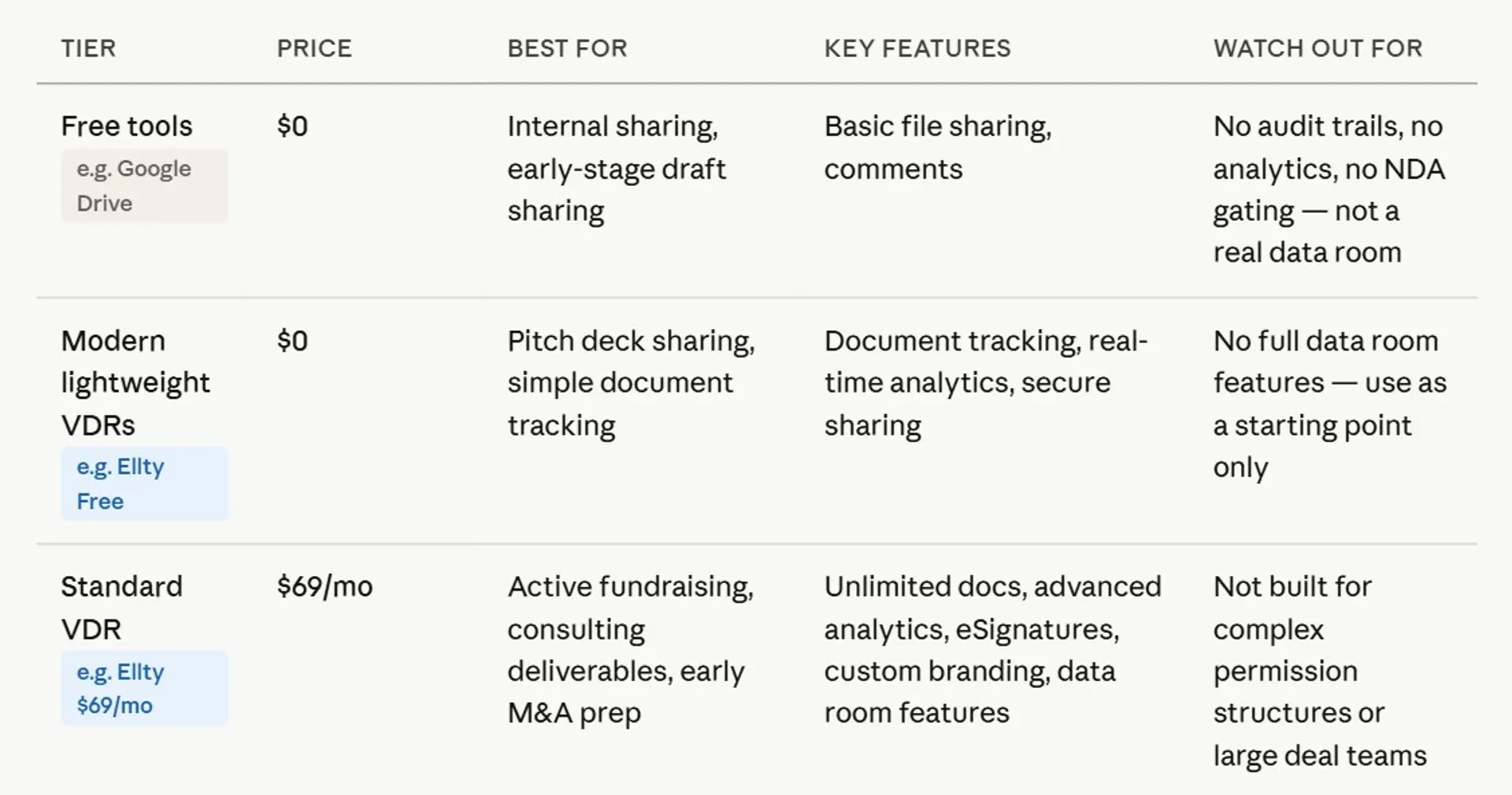

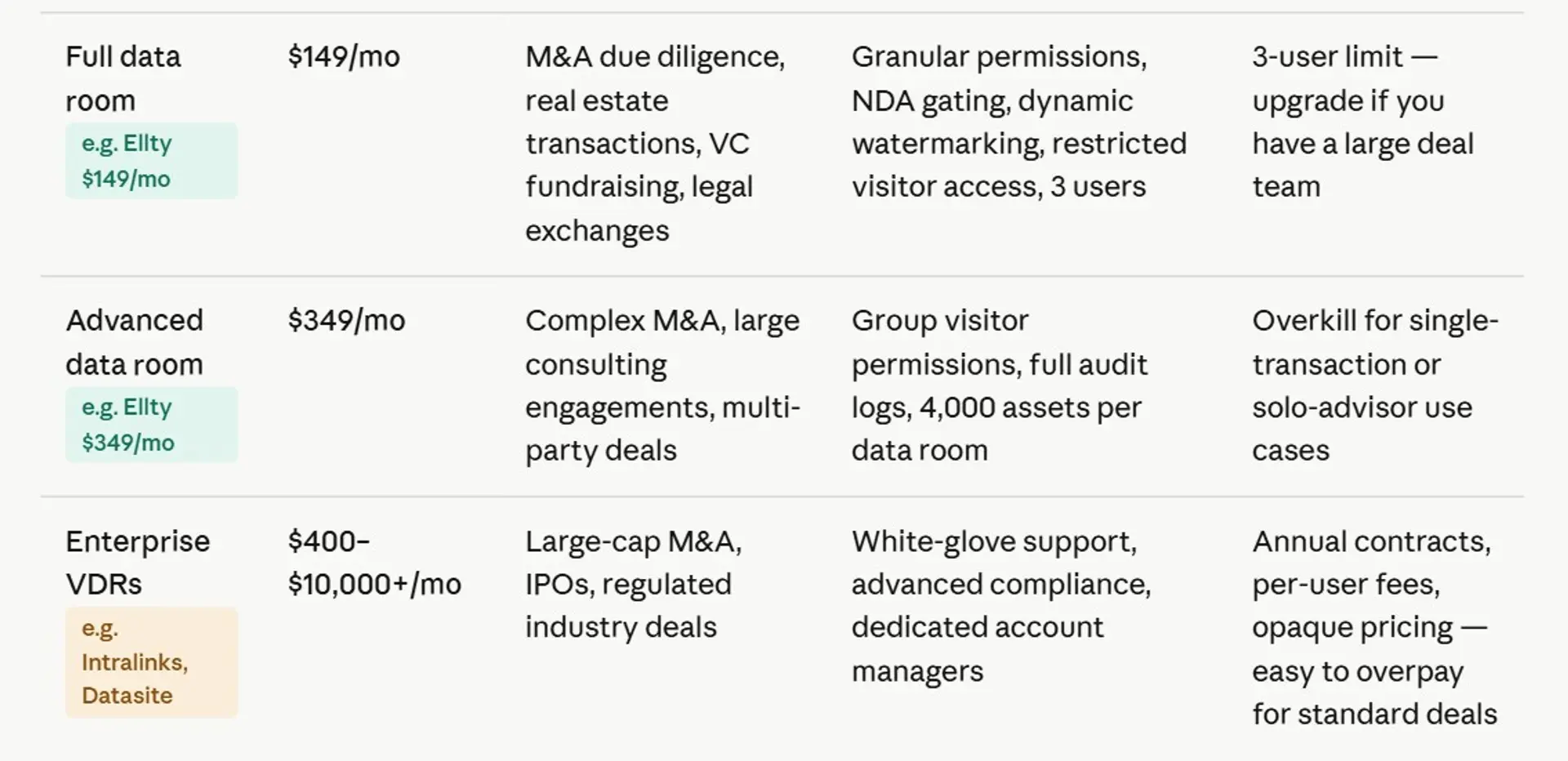
Enterprise VDRs like Datasite and Intralinks are priced for banks and law firms. They're powerful, but you're often looking at $1,000+ per month, sometimes with per-user and per-page pricing. That's fine if you're running a $500M acquisition. It's not the right tool for a founder raising a $3M seed round.
For most businesses, the realistic choice is between a simpler VDR built for founders or stitching together Drive + a document analytics tool. Ellty sits in the former category - data room features with flat monthly pricing, no per-user fees, and analytics included from the start.
Where Ellty fits in
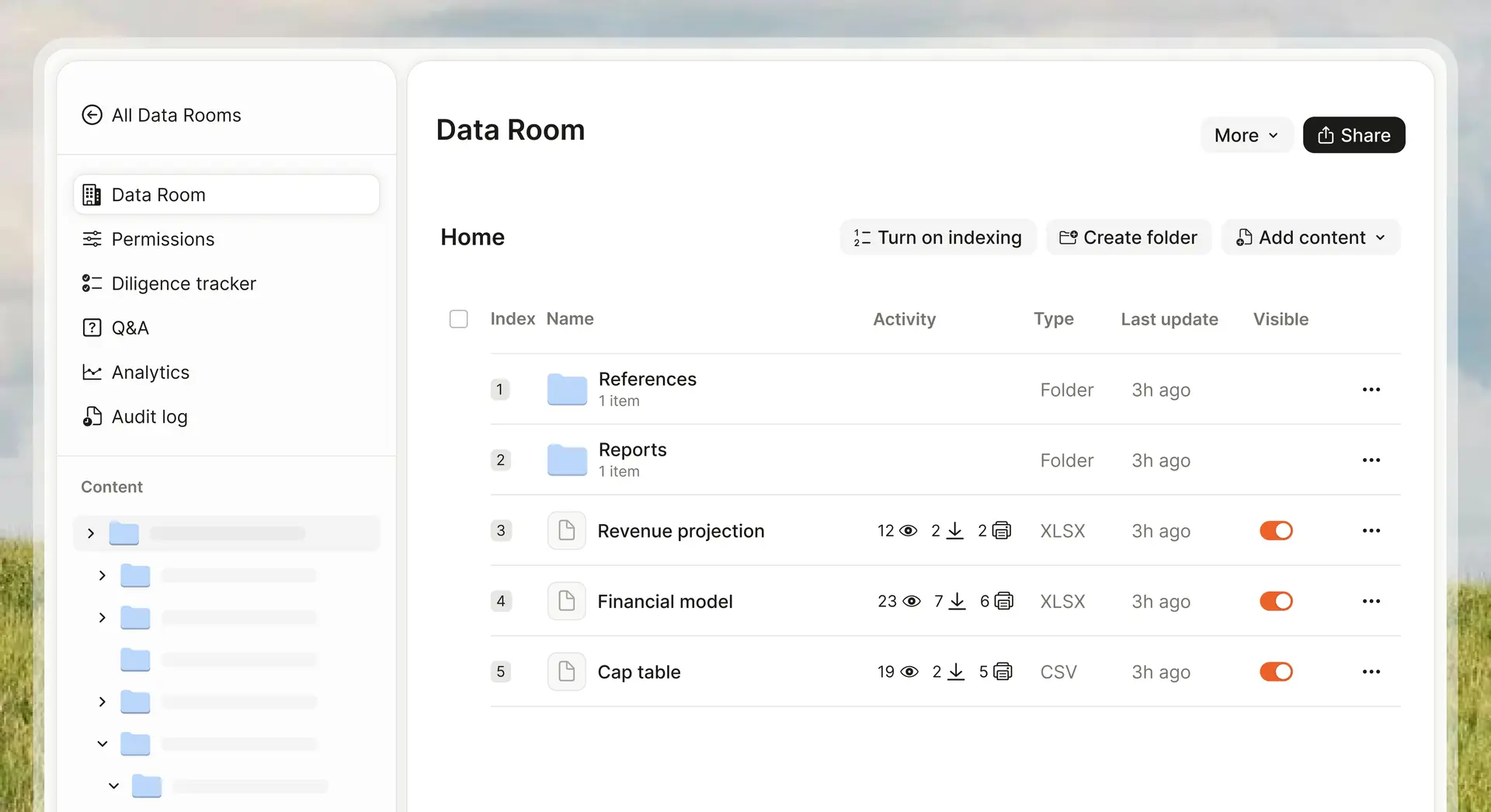
Ellty is built for teams who need a secure, trackable place to share documents without the pricing model of enterprise VDRs.
What Ellty offers

Ellty is a secure document sharing, pitch deck analytics, and virtual data room platform built for all kind of businesses. It's not trying to compete with Intralinks on enterprise M&A - it's trying to help founders share documents securely, track investor engagement, and move faster on fundraising without a sales call or a month of setup. You upload your documents, organize them into a data room, set permissions, enable NDA gating, and share a trackable link - all in the same day.
Where Ellty stands out against legacy platforms is the pricing model. There are no per-user charges, no per-page fees, and no custom quotes that take weeks to negotiate. You pick a plan, get set up quickly, and know exactly what you're paying - whether you're sharing documents with 3 people or 30. For anyone who needs a professional data room without an enterprise contract, Ellty is the place to start.

FAQ
What should I include in a data room for investors?
At minimum: pitch deck, cap table, financial model, unit economics, product overview, team bios, and key legal documents (incorporation, IP assignments, prior investment docs). At Series A and beyond, add historical financials, key customer contracts, and a detailed market analysis. The exact list depends on your stage and what the investor is focused on.
What are the 4 P's of due diligence?
People, Product, Performance, and Potential. People covers the team and their ability to execute. Product covers the technology, IP, and roadmap. Performance covers the financial metrics and unit economics. Potential covers the market size and competitive positioning. Most documents in a data room map to at least one of these four categories.
What should I expect in a data room review?
Expect investors to start with your pitch deck, move to the cap table and legal section, then spend significant time on your financial model and metrics. They'll cross-reference numbers across documents and follow up with specific questions. The whole initial review can take anywhere from a few hours to a couple of weeks depending on the investor's process and the complexity of your business.
How is a data room used in M&A vs. venture fundraising?
In venture fundraising, a data room is usually reviewed by 1-3 people over a few weeks. In M&A, entire deal teams - legal, finance, technical, HR - review a much larger set of documents over months. M&A data rooms require stronger access controls, full audit logs, NDA gating, and often Q&A management tools. The document volume is typically 5-10x larger than a fundraising data room.
Can I use Google Drive as a data room?
You can, but it comes with real limitations. Drive has no document-level analytics, no NDA gating, no watermarking, and basic access controls. For a pre-seed round with friendly angels, it might work. For any formal institutional raise, a proper virtual data room gives you meaningful advantages - mainly the ability to track investor engagement and control access more precisely.
What is a self-hosted data room?
A self-hosted data room is one you set up and manage yourself, usually using existing tools like Google Drive, Dropbox, Notion, or a password-protected website. It costs less upfront but lacks the security features, analytics, and access controls that a purpose-built VDR provides. Most founders start here and upgrade as their fundraising gets more serious.
How do investors use data room analytics?
Some VDRs give investors visibility into their own activity summaries, but the analytics are primarily a tool for founders. You can see which documents were opened, which pages were viewed, how long each session lasted, and who accessed what. This helps you gauge interest level, prepare for the right follow-up conversation, and identify if there are sections investors aren't engaging with.
When should I send an investor my data room?
Not at the first meeting. Share your pitch deck first. Open the data room only when there's a genuine signal of interest - a verbal indication they're moving forward, a request for more detailed information, or a term sheet in play. Sharing too early devalues the data room and risks distributing sensitive information to investors who aren't serious.
Do I need an NDA before sharing my data room?
Most experienced VCs won't sign NDAs before reviewing a data room - it's common practice not to, because they see hundreds of decks in overlapping spaces. For less sensitive early-stage materials, an NDA isn't necessary. But for detailed financial data, unreleased product information, or customer contracts, you may want NDA gating enabled. Some VDR platforms (including Ellty Data Room plan) let you require NDA acceptance before anyone can access the room.
How long does it take to set up a data room?
If your documents are already organized, setting up a structured data room takes a few hours - maybe less. The longer part is gathering and updating the actual documents. If you maintain your documents continuously rather than scrambling before each raise, you can have a data room ready to share within an hour of receiving interest from an investor.
Author

Anika Tabassum Nionta is a Content Manager at Ellty, where she writes about secure document sharing, virtual data rooms, M&A, due diligence, fundraising, and sales enablement. With over 6 years of writing experience, she helps professionals understand how to share confidential documents securely, track engagement, and manage deals more effectively. Anika holds both a BA and MA in English from Dhaka University. Outside of work, she enjoys reading, exploring new cafes in Dhaka, and connecting with entrepreneurs and dealmakers in her community.

