
Most people only think about a data room when someone asks for one. By then, you're already behind.
Whether it's a PE firm sending you a due diligence checklist, a buyer requesting financials before closing, or a lawyer asking for contracts ahead of a hearing - that moment always comes with a deadline attached. Scrambling to set up a data room while managing calls, negotiations, and everything else is not where you want to be.
This guide covers when you actually need a virtual data room, what that looks like across different situations - M&A, real estate, consulting, fundraising, legal and what to look for in a provider. It also covers when you don't need one, because not every document-sharing situation calls for a full VDR setup.
What is a virtual data room, quickly
A virtual data room is a secure online space for storing and sharing confidential documents with people outside your organization - buyers, investors, lawyers, auditors, advisors. It's not cloud storage. It's not a shared folder with a password. It's a controlled environment built specifically for situations where the documents are sensitive and the stakes are real.
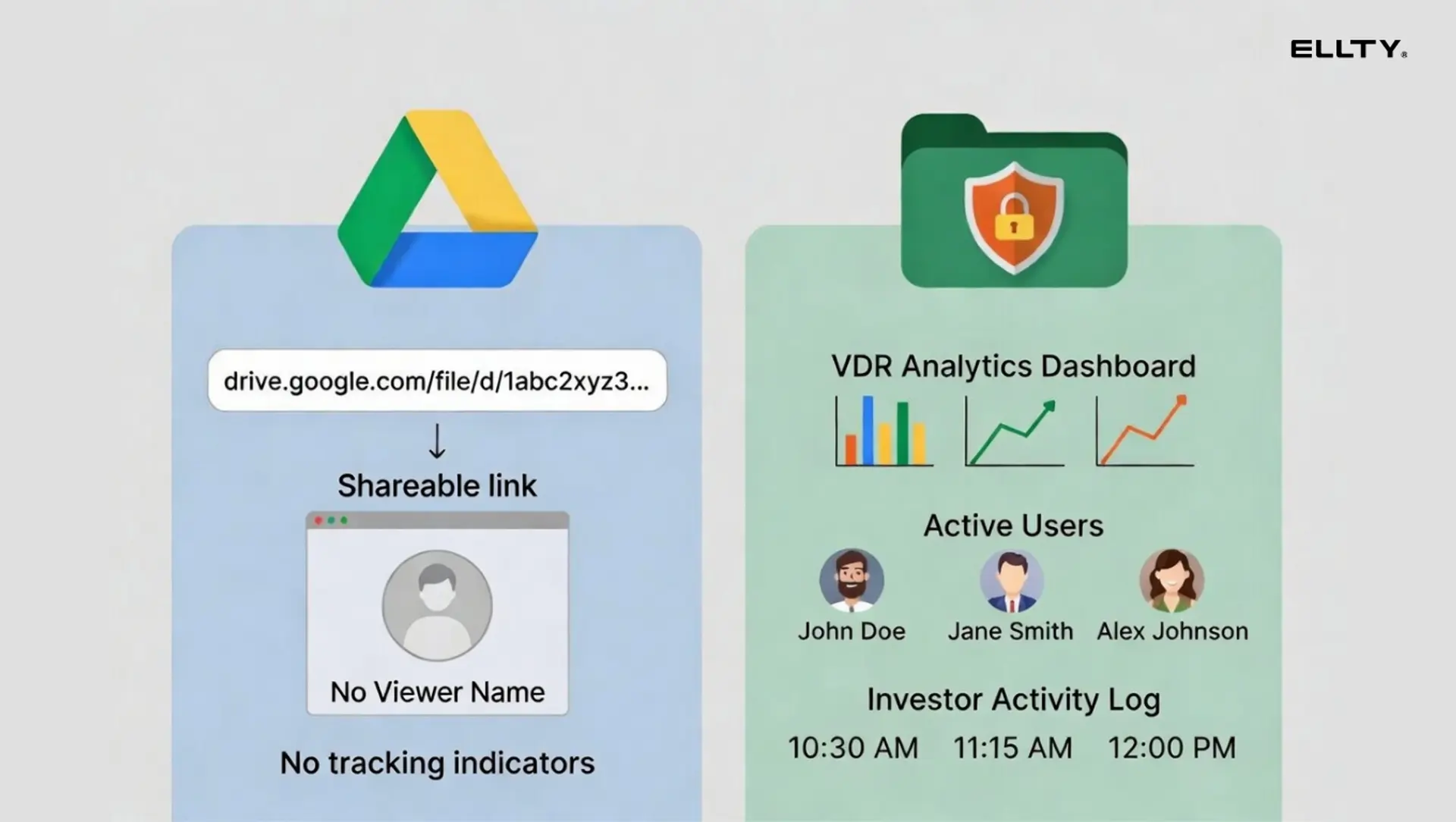
Here's what a VDR does that Dropbox or Google Drive simply don't:
- Controls access at every level — you decide who sees which folders, which files, and for how long
- Logs every action — every view, download, and interaction is timestamped and recorded
- Gates access behind an NDA — nobody sees anything until they've agreed to your terms
- Watermarks documents with the viewer's identity, so leaks can be traced
- Shows you engagement data — who opened what, which pages they spent time on, what they skipped
In any deal context - whether you're selling a business, closing a property transaction, or sharing client deliverables - these aren't extras. They're the baseline. If sensitive documents are leaving your hands, you need to know where they go and who's looking at them.

The clearest signs you need a VDR right now
There's no universal rule about when to set one up. But there are specific situations where not having one creates real problems.
You're entering formal fundraising
Series A and beyond means institutional investors. Institutional investors have processes. Those processes include due diligence, and due diligence requires organized, access-controlled document sharing. If you're sending financials over email or sharing a Google Drive link, you're signaling that you haven't done this before.
At seed stage, a basic pitch deck with tracking is usually enough. But once you're raising from VC or PE firms, expect them to ask for a data room within the first few meetings if things are going well.
A PE firm or strategic acquirer is involved
This is non-negotiable. Private equity due diligence is structured, multi-party, and involves lawyers, accountants, and investment teams reviewing simultaneously. They need a controlled environment. They also need an audit trail - partly for internal compliance, partly because they need to document what was disclosed if the deal later has legal complications.
If you're in an M&A process - whether you're being acquired or making an acquisition - a proper virtual data room is required, not optional.
You're sharing confidential documents with more than two external parties
The moment multiple external parties are in your documents, you need controls. Who has access to what? Can they download? Are they sharing with people you didn't authorize? Without a VDR, you have no answers to any of those questions.
Your documents contain IP, customer data, or financial details
These categories carry legal risk if mishandled. IP disclosures without proper controls can complicate future patent applications or licensing. Customer data sharing without proper data processing agreements creates regulatory exposure. Financial details shared without an NDA trail create problems if talks fall apart and information surfaces publicly.
You're running a competitive process
If you're talking to multiple potential investors or buyers simultaneously, you need to manage who sees what and in what order. A data room lets you grant and revoke access by party, track who's engaged, and make sure no one party gets an information advantage you didn't intend.
You're closing a real estate transaction
Property deals involve a lot of paper - title documents, inspection reports, environmental assessments, lease agreements, financial statements, and more. When buyers, lenders, and lawyers are all reviewing documents at the same time, a shared folder creates version confusion and zero visibility. A data room keeps everything organized, shows you exactly who has reviewed which documents, and gives you a clean record of what was shared and when - which matters if anything is disputed after closing.
You're a consultant or advisor managing client deliverables
Consulting engagements regularly involve sharing sensitive analysis, financial models, strategic recommendations, and internal client data with stakeholders across different organizations. Emailing files back and forth creates version control problems and no audit trail. A data room gives you a professional, controlled environment to deliver work - with visibility into whether the right people have actually read it, and the ability to revoke access when the engagement ends.
You're preparing for a legal proceeding or regulatory review
Litigation, audits, and regulatory requests all require producing documents in an organized, verifiable way. You need to show not just what was shared, but when, with whom, and in what form. A VDR creates that record automatically. It also lets your legal team control exactly which documents are visible to which parties, so nothing gets shared that shouldn't be, and nothing that was shared can be denied later.

When you probably don't need a full VDR
Being honest about this matters. A lot of VDR providers want you to think you need enterprise software the moment you write your first formal email. That's not true.
You're at pre-seed stage with informal investors
If you're raising from angels or friends and family, a well-organized pitch deck with basic document tracking is usually fine. You don't need NDA gating, dynamic watermarking, or multi-party access controls for a $200K pre-seed round from three people you already know.
You're doing an internal document review
VDRs are for external sharing. If you're organizing documents internally - even sensitive ones - a secure internal system or proper cloud storage with permission controls is enough. You don't need a VDR for that.
You're sharing one document with one person
Track it, yes. Log who opened it, yes. But a full data room setup for a single document going to a single reviewer is overkill. Most pitch deck tracking tools handle that case fine.
Virtual data room due diligence: what it looks like in practice
Due diligence is the process where an investor or acquirer verifies everything you've told them. It's structured, it's thorough, and it generates a lot of document requests.
Here's what a typical due diligence data room workflow looks like:


Each phase involves different people needing different access. A VDR lets you manage that without sending separate emails for every update. You add users, set their permissions, and they see exactly what you've granted - nothing more.
The analytics matter here too. When you can see that an investor's lawyer has spent two hours in your contracts folder and opened your IP assignment agreements three times, you know what question is coming. That gives you time to prepare.
If you're heading into an M&A process, set up your data room before the first NDA gets signed. Ellty Data Room Plus plan at $349/month includes group visitor permissions, audit logs, and up to 4,000 assets.
Virtual data room pricing: what you should expect to pay
This is where businesses often get surprised. VDR pricing ranges from free to several thousand dollars per month, and the difference isn't always obvious upfront.


Per-user pricing is the other thing to watch. It sounds reasonable until you count everyone who needs access: your co-founder, your CFO, your lawyer, your accountant, the investor's team. You're at 8-10 users before a single document gets reviewed. At $30-50 per user per month, that adds up fast.
Virtual data room Microsoft: can you just use what you already have?
This comes up constantly. Microsoft 365 subscribers often ask whether SharePoint or Teams can substitute for a proper branded VDR. The short answer is no, but it's worth understanding why.
SharePoint is a collaboration platform. It has permissions, version history, and decent access controls. For internal document management, it's fine. For external due diligence, it falls short in specific ways:
- No audit log that captures external viewer activity in a deal-ready format
- No NDA gating - you can't require someone to agree to an NDA before accessing a SharePoint folder
- No document-level analytics showing who read what and for how long
- No dynamic watermarking tied to external viewer identity
- No investor-facing interface - SharePoint looks like an internal IT tool because it is one
Microsoft does have a product called Microsoft Syntex (formerly SharePoint Syntex) with some enhanced document management features, but it's not positioned as a VDR and doesn't have deal-specific features like investor analytics or NDA gating.
Use Microsoft 365 for internal work. Use a purpose-built VDR when external parties are involved in a deal context.

Ellty as a virtual data room option: what you actually get

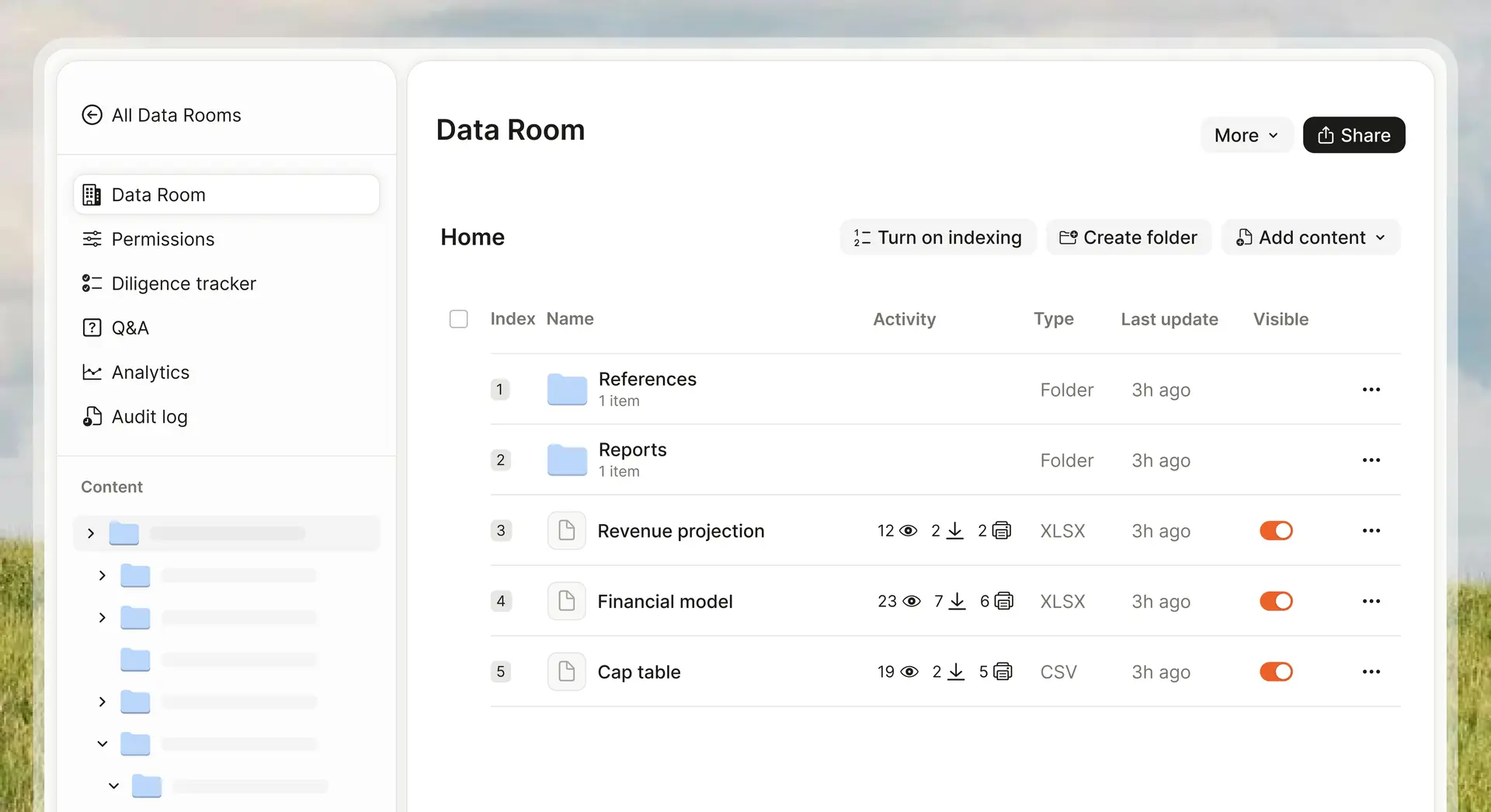
Ellty is a secure document sharing and analytics platform with full data room functionality, built for anyone who needs to share sensitive documents in a controlled, trackable way. Whether you're raising a funding round, closing a property deal, running a consulting engagement, or managing an acquisition, Ellty gives you the core tools that matter: access controls, real-time activity tracking, NDA gating, and a clean audit trail.
Pricing is flat and transparent, with no per-user fees and no surprise overages as your deal team grows.
Free — $0/month. Document tracking, real-time analytics, and secure sharing. A good starting point if you're in early conversations and want to see who's opening what before setting up a full data room.
Standard — $69/month. Unlimited documents, advanced analytics, eSignatures, custom branding, and data room features included. Works well for smaller deals and ongoing client or investor communication where you need a professional, trackable experience.
Data Room — $149/month. This is where the core VDR features come in. Granular permissions, NDA gating, dynamic watermarking, and restricted visitor access - everything you need to run a controlled document review, whether that's a due diligence process, a property transaction, or a client deliverable that can't be forwarded around freely.
Data Room Plus — $349/month. Group visitor permissions, full audit logs, and support for up to 4,000 assets per data room. Built for heavier document loads and multi-party deals where you need structured access control across different groups of reviewers.
Where Ellty stands out against legacy platforms is the pricing model. There are no per-user charges, no per-page fees, and no custom quotes that take weeks to negotiate. You pick a plan, get set up quickly, and know exactly what you're paying - whether you're sharing documents with 3 people or 30. For anyone who needs a professional data room without an enterprise contract, Ellty is the place to start.

How to evaluate virtual data room providers
When you're comparing options, here's what actually matters for a founder running a deal process:
Security and compliance
SOC 2 Type II certification is the standard. It means an independent auditor has reviewed the provider's security controls. Also check for AES-256 encryption at rest, TLS 1.2+ in transit, and two-factor authentication for all users. Don't take marketing copy at face value - ask to see the compliance documentation.
Access control granularity
Can you restrict access at the folder level? The document level? Can you prevent downloads on specific files while allowing viewing? Can you set expiry dates on access? These aren't edge cases. They're the core function of a VDR.
Analytics depth
Page-level analytics matter. Knowing that an investor opened your data room is less useful than knowing they spent 45 minutes on your financial model and skipped your market analysis entirely. That's actionable intelligence. Look for per-page time tracking, not just open notifications.
Pricing structure
Flat monthly fee vs. per-user pricing vs. per-page or per-GB pricing. Per-user and per-page pricing scales against you as a deal gets more complex. Flat-fee or per-room pricing is more predictable. Ellty charges a flat monthly fee with no per-user costs on its data room plans, which matters when you have 10+ people in your room simultaneously.
Setup time
A VDR you can't set up quickly is a problem when you're under time pressure. The platform should be self-serve - no sales call required to get started. If the provider requires a demo before you can even see the product, that's a signal about how the relationship will go.
Support quality
During active due diligence, you don't have time for slow support responses. Check reviews for actual support quality. Enterprise providers often have dedicated deal teams. Ellty offers support through standard channels - appropriate for the use case it serves.

Setting up your data room: the practical steps
Once you've decided you need one, here's the actual process. This applies whether you're using Ellty or another provider.
Step 1: Choose your folder structure before you upload anything
The most common mistake is uploading documents and organizing later. Do it the other way. Decide on your top-level folders first. A standard structure for a fundraising data room: Corporate, Financials, Legal, Commercial, Product/Tech, Team. M&A due diligence rooms may add Environmental, Regulatory, and Insurance.
Step 2: Set up NDA gating before you invite anyone
If you're on a plan that includes NDA gating, configure it before a single document goes in. The NDA gate creates a legal record that each viewer agreed to confidentiality terms before access. Don't add it as an afterthought after people are already in your room.
Step 3: Upload and label documents clearly
File naming matters. 'Q3 2024 Management Accounts - Final.pdf' is better than 'mgmt_accounts_v3_FINAL_FINAL.pdf'. Investors are moving fast across multiple companies. Make it easy for them to find what they need without asking you.
Step 4: Set permissions before inviting
Decide what each party should see before you send any invite. Your financial buyer doesn't need your source code. Your accountant doesn't need your cap table. Your lawyer needs the legal folder but maybe not the full commercial data. Set it, then invite.
Step 5: Monitor engagement actively
Your data room analytics are live intelligence. Check them regularly. Who's in the room? What are they reading? Who hasn't opened anything in a week? Use this data to drive your follow-up, not just the conversations you're having directly.
Ready to get your data room live?
Ellty lets you set up a secure, analytics-enabled data room today - free to start, Data Room plan from $149/month. No sales call, no setup fee.
Frequently asked questions
When do startups actually need a virtual data room?
The clearest trigger is institutional investor involvement. If you're raising from VC or PE firms, or if an acquirer has expressed serious interest, you need a proper data room. Before that - seed rounds with angels, informal investor conversations - a pitch deck tracking tool is usually enough. The moment multiple external parties need access to confidential documents simultaneously, a VDR becomes necessary.
Is there a good free virtual data room alternative?
Yes, with caveats. Ellty free plan covers document tracking, real-time analytics, and secure sharing with no time limit. That's genuinely useful for pitch deck sharing and early investor conversations. What it doesn't cover is NDA gating, granular permission controls, and watermarking - features you'll need for active due diligence. Free plans across most providers follow the same pattern: good for tracking, limited for deal-specific security features.
Can I use Microsoft SharePoint as a data room?
Not effectively. SharePoint works well for internal document management, but it wasn't built for deal due diligence. It lacks NDA gating, deal-specific analytics, dynamic watermarking, and the kind of audit logs that investors and lawyers expect in a formal process. If you're using Microsoft 365 anyway, it's fine for organizing internal documents. For external deal sharing, use a purpose-built VDR.
How much does virtual data room due diligence cost?
The VDR platform itself ranges from free to several thousand dollars a month depending on the provider and deal complexity. The bigger cost is associated due diligence services: legal review ($15,000-$75,000+), accounting ($10,000-$40,000), and technical review if applicable ($5,000-$20,000). The platform is usually the smallest line item.
Do I need a VDR for a seed round?
Usually not. Seed rounds - especially from angels or small funds - typically don't involve the same structured due diligence process as a Series A or beyond. A pitch deck with tracking analytics and the ability to share core financial documents securely is enough at seed stage. Once you're raising $3M+ from institutional investors, the expectations shift and a proper data room becomes worthwhile.
How do I know if my VDR provider is actually secure?
Ask for their SOC 2 Type II report. This is a third-party audit of their security controls and is the baseline standard for any reputable VDR. Also verify: AES-256 encryption at rest, TLS 1.2+ encryption in transit, two-factor authentication availability, and where data is physically hosted. Don't rely on 'bank-grade security' marketing language - ask for the actual certifications.
What is NDA gating and do I need it?
NDA gating requires a visitor to digitally agree to a non-disclosure agreement before they can access your data room. The agreement is timestamped and logged, creating a legal record of consent. You need it any time you're sharing genuinely confidential information with external parties who haven't signed a separate NDA through your lawyers. It's standard for PE and M&A due diligence and included in Ellty Data Room plan.
How long does it take to set up a virtual data room?
With a modern self-serve platform, the technical setup takes under an hour. The time-consuming part is gathering and organizing your documents - that can take days if you haven't prepared them in advance. The practical advice: start building your document library before you need it. Have your core documents organized and ready so that when due diligence starts, you're adding files to an existing structure rather than building from scratch under pressure.
The bottom line
You need a virtual data room when external parties - investors, acquirers, lawyers, auditors - need access to your confidential documents in a structured, controlled way. That's not a complicated test.
Before that point, a document tracking tool handles most of what you need. After that point, trying to run due diligence through email and shared drives creates real problems: no audit trail, no access controls, no intelligence on what investors are focused on.
The good news is that getting set up doesn't have to be expensive or time-consuming. Start with a free plan while you're in early conversations. Upgrade to a full data room plan when you are ready.
Build your document library before you need it. Set up your data room before anyone asks. When the time comes, you'll be glad you did.
Start your data room today - free forever on the basic plan, $149/month when you're ready for full VDR features. No sales call, no setup fee, live in under an hour.
Author

Anika Tabassum Nionta is a Content Manager at Ellty, where she writes about secure document sharing, virtual data rooms, M&A, due diligence, fundraising, and sales enablement. With over 6 years of writing experience, she helps professionals understand how to share confidential documents securely, track engagement, and manage deals more effectively. Anika holds both a BA and MA in English from Dhaka University. Outside of work, she enjoys reading, exploring new cafes in Dhaka, and connecting with entrepreneurs and dealmakers in her community.

