
You're deep in fundraising. An investor is interested. Then they say: "We'll need to run due diligence."
That phrase alone can cost you tens of thousands of dollars - or almost nothing - depending on your stage, your preparation, and the tools you use.
This guide breaks down exactly what due diligence costs, what drives those costs, and where most founders overspend. No fluff, no vague ranges.
What is due diligence, quickly
Due diligence is the process where an investor (or acquirer) verifies everything you've told them. Financials, legal structure, cap table, IP ownership, customer contracts, team backgrounds - all of it.
It's not a formality. Investors have walked away from deals mid-diligence because something didn't check out. The cost you pay is the cost of having your house in order and letting them look inside.
The scope varies enormously depending on deal size, deal type, and how organized you are going in.


The short answer: what does due diligence cost?
Here's a realistic cost range by scenario:


These are founder-side costs. The investor often runs their own separate process. You're paying for your lawyers, your accountants, and your tools.
The main cost categories
Due diligence isn't one bill. It's several. Here's what you're actually paying for.
Legal fees
This is usually the biggest line item. You'll need a lawyer to review and prepare documents - term sheets, existing contracts, IP assignments, employee agreements, and more.
Expect $300-$700 per hour for startup lawyers at mid-tier firms. Top-tier firms in NYC or SF run $800-$1,200/hour.
What drives the hours up:
- Messy cap table (unconverted SAFEs, missing signatures, informal agreements)
- IP not properly assigned to the company (common if founders did work before incorporation)
- Employment agreements that weren't signed or are non-standard
- Complex existing investor rights or side letters
- International entities or IP held in different jurisdictions


If your legal house is already in order going into the raise, you can cut these numbers significantly. If it's not, budget for the high end.
Financial and accounting costs
Investors will look at your financials. Depending on the stage, that could mean an informal review or a full audit.
- Bookkeeping cleanup: $500-$5,000 (one-time)
- Accountant time for financial prep and Q&A: $1,500-$10,000
- Compiled or reviewed financials: $3,000-$15,000
- Full audit (usually required at Series B+): $15,000-$50,000+
If you're on Quickbooks or Xero and your books are clean, you're on the low end. If you've been running expenses through personal cards, mixing accounts, or operating without a bookkeeper, expect a cleanup bill before any of this can even start.
Data room and document management costs
You need a secure, organized place to share documents with investors. This is where data room software comes in.
Not all data rooms are equal, and the pricing range is huge:


The enterprise VDR platforms charge per page, per user, or both. A 3-month deal process can easily hit $15,000-$30,000 in platform fees alone if you're not paying attention.
For most seed and Series A founders, that's overkill. You need document security, access control, and analytics - not a platform built for billion-dollar M&A.
Advisory and consulting fees
Some founders bring in an advisor, fractional CFO, or investment banker depending on the deal type.
- Fractional CFO for fundraising support: $2,000-$8,000/month
- Investment banker for growth rounds or M&A: 2-5% of deal size (success fee)
- Due diligence consultant (rare for early stage): $5,000-$30,000 flat
For pre-seed and seed rounds, you usually don't need an investment banker. For Series B+ and M&A, it's often worth it - the fees come out of the deal proceeds.
The costs no one talks about
Time is the most underestimated cost. Founders typically spend 20-40% of their time on fundraising during an active process - and due diligence adds another 15-25 hours of focused work on top of that.
That's engineering work that doesn't happen, customers who don't get called back, and team decisions that get delayed. The opportunity cost can easily exceed the direct financial costs.
Other hidden costs:
- Reprinting or notarizing documents: $200-$500
- Background checks on key executives (requested by some investors): $300-$1,500 per person
- Technical due diligence support (dev time for code reviews): 10-30+ hours
- Tax advice for deal structuring: $1,000-$5,000
What drives costs up (and what doesn't have to)

Things that increase your due diligence cost
- Starting from scratch when the investor asks - no pre-organized data room means 20+ hours of scrambling
- Missing or incomplete documents (cap table errors, unsigned agreements)
- Switching legal counsel mid-process - new lawyer has to get up to speed
- Using the wrong data room tool - per-user fees add up fast if the investor's whole team needs access
- Lack of financial documentation - if your books are a mess, the accountant bills go up
- Slow response times - lawyers charge by the hour, delays extend the engagement
Things that keep costs reasonable
- Having a data room ready before the process starts
- Clean, auditable books (even simple Quickbooks with a part-time bookkeeper)
- Standardized employment agreements and IP assignments from day one
- A clear, maintained cap table (Carta, Pulley, or even a clean spreadsheet)
- One point of contact for investor questions so lawyers don't draft duplicative responses
Due diligence cost by stage
The stage of your raise is the single biggest predictor of cost. Here's what to expect at each level.
Pre-seed and angel rounds
Most angel deals don't trigger formal due diligence. Angels will read your deck, talk to a few references, review your cap table, and look at basic financials.
Cost range: $2,000-$15,000 total. Mostly lawyer time to clean up formation documents and review any existing agreements. If you used a standard YC SAFE template and incorporated through Stripe Atlas or a standard law firm, you're on the low end.
Seed rounds
VC-led seed rounds bring more scrutiny. Expect a request for a full data room with 20-50 documents. The investor's legal team will review key agreements.
Cost range: $10,000-$40,000. This is where a good data room tool pays for itself. You'll spend 1-2 months in this process on average.
The biggest variable: IP ownership. If any of your core tech was built by a contractor who didn't sign an IP assignment, or by a founder before the company was formed, you'll spend real legal hours fixing it.
Series A
Series A due diligence is thorough. Expect investor legal teams to review every contract, every employment agreement, financial model assumptions, customer contracts, and more.
Cost range: $30,000-$100,000. Legal fees dominate. You may also need compiled or reviewed financials from an independent accountant.
This is the stage where having everything organized in advance is most valuable. Founders who go into Series A with a clean, well-organized data room cut weeks off the process.
Series B and beyond
By Series B, the deal is big enough that investors bring in third-party firms for financial, legal, and sometimes technical due diligence.
Cost range: $75,000-$250,000+. You'll likely need audited financials, full legal representation, and a proper enterprise-grade data room if you don't already have one.
M&A and acquisitions
This is a different category entirely. Acquirers run comprehensive due diligence across every function: legal, financial, technical, HR, operations, customers, and more.
Cost range: $100,000-$500,000+. Investment bankers, M&A lawyers, and multiple advisors are typically involved. The cost is partially offset by the deal value - and many of these expenses come out of deal proceeds at close.
How to reduce your due diligence cost
1. Build your data room before you need it
The single highest-leverage thing you can do. When an investor asks for documents and you can share a link within 24 hours, you save 20-40 hours of scrambling - and make a strong operational impression.
A basic data room should include:
- Corporate formation documents (certificate of incorporation, bylaws, state filings)
- Cap table (with all SAFEs, options, and warrants)
- Financial statements (last 2-3 years, or full history if shorter)
- Financial model
- Current and historical investor agreements
- Key customer and vendor contracts
- IP assignments for all founders and key contractors
- Employment agreements for key employees
- Board and shareholder meeting minutes
- Any pending litigation or disputes
2. Fix legal issues before the process starts
IP assignments, missing signatures, and messy cap tables are the three most common issues that slow down due diligence and increase legal fees. Fix them proactively, not reactively.
A legal cleanup session with your lawyer before fundraising - 5-10 hours at $400-$600/hour - will often save you more than that in reactive billing during diligence.
3. Keep your books clean year-round
Even if you're pre-revenue, have a part-time bookkeeper or use software that's consistently maintained. The cost of a few hours per month is far less than a financial cleanup billed at accountant rates during a live deal.
4. Choose the right data room tool for your stage
Enterprise VDR pricing is designed for deals where $5,000/month in platform fees is noise. For seed and Series A founders, you don't need that.
Look for tools that give you:
- Granular access controls (who can see which folders)
- Analytics (who viewed what, when)
- Secure link sharing without requiring investor accounts
- No per-user fees that scale with your investor's team size
Ellty Data Room plan at $149/month includes granular permissions, NDA gating, dynamic watermarking, and restricted visitor access - without per-user fees. For founders sharing documents with a small investor team, this is a meaningful cost difference versus per-user platforms.
5. Respond quickly
Due diligence costs more when it drags on. Every week the process extends is another week of legal billing, another week of your time, and another week of deal uncertainty.
Assign one person internally - ideally you or your COO - to be the single point of contact for all investor requests. Fast, organized responses compress the timeline.
What investors actually look for (and what gets deals killed)
Understanding this helps you prioritize where to spend.
Red flags that kill deals mid-diligence
- IP owned by a founder personally rather than the company
- Cap table with missing signatures or ambiguous ownership
- Key customers on month-to-month contracts with no notice period
- Revenue recognized in ways that don't match accounting standards
- No documentation of board decisions (approval of options, key contracts, etc.)
- Undisclosed litigation or regulatory issues
- Founders who can't answer basic questions about their own financials
Things that actually help deals close faster
- A clean, organized data room shared on day one
- Financials that match what was in the pitch deck
- Clear answers to questions, backed by documents
- Evidence of customer traction with actual contracts, not just logos
- A cap table that's been maintained and reflects reality
Due diligence readiness scorecard
Audit these 10 items before you go into a raise


Data room tools compared
Your data room choice affects both cost and investor experience. Here's an honest comparison:


A few practical notes on tool choice:
- Enterprise VDRs are designed for deals where legal teams on both sides are running the process. If you're a seed-stage founder, you don't need that.
- Google Drive is fine for sharing pitch materials with angels you know. It's not appropriate for formal due diligence with a VC firm - there's no audit trail, no access control, and no ability to revoke access to specific documents.
- Ellty works well when you need a data room without per-user fees, need to set up quickly, and want visibility into who is actually reviewing your documents.
How Ellty fits into the due diligence process

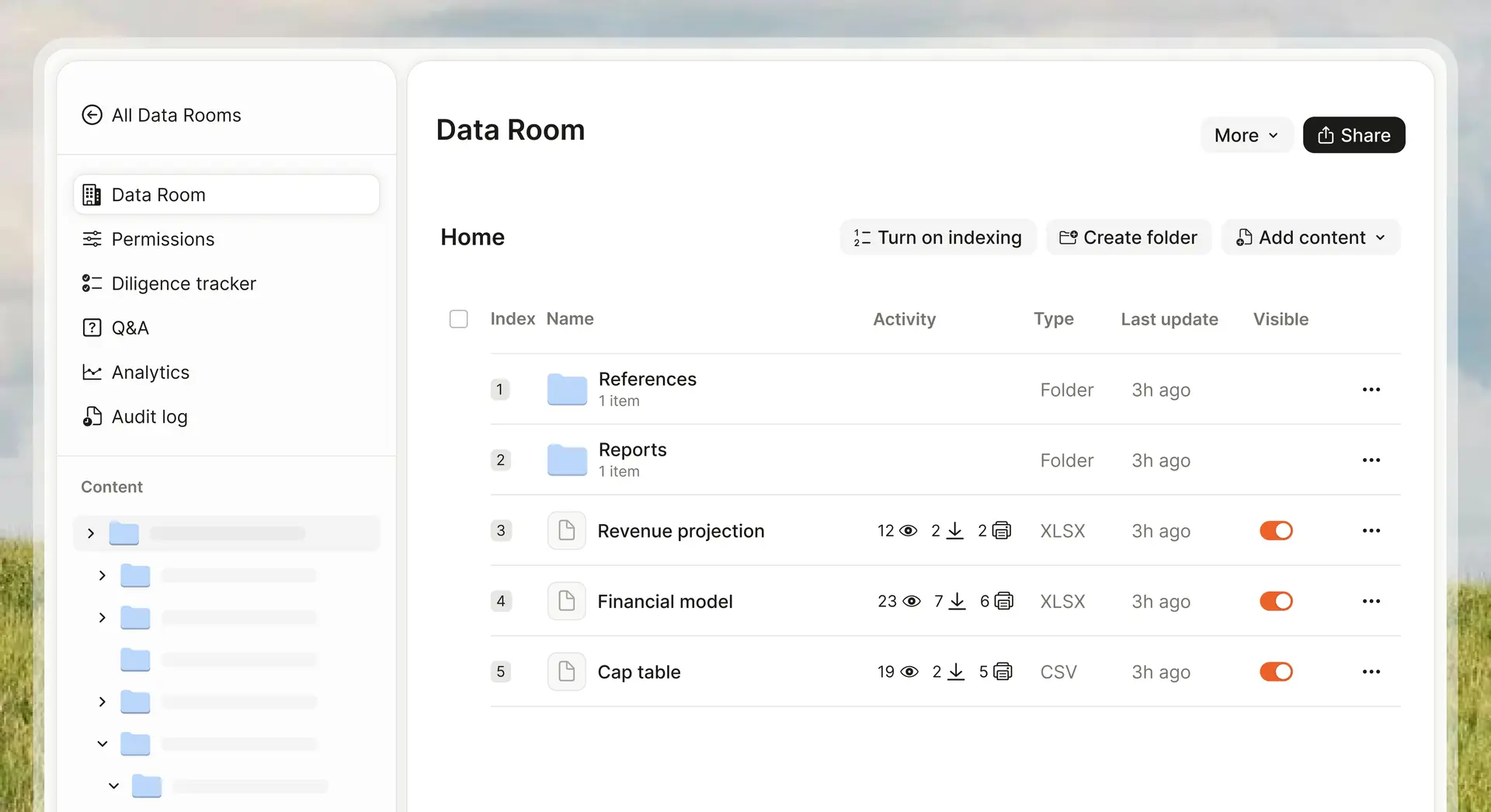
Ellty is a secure file sharing and analytics platform with a secure data room feature. It's not an enterprise VDR, and it doesn't try to be.
Here's what Ellty actually offers:
Document sharing and analytics
Upload your due diligence documents, create a trackable link, and see who viewed it, which pages they spent time on, and when. This is useful before due diligence even starts - it tells you which investors are genuinely engaged.
Data room features
The Data Room plan ($149/month) includes:
- Granular permissions - control who can see which folders and files
- NDA gating - require visitors to sign an NDA before accessing documents
- Dynamic watermarking - watermarks that identify who is viewing the document
- Restricted visitor access - prevent downloading or printing where needed
- 3 users included, no per-user fees for investor access
What Ellty is best for
Teams who need a real data room without enterprise pricing. If you're doing a deal that requires extensive third-party audit support, multiple legal teams, and advanced workflow features, you'll likely need a more sophisticated VDR.
If you're organizing documents for a serious deal, need to share securely, want visibility into who's reviewing what, and don't want to pay per-user fees - Ellty is worth a look.

A real example: seed round due diligence cost breakdown
Let's make this concrete. Here's what a typical seed round due diligence process might cost a well-prepared founder versus an unprepared one.
Scenario: $2M seed round, first institutional check


The $27,000 difference is almost entirely a function of preparation. Same deal, same investor, same company - just different starting points.
And that's before accounting for the extra 40 hours of founder time on the unprepared side, which is time not spent on product, customers, or hiring.
FAQ: due diligence cost
Who pays for due diligence?
Both sides pay their own costs. You pay your lawyers, your accountants, and your tools. The investor pays theirs. There's no standard arrangement where one side covers the other's costs, though in some M&A deals the buyer may agree to reimburse certain seller costs - but this is negotiated, not default.
Can I do due diligence without a lawyer?
For very early-stage angel deals with people you know well, sometimes yes. For any VC-led round, no. The documents involved - term sheets, existing investment agreements, IP assignments - require legal review. Trying to navigate them without a lawyer is a real risk. The money you save on legal fees can easily be lost in a negotiation you didn't understand or a document issue you didn't catch.
How long does due diligence take?
For seed rounds: 4-8 weeks. For Series A: 6-12 weeks. For M&A: 3-6 months or longer. These timelines drive total cost - the longer it takes, the more lawyer and advisor hours accumulate. A well-organized data room and fast responses are the main levers you control.
What documents do I need for a data room?
The standard set includes: formation documents, cap table, financial statements, financial model, existing investment agreements, customer contracts (key ones), employment and contractor agreements, IP assignments, board minutes, and any litigation disclosures. Most investors provide a diligence checklist - building your data room to match that format saves time.
Is a virtual data room necessary for seed rounds?
Not always, but it helps significantly. For deals above $500K from institutional investors, you should have something more organized and secure than Google Drive. A proper data room with access controls and audit logs gives investors confidence and gives you visibility into who's actively reviewing materials.
What's the difference between a data room and a shared folder?
A shared folder (Google Drive, Dropbox) has no access controls per-document, no audit trail, no analytics, and no ability to revoke access to specific files after sharing. A data room lets you control exactly who sees what, track activity, add NDA requirements, and watermark documents. For formal due diligence, the difference matters.
How do I keep due diligence costs low without cutting corners?
The main levers:
(1) prepare early - don't wait for an investor to ask before organizing documents;
(2) fix legal issues before fundraising, not during;
(3) choose tools that fit your stage - you don't need an enterprise VDR for a seed round;
(4) respond quickly to investor requests to avoid extended timelines.
Do I need audited financials for due diligence?
For pre-seed and seed rounds, usually not. For Series A, sometimes - it depends on the investor. For Series B and beyond, almost always. Full audits are expensive ($15,000-$50,000+). If you know you'll need one eventually, starting the relationship with an audit firm early is worth it.
What kills deals during due diligence?
The most common deal killers: IP ownership issues (tech not properly assigned to the company), cap table problems (missing signatures, unconverted instruments), revenue that doesn't match the pitch, undisclosed litigation, and founders who can't explain their own business metrics. None of these are unfix-able, but they're expensive to fix mid-process.
Summary: budget for due diligence before you need it
Due diligence is not a cost you can avoid. It's a cost you can control.
The founders who spend the least on diligence are not the ones who cut corners. They're the ones who prepared early, kept their books clean, fixed legal issues proactively, and used tools that fit their stage.
Budget range by stage:
- Pre-seed / angel: $2,000-$15,000
- Seed: $10,000-$40,000
- Series A: $30,000-$100,000
- Series B+: $75,000-$250,000+
- M&A: $100,000-$500,000+
Start building your data room now, not when an investor asks. It takes a few hours to set up properly, and it'll save you weeks and thousands of dollars when the time comes.
Ready to set up your data room?
Ellty lets you organize and share due diligence documents with trackable links, granular permissions, NDA gating, and real-time analytics. No per-user fees. Setup takes minutes.
Start free at ellty.com - the Data Room plan is $149/month with 3 users included.
Author

Anika Tabassum Nionta is a Content Manager at Ellty, where she writes about secure document sharing, virtual data rooms, M&A, due diligence, fundraising, and sales enablement. With over 6 years of writing experience, she helps professionals understand how to share confidential documents securely, track engagement, and manage deals more effectively. Anika holds both a BA and MA in English from Dhaka University. Outside of work, she enjoys reading, exploring new cafes in Dhaka, and connecting with entrepreneurs and dealmakers in her community.

