
Every business deal looks different on the surface. But underneath, almost all of them share one common risk: hidden tax problems that nobody talked about until it was too late.
Whether you are acquiring a company, bringing in a new investor, or merging with a competitor, the target's tax history can either validate the deal or completely derail it. And in many cases, the problems are not dramatic or obvious. They are buried in years of tax filings, unpaid assessments, unclear transfer pricing arrangements, or deferred liabilities that were never properly disclosed.
This is exactly why tax due diligence exists.
Tax due diligence is the process of reviewing a company's tax position thoroughly before closing a deal. It helps buyers understand what they are actually paying for, and it helps sellers avoid last-minute surprises that chip away at their valuation. Done well, it gives both sides the confidence to move forward.
In this guide, we will walk you through everything involved in tax due diligence: what it is, why it matters, what you should be looking for, how to organize the process efficiently, and how a virtual data room (VDR) like Ellty makes the whole thing easier to manage.
What is tax due diligence?
Tax due diligence is a structured investigation into a company's tax affairs. It is typically conducted by the acquiring party or their advisors during the due diligence phase of a transaction, and its goal is straightforward: find any tax risks or exposures before they become the buyer's problem.
At its core, tax due diligence answers a few key questions:
- Has the company been paying its taxes correctly and on time?
- Are there any open disputes with tax authorities?
- Are there liabilities that have not been recognized on the balance sheet?
- Does the company's tax structure create any risk going forward?
- Are there tax benefits or losses that carry value and can be preserved post-deal?
It is important to understand that tax due diligence is not just about checking boxes. It is about building a clear picture of the target company's real financial position, separate from what is shown in the books. Tax exposures that are not discovered before a deal closes become the acquirer's responsibility after it. That is a significant risk, and it is one of the main reasons why thorough tax review is non-negotiable in any serious transaction.
Tax due diligence typically covers corporate income tax, indirect taxes like VAT or GST, payroll taxes and employment tax compliance, withholding taxes on payments to non-residents, transfer pricing between related entities, and any specific industry-related tax obligations.
The scope can vary depending on the size of the deal, the complexity of the target's structure, and the jurisdictions involved. But the underlying purpose stays the same: give the buyer a full, honest view of the tax risk.
Why tax due diligence is critical
Many acquirers underestimate tax due diligence until they experience what happens without it. The consequences can range from uncomfortable to genuinely deal-breaking.
Hidden liabilities can wipe out deal value.
A company may look profitable on paper, but if it has years of unpaid tax obligations or is facing a large assessment from a tax authority, that liability transfers to the buyer. In some cases, buyers have inherited tax problems that exceeded the value they expected to gain from the acquisition.
Tax structures can be complex and fragile.
Many companies have tax arrangements that depend on specific conditions staying the same, such as a particular ownership structure, a certain level of revenue, or an existing treaty position. After a change in ownership, those arrangements may no longer hold, triggering unexpected tax costs.
Regulatory scrutiny is increasing.
Tax authorities in most jurisdictions have become more sophisticated. Transfer pricing audits, permanent establishment challenges, and substance requirements are all areas where companies face growing scrutiny. If the target has taken aggressive positions in any of these areas, that risk does not disappear when the deal closes.
Tax warranties and indemnities depend on what you know.
In a deal negotiation, the representations and warranties around tax are only as useful as the diligence that informed them. If you did not look closely enough, you cannot negotiate the right protections, and you may not even know what to ask for.
There are potential upsides too.
Tax due diligence is not just about finding problems. A thorough review might reveal unused tax losses that can be carried forward, valuable R&D credits, or structures that can be optimized post-acquisition. These are real financial benefits that a buyer should know about.
In short, tax due diligence protects both sides of a deal. It gives buyers confidence that they know what they are paying for, and it gives sellers a cleaner path to closing by surfacing and resolving issues early.
Tax due diligence checklist
A strong tax due diligence process is built around a comprehensive document request list. The following checklist covers the core areas that should be reviewed in any transaction. Depending on the target's size and structure, some areas will require more depth than others.
Corporate income tax
- Tax returns for the past 3 to 5 years (federal, state, and where applicable, international)
- Tax assessments and notices received from authorities
- Evidence of taxes paid and payment history
- Details of any open audits or investigations
- Deferred tax positions and supporting workpapers
- Any tax opinions obtained in the past
VAT, GST, and indirect taxes
- Indirect tax returns for recent years
- Correspondence with tax authorities on any disputes
- Review of indirect tax treatment for key transactions
- Any pending refund claims or disputes
Payroll and employment taxes
- Payroll tax filings and payment records
- Treatment of contractors versus employees (misclassification is a common risk area)
- Benefits and deferred compensation arrangements
- Any employment tax audits or assessments
Transfer pricing
- Intercompany agreements and pricing policies
- Transfer pricing documentation and benchmarking studies
- Related-party transactions and their tax treatment
- Any transfer pricing adjustments made by tax authorities
Tax losses and credits
- Schedule of net operating losses or other carried-forward tax attributes
- R&D or other tax credits, with documentation of eligibility
- Assessment of whether losses survive the change in ownership
Jurisdictional considerations
- Confirmation of tax residency status
- Any permanent establishment risk in jurisdictions where the company operates but is not registered
- Treaty positions relied upon and their current validity
Pending or threatened disputes
- Any correspondence with tax authorities in the last 3 to 5 years
- Ongoing litigation related to tax matters
- Provisions made in the accounts for uncertain tax positions
Using technology to simplify tax due diligence
The volume of documents involved in tax due diligence is significant. Even for a mid-sized company, you are looking at years of tax filings, correspondence with authorities, intercompany agreements, payroll records, and more. Managing all of this through email threads and shared drives is genuinely difficult, and it creates real risks.
Documents get forwarded to people who should not have them. Sensitive information sits in inboxes without any visibility into who has seen it. Version control becomes a nightmare. And when a deal team has multiple advisors across different firms, keeping everyone working from the same set of documents is almost impossible without the right infrastructure.
Technology, and specifically virtual data rooms, exists to solve these problems.
A well-set-up VDR gives you a single, secure place to organize and share all due diligence documents. It controls who can see what. It tracks every action, so you always know who viewed, downloaded, or printed a document. It allows you to gate access behind an NDA before anyone sees anything sensitive. And it keeps a clean audit trail throughout the process, which is valuable both during the deal and after it closes.
Beyond security, the right technology also speeds things up. When documents are organized clearly, reviewers spend less time searching and more time actually reviewing. When you can see in real time which sections the buyer's team is spending time on, you can anticipate questions and respond proactively. When everything is in one place, nothing falls through the cracks.
For tax due diligence specifically, this matters because the stakes are high and the documents are sensitive. Tax returns, transfer pricing studies, and details of disputes with authorities are not things you want circulating freely. The right platform keeps them protected while still making the process efficient.
Virtual data rooms: the backbone of due diligence
If you are running or participating in a due diligence process, a virtual data room is not optional. It is the infrastructure that holds everything together.
The question is not whether to use a VDR. The question is which one to use, and whether it fits your actual needs.
Legacy VDR platforms were built for large investment banks and law firms running billion-dollar transactions. They are expensive, slow to set up, and priced in ways that make them inaccessible for smaller deals or teams that do not have a dedicated procurement process. Per-user fees, per-page charges, and multi-week onboarding timelines are all common. For many users, those platforms create more friction than they remove.
This is exactly the gap that Ellty fills.

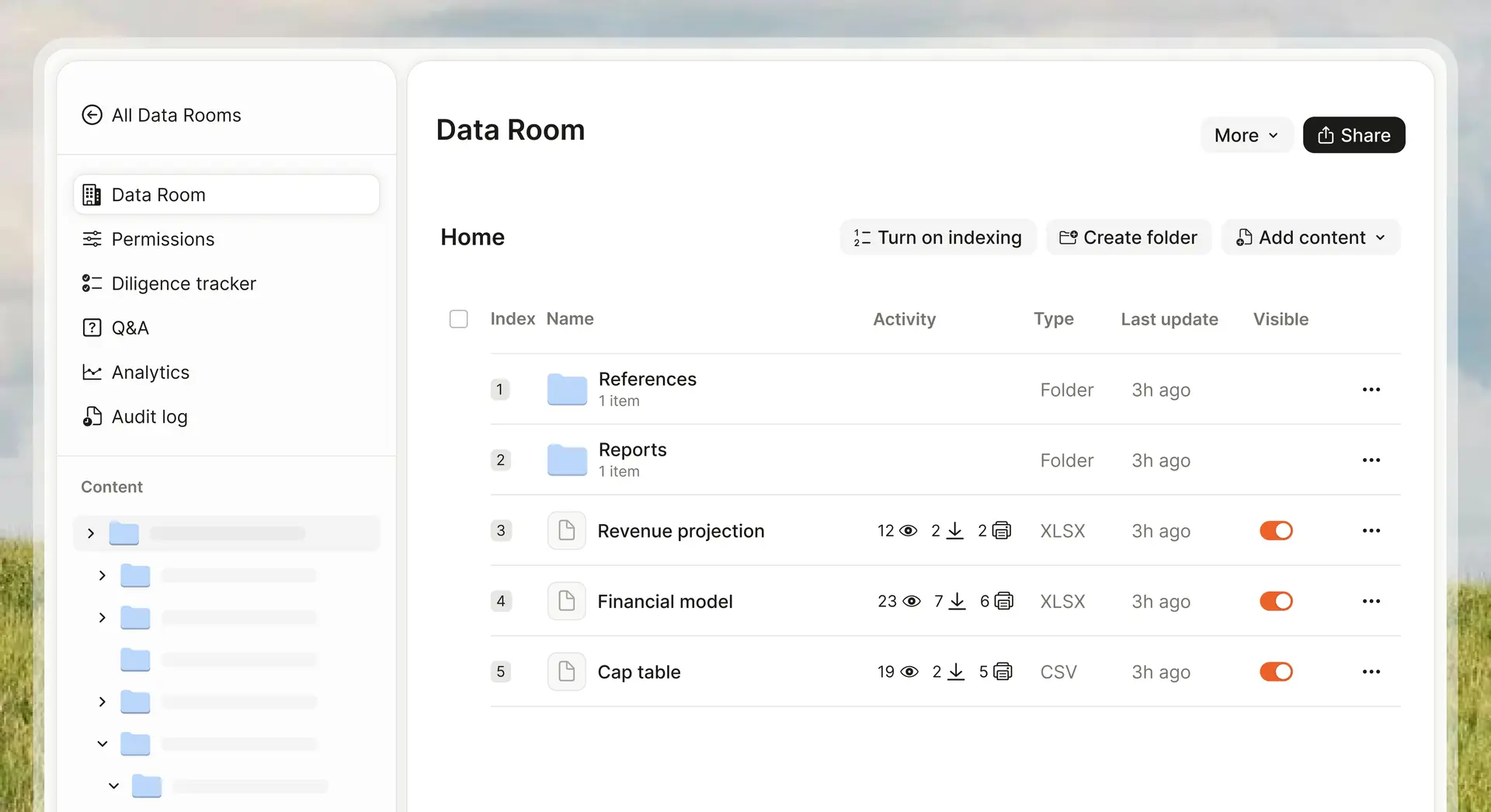
Ellty is a secure document sharing and analytics platform with full VDR functionality. It is built for anyone who needs to share sensitive documents in a controlled, trackable way, whether that is a merger, an acquisition, a funding round, or a property transaction.
What Ellty gives you
Access controls and permissions. You decide who sees what. Role-based permissions let you give different reviewers access to different sections of the data room, which is especially important in tax due diligence where some documents are more sensitive than others.

NDA gating. Visitors must agree to your NDA before they can access the data room. This is a critical protection when sharing tax documents, transfer pricing studies, or information about open disputes.
Dynamic watermarking. Every document viewed or downloaded carries a watermark tied to the viewer's identity. This discourages unauthorized sharing and creates accountability.
Real-time activity tracking. You can see exactly who is looking at which documents, how long they spend on them, and when they return. During a due diligence process, this is genuinely useful, because it tells you where the buyer's focus is and helps you prepare for the right conversations.

Full audit logs. Every action in the data room is recorded. This is valuable during the deal and also after close, if any questions arise about what was disclosed and when.
Clean, fast setup. Ellty is designed to be set up quickly. You do not need a technical team or weeks of onboarding. You can have a working data room running in a matter of hours.
Ellty pricing: clear and predictable
One of the most frustrating things about legacy VDR platforms is the pricing. Custom quotes, per-user fees, and charges based on document volume add up fast, and they make it hard to plan your costs in advance.
Ellty takes a different approach.
- Free plan ($0/month): Document tracking, real-time analytics, and secure sharing. A solid starting point for early conversations.
- Standard ($69/month): Unlimited documents, advanced analytics, eSignatures, custom branding, and full data room features. Works well for smaller deals and ongoing client communication.
- Room ($149/month): Granular permissions, NDA gating, dynamic watermarking, and restricted visitor access. Everything you need for a proper controlled document review.
- Room Plus ($349/month): Group visitor permissions, full audit logs, and support for up to 4,000 assets per data room. Built for multi-party deals with heavy document loads.
There are no per-user fees, no per-page charges, and no surprise overages. Whether you are sharing documents with 3 people or 30, you pay the same flat rate.


Strategies for effective tax due diligence
Having the right tools and the right checklist gets you most of the way there. But the difference between a good tax due diligence process and a great one comes down to how you execute it.
Start with scoping, not documents
Before you request a single document, take time to understand the target's business properly. Where does it operate? What is its legal structure? Does it have related-party transactions? Has it gone through any restructuring? The answers to these questions shape the scope of the review, and they help you focus your effort on the areas of highest risk rather than treating every section equally.
A targeted approach is faster, cheaper, and more likely to surface the issues that actually matter.
Organize the data room before documents arrive
If you are on the seller side, structure the data room before you start uploading documents. Use clear folders that map to the major due diligence categories. Label documents consistently. Make sure the index you provide to the buyer matches the structure in the data room.
This might sound like administrative work, but it makes a real difference. A well-organized data room speeds up the buyer's review, reduces back-and-forth requests for clarification, and signals that the seller has their affairs in order. That matters for the deal's tone.
If you are using Ellty, this setup takes very little time. You can create a folder structure, set permissions for each section, and enable NDA gating before sharing access with the review team.
Assign clear ownership within the review team
Tax due diligence typically involves multiple advisors: external tax counsel, internal finance teams, M&A advisors, and sometimes specialist consultants for specific areas like transfer pricing or employment taxes. With that many people involved, it is easy for things to fall between the cracks.
Assign clear ownership for each area of the review. One person should be responsible for collecting and reviewing corporate income tax documents. Another should own employment taxes. A third should lead on transfer pricing. Make sure everyone knows what they are responsible for and what the timeline looks like.
Do not just flag risks, quantify them
When an issue is identified during tax due diligence, the natural instinct is to note it and move on. But a finding without a number attached to it is not very useful. As much as possible, try to estimate the financial exposure associated with each risk.
This is not always straightforward. Open audits may not have a clear outcome yet. But even a rough range gives both sides something to work with when negotiating price adjustments, indemnities, or escrow arrangements.
Use activity data to guide conversations
If you are a seller using a VDR like Ellty, pay attention to the activity data your platform provides. If the buyer's team is spending a lot of time in the transfer pricing section, that tells you something. If they keep returning to a specific document, it is probably worth getting ahead of the question.
Real-time analytics are not just a security feature. They are a deal management tool. Use them to stay one step ahead.
Close loops before closing the deal
One of the most common causes of deal delay is unresolved tax queries. A question gets raised, the seller provides a document, the buyer has a follow-up, and it goes back and forth for weeks. This is normal, but it can be minimized with a structured query management process.
Use a centralized Q&A log, ideally within your VDR, to track every question, who is responsible for answering it, and when it was resolved. This keeps the process moving and gives both sides a clear record of what was asked and answered.
Frequently asked questions
How long does tax due diligence take?
It depends on the complexity of the target and the size of the transaction. For a straightforward SME acquisition with clean records, a focused tax review might take 2 to 3 weeks. For a larger business with multiple entities, international operations, or complex tax arrangements, it can take 6 to 8 weeks or more. Starting with a well-organized data room shortens this significantly.
Who conducts tax due diligence?
It is usually led by external tax advisors or the buyer's in-house tax team, often working alongside M&A counsel. For complex cross-border transactions, specialist advisors may be brought in for specific jurisdictions or areas like transfer pricing. The seller typically has their own advisors helping them prepare and respond to requests.
What is the difference between tax due diligence and financial due diligence?
Financial due diligence looks at the overall financial health of the business: revenue, profitability, working capital, and cash flow. Tax due diligence is specifically focused on tax compliance, exposures, and liabilities. They overlap in areas like deferred tax and historical losses, but they are usually conducted by different teams with different objectives.
What happens if a tax risk is found during due diligence?
It depends on the nature and size of the risk. In some cases, the seller can resolve the issue before close (for example, paying an outstanding liability). In others, the risk is reflected in the deal price through a price adjustment. For ongoing or uncertain risks, buyers typically negotiate tax indemnities or escrow arrangements to protect themselves after close.
What documents should a seller prepare for tax due diligence?
The core set includes tax returns for the past 3 to 5 years, evidence of tax payments, correspondence with tax authorities, any tax opinions obtained, intercompany agreements, transfer pricing documentation, and details of any open audits or disputes. Organizing these in a structured data room before the process begins saves significant time.
Is a virtual data room necessary for tax due diligence?
Strictly speaking, you can conduct due diligence without one. But sharing sensitive tax documents over email or through generic file-sharing platforms creates real risks around confidentiality, version control, and audit trail. A VDR like Ellty provides the security, access control, and tracking that the process genuinely needs, without adding complexity or cost.
Can Ellty handle large document volumes for complex transactions?
Yes. Ellty Room Plus plan supports up to 4,000 assets per data room, with group visitor permissions and full audit logs. It is designed for multi-party deals where different reviewers need access to different sections, and where the document load is heavy. The flat monthly pricing means you are not penalized for having more documents or more reviewers.


Final thoughts
Tax due diligence is one of those parts of a deal that can feel like a formality until it is not. When it surfaces a significant liability, or reveals that a structure that looked solid actually creates a major post-close risk, its value becomes very clear.
The good news is that a well-run tax due diligence process does not have to be slow, expensive, or chaotic. With the right scope, the right team, and the right infrastructure, it can be thorough and efficient at the same time.
A virtual data room is central to that infrastructure. It keeps sensitive documents secure, gives both sides clear visibility into the process, and creates the audit trail that protects everyone involved. Ellty is built specifically for this kind of work, with the features that matter - access controls, NDA gating, dynamic watermarking, real-time activity tracking - at a price that makes sense for deals of all sizes.
Whether you are buying, selling, or advising on a transaction, the approach you take to tax due diligence shapes the outcome. Take it seriously, plan it properly, and use the right tools.
Ready to set up your due diligence data room? Start with Ellty today - no per-user fees, no surprises, no enterprise contract required.
Looking for more resources on due diligence and secure document sharing? Explore the Ellty blog for practical guides on M&A, investor relations, and document management best practices.
Author

Anika Tabassum Nionta is a Content Manager at Ellty, where she writes about secure document sharing, virtual data rooms, M&A, due diligence, fundraising, and sales enablement. With over 6 years of writing experience, she helps professionals understand how to share confidential documents securely, track engagement, and manage deals more effectively. Anika holds both a BA and MA in English from Dhaka University. Outside of work, she enjoys reading, exploring new cafes in Dhaka, and connecting with entrepreneurs and dealmakers in her community.

