
Whether you are buying a business, raising capital, or closing an acquisition, financial due diligence is one of the most important steps you will go through. Get it right, and you move forward with confidence. Get it wrong, and you could be walking into a deal that costs far more than you expected.
This guide covers everything you need to know about financial due diligence - what it is, why it matters, what documents you need, and how the right software can make the whole process significantly smoother.
What is financial due diligence?
Financial due diligence is the process of carefully reviewing and verifying the financial health of a business before completing a transaction. It is the part of a deal where one party, usually the buyer or investor, digs into the numbers to confirm that everything being claimed about the business is actually true.
Think of it this way: when someone tells you their business made $5 million last year, financial due diligence is how you find out whether that number holds up under scrutiny.
The process typically involves reviewing financial statements, tax records, cash flow data, revenue breakdowns, debt obligations, and dozens of other financial documents. The goal is simple, to understand what you are really buying or investing in, and to make sure there are no unpleasant surprises waiting on the other side of the deal.
Financial due diligence is not just for large acquisitions. It applies to fundraising rounds, mergers, joint ventures, real estate transactions, and any situation where significant financial commitment is involved.
Why financial due diligence is so important


Skipping or rushing financial due diligence is one of the most common and costly, mistakes in business transactions. Here is why it deserves serious attention.
It protects you from hidden risks. A business might look profitable on the surface but carry hidden liabilities, unpaid taxes, or customer concentration risks that are not immediately obvious. Due diligence surfaces these issues before you commit.
It validates the asking price. Valuations are often based on claimed revenue or EBITDA figures. Financial due diligence confirms whether those figures are accurate and whether the valuation is actually justified.
It gives you negotiating power. When you find issues during due diligence and you often will, you have grounds to renegotiate the deal terms, adjust the price, or walk away entirely. Without due diligence, you lose that leverage.
It reduces post-deal surprises. Many deals that go wrong do so because the buyer discovers problems after closing that they should have found before. Thorough due diligence dramatically reduces this risk.
It builds trust. On the sell-side, having your financials properly organized and transparently presented signals professionalism and builds buyer confidence. It can actually speed up the deal and strengthen your negotiating position.
In short, financial due diligence is how serious deal-makers protect themselves and make better decisions.
What documents and data are needed for financial due diligence?
The document list for financial due diligence can feel overwhelming at first, but it generally falls into a few clear categories.
Financial statements
- Audited or reviewed financial statements for the past 3–5 years
- Income statements, balance sheets, and cash flow statements
- Monthly management accounts for the current year
Revenue and sales data
- Customer contracts and recurring revenue breakdowns
- Revenue by product, service, or customer segment
- Sales pipeline and backlog reports
Tax records
- Corporate tax returns for the past 3–5 years
- Any notices of tax assessments or ongoing tax disputes
- VAT or sales tax filings
Debt and liabilities
- Details of all outstanding loans and credit facilities
- Lease obligations and off-balance-sheet commitments
- Any pending legal claims or contingent liabilities
Working capital
- Accounts receivable and payable aging reports
- Inventory records and valuation methods
- Bank statements for the past 12 months
Operational and other financial data
- Budgets and financial forecasts
- Payroll records and employee benefit obligations
- Insurance policies
Managing all of these documents securely and making sure the right people can access the right files, is where a virtual data room becomes essential.
Ready to organize your due diligence documents securely?
Start your free Ellty account and set up a professional data room in minutes, no enterprise contract needed.
What is financial due diligence vs. a financial audit?
These two terms get confused often, so it is worth being clear about the difference.
A financial audit is a formal, independent examination of a company's financial statements to confirm they are prepared according to accounting standards (like GAAP or IFRS). It is typically conducted by a licensed external auditor on behalf of the company, and the resulting report is intended for a wide audience like shareholders, regulators, lenders.
Financial due diligence is different in both purpose and scope. It is conducted on behalf of a specific party, usually a buyer or investor, to evaluate a business for a particular transaction. It goes beyond just checking accounting compliance. It looks at the quality of earnings, the sustainability of revenue, working capital trends, and forward-looking financial health.
Financial due diligence for the sell-side
If you are the seller or the company being acquired, financial due diligence is not something that just happens to you, it is something you should actively prepare for.
Preparation is everything. Buyers will ask for a lot of documents, and how quickly and cleanly you can provide them says a lot about your business. A disorganized data room filled with mislabeled files and missing documents slows the process down and creates doubt in the buyer's mind.
Run your own review first. Before opening your data room to any buyer, do an internal review of your own financials. Identify any inconsistencies, gaps, or areas that might raise questions. It is far better to address these proactively than to have a buyer discover them mid-process.
Control access carefully. During due diligence, you are sharing sensitive financial information. You need to know exactly who is looking at what, and you need to be able to revoke access at any point. This is where having a proper virtual data room becomes non-negotiable, rather than emailing documents or using a shared Google Drive folder.
Present your story clearly. Numbers alone do not tell the whole story. Use your data room to provide context where needed like explanatory notes, management presentations, and clear labelling of documents help buyers understand what they are looking at.
Track engagement. With Ellty, you can see in real time which documents buyers are spending time on, which pages they are reading most, and who has accessed what. This intelligence tells you what concerns they might have before they even raise them, giving you time to prepare strong, clear answers.
Set up your Ellty data room before you start buyer conversations. With NDA gating, dynamic watermarking, and real-time analytics, you stay in control from day one.
Financial due diligence for the buy-side
As a buyer or investor, financial due diligence is your primary tool for making a well-informed decision. Here is how to approach it effectively.
Start with a structured request list. Before you begin reviewing anything, send the seller a clear, organized list of the documents and data you need. This prevents back-and-forth and keeps the process moving efficiently.
Verify, do not just review. Do not take documents at face value. Cross-reference revenue figures with bank statements and tax returns. Check that customer contracts match the revenue figures in the financial statements. Look for consistency across documents.
Focus on quality of earnings. One of the most important things to assess is whether reported earnings are genuinely recurring and sustainable, or whether they have been inflated by one-off items, aggressive accounting, or unsustainable contracts.
Assess working capital carefully. Working capital trends tell you how much cash the business needs to operate on a day-to-day basis. Misunderstanding working capital requirements is a common source of post-deal problems.
Look beyond the numbers. Financial due diligence surfaces the data, but you also need to understand the story behind it. Why did revenue dip in year two? Why is the accounts receivable balance so high? These questions often reveal more than the numbers alone.
Use a data room with good analytics. Accessing documents through a proper virtual data room, rather than email attachments, keeps everything organized, version-controlled, and auditable. With Ellty Room plan, you get granular permission controls so different members of your deal team can access exactly what they need, nothing more.
How long does the financial due diligence process take?
There is no single answer, it depends heavily on the size and complexity of the deal, how prepared the seller is, and how quickly both sides can work through the document review.
As a rough guide:
- Small deals or seed-stage fundraising: 2–4 weeks
- Mid-market acquisitions: 4–8 weeks
- Complex or large transactions: 8–16 weeks or more
The biggest factor that slows down financial due diligence is poor document organization on the sell-side. When documents are missing, mislabeled, or scattered across multiple platforms, the process stalls. Every delay costs both sides time and, often, money.
The second biggest factor is access management. If buyers have to wait for documents to be emailed to them, or if they cannot access certain files without chasing the seller, the process drags on unnecessarily.
A well-organized virtual data room, with all documents uploaded, clearly labelled, and access permissions set correctly from the start. It can cut weeks off a typical due diligence timeline. That is a meaningful difference when deals are time-sensitive.
Financial due diligence checklist
Use this checklist as a starting point when preparing for or conducting financial due diligence.
Financial statements
- Three to five years of audited financial statements
- Most recent year-to-date management accounts
- Monthly profit and loss statements for the past 12–24 months
- Balance sheet at each year-end
Revenue and customers
- Revenue breakdown by product, service, or segment
- Customer concentration analysis (% of revenue from top customers)
- List of top customers with contract terms and renewal dates
- Recurring vs. one-time revenue breakdown
- Sales pipeline and backlog
Cash flow
- Historical cash flow statements
- Working capital analysis (accounts receivable, payable, inventory)
- Bank statements for the past 12 months
- Capital expenditure history and plans
Tax and compliance
- Corporate tax returns for the past three to five years
- VAT or sales tax compliance records
- Any open tax audits, disputes, or assessments
- Transfer pricing documentation (if applicable)
Debt and liabilities
- All loan and credit facility agreements
- Debt repayment schedules
- Off-balance-sheet obligations and commitments
- Contingent liabilities and pending legal claims
Payroll and benefits
- Employee headcount and payroll records
- Pension and benefits obligations
- Key management compensation arrangements
Budgets and forecasts
- Current year budget vs. actual comparison
- Three to five year financial projections
- Key assumptions underlying the forecasts
Other
- Insurance policies
- Any related-party transactions
- Prior acquisition or transaction history
How to choose financial due diligence software

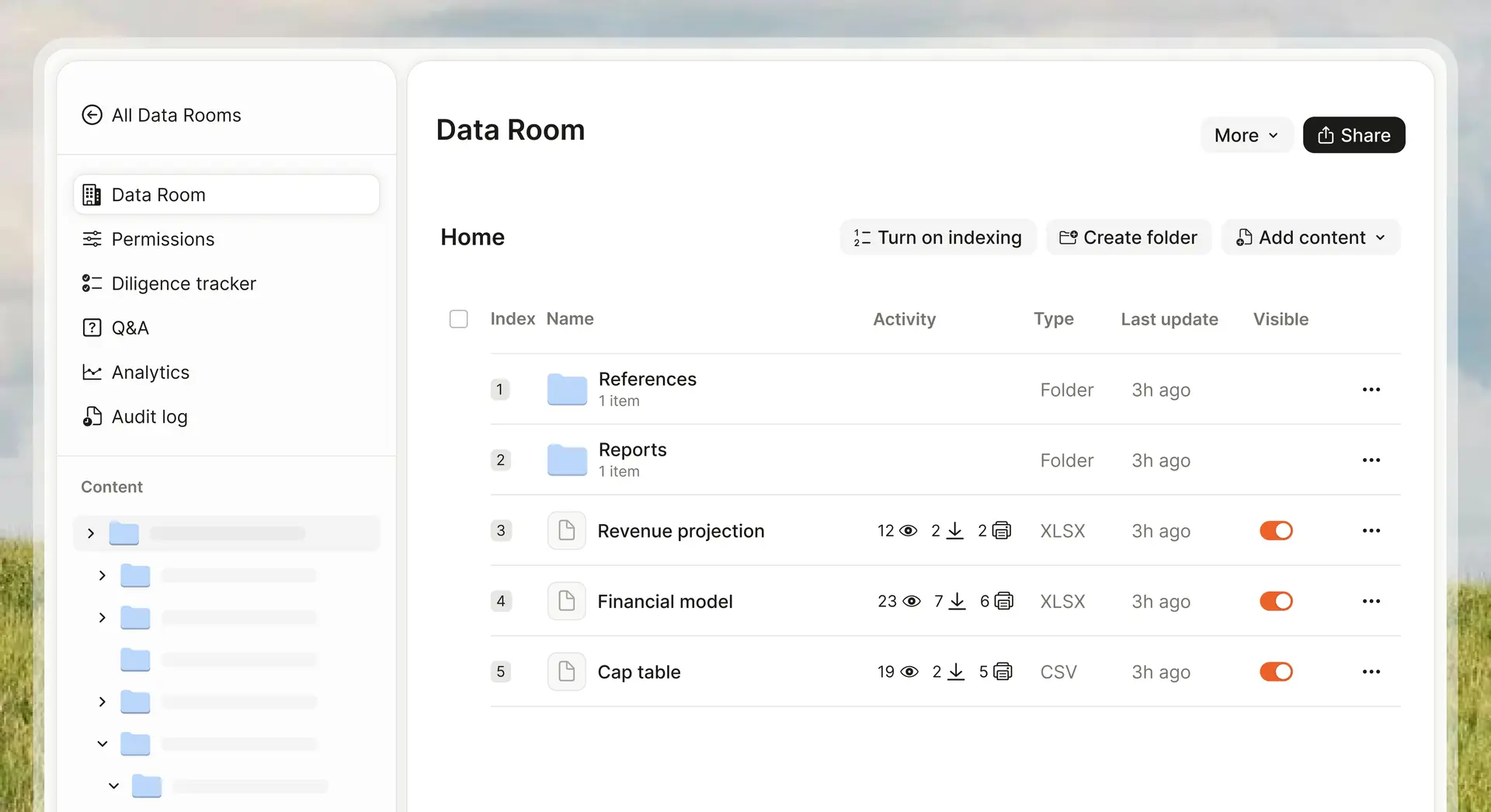
The right software makes a real difference in how smoothly a due diligence process runs. Here is what to look for and why Ellty is worth considering.
Security and access control. You are sharing highly sensitive financial information. Your platform needs granular permission settings, so you control exactly who can view, download, or print each document. Ellty Room and Room Plus plans offer granular permissions, NDA gating, and dynamic watermarking - all the tools you need to run a controlled review.
Real-time activity tracking. Knowing who has accessed which documents and when, is not just a nice-to-have. It tells you how serious a buyer is, what parts of the financials they are focused on, and whether they have actually reviewed the key documents. Ellty provides real-time analytics across all plans.

Ease of setup. Legacy virtual data rooms often require a lengthy onboarding process, custom quotes, and dedicated account managers just to get started. Ellty is different. You pick a plan, set up your data room, and start uploading documents, no enterprise contract, no waiting period.
Transparent pricing. Most traditional VDR providers charge per user or per page, which means costs balloon as your deal team grows or your document count increases. Ellty uses flat monthly pricing with no per-user fees and no surprise charges. The Room plan starts at $149/month and includes everything you need for a full due diligence process. Room Plus at $349/month supports up to 4,000 assets and group permissions for multi-party deals.
Professional presentation. How your data room looks matters. Ellty Standard plan and above include custom branding, so your data room reflects your own identity, not a generic template.
Scalability. Whether you are running a small fundraising round or a complex multi-party acquisition, Ellty scales with you. Start with the free plan for early conversations and upgrade as your deal progresses.


FAQs
What is the main goal of financial due diligence?
The main goal is to verify the financial health and performance of a business before completing a transaction. It confirms that the numbers being presented are accurate, identifies any hidden risks or liabilities, and gives the buyer or investor the information they need to make a well-informed decision.
Who typically conducts financial due diligence?
On the buy-side, it is usually conducted by the buyer's internal finance team, an external M&A advisor, or a specialist due diligence firm. On the sell-side, companies often engage advisors to help prepare for the process and organize their data room. For smaller deals, the buyer might conduct the review themselves.
What is the difference between financial due diligence and legal due diligence?
Financial due diligence focuses on the numbers such as revenue, earnings, cash flow, liabilities, and financial projections. Legal due diligence covers contracts, intellectual property, regulatory compliance, litigation risks, and corporate structure. Both are typically conducted in parallel as part of a broader M&A or investment process.
What is a virtual data room and why is it used in due diligence?
A virtual data room (VDR) is a secure online platform used to store and share sensitive documents during a transaction. It provides access controls, activity tracking, and audit trails, ensuring that confidential financial information is only seen by authorized parties. It also keeps all documents organized in one place, which speeds up the review process significantly.
Can financial due diligence be done remotely?
Yes, and in fact most financial due diligence today is conducted remotely. Buyers and their advisors access documents through a virtual data room, conduct analysis from their own offices, and communicate via video calls and secure messaging. A well-organized VDR like Ellty makes remote due diligence just as effective as in-person review.
What happens if financial due diligence uncovers problems?
It depends on the nature and severity of the issues. Minor problems might be resolved with additional documentation or clarification. More significant issues such as undisclosed liabilities or material inconsistencies in reported earnings, typically lead to renegotiation of the deal price or terms. In serious cases, the buyer may choose to walk away entirely.
How much does it cost to conduct financial due diligence?
Costs vary widely depending on deal size and complexity. For large transactions, professional due diligence services from an advisory firm can run into tens of thousands of dollars. For smaller deals, buyers often manage the process internally. The cost of the software platform used to manage document sharing is typically much lower. Ellty Room plan, for example, is $149/month with no per-user fees, making it accessible even for smaller deal teams.
Final thoughts
Financial due diligence is not something to rush or cut corners on. It is the process that stands between you and a costly mistake, whether you are the buyer trying to understand what you are getting into, or the seller trying to close a deal quickly and cleanly.
The good news is that with the right preparation and the right tools, financial due diligence does not have to be painful. Sellers who organize their documents properly, set up a professional data room, and proactively address potential questions can move through the process significantly faster. Buyers who follow a structured approach, use a checklist, and have access to a well-organized data room can make better decisions in less time.
Ellty was built for exactly this kind of work. It gives you the core tools that matter. Secure document sharing, real-time activity analytics, access controls, NDA gating, and a clean audit trail without the complexity or cost of legacy enterprise platforms. Whether you are running a small fundraising round or managing a complex acquisition, Ellty gives you everything you need to run a controlled, professional due diligence process.
Flat pricing. No per-user fees. No enterprise contract required.


Author

Anika Tabassum Nionta is a Content Manager at Ellty, where she writes about secure document sharing, virtual data rooms, M&A, due diligence, fundraising, and sales enablement. With over 6 years of writing experience, she helps professionals understand how to share confidential documents securely, track engagement, and manage deals more effectively. Anika holds both a BA and MA in English from Dhaka University. Outside of work, she enjoys reading, exploring new cafes in Dhaka, and connecting with entrepreneurs and dealmakers in her community.

