
Before any serious deal closes, whether it's a startup acquisition, a real estate transaction, a funding round, or a business merger, there's a process that happens behind the scenes. It's called due diligence, and it's essentially the buyer or investor's way of saying: "Before we commit, let us verify everything."
Due diligence is a structured investigation. The goal is to confirm that what's being presented actually holds up under scrutiny such as the financials, the legal standing, the contracts, the team, the assets.
Think of it like a pre-purchase inspection on a house. You've agreed on the price. You like what you see. But before you hand over the money, you bring in someone to check the foundation, the wiring, and the plumbing. That inspection is due diligence.
In business deals, this "inspection" can involve dozens of people, hundreds of documents, and weeks, sometimes months of back-and-forth between legal teams, accountants, investors, and advisors.
So how long does it actually take? The honest answer is: it depends. But in this guide, we'll break down the timelines, what affects them, and how the right tools like a modern virtual data room, can make the whole process faster and less painful.


Types of due diligence
Due diligence isn't a single checklist. It's a collection of reviews that happen in parallel, each focused on a different part of the business or deal. Understanding the types helps you understand why timelines vary so widely.
Financial Due Diligence is usually the starting point. Reviewers go through financial statements, tax records, revenue breakdowns, liabilities, and cash flow history. The goal is to confirm the numbers are real and the business is financially healthy or to identify risks before they become your problem.
Legal Due Diligence covers contracts, intellectual property, corporate governance documents, employment agreements, ongoing litigation, and regulatory compliance. Legal teams look for anything that could expose the buyer to unexpected liability.
Operational Due Diligence examines how the business actually runs, its processes, systems, suppliers, customer relationships, and key personnel. This matters especially in acquisitions where operational continuity is critical.
Commercial Due Diligence looks at the market. What's the competitive landscape? How defensible is the company's position? Is the revenue model sustainable?
Technical Due Diligence applies mostly to software and tech companies. It involves reviewing the codebase, infrastructure, security practices, and technical debt.
HR and People Due Diligence covers the team: employment contracts, compensation structures, equity arrangements, and whether key people are likely to stay post-deal.
In larger transactions, all of these happen simultaneously, with different workstreams running at the same time, which is one reason deals can feel chaotic without the right coordination tools.
Typical due diligence phases


Regardless of deal type, due diligence tends to follow a predictable arc with three broad phases.
Phase 1 - Preparation (1–2 weeks)
Before the buyer even starts reviewing, the seller needs to get organized. This means gathering documents, sorting them into categories, setting up access controls, and deciding who gets to see what. This phase is often underestimated. Disorganized document preparation is one of the biggest sources of delay in any deal. A well-set-up virtual data room, populated in advance, can cut this phase significantly.
Phase 2 - Active review (2–8 weeks)
This is where the buyer's team digs in. They're reading documents, raising questions, requesting additional materials, and flagging concerns. This phase runs longer when documents are missing, poorly organized, or shared through insecure, untracked channels (like email). The quality of the data room and how quickly the seller responds to queries, drives the pace here more than almost anything else.
Phase 3 - Negotiation and closing (1–4 weeks)
Once the review is complete, findings inform the final negotiation. Price adjustments, representations and warranties, indemnification clauses - all of this gets worked out in the final stretch. If significant issues were surfaced during review, this phase can drag. If the review went cleanly, it moves quickly.
Key factors affecting the timeline
The same type of deal can take three weeks or three months depending on a handful of variables. Here are the ones that matter most.
Document readiness - If the seller walks into due diligence with a clean, well-organized data room, the process moves faster. If documents are scattered across email threads, shared drives, and physical folders, expect delays. Buyers can't review what they can't find.
Deal complexity - A simple share purchase with a small team moves faster than a multi-entity acquisition with cross-border regulatory requirements. More moving parts means more time.
Number of parties involved - Due diligence involving multiple bidders, co-investors, or advisors on both sides multiplies the coordination overhead. More people means more questions, more back-and-forth, and more potential for bottlenecks.
Responsiveness - Every question the buyer raises needs an answer. Every missing document needs to be found and uploaded. Deals slow down when either side is slow to respond. Having a centralized Q&A workflow in your data room, rather than chasing answers over email, makes a real difference here.
Regulatory environment - Cross-border deals, regulated industries (finance, healthcare, real estate), and transactions above certain value thresholds often require regulatory approvals that operate on their own timeline entirely.
Quality of the data room - This deserves its own mention. A disorganized or insecure data room creates friction at every stage. A good one with clear folder structures, access controls, and activity tracking, keeps things moving and gives the seller visibility into what reviewers are actually looking at.
Estimated timelines by deal type
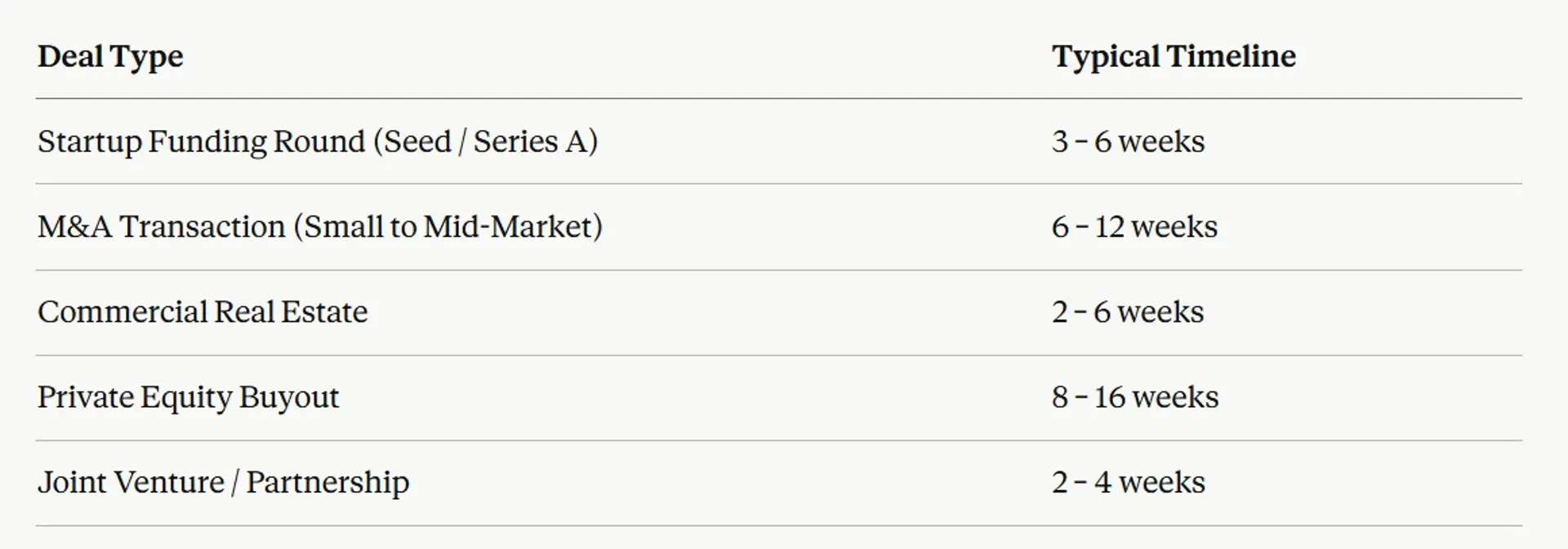
Here's a practical breakdown of how long due diligence typically takes across common deal types. These are realistic ranges based on typical deal structures, not best-case scenarios.
Startup funding rounds (seed / series A)
Typical timeline: 3–6 weeks Early-stage deals tend to move faster because the business is smaller and there's less legal and financial complexity. Investors are focused on the team, product, and early metrics. The data room is usually modest - cap table, financials, pitch deck, key contracts. Founders who prepare their documents in advance and use a proper data room (rather than a Google Drive folder) tend to close faster.
M&A transactions (small to mid-market)
Typical timeline: 6–12 weeks Acquisitions involve more depth across every category such as financial, legal, operational, HR. Buyers are assuming full responsibility for the business, so they look harder. The volume of documents is higher, and multiple workstreams run in parallel. Good document organization and a responsive seller team are the biggest factors in keeping this timeline tight.
Real estate transactions (Commercial)
Typical timeline: 2–6 weeks Property deals focus on title searches, environmental assessments, lease agreements, financial history of the asset, and zoning compliance. Well-prepared property packages move quickly; incomplete or disorganized ones do not.
Private equity buyouts
Typical timeline: 8–16 weeks PE firms run thorough processes, often with specialist advisors across financial, legal, and commercial workstreams. The diligence is deep, the document volumes are large, and the analysis is detailed. These deals almost always benefit most from a structured, well-organized VDR with group permissions and full audit logs.
Joint ventures and partnerships
Typical timeline: 2–4 weeks Lighter than full acquisitions, but still require legal and financial review. The timeline is usually shorter because each party retains independence and the risk profile is lower.

How to choose due diligence software and why Ellty makes sense

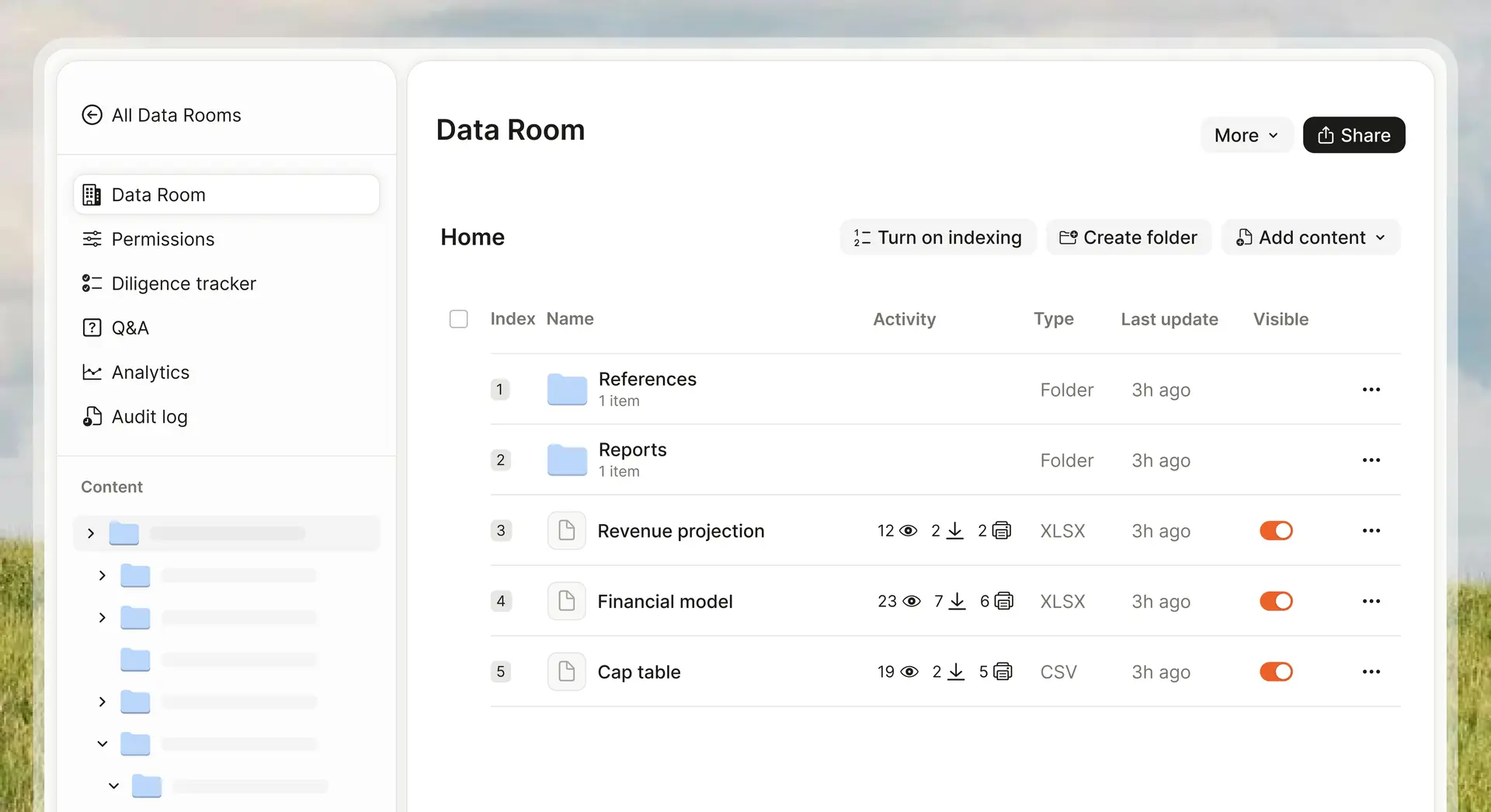
The tool you use to manage due diligence has a direct effect on how long the process takes. A virtual data room (VDR) is the standard solution, but not all VDRs are built the same way, and the legacy platforms built for enterprise deals often come with pricing and complexity that doesn't fit most modern deal teams. Here's what actually matters when choosing due diligence software:
Security and access control
You're sharing sensitive documents. You need to control exactly who sees what, and you need to be confident those controls hold. Look for granular permissions, NDA gating before access is granted, and dynamic watermarking to trace any leaks.
Activity tracking
Knowing which documents buyers are spending time on tells you a lot. Are they focused on the financials? Circling back to a specific contract? Good data rooms surface this in real time, giving sellers useful intelligence during the process.
Ease of setup
If it takes your team a week to configure the platform, you've already lost time. A good VDR should be up and running in hours, not days.
Clean audit trail
Every download, every login, every permission change should be logged. This protects both parties and keeps the process accountable.
Transparent pricing
Legacy enterprise VDRs often charge per user, per page, or require custom quotes that take weeks to negotiate. That model doesn't work for most deals.
This is exactly where Ellty was built to fit.
Ellty is a secure document sharing and analytics platform with full data room functionality, designed for deal teams that need professional-grade features without enterprise-grade pricing complexity.
The platform offers four straightforward tiers:

No per-user fees. No per-page charges. No custom contracts that take weeks to negotiate. You pick a plan, set up your room, and you're running, whether your deal team has 3 people or 30.
For founders preparing for a funding round, operators running an M&A process, or property professionals managing a transaction, Ellty gives you the core tools that actually move deals forward: access controls, real-time tracking, NDA gating, and a clean audit trail - all at a price that makes sense.

FAQs
What is the average time for due diligence in an M&A deal?
Most mid-market M&A transactions take between 6 and 12 weeks for due diligence, though complex multi-entity deals can run longer. The biggest variable is document readiness on the seller's side and how quickly the seller's team responds to buyer queries.
Can due diligence be done faster?
Yes. The most reliable way to speed up the process is to prepare thoroughly in advance. Sellers who organize their documents into a clean virtual data room before the process begins, rather than scrambling to gather files mid-review, routinely cut timelines by weeks. Having a responsive Q&A process and clear internal ownership also helps.
What happens if due diligence takes too long?
Extended timelines create real risks: deal fatigue on both sides, shifting market conditions, and the possibility of the buyer walking away or renegotiating terms. Prolonged processes also increase legal and advisory fees. Keeping the process moving is in everyone's interest.
Does a virtual data room actually speed things up?
It does, when it's set up properly. A good VDR means documents are organized, access is controlled, activity is tracked, and questions can be raised and answered in one place. Compared to sharing documents over email or through unstructured cloud folders, a data room reduces back-and-forth and gives both parties clarity on what's been reviewed.
What documents are typically included in a due diligence data room?
Common categories include: incorporation documents and corporate structure, financial statements (usually 3 years), tax filings, key contracts (customer, supplier, employment), intellectual property documentation, cap table and equity agreements, any pending or prior litigation, and regulatory compliance records. The exact list varies by deal type.
Is due diligence confidential?
Yes. Confidentiality is a fundamental part of the process. NDA agreements are typically signed before document access is granted, and a proper virtual data room enforces this with NDA gating, meaning reviewers must accept a non-disclosure agreement before they can view any materials. Ellty Room plan includes NDA gating as a standard feature.
How is due diligence different from an audit?
An audit is a formal, standardized review of financial records conducted by a qualified external auditor, usually for compliance or regulatory purposes. Due diligence is a broader, deal-specific investigation that goes beyond financials to cover legal, operational, commercial, and other areas. They serve different purposes and are conducted differently, though audit reports are often included as part of the due diligence document set.
Final thoughts
Due diligence doesn't have to be the slow, stressful part of a deal. Most of the delays that stretch timelines come down to two things: disorganized document preparation and poor communication between parties. Both are solvable.
The teams that move fastest are the ones who treat due diligence as something to prepare for, not react to. That means getting your documents organized before the process starts, setting up a proper data room with the right access controls, and having a clear internal process for responding to buyer queries quickly.
The tool you use matters too. Not because technology replaces the work, but because the right platform removes friction at every step, from the initial document upload to the final audit log. Ellty was built for exactly this: a clean, secure, professionally equipped data room that you can set up in a day and run without an enterprise contract.
If you're heading into a deal, whether it's a funding round, an acquisition, a property transaction, or something else, getting your data room in order is one of the highest-leverage things you can do before the process begins.
Set up your Ellty data room before your next deal.
Author

Anika Tabassum Nionta is a Content Manager at Ellty, where she writes about secure document sharing, virtual data rooms, M&A, due diligence, fundraising, and sales enablement. With over 6 years of writing experience, she helps professionals understand how to share confidential documents securely, track engagement, and manage deals more effectively. Anika holds both a BA and MA in English from Dhaka University. Outside of work, she enjoys reading, exploring new cafes in Dhaka, and connecting with entrepreneurs and dealmakers in her community.

