
Whether you're buying a business, closing a funding round, or entering a major partnership, due diligence is what stands between a smart decision and an expensive mistake.
What is due diligence?


Due diligence is the process of thoroughly investigating and verifying information before entering into a business deal, investment, or legal agreement. Think of it as doing your homework before you sign anything.
When someone says "we're in due diligence," they mean a team of people is actively reviewing documents, financials, contracts, and records to confirm that what's being presented is accurate and to uncover anything that might not be.
It happens in a wide range of situations: mergers and acquisitions (M&A), venture capital and private equity deals, real estate transactions, IPOs, partnerships, and more. No matter the context, the goal is always the same - reduce risk, build confidence, and make informed decisions.
Due diligence is not a one-size-fits-all process. Depending on the deal, you might need to look closely at the financials, the legal structure, the people, the technology, or even the environmental impact. That's why due diligence is divided into different types, each focused on a specific area of the business.
Types of due diligence
There are many types of due diligence, and most large deals require more than one. Each type digs into a different part of the business. Here's a breakdown of the major ones.
1. Corporate Due Diligence
Corporate due diligence looks at the company's legal existence and corporate structure. It confirms that the company is properly registered, that the ownership is clear, and that there are no hidden issues at the corporate level.
This includes reviewing the company's certificate of incorporation, bylaws, shareholder agreements, board resolutions, and any corporate governance policies. The goal is to understand who actually owns what, and whether the company has the legal authority to proceed with the transaction.
This is usually the first type of due diligence to kick off, because if there are structural or ownership issues, everything else becomes much more complicated.
2. Financial Due Diligence
Financial due diligence is often the most detailed and time-intensive part of the process. It involves a deep dive into the company's financials, income statements, balance sheets, cash flow statements, tax returns, and financial projections.
The aim is to verify that the numbers presented are accurate, sustainable, and free of manipulation. Analysts will look at revenue trends, profit margins, debt levels, working capital, and any financial risks or liabilities that haven't been disclosed upfront.
For investors and acquirers, this is where you find out whether the business is actually worth what it claims to be worth.
3. Administrative Due Diligence
Administrative due diligence looks at how the company operates on a day-to-day basis from a management and compliance perspective. This includes reviewing internal policies, record-keeping practices, regulatory filings, business licenses, insurance coverage, and whether the company is compliant with relevant laws and standards.
It sounds less exciting than financial analysis, but gaps in administrative compliance can create serious problems post-deal. A missing license or a lapsed insurance policy can cause significant delays, or worse, legal liability.
4. Tax Due Diligence
Tax due diligence examines the company's tax history and obligations. This covers corporate income tax, payroll tax, VAT or sales tax, transfer pricing, deferred tax liabilities, and any ongoing or historical disputes with tax authorities.
The goal is to identify any unpaid taxes, aggressive tax positions, or pending audits that could become the buyer's problem after the deal closes. Tax liabilities can be significant, and they're often not visible on the surface without a proper review.
Buyers want to know: are there any tax bombs waiting to go off?
5. Operational Due Diligence
Operational due diligence focuses on how the business actually runs. It reviews the company's processes, supply chain, vendor relationships, production capabilities, quality controls, and how efficiently the business operates on a daily basis.
This type of due diligence is especially important in manufacturing, logistics, or service-heavy businesses where operational efficiency directly affects profitability. It helps buyers understand if the operations are scalable, sustainable, and free of hidden bottlenecks.
6. Human Resource Due Diligence
HR due diligence looks at the people side of the business. This includes reviewing employment contracts, compensation structures, benefit plans, pension obligations, union agreements, and key person dependencies.
One of the biggest concerns in any acquisition is whether the important people will stay after the deal closes. HR due diligence helps identify that risk. It also uncovers any pending employee disputes, compliance issues related to labor laws, or underfunded retirement obligations.
Culture fit is also increasingly part of HR due diligence, especially in deals where integrating two teams is critical to success.
7. Intellectual Property Due Diligence
IP due diligence reviews all the intellectual property owned or used by the company. This includes patents, trademarks, copyrights, trade secrets, software licenses, and proprietary technology.
The key questions are: Does the company actually own what it claims to own? Are there any IP disputes or third-party claims? Are the licenses properly documented and transferable? Is there any technology that could be challenged or challenged?
For technology companies, biotech firms, or any business where IP is a core asset, this type of due diligence can be the most critical of all.
8. Strategic Due Diligence
Strategic due diligence takes a step back from the details and looks at the bigger picture. It evaluates whether the deal makes sense from a strategic standpoint, how the target company fits into the buyer's long-term plans, what the competitive landscape looks like, and whether the anticipated synergies are realistic.
This type of due diligence often involves market analysis, competitive positioning, customer concentration risk, and growth potential. It's about making sure the deal isn't just financially viable, but strategically sound.
9. Legal Due Diligence
Legal due diligence reviews all legal matters related to the business. This includes reviewing contracts (customer, vendor, and employee agreements), pending or past litigation, regulatory compliance, and any legal obligations that could affect the deal.
A legal due diligence team will go through hundreds, sometimes thousands of documents to spot anything that could create liability or restrict what the buyer can do with the business after closing. It's one of the broadest and most document-intensive types of due diligence.
This is also where a Virtual Data Room (VDR) like Ellty becomes absolutely essential. Organizing and sharing large volumes of legal documents securely, with controlled access, is exactly what a VDR is built for.


10. Environmental Due Diligence
Environmental due diligence evaluates whether the company (or its assets) has any environmental liabilities. This is especially relevant for real estate transactions, manufacturing businesses, mining companies, or any industry with significant environmental exposure.
Reviewers look at compliance with environmental regulations, any history of violations, contamination on owned properties, and ongoing environmental risks. Environmental liabilities can be expensive to remediate, and in some cases, they can kill a deal entirely.
11. Asset Due Diligence
Asset due diligence verifies the physical and financial assets of the business. This includes real estate, machinery, equipment, vehicles, inventory, and any other tangible assets being acquired.
The review confirms that the assets actually exist, that they're in the condition claimed, that the company truly owns them (or has the right to transfer them), and that they're valued fairly. It's common to find discrepancies between what's on paper and what's actually on the ground.
12. IT Due Diligence
IT due diligence examines the technology infrastructure, systems, and cybersecurity posture of the business. It covers software systems, data management practices, IT contracts and licenses, cybersecurity policies, and any existing vulnerabilities or incidents.
As businesses become more technology-dependent, IT due diligence has become more important than ever. A business with outdated infrastructure, poor data security, or overreliance on a single system can represent significant hidden costs or risks.
The due diligence process
While each type of due diligence focuses on different areas, the overall process follows a similar structure:
Step 1 - Define the Scope
Before anything else, the parties agree on what types of due diligence are needed and what the timeline looks like. This depends on the size and complexity of the deal.
Step 2 - Create a Due Diligence Checklist
A detailed list of documents and information requested from the target company. This typically covers dozens of categories and hundreds of individual items.
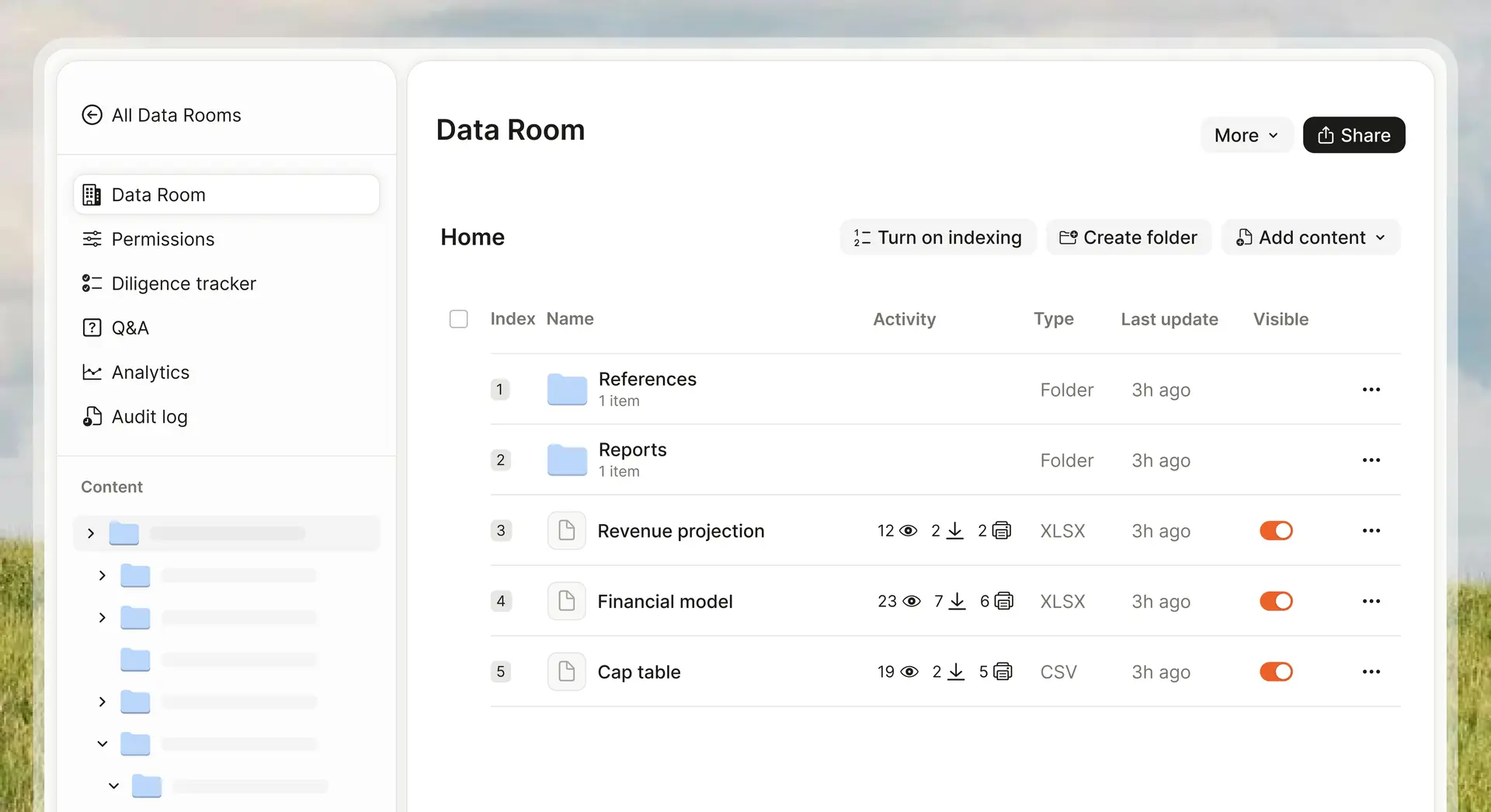
Step 3 - Set Up a Secure Data Room
The target company uploads all requested documents into a secure, controlled environment, typically a Virtual Data Room. This is where platforms like Ellty come in. The data room ensures that sensitive documents can be shared with the right people, at the right level of access, with a clear audit trail of who viewed what and when.
Step 4 - Review and Analysis
The buyer's team goes through the documents, flags issues, and asks follow-up questions.
Step 5 - Q&A and Follow-Up
Questions are raised, clarifications are requested, and additional documents may be needed. A well-organized data room makes this back-and-forth much smoother.
Step 6 - Due Diligence Report
Findings are compiled into a report that summarizes risks, issues, and key takeaways. This forms the basis for deal negotiations or termination.
Step 7 - Decision
The buyer decides whether to proceed, renegotiate terms, or walk away based on the findings.
How to choose due diligence software and why Ellty is worth considering
The volume of documents involved in due diligence is significant. Managing them over email, shared drives, or generic cloud storage creates real problems such as version confusion, security gaps, no visibility into who's looking at what, and no way to control access properly.
A dedicated Virtual Data Room solves all of that. Here's what to look for, and how Ellty stacks up.

Security and Access Control
You need granular permission settings. Not everyone on the deal team should see everything. Ellty Room and Room Plus plans offer group visitor permissions, NDA gating, dynamic watermarking, and restricted visitor access. So you control exactly who sees what.

Activity Tracking and Analytics
One of the biggest advantages of a VDR over regular file sharing is visibility. Ellty provides real-time activity tracking and document analytics, so you can see which documents are being reviewed, who's engaging most, and where attention is focused. That's valuable intelligence during any deal.

Ease of Setup
Legacy VDR platforms often require sales calls, custom quotes, and days to get set up. Ellty is different. You pick a plan, set up quickly, and know exactly what you're paying. No per-user fees. No surprise overages. No enterprise contracts needed.
Transparent, Flat Pricing
Ellty pricing is simple and honest:


Whether you're sharing documents with 3 people or 30, the price stays the same. No per-user charges, no per-page fees, no custom quotes that take weeks to arrive.


FAQs
What is the main purpose of due diligence?
Due diligence is the process of verifying information and assessing risks before completing a business deal. The main purpose is to ensure that the buyer or investor has a clear, accurate picture of what they're getting into. So there are no unpleasant surprises after the deal closes.
How long does a due diligence process typically take?
It depends on the size and complexity of the deal. Simple transactions might be completed in two to four weeks. Complex M&A deals can take several months. Having well-organized documents in a secure data room typically speeds up the process significantly.
Who is responsible for conducting due diligence?
In most deals, the buyer or investor is responsible for conducting due diligence, usually with the help of legal, financial, and other specialized advisors. The target company is responsible for providing accurate and complete information.
What happens if due diligence uncovers a problem?
Problems found during due diligence can lead to deal renegotiation, a reduction in the purchase price, additional warranties or indemnities, or in some cases, the deal being called off entirely. It's not automatically a deal-killer, it depends on the severity of the issue.
What is a Virtual Data Room, and why is it important for due diligence?
A Virtual Data Room (VDR) is a secure online platform used to store and share confidential documents during a due diligence process. It provides controlled access, document tracking, and an audit trail, all of which are essential when sensitive business information is being reviewed by multiple parties. Platforms like Ellty are built specifically for this purpose.
Do all due diligence processes require all 12 types?
No. The types of due diligence required depend on the nature of the deal. A simple asset purchase might only require financial, legal, and asset due diligence. A full company acquisition is more likely to involve most or all types. Your advisors will help define the scope at the start.
Can due diligence be done remotely?
Yes, and this has become the standard in most modern transactions. With a secure Virtual Data Room, all documents can be shared, reviewed, and tracked online without the need for physical document rooms. This makes the process faster and more accessible, especially for cross-border deals.
Final thoughts
Due diligence is not just a box to check before closing a deal. Done properly, it protects you from risk, validates your investment thesis, and gives you the information you need to negotiate from a position of knowledge.
Each type of due diligence serves a specific purpose and together, they give you a complete picture of what you're really buying into. Whether you're an investor, an acquirer, a founder preparing for a funding round, or an advisor managing a transaction, understanding the different types of due diligence is fundamental to doing deals well.
And behind every smooth due diligence process is a well-organized, secure environment for sharing and managing documents. That's exactly what Ellty is built for without the enterprise pricing, the complex setup, or the per-user fees that come with legacy platforms.
Start your free Ellty account today and see how much smoother document sharing can be.
Author

Anika Tabassum Nionta is a Content Manager at Ellty, where she writes about secure document sharing, virtual data rooms, M&A, due diligence, fundraising, and sales enablement. With over 6 years of writing experience, she helps professionals understand how to share confidential documents securely, track engagement, and manage deals more effectively. Anika holds both a BA and MA in English from Dhaka University. Outside of work, she enjoys reading, exploring new cafes in Dhaka, and connecting with entrepreneurs and dealmakers in her community.

