
Whether you're raising a funding round, closing an acquisition, or entering a major partnership, technical due diligence can make or break the deal. Here's everything you need to know, from what it means to how to do it right.
What is technical due diligence?
When two parties are about to do a big deal, say, an investor is putting money into a startup, or a company is acquiring another, they don't just take each other's word for it. They dig in. They verify. That process is called due diligence.
Technical due diligence (tech DD) is the part of that process focused specifically on the technology. It's a structured review of a company's technical assets, the software, the infrastructure, the security practices, the engineering team, and the code itself.
The goal is simple: figure out if the technology is what it's claimed to be, and whether it can support where the business is headed.
Think of it like a home inspection before buying a house. The house looks great from the outside. But before you sign anything, you want someone to check the wiring, the roof, the foundation. Technical due diligence does the same for a tech company or product.
It's not just for acquisitions, either. Investors run tech DD before leading funding rounds. Companies run it before major partnerships or vendor selections. And sellers run it on themselves proactively, before going to market, so they know what's coming and can fix things in advance.
Why technical due diligence is so important
Most deals today involve technology in some form. Even companies that aren't "tech companies" run on software, use cloud infrastructure, and have technical teams. This means technical risks are business risks and they can directly affect the value of a deal.
Here's why tech DD matters so much:
It surfaces hidden problems. Legacy code, poor architecture, security vulnerabilities, overreliance on a single developer, these are the kinds of things that don't show up in a pitch deck. Technical due diligence brings them to light before the deal closes.
It validates what's being claimed. Founders say their platform is scalable. Their NPS is high. Their infrastructure is enterprise-ready. Technical DD verifies whether that's actually true.
It protects both sides. For buyers and investors, it limits the risk of paying too much for something that will cost more to fix than expected. For sellers, it's a chance to demonstrate quality and build trust.
It informs deal terms. Findings from tech DD don't always kill deals, they shape them. A buyer might adjust the price, add earn-out clauses, or require specific remediation steps as a condition of closing.
It saves money long-term. Discovering a major technical problem after the deal closes is far more expensive than finding it during due diligence. The cost of a thorough tech review is almost always less than the cost of the surprises it prevents.
In short, skipping or rushing technical due diligence is a gamble and in high-stakes deals, it's one that rarely pays off.
What documents and data are needed for technical due diligence?
One of the most practical questions deal teams ask is: what exactly do we need to gather?
The document requirements vary by deal type and company size, but here's a solid starting list:
Architecture & infrastructure
- System architecture diagrams
- Cloud infrastructure documentation (AWS, GCP, Azure configurations)
- Database schemas and data flow diagrams
- Disaster recovery and backup procedures
Codebase & development
- Access to the code repository (or a review by the buyer's technical team)
- Documentation on tech stack and key libraries/dependencies
- Version control history
- CI/CD pipeline documentation
Security & compliance
- Security audit reports and penetration test results
- Data privacy policies and GDPR/CCPA compliance documentation
- Access control policies
- Incident response logs and history
Product & engineering
- Product roadmap
- Engineering team structure (org chart, key personnel, contractors vs. employees)
- Known bugs and technical debt register
- SLA (Service Level Agreement) documentation
Intellectual property
- IP ownership documentation
- Software licenses (third-party libraries)
- Open-source usage and compliance
- Patent filings, if any
Operational
- Uptime and performance metrics
- Cost breakdown for infrastructure
- Vendor and third-party dependency documentation
- Customer data handling documentation
Gathering all of this takes time and coordination. The documents are often sensitive, and they need to be shared securely with the right people, not via email attachments or open Google Drive folders. That's exactly where a Virtual Data Room comes in. More on that shortly.


Key areas of focus in technical due diligence
Once the documents are gathered, the actual review begins. Here are the core areas a technical reviewer will examine:
1. Code quality and architecture
Is the codebase maintainable? Is it well-documented? Are there serious architectural problems that will limit scalability? Technical reviewers look for code smells, outdated dependencies, and signs of shortcuts that will become expensive later.
2. Scalability
Can the system handle 10x the current load? Is the architecture built in a way that allows it to grow with the business, or is it already near its ceiling?
3. Security posture
This is increasingly a deal-breaker. Are there known vulnerabilities? How is data protected? Who has access to production systems? Is there evidence of past breaches or incidents?
4. Technical debt
Almost every codebase has some. The question is how much, how severe, and how aware the team is of it. A company that knows its tech debt and has a plan for it is very different from one that's in denial.
5. Team and knowledge dependencies
Is critical knowledge held by one or two people? What happens if a key engineer leaves? Technical reviewers look at bus factor, the risk that the project stalls if one person walks out.
6. Third-party dependencies
Is the product heavily dependent on external services or libraries that could change pricing, go away, or cause compliance issues? This is often underexamined but can be a significant risk.
7. Infrastructure and DevOps maturity
How is software deployed and updated? Are there proper testing environments? Is there monitoring and alerting in place? Does the team follow modern DevOps practices?
8. IP ownership
Does the company actually own the code? Was any of it written by contractors who retain rights? Are there open-source components used in ways that could create licensing obligations?
How long does the technical due diligence process take?
There's no one-size-fits-all answer here, but here's a practical guide:
For a small startup or early-stage company (small codebase, simple architecture), a focused technical review can be completed in 1 to 2 weeks.
For a mid-sized company with a more complex product and team, expect 2 to 4 weeks.
For a large enterprise or a company with complex infrastructure, significant data assets, or regulatory requirements, the process can take 4 to 8 weeks or longer.
What affects the timeline?
- How well-prepared the target company is. If documents are organized, accessible, and up to date, the review moves faster. If the team needs to scramble to find documentation, it drags on.
- Responsiveness during Q&A. Technical due diligence always involves follow-up questions. Slow responses slow everything down.
- Scope of the review. A narrow security audit is faster than a full-stack technical review.
- Size and experience of the review team. A seasoned team with the right tools works faster.
The best way to compress the timeline on the seller's side is to prepare early. Run a self-assessment before going to market. Organize your documents. Know your weaknesses and have answers ready.


The role of a virtual data room (VDR) in technical due diligence
Here's where the process gets practical.
All those documents we talked about like the architecture diagrams, the security reports, the code documentation, the IP ownership records, they need to be shared with the other party. Securely. In a controlled way. With a full record of who accessed what.
That's what a virtual data room does. And it's not an optional nice-to-have. For any serious deal, it's the standard.
Why not just use email or google drive?
Email attachments have no controls once they're sent. Google Drive links get forwarded. Documents get downloaded and end up in places they shouldn't. There's no audit trail. There's no way to revoke access. For sensitive technical documentation, which often includes security architecture, IP, and proprietary processes, this is a serious problem.
A proper VDR gives you:
- Controlled access. You decide exactly who sees what. A lawyer reviewing contracts doesn't need access to code documentation. A technical reviewer doesn't need access to cap table information.
- An audit trail. Every document opened, every page viewed, every download logged. This matters both for security and for understanding the other party's interest level.
- NDA gating. Before anyone can even enter the data room, they sign an NDA. Automated, trackable, no chasing.
- Dynamic watermarking. Documents are watermarked with the viewer's identity, deterring leaks.
- Revocable access. If someone leaves the deal, you turn off their access instantly.
This is exactly what Ellty is built for.

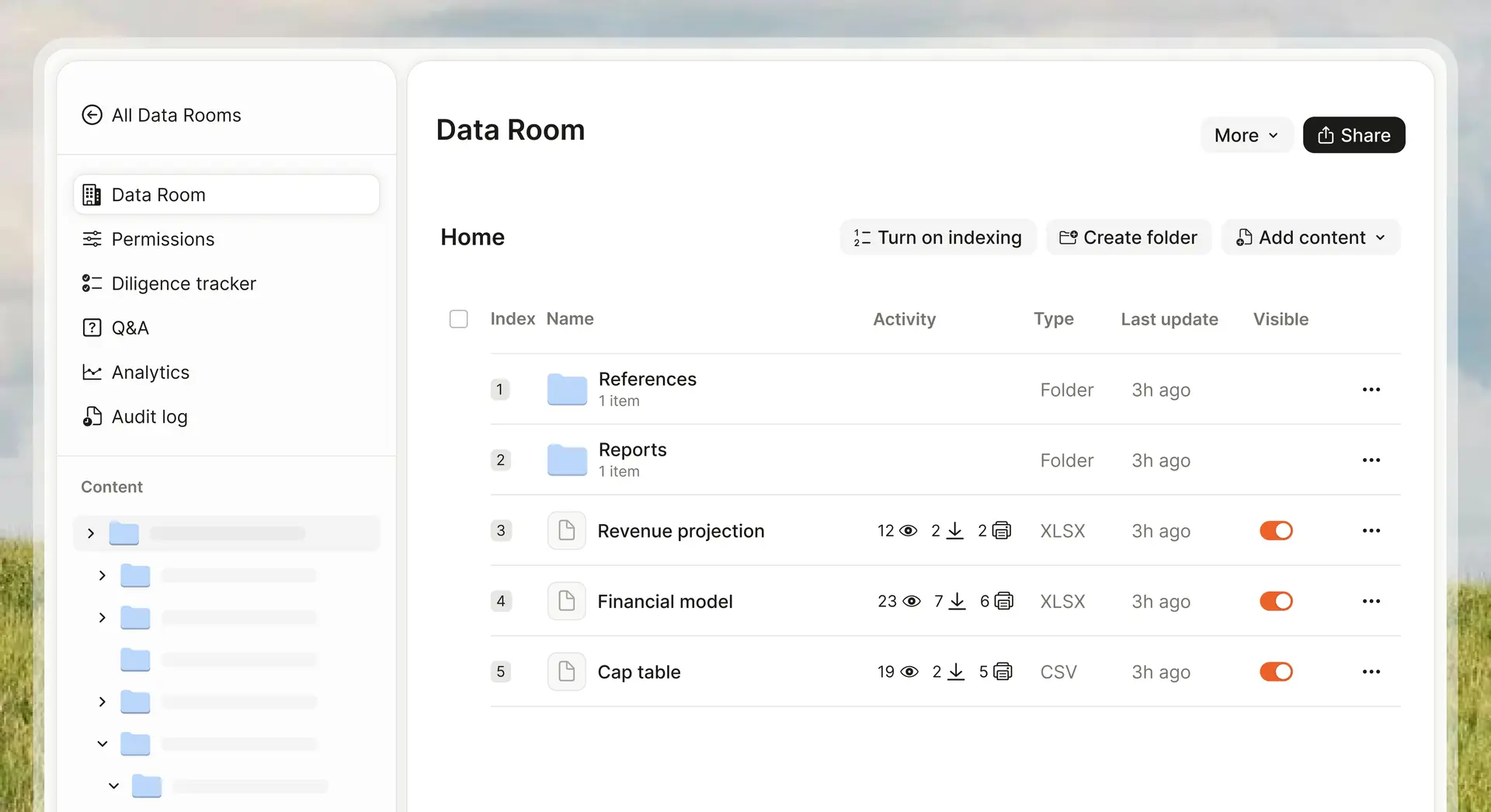
Ellty is a secure document sharing and analytics platform with full Virtual Data Room functionality. It's designed for exactly this kind of situation, sharing sensitive documents with outside parties in a controlled, tracked, professional way.
What makes Ellty different from legacy VDR platforms?
For one, the pricing. Traditional VDR providers charge per user, per page, or require custom quotes that take weeks to negotiate. Ellty is flat-rate, transparent, and gets you set up quickly:

No per-user charges. No per-page fees. No surprise overages as your deal team grows. Whether you're sharing documents with 3 people or 30, the price stays the same.
For anyone running a technical due diligence process, whether you're the target company preparing your documents, or the acquirer managing a review, Ellty gives you the infrastructure to do it professionally, without the enterprise contract.


Best practices and pitfalls for technical due diligence
Whether you're on the buy side or the sell side, there are some important things to get right.
Best practices
Start preparation early. For sellers, don't wait until you have a term sheet to start organizing your technical documentation. The companies that sail through due diligence are the ones who treated preparation as an ongoing practice, not a last-minute scramble.
Be honest about weaknesses. Trying to hide technical debt or known vulnerabilities rarely works, experienced technical reviewers will find them. Being upfront and having a remediation plan builds far more trust than getting caught glossing over problems.
Assign a technical point of contact. Someone on the seller's team should own the due diligence process, answering questions quickly, organizing materials, and coordinating with the review team. Deals slow down when responses take days.
Use a structured data room. Organize documents into clear folders that match the areas of review. Make it easy for reviewers to find what they need. A well-organized data room signals professionalism and operational maturity.
Control access carefully. Not everyone on the other party's team needs access to everything. Set up role-based permissions from day one.
Common pitfalls
Over-sharing too early. Some sellers dump everything into a data room before getting NDAs signed or before the deal is at a serious stage. This is a security risk and a negotiating mistake.
Under-resourcing the review. Technical due diligence requires experienced people, a non-technical person reviewing code documentation will miss what matters. Engage the right experts.
Treating it as a checklist exercise. The goal isn't to tick boxes. It's to genuinely understand the technical situation. Rushed, surface-level reviews miss things that cause problems later.
Ignoring the people side. Technology is built by people. A technical review that ignores team structure, knowledge concentration, and key person risk is incomplete.
Letting it drag on. Long, slow due diligence kills deals. Both sides should agree on a timeline upfront and hold to it.
Post-due diligence action and integration
Technical due diligence doesn't end with the report. What happens after is just as important.
For buyers and investors: The findings should directly inform deal terms. Significant technical debt might justify a price adjustment. A critical security vulnerability might need to be remediated as a closing condition. A strong finding might give you more confidence to move quickly. Use what you've learned.
For sellers: If issues were found, address them. Even if the deal is already agreed, fixing flagged problems or at least demonstrating a credible plan to fix them, builds goodwill and reduces post-close friction.
Post-acquisition integration requires its own technical planning. How will the two systems be integrated? What's the roadmap for retiring legacy components? Who leads the technical integration? These questions are better answered with the benefit of thorough due diligence findings than without.
Maintaining access to the original data room through the integration period is also valuable. It serves as a reference, a record of the technical state at the time of acquisition, which helps teams understand decisions made during integration.
Ellty data rooms don't disappear when a deal closes. You can continue to use the platform for post-close document sharing, stakeholder communication, and ongoing access management, all on the same transparent, predictable pricing model.
Frequently asked questions
What is the difference between technical due diligence and general due diligence?
General due diligence covers the full scope of a deal - financial, legal, commercial, operational. Technical due diligence is a specific workstream within that, focused on the technology stack, code, infrastructure, security, and engineering team. In many deals, a specialist technical team handles this separately from the broader legal and financial review.
Who conducts technical due diligence?
It depends on the deal. Some buyers have in-house technical teams for this. Others hire specialist firms like technical due diligence consultancies or boutique advisory firms with engineering expertise. For VC-backed deals, the investor often brings in an external technical reviewer or relies on a trusted CTO advisor.
Is technical due diligence always required?
Not always, but it's strongly recommended for any deal where technology is a significant part of the value or risk. If you're acquiring a SaaS company, funding a tech startup, or entering a technology partnership, skipping tech DD is a meaningful risk.
Can a startup prepare for technical due diligence on a tight budget?
Yes. Many of the most important preparation steps such as documenting your architecture, organizing your code repository, writing up your tech stack and dependencies. They don't require outside spend. Using a cost-effective VDR like Ellty to manage document sharing means you don't need to pay enterprise rates to run a professional process.
How is intellectual property verified during technical due diligence?
Reviewers will look at employment contracts, contractor agreements, and any IP assignment documentation. They'll also check the codebase for open-source components and review the licenses associated with those to make sure there are no obligations that could affect the deal or future product development.
What happens if major issues are found during technical due diligence?
It depends on what's found and how significant it is. Some findings are deal-breakers. Most are not. Common outcomes include price adjustments, escrow arrangements, remediation requirements as a condition of closing, or updated representations and warranties. Finding issues early is far better than discovering them after the deal closes.
How should documents be organized in a data room for technical due diligence?
A clean structure makes a big difference. Organize folders around the key areas of review: Architecture & Infrastructure, Code & Development, Security, Team & Organization, IP & Licenses, Operational Metrics. Keep naming conventions consistent and make sure documents are current. A messy, hard-to-navigate data room slows down the review and signals disorganization.
Final thoughts
Technical due diligence isn't just a box to check. When it's done well, it protects everyone involved - buyers, sellers, and investors alike. It replaces assumptions with evidence. It replaces surprises with clarity. And it gives deal teams the foundation they need to negotiate fairly and integrate successfully.
The technology side of a business is often where the most value lives and where the most risk hides. Taking it seriously during due diligence is one of the highest-leverage things any deal team can do.
If you're preparing for a due diligence process, whether you're a founder getting ready for a fundraise, an acquirer kicking off a review, or an advisor managing a complex deal, having the right infrastructure in place matters. A secure, well-organized, fully tracked data room is not a luxury. It's a basic requirement for running a professional process.
That's what Ellty is built for. Flat pricing. No per-user fees. Set up in minutes. With all the access controls, NDA gating, watermarking, and audit logging that a serious deal demands.
Start your free data room today, no enterprise contract required.
Author

Anika Tabassum Nionta is a Content Manager at Ellty, where she writes about secure document sharing, virtual data rooms, M&A, due diligence, fundraising, and sales enablement. With over 6 years of writing experience, she helps professionals understand how to share confidential documents securely, track engagement, and manage deals more effectively. Anika holds both a BA and MA in English from Dhaka University. Outside of work, she enjoys reading, exploring new cafes in Dhaka, and connecting with entrepreneurs and dealmakers in her community.

