
Mergers and acquisitions are big moves. Whether you are buying a company, selling one, or somewhere in the middle, a lot can go wrong if you do not do your homework properly. That homework has a name: legal due diligence.
This guide breaks down everything you need to know about legal due diligence in M&A - what it is, why it matters, how it works, who does it, and how the right software can make the whole process a lot smoother.
What is legal due diligence in M&A?
Legal due diligence is the process of reviewing all the legal aspects of a company before a merger or acquisition is finalized. Think of it as a thorough background check, but for a business.
The goal is simple: the buyer wants to know exactly what they are getting into. Are there any pending lawsuits? Are the contracts in order? Does the company actually own what it says it owns? Are there any regulatory issues that could cause problems later? Legal due diligence answers all of these questions.
It typically happens after a Letter of Intent (LOI) is signed, but before the deal closes. During this window, the buyer's legal team goes through the seller's documents in detail, everything from corporate records and contracts to intellectual property, employment agreements, and compliance history.
The output is usually a due diligence report that summarizes findings, flags risks, and informs the final negotiation.


Why legal due diligence is so important
Skipping or rushing legal due diligence is one of the most common reasons M&A deals fall apart or worse, close and then fall apart later.
Here is why it matters so much:
- It uncovers hidden liabilities. A company might look healthy on the surface but have lawsuits, tax issues, or contract breaches lurking beneath.
- It protects the buyer. Once the deal closes, the buyer inherits everything, the good and the bad. Due diligence is your chance to identify the bad before it becomes your problem.
- It supports better valuation. If you find risks during due diligence, you can use them to renegotiate the price or ask for indemnities.
- It prevents regulatory problems. Some industries have strict rules. Legal due diligence ensures the target company is compliant and that the acquisition will not trigger regulatory hurdles.
- It builds confidence. For both sides, a clean and thorough due diligence process signals professionalism and builds trust in the transaction.
Put simply, legal due diligence is how you make sure you are not buying someone else's problems.
Need a secure place to share and review sensitive deal documents?
Ellty data room gives you full control over who sees what with real-time tracking and audit logs.
Types of legal due diligence
Legal due diligence is not just one thing. It covers several areas, and depending on the deal, some will be more relevant than others.
1. Corporate due diligence
This looks at the company's legal structure - incorporation documents, shareholder agreements, board resolutions, and ownership records. You want to confirm the entity exists as described and that ownership is clean.
2. Contractual due diligence
A review of all material contracts with customers, suppliers, partners, and landlords. The key questions here are: do any contracts have change-of-control clauses (which could be triggered by the acquisition), and are there any contracts that are about to expire or are underperforming?
3. Intellectual property due diligence
If the target company's value lies in its IP like patents, trademarks, copyrights, or software. You need to make sure they actually own it. IP due diligence also checks for any third-party licenses and potential infringement claims.
4. Employment and HR due diligence
This covers employment contracts, executive agreements, non-competes, benefit plans, and any pending employment disputes. Labor law compliance is also reviewed here.
5. Litigation due diligence
Are there any current, pending, or threatened lawsuits? What about regulatory investigations or government orders? This is one of the most important areas because litigation can create significant financial exposure.
6. Regulatory and compliance due diligence
Depending on the industry, a company may need to hold specific licenses or comply with industry regulations. This review checks whether the company is in good standing and flags any compliance gaps.
7. Real estate and asset due diligence
If the company owns or leases property or significant physical assets, those need to be reviewed too such as titles, leases, zoning, and any encumbrances.
How to perform legal due diligence
Legal due diligence follows a structured process. Here is how it typically works:
- Define the scope. Agree on what areas will be reviewed based on the size of the deal and the target company's industry.
- Set up a data room. The seller compiles all relevant documents into a secure data room. This is where a tool like Ellty becomes essential, more on that later.
- Send a due diligence request list. The buyer's legal team sends a detailed list of all the documents and information they need.
- Review documents. Lawyers, advisors, and sometimes accountants work through the documents systematically.
- Raise queries. If something is missing or unclear, the buyer raises questions that the seller needs to answer.
- Prepare a due diligence report. The legal team compiles findings into a report that outlines risks, open issues, and recommendations.
- Negotiate and close. The report informs the final negotiation on price, representations, warranties, and indemnities.
Steps in legal due diligence
If you want a quick, clear breakdown, here are the key steps in the legal due diligence process:
- Step 1 - Sign an NDA: Before any documents are shared, both parties sign a non-disclosure agreement to protect confidential information.
- Step 2 - Prepare the due diligence request list: The buyer's legal counsel creates a checklist of everything they need to review.
- Step 3 - Upload documents to a secure data room: The seller organizes and uploads relevant documents in a structured way.
- Step 4 - Review and flag issues: The buyer's team reviews documents, flags risks, and tracks what has been reviewed.
- Step 5 - Q&A and clarification: Any gaps are addressed through a formal question-and-answer process.
- Step 6 - Compile the due diligence report: All findings are documented and shared with the deal team.
- Step 7 - Finalize deal terms: Risks identified during due diligence are used to negotiate warranties, indemnities, or price adjustments.
Legal due diligence for the sell-side
Most people think of due diligence as something the buyer does. But sellers have a role to play too and doing it well can make or break a deal.
Sell-side due diligence means preparing your company's documents and information before the buyer even shows up. It is a proactive approach that puts you in control.
Here is what sell-side preparation typically looks like:
- Organize all corporate documents and ensure they are up to date
- Review contracts for any problematic clauses (especially change-of-control provisions)
- Identify and resolve any open litigation or regulatory issues
- Prepare a clean, well-organized data room
- Conduct an internal legal review to spot issues before the buyer does
The benefit of this approach? Fewer surprises, faster deal timelines, and a stronger negotiating position. When a buyer sees that a seller is organized and transparent, it builds confidence and trust in the process.
Building a sell-side data room?
Ellty Room plan gives you NDA gating, dynamic watermarking, and granular permissions. So you stay in control of every document you share. Try it from $149/month.
Legal due diligence for the buy-side
For buyers, legal due diligence is essentially a risk management exercise. You are trying to answer one fundamental question: is what we are buying worth what we are paying for it?
Buy-side legal due diligence focuses on:
- Verifying ownership and corporate structure
- Identifying material contracts and their terms
- Assessing litigation exposure and regulatory risk
- Confirming IP ownership and freedom to operate
- Understanding employee obligations and HR risks
- Checking that all required licenses and permits are in place
The buy-side team typically includes M&A lawyers, sometimes supported by specialists in areas like IP, employment, or regulatory law, depending on the target company's business.
The goal is not to find a reason to walk away from the deal, it is to understand what you are getting into and make sure you are protected if something goes wrong later.
Who pays for due diligence?
This is a common question and the answer is fairly straightforward: each party pays for its own costs.
The buyer pays for their legal team, advisors, and any specialists they bring in to conduct the review. The seller pays for the cost of preparing documents, organizing the data room, and any legal advisors they engage on their side.
In some cases, particularly in competitive auction processes, sellers commission a vendor due diligence report upfront and share it with potential buyers. This can speed up the process and reduce cost duplication, but the seller bears the upfront cost in that case.
The total cost of due diligence varies widely depending on the size and complexity of the deal. For smaller transactions, it might be a few thousand dollars. For large, complex deals, legal fees alone can run into hundreds of thousands.
This is one reason why having an efficient, organized process matters. The longer due diligence drags on, the more it costs everyone.
How long does the legal due diligence process take?
There is no fixed timeline, but here is a general guide:


The biggest driver of delay is almost always document availability. If the seller has not prepared properly, the review takes longer and costs more. This is exactly why sell-side preparation and a well-organized data room make such a difference.
What does legal due diligence include?
A full legal due diligence review typically covers the following areas:
- Corporate records — Certificate of incorporation, articles of association, shareholder register, board minutes
- Ownership and capitalization — Share structure, any options or warrants outstanding, cap table
- Material contracts — Customer and supplier agreements, partnership agreements, exclusivity arrangements
- Intellectual property — Patents, trademarks, copyrights, domain names, software licenses
- Employment — Employment contracts, executive agreements, non-competes, stock option plans, HR policies
- Litigation — Current and past lawsuits, regulatory inquiries, arbitration proceedings
- Regulatory compliance — Licenses, permits, regulatory filings, industry-specific compliance
- Data protection — Privacy policies, GDPR or equivalent compliance, data processing agreements
- Real estate — Lease agreements, property ownership, any encumbrances
- Insurance — Policies in place, any material claims history
- Financing — Loan agreements, security interests, any charges over assets
- Tax — While often handled separately as tax due diligence, open tax positions may be flagged
M&A legal due diligence checklist
Here is a practical checklist to use when running legal due diligence on a target company:


Want a ready-to-use due diligence checklist in your data room?
Ellty lets you organize all your document requests in one structured, trackable space.
How to choose legal due diligence software and why Ellty is the right choice
The days of emailing documents back and forth or sharing a messy Dropbox folder are over. For any serious M&A transaction, you need a proper Virtual Data Room (VDR) - a secure, organized environment where documents can be shared, tracked, and controlled.
Here is what to look for in due diligence software:
- Security - End-to-end encryption, access controls, and the ability to restrict what users can do with documents (download, print, screenshot).
- Permissions management - Granular control over who can see which folders and documents, with the ability to set different access levels for different reviewers.
- NDA gating - The ability to require visitors to sign an NDA before they can access the data room.
- Activity tracking - Real-time analytics showing who opened which document, how long they spent on it, and what they engaged with most.
- Audit trail - A complete log of all activity in the data room, which is important for compliance and accountability.
- Ease of use - The interface should be clean and simple. You want lawyers and advisors spending their time reviewing documents, not figuring out how to navigate the platform.
- Transparent pricing - No per-user fees, no per-page charges, and no surprise invoices at the end of the deal.
This is where Ellty stands out.
Why Ellty works well for M&A due diligence

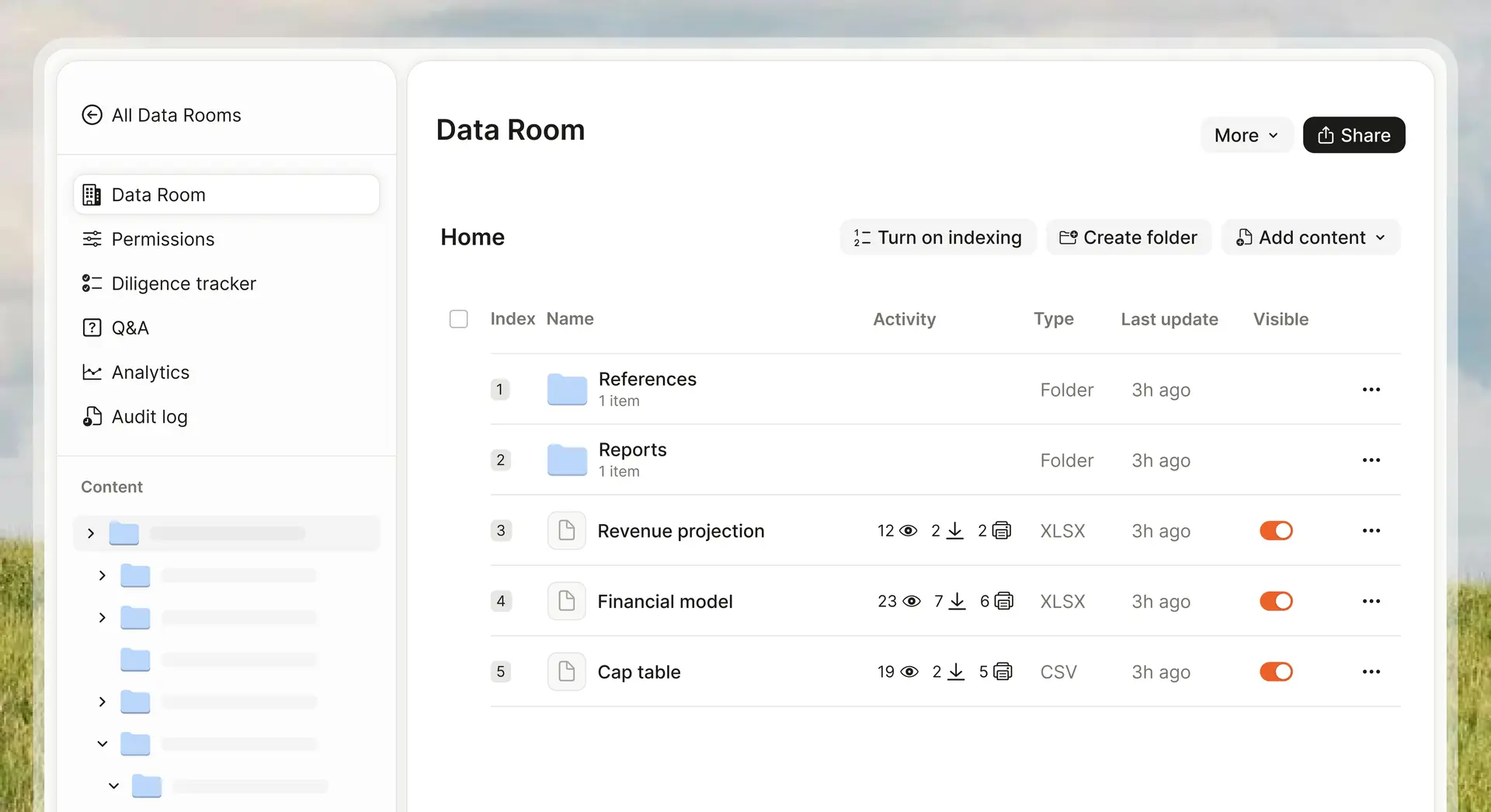
Ellty is a secure document sharing and analytics platform with full data room functionality. It is built for exactly the kind of controlled, structured document review that legal due diligence requires.
Here is what you get with Ellty:
- Access controls so you decide who sees what and what they can do with it
- Real-time activity tracking so you always know who is engaging with your documents
- NDA gating before anyone can access your data room
- Dynamic watermarking to protect against unauthorized sharing
- Granular permissions for different groups of reviewers
- Full audit logs for compliance and accountability
- Support for up to 4,000 assets per data room on the Room Plus plan
And the pricing is straightforward and honest:

Unlike legacy VDR platforms that charge per user, per page, or require lengthy enterprise negotiations, Ellty gives you a clear price, a fast setup, and the features you actually need, whether you are sharing documents with 3 people or 30.
For M&A professionals, legal teams, and advisors who want a professional, secure due diligence environment without the complexity and cost of an enterprise platform, Ellty is the right place to start.


FAQs
What is the difference between legal due diligence and financial due diligence?
Legal due diligence focuses on legal risks - contracts, litigation, IP, compliance, and corporate structure. Financial due diligence focuses on the numbers - revenue, profitability, cash flow, and financial reporting. Both are usually conducted in parallel during an M&A process.
Can legal due diligence kill a deal?
Yes, it can. If the review uncovers significant issues such as undisclosed litigation, serious regulatory violations, or major contractual liabilities, the buyer may choose to walk away. More commonly, serious findings lead to price adjustments or the inclusion of indemnity provisions in the purchase agreement.
Is legal due diligence required by law?
There is no legal requirement to conduct due diligence, but it is considered standard practice and is expected in most M&A transactions. Skipping it exposes the buyer to significant financial and legal risk.
Who typically leads the legal due diligence process?
On the buy side, it is usually led by the buyer's M&A counsel, a law firm or in-house legal team with M&A experience. On the sell side, the company's existing legal counsel typically manages the preparation and disclosure process.
What is a virtual data room and why is it used in due diligence?
A virtual data room (VDR) is a secure online platform used to store and share confidential documents during a transaction. It replaces the old practice of physically visiting a location to review paper documents. VDRs allow multiple reviewers to access documents simultaneously, track engagement, and maintain a clean audit trail. Ellty is a VDR platform purpose-built for this kind of structured document sharing.
How should I organize documents in a due diligence data room?
Use a clear folder structure that mirrors the categories in your due diligence checklist - Corporate, Contracts, IP, Employment, Litigation, etc. Label documents clearly, keep versions organized, and set appropriate permissions for each folder. Ellty Room and Room Plus plans are designed to support this kind of structured, multi-party document review with granular access controls.
What happens after legal due diligence is completed?
The legal team prepares a due diligence report summarizing findings, risks, and recommendations. This report is used by the deal team to finalize negotiations including any adjustments to price, warranties, representations, and indemnities in the purchase and sale agreement. The transaction then moves toward signing and closing.
Final thoughts
Legal due diligence is not just a box-ticking exercise. It is one of the most important steps in any M&A transaction and when done well, it gives both sides the clarity and confidence they need to close a deal on solid ground.
For buyers, it is your best protection against inheriting problems you did not sign up for. For sellers, being prepared and organized is one of the strongest signals you can send to a potential acquirer.
The process takes time, expertise, and the right tools. A well-structured data room, clear document organization, and a reliable platform to share and track everything are not optional extras, they are part of what makes a due diligence process run smoothly.
Ellty is built for exactly this purpose. Whether you are a seller building your first data room, a buyer reviewing documents across multiple workstreams, or an advisor managing the process on behalf of a client, Ellty gives you the control, visibility, and security you need, at a price that makes sense.
Start your due diligence data room today.
Ellty offers transparent pricing, fast setup, and all the features you need to run a professional, secure document review.
Author

Anika Tabassum Nionta is a Content Manager at Ellty, where she writes about secure document sharing, virtual data rooms, M&A, due diligence, fundraising, and sales enablement. With over 6 years of writing experience, she helps professionals understand how to share confidential documents securely, track engagement, and manage deals more effectively. Anika holds both a BA and MA in English from Dhaka University. Outside of work, she enjoys reading, exploring new cafes in Dhaka, and connecting with entrepreneurs and dealmakers in her community.

