
Going public is a big deal. Literally.
An IPO marks the moment a private company opens itself up to public investors, market scrutiny, and a whole new level of accountability. It is exciting. It is also one of the most legally and operationally demanding things a company will ever go through.
And right at the center of it all is due diligence.
Due diligence for an IPO is not just a box to check before ringing the opening bell. It is a thorough, structured review of everything your company is, everything it owes, and everything that could go wrong. Get it right, and you build the kind of investor confidence that drives a strong listing. Miss something, and you may be dealing with delays, regulatory scrutiny, or worse, a derailed offering.
The good news? A well-organized due diligence process is very much achievable. You just need the right preparation, the right team, and the right tools.
This blog walks you through what IPO due diligence actually involves, where companies typically go wrong, what legal risks tend to hide in plain sight, and how a virtual data room like Ellty can make the whole process cleaner, faster, and far less stressful.
What is due diligence for IPO, and why it matters
At its core, IPO due diligence is the process of verifying that everything your company says about itself is accurate, complete, and defensible under scrutiny.
Before a company can list on a public exchange, regulators, underwriters, and potential investors will look hard at your financials, your legal standing, your corporate governance, your intellectual property, your contracts, and your risk profile. If there are gaps, inconsistencies, or surprises, they will find them.
Due diligence protects everyone involved. It protects investors from buying into companies with undisclosed risks. It protects the underwriters from liability. And, when done properly, it actually protects the company itself by forcing a clear-eyed look at its own vulnerabilities before the rest of the world gets to see them.
There are several layers to it:
Financial due diligence covers the accuracy of your financial statements, revenue recognition practices, audit history, outstanding liabilities, and projections.
Legal due diligence reviews your corporate structure, contracts, litigation history, intellectual property ownership, regulatory compliance, and any known legal exposures.
Operational due diligence looks at how the business actually runs, including key dependencies, supplier relationships, technology infrastructure, and internal controls.
Tax due diligence checks that your tax filings are in order and flags any potential exposure from past or ongoing audits.
Each of these areas needs to be reviewed systematically, documented carefully, and made available to the right parties at the right time. That last part is where a lot of companies run into trouble.
Key preparation steps
Preparing for IPO due diligence is not something you can start two weeks before your planned listing date. It takes months, often longer, and the earlier you start, the better positioned you will be.
Here are the key steps every company should work through:


1. Conduct an internal audit first
Before anyone external looks at your company, you need to look at it yourself, critically. Bring together your legal, finance, compliance, and operations teams to run an internal review. The goal is to find problems before your underwriters or regulators do, so you have time to fix them.
2. Organize your corporate records
This sounds simple, but it is where many companies find themselves scrambling. You need clean, complete records of incorporation documents, board resolutions, shareholder agreements, equity grants, and any amendments to your corporate structure. If documents are scattered across email threads, old hard drives, or different team members' folders, that is a problem you need to solve now.
3. Compile all material contracts
Any contract that could materially affect your business needs to be reviewed and disclosed. This includes customer agreements, supplier contracts, licensing agreements, partnership deals, and any contracts with change-of-control provisions that could be triggered by an IPO.
4. Review your litigation history
Past legal disputes, even settled ones, can come back up during due diligence. You need a complete picture of any claims made against the company, any regulatory actions, and any pending disputes, along with documentation of how they were resolved.
5. Verify your intellectual property
Own what you say you own. Make sure all patents, trademarks, copyrights, and trade secrets are properly registered and assigned to the company, not to individual founders or employees who have since left.
6. Clean up your cap table
Investors will look closely at who owns what. Your capitalization table should be accurate, up to date, and reflect all outstanding equity, options, warrants, and convertible instruments. Any ambiguities here create red flags.
7. Prepare your data room
This is where everything comes together. A well-organized data room is the single most important operational step in IPO due diligence. It is the central repository where all your documents live, where reviewers access materials, and where the entire process is tracked and controlled.
Virtual data rooms: the backbone of IPO due diligence (and why Ellty is the right choice)
If you have been through a fundraising round, a property transaction, or an M&A process, you already know what a virtual data room is. For IPO due diligence, it is not optional. It is essential.
A virtual data room (VDR) is a secure online repository where you store, organize, and share sensitive documents with authorized reviewers. During an IPO, that means your legal counsel, underwriters, auditors, regulators, and prospective investors, all needing access to specific documents, under controlled conditions, with a clear record of who saw what and when.
Here is why the quality of your VDR matters so much:
Access control. Not every reviewer needs to see every document. Your lead underwriter might need access to financial statements but not employment contracts. Your legal counsel needs the litigation history but not the product roadmap. A good VDR lets you set granular permissions so each party sees only what they are supposed to see.
Real-time activity tracking. You need to know when reviewers are accessing documents, what they are looking at, and how long they are spending on specific files. This tells you where interest is concentrated and helps you anticipate follow-up questions.
NDA gating. Before anyone enters your data room, they should agree to a non-disclosure agreement. A proper VDR handles this automatically, so you are not chasing signed NDAs across email threads.
Audit trails. Every action taken inside the data room should be logged. Every document viewed, downloaded, or shared creates a record. This is not just operationally useful, it is a legal requirement in many regulatory contexts.
Dynamic watermarking. Documents that leave your data room should carry identifying marks. Watermarking makes it clear where a document came from and who accessed it, which deters unauthorized sharing.
This is exactly what Ellty is built for.

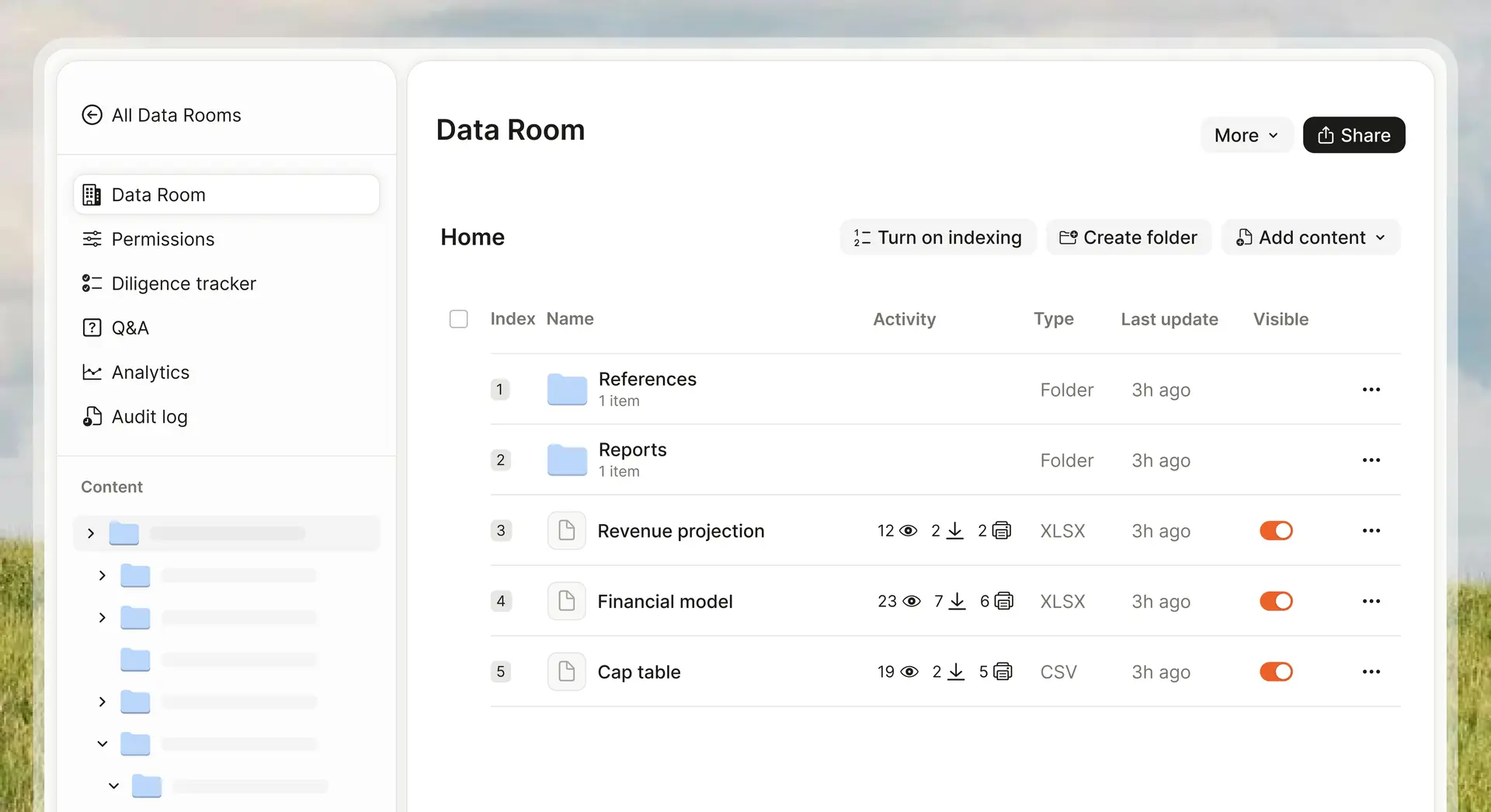
Ellty is a secure document sharing and analytics platform with full VDR functionality, designed for anyone who needs to share sensitive documents in a controlled, trackable way. Whether you are preparing for an IPO, running a fundraising process, or managing an acquisition, Ellty gives you the tools that actually matter.

Here is what you get with Ellty, depending on your plan:
- Free plan ($0/month): Document tracking, real-time analytics, and secure sharing. A solid starting point if you are in early conversations and want to see who is opening what before setting up a full data room.
- Standard ($69/month): Unlimited documents, advanced analytics, eSignatures, custom branding, and data room features. Works well for smaller deals and ongoing investor communication.
- Room ($149/month): Granular permissions, NDA gating, dynamic watermarking, and restricted visitor access. Everything you need to run a controlled document review for IPO due diligence.
- Room Plus ($349/month): Group visitor permissions, full audit logs, and support for up to 4,000 assets per data room. Built for heavier document loads and multi-party deals.
What makes Ellty stand apart from legacy VDR platforms is the pricing model. There are no per-user charges, no per-page fees, and no custom quotes that take weeks to negotiate. You pick a plan, get set up quickly, and know exactly what you are paying, whether you are sharing documents with 3 people or 30.
For any company running IPO due diligence without an enterprise budget, Ellty is where you start.

Why traditional due diligence falls short
Despite its importance, IPO due diligence has historically been a fragmented, slow, and error-prone process. And in many organizations, it still is.
Here is what traditional due diligence typically looks like in practice:
Documents live in different places. Legal files are in one folder. Finance documents are in another. Some things exist only in email chains. A few critical contracts are sitting on someone's laptop.
Reviews happen manually. Teams spend hours, sometimes days, trying to locate documents, compile versions, and figure out what is missing. Reviewers send questions back through email, and responses go into threads that no one can easily track.
Access is uncontrolled. Documents get shared via email attachments or consumer file-sharing tools with no audit trail. Reviewers forward things they should not. Sensitive information ends up in places it was never meant to be.
Version confusion causes errors. Multiple versions of the same document circulate. Nobody is sure which one is current. Reviewers make notes on outdated files.
Nothing is tracked. When regulators ask who had access to what, and when, there is no reliable answer.
Each of these problems creates risk. During an IPO process, where regulators and underwriters are looking for evidence of good governance and transparency, an unorganized due diligence process is itself a warning sign.
The solution is not just working harder. It is working with better infrastructure. A purpose-built VDR addresses every one of these problems by design.
Where hidden legal risks typically emerge
Even well-prepared companies can miss legal risks during IPO due diligence. Some risks are obvious. Others are buried in places that standard reviews do not always reach.
Here are the areas where hidden legal risks most commonly emerge:
Undisclosed or underestimated litigation
Companies may be aware of ongoing disputes but assume they are minor or will resolve themselves before the IPO. That assumption is dangerous. Even a lawsuit that seems manageable can attract attention from regulators or create uncertainty for investors. Everything material needs to be disclosed, with full context.
Historical legal exposure
Past cases that were settled or dismissed can still surface during IPO review. If a company was involved in contractual disputes, employment claims, financial irregularities, or compliance violations, those histories need to be documented and disclosed, even if they seem long resolved.
Regulatory non-compliance
License gaps, missed filings, or statutory obligations that were overlooked internally can become serious concerns during regulatory review. This is especially common in heavily regulated industries like fintech, healthcare, and financial services.
Director and promoter background risks
The legal history of key individuals, including founders, board members, and major shareholders, is scrutinized closely. Any criminal records, prior litigation, or regulatory sanctions create red flags that can hold up a listing.
Intellectual property disputes
If there is any ambiguity around who owns the company's core IP, whether through prior employment agreements, co-founder disputes, or licensing arrangements, it needs to be resolved before the IPO process begins.
Contractual liabilities and change-of-control clauses
Some contracts include provisions that are triggered by an IPO or change of control. If these are not identified and addressed in advance, they can create unexpected obligations or give third parties leverage over the listing.
Data privacy and cybersecurity compliance
With regulations like GDPR and similar frameworks becoming more stringent globally, any gaps in how a company handles personal data can create significant legal exposure. Auditors and regulators are paying close attention to this area.
Here are the seven hidden legal risk zones as a clean reference table:
# | Risk zone | What it covers | Why it's dangerous |
1 | Undisclosed litigation | Ongoing disputes the company considers minor or expects to settle | Even small lawsuits attract regulatory attention during IPO review |
2 | Historical legal exposure | Past cases, settlements, or compliance violations | Old issues can resurface and damage investor perception |
3 | Regulatory non-compliance | Missed filings, expired licenses, or overlooked statutory obligations | Regulators will catch what internal teams missed |
4 | Director and promoter background | Legal or criminal history of founders, board members, key shareholders | Personal red flags can hold up or kill the entire listing |
5 | Intellectual property disputes | Unclear IP ownership, co-founder disagreements, unassigned patents | Ambiguous ownership undermines your core business value |
6 | Contractual liabilities | Change-of-control clauses, unresolved obligations, ambiguous terms | An IPO can trigger hidden contract provisions you didn't know existed |
7 | Data privacy and cybersecurity | GDPR gaps, poor data handling practices, unresolved breaches | Regulators and institutional investors are scrutinizing this heavily right now |
Strengthening due diligence for IPO with better legal insight
The way to handle legal risk in an IPO is not to hope it does not exist. It is to find it early, document it clearly, and address it before it becomes someone else's discovery.
Here is how companies can build a stronger approach:
Start the process earlier than you think you need to
Most legal issues that derail IPOs are not discovered during due diligence. They are discovered late in due diligence, when there is not enough time to fix them. Starting 12 to 18 months before your target listing date gives you room to address problems without pressure.
Go beyond self-disclosure
Internal teams naturally have blind spots. Independent legal review, external litigation searches, and regulatory compliance audits provide the kind of objective scrutiny that internal reviews miss.
Prioritize material risks
Not every legal issue carries the same weight. Focus your deepest analysis on things that could affect valuation, create investor liability, or attract regulatory attention. Minor historical matters still need documentation but do not require the same level of escalation.
Create a structured disclosure framework
Every potential legal risk should be logged, categorized by severity, assigned to an owner, and tracked through to resolution. This is not just good practice. It creates a documented record that shows regulators and investors you take governance seriously.
Keep all legal documentation in one place
This is where Ellty becomes directly valuable. When your legal team, underwriters, auditors, and counsel all need access to the same documents, having everything in a single organized data room, with controlled permissions and a full audit trail, eliminates the noise and reduces the risk of version errors or unauthorized access.

Pre-IPO due diligence checklist: ready-to-use template
Use this checklist as a starting point for organizing your IPO due diligence. It covers the core document categories that underwriters, legal teams, and regulators will typically request.
Corporate structure and governance
- Certificate of incorporation and all amendments
- Current bylaws or articles of association
- Board resolutions and meeting minutes (last 3-5 years)
- Shareholder agreements and voting agreements
- Subsidiary structure and organizational chart
- Registered agent information and state filings
Capitalization and equity
- Current capitalization table
- Stock option and equity incentive plans
- All outstanding warrants, options, and convertible instruments
- Vesting schedules for founders and key employees
- Records of all equity issuances and transfers
Financial records
- Audited financial statements (last 3-5 years)
- Unaudited interim statements
- Revenue recognition policies
- Summary of outstanding debt and credit facilities
- Accounts receivable aging report
- Financial projections and assumptions
Tax
- Corporate tax returns (last 3-5 years)
- Records of any tax audits or disputes
- Transfer pricing documentation (if applicable)
- R&D tax credit claims and documentation
- Sales and use tax compliance records
Material contracts
- Key customer and supplier agreements
- Licensing and distribution agreements
- Partnership and joint venture agreements
- Lease agreements for all material properties
- Any contracts with change-of-control provisions
- Government contracts (if applicable)
Intellectual property
- Patent registrations and applications
- Trademark and copyright registrations
- Trade secret policies and documentation
- IP assignment agreements from founders and employees
- Any IP licensing agreements inbound or outbound
- Open-source software usage and compliance records
Litigation and legal exposure
- All pending and threatened litigation
- Settlement agreements from resolved disputes
- Regulatory investigations or enforcement actions
- Correspondence with regulatory bodies
- Director and officer insurance policies
Employment and human resources
- Standard employment agreement templates
- Non-compete and non-solicitation agreements
- Key employee retention agreements
- Summary of employee benefit plans
- Records of any labor disputes or employment claims
- Immigration documentation for foreign nationals in key roles
Regulatory and compliance
- All material licenses and permits
- Industry-specific regulatory filings
- Data protection and privacy policies
- GDPR or equivalent compliance documentation
- Anti-bribery and anti-corruption policies
- Environmental compliance records (if applicable)
Insurance
- Summary of all active insurance policies
- Directors and officers (D&O) insurance coverage details
- Cyber liability insurance documentation
- Claims history for last 3-5 years
Frequently asked questions
What is IPO due diligence?
IPO due diligence is the process of thoroughly reviewing a company's financial, legal, operational, and tax records before it lists on a public exchange. It is conducted by underwriters, legal advisors, auditors, and regulators to ensure that the company's public disclosures are accurate, complete, and do not contain material omissions. The goal is to protect investors, satisfy regulators, and surface any risks that need to be addressed before the listing.
How early should a company start IPO due diligence?
Most advisors recommend starting the due diligence preparation process at least 12 to 18 months before the target IPO date. This gives legal, finance, and compliance teams enough time to identify gaps, resolve issues, and organize documentation properly. Starting late is one of the most common reasons IPOs get delayed.
What documents are typically requested during IPO due diligence?
The document request list for an IPO is extensive. It typically covers corporate governance records, financial statements, material contracts, intellectual property registrations, litigation history, tax filings, employment agreements, regulatory licenses, and insurance documentation. The specific requirements vary by jurisdiction and industry, but the checklist in this blog covers the core categories.
What is a virtual data room, and why do you need one for IPO due diligence?
A virtual data room (VDR) is a secure online platform for storing, organizing, and sharing sensitive documents with authorized reviewers. For IPO due diligence, it is the central hub where all materials are made available to underwriters, legal teams, auditors, and regulators under controlled conditions. A good VDR provides access controls, audit trails, NDA gating, and document tracking features that email or consumer file-sharing tools simply cannot offer.
What is the difference between a VDR and a regular file-sharing tool like Google Drive or Dropbox?
Consumer file-sharing tools are designed for convenience, not for controlled, auditable document review. They lack granular permission settings, do not generate comprehensive audit logs, cannot enforce NDA agreements before access, and do not provide the kind of security infrastructure that sensitive IPO documents require. A purpose-built VDR like Ellty is specifically designed for high-stakes document review, with the compliance, tracking, and security features that a public offering demands.
What happens if legal risks are discovered late in the IPO process?
Late discovery of material legal risks is one of the main reasons IPOs get delayed or withdrawn. Depending on the nature of the risk, it may require additional disclosure, resolution before listing, or in serious cases, a decision to postpone the offering entirely. This is why early, proactive legal due diligence is so important. Identifying risks months in advance gives the company time to address them properly.
How does Ellty support IPO due diligence specifically?
Ellty provides the core infrastructure for organizing and sharing IPO due diligence documents securely. With features like granular permissions, NDA gating, dynamic watermarking, real-time activity tracking, and full audit logs, Ellty Room and Room Plus plans are built for exactly this kind of controlled, multi-party document review. And unlike legacy VDR platforms, Ellty offers flat, transparent pricing with no per-user fees or surprise overages, so you can focus on the deal, not on your software costs.
Final thoughts
An IPO is not just a financial event. It is a transparency event. The entire process is built on the premise that the company going public has nothing to hide and everything organized.
Due diligence is where that premise is tested. It is where every contract, every claim, every liability, and every risk is put under a lens. Done well, it strengthens your position and builds investor confidence. Done poorly, it creates delays, invites scrutiny, and in some cases, ends the listing before it begins.
The companies that go through this process most smoothly tend to share a few common traits. They start early. They conduct honest internal reviews before external ones begin. They document everything, not just the good, but the complicated too. And they use tools built for the job, not tools repurposed from something else.
A virtual data room is not a luxury in this context. It is the infrastructure that holds the whole process together. It is where your documents live, where reviewers work, and where the record of the entire due diligence process is built.
Ellty is built precisely for this. Whether you are just starting to organize your pre-IPO documentation or you are in the middle of a full review with multiple teams requesting access, Ellty gives you the control, the clarity, and the audit trail you need, at a price that makes sense.
If your IPO preparation is already underway, or if you are planning for one in the next 12 to 18 months, now is the right time to get your document infrastructure in place.
Start your IPO data room with Ellty. Flat pricing, no per-user fees, full VDR features from day one.
This blog is intended for informational purposes only and does not constitute legal or financial advice. Please consult qualified legal and financial advisors for guidance specific to your situation.
Author

Anika Tabassum Nionta is a Content Manager at Ellty, where she writes about secure document sharing, virtual data rooms, M&A, due diligence, fundraising, and sales enablement. With over 6 years of writing experience, she helps professionals understand how to share confidential documents securely, track engagement, and manage deals more effectively. Anika holds both a BA and MA in English from Dhaka University. Outside of work, she enjoys reading, exploring new cafes in Dhaka, and connecting with entrepreneurs and dealmakers in her community.

