
Running a small business is a constant exercise in trust. You trust your suppliers to deliver. You trust your partners to follow through. You trust a buyer when they say they are serious, or an investor when they say the numbers look good.
But trust alone is not a business strategy.
That is where due diligence comes in. Whether you are buying another business, selling yours, bringing in a new investor, or signing a major contract, due diligence is the process that protects you before you commit. It replaces assumptions with facts, and gut feelings with verified information.
For small businesses, this matters even more. A large corporation can absorb a bad deal. A small business usually cannot. One poorly vetted acquisition or one overlooked liability can cost years of work.
This guide walks you through everything you need to know about due diligence as a small business, including what it is, why it matters, how to actually do it, and what tools make the whole process smoother and more secure.
If you are currently in the middle of a deal or preparing for one, this is the guide you want to read before you sign anything.
What is due diligence?
Due diligence is the process of investigating and verifying information before making a major business decision.
Think of it like this: before buying a used car, you would check the service history, inspect the engine, and maybe get a mechanic to look at it. You would not just take the seller's word that it runs fine. Due diligence is that same instinct, applied to business transactions.
In practice, it means reviewing financial records, legal documents, contracts, operations, tax filings, employee agreements, intellectual property, and anything else that might affect the value or risk of a deal.
The term comes from law, where it referred to the reasonable care that a party should take before entering an agreement. In business, it has grown into a structured process that both sides of a deal go through before finalizing terms.
Due diligence can happen in different directions:
- A buyer does due diligence on a business they want to acquire
- An investor does due diligence on a startup or company before writing a check
- A seller does their own due diligence on a potential buyer to check if they are credible and capable
- A business does due diligence on a new partner, vendor, or client before entering a significant relationship
For small businesses, the stakes of skipping this step are very real. Undisclosed debts, pending lawsuits, inflated revenue numbers, and non-transferable contracts are just a few of the surprises that a proper due diligence process would catch before they become your problem.
Why due diligence is important


Let us be direct: most deals that go wrong, go wrong because someone did not look closely enough before committing.
Due diligence is not just a formality or a box to check. It serves several important functions that protect everyone involved in a transaction.
It reveals what the numbers actually mean. A business can look profitable on the surface but have serious problems underneath. Revenue might be inflated, costs understated, or profits coming from a single client who is likely to leave. Due diligence gives you a real picture of financial health.
It uncovers hidden liabilities. Lawsuits, tax debts, unpaid vendor invoices, environmental issues, or lease obligations can transfer to a new owner depending on how a deal is structured. Without due diligence, you might be inheriting problems you did not know existed.
It confirms ownership and legal standing. Does the seller actually own what they are selling? Are there co-founders or partners with claims on the business? Is the intellectual property registered properly? These questions have to be answered before money changes hands.
It gives you negotiating power. When you uncover issues during due diligence, you have the right to renegotiate. The purchase price might need to come down, or the seller might need to fix certain problems before closing. Due diligence findings often reshape the final deal.
It protects you legally. If something goes wrong after a deal closes and you can show you did proper due diligence, your legal exposure is significantly reduced. Courts and regulators look at whether parties acted reasonably and responsibly.
It builds confidence. For investors especially, a clean and well-documented due diligence process signals that a business is professionally run. It builds trust in the team and in the transaction.
For small businesses that may not have legal teams or financial advisors on call, getting this process right is critical. The good news is that with the right tools and a clear checklist, it is completely manageable.
Types of due diligence in small businesses
Due diligence is not one single thing. It covers different areas of a business, and which types you focus on will depend on what the deal involves. Here is a breakdown of the main categories relevant to small businesses.
Financial due diligence
Financial due diligence is usually the starting point. You are looking at the financial health of the business: profit and loss statements, balance sheets, cash flow, tax returns, debt obligations, and revenue consistency. The goal is to verify that the numbers being presented are accurate and sustainable.
Legal due diligence
This covers contracts, licenses, permits, ongoing litigation, intellectual property rights, and corporate structure. You want to make sure the business is legally compliant, has no undisclosed legal exposure, and that key agreements will remain valid after the transaction.
Operational due diligence
Operational due diligence looks at how the business actually runs on a day-to-day basis: supplier relationships, systems and processes, key personnel, technology infrastructure, and operational dependencies. A business that depends entirely on one person or one client is a different risk than one with diversified operations.
Commercial due diligence
Commercial due diligence examines the market position of the business. Who are the customers? How strong is the brand? Who are the competitors? Is the market growing or shrinking? This helps you understand whether the business has a future, not just a past.
Tax due diligence
Often done alongside financial due diligence, this focuses specifically on the tax history and obligations of the business. Are all returns filed and up to date? Are there any outstanding disputes with tax authorities? Are there any tax structures that could create problems after the deal closes?
HR and employee due diligence
HR due diligence looks at employment contracts, payroll, benefits, key employee retention risks, any employment disputes or claims, and whether the workforce is structured in a compliant way.
Technology and data due diligence
Increasingly important for any business that relies on software, platforms, or digital assets. This covers cybersecurity posture, data handling practices, software licenses, and whether the technology stack is current or a liability.
For most small business deals, financial, legal, and operational due diligence will cover the most ground. The depth of each category depends on the size and complexity of the deal.
Due diligence checklist
This is the most practical part of this guide. Below is a detailed checklist organized by category. Use it as a starting point and adapt it to the specifics of your deal.
Financial documents
- Last 3-5 years of profit and loss statements
- Last 3-5 years of balance sheets
- Monthly cash flow statements for the past 2 years
- Tax returns for the past 3-5 years
- Current accounts receivable and payable aging reports
- List of all debts, loans, and credit lines with terms and outstanding balances
- Any deferred revenue or unusual revenue recognition practices
- Bank statements for the past 12 months
- Details of any one-time or non-recurring income or expenses
- Breakdown of revenue by customer, product, or service line
- Details of any financial restatements or accounting changes
Legal and corporate documents
- Articles of incorporation or formation documents
- Current ownership structure and cap table
- Shareholder or partnership agreements
- Board meeting minutes for the past 3 years
- All existing contracts with customers, vendors, suppliers, and partners
- Any non-disclosure, non-compete, or exclusivity agreements
- Active or pending litigation, arbitration, or regulatory proceedings
- Insurance policies and coverage details
- Business licenses and permits (and their transferability)
- Any government approvals or certifications required to operate
Intellectual property
- Registered trademarks, patents, and copyrights
- Pending IP applications
- Domain name ownership and registration records
- Software licenses used in the business (both owned and third-party)
- Any IP disputes or claims from third parties
- Agreements assigning IP from founders or employees to the company
Operations
- Organizational chart and key personnel list
- Employee contracts and any non-compete or non-solicitation agreements
- Payroll records and employee benefits summary
- Details of any outstanding HR claims or disputes
- Office or facility leases, including term and renewal options
- Key vendor and supplier contracts
- Business continuity and disaster recovery plans (if any)
- Standard operating procedures for core business functions
Tax
- Filed tax returns for the last 3-5 years (federal, state, and local where applicable)
- Any ongoing or past tax audits or disputes
- Sales tax compliance records
- Payroll tax filings and compliance records
- Any tax credits, deferrals, or special treatments in use
Technology and data
- List of all software tools, platforms, and subscriptions
- Data storage and backup practices
- Any known cybersecurity incidents in the past 3 years
- Privacy policy and data protection compliance records
- Customer data handling agreements or consent records
- IT infrastructure overview (owned vs. cloud-based)
Customers and revenue
- List of top 10-20 customers with revenue contribution
- Customer contracts, renewal terms, and cancellation rights
- Customer concentration risk (what percentage of revenue comes from the top 3 customers)
- Customer churn history and retention rates
- Any customer complaints, disputes, or pending claims
- Pipeline and committed future revenue
Real estate and physical assets
- Lease agreements for all business locations
- Owned real estate with title documentation
- List of major physical assets (equipment, vehicles, inventory) with valuations
- Any liens or encumbrances on physical assets
- Maintenance records for significant equipment
This checklist is not exhaustive, but it covers the core of what most small business due diligence processes will require. If you are handling a more complex deal, working with a lawyer or accountant to expand this list is a worthwhile investment.
Collecting, organizing, and sharing these documents securely is where a virtual data room becomes essential. Ellty makes this process straightforward: upload your documents, set access permissions, and let the other party review in a controlled environment. You can see exactly who viewed what and when, which helps keep the process moving without losing track of where things stand.

Virtual data rooms: the backbone of due diligence
Once you understand what due diligence involves, the next question is: how do you actually manage all of this information?
Think about the checklist above. You are dealing with dozens, sometimes hundreds, of sensitive documents. Financial records, legal agreements, employee data, customer contracts. These cannot be sent over email. They cannot sit in a shared Google Drive folder with open access. They need to be organized, controlled, and tracked.
That is what a virtual data room (VDR) does. A VDR is a secure online space where you can store, share, and manage confidential documents during a transaction or business process. It gives you control over who sees what, creates an audit trail of every interaction, and protects the integrity of the process.
For small businesses, the case for a VDR is straightforward: it makes you look professional, keeps your documents safe, and gives you visibility into the review process that you simply cannot get any other way.
This is where Ellty fits in.

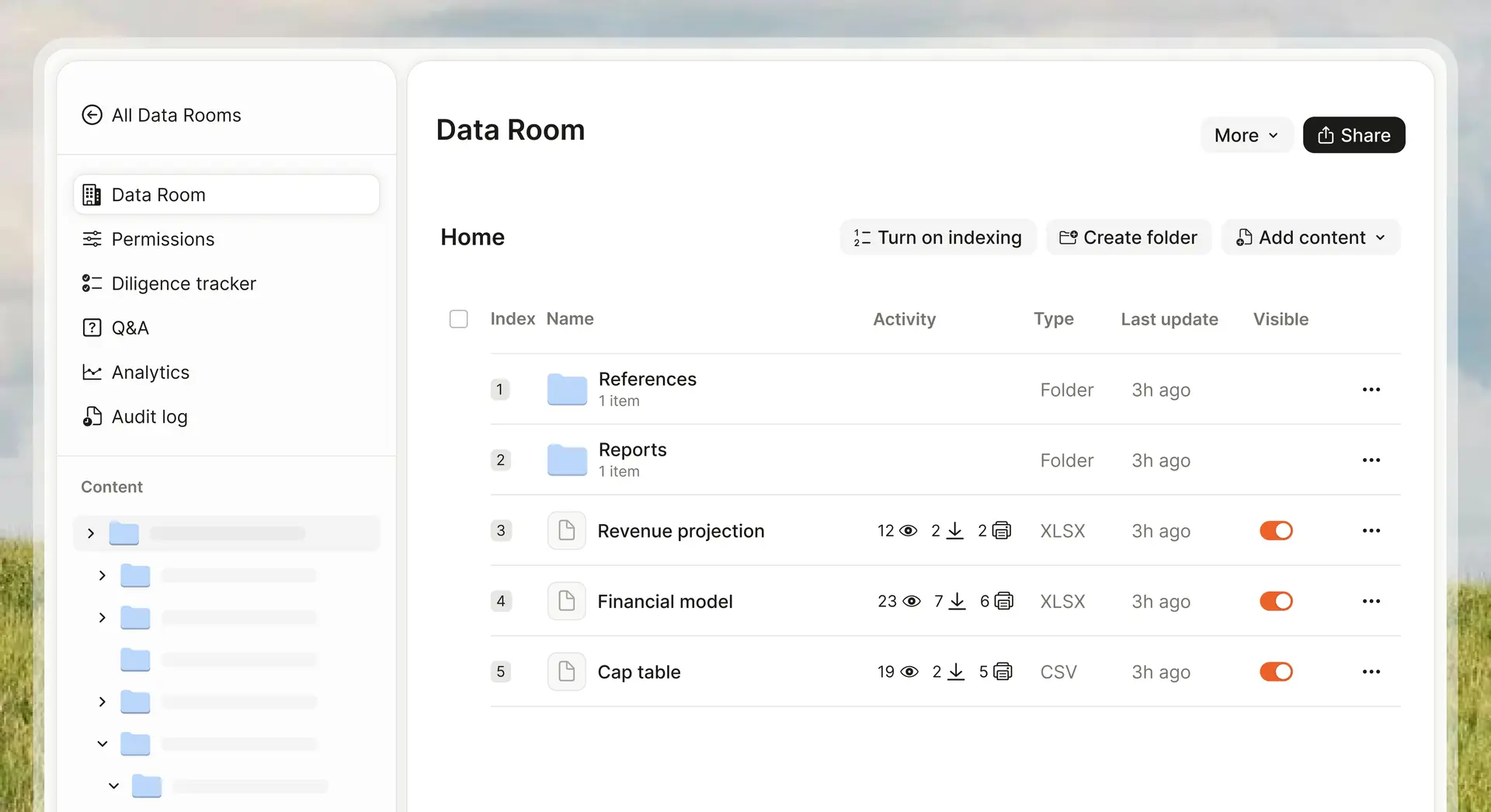
Ellty is a secure document sharing and analytics platform with full data room functionality, built for anyone who needs to share sensitive documents in a controlled and trackable way. Whether you are raising a round, closing a property deal, running a consulting engagement, or managing an acquisition, Ellty gives you the tools that matter.
Here is what makes Ellty the right choice for small businesses specifically:
Flat, transparent pricing with no per-user fees. One of the biggest frustrations with legacy VDR platforms is the cost. Many charge per user, per page, or require enterprise contracts that take weeks to negotiate. Ellty does none of that. You pick a plan, get set up quickly, and know exactly what you are paying, whether you are sharing documents with 3 people or 30. For a small business, this is a significant advantage.
Free starting point. Ellty free plan includes document tracking, real-time analytics, and secure sharing. If you are in early conversations and want to see who is opening what before setting up a full data room, this is a sensible place to start.
Standard plan at $69/month. Unlimited documents, advanced analytics, eSignatures, custom branding, and data room features. This works well for smaller deals, ongoing client communication, and investor updates where you need a professional and trackable setup.
Room plan at $149/month. This is where the core VDR features come in. Granular permissions, NDA gating, dynamic watermarking, and restricted visitor access. Everything you need to run a controlled document review for a due diligence process, property transaction, or sensitive client deliverable.
Room Plus at $349/month. Group visitor permissions, full audit logs, and support for up to 4,000 assets per data room. Built for heavier document loads and multi-party deals with structured access control across different reviewer groups.


Key features that matter during due diligence:
- Access controls: Decide exactly who can see which documents. A potential buyer does not need to see everything on day one. You can reveal documents in stages as the deal progresses.
- NDA gating: Require reviewers to sign a non-disclosure agreement before they can access your data room. This is a standard protection in professional due diligence processes.
- Dynamic watermarking: Every document downloaded carries identifying information tied to the reviewer. This discourages unauthorized sharing.
- Real-time activity tracking: You can see who opened which document, how long they spent on it, and whether they downloaded it. This is valuable intelligence during a deal.
- Audit trail: A complete log of all activity in the data room, which is important for legal protection and process integrity.
For any small business going through a significant transaction, setting up a proper data room is not a luxury. It is a professional expectation. And with Ellty pricing, it is well within reach.


How to conduct due diligence effectively for small businesses
Knowing what due diligence covers is one thing. Running the process smoothly is another. Here is a practical walkthrough of how to approach it as a small business.
Step 1: Define the scope early
Not every deal requires the same level of scrutiny. A small vendor contract is different from an acquisition. Before you start gathering documents or sending requests, agree with all parties on what the due diligence process will cover, how long it will take, and who is responsible for what. A clear scope saves time and prevents unnecessary friction.
Step 2: Organize your documents before the process begins
If you are the party being reviewed (the seller or the business seeking investment), preparation is everything. Go through the checklist above and get your documents in order before the other party starts asking. Missing, incomplete, or disorganized documents slow the process and raise red flags. Uploading everything to a structured Ellty data room before the review begins shows professionalism and builds confidence in the deal.
Step 3: Set up a secure data room
Create your data room on Ellty, organize documents into clear folders by category (financial, legal, operations, etc.), and set appropriate access permissions. Use NDA gating so reviewers must sign before accessing anything. Turn on activity tracking so you can monitor who is engaging with your materials.
Step 4: Share access in stages if needed
For more sensitive deals, you might not want to share everything at once. You could start with high-level financials and business summaries, then give deeper access to legal and operational documents as the deal progresses and trust builds. Ellty's permission controls make this easy to manage.
Step 5: Track engagement and follow up
Real-time analytics from Ellty will tell you which documents the reviewing party has opened and which they have not. If a buyer has not looked at your financial statements after a week, that is useful information. It might mean they need a prompt, or it might signal a lack of seriousness. Either way, you have visibility.

Step 6: Address findings promptly
When the reviewing party raises questions or flags issues from the documents, respond quickly and clearly. Delays in this stage can create doubt or stall a deal unnecessarily. If a document is missing, say so and provide a timeline for when it will be available.
Step 7: Keep records of the entire process
At the end of due diligence, you want a full record of what was shared, who reviewed it, and what was agreed. Ellty audit logs give you this automatically. This record is important if any disputes arise after closing.
Best practices for small businesses
Running a clean due diligence process takes discipline. Here are the practices that make the biggest difference.
Keep your documents current and organized year-round. The businesses that handle due diligence best are the ones that maintain their records properly all the time, not just when a deal is coming. Regular bookkeeping, filed contracts, and up-to-date corporate records make the process much faster.
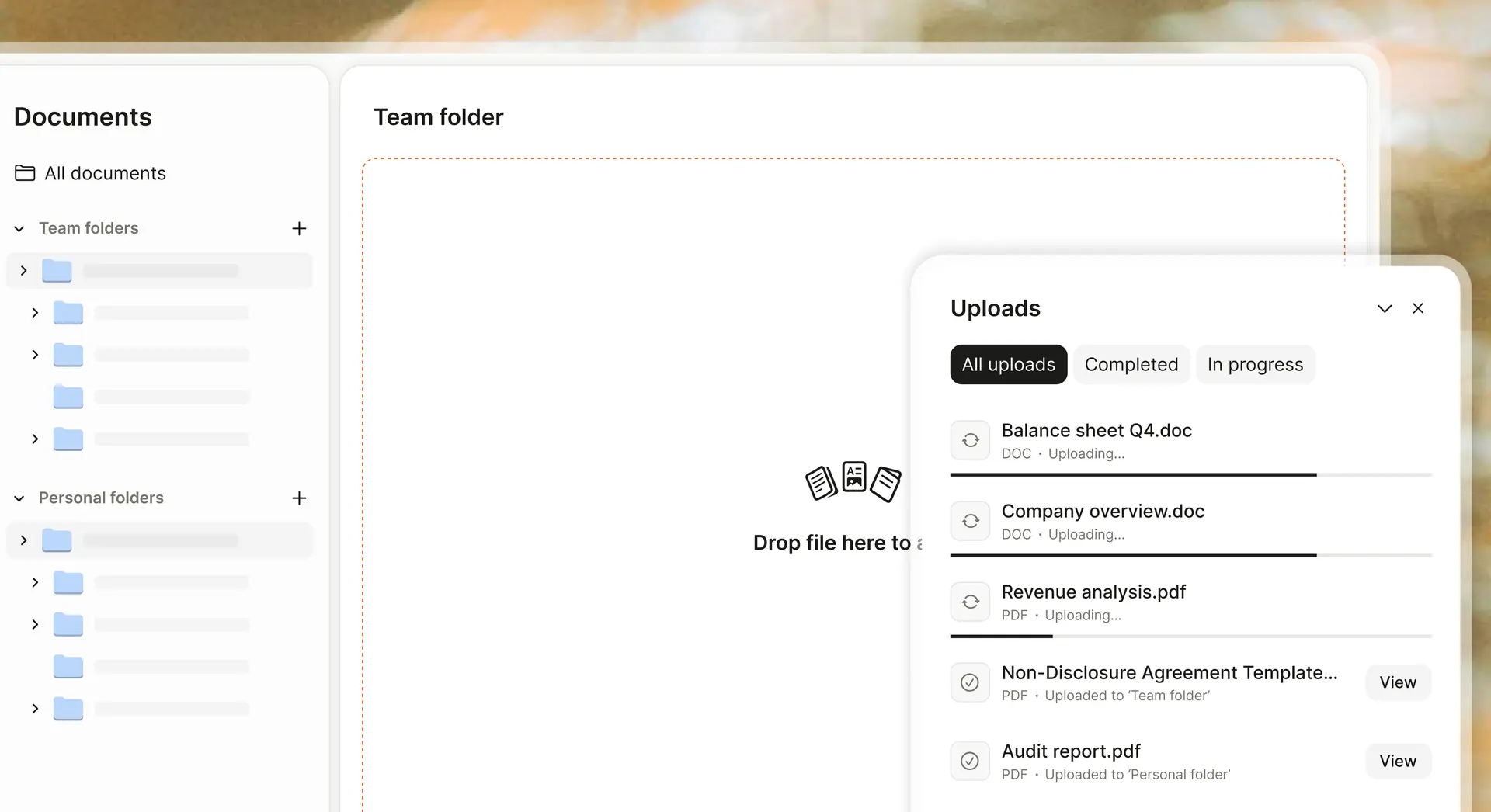
Do not wait for a deal to start preparing. If you think there is any chance you might sell, raise capital, or enter a significant partnership in the next 1-2 years, start organizing your documents now. Rushing this process at the last minute leads to errors and missed items.
Treat the process as a two-way exercise. If you are buying a business, conduct thorough due diligence. But if you are selling, you should also do some diligence on the buyer. Are they financially capable of completing the deal? Do they have a history of failed acquisitions? Understanding who you are dealing with is just as important.
Involve the right professionals. For most significant transactions, working with an accountant and a lawyer is worth the cost. They will catch things you might miss and help you interpret what you find. Ellty is not a replacement for professional advice, but it is the right tool for managing the document flow.
Use a secure platform for document sharing. Do not send sensitive business documents over email. Do not use public file-sharing services without proper access controls. The information involved in due diligence is among the most sensitive in your business. It deserves the appropriate level of security.
Set a clear timeline and stick to it. Due diligence that drags on creates uncertainty and can kill deals. Agree on a realistic deadline at the start and hold both sides accountable to it.
Communicate clearly about what you cannot share. If certain documents are subject to confidentiality restrictions or are genuinely not available, say so clearly and explain why. Ambiguity looks worse than honest limitations.
Risks of not conducting due diligence properly for small businesses
It is worth being direct about what can go wrong when due diligence is skipped or done poorly.
You might inherit undisclosed debts. If a business has unpaid loans, vendor invoices, or tax obligations that were not disclosed and the deal structure makes you responsible for them, you could be paying for someone else's liabilities for years.
You could buy a business with pending litigation. Lawsuits that are not disclosed during due diligence can become your problem after closing. Legal disputes are expensive, time-consuming, and reputationally damaging.
You might overpay significantly. If financial information is inaccurate or misleading and you do not verify it independently, you could pay far more than the business is actually worth. Recovering from overpaying for a business is difficult, especially for a small business with limited financial reserves.
Key contracts might not transfer. Some customer contracts, supplier agreements, or licenses contain clauses that make them non-transferable without consent. If you do not check for these before the deal closes, you could lose critical business relationships the day after you take ownership.
Key people might leave. If you do not review employment agreements and have conversations about retention before closing, you might find that the people who made the business valuable are not sticking around.
Regulatory problems can surface later. Some industries require specific licenses, permits, or regulatory approvals. If the business is not compliant or if the licenses do not transfer to a new owner, you could face fines, shutdowns, or forced changes to the business model.
You lose legal protection. If a deal goes wrong and you cannot show that you conducted reasonable due diligence, your legal position is much weaker. Proper due diligence is also a form of legal protection.
The cost of doing due diligence properly is small compared to the cost of a deal that goes wrong. For small businesses, where margins are tighter and resources are limited, this is not a step you can afford to skip.
Frequently asked questions
What does due diligence mean for a small business buying another business?
It means systematically verifying all the important information about the business you are buying before the deal closes. You are checking financial records, legal documents, contracts, operations, and anything else that affects the value and risk of the transaction. The goal is to make sure you know exactly what you are buying and that there are no significant surprises after closing.
How long does due diligence take for a small business deal?
It depends on the size and complexity of the deal. For a straightforward small business acquisition, due diligence might take 2-4 weeks. For more complex transactions, it can take several months. Setting a clear timeline at the start of the process, and using a tool like Ellty to keep documents organized and accessible, helps keep things moving.
Do I need a lawyer to do due diligence?
Not necessarily for every aspect, but for legal review of contracts, corporate structure, and compliance issues, having a lawyer involved is strongly recommended. They will catch things that most non-lawyers would miss. For financial due diligence, an accountant adds significant value. Think of your tools and platforms as handling the logistics, and professionals as handling the interpretation.
What is a virtual data room and why do I need one?
A virtual data room is a secure online platform for storing and sharing confidential documents during a business transaction or due diligence process. It gives you control over who sees which documents, tracks all activity, and creates an audit log. You need one because sensitive business documents should not be shared over email or unsecured file-sharing services. Ellty provides full VDR functionality at transparent, flat pricing with no per-user fees.
Can the seller refuse to share certain documents during due diligence?
Yes, but it comes with consequences. Sellers can decline to share certain information, usually for confidentiality reasons, but buyers generally factor this into their risk assessment and pricing. Refusing to share standard financial documents or legal filings without a clear reason typically raises concerns. Most serious buyers expect full cooperation on standard due diligence requests.
What happens if something is discovered during due diligence that changes the deal?
This is actually the point of due diligence. If significant issues are found, the buyer can renegotiate the price, ask the seller to fix the issue before closing, require specific warranties and indemnities, or in some cases walk away from the deal entirely. Finding problems during due diligence is far better than discovering them after you have already closed.
Is due diligence only relevant for acquisitions, or does it apply to other situations?
Due diligence applies to any significant business decision where you are relying on information from another party. This includes raising or accepting investment, entering into a major partnership or joint venture, signing a significant vendor or supplier contract, onboarding a high-value client, or bringing on a new business partner. The depth and scope of due diligence will vary, but the principle applies broadly.
Final thoughts
Due diligence is not about distrust. It is about being responsible with your business and the people who depend on it.
For small businesses, a bad deal can have serious consequences. The time and money you spend on proper due diligence is one of the best investments you can make in the health of your business.
The process does not have to be overwhelming. Start with a clear checklist. Organize your documents early. Use a secure platform to manage the review. Bring in the right professionals for legal and financial interpretation. And keep the whole process moving with clear timelines and transparent communication.
Ellty was built to make this easier. Whether you are going through your first acquisition, preparing for an investment round, or simply need a professional way to share sensitive documents with a partner or client, Ellty gives you the tools without the enterprise pricing. Start for free, scale as your deal grows, and know exactly what you are paying every step of the way.
A well-run due diligence process does not just protect you from problems. It also signals to the other party that you are serious, organized, and ready to close. That reputation is worth building.
Have questions about setting up a due diligence process or getting started with Ellty? Reach out to the team.
Author

Anika Tabassum Nionta is a Content Manager at Ellty, where she writes about secure document sharing, virtual data rooms, M&A, due diligence, fundraising, and sales enablement. With over 6 years of writing experience, she helps professionals understand how to share confidential documents securely, track engagement, and manage deals more effectively. Anika holds both a BA and MA in English from Dhaka University. Outside of work, she enjoys reading, exploring new cafes in Dhaka, and connecting with entrepreneurs and dealmakers in her community.

