
When a deal is on the table, whether it's an acquisition, a merger, or a major investment, everyone's eyes go straight to the financials. Revenue, EBITDA, cash flow. That's understandable. But experienced dealmakers know that the numbers only tell part of the story.
The other part? The people.
HR due diligence is the process of examining a company's human resources, its workforce, its employment practices, its compensation structures, its compliance history, and the culture that holds it all together. Skip this step, and you might close a deal that looks great on paper but falls apart when you try to integrate two completely different organizations.
In this guide, we'll walk through everything you need to know about HR due diligence - from what it actually involves, to how long it takes, to the checklist you should be using. We'll also talk about how a Virtual Data Room (VDR) like Ellty can make the whole process faster, more secure, and a lot less stressful.
What is HR due diligence?


HR due diligence is a structured review of a company's human capital and employment-related matters before a significant business transaction. It's typically conducted during mergers and acquisitions (M&A), but it also applies to private equity investments, joint ventures, and even large-scale partnerships.
Think of it as doing your homework on the people side of a business. You want to understand:
- Who works there, and what are their roles?
- How are people compensated, and are those compensation packages sustainable?
- Is the company compliant with employment laws?
- Are there any pending disputes, lawsuits, or grievances?
- What does the organizational structure look like, and who are the key people?
- What does the culture look like and will it clash with yours?
HR due diligence isn't just about finding problems (although it often does). It's also about understanding what you're getting like the talent, the institutional knowledge, the leadership pipeline, and figuring out how to protect and build on it after the deal closes.
Why is HR due diligence important?
Here's the hard truth: a significant number of mergers and acquisitions fail to deliver the expected value and workforce issues are frequently one of the top reasons why. Culture clashes. Talent walks. Integration is messier than expected.
HR due diligence helps you avoid those surprises. Here's why it matters:
1. It uncovers hidden liabilities
Employment-related liabilities can be expensive and hard to see from the outside. Unpaid overtime, misclassified contractors, pending discrimination claims, unresolved workplace injuries - these don't always show up in the financials. A proper HR review brings them to the surface before you're contractually on the hook.
2. It protects key talent
Every company has people who are critical to its operation. HR due diligence helps you identify them and figure out whether they'll stay post-close. If three of the five most important employees have no retention agreements and are already talking to recruiters, that's something you need to know now.
3. It informs deal valuation and structure
What you find in HR due diligence can directly affect how you price and structure a deal. Underfunded pension obligations, high voluntary turnover, or a workforce that's heavily concentrated in one location - all of these affect value. Buyers who skip HR review often overpay.
4. It sets up integration for success
Post-merger integration is where deals live or die. The smoother you understand the HR landscape going in, the better you can plan for what comes after such as org structure, benefits harmonization, reporting lines, and cultural alignment.
5. It keeps you compliant
Depending on the industry and geography, acquiring a company can mean inheriting its compliance obligations. Understanding the current state of HR compliance before you close helps you plan for any remediation needed.

HR due diligence: sell-side
Sell-side HR due diligence is the work a company does to prepare for being acquired or invested in. Many sellers underestimate how important this is and they pay for it.
When a buyer's team starts asking questions, the last thing you want is to scramble for documents, realize your employment contracts are out of date, or discover that your headcount data doesn't match your payroll records. Preparation is everything.
As a seller, your HR due diligence work typically involves:
- Organizing and compiling all HR documentation in a secure, accessible format
- Reviewing employment contracts for any unusual terms, especially around change of control
- Auditing your employee classifications - employees vs. contractors, exempt vs. non-exempt
- Reviewing compensation and benefits to identify any gaps or inconsistencies
- Pulling together your organizational chart and identifying key person dependencies
- Reviewing any pending or historical HR-related claims or disputes
- Preparing a clear picture of your workforce - headcount, tenure, attrition rates
Sellers who run a clean, well-organized data room with HR documents pre-loaded tend to earn more buyer trust and move through due diligence faster. It signals that the business is well-run and has nothing to hide.
Ready to get your documents organized for a smooth due diligence process?
Ellty Room plan gives you granular permissions, NDA gating, and dynamic watermarking, starting at just $149/month.
HR due diligence: buy-side
Buy-side HR due diligence is the review process conducted by the acquirer or their advisors. The goal is to fully understand the workforce of the target company and assess any risks or opportunities before committing to the deal.
On the buy side, you're essentially asking: "What are we actually getting when we acquire this company's people, and what will it cost us?"
Key areas of buy-side HR review include:
Workforce composition
You'll want a clear picture of how many people work there, what roles they're in, where they're located, and how the organization is structured. This includes understanding headcount trends is the workforce growing, shrinking, or stable?
Compensation and benefits
Salary benchmarks, bonus structures, equity plans, pension and retirement obligations - all of this needs scrutiny. Are compensation levels sustainable? Are benefits competitive? Are there any deferred compensation arrangements that will become obligations post-close?
Employment agreements and restrictive covenants
Which employees have formal agreements? Are there non-competes, non-solicitation clauses, or IP assignment agreements? These matter a lot especially for key talent in technical or sales roles.
Labor relations
Is the workforce unionized? If so, what are the collective bargaining agreements, and when do they expire? Any history of labor disputes or strikes?
Culture and people risk
This is harder to quantify, but it matters enormously. Glassdoor reviews, employee survey results, turnover data, and leadership stability all give you a window into how people feel about working there. Cultural misalignment is one of the most common reasons acquisitions fail.
Compliance and litigation
EEOC claims, wage and hour disputes, harassment investigations, OSHA violations, you need to know about all of it. Even resolved matters are worth reviewing for patterns.
How long does the HR due diligence process take?
This is one of the most common questions, and the honest answer is: it depends. The complexity of the target company, the quality of their documentation, and the scope of the deal all play a role.
That said, here are some general benchmarks:
- Small deals (under 100 employees): 2–4 weeks
- Mid-size transactions (100–500 employees): 4–8 weeks
- Large or complex transactions (500+ employees, multi-location, or unionized): 8–16 weeks or more
These timelines assume that documents are accessible and organized. When sellers have a well-structured data room ready from day one, the process moves significantly faster. When they don't, when buyers are chasing documents, waiting on email attachments, or dealing with inconsistent records, timelines stretch and deals sometimes fall apart.
The biggest time-wasters in HR due diligence are almost always document management issues: missing files, disorganized records, version confusion, or access delays. This is exactly where a VDR earns its place in the process.
Reduce due diligence delays with a secure, organized data room. Explore Ellty plans, no per-user fees, no surprise charges.
The HR due diligence checklist
Here's a breakdown of the key areas and documents typically covered in HR due diligence. This is the foundation of what you'll need, actual requirements may vary based on deal type, jurisdiction, and company size.


Conducting HR due diligence with virtual data rooms
Why a VDR makes all the difference
Traditionally, due diligence meant physical data rooms, renting a space, flying in advisors, spending days reviewing hard-copy documents under strict supervision. Even when the process moved online, many teams still relied on email threads, shared drives, and password-protected zip files. Not exactly efficient. And definitely not secure.
A Virtual Data Room (VDR) is purpose-built for this kind of high-stakes document exchange. It gives both buyers and sellers a controlled, trackable, and secure environment to share sensitive materials. Instead of wondering whether a document has been forwarded to someone unauthorized, you know exactly who accessed what and when.
For HR due diligence specifically, this matters a lot. HR documents contain some of the most sensitive information in any organization: salaries, personal data, medical leave records, legal disputes. You need to know this information is protected.
How Ellty supports HR due diligence

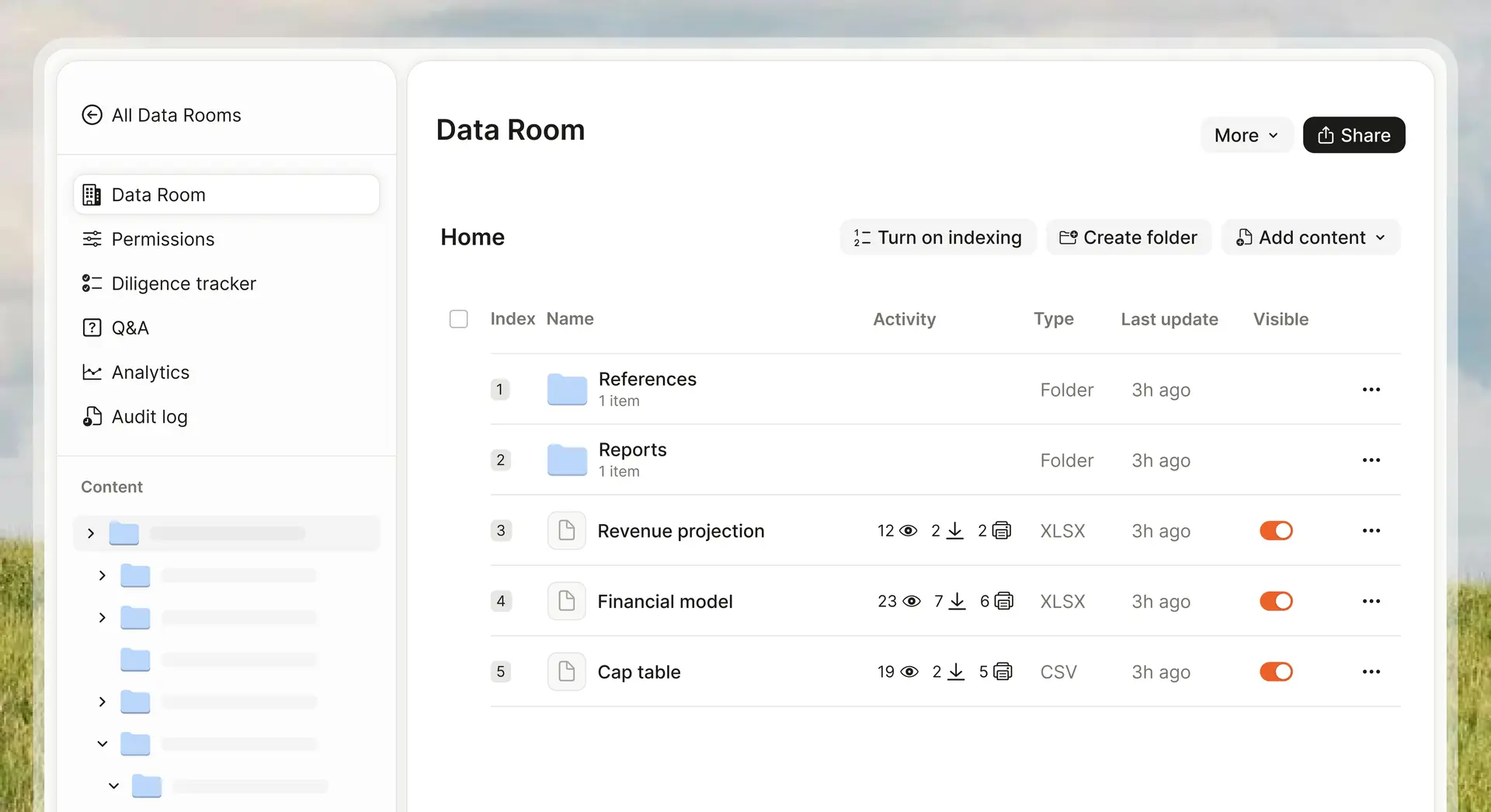
Ellty is a secure document sharing and analytics platform built for exactly this kind of use case. Whether you're a seller preparing your HR data room or a buyer reviewing it, Ellty gives you the tools that matter.
Controlled access
Not everyone on a deal team needs to see everything. With Ellty Room and Room Plus plans, you get granular permissions, controlling who can view, download, or print specific documents. This is essential for HR files, where access should be limited to the people who genuinely need it.
NDA gating
Before anyone can view your data room, Ellty can require them to sign a Non-Disclosure Agreement. This happens automatically, right at the entry point, no manual tracking, no chasing signatures, no gaps in your paper trail.
Real-time activity tracking
One of the most useful features for any due diligence process is knowing what's happening inside your data room. Ellty shows you exactly who is opening documents, how long they're spending on each one, and how often they return. For sell-side teams, this is valuable intelligence, you can see where buyer interest is concentrated and which documents are generating the most attention.

Dynamic watermarking
Every document viewed in Ellty can be watermarked with the viewer's name and email. This discourages unauthorized sharing and creates accountability. If a document ends up somewhere it shouldn't, you know exactly who had access to it.
Full audit logs
At the end of a deal or if a deal falls apart, you need a clear record of who saw what and when. Ellty Room Plus plan includes full audit logs that give you exactly that. It's not just good practice; in many jurisdictions it's a legal requirement for deals involving personal data.
Transparent, predictable pricing
One of the most frustrating things about legacy VDR platforms is the pricing. Per-user fees, per-page charges, custom quotes, minimum contract terms. Ellty works differently. Plans are flat and transparent, from the free starter tier all the way up to Room Plus at $349/month and there are no per-user charges. Whether you're sharing with 3 reviewers or 30, the price doesn't change.
For HR due diligence teams working with multiple advisors, lawyers, and analysts on both sides of a deal, this is a significant practical advantage.

HR due diligence checklist (quick reference)
Use this as your starting checklist when preparing for or conducting HR due diligence. It covers the essentials, adapt it to your specific deal and jurisdiction.
Workforce & organization
- Current org chart and headcount by department
- Full-time, part-time, and contractor breakdown
- Recent hiring and attrition data (last 2–3 years)
- Locations and any multi-jurisdiction considerations
- Key person dependencies and succession planning
Employment documentation
- All employment contracts and offer letters
- Executive and C-suite agreements
- Change-of-control clauses
- Non-compete and non-solicitation agreements
- IP assignment agreements
Compensation & benefits
- Salary structures and pay bands
- Bonus and commission plans
- Equity and stock option plans
- Pension and retirement obligations
- Health, dental, and other benefits plans
- Deferred compensation arrangements
Compliance
- Worker classification audit (employees vs. contractors)
- Wage and hour compliance review
- OSHA records and workplace safety compliance
- FMLA, ADA, and other leave compliance
- EEOC compliance history
Labor relations
- Union membership and CBAs
- Grievance history
- History of labor disputes or strikes
Legal & disputes
- Pending employment litigation
- Historical claims and settlements
- Active HR investigations
- Whistleblower complaints
Policies & culture
- Employee handbook (current version)
- Anti-harassment and discrimination policies
- Remote/hybrid work policies
- Employee engagement or survey data
- Voluntary turnover rates
Upload your HR documents securely and share with your deal team. Ellty Room plan starts at $149/month with NDA gating, dynamic watermarking, and real-time activity tracking.
FAQs
What is the difference between HR due diligence and legal due diligence?
They overlap, but they're not the same. Legal due diligence covers all of a company's legal obligations and exposures - contracts, IP, litigation, regulatory compliance. HR due diligence is specifically focused on the workforce: employment practices, compensation, culture, and people-related risk. In most deals, legal and HR due diligence are conducted in parallel, often by different teams.
Who conducts HR due diligence?
It depends on the deal. In larger transactions, buy-side teams often bring in specialized HR advisors or management consultants alongside their internal HR and legal teams. In smaller deals, the buyer's own HR leadership may handle the review. Sell-side HR due diligence is usually led by the company's Head of HR or CHRO, often supported by outside counsel.
What happens if HR due diligence uncovers serious issues?
It depends on what's found. Minor issues like outdated policies, and small documentation gaps are usually addressed through representations and warranties in the purchase agreement. More serious issues such as pending litigation, major compliance failures, or an underfunded pension, can result in price adjustments, deal restructuring, or in some cases, the buyer walking away entirely.
Do smaller deals really need HR due diligence?
Yes. The proportional risk might be smaller, but the types of issues that come up, misclassified contractors, undisclosed claims, key person risk, are just as common in small companies as large ones. The scope of review may be narrower, but skipping HR due diligence entirely in any transaction is rarely advisable.
Is HR due diligence relevant for private equity investments, or just acquisitions?
Both. Private equity investors acquiring majority stakes conduct HR due diligence for many of the same reasons as strategic acquirers, to assess workforce quality, understand compensation costs, and identify any people-related liabilities. Even for minority investments, HR due diligence gives investors a clearer picture of the business.
How do Virtual Data Rooms help protect HR documents?
VDRs provide a controlled environment for sharing sensitive documents. Unlike email or shared drives, a VDR gives you granular access controls, tracks who views each document and for how long, prevents unauthorized downloading or forwarding, and maintains a full audit log. For HR documents, which contain salaries, personal data, and legal records, that level of control is essential. Ellty Room and Room Plus plans are specifically designed for this kind of controlled document review.
Can Ellty be used for both buy-side and sell-side due diligence?
Absolutely. Sell-side teams use Ellty to build and organize their data room before opening it to buyers. Buy-side teams use it to access and review documents in a structured, trackable way. Both sides benefit from the activity analytics. Sellers can see what's generating interest, and buyers can manage their review process in one place. With no per-user fees, it works well whether you're sharing with a small internal team or a large group of external advisors.
Final thoughts
HR due diligence isn't a box-ticking exercise. It's one of the most important parts of any deal, the part that tells you whether the business you're acquiring will actually work once the ink is dry.
The people, the culture, the compensation structures, the compliance history - all of it affects what a business is actually worth, and what it will take to integrate it successfully. Buyers who skip or rush through HR due diligence often pay for it on the other side of the deal.
The good news is that the process has gotten a lot more manageable with the right tools. When sellers organize their HR documents in a proper data room from the start, and when buyers have a clean, controlled environment to review them, due diligence moves faster and deals close with fewer surprises.
That's exactly what Ellty is built for. Whether you're running a $5M deal or a $50M transaction, you get a professional data room with the features that matter such as access controls, NDA gating, real-time tracking, and a full audit trail, at a price that makes sense. No enterprise contract required.
Author

Anika Tabassum Nionta is a Content Manager at Ellty, where she writes about secure document sharing, virtual data rooms, M&A, due diligence, fundraising, and sales enablement. With over 6 years of writing experience, she helps professionals understand how to share confidential documents securely, track engagement, and manage deals more effectively. Anika holds both a BA and MA in English from Dhaka University. Outside of work, she enjoys reading, exploring new cafes in Dhaka, and connecting with entrepreneurs and dealmakers in her community.

