
A practical guide for founders, investors, and deal teams navigating M&A and investment decisions.
What is commercial due diligence?


When a company is being acquired, merged with another business, or receiving significant investment, neither party can simply take the other's word for it. Every claim about revenue, market position, customer relationships, and growth potential needs to be verified. That verification process, specifically focused on the commercial side of the business, is called commercial due diligence (CDD).
In simple terms, commercial due diligence is the work you do to understand whether a business is as strong as it appears. You are asking: Does this company actually have the customers it claims? Is the market big enough for the returns we expect? Is the revenue real and recurring? Are the competitors manageable? Can this business grow?
Commercial due diligence is one part of a broader due diligence process that also includes financial, legal, tax, and technical reviews. But the commercial side is often the most forward-looking piece. While financial due diligence tells you what has happened, commercial due diligence tells you what is likely to happen and whether the investment thesis actually holds up.
It is used primarily in:
- Mergers and acquisitions (both buy-side and sell-side)
- Private equity and venture capital deals
- Major partnerships or joint ventures
- Strategic investments
Whether you are a PE firm evaluating a target company, a startup preparing for Series B, or a corporate development team running an acquisition, commercial due diligence is a standard and essential step before closing any significant deal.
Why commercial due diligence is critical in M&A and investments
Many deals fail, not because of financial errors, but because the commercial assumptions were wrong. The market was smaller than expected. The customers weren't as loyal as they appeared. A competitor moved in and disrupted the business model.
Commercial due diligence exists to catch those problems before they become expensive mistakes.
Here is why it is not optional:
It validates the investment thesis. Every deal is built on a story: "This company is positioned well in a growing market, and here is why it will outperform." Commercial due diligence tests whether that story is real. If it is not, you find out before the money moves.
It protects against overpaying. Valuations are often based on projected growth. If the market is saturated or the pipeline is weaker than it looks, those projections are inflated. CDD gives you the evidence to negotiate a more accurate price or walk away.
It uncovers hidden risks. Customer concentration, declining retention, an aggressive competitor entering the market, these are risks that do not always show up in financial statements. Commercial due diligence brings them into the open.
It supports post-deal planning. If you understand the commercial landscape before the deal closes, you are better prepared to act once it does. You know which customers to protect, which markets to expand into, and where the real growth levers are.
In short, skipping or rushing commercial due diligence is one of the most common reasons deals underperform. The upfront investment in a thorough review almost always pays off.
Types of commercial due diligence
Not every commercial due diligence engagement looks the same. The scope and depth depend on the type of deal, the industry, and the questions the buyer or investor needs to answer. Here are the main types:
Buy-side commercial due diligence
This is commissioned by the buyer or investor. The goal is to independently validate the target company's commercial position, market size, customer base, and competitive dynamics, before committing capital. It tends to be more in-depth and skeptical by design.
Sell-side commercial due diligence (vendor due diligence)
Here the seller commissions the review, usually to prepare for a sale process. A well-prepared vendor due diligence report helps sellers anticipate buyer questions, speed up negotiations, and demonstrate that the business has nothing to hide. It also signals credibility to potential buyers.
Market assessment
A focused look at the size, growth trajectory, and dynamics of the market the target operates in. This is often the starting point of any CDD engagement.
Customer and commercial review
A detailed examination of the customer base, who the customers are, how much they spend, how loyal they are, and how likely they are to stay. Sometimes this involves direct interviews with key customers.
Competitive analysis
Mapping out the competitive landscape: who the real competitors are, how they differentiate, where the target has a genuine advantage, and where it is vulnerable.
Go-to-market and revenue model review
Evaluating whether the company's sales approach, pricing model, and distribution channels are sustainable and scalable.
In practice, a full commercial due diligence engagement will cover all of these areas. Smaller or faster deals may focus on just one or two.
The commercial due diligence process
Commercial due diligence follows a logical sequence. While the exact steps can vary depending on the deal and the team running it, the general process looks like this:
Step 1 - Define the scope and key questions
Before any work begins, the deal team identifies the most important questions this review needs to answer. What are the risks the buyer is most concerned about? What assumptions does the investment thesis rest on? This focus prevents the review from becoming unfocused and ensures the output is actually useful.
Step 2 - Desk research and market analysis
The team starts with secondary research: industry reports, analyst data, public financial filings, news, and competitor information. This builds a baseline understanding of the market before digging into company-specific data.
Step 3 - Data room review
This is where the target company's internal documents come in. Sales data, customer contracts, churn and retention numbers, pipeline reports, pricing strategies, marketing materials - all of this goes into a secure data room for the deal team to review. A well-organized data room saves significant time here. A messy one can slow down the whole process.
Step 4 - Management interviews
The deal team meets with the target company's leadership, typically the CEO, Chief Commercial Officer, Sales Director, and other senior commercial roles. These conversations test the management team's credibility and surface nuances that documents alone cannot reveal.
Step 5 - Customer and expert interviews
For a thorough review, the team often speaks directly with the target's customers (with permission), former employees, and industry experts. These conversations provide independent perspectives on customer satisfaction, competitive positioning, and market dynamics.
Step 6 - Analysis and synthesis
All the information gathered is analyzed against the initial investment thesis. The team identifies where the thesis holds up, where there are gaps, and what the key risks are.
Step 7 - Report and recommendations
The output is a structured report that answers the original questions, summarizes findings, flags red flags, and provides a commercial view on the deal's viability and valuation.
Commercial Due Diligence Checklist
A thorough commercial due diligence review covers a lot of ground. Here is a practical checklist of what to look for and gather:
Market and Industry
- Total addressable market (TAM) and growth rate
- Market segmentation and dynamics
- Key regulatory or macro factors affecting the industry
- Industry benchmarks for key performance metrics
Customers
- Full customer list with revenue breakdown
- Customer concentration (e.g., top 10 customers as % of revenue)
- Retention rates and churn data (at least 2–3 years)
- Net promoter scores or other satisfaction metrics
- Key customer contract terms (length, renewal clauses, exit provisions)
- Evidence of any recent significant customer losses or at-risk accounts
Competitive Landscape
- Identified direct and indirect competitors
- Competitive positioning maps
- Win/loss data from recent sales cycles
- Pricing comparison with competitors
- Assessment of barriers to entry
Revenue and Commercial Model
- Revenue breakdown by product, segment, and geography
- New business vs. renewal revenue split
- Pipeline health and conversion rates
- Pricing model and recent pricing changes
- Recurring vs. transactional revenue ratio
Go-to-Market
- Sales team structure, capacity, and productivity metrics
- Marketing channels and their effectiveness
- Partner or reseller channel details (if applicable)
- Customer acquisition cost (CAC) and payback period
Management and Team
- Track record of the commercial leadership team
- Evidence of successful execution against past plans
- Team stability (any recent senior departures?)
How long does the commercial due diligence process take?
The honest answer is: it depends. But here are some practical benchmarks.
For a typical mid-market M&A transaction, a full commercial due diligence engagement runs between four and eight weeks. This assumes a dedicated team of advisors, good access to the target's data room, and reasonably responsive management.
For smaller deals or buy-and-build transactions where the buyer already knows the sector well, a lighter-touch CDD can be completed in two to three weeks.
For large, complex deals, especially cross-border transactions or highly regulated industries, the process can take eight to twelve weeks or more.
Several factors affect the timeline:
- Data room readiness: If the seller has prepared a well-organized data room with all key documents indexed and accessible, the review moves faster. If documents are missing, scattered, or hard to navigate, the whole process slows down.
- Management availability: Delays in scheduling interviews and getting answers to follow-up questions are among the most common causes of timeline slippage.
- Scope of the engagement: A narrow market assessment takes far less time than a full commercial and customer review.
- External interviews: Arranging customer and expert interviews takes time to coordinate and is often the longest lead-time item in the process.
One thing worth saying clearly: do not let timeline pressure compromise the quality of the review. A rushed CDD that misses a critical red flag is worse than a thorough one that takes a few extra days.
The role of a VDR in commercial due diligence and why Ellty gets it right
At the heart of any due diligence process is document sharing. The target company needs to share a large volume of sensitive commercial documents, customer contracts, revenue reports, pipeline data, and sales performance records with a deal team that may include external advisors, legal counsel, and potential investors. That process needs to be controlled, secure, and trackable.
This is exactly what a virtual data room (VDR) is built for. And not all VDRs are created equal.
What a good VDR needs to do for commercial due diligence:
A well-run CDD process requires more than just a folder full of shared files. The deal team needs to know who has reviewed which documents. The seller needs to ensure sensitive information does not leave the review environment. Access needs to be easy to grant and just as easy to revoke.
Specifically, you need:
- Granular access controls, so different reviewers only see what they are supposed to see
- An NDA gate, so no one can access documents before signing a non-disclosure agreement
- Real-time activity tracking, so you know who opened what and when
- A full audit trail, in case any disputes arise later
- Dynamic watermarking, to discourage unauthorized sharing
- The ability to organize documents clearly so reviewers can find what they need quickly
Where Ellty fits in

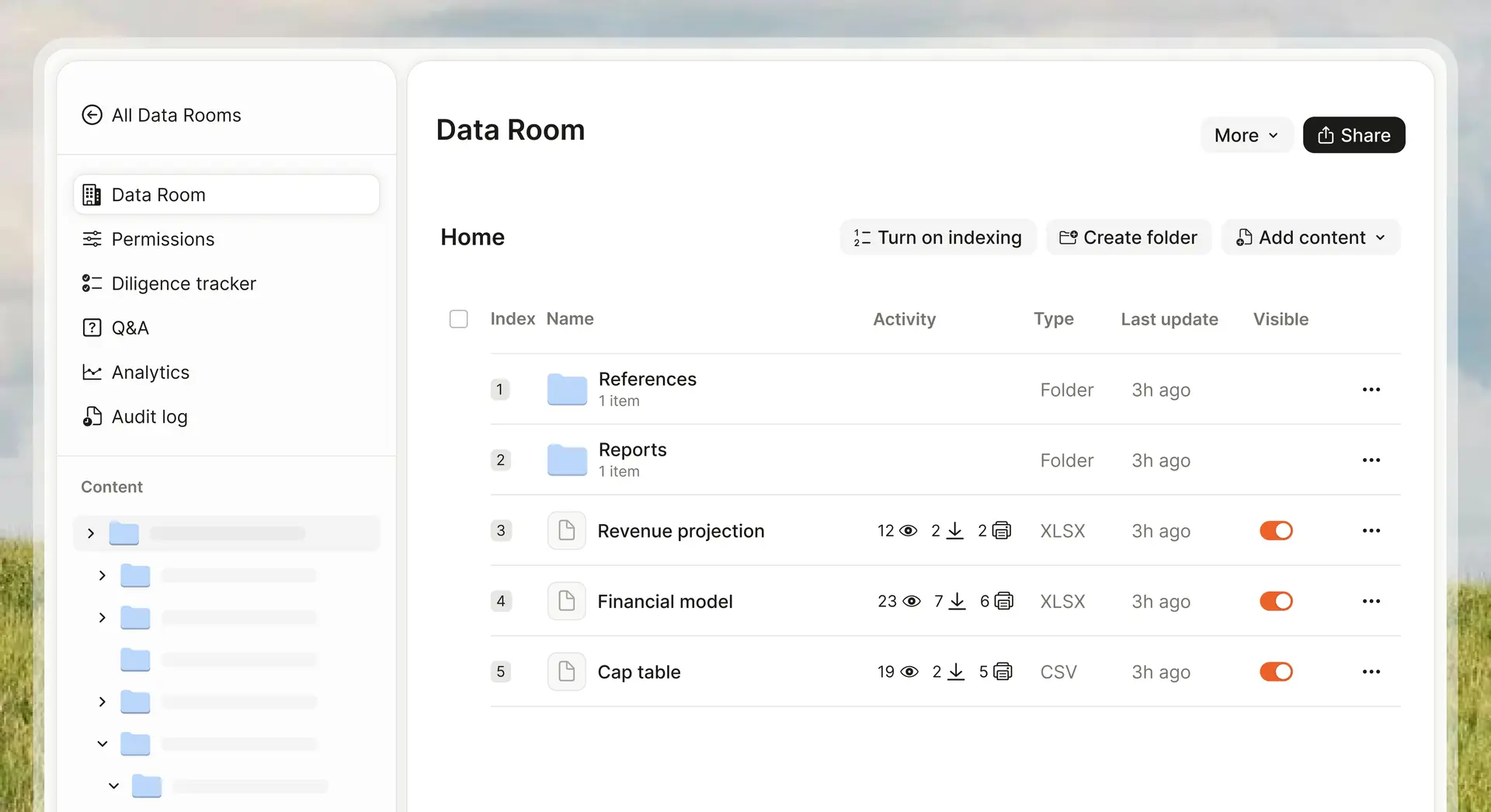
Ellty is a secure document sharing and analytics platform built around these exact needs. It is not an enterprise-contract platform that requires weeks of negotiation to set up. It is a clean, professional-grade data room that you can have running the same day you decide you need it.
Here is how Ellty plans map to common CDD scenarios:
The Free plan is a sensible starting point for early-stage conversations, when you want to share a handful of key documents and see who is engaging with them before a formal process begins.
The Standard plan at $69/month works well for smaller deals and ongoing investor or client communication. You get unlimited documents, eSignatures, advanced analytics, and custom branding. No per-user fees mean you can add your full advisory team without watching costs multiply.
For deals requiring a proper controlled review environment, the Room plan at $149/month is where Ellty really delivers. You get granular permissions, NDA gating, dynamic watermarking, and restricted visitor access - everything a commercial due diligence process needs. The Room plan is built for exactly this scenario: a structured document review where you need to control access carefully and maintain a clean audit trail.
For larger transactions with more complex multi-party review needs, the Room Plus plan at $349/month adds group visitor permissions, full audit logs, and support for up to 4,000 assets, without the enterprise pricing that legacy VDR platforms charge for equivalent functionality.
The single most important thing that separates Ellty from the established players in this space is the pricing model. There are no per-user charges, no per-page fees, and no custom quotes that take weeks to arrive. You pick a plan, know exactly what you are paying, and get started. Whether your deal team is three people or thirty, the cost is the same.
For anyone running a commercial due diligence process, whether you are the target company setting up a data room or an advisory firm managing the review, Ellty gives you the infrastructure you need, at a price that does not require board approval.

Key commercial risks and red flags
One of the primary outputs of any commercial due diligence engagement is a clear-eyed list of risks. Some of these are deal-breakers. Others are manageable with the right mitigation strategy. Here are the most common commercial red flags to watch for:
High customer concentration
If 30–40% or more of revenue comes from a single customer, the business is fundamentally exposed. Losing that customer would be catastrophic, and any savvy buyer will want to understand that relationship in depth.
Declining retention or rising churn
Revenue that is falling away at the base is difficult to replace. Churn trends that are worsening, are a serious warning sign, especially if management has not identified the cause.
Commoditizing market
If pricing power is eroding and customers increasingly treat the product as interchangeable with competitors, long-term margin sustainability becomes questionable.
Overly dependent pipeline
If most of the projected revenue growth rests on a small number of large, unconfirmed deals, the forecast is fragile. Buyers should stress-test what the business looks like if two or three of those deals do not close.
Management credibility gaps
When management's commercial claims do not line up with the data or when they are unable to explain trends in their own numbers, that is a problem. It may indicate poor management information systems, or something more concerning.
Competitive threats that have not been factored in
A well-funded new entrant, a shift in technology, or a major incumbent moving down-market can all materially change the competitive landscape. CDD should assess whether management has a clear-eyed view of these threats.
Channel dependency
If a significant portion of revenue is tied to a single distribution partner or reseller, that relationship warrants careful review. What happens if the partner walks away or shifts priorities?
Unclear or unsustainable unit economics
If customer acquisition costs are high and payback periods are long, growth may be burning more cash than it is creating value. This is especially relevant for SaaS and subscription businesses.
None of these risks is automatically a reason to abandon a deal. But each one requires clear answers, and ideally a mitigation strategy, before proceeding.
FAQs
What is the difference between commercial due diligence and financial due diligence?
Financial due diligence looks at the numbers like revenue, costs, EBITDA, cash flow, working capital, and accounting practices. It is about validating what has already happened financially. Commercial due diligence looks at the business itself: the market, customers, competition, and growth potential. It is more forward-looking. Both are necessary in a thorough deal review, and they complement each other.
Who typically carries out commercial due diligence?
It is usually led by a specialist advisory firm, strategy consultants, corporate finance advisors, or dedicated CDD practitioners. It is commissioned by either the buyer or the seller. Larger PE firms often have in-house deal teams that lead the process, bringing in external advisors for specific workstreams like market research or customer interviews.
Is commercial due diligence always required?
There is no legal requirement to conduct commercial due diligence. But for any significant deal, skipping it is a risk that is hard to justify. Even a lighter-touch review that takes a week or two is far better than none at all. The cost of a CDD engagement is small relative to the cost of getting a deal wrong.
How does a Virtual Data Room help with the commercial due diligence process?
A VDR is the mechanism through which the target company shares its commercial documents with the deal team in a controlled, secure environment. A good VDR lets the seller manage access carefully, track who reviews what, gate access with NDAs, and maintain a full audit trail. Without a VDR, document sharing becomes chaotic and hard to control. Platforms like Ellty make it straightforward to set up a professional data room quickly, without the complexity or cost of legacy enterprise platforms.
What documents are typically shared in a data room for commercial due diligence?
Common documents include customer lists and contracts, revenue breakdowns by segment, sales pipeline reports, retention and churn data, pricing schedules, competitor analysis prepared by management, board presentations, marketing materials, and go-to-market strategy documents. The exact documents depend on the nature of the business and the scope of the review.
How do sellers prepare for commercial due diligence?
Preparation matters. Sellers who are well-prepared move through the process faster and make a stronger impression on potential buyers. Key steps include organizing all commercial documents in a structured data room before the process begins, having clear answers ready for common questions (particularly around customer concentration and retention), preparing a concise narrative around the market opportunity and competitive position, and ensuring management is aligned on the key messages before any buyer conversations.
Can commercial due diligence be done remotely?
Yes, and increasingly it is. Most of the process like data room review, management interviews and expert calls, can be conducted entirely online. A properly organized virtual data room is essential to making remote CDD run smoothly. The shift to remote deal processes has accelerated adoption of platforms like Ellty, which are designed from the ground up for secure, trackable digital document sharing.
Final thoughts
Commercial due diligence is one of the most valuable things you can do before committing to a significant deal. It is the process that turns assumptions into evidence, that separates a credible investment thesis from a hopeful one, and that ensures the business you are buying or backing is what it appears to be.
Done well, it does not just protect you from bad deals. It also helps you understand the business more deeply, which makes you a better owner, operator, or investor once the deal closes.
The process is not without friction. It requires a lot of documentation, careful coordination, and honest conversations. The data room needs to be well-organized. Sensitive information needs to be shared carefully, with the right access controls and a full audit trail.
That is exactly the gap that Ellty fills. For deal teams and companies who need a professional-grade data room without an enterprise price tag, Ellty provides the controls, the tracking, and the transparency that commercial due diligence demands - at a flat, predictable price.
Whether you are just starting early conversations or running a full buy-side review, having the right infrastructure in place makes the whole process faster, smoother, and less stressful for everyone involved.


Author

Anika Tabassum Nionta is a Content Manager at Ellty, where she writes about secure document sharing, virtual data rooms, M&A, due diligence, fundraising, and sales enablement. With over 6 years of writing experience, she helps professionals understand how to share confidential documents securely, track engagement, and manage deals more effectively. Anika holds both a BA and MA in English from Dhaka University. Outside of work, she enjoys reading, exploring new cafes in Dhaka, and connecting with entrepreneurs and dealmakers in her community.

