
Deals fall apart for many reasons. Bad financials, misaligned expectations, cultural clashes. But one of the most common and most preventable - reasons is a technology problem that nobody caught in time.
That's what IT due diligence is for.
Whether you're acquiring a company, investing in a startup, or entering a major partnership, the technology stack of the other party matters more than most people realize. A business that looks healthy on paper can be sitting on outdated infrastructure, unpatched security vulnerabilities, or a codebase only one person understands. None of that shows up in a balance sheet.
This guide walks you through everything you need to know about IT due diligence: what it is, why it matters, how to do it well, and what tools make the process faster and safer. If you're running a deal right now or getting ready to, this is where to start.
What is IT due diligence?
IT due diligence is the process of reviewing and evaluating a company's technology before a transaction. It's a structured investigation into everything tech-related: the software they use, the systems they run, the security practices they follow, the data they hold, and the people who keep it all working.
Think of it as a health check for a company's technology. Just like you'd inspect a building before buying it, IT due diligence lets you inspect the digital infrastructure before committing to a deal.
It usually happens during mergers and acquisitions (M&A), but it's also common in:
- Funding rounds, where investors want to know the startup's technology is solid
- Vendor assessments, where companies evaluate a supplier's systems before signing a long-term contract
- Joint ventures, where two parties need to understand how their tech will work together
- Private equity deals, where the buyer needs to understand integration costs upfront
The output of IT due diligence is a clear picture of what you're getting. Not just the positives, but the risks, the liabilities, and the work that'll be needed after the deal closes.
Why IT due diligence is important
Skipping IT due diligence or doing it poorly has real consequences. Here's why it deserves serious attention.
You can't see technology risks from the outside. Financial records tell you a lot, but they don't tell you that the company's entire customer database is stored on an unencrypted server, or that their key software vendor is going out of business next year, or that they're one bad actor away from a data breach. IT due diligence brings those risks to the surface.
Technology problems are expensive to fix after the fact. If you discover post-acquisition that the company's core system is incompatible with yours, you're looking at a costly, time-consuming migration. If a security breach happens after the deal closes, you own that liability. Finding these problems before you sign is always better.
IT assets are often a significant part of the deal value. In many acquisitions, especially in tech, the software, data, and intellectual property are the whole point of the deal. You want to make sure those assets are what they appear to be - properly licensed, legally owned, and actually functional.
It gives you negotiating power. When you find genuine risks during IT due diligence, you can price them into the deal. You might negotiate a lower purchase price, request escrow arrangements, or set conditions that protect you if problems surface after closing.
Regulators and investors expect it. For public companies and regulated industries, demonstrating that proper technology due diligence was conducted is increasingly a compliance requirement, not just good practice.
Key steps in the IT due diligence process
IT due diligence isn't a single conversation. It's a structured process that moves through several phases. Here's how it typically works.
1. Define the scope
Before you start requesting documents, decide what you need to review. This depends on the type of transaction, the size of the company, and the industry. A SaaS startup and a manufacturing company have very different technology profiles.
Common areas of scope include: infrastructure, cybersecurity, software and licensing, data and privacy, IT governance, and key personnel.
2. Gather documentation
The target company needs to provide documentation and a lot of it. This is where a secure data room becomes essential (more on that shortly). You'll be collecting network diagrams, software contracts, security audit reports, IT policies, system architecture documents, and much more.
The quality and organization of what they share will itself tell you something about how they manage their technology.


3. Review and analyze
Your team or an external IT due diligence advisor goes through the documentation systematically. They're looking for gaps, inconsistencies, red flags, and anything that requires follow-up.
This is also the stage where on-site visits or technical interviews with key staff may happen. Documents don't always tell the full story.
4. Identify and rank risks
Not every issue found is a deal-breaker. The goal is to identify, categorize, and prioritize what you've found. High severity issues (like significant security vulnerabilities or unlicensed software) need to be addressed directly. Lower severity issues may just need a remediation plan post-closing.
5. Document findings and recommendations
Everything gets written up in a clear IT due diligence report. This document informs the deal structure, the negotiation, and the integration plan if the deal goes ahead.
6. Follow-up and verification
In some cases, especially for high-stakes deals, you may want to verify specific claims with third-party experts - security firms, software auditors, or cloud infrastructure specialists.
The role of technology in IT due diligence
Technology doesn't just get reviewed during due diligence, it also powers the process itself.
Running a thorough IT review means sharing and receiving hundreds of sensitive documents. System architecture diagrams, vendor contracts, security policies, audit reports, employee org charts. All of it needs to move between parties without leaking, without getting lost, and with a clear record of who accessed what.
That's not something you can manage over email or shared drives. The tools you use to run the process directly affect the quality and security of the process.


Modern due diligence relies on:
- Virtual Data Rooms (VDRs) - secure, controlled environments where documents are shared and reviewed
- Collaboration tools - for coordinating between legal, technical, and financial teams
- Project management software - to track which items on the checklist have been completed
- Automated document analysis - to flag issues faster in large document sets
The technology infrastructure supporting the process needs to be just as reliable as the one being reviewed.
Virtual Data Rooms: the backbone of IT due diligence
If you're running a due diligence process, you need a Virtual Data Room. There's really no substitute.
A Virtual Data Room (VDR) is a secure online space where documents are stored, shared, and reviewed. Unlike a shared folder or email thread, a VDR gives you granular control over who sees what, when they see it, and what they can do with it. Every action is tracked. Every access is logged. And sensitive documents don't end up forwarded to people they were never meant for.
For IT due diligence specifically, this matters enormously. You're dealing with documents that describe a company's vulnerabilities, its data handling practices, its security gaps. That information is sensitive in both directions, the sharing party needs to know it's protected, and the reviewing party needs to trust they're getting accurate, unaltered documents.
Why Ellty is the right choice for due diligence

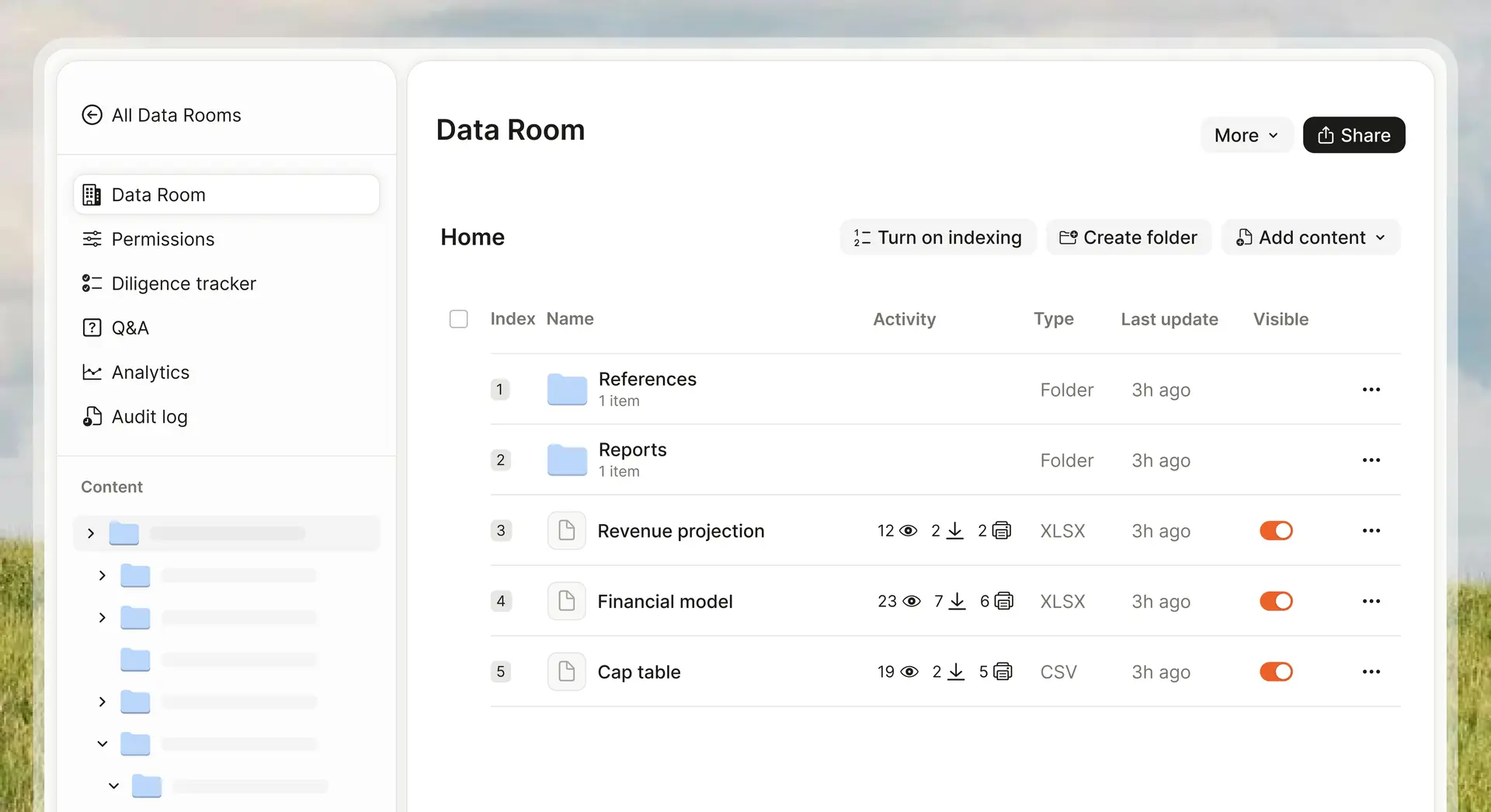
Ellty is a secure document sharing and analytics platform built for exactly this kind of work. It gives deal teams the tools they actually need, without the complexity and cost of legacy enterprise platforms.
Here's what sets Ellty apart for IT due diligence:
Granular access controls. You decide exactly who can see which documents. Different reviewers can get access to different sections of the data room - legal sees contracts, the tech team sees infrastructure docs, and nothing bleeds across. This is available in Ellty Room plan ($149/month).
NDA gating. Before anyone can access the data room, they can be required to sign an NDA. No NDA, no access. This is a simple but critical protection, and Ellty handles it automatically.
Dynamic watermarking. Every document viewed or downloaded carries the viewer's information. This deters unauthorized sharing and creates a clear trail if something does leak.
Real-time activity tracking. You can see exactly who opened what, when, and how long they spent on it. This kind of visibility helps you understand which reviewers are engaged and surfaces any unusual access patterns quickly.

Full audit logs. Ellty Room Plus plan ($349/month) gives you complete audit logs and support for up to 4,000 assets per data room. For larger deals with many document sets and multiple reviewer groups, this is exactly the structure you need.
Flat, transparent pricing. No per-user fees, no per-page charges, no contracts that take weeks to negotiate. You pick a plan, get set up quickly, and know exactly what you're paying - whether your deal team has 3 people or 30.
Ellty plans start at $0/month for basic document tracking and go up through Standard ($69/month) for advanced analytics and eSignatures, Room ($149/month) for full VDR features, and Room Plus ($349/month) for larger multi-party deals.

For anyone running IT due diligence without an enterprise budget or who simply doesn't want to overpay for features they don't need, Ellty is where the process should live.

Common risks identified during IT due diligence
IT due diligence turns up different kinds of problems depending on the company and deal type. Here are the most common risk categories reviewers encounter.
Cybersecurity vulnerabilities
This is often the biggest concern. Reviewers look for outdated software, unpatched systems, weak access management, missing encryption, and inadequate incident response plans. A company that hasn't done a security audit in two years is a red flag.
Technical debt
Technical debt refers to the accumulated cost of shortcuts taken in building and maintaining software systems. A codebase that's been patched repeatedly without proper refactoring, or infrastructure that's far behind in version upgrades, creates risk - and post-deal remediation cost.
Licensing and intellectual property issues
Is the software the company uses properly licensed? Do they own the code they've built, or has it been developed by contractors without clear IP assignments? Unlicensed software and disputed IP can create significant legal and financial exposure.
Data and privacy compliance
With regulations like GDPR, HIPAA, and various national data protection laws, companies are legally required to handle personal data in specific ways. Reviewers look at what data is held, how it's stored, who has access, and whether the company is compliant. A data compliance failure is both a legal risk and a reputational one.
Vendor and third-party dependency
If a company relies heavily on a third-party vendor for a critical system, and that vendor relationship is fragile or the contract expires soon, that's a risk you need to know about. Single points of failure in technology supply chains can be deal-defining issues.
Key person dependency
Sometimes the entire technology operation depends on one or two key individuals. If they leave after the deal closes, the buyer inherits a serious operational gap. This needs to be assessed and addressed in deal terms.
Infrastructure scalability
Will the current technology actually support growth? If the acquiring company has expansion plans, the target's infrastructure needs to be able to scale. Discovering scalability limits post-deal is an expensive surprise.
IT due diligence checklist
Use this checklist as a starting framework. Depending on the deal type and industry, you may need to expand specific sections.
Infrastructure and systems
- Network architecture documentation
- Server inventory (on-premise and cloud)
- Disaster recovery and business continuity plans
- System uptime and incident history
- Hardware lifecycle status
Cybersecurity
- Most recent security audit or penetration test results
- Vulnerability management process
- Data encryption practices (at rest and in transit)
- Access management and identity policies
- Incident response plan and history of past incidents
Software and licensing
- Inventory of all software used
- License agreements and compliance status
- Open-source software usage and license obligations
- Software development practices and code review processes
- Version control and deployment procedures
Data and privacy
- Data inventory (what's held, where it's stored, who can access it)
- Privacy policy and data retention practices
- GDPR / HIPAA / relevant regulatory compliance documentation
- Third-party data sharing agreements
- History of data breaches or regulatory actions
IT governance
- IT organizational structure and key personnel
- IT policies and procedures documentation
- Change management process
- IT budget and spend history
Vendor and contracts
- All active technology vendor contracts
- Upcoming renewals and critical dependencies
- SLA documentation from key vendors
- Cloud service agreements
Intellectual property
- IP ownership documentation for internally developed software
- Developer and contractor IP assignment agreements
- Patent, trademark, or copyright registrations
Risks in conducting IT due diligence
IT due diligence is designed to find risk, but the process itself carries risks that deal teams need to manage.
Information security during the review. You're sharing highly sensitive documents with multiple parties. If the process isn't running through a secure, access-controlled platform, you're creating the very exposure you're trying to assess. Using a proper VDR like Ellty isn't optional; it's a core part of responsible due diligence practice.
Incomplete documentation. The target company may not have everything you request, or may provide outdated or inaccurate documentation. Reviewers need to flag gaps and push for complete information before concluding the review.
Scope creep. IT due diligence can expand rapidly. Without a defined scope and timeline, reviews can run over budget and delay deal timelines. A clear scope document agreed on at the start prevents this.
Over-reliance on documentation. Documents don't always reflect reality. A company might have an excellent written security policy but poor actual practice. Technical interviews, system demos, and where possible, direct observation, are essential complements to document review.
Confidentiality breaches. Information about vulnerabilities, data practices, or key personnel shared during due diligence is extremely sensitive. If this information reaches the wrong people - competitors, malicious actors, or the general public - the consequences can be serious. NDAs, access controls, and audit logs (all features in Ellty data rooms) are the defense against this.
Poor communication between teams. IT due diligence involves lawyers, technologists, financial analysts, and deal managers. When these teams don't communicate well, things get missed. Clear ownership of each section of the review, shared tracking, and regular sync calls reduce this risk.
Frequently asked questions
How long does IT due diligence take?
It depends on the size and complexity of the company and deal. For a small company or early-stage startup, a focused IT review might take one to two weeks. For a larger company with complex infrastructure, it can take four to eight weeks or more. The earlier you start organizing documentation in a structured data room, the faster the process tends to go.
Who should conduct IT due diligence?
Ideally, a combination of internal and external experts. Your internal IT or technology leadership should be involved to understand strategic fit and integration implications. External specialists - IT due diligence advisors, cybersecurity firms, or M&A technology consultants - add objectivity and specific expertise that most internal teams don't have.
What's the difference between IT due diligence and cybersecurity due diligence?
Cybersecurity due diligence is a subset of IT due diligence. IT due diligence covers the full technology landscape - infrastructure, systems, software, data, governance, and people. Cybersecurity due diligence focuses specifically on security risks, vulnerabilities, and compliance. In high-risk industries or large deals, both are conducted, sometimes by separate teams.
Do I need a Virtual Data Room for IT due diligence?
Yes, practically speaking. Sharing hundreds of sensitive technology documents over email or standard cloud drives is a security and governance problem. A VDR gives you access controls, audit trails, NDA gating, and activity tracking that you simply can't replicate with consumer tools. Ellty Room plan ($149/month) covers everything most deal teams need, with no per-user fees.
What happens if IT due diligence finds serious problems?
That depends on the deal and the severity of the issue. Findings become part of the negotiation. Buyers might request a price reduction, require the seller to remediate specific issues before closing, set up indemnification provisions, or - in extreme cases - walk away from the deal. The point of finding problems is to address them, not necessarily to kill the deal.
How do I get the target company to provide all the information I need?
This is often a negotiation in itself. The due diligence request list should be clearly agreed on as part of deal terms, with defined timelines for delivery. Organizing the requests clearly, ideally through a shared data room where items can be tracked as uploaded, makes it easier for the target to comply. Ellty platform supports this kind of structured exchange, making it easy to see exactly what's been provided and what's still pending.
Can IT due diligence be done remotely?
Yes, and increasingly it is. Virtual Data Rooms and video conferencing have made fully remote IT due diligence standard practice for most transactions. In some cases, particularly where physical data centers or hardware need to be assessed, an on-site visit may still be necessary, but the majority of the process can run effectively online.
Final thoughts
IT due diligence is one of the most important and most underestimated, parts of any transaction. It's the process that tells you what you're actually buying. Not just the headline metrics, but the real-world state of the technology, the security risks, the compliance gaps, and the integration costs waiting on the other side of the deal.
Done well, it protects you. It gives you the information to negotiate confidently, plan realistically, and close deals without nasty surprises. Done poorly or skipped entirely, it leaves you exposed to risks that could cost far more than the deal was ever worth.
The good news is that running a clean, thorough IT due diligence process isn't complicated if you have the right structure and the right tools. Start with a clear scope, work from a solid checklist, get the right experts involved, and make sure your document review process runs through a secure, well-organized data room.
That's where Ellty fits in. Whether you're running a focused review for a small acquisition or managing a multi-party deal with hundreds of documents across multiple reviewer groups, Ellty gives you the control, visibility, and security the process demands - at a price that's straightforward and fair.
Start your free Ellty account and get your due diligence data room set up today.
IT due diligence is a professional process. This guide is intended as a practical overview and does not constitute legal or financial advice. For complex transactions, engage qualified advisors with relevant experience.
Author

Anika Tabassum Nionta is a Content Manager at Ellty, where she writes about secure document sharing, virtual data rooms, M&A, due diligence, fundraising, and sales enablement. With over 6 years of writing experience, she helps professionals understand how to share confidential documents securely, track engagement, and manage deals more effectively. Anika holds both a BA and MA in English from Dhaka University. Outside of work, she enjoys reading, exploring new cafes in Dhaka, and connecting with entrepreneurs and dealmakers in her community.

