
If you are thinking about selling your business, merging with another company, or bringing in a major investor, one thing you simply cannot afford to skip is sell-side due diligence.
Most people have heard of due diligence from the buyer's side. The buyer checks your books, asks tough questions, and decides if the deal is worth it. But what about you, the seller? Should you just sit back and wait to be audited?
Absolutely not.
Sellers who prepare their own due diligence before going to market close deals faster, negotiate from a stronger position, and avoid last-minute surprises that can kill a transaction or reduce the final price. The companies that go in unprepared are the ones that end up with price cuts, extended timelines, or deals that fall apart entirely at the finish line.
This guide covers everything you need to know about sell-side due diligence, from what it actually is, to who should be involved, to a practical checklist you can start using today. We have also included how the right tools, specifically a Virtual Data Room like Ellty, can make the whole process cleaner, faster, and more professional.
Whether you are running a small business or managing a mid-sized acquisition, this is the guide you need before you begin.
What is sell-side due diligence?
Sell-side due diligence is the process where the seller reviews their own business before a deal is put on the table. Instead of waiting for a buyer to come in and find problems, you find them yourself first.
Think of it like preparing your home before listing it on the market. You fix the leaky tap, repaint the walls, and sort out whatever might cause a buyer to walk away or negotiate the price down. Sell-side due diligence does the same thing for your business, except instead of leaky taps, you are looking at financial records, legal contracts, tax filings, employee agreements, intellectual property, and much more.
The process typically involves gathering all key business documents, reviewing them critically, identifying any gaps or risks, resolving what can be resolved, and then organizing everything in a way that is ready for buyer review. The result is a clean, well-prepared document package that gives buyers confidence and removes uncertainty from the negotiation table.
Unprepared seller | Prepared seller | |
|---|---|---|
Deal timeline | Months of delays, missing documents | Faster close, answers ready upfront |
Price negotiation | Buyers use gaps to push price down | Negotiate from a position of strength |
Buyer confidence | Uncertainty raises perceived risk | Organised data room builds credibility fast |
Risk of deal falling through | High - surprises derail late-stage deals | Low - issues resolved before buyer sees them |
Document readiness | Scattered, incomplete, hard to find | Organized data room, ready to share |
Sell-side vs. buy-side due diligence: Key differences
Both types of due diligence review the same business, but from opposite angles with very different goals.
Buy-side due diligence is what the buyer does. Their job is to verify everything the seller claims, find hidden risks, and decide whether the deal makes financial sense for them. They want to find problems so they can either walk away or negotiate a lower price.
Sell-side due diligence is what the seller does, and it is done in advance. The seller's goal is to identify issues before the buyer does, fix what can be fixed, and present a business that is clearly understood, well-documented, and ready to transact.
Here is a quick breakdown of the key differences:
Sell-side due diligence | Buy-side due diligence | |
|---|---|---|
Who does it | The seller, often with advisors | The buyer, often with advisors |
When it happens | Before going to market | After a letter of intent is signed |
Main goal | Identify and fix issues early | Verify claims and find risks |
Outcome | Cleaner, faster deal | Informed purchase decision |
Cost | Borne by the seller | Borne by the buyer |
One important thing to note here: sell-side due diligence does not replace buy-side due diligence. The buyer will still conduct their own review. What sell-side preparation does is reduce friction, build trust, and prevent the deal from derailing on avoidable issues.
Why sell-side due diligence matters
Some sellers see due diligence as something that happens to them. The reality is, it is something that can work for you if you approach it the right way.
Here is why it matters:
It protects the deal price. Buyers use uncertainty and risk as leverage to negotiate the price down. When you have everything documented and issues addressed upfront, there is less room for them to argue. You are negotiating from a position of strength.
It shortens the deal timeline. Most deals take longer than expected not because of complex negotiations, but because documents are missing, records are incomplete, or information takes weeks to gather. Preparing in advance means answers are ready when questions come.
It builds buyer confidence. A well-organized data room with complete, accurate information signals that this is a well-run business. Buyers notice when a seller is organized. It builds credibility and reduces perceived risk.
It reduces the risk of deals falling through. A large number of M&A deals collapse during due diligence. Many of those failures come from surprises, not because the underlying business was bad, but because the seller was not ready. Sell-side preparation removes that risk.
It helps you understand your own business better. Going through this process often reveals things the seller was not fully aware of - undocumented liabilities, missing agreements, contracts that are about to expire. Finding these before a buyer does is always better.
If you are serious about getting a deal done at the right price and on the right timeline, sell-side due diligence is not optional. It is a smart investment in the outcome.
Who should be involved in the process?
Sell-side due diligence is not a solo job. Depending on the size and complexity of your business, you will need a team working on it. Here are the key people who should be at the table.
The business owner or CEO needs to set the tone, approve decisions, and be across the key documents. Buyers will ultimately want to hear from the top.
A financial advisor or CFO handles the financial records, works through the numbers, and ensures everything is accurate and presented clearly. This is often where the most scrutiny happens.
A legal advisor reviews contracts, identifies liabilities, ensures corporate documents are in order, and flags anything that could be a legal issue during the transaction.
An accountant or auditor provides independent verification of the financial statements, which buyers take far more seriously than internally prepared numbers.
An M&A advisor or investment banker (if involved) will help structure the narrative around the business, prepare the information memorandum, and manage the overall deal process.
HR and operations leads help gather employment records, organizational charts, and information about key personnel and operational processes.
For smaller businesses that cannot afford a full advisory team, at a minimum, you need a good accountant and a lawyer who understands business transactions. Everything else can be coordinated by the owner with the right tools and processes in place.
Preparing for sell-side due diligence
Before you start pulling documents together, it helps to have a clear approach. Here is how to prepare effectively.
Start early. Ideally, you should begin preparing six to twelve months before you plan to go to market. This gives you time to identify gaps, fix issues, and update any records that are out of date.
Audit your own documents first. Before anything else, do a basic document audit. What do you have? What is missing? What is out of date? This initial review gives you a clear picture of the work ahead.
Resolve known issues. If you are aware of legal disputes, gaps in your financials, or compliance issues, address them before the buyer sees them. Not everything can be fixed, but anything you can resolve should be resolved.
Get your financials cleaned up. This means having at least three years of financial statements reviewed or audited, reconciling your accounts, and making sure your numbers tell a consistent and accurate story.
Organise your corporate records. Articles of incorporation, shareholder agreements, board minutes, cap tables, licenses - these all need to be current and easy to find.
Set up a data room. This is where everything comes together. A Virtual Data Room (VDR) is the standard way to share documents securely during a deal. It keeps everything in one place, controls who can see what, and tracks buyer activity so you know what they are looking at.
Sell-side due diligence checklist
This checklist covers the core categories. Not every item will apply to every business, but this is a strong foundation to work from.
Corporate and legal documents
- Certificate of incorporation and all amendments
- Shareholder agreements and registers
- Board meeting minutes (last 3 years)
- Cap table with current equity ownership
- Operating agreement or bylaws
- Any pending or past litigation, claims, or disputes
- Regulatory licenses and permits
- List of subsidiaries or related entities
Financial records
- Audited or reviewed financial statements (last 3 years)
- Management accounts (current year to date)
- Tax returns (last 3 years) and any outstanding tax liabilities
- Accounts receivable and payable ageing reports
- Cash flow statements
- Details of any debt, loans, or credit facilities
- Budget vs. actual performance analysis
Contracts and agreements
- Key customer contracts (with terms, renewal dates, and revenue impact)
- Supplier and vendor agreements
- Lease agreements for property or equipment
- Any exclusivity or non-compete agreements
- Partnership or joint venture agreements
- Any contracts with change-of-control clauses (these need careful review)
Intellectual property
- List of trademarks, patents, and copyrights
- Evidence of ownership or registration
- Licensing agreements (inbound and outbound)
- Any IP disputes or risks
Human resources
- Organizational chart
- Employee count, roles, and compensation summary
- Employment contracts for key staff
- Details of any pending employment disputes
- Benefit plans, pension or superannuation obligations
- Details of any staff who are critical to operations
Operations
- Overview of key business processes
- Technology systems and software licenses
- IT infrastructure overview
- Data privacy and security policies
- Insurance policies and coverage details
- Details of any regulatory compliance programmes
Sales and marketing
- List of top customers and revenue concentration
- Sales pipeline overview
- Marketing strategy summary
- Customer retention data
- Any signed letters of intent or term sheets with prospects
Virtual Data Rooms: The backbone of due diligence
No matter how well-prepared your documents are, if they are scattered across email attachments, shared drives, and USB sticks, you have a problem. A Virtual Data Room (VDR) is the standard professional solution for organizing, sharing, and managing documents during a transaction.
Here is why a VDR is essential for sell-side due diligence:
Controlled access. You decide who sees what. Legal advisors see contracts. Financial reviewers see the accounts. Potential buyers see what is appropriate at each stage of the process. Nothing gets shared by accident.


Document tracking. You can see exactly who viewed which documents, when, and for how long. This tells you what buyers are most focused on and helps you anticipate questions before they are asked.
NDA gating. Before anyone gets access to your sensitive materials, they can be required to sign a non-disclosure agreement directly within the platform.
Audit trails. A complete log of all activity in the data room protects you legally and professionally. If there is ever a dispute about what was shared or when, the record is there.
Professionalism. A well-structured VDR signals to buyers that this is a serious, organized transaction. First impressions matter in M&A.
Why Ellty is the right choice
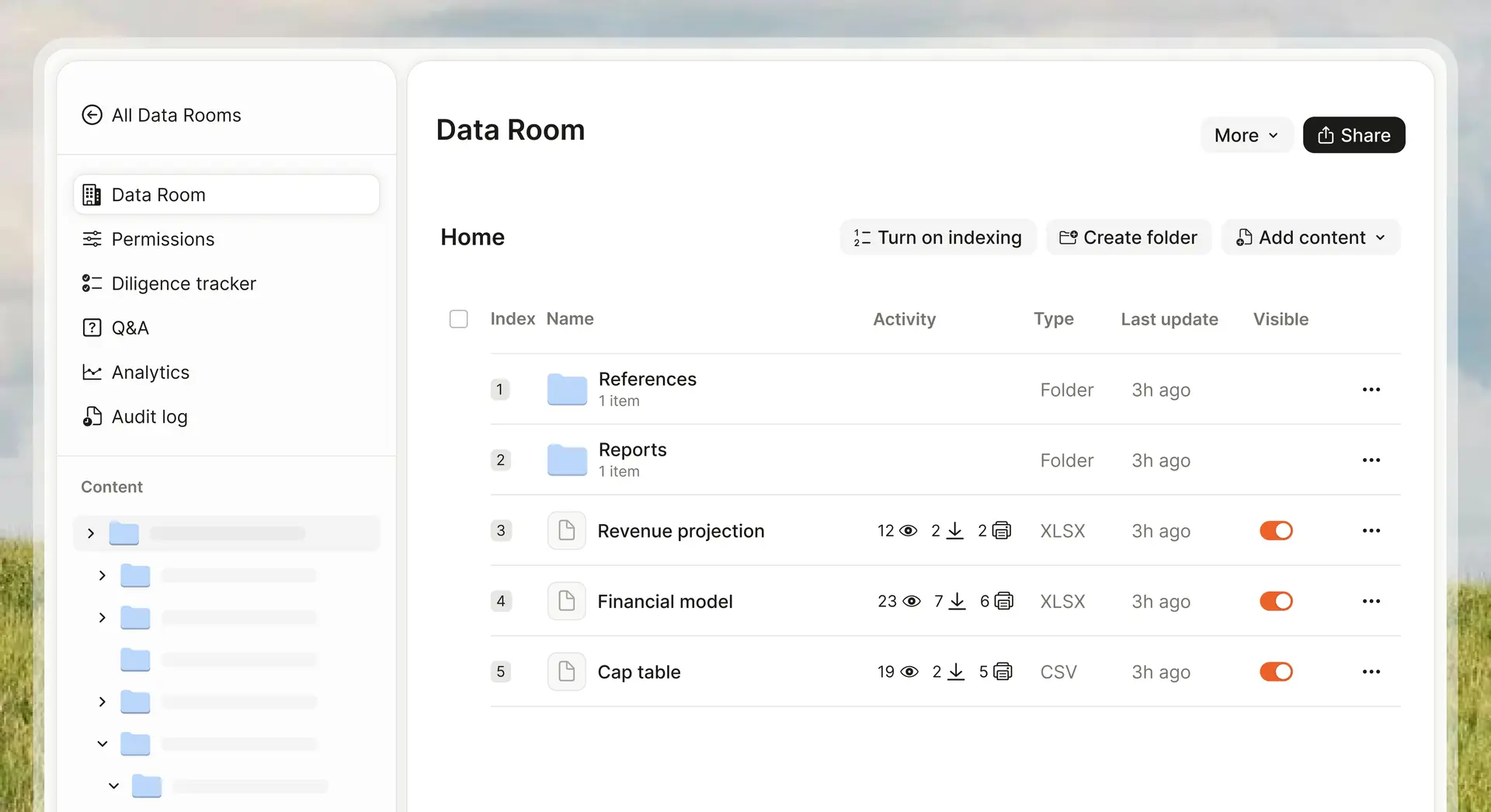
For businesses that need a professional data room without the complexity or cost of legacy enterprise platforms, Ellty is purpose-built for this.
Ellty is a secure document sharing and analytics platform with full data room functionality, built for anyone who needs to share sensitive documents in a controlled, trackable way. Whether you are running a funding round, managing an acquisition, or sharing materials with investors or advisors, Ellty gives you the tools that actually matter.
What sets Ellty apart:
- No per-user fees. Legacy VDR platforms charge per user, per page, and often require custom quotes that take weeks. Ellty uses flat, transparent pricing from the start.
- Granular permissions. Control exactly who can view, download, or print each document.
- Dynamic watermarking. Every document viewed is watermarked with the viewer's details, which deters leaks and adds accountability.
- NDA gating. Require visitors to sign an NDA before they can access the room.
- Real-time analytics. See who is active in your data room, what they are reading, and how long they spend on each document.
- eSignatures. Collect signatures without switching to a separate tool.
- Full audit logs. A complete, downloadable record of all activity.
Ellty plans are straightforward:
- Free plan ($0/month): Document tracking, real-time analytics, and secure sharing. A good starting point if you are in early conversations.
- Standard ($69/month): Unlimited documents, advanced analytics, eSignatures, custom branding, and data room features. Works well for smaller deals and ongoing client or investor communication.
- Room ($149/month): Granular permissions, NDA gating, dynamic watermarking, and restricted visitor access - everything you need to run a controlled document review.
- Room Plus ($349/month): Group visitor permissions, full audit logs, and support for up to 4,000 assets per data room. Built for heavier document loads and multi-party deals.


There are no per-user charges, no per-page fees, and no surprise bills at the end of the month. You pick a plan, get set up quickly, and know exactly what you are paying.

How to conduct sell-side due diligence effectively for small businesses
Large corporations have entire teams to manage due diligence. For a small business owner, it can feel overwhelming. But it does not have to be.
Here is a practical approach for smaller businesses:
Keep it proportionate. A 10-person business does not need the same level of documentation as a 500-person company. Focus on what is material: your financials, key contracts, legal structure, and any obvious risk areas.
Use a checklist and work through it systematically. Do not try to do everything at once. Break the checklist into categories and assign a clear owner to each. Work through it section by section over several weeks.
Get your accountant involved early. Even if you cannot afford a full audit, having an accountant clean up your books and prepare a financial summary is worth every dollar. Buyers trust independently reviewed numbers far more than those prepared by the owner.
Document what you know. A lot of small businesses run on informal arrangements - handshake deals, unwritten processes, verbal agreements. As part of due diligence preparation, convert these to written records. This includes things like key customer relationships, supplier arrangements, and operational processes.
Do not hide problems. If there are known issues in the business, the instinct can be to bury them or hope the buyer does not notice. This is a bad strategy. Issues that come out during buyer due diligence, especially ones you knew about, can kill a deal entirely or result in indemnity clauses that hurt you after closing. It is better to disclose proactively, with context, and address what you can.
Use Ellty to organize your documents. Even at the Standard plan ($69/month), you get a professional, organized document room that keeps everything in one place and lets you track who is looking at what. For a small business going through a deal, this is a practical and affordable way to run things professionally without hiring an expensive advisory firm to manage it for you.
Start earlier than you think you need to. For small businesses, six months is a reasonable runway. Three months is tight. Leaving it until you have a buyer at the table is too late.


Sell-side due diligence questions that should be asked
Going through the documents is one part of the process. Asking the right questions is another. Here are the critical questions every seller should be able to answer before a buyer asks them.
On financials:
- Are our financial statements accurate and up to date?
- Can we explain any unusual spikes or drops in revenue or profit over the last three years?
- Do we have any undisclosed liabilities or contingent costs?
- What is our current debt situation and what are the repayment terms?
On legal:
- Are all key contracts current and properly executed?
- Do any of our contracts include change-of-control clauses that could be triggered by this sale?
- Are there any ongoing or threatened legal disputes?
- Is our business in compliance with all relevant regulations and licenses?
On customers and revenue:
- What percentage of revenue comes from our top five customers?
- Are there any customer contracts expiring in the next 12 months that have not yet been renewed?
- How sticky is our customer base, and what is our annual churn rate?
On people:
- Are there key employees whose departure would significantly affect the business?
- Are all employment contracts properly documented?
- Are there any pending HR disputes or issues?
On intellectual property:
- Do we own (not just license) the key IP that drives our business?
- Is all IP registered where applicable?
- Are there any IP disputes or challenges?
On operations:
- Are there any single points of failure in our operations?
- Are our IT systems and data practices compliant with relevant data protection laws?
- Do we have adequate insurance coverage?
If you cannot answer all of these confidently, that is where to focus your preparation.
Should you involve third-party companies to perform sell-side due diligence?
This is a common question, and the honest answer is: it depends on the size and complexity of your deal.
When third-party advisors are worth it:
For transactions above a certain size, typically $5 million or more, it makes strong commercial sense to engage external advisors. This typically means a financial advisor or M&A firm, an independent auditor, and a legal team familiar with M&A transactions.
External advisors bring several things that are hard to replicate internally. They have done this many times before, so they know what buyers look for, what red flags to address, and how to present information in the most credible way. They also provide an independent stamp of credibility. A financial report prepared by a reputable accounting firm carries far more weight with buyers than one prepared by the seller's own team.
Third-party due diligence firms can also conduct a "vendor due diligence" report, which is a formal independent review of the business that is shared directly with buyers. This is particularly common in larger transactions, auctions, or private equity deals.
When you might manage it yourself:
For smaller deals, smaller businesses, or early-stage transactions, bringing in a full external due diligence team may not be practical or cost-effective. In these cases, a business owner working with their existing accountant and legal advisor, combined with good documentation practices and a solid VDR setup, can get through the process effectively.
The middle ground:
Many businesses go for a hybrid approach. They manage the document gathering and organization themselves using a platform like Ellty, bring in an accountant for the financial review, and engage a lawyer for the legal review. This gets you most of the benefit without the full cost of a dedicated M&A advisory team.
The key principle regardless of approach: make sure that whoever is involved knows what they are doing, and that the output is thorough, accurate, and well-organized. Buyers can tell the difference.
Looking to manage your due diligence process more professionally? Ellty Room plan gives you everything you need to run a controlled, trackable document review at a flat monthly rate, with no surprises.
FAQs
How long does sell-side due diligence typically take?
It varies depending on the size and complexity of your business. For a small business, the preparation process can take anywhere from one to three months. For a mid-sized company, plan for three to six months. The more prepared you are in advance, the faster the buyer's review process will be once the deal is underway.
What is the difference between vendor due diligence and sell-side due diligence?
These terms are often used interchangeably, but there is a subtle difference. Sell-side due diligence is the broader process of the seller reviewing and preparing their business for a transaction. Vendor due diligence (VDD) specifically refers to a formal independent report, usually prepared by an accounting or advisory firm, that is shared with potential buyers. VDD is a structured deliverable; sell-side due diligence is the overall preparation process.
Do I need a Virtual Data Room for sell-side due diligence?
You do not legally need one, but it is strongly recommended. A VDR keeps all your documents organized and secure, controls who has access, tracks buyer activity, and creates a professional impression. The alternative - sharing documents over email or through Dropbox - creates security risks, is difficult to manage, and does not provide the access controls or audit trail that serious transactions require.
Can sell-side due diligence hurt my deal?
If done poorly, yes. An incomplete or rushed sell-side process that misses key issues can actually create more problems than it solves - either by giving buyers a false sense of security that gets broken later, or by surfacing issues without having a plan to address them. Done well, however, sell-side due diligence almost always improves deal outcomes.
What are the most common documents requested during due diligence?
The most consistently requested items are: financial statements (three years), tax returns (three years), key customer contracts, a corporate structure overview with cap table, employment agreements for key staff, IP ownership documentation, any pending legal claims, and details of any debt or financial obligations. Having these documents ready before a buyer asks is one of the highest-value things a seller can do.
Should small businesses do sell-side due diligence even for smaller deals?
Yes. The scale of the preparation should match the scale of the deal, but even a small acquisition will involve a buyer reviewing the business. The principles are the same whether the deal is $500,000 or $50 million. Clean records, organized documents, and no hidden surprises benefit every transaction.
How much does sell-side due diligence cost?
Costs vary significantly depending on whether you bring in external advisors. A full advisory team for a larger deal can run into tens of thousands of dollars. For smaller businesses managing it with their existing accountant and lawyer, it is mainly a cost of time. Using a tool like Ellty to manage the document side of the process, starting at $69/month for the Standard plan, is one of the most cost-effective ways to get a professional-level setup without the enterprise price tag.
Final thoughts
Sell-side due diligence is not the most exciting part of a transaction. But it is one of the most important.
The sellers who prepare properly are the ones who close deals at their target price, on their preferred timeline, without the stress of last-minute surprises and frantic document hunts. The ones who skip it often find out the hard way that a buyer's due diligence process is far more uncomfortable when you are not ready for it.
The good news is that the core work is straightforward. Gather your documents, review them critically, fix what you can, and organize everything in a way that is easy for buyers to review. The checklist and guidance in this blog give you a solid starting point.
And when it comes to managing the document side of the process, you do not need to overspend on an enterprise platform to do it right. Ellty gives you a professional, secure, fully-featured Virtual Data Room at a flat, transparent monthly price. No per-user fees, no complex setup, no surprise bills.
Whether you are just starting to prepare or already in conversations with potential buyers, setting up your data room early is one of the best moves you can make.
Start with Ellty today and see how easy it is to run a professional due diligence process, whatever the size of your deal. Your first data room is free to set up.
This blog is intended for general informational purposes. For specific legal or financial advice related to your transaction, consult a qualified professional.
Author

Anika Tabassum Nionta is a Content Manager at Ellty, where she writes about secure document sharing, virtual data rooms, M&A, due diligence, fundraising, and sales enablement. With over 6 years of writing experience, she helps professionals understand how to share confidential documents securely, track engagement, and manage deals more effectively. Anika holds both a BA and MA in English from Dhaka University. Outside of work, she enjoys reading, exploring new cafes in Dhaka, and connecting with entrepreneurs and dealmakers in her community.

