
When a deal is on the table, whether it is a business acquisition, a funding round, or a real estate transaction, one thing stands between you and a closed deal: due diligence. And at the heart of every due diligence process is a mountain of documents.
For anyone going through this for the first time, it can feel overwhelming. What documents do you actually need? How do you organize them? Who gets access to what? These are fair questions, and this guide will walk you through everything you need to know.
Whether you are a startup founder preparing for investor scrutiny, a business owner being acquired, or a legal or finance professional managing a deal, this blog will help you understand exactly what due diligence documents are, how they are categorized, and the best way to manage them.
By the end, you will also see why having the right platform to store and share these documents is just as important as the documents themselves.


What is due diligence?
Due diligence is the process of investigating and verifying information before making a major business or financial decision. Think of it as doing your homework before signing on the dotted line.
In a typical deal, the buyer or investor will request access to a large set of documents from the seller or target company. These documents cover everything from financial history and legal standing to assets, contracts, and intellectual property. The goal is simple: make sure everything being claimed is actually true, and spot any risks before money changes hands.
Due diligence can take anywhere from a few weeks to several months depending on the deal size and complexity. It involves multiple parties - lawyers, accountants, investors, advisors - all working through documents at the same time.
This is exactly why organizing and sharing those documents securely is so important.
What are due diligence documents?
Due diligence documents are the official records and files that a company shares with potential buyers, investors, or partners so they can verify the company's claims and assess its true value.
These documents give the other party a clear, factual picture of the business. They are not just formalities, they can make or break a deal. A missing contract, an inconsistency in financial records, or an unresolved legal dispute found during due diligence can cause delays, renegotiations, or even a deal falling through entirely.
Due diligence documents generally fall into six main categories. Let us go through each one.
1. Corporate governance due diligence documents
Corporate governance documents show the legal structure of your business and how it is run. These are often the first things a buyer or investor will ask for because they need to confirm that the company is properly set up and that ownership and decision-making are clearly defined.
Typical documents in this category include:
- Certificate of incorporation and any amendments
- Articles of association or bylaws
- Shareholder agreements
- Cap table (the breakdown of who owns what percentage of the company)
- Board meeting minutes and resolutions
- Details of any subsidiaries or affiliated entities
- Any existing shareholder or voting rights agreements
These documents tell the story of who built the company, who owns it now, and how big decisions get made. Investors and acquirers scrutinize this category closely because gaps here can signal governance problems.
If your cap table is messy or your board minutes are incomplete, that can raise red flags. Getting these documents in order before you enter a deal process is one of the smartest things you can do.


2. Financial due diligence documents
This is often the most closely reviewed category. Financial due diligence is about giving the other party a clear and honest picture of the company's financial health, past performance, and future potential.
Key documents here include:
- Audited financial statements for the last 3-5 years (income statement, balance sheet, cash flow statement)
- Management accounts (more recent, unaudited financial summaries)
- Tax returns for the same period
- Details of any outstanding loans, credit facilities, or debt agreements
- Revenue forecasts and financial projections
- Details of revenue by customer, product, or geography
- Accounts receivable and accounts payable aging reports
- Any pending tax disputes or assessments
Financial documents are where buyers do the deep number-crunching. They are looking for trends, red flags, and any differences between what was presented in pitches and what the actual numbers show.
A common issue is inconsistency between different financial documents. Make sure your numbers line up across all documents before sharing them.
3. Legal and compliance due diligence documents
Legal documents cover all the contracts, agreements, and regulatory obligations that the business has entered into or is subject to. Compliance documents show that the company operates within the laws and regulations of its industry and geography.
This category typically includes:
- All major commercial contracts (with customers, suppliers, and partners)
- Employment contracts for key staff
- Non-disclosure agreements currently in force
- Any litigation history or pending legal disputes
- Regulatory licenses and permits
- Privacy and data protection policies
- Anti-bribery and anti-corruption compliance records
- Any government investigations or consent orders
Legal due diligence is often where surprises show up. A contract with an unfavorable termination clause, an unresolved lawsuit, or a missing regulatory license can all create problems. Legal teams on both sides spend significant time in this category.


4. Asset and technology due diligence documents
For any company that owns physical assets like machinery, property, vehicles, equipment or relies on technology systems to run the business, this category becomes very important.
Documents typically included here are:
- List of all owned or leased physical assets with valuations
- Property ownership documents or lease agreements
- Insurance policies covering key assets
- Technology infrastructure overview (what systems and platforms the company uses)
- Software licenses and subscriptions
- IT security policies and any records of past data breaches
- Details of any third-party software or technology dependencies
- Contracts with IT vendors or managed service providers
Buyers want to know if the technology is up to date, whether there are any single points of failure, and whether the company is exposed to cybersecurity risks. For tech-enabled businesses, this section can be just as important as the financial section.
5. Intellectual property and digital assets due diligence
If the value of your business is built on what you know or what you have created, then intellectual property (IP) is a core part of your due diligence package.
Documents in this section include:
- Trademark registrations (and pending applications)
- Patent filings and granted patents
- Copyright registrations for original content, software, or designs
- Domain name ownership records
- Source code ownership and any third-party open-source license details
- Trade secret policies and records
- IP assignment agreements from founders, employees, or contractors
- Any IP disputes or cease-and-desist letters received
IP due diligence is especially critical in tech acquisitions and product-based businesses. A buyer acquiring a software company needs to confirm that the company actually owns the code it runs on. Missing IP assignment agreements, especially for work done by early contractors, are one of the most common issues found in deals.
6. Balance sheet - the financial snapshot
The balance sheet deserves its own dedicated focus within your due diligence documents. While it sits within financial due diligence, it is important enough to look at closely on its own.
A balance sheet is a snapshot of what a company owns (assets), what it owes (liabilities), and what is left over for shareholders (equity) at a specific point in time.
During due diligence, the balance sheet is analyzed to understand:
Assets
- Current assets: Cash, accounts receivable, inventory, and other items that will be converted to cash within a year
- Fixed assets: Property, plant, equipment, and long-term investments
- Intangible assets: Brand value, goodwill, patents, and other non-physical assets
Liabilities
- Current liabilities: What the company owes in the short term - supplier payments, short-term loans, tax obligations
- Long-term liabilities: Bonds, long-term loans, pension obligations, deferred tax
Equity
- Shareholder equity represents what the owners actually own after all debts are paid
- It includes paid-in capital, retained earnings, and any reserves
Buyers and investors analyze the balance sheet alongside income statements and cash flow statements to get a full picture. Common red flags include high debt-to-equity ratios, accounts receivable that look inflated, or liabilities that were not disclosed upfront.
Keeping your balance sheet current and having it audited by a reputable firm significantly increases buyer confidence.
Due diligence documents timeline

Stage 1 - Initial request
The buyer or investor sends a due diligence request list to the seller. This is the official starting gun. The document milestone here is the "DD request list received."
Stage 2 - Data room setup
The seller sets up a virtual data room and begins uploading documents into organized folders. The milestone here is "data room live and accessible."
Stage 3 - Document review begins
The buyer's team starts reviewing documents. Lawyers look at legal files, accountants dig into financials. The milestone here is "first document access logged."
Stage 4 - Follow-up questions
Reviewers raise questions, flag gaps, or request additional documents. This is a back-and-forth stage. The milestone is "Q&A log opened, additional documents uploaded."
Stage 5 - Expert reports
Third-party experts like auditors, property valuers, or technical specialists submit their findings. The milestone here is "third-party reports added to data room."
Stage 6 - Issues identified and negotiated
Any red flags found during review are discussed and negotiated between both parties. The milestone is "revised documents or representations submitted."
Stage 7 - Final sign-off
Both sides agree that due diligence is complete and satisfactory. The milestone is "due diligence sign-off letter issued."
Stage 8 - Deal close
Contracts are signed, funds are transferred, and the deal is done. The milestone here is "final signed agreements archived in data room."
How to organize your due diligence documents
Gathering documents is one challenge. Organizing them is another. Poor organization can slow a deal down, frustrate reviewers, and make your company look unprepared.
Here is a practical approach to organizing your due diligence package:
Use a clear folder structure. Group documents by categories such as corporate, financial, legal, assets, IP, and use consistent naming conventions. Reviewers should be able to find what they are looking for without needing to ask.
Number your documents. A numbered index that maps to your folder structure makes navigation easy and helps you track what has been provided and what is outstanding.
Keep versions under control. When documents are updated, do not just overwrite the old file. Use version numbering (v1, v2, etc.) and keep track of what changed and when.
Remove duplicates. It is easy for document collections to accumulate duplicates. Clean your folders before uploading. Duplicate or conflicting documents confuse reviewers and can create unintended legal questions.
Flag sensitive documents. Some documents within a due diligence package need more restricted access. For example, customer contract details may need to be limited to legal reviewers only. Tag and separate these clearly.
Prepare a document index. A master index listing every document, its category, its current status (uploaded, pending, redacted), and who has access is a professional touch that makes the whole process smoother.

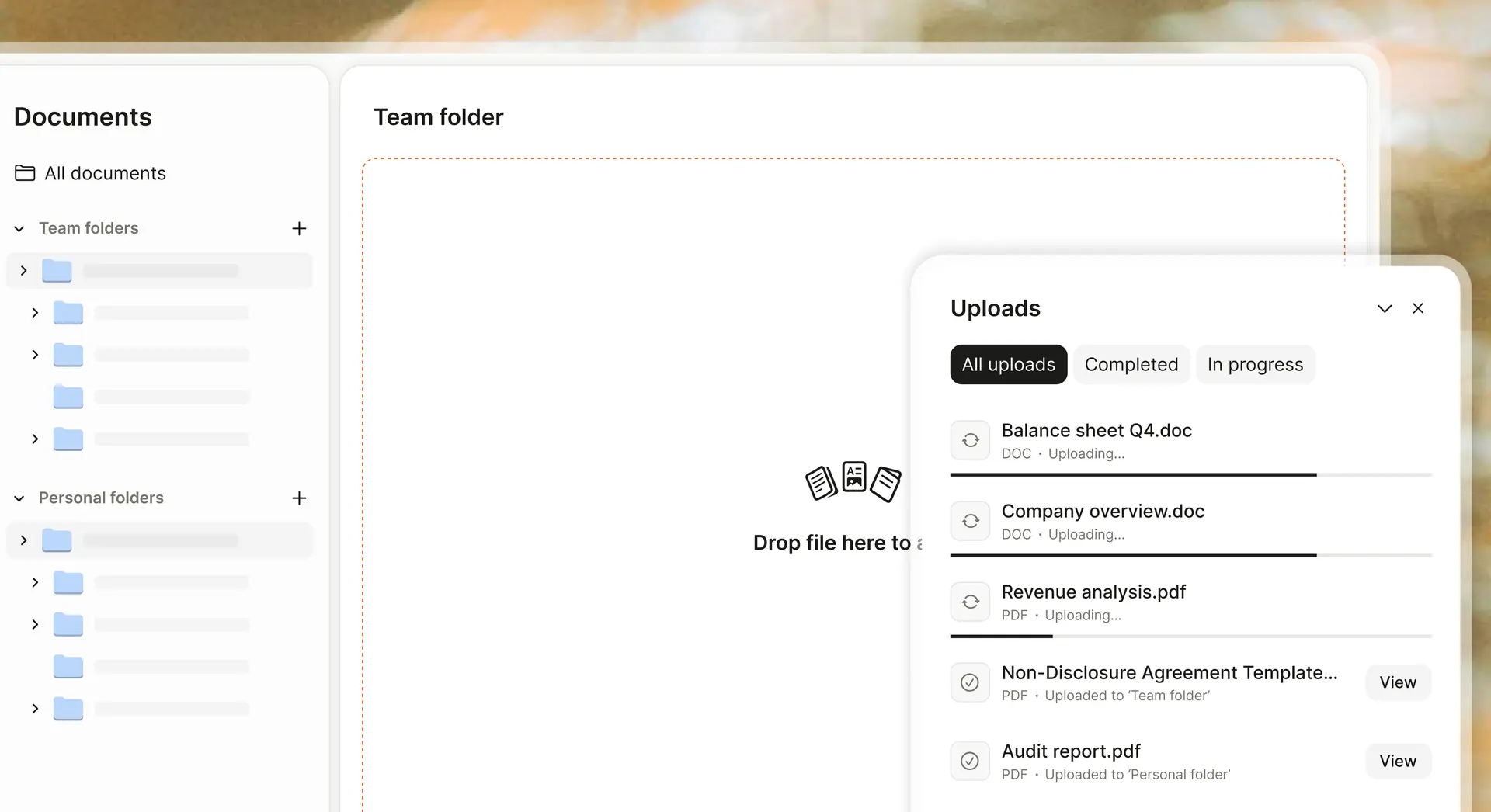
Want to skip the spreadsheet and manage your document index inside a real data room? Ellty Standard plan gives you unlimited documents and advanced analytics for $69/month.
Virtual data rooms: the backbone of due diligence (and why Ellty gets it right)
You can have the best-organized document package in the world, but if you are sharing it through email attachments or a generic file storage link, you are creating real problems. There is no visibility into who accessed what, no way to revoke access once it is shared, and no audit trail if a dispute arises.
This is where a virtual data room (VDR) comes in, and this is where Ellty was built.
What is a virtual data room?
A virtual data room is a secure online platform for sharing sensitive documents with multiple parties during a deal or review process. It gives you control over who can see what, tracks every action taken in the room, and creates a proper record of the process.
Why Ellty is a smart choice
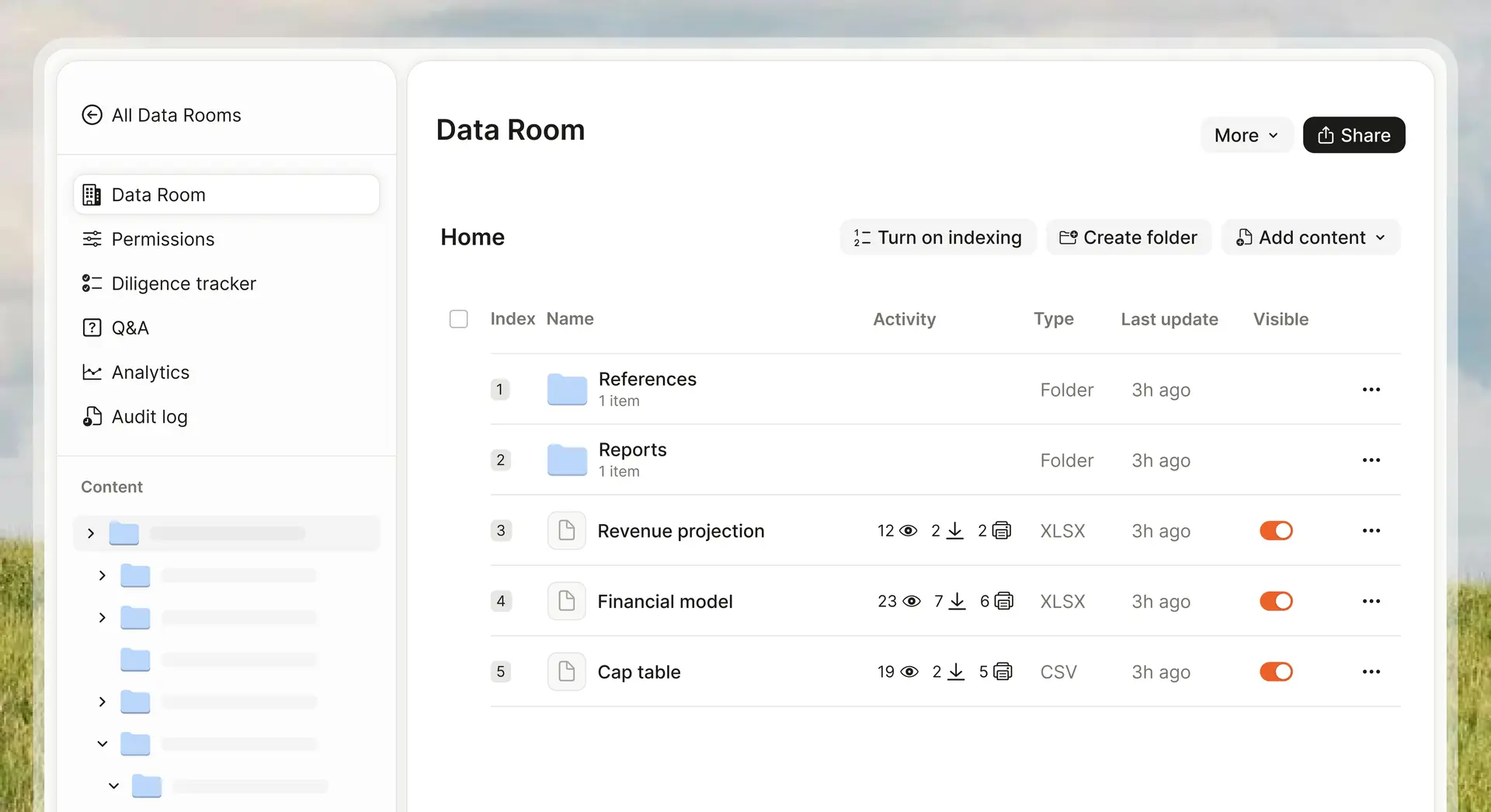
Ellty was built for exactly this kind of use. It is a secure document sharing and analytics platform with full data room functionality, built for anyone who needs to share sensitive documents in a controlled, trackable way.
Here is what you get:
- Access controls - decide exactly who can view, download, or print each document
- Real-time activity tracking - see who opened what, how long they spent on a document, and what they came back to
- NDA gating - require visitors to sign an NDA before they can access the room
- Dynamic watermarking - documents are watermarked with the viewer's details to deter unauthorized sharing
- Audit logs - a complete record of every action taken in the room, useful for legal compliance and deal management
- eSignatures - get documents signed without ever leaving the platform
What makes Ellty different from legacy VDR platforms is the pricing model. There are no per-user charges, no per-page fees, and no enterprise contracts that take weeks to negotiate. You pick a plan, get set up quickly, and know exactly what you are paying.
Here is a quick breakdown of Ellty plans:

Whether you are sharing documents with 3 people or 30, you pay the same flat rate. That is a real advantage when deal teams grow quickly and legacy platforms start charging per user.

FAQs
What is the most common mistake companies make during due diligence?
The most common mistake is being unprepared. Companies that scramble to gather documents after a deal is already in motion create delays, look disorganized, and sometimes reveal gaps they did not even know existed. The best approach is to maintain a "deal-ready" document folder at all times, even when you are not actively in a transaction.
How long does due diligence typically take?
The time depends on the size and complexity of the deal. For a small acquisition or a seed funding round, it can be two to four weeks. For larger M&A transactions, it can take three to six months or longer. Having your documents organized and accessible from day one can significantly reduce this timeline.
Do I need all these documents for a small deal?
Not always. The scope of due diligence is usually proportional to the size of the deal. A small acquisition or early-stage investment may only require a subset of these documents. Your legal advisor or the requesting party will typically provide a due diligence request list that tells you exactly what is needed.
What is the difference between a data room and cloud storage like Google Drive or Dropbox?
General cloud storage tools are built for file sharing, not deal management. A virtual data room adds access controls, activity tracking, NDA gating, watermarking, and audit logs - all of which matter during a deal. Using Google Drive for due diligence is a bit like using a notepad to run a database. It can technically work, but it is not built for the job.
Can I use Ellty if I am not a large company?
Yes - in fact, Ellty is designed for exactly that. Its flat pricing model with no per-user fees makes it accessible for startups, small businesses, consultants, and anyone running a deal without an enterprise budget. The free plan even lets you get started with document tracking before you commit.
What is NDA gating in a virtual data room?
NDA gating means that before a visitor can access any documents in your data room, they are required to read and sign a non-disclosure agreement. This is an important protection during due diligence because you are sharing confidential company information with parties who have not yet become formal partners or buyers. Ellty includes NDA gating as part of its Room plan and above.
How do I know if my due diligence documents are complete?
The best way is to work from a due diligence checklist tailored to your deal type. Your legal counsel or financial advisor can provide one, and the requesting party will often send a due diligence request list. Once you have a list, map every item to a document in your data room so you can track what is ready, what is pending, and what needs to be created.
Final thoughts
Due diligence does not have to be chaotic. When you understand what documents are needed, organize them properly, and use the right platform to share them securely, the process becomes far more manageable for everyone involved.
Think of your due diligence document package as a reflection of how your business is run. A well-organized, complete, and professionally presented document room signals to buyers and investors that you take the process seriously and that you have nothing to hide.
The six categories covered in this blog - corporate governance, financial records, legal and compliance, assets and technology, intellectual property, and balance sheet documents - form the backbone of almost every due diligence process. Start with these, get them organized, and you will be in a much stronger position when a deal opportunity arises.
And when it comes to sharing these documents, do not leave it to chance. Use a platform that gives you real control, real visibility, and a real audit trail.
Ellty gives you everything you need to run a secure, professional due diligence process, without the enterprise price tag.
Author

Anika Tabassum Nionta is a Content Manager at Ellty, where she writes about secure document sharing, virtual data rooms, M&A, due diligence, fundraising, and sales enablement. With over 6 years of writing experience, she helps professionals understand how to share confidential documents securely, track engagement, and manage deals more effectively. Anika holds both a BA and MA in English from Dhaka University. Outside of work, she enjoys reading, exploring new cafes in Dhaka, and connecting with entrepreneurs and dealmakers in her community.

