
What is vendor due diligence?
Before you sign a contract with a new supplier, hand over sensitive data to a third-party service provider, or bring a new partner into your operations, there is a question you need to answer first: Can this vendor actually be trusted?
That is what vendor due diligence is about. At its core, vendor due diligence (VDD) is the process of thoroughly evaluating a company before you enter into a business relationship with them. It is a structured way of checking that the people or organizations you are working with are financially healthy, legally compliant, operationally reliable, and aligned with your own standards.
Think of it as doing your homework before committing. Just like you would research a product before making a big purchase, you research a vendor before trusting them with part of your business.
Vendor due diligence is not a new concept. Businesses have been vetting their suppliers for as long as commerce has existed. But in today's environment, where supply chains are global, data privacy laws are strict, and one weak link can bring significant damage, vendor due diligence has become more structured, more important, and frankly, more essential than ever.
It typically involves collecting and reviewing a range of documents: financial statements, compliance certifications, legal filings, operational records, and more. This is where having the right tools matters. When vendors are sharing sensitive documents, and buyers are reviewing them, you need a secure and organized environment to manage all of it.


Why is vendor due diligence important?
The short answer: because the cost of not doing it is almost always higher than the cost of doing it.
When you skip vendor due diligence, you are essentially trusting a company blindly. And while most vendors are straightforward, some are not. Financial instability, pending lawsuits, data security gaps, or simply inflated claims, these are things you only discover if you look for them.
Here is why vendor due diligence deserves your full attention:
It protects your business from risk. A vendor going bankrupt mid-contract can disrupt your entire operations. A vendor with poor data security practices can expose your customer data. A vendor with compliance violations can drag your name into regulatory trouble. Due diligence helps you spot these risks before they become your problem.
It builds stronger, more trustworthy partnerships. When both sides go through a proper due diligence process, it sets a professional tone from the start. Vendors who are confident in their records will welcome the review. Those who are not will make that clear pretty quickly.
It is often a legal or regulatory requirement. Depending on your industry, you may be required to vet your vendors. Healthcare companies, financial institutions, and government contractors have strict third-party risk management obligations. Vendor due diligence is not optional for them. It is mandatory.
It saves money in the long run. A bad vendor relationship, one that ends in disputes, service failures, or legal action, is expensive. The time and effort spent on proper due diligence upfront is a fraction of what it costs to deal with a bad vendor after the fact.
In short, vendor due diligence is not just a box to check. It is a business protection exercise that gives you informed confidence before making important decisions.
Key aspects of vendor due diligence
Vendor due diligence is not a single task, it is a process that moves through several stages. Each stage builds on the previous one to give you a complete picture of the vendor you are evaluating.
Identification and scoping
The process starts with identifying which vendors need to be reviewed and to what depth. Not every vendor requires the same level of scrutiny. A critical IT infrastructure partner deserves deeper review than a company that supplies your office stationery. Scoping helps you direct your effort where it matters most.
Document collection
Once the scope is clear, the next step is gathering the relevant documents. This typically includes financial statements, tax records, legal agreements, certifications, and information about data handling practices. The vendor provides these, which is exactly why having a secure and organized document-sharing platform matters. You want the vendor to be able to upload materials in a controlled environment, not send them over email where they can be forwarded, lost, or accessed by the wrong person.
Review and analysis
With documents in hand, the review team goes through them carefully. This is where you look for red flags like inconsistencies in financials, gaps in compliance, unclear legal standing, or anything that does not add up. It is also where you assess the vendor's strengths.
Risk assessment
Based on the review, you assign a risk level. Some issues are manageable. Others are deal-breakers. This assessment forms the basis for your decision.
Decision and documentation
Finally, you make an informed call: proceed, renegotiate terms, or walk away. Whatever the outcome, you document the findings so there is a clear record of the process.
Key areas of focus


When conducting vendor due diligence, there are several core areas that almost every review should cover.
Financial health
Is the vendor financially stable? Review their financial statements, credit history, and any signs of financial stress. A vendor that is struggling financially may cut corners, fail to deliver, or disappear entirely.
Legal and compliance standing
Are there any outstanding lawsuits, regulatory penalties, or compliance issues? Check for litigation history, sanctions, and whether they hold the certifications and licenses relevant to their industry.
Data security and privacy
If you are sharing sensitive data with this vendor or if they will handle your customers' data, their security posture matters enormously. Look for certifications like ISO 27001 or SOC 2, understand their data handling policies, and review how they manage access control.
Operational capabilities
Can the vendor actually deliver on what they are promising? Review their track record, client references, key personnel, and the infrastructure they use to deliver their service.
Reputational standing
What is their reputation in the market? Have there been any public controversies, negative press, or consistent complaints from clients? Reputation is harder to measure than financials, but it is equally important.
Contractual and subcontractor risk
Review the vendor's standard contract terms. Also understand who their subcontractors or sub-suppliers are, a vendor who is compliant may still expose you to risk through their own supply chain.
Benefits of vendor due diligence
When done properly, vendor due diligence delivers real, measurable benefits for your business.
Reduced operational risk
You know what you are getting into before you commit. If a vendor has a track record of service failures, or their financials show instability, you find out during due diligence, not after you have signed a year-long contract.
Regulatory compliance
Many regulatory frameworks require you to maintain evidence of third-party vetting. A proper due diligence process gives you that documented trail, protecting you from fines or sanctions.
Better negotiating position
When you have done your research, you know what the vendor's strengths and weaknesses are. That gives you leverage in negotiations, whether that is on pricing, service terms, or liability clauses.
Stronger vendor relationships
Counterintuitively, going through a thorough due diligence process can strengthen the relationship with a vendor. It signals that you are serious, professional, and that you hold your partners to a high standard. Good vendors respect that.
Peace of mind
Ultimately, vendor due diligence gives you confidence. When you know you have done your homework, you can enter into the relationship without nagging doubts. That peace of mind is genuinely valuable, especially for high-stakes decisions.
Key considerations
There are a few things to keep in mind as you build or refine your vendor due diligence process.
Proportionality matters. Not every vendor needs the same depth of review. Apply your highest scrutiny to vendors with the greatest impact on your business, those handling sensitive data, those deeply integrated into your operations, or those critical to your service delivery. A tiered approach lets you allocate your time and resources intelligently.
Due diligence is not a one-time event. Vendors change over time. A company that was financially healthy two years ago may not be today. Regulatory requirements evolve. Subcontractors change. Schedule periodic reviews of your key vendors to make sure your assessment stays current.
Confidentiality must be taken seriously. During due diligence, vendors share some of their most sensitive information with you. That information needs to be handled with care. Use proper access controls, NDA agreements, and audit trails to ensure that what is shared in the due diligence process stays protected.
Document everything. Whatever you find, good or bad, document it. Keep records of what was reviewed, what was found, and what decisions were made. This creates accountability, supports compliance, and gives you a reference point for future decisions.
Speed versus thoroughness. There is often pressure to close deals quickly. But rushing due diligence to meet a timeline is exactly the kind of shortcut that leads to problems later. Build realistic timelines that allow proper review without creating unnecessary bottlenecks.


A simple vendor due diligence checklist
Knowing what vendor due diligence involves is one thing. Having a practical checklist to work from is another. Below is a straightforward checklist you can use when evaluating a new vendor. You may not need every item for every vendor, use your judgment based on the level of risk involved, but this gives you a solid starting point.
Company Basics
- Confirm the vendor's legal business name, registration number, and country of incorporation
- Verify that the business is currently active and in good standing
- Confirm the ownership structure, who owns the business, and are there any parent companies or subsidiaries relevant to the relationship?
- Review the company's history, including how long they have been in operation
Financial Health
- Request and review the last 2–3 years of financial statements
- Check for signs of financial stress, declining revenue, high debt levels, or cash flow issues
- Review credit history or ratings where available
- Confirm there are no outstanding unpaid debts or insolvency proceedings
Legal and Compliance
- Check for any current or historical litigation, disputes, or regulatory actions
- Confirm the vendor holds all licenses and certifications required for their industry
- Review compliance with relevant regulations in your sector (data protection, financial services, healthcare, etc.)
- Check for any sanctions or watch-list flags using appropriate screening tools
Data Security and Privacy
- Ask for evidence of data security certifications (ISO 27001, SOC 2, or equivalent)
- Review their data handling and privacy policies
- Understand how they manage access to sensitive information internally
- Confirm their approach to incident response and data breach notification
Operational Capability
- Request references from existing clients and actually follow up on them
- Review the vendor's track record of delivering on contracts
- Understand their key personnel and assess whether they have the team to deliver
- Check for any known operational disruptions, outages, or service failures
Reputation and Market Standing
- Search for any negative press, public complaints, or industry controversies
- Check independent review platforms where relevant
- Assess their standing within their industry are they recognized, accredited, or awarded?
Contractual and Subcontractor Review
- Review their standard contract terms for fairness and clarity
- Identify any key subcontractors or third parties involved in service delivery
- Assess the risk exposure created by those subcontractors
- Confirm liability, indemnity, and termination clauses are acceptable
Document and Process Management
- Ensure all documents are collected and stored securely, not scattered across emails
- Confirm that only authorized reviewers have access to sensitive vendor materials
- Maintain a clear record of what was reviewed, by whom, and when
- Document the final decision and the reasoning behind it
This checklist is designed to be used alongside a secure document environment. When vendors are uploading financial records, compliance certificates, and legal filings, the last thing you want is those materials floating around in email threads. A platform like Ellty lets you collect all of these documents in a single, controlled data room with access restricted to the right people and every action logged automatically.

Conducting due diligence with virtual data rooms - Why Ellty gets it right
One of the most practical challenges in vendor due diligence is document management. You are dealing with large volumes of sensitive files that need to be shared with a specific set of people, reviewed in an organized way, and tracked throughout the process. Email threads do not cut it. Shared drives are too loose. You need a proper solution.
That is where a Virtual Data Room (VDR) comes in and where Ellty stands out.
What is a Virtual Data Room?
A VDR is a secure online environment where documents can be shared, reviewed, and managed in a controlled way. Instead of emailing PDFs back and forth (where you lose track of who has what, and files can be forwarded anywhere), a VDR gives you a single, secure hub where everything is organized and every action is logged.
In a due diligence context, this means the vendor uploads their documents into the data room. Your review team accesses only what they are authorized to see. Every view, download, or interaction is tracked. And when the process is complete, you have a clean audit trail.
Why Ellty works for vendor due diligence specifically

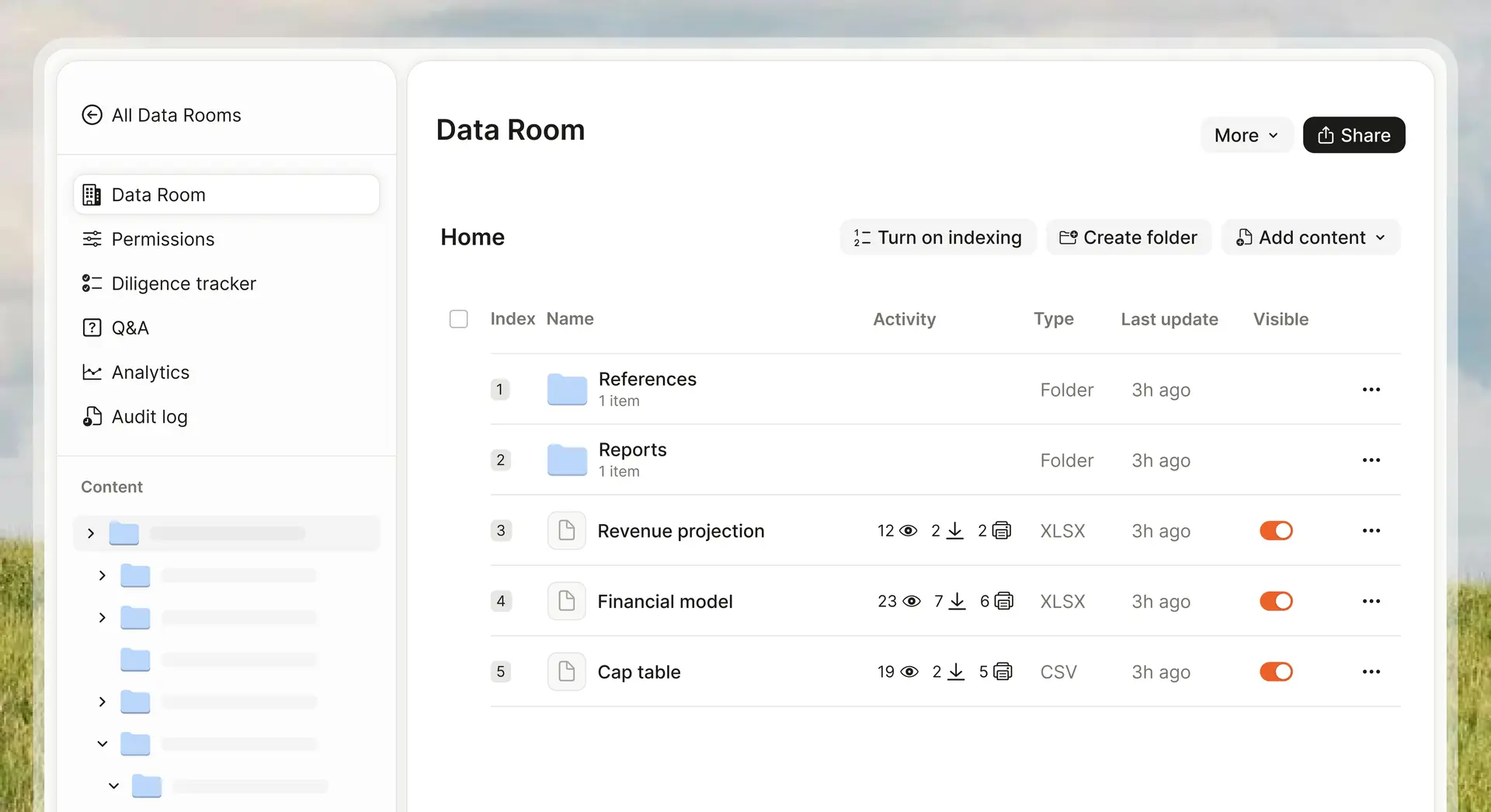
Ellty was built for exactly this kind of work, secure document sharing with real accountability. Here is what makes it practical for vendor due diligence:
Granular access controls. With Ellty Room and Room Plus plans, you can set exactly who sees what. Different reviewers can be given access to different sections of the data room. If a financial analyst only needs to see the financial documents, there is no reason for them to have access to legal filings. Ellty gives you that precision.
NDA gating. Before a reviewer can access the data room, you can require them to sign a non-disclosure agreement. This is critical in due diligence, where confidential vendor information is being shared. It protects the vendor and protects you.
Dynamic watermarking. Every document viewed in Ellty can carry a visible watermark tied to the viewer's identity. This is a serious deterrent against unauthorized sharing, and it creates a clear chain of accountability.
Real-time activity tracking. Know exactly who opened which document, how long they spent on it, and what they downloaded. This level of visibility is useful both for managing the process and for maintaining a formal record.

Full audit logs. Ellty Room Plus plan gives you complete audit logs, a timestamped record of everything that happened in the data room. This is exactly the kind of documentation that compliance and legal teams need.
Transparent, flat-rate pricing. This is where Ellty is genuinely different from traditional VDR platforms. Legacy data room providers often charge per page, per user, or per gigabyte and their pricing can spiral quickly as a deal scales. Ellty pricing is flat and straightforward. The Room plan starts at $149/month, and Room Plus is $349/month, which supports up to 4,000 assets per data room, group permissions, and full audit logs. No per-user charges. No surprise overages. No weeks-long negotiations to get a quote.
For a legal team, a procurement department, or a business managing multiple vendor reviews simultaneously, that predictability is genuinely valuable.
Quick setup. Due diligence processes often need to move fast. Ellty is designed to be set up quickly, so you can have a secure, professional data room live in hours, not days.

Frequently asked questions
What is the difference between vendor due diligence and buyer due diligence?
Vendor due diligence is conducted on the vendor, the company supplying goods or services. Buyer due diligence (or simply "due diligence") is typically used in the context of acquisitions, where the buyer reviews the company being purchased. In practice, vendor due diligence is about evaluating who you are working with before entering a commercial relationship.
How long does a vendor due diligence process typically take?
The time depends on the complexity of the review. A simple vendor review might take a few days. A comprehensive due diligence process for a critical vendor, one involving financial, legal, operational, and compliance review, can take several weeks. Having an organized document environment (like a VDR) can significantly speed things up, since reviewers can access everything in one place rather than chasing down files.
What documents are typically requested during vendor due diligence?
Common document requests include: financial statements (typically 2-3 years), tax filings, details of legal proceedings or disputes, compliance certificates and licenses, data security policies, key contracts or customer references, and information about subcontractors or partners. The exact list depends on the nature of the vendor and the level of scrutiny required.
Do small businesses need to conduct vendor due diligence?
Yes, though the depth of the process can be scaled appropriately. Even a small business working with a critical supplier or data processor should conduct at least a basic review. The risk of a vendor failure or compliance issue does not scale with the size of the company evaluating them.
How does a Virtual Data Room help with vendor due diligence?
A VDR provides a secure, organized environment for sharing and reviewing documents. It replaces messy email threads with a structured system where access is controlled, activity is tracked, and confidentiality is protected. For vendor due diligence, this means you can manage the entire document review process in one place with a clear audit trail at the end.
Can Ellty handle multiple vendor reviews at the same time?
Yes. Ellty Room Plus plan supports up to 4,000 assets per data room, with group visitor permissions and full audit logs. You can structure separate sections for different vendors or run parallel reviews with different access groups. The flat-rate pricing also means you are not penalized for scaling up.
Is vendor due diligence legally required?
In some industries and jurisdictions, yes, it is a regulatory requirement. Financial services, healthcare, and government contracting, for example, all have formal third-party risk management requirements. But even where it is not legally mandated, vendor due diligence is considered best practice and can protect a business from significant commercial, financial, and reputational harm.
Final thoughts
Vendor due diligence is one of those processes that rarely gets the attention it deserves, until something goes wrong. A supplier that turns out to be financially unstable, a vendor with poor data security practices, a partner that turns out to be in the middle of undisclosed litigation - these are problems that due diligence is specifically designed to prevent.
The good news is that doing vendor due diligence well does not have to be complicated or expensive. What it requires is a structured approach, a clear checklist of what to review, and the right tools to manage the document sharing and review process securely.
That is exactly what Ellty provides. Whether you are running a one-off vendor review or managing a recurring vendor assessment program, Ellty gives you the secure document environment, the access controls, and the audit trail you need, at a price that is straightforward and predictable.
Vendor relationships are at the heart of most businesses. The ones built on proper evaluation from the start tend to be stronger, cleaner, and more resilient. Take the time to do it right.
Ellty is a secure document sharing and analytics platform with full data room functionality, built for anyone who needs to share sensitive documents in a controlled, trackable way. Plans start at $0/month. Visit Ellty.com to learn more.
Author

Anika Tabassum Nionta is a Content Manager at Ellty, where she writes about secure document sharing, virtual data rooms, M&A, due diligence, fundraising, and sales enablement. With over 6 years of writing experience, she helps professionals understand how to share confidential documents securely, track engagement, and manage deals more effectively. Anika holds both a BA and MA in English from Dhaka University. Outside of work, she enjoys reading, exploring new cafes in Dhaka, and connecting with entrepreneurs and dealmakers in her community.

