
Due diligence has always been one of the most critical parts of any business deal. Whether you are acquiring a company, closing a property transaction, or raising a funding round, the process of reviewing documents, verifying facts, and assessing risks takes a lot of time and focus. Traditionally, this has meant long hours, large teams of reviewers, and considerable expense.
But that is changing. Artificial intelligence is now making its way into due diligence workflows, and the impact is real. AI tools can process large volumes of documents faster than any human team, flag potential risks automatically, and surface insights that might otherwise be missed. For deal teams looking to move faster without cutting corners, AI-driven due diligence is quickly becoming the smarter way to work.
In this guide, we walk through what AI due diligence actually means, why it matters, and how platforms like Ellty are helping teams run cleaner, more efficient processes from start to finish.
What is AI due diligence?
AI due diligence is the use of artificial intelligence tools to support, speed up, or partially automate the process of reviewing documents and assessing risks in a transaction or business evaluation.
In a traditional due diligence process, a team of lawyers, accountants, or analysts manually reviews hundreds, sometimes thousands of documents. They look for red flags, verify numbers, confirm legal compliance, and build a picture of the target company or asset. It is thorough work, but it is also slow and expensive.
AI changes that equation. With the right tools, you can use machine learning models to read contracts at scale, natural language processing to extract key clauses automatically, and intelligent search to find what matters in a large document set. The AI does not replace human judgment, but it handles the heavy lifting so that human reviewers can focus on the decisions that actually require expertise.
AI due diligence can apply across many types of transactions, including mergers and acquisitions, real estate deals, investment rounds, private equity reviews, and legal contract audits. The common thread is using technology to make the review process more efficient, more consistent, and less prone to human error.
Why is AI due diligence important?
The short answer is that traditional due diligence does not scale well. As deals grow more complex and document volumes increase, the pressure on review teams becomes enormous. Mistakes happen. Important clauses get missed. Timelines slip.
Here is why AI matters in this context:
Speed
A typical M&A due diligence process can take weeks or even months. AI tools can review and categorize thousands of documents in a fraction of that time. When a deal has a tight window, that speed advantage is significant.
Accuracy
Humans get tired. When you are reviewing document number 400 of 600, your attention is not the same as it was at document number one. AI does not have that problem. It applies the same level of scrutiny to every document, every time.
Cost
Reducing manual review hours directly reduces cost. Smaller teams can cover more ground, and you spend less on external advisors for routine document review tasks.
Consistency
AI applies the same criteria across every document. There is no variation based on who happens to be reviewing a file on a given day. This makes the overall due diligence output more reliable.
Risk detection
AI models trained on legal and financial documents can flag unusual clauses, missing provisions, or risk patterns that a human reviewer might overlook simply because they are processing too much at once.
Key areas where AI enhances due diligence
AI is not one single tool. It is a collection of capabilities that can be applied at different stages of the due diligence process. Here are the most impactful areas:
1. Document review and classification
This is where AI delivers the most immediate value. Instead of a reviewer manually opening and categorizing every file, AI can automatically sort documents by type like contracts, financial statements, HR files, IP agreements and route them to the right reviewers. This alone cuts days off a typical timeline.
2. Contract analysis
AI natural language processing tools can scan contracts to extract specific clauses, identify missing provisions, and highlight terms that fall outside normal parameters. Change of control clauses, indemnification language, termination rights - all of this can be pulled and summarized automatically.
3. Financial data extraction
Rather than manually pulling figures from financial statements, AI can extract revenue numbers, liabilities, cash flow data, and other key metrics and structure them for analysis. This reduces transcription errors and speeds up financial modeling.
4. Risk flagging
AI can cross-reference documents against known risk indicators such as regulatory issues, non-standard terms, or unusual payment structures, and surface these automatically. Reviewers get a shortlist of what needs attention, rather than having to find it themselves.
5. Compliance checking
For regulated industries or cross-border transactions, compliance requirements can be extensive. AI tools can check documents against regulatory frameworks and flag potential gaps, which is especially useful when dealing with GDPR, employment law, or environmental regulations.
6. Q&A and information retrieval
Some AI platforms allow reviewers to ask questions in plain language like 'Does this agreement include a non-compete clause?', and get immediate answers based on the document set. This turns document search from a manual task into a conversation.


Benefits of AI-driven due diligence
The benefits of AI in due diligence go beyond just saving time. Here is a fuller picture of what teams gain when they bring AI into their process:
- Faster deal cycles: Shorter review periods mean deals close sooner, which is a competitive advantage in fast-moving markets.
- Lower external advisor costs: When AI handles routine document review, you rely less on expensive legal and financial teams for the basics.
- Scalability: A small internal team can handle a large deal without hiring additional reviewers. AI scales with your document volume.
- Better audit trail: AI-assisted reviews generate structured logs and outputs that make it easier to document what was reviewed and when.
- Early risk identification: Problems surface earlier in the process, giving you more time to negotiate, adjust deal terms, or walk away if necessary.
- Reduced deal fatigue: Long due diligence processes are exhausting. AI reduces the manual burden, keeping teams sharper when it counts.
- Consistent standards: Every deal gets the same level of rigor. There is no variation based on team bandwidth or individual reviewer habits.
Challenges & limitations of AI in due diligence


AI is a powerful tool, but it is not perfect. It is important to understand where the technology has limits so you can use it effectively rather than over-relying on it.
Context and nuance
AI is good at pattern recognition, but it does not always understand context the way a human does. A clause that looks unusual in isolation might be completely normal given the specifics of a deal. Human reviewers still need to apply judgment to AI-flagged items.
Training data quality
AI models are only as good as the data they were trained on. If a model has not been trained on documents similar to the ones in your deal, it may miss things or generate unhelpful flags. This is why specialized legal and financial AI tools generally outperform general-purpose ones in this context.
Language and jurisdiction
Not all AI tools handle multiple languages or legal systems equally well. If your deal involves documents in different languages or across different regulatory frameworks, you need to check whether the tool you are using can handle that reliably.
Data Security
Due diligence involves highly sensitive documents. Any AI tool you bring into the process needs to meet your security requirements. This means encrypted storage, controlled access, and a clear understanding of where your data is going.
Human oversight is still essential
AI should be treated as a first-pass reviewer, not a final decision-maker. The risk assessment, negotiation, and final judgment still require experienced humans. AI surfaces what needs attention. People decide what to do about it.
The future of AI in due diligence
AI in due diligence is still developing, and the pace of progress is fast. Here is where things are heading:
Deeper integration with data rooms
The future is not AI as a standalone tool, it is AI built directly into the platforms where due diligence actually happens. Expect to see virtual data rooms with built-in AI capabilities that can analyze documents the moment they are uploaded, without requiring separate tools.
Predictive risk scoring
Rather than just flagging what looks unusual, future AI systems will be able to assign risk scores to entire deals based on patterns from thousands of previous transactions. This will give deal teams a much clearer picture of relative risk before they are deep into the process.
Real-time collaboration intelligence
AI will increasingly track not just documents but reviewer behavior. Which sections are getting the most attention? Where is the review team spending time? This kind of intelligence will help deal leads identify where concerns are clustering in real time.
Greater automation of routine checks
Tasks like verifying company registration details, checking for litigation history, and confirming regulatory filings will become increasingly automated. Human reviewers will focus more on interpretation and less on data gathering.
More accessible for smaller teams
As AI tools become easier to use and more affordable, due diligence capabilities that used to require large teams will become available to much smaller organizations. This democratization of the process is already underway, and it will continue.
Ellty gives you the tools to organize and share due diligence documents securely with real-time analytics, access controls, and NDA gating. Try it free, no credit card needed.
Conducting Due Diligence with Virtual Data Rooms
Why Ellty is the right choice for your next deal

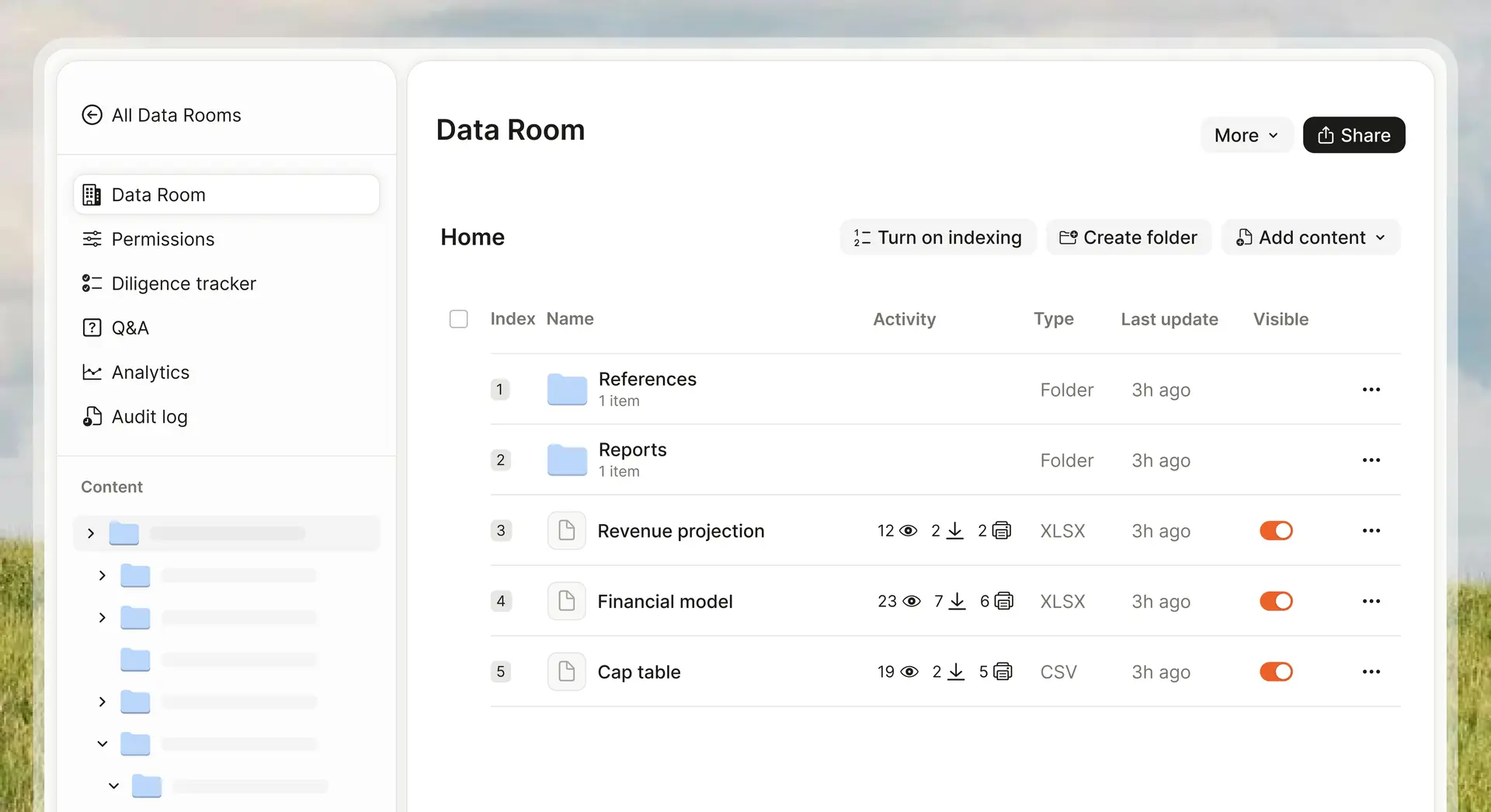
AI tools work best when the underlying document management process is solid. That is where a virtual data room comes in. Before AI can analyze your documents, those documents need to be organized, accessible, and secure. This is exactly what Ellty is built for.
Ellty is a secure document sharing and analytics platform with full data room functionality. It is built for anyone who needs to share sensitive documents in a controlled, trackable way, whether you are running a funding round, closing a property deal, managing an acquisition, or handling a consulting engagement.
What makes Ellty stand out
Clean, controlled access
With Ellty, you decide exactly who sees what. Granular permissions let you control access at the document level, so reviewers only see what they are meant to see. NDA gating ensures that visitors must agree to your terms before accessing the room. Dynamic watermarking discourages unauthorized sharing.
Real-time activity tracking
One of the most useful features in any due diligence process is knowing how reviewers are engaging with your documents. Ellty shows you in real time who has opened what, how long they spent on each document, and when they were last active. This kind of visibility helps you understand where interest is highest and where questions are likely to come from.

Full audit trail
Every action in an Ellty data room is logged. This gives you a complete record of who accessed what and when, which matters both for compliance and for post-deal accountability.
No per-user fees
This is where Ellty genuinely differs from legacy VDR platforms. Most enterprise data room providers charge per user, per page, or per download and those costs add up fast on a live deal. Ellty uses flat-rate pricing with no surprise overages. You pick a plan, get set up in minutes, and know exactly what you are paying whether you are sharing documents with three people or thirty.
Ellty plans at a glance


Ellty offers four pricing tiers to match where you are in your deal process:
- Free - $0/month. Document tracking, real-time analytics, and secure sharing. A good starting point if you are in early conversations and want to see who is opening what before setting up a full data room.
- Standard - $69/month. Unlimited documents, advanced analytics, eSignatures, custom branding, and data room features included. Works well for smaller deals and ongoing client or investor communication.
- Data Room - $149/month. Granular permissions, NDA gating, dynamic watermarking, and restricted visitor access. Everything you need to run a controlled document review for due diligence, property transactions, or sensitive client deliverables.
- Data Room Plus - $349/month. Group visitor permissions, full audit logs, and support for up to 4,000 assets per data room. Built for heavier document loads and multi-party deals where you need structured access control across different groups of reviewers.
For anyone who needs a professional data room without an enterprise contract, Ellty is the place to start. The setup is quick, the pricing is straightforward, and the features cover everything you need to run a clean, organized due diligence process.

Frequently asked questions
What is AI due diligence, exactly?
AI due diligence refers to using artificial intelligence tools to assist in the process of reviewing and analyzing documents during a business transaction. This includes contract analysis, risk flagging, financial data extraction, and intelligent document search. The goal is to make the process faster, more consistent, and less resource-intensive.
Can AI fully replace human reviewers in due diligence?
No, and it should not be expected to. AI handles the heavy lifting such as sorting documents, extracting data, and flagging unusual terms, but the final judgment on risk, deal terms, and negotiation strategy still requires human expertise. Think of AI as a very capable first reviewer, not a replacement for your legal and financial team.
Is it safe to use AI tools with confidential due diligence documents?
It depends on the platform. You should only use AI tools that offer encrypted storage, strict access controls, and a clear data handling policy. The same applies to your data room. Ellty, for example, is built with security as a foundation, access is controlled, activity is logged, and documents can only be accessed by people you have explicitly authorized.
How does a virtual data room support AI due diligence?
A virtual data room is where due diligence documents are organized and shared. It acts as the secure foundation for the process. AI tools can be layered on top to analyze those documents. Platforms like Ellty give you the structure and security that makes document review manageable, whether you are using AI analysis tools or traditional manual review.
What types of deals benefit most from AI due diligence?
Any transaction that involves a large volume of documents benefits from AI assistance. This typically includes mergers and acquisitions, private equity and venture capital investments, commercial real estate transactions, legal contract reviews, and regulatory compliance audits. The larger and more complex the deal, the more value AI adds.
How long does AI-assisted due diligence typically take compared to traditional due diligence?
This varies depending on the deal size and document volume, but AI can significantly compress timelines. Document review tasks that might take a team of reviewers several weeks can often be completed in days when AI is handling initial classification, extraction, and flagging. Human review of AI-surfaced issues is then much more focused and efficient.
Do I need technical expertise to use a virtual data room for due diligence?
No. Modern virtual data rooms, including Ellty, are designed to be easy to set up and use without any technical background. You can organize your documents, set permissions, and invite reviewers in minutes. The platform handles the security and structure, you focus on the deal.
Final thoughts
Due diligence is not going away. If anything, it is becoming more important as transactions grow more complex and the stakes get higher. What is changing is how teams approach it. AI is shifting the work from manual, time-consuming document review toward smarter, faster, and more consistent processes.
But AI tools are only as effective as the environment they operate in. Documents need to be organized, accessible, and secure before any analysis can begin. That is why the data room you choose matters just as much as the AI tools you use.
Ellty gives you that foundation. A clean, secure data room with real-time analytics, granular access controls, and transparent flat-rate pricing. So you can focus on the deal, not the admin. Whether you are preparing for your first investor review or running a full M&A process, Ellty has a plan that fits.
Author

Anika Tabassum Nionta is a Content Manager at Ellty, where she writes about secure document sharing, virtual data rooms, M&A, due diligence, fundraising, and sales enablement. With over 6 years of writing experience, she helps professionals understand how to share confidential documents securely, track engagement, and manage deals more effectively. Anika holds both a BA and MA in English from Dhaka University. Outside of work, she enjoys reading, exploring new cafes in Dhaka, and connecting with entrepreneurs and dealmakers in her community.

