
Real estate deals move fast. Sellers want quick decisions. Buyers feel pressure to act before someone else does. And in the middle of all that urgency, the most important step often gets rushed or skipped entirely - due diligence.
This is a mistake that can cost you far more than the deal itself.
Whether you're buying a commercial property, closing an investment deal, or helping a client navigate a transaction, due diligence is what separates smart decisions from expensive ones. This guide breaks it all down - what it means, how to do it right, and how modern tools like Ellty make the whole process cleaner and more controlled.
What is due diligence?
Due diligence in real estate is the process of thoroughly investigating a property before you commit to buying it. Think of it as doing your homework - but the stakes are much higher than a test.
During this period, the buyer has the right to review everything about the property: its legal status, physical condition, financial records, zoning compliance, and more. The goal is simple - confirm that what you're buying is actually what you think it is, and that there are no hidden problems waiting to show up after the deal is done.
Due diligence is not just about finding problems, though. It also helps you understand the full value of a property, negotiate better terms, and make a confident, informed decision.
It typically happens after a purchase agreement is signed but before the deal officially closes. During this window, the buyer can inspect, question, and in many cases, walk away if something serious comes up.
Why due diligence is critical in real estate
Real estate transactions involve a lot of money. And unlike most purchases, you can't return a property if something goes wrong after closing.
Here's why skipping or rushing due diligence is one of the most costly mistakes a buyer can make:
Hidden liabilities become your problem. Once the deal closes, any legal disputes, unpaid taxes, environmental issues, or undisclosed liens on the property belong to you. Due diligence is your chance to find these before they become your responsibility.
Physical problems are expensive to fix. A building might look fine on the surface but have serious structural, electrical, or plumbing issues underneath. An inspection during due diligence can save you from inheriting repair costs worth hundreds of thousands of dollars.
Zoning and permits matter more than most buyers realize. A property may be marketed for a specific use like retail, residential, mixed-use, but if the zoning or permits don't match, you could find yourself unable to use it the way you planned.
Financing can fall apart. Lenders often require clean due diligence results before approving a loan. If issues surface during this phase, your financing could be delayed or denied.
It gives you negotiating power. If due diligence uncovers problems, you don't have to walk away. You can use those findings to negotiate a lower price, request repairs, or ask the seller to cover certain costs.
In short, due diligence is your protection. It is the one step in the process that exists entirely in your favor as a buyer.
Real estate due diligence framework
A good due diligence process isn't just a checklist. It's a structured framework that covers every major area of risk. Here are the four core pillars:
1. Legal due diligence
Legal due diligence covers everything related to ownership, rights, and legal obligations tied to the property.
- Title search and ownership verification
- Existing liens, mortgages, or encumbrances
- Easements, rights of way, or deed restrictions
- Pending litigation or disputes involving the property
- HOA rules and restrictions (if applicable)
2. Financial due diligence
Financial due diligence is for investment properties especially, the numbers need to hold up.
- Review of rent rolls and lease agreements
- Income and expense statements (usually 2-3 years)
- Outstanding property taxes or assessments
- Operating costs and capital expenditure history
- Projected returns and vacancy rates
3. Physical due diligence
This is the hands-on inspection side of things.
- Structural and foundation inspection
- Roof, HVAC, plumbing, and electrical systems
- Environmental assessments (especially for commercial properties)
- Survey and boundary verification
- ADA compliance or building code status
4. Market due diligence
This puts the property in context of its surrounding market.
- Comparable sales and rental data
- Neighborhood trends and development plans
- Proximity to infrastructure, transport, and amenities
- Demand drivers for the property type
When all four of these areas are covered thoroughly, you get a complete picture of the opportunity and the risks.
Real estate due diligence checklist
Use this checklist as your starting point. Depending on the size and type of the transaction, some items may need to be expanded or adapted.
Legal documents
- Purchase agreement and all addendums
- Title report and title insurance commitment
- Survey report
- Zoning certificate and permitted uses
- Certificate of occupancy
- Any pending or past litigation documents
- Easement agreements
Financial documents
- Last 2-3 years of operating statements
- Current rent roll (for income-producing properties)
- Property tax records and any outstanding assessments
- Utility bills and service contracts
- Capital improvement history
Physical inspection reports
- General property inspection report
- Roof inspection
- Structural engineering report (for older buildings)
- Environmental Phase I assessment (Phase II if needed)
- Pest inspection
- HVAC, plumbing, and electrical inspection reports
Leases and tenant information
- All current lease agreements
- Security deposit records
- Tenant correspondence and any disputes
- Lease expiration schedule
Insurance and compliance
- Current insurance policies and claims history
- Fire, safety, and building code compliance records
- Flood zone determination
How long is the due diligence period in real estate?
This is one of the most common questions in any real estate deal, and the honest answer is: it depends.
In most residential real estate transactions in the US, the due diligence period typically runs anywhere from 7 to 30 days. For commercial properties, it can range from 30 to 90 days and for large or complex deals, it sometimes extends even further by mutual agreement.
The length of the period depends on several factors:
- Type of property: Residential properties are generally simpler to review. Commercial, industrial, or mixed-use properties take more time.
- Size of the transaction: Larger deals involve more documents, more parties, and more areas to investigate.
- Complexity of the title: If there are existing tenants, multiple owners, or legal complications, more time is needed.
- Condition of the property: Older properties or those requiring environmental assessments will need a longer review window.
- Availability of documents: If the seller takes time to provide records, the clock keeps running.
One important note - the due diligence period is usually negotiated as part of the purchase agreement. Buyers should always push for enough time to do it properly. Rushing this step to close a deal faster is rarely worth it.
If new issues come up during the review, it is also possible to request an extension from the seller. Most reasonable sellers will agree, since it's in their interest to close cleanly too.
Virtual data rooms: the backbone of real estate due diligence
Here's where the process gets modern.
Not long ago, due diligence meant physical document rooms, a conference room stacked with binders, where buyers and their advisors had to physically show up to review materials. That was slow, expensive, and frankly, a security nightmare.
Today, Virtual Data Rooms (VDRs) have changed everything.
A VDR is a secure online platform where all due diligence documents are stored, shared, and tracked in a controlled environment. Instead of emailing sensitive files or setting up physical meetings, sellers upload everything to one place and buyers can access it from anywhere, under controlled conditions.
For real estate transactions specifically, VDRs solve some very real problems:
- Security: Sensitive financial and legal documents are not floating around in email threads or unprotected file-sharing links.
- Access control: You decide exactly who can see what. A lender might see financials but not tenant correspondence. A technical consultant might only access inspection reports.
- Tracking: You can see exactly who viewed which document, when, and for how long. This gives sellers valuable insight into buyer interest, and gives everyone an audit trail.
- Speed: Everyone works from the same, always-updated set of documents. No version confusion, no back-and-forth.
How Ellty makes real estate due diligence easier

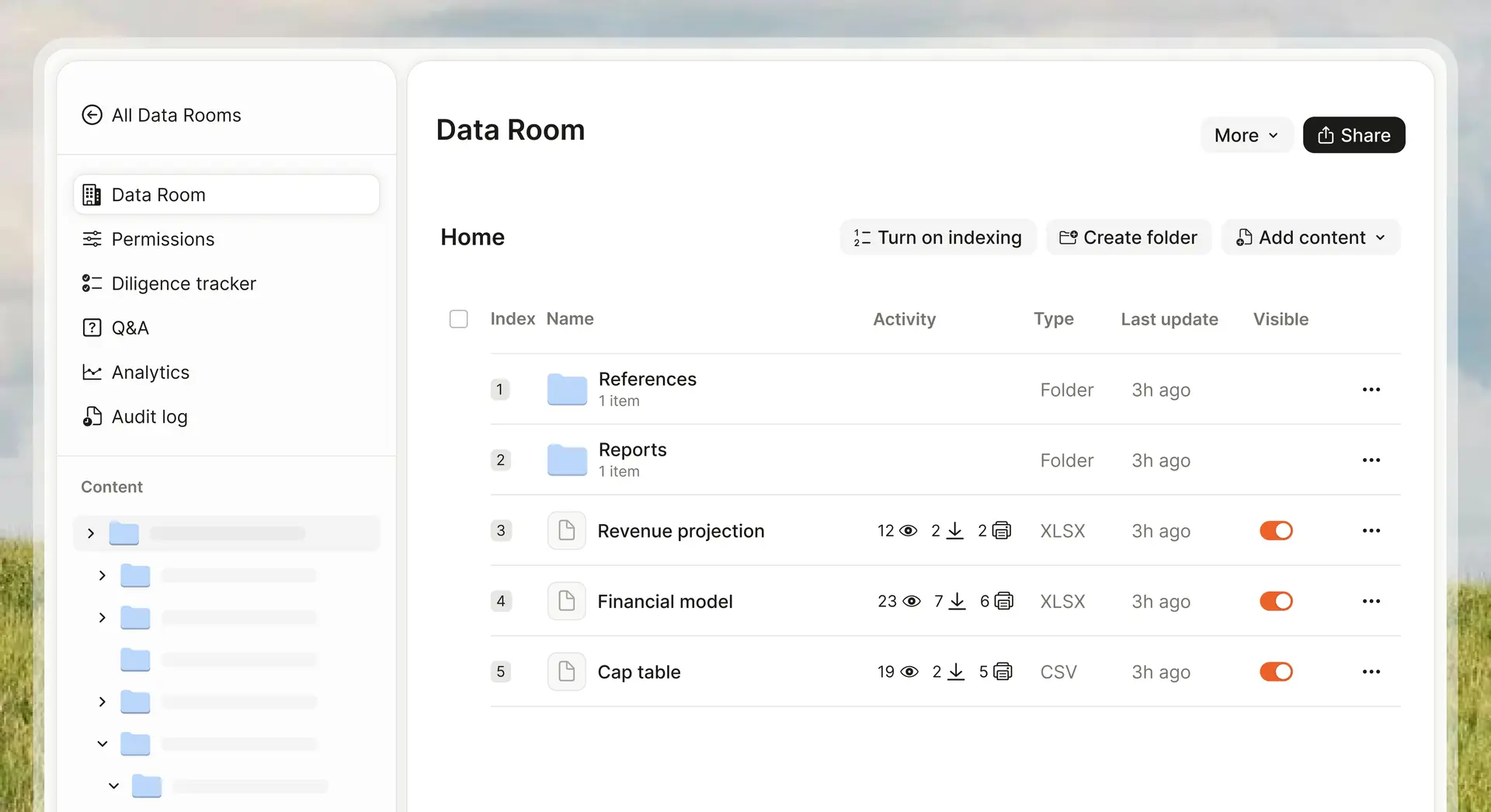
Ellty is a secure document sharing and analytics platform built with full VDR functionality. It is designed for exactly the kind of controlled, sensitive document sharing that real estate due diligence demands.
Here is what Ellty brings to the table for property transactions:
Granular access controls. With Ellty Room and Room Plus plans, you can set precise permissions for every reviewer. Different parties such as legal teams, financial analysts, brokers, lenders - only see the documents they're supposed to see.

NDA gating. Before a reviewer can access the data room, Ellty can require them to sign a Non-Disclosure Agreement. This is critical in competitive transactions where you're sharing sensitive property and financial data with multiple parties.
Dynamic watermarking. Every document viewed in Ellty can be automatically watermarked with the viewer's name and access timestamp. This deters unauthorized sharing and adds a layer of accountability.
Real-time activity tracking. Ellty analytics show you exactly what's being read, how long someone spent on a document, and which sections got the most attention. For sellers, this is valuable intelligence. For buyers, it confirms that their review is complete.

Clean audit trail. Every access event is logged. This matters both during the deal and after - especially if any disputes arise about what was disclosed and when.
Transparent, flat pricing. This is where Ellty stands out. Most legacy VDR platforms charge per user or per page, and custom quotes can take weeks to negotiate. Ellty pricing is simple and flat:
- Free - Document tracking, real-time analytics, secure sharing. Good for early conversations.
- Standard ($69/month) - Unlimited documents, advanced analytics, eSignatures, and custom branding. Works well for smaller deals and ongoing client communication.
- Room ($149/month) - Granular permissions, NDA gating, dynamic watermarking, and restricted visitor access. Everything you need to run a controlled due diligence process.
- Room Plus ($349/month) - Group visitor permissions, full audit logs, and support for up to 4,000 assets per data room. Built for complex, multi-party transactions.
No per-user fees. No per-page charges. No surprise bills at the end of the deal.
Whether you're managing a single property transaction or running due diligence across multiple deals at the same time, Ellty gives you a professional, scalable platform without the enterprise contract or the wait.


Risk assessments in real estate
Even after due diligence is complete, risk doesn't disappear. It just becomes known and known risks are manageable ones.
A proper risk assessment takes everything uncovered during due diligence and evaluates it in terms of likelihood and impact. Here's how to think about it:
Legal risk
Are there any title defects, unresolved disputes, or regulatory issues? Legal risks can delay or kill a deal, or result in costly litigation post-closing. A clean title report and legal review should be non-negotiable.
Financial risk
Does the property generate the income you're projecting? Are the operating expenses realistic? For investment properties, stress-test the numbers against higher vacancy rates or increased expenses. What happens to your returns if conditions shift?
Physical or structural risk
Inspection reports might flag issues that range from minor to serious. Some can be factored into the price; others might be deal-breakers. Environmental contamination, for instance, carries both cost and liability risk that extends well beyond the purchase price.
Market and timing risk
Real estate is cyclical. Even a well-bought property carries market risk. Interest rate changes, economic downturns, or shifts in local demand can affect both value and income. Understanding where you are in the cycle matters.
Tenant and occupancy risk
For income-producing properties, tenant quality and lease terms are a risk factor. A short lease with a financially weak tenant is a very different situation than a long-term lease with a creditworthy anchor tenant.
Once risks are identified, you have three options: accept them, mitigate them through negotiation or contract terms, or walk away. The whole point of due diligence is making sure that choice is yours to make, with full information.
Don't leave risk management to chance. Ellty activity tracking and audit logs keep your due diligence process documented and defensible from start to finish. Try Ellty today.
FAQs
What is the purpose of due diligence in real estate?
Due diligence gives the buyer a structured opportunity to investigate a property before committing to the purchase. It helps uncover legal, financial, and physical issues that could affect the property's value or the buyer's ability to use it as intended. The goal is to make a fully informed decision, not to find a reason to walk away, but to confirm you're walking in with eyes open.
What happens if issues are found during due diligence?
Finding issues doesn't automatically kill a deal. In most cases, it opens a negotiation. The buyer can request a price reduction, ask the seller to make repairs, require funds to be held in escrow, or ask for additional warranties. If the issues are serious enough and can't be resolved, the buyer may be able to walk away and recover their earnest money deposit, depending on the terms of the purchase agreement.
Can the due diligence period be extended?
Yes, in most cases it can, as long as both parties agree. If additional inspections are needed, documents are delayed, or complex legal issues come up, it is common to request a short extension. This should be done in writing and agreed to before the original period expires.
Who is responsible for conducting due diligence?
The buyer is primarily responsible for conducting due diligence, but they rarely do it alone. A typical due diligence team includes real estate attorneys, accountants or financial advisors, property inspectors, environmental consultants, and sometimes a dedicated transaction advisor. For large deals, all of these professionals may be involved simultaneously.
What is a Virtual Data Room, and do I really need one for real estate due diligence?
A Virtual Data Room is a secure online platform for storing and sharing sensitive deal documents. For small transactions, you might manage without one. But for any deal involving multiple parties, sensitive financials, or large document volumes, a VDR is not just convenient - it's essential. It keeps things organized, protects sensitive information, and creates a clear record of everything shared. Platforms like Ellty make this accessible with simple setup or enterprise pricing.
What is the difference between due diligence and a home inspection?
A home inspection is one component of due diligence, the physical assessment of a property's condition. Due diligence is the broader process that covers legal, financial, physical, and market aspects of the property. A home inspection alone is not sufficient due diligence, especially for commercial or investment properties where financial and legal review is equally important.
What documents should a seller prepare before the due diligence period begins?
Sellers who are well-prepared can significantly speed up the process and instill buyer confidence. Key documents to have ready include: title reports, survey records, all current lease agreements, financial statements and rent rolls, tax records, inspection reports (if available), permits and certificates of occupancy, insurance history, and any legal correspondence related to the property. Organizing these in a VDR like Ellty before the process starts makes the entire review smoother for all parties.
Final thoughts
Due diligence in real estate is not bureaucracy. It is the single most important step between a signed agreement and a closed deal that you can actually stand behind.
Buyers who skip it or rush through it often discover too late that the deal they thought they made was not the deal they actually got. Sellers who facilitate a clean, organized review process close faster and build trust with their counterpart.
The real estate industry moves quickly, but good decisions require complete information. A structured due diligence process, supported by the right tools, is what gets you there.
Platforms like Ellty exist to make that process more controlled and less chaotic. Instead of scattered emails and unsecured file links, you have one organized, trackable, permission-controlled environment where everything lives and every action is logged. Whether you're sharing documents with three people or thirty, whether it's a single deal or several running in parallel, Ellty gives you the infrastructure to do it right without the complexity or the cost of legacy enterprise platforms.
Real estate transactions are too significant to leave to chance. Do the work. Review the documents. Ask the hard questions. And make sure the tools you're using are built to protect the process every step of the way.
Start your next real estate due diligence process on the right foundation.


Author

Anika Tabassum Nionta is a Content Manager at Ellty, where she writes about secure document sharing, virtual data rooms, M&A, due diligence, fundraising, and sales enablement. With over 6 years of writing experience, she helps professionals understand how to share confidential documents securely, track engagement, and manage deals more effectively. Anika holds both a BA and MA in English from Dhaka University. Outside of work, she enjoys reading, exploring new cafes in Dhaka, and connecting with entrepreneurs and dealmakers in her community.

