
You don't need an enterprise data room to share documents with investors. But you also can't get away with a Google Drive folder if you're serious about fundraising. This guide breaks down what investor portals actually are, what features matter by use case, and which tools make sense at each stage.
What is an investor portal?
The use cases vary a lot depending on who you are. Here's a practical breakdown:
For startup founders, the main use case is fundraising. You're sharing a pitch deck, financial model, cap table, and legal documents with potential investors during due diligence. You want to know who opened what, which slides they spent time on, and whether they're actually engaged or just humoring you.
For fund managers and VC firms, it's more about ongoing investor relations. LP updates, capital call notices, distribution reports, fund performance summaries - all of this flows through the portal on a quarterly or monthly basis. The investors aren't just reviewing documents once. They're returning repeatedly for updates.
For private equity and real estate funds, the requirements get more specific. You need role-based access so an LP can only see their own performance data, not another investor's. You need audit logs for regulatory compliance. You may need integration with your fund administration system so that capital call amounts auto-populate into the portal rather than being entered manually.
For corporate investor relations teams dealing with shareholders and capital markets, the focus shifts to earnings reports, board materials, ESG disclosures, and proxy documentation - structured, recurring, highly regulated.
Key features to look for in investor portal software


Not all portals are built the same. Before you commit to any tool, these are the features worth understanding - and knowing whether you actually need them.
Document repository
A structured place to store and organize files. Should support folders, version control, and bulk uploads. Basic - but the implementation quality varies more than you'd expect.
Access controls
Who can see what. This ranges from simple password protection to granular per-document, per-user permission settings. The more sophisticated, the better for due diligence and LP portals.
Document analytics
View tracking, time spent per page, who accessed which file and when. Essential for fundraising. Also useful for LP engagement monitoring.
NDA gating
Require visitors to accept a non-disclosure agreement before accessing the portal. Legally useful. Not standard on all platforms - check before assuming.
Dynamic watermarking
Automatically stamps each page with the viewer's email or IP address. Discourages unauthorized forwarding of sensitive documents.
Audit logs
A complete record of all access events. Who logged in, what they viewed, when they downloaded something. Required for formal compliance in many fund structures.
eSignatures
Collect legally binding signatures on subscription agreements, NDAs, or other documents directly within the portal.
CRM integration
Sync investor data with your existing CRM. Useful for larger funds managing hundreds of LPs or investor contacts.
The honest answer is that most businesses don't need all of these at once. Start with access controls and document analytics. Add NDA gating and watermarking when you're sharing financials in active due diligence. Audit logs and CRM integration matter when you're running an actual fund, not when you're raising your seed round.
6 Investor Portal Tools Worth Knowing and When to Use Each
1. Ellty - Best for secure document sharing and fundraising due diligence


Ellty sits in a specific and underserved category: secure document sharing with external parties where you need to know what happens to your files after you send them. It's not a general-purpose cloud storage tool, it's built for founders, dealmakers, and anyone sharing sensitive documents with investors, clients, or partners.
Security: Encrypted sharing with access controls, link expiration, password protection, and NDA gating. Dynamic watermarking and audit logs are available on paid plans.
Sharing controls: This is where Ellty stands out. Instead of sending static links, you get trackable links that show you who accessed the file, which pages they read, and for how long. Real-time notifications when a document is opened. The ability to revoke access instantly. Optional NDA gating before a recipient can view anything.
Data room features: The Data Room plan ($149/month) includes granular permissions, NDA gating, dynamic watermarking, and complete audit logs - the features typically required for investor due diligence. The Data Room Plus plan ($349/month) adds group visitor permissions and supports up to 4,000 assets.
Best for: Teams sharing confidential documents with investors, early-stage due diligence, anyone who needs to know what happens to their documents after sharing.
Limitations: Not built for internal file management or ongoing LP reporting. If you need capital account dashboards or fund administration integration, you'll need a different tool.
Pricing: Free plan available. Standard from $69/month. Data Room from $149/month.


2. Docsend - Best for pitch deck tracking and investor pipeline management

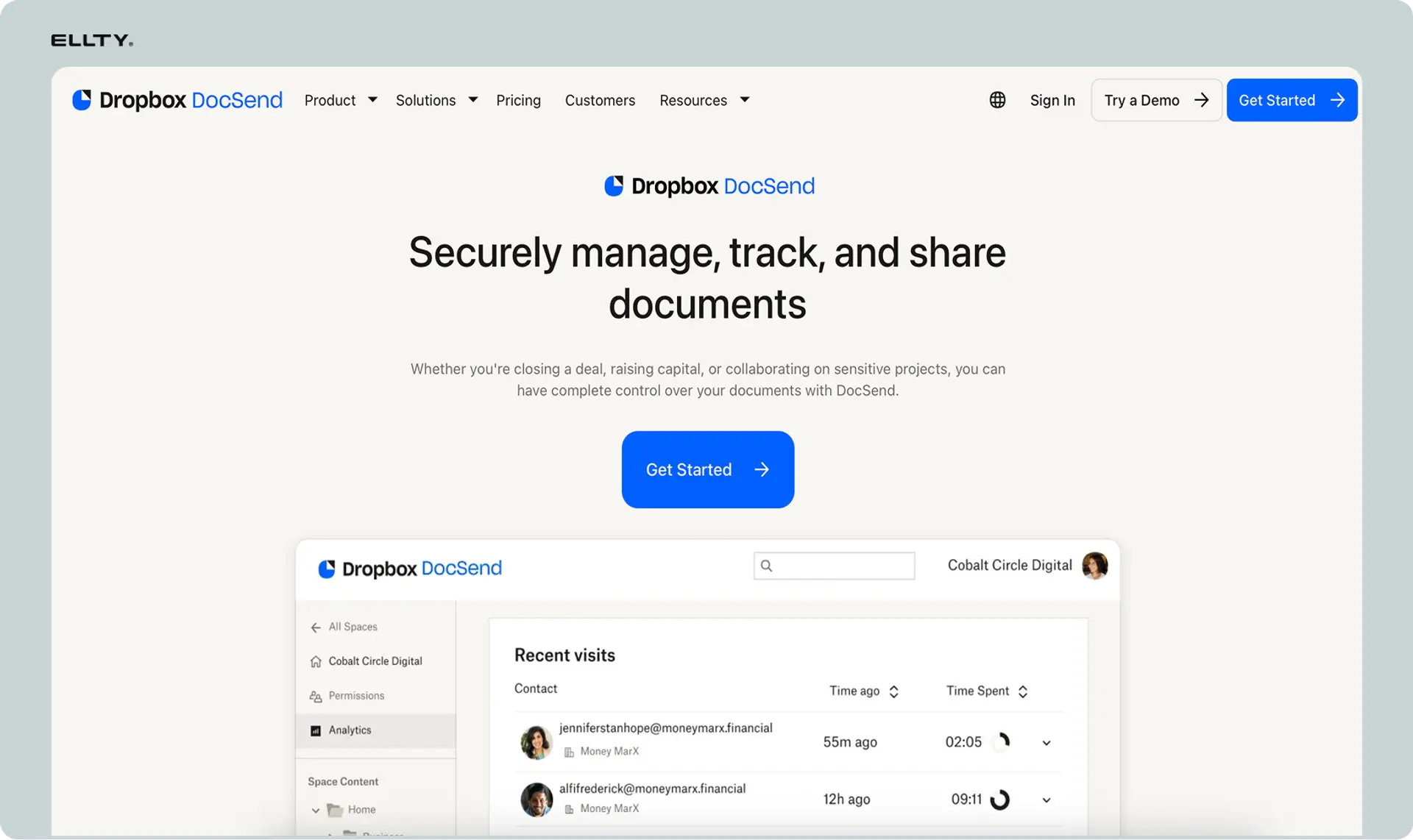
Docsend built its reputation almost entirely on one use case: founders sending pitch decks to investors and wanting to know who actually read them. It remains one of the cleanest implementations of document analytics for early-stage fundraising, and its acquisition by Dropbox has made it a natural fit for teams already in that ecosystem.
Security: Password protection, email verification, link expiration, and NDA gating. No dynamic watermarking on standard plans.
Sharing controls: Trackable links with page-level analytics are the core product. You can see exactly where an investor dropped off, how long they spent on your financial slide, and whether they forwarded the link to a partner. Access can be revoked at any time. Investor pipeline tools let you organize contacts and track engagement across multiple document sends.
Data room features: Docsend Spaces functions as a lightweight data room, a structured folder environment with controlled access. It works well for seed and Series A due diligence but lacks the audit log depth and watermarking of purpose-built VDR tools.
Best for: Founders actively fundraising who want tight feedback on investor engagement, teams already using Dropbox for file storage.
Limitations: Pricing scales with the number of users and documents, which can get expensive quickly. The data room functionality is limited compared to dedicated VDR platforms. Not designed for fund managers managing ongoing LP relationships.
Pricing: Personal plan from $15/month. Advanced plans with data room features from $65/month per seat.
3. Visible - Best for emerging fund managers and startup investor updates

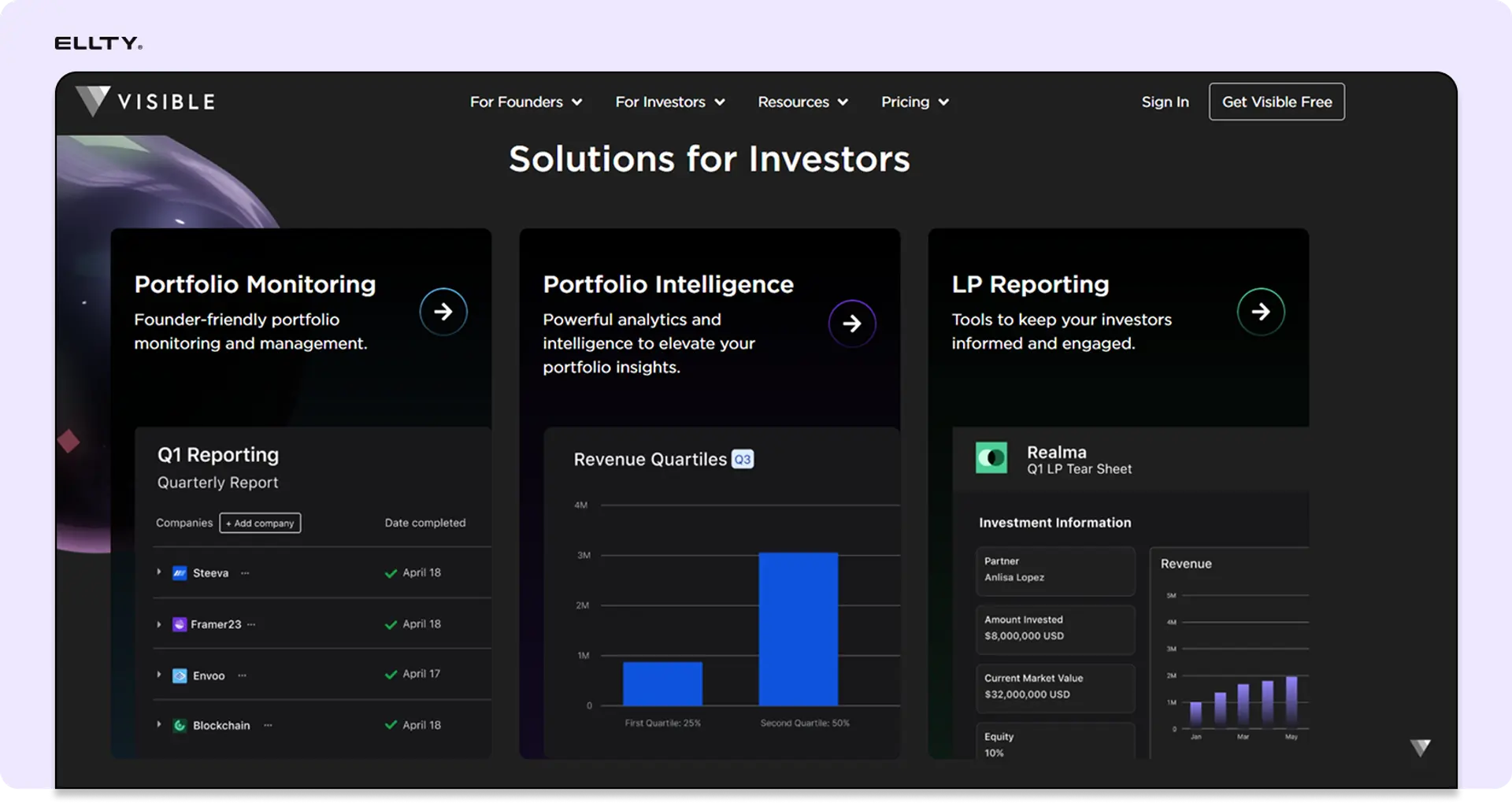
Visible occupies a distinct position: it's less a document vault and more an investor relations communication platform. Where Ellty and Docsend focus on controlling what happens to documents you share, Visible focuses on making it easy to send structured updates to investors on a recurring basis — and track whether they're actually reading them.
Security: Role-based access controls, password-protected portals, and view tracking. Not a full VDR - security features are lighter than platforms built for formal due diligence.
Sharing controls: Investor update emails with built-in analytics, trackable links, and engagement reporting. You can see which investors opened your update, clicked through to your data room, and how long they spent reviewing materials.
Data room features: Visible includes a basic data room for document storage and sharing. It integrates with metrics and KPI reporting, which is genuinely useful for portfolio companies sending quarterly updates to early-stage investors who want numbers, not just narrative.
Best for: Startup founders sending recurring investor updates, emerging fund managers maintaining LP communication without full fund administration software, anyone managing a large investor contact list.
Limitations: Not a serious VDR for formal due diligence. Lacks NDA gating, dynamic watermarking, and the audit log depth required for regulated fund structures. Better suited as a communication layer than a document security platform.
Pricing: Free plan available. Paid plans from $79/month.
4. Juniper Square - Best for established real estate and private equity funds


Juniper Square was built specifically for real estate investment managers and has since expanded into private equity and credit. It's not a document sharing tool with portal features bolted on, it's a fund administration platform where the investor portal is a core module, connected directly to the accounting and reporting layer.
Security: SOC 2 Type II certified. Role-based LP access controls, full audit logs, and compliance-grade document management. Each LP sees only their own data - capital accounts, distribution history, tax documents - with no risk of cross-LP visibility.
Sharing controls: Document delivery is structured around fund workflows: capital call notices, distribution notices, quarterly reports, and K-1 packages. LPs receive notifications when new documents are available and can confirm receipt - useful for legal documentation of notice delivery.
Data room features: Less relevant here. Juniper Square is not typically used for fundraising due diligence. It's an ongoing LP portal integrated with fund accounting, not a deal-by-deal document vault.
Best for: Real estate fund managers, established PE funds, any fund structure requiring automated LP reporting, capital account visibility, and compliance-grade audit trails.
Limitations: Significant overkill for seed-stage founders or emerging managers with fewer than 20 LPs. Pricing and implementation complexity reflect the enterprise positioning. Requires onboarding support, not a self-serve tool.
Pricing: Custom pricing. Typically starts in the range of $1,000–$2,000/month depending on fund size and features required.
5. iDeals - Best for mid-market M&A and formal due diligence processes


iDeals is a virtual data room built specifically for transactions: M&A, private equity deal execution, real estate dispositions, and capital raises requiring formal due diligence. It competes in the same tier as Datasite and Intralinks but with a more accessible price point for mid-market deals and a self-serve setup that doesn't require a full enterprise sales cycle.
Security: AES-256 encryption, dynamic watermarking, fence view (blur the document if the user tries to screenshot), granular per-document permissions, and full audit logs. Two-factor authentication is standard. SOC 2 and ISO 27001 certified.
Sharing controls: Highly granular. You can set view-only, print, download, or no-access permissions per document, per user, or per group. Trackable access with timestamped audit logs of every action. Q&A module for managing due diligence questions and responses, a feature absent from most lighter-weight tools.
Data room features: This is the entire product. Bulk upload with automatic indexing, version control, redaction, and a structured Q&A workflow that keeps due diligence questions organized and auditable.
Best for: Mid-market M&A transactions, PE firms running formal sale processes, any deal requiring a structured Q&A workflow and compliance-grade access controls.
Limitations: More than most founders need for a seed round. Pricing scales with storage and users - costs rise on larger, more complex deals. The investor experience is functional but not particularly elegant compared to simpler tools.
Pricing: From approximately $149/month for smaller projects. Mid-market M&A deals typically run $400–$1,500/month depending on deal size and duration.
6. Anduin - Best for subscription document workflows and LP onboarding


Anduin focuses on a specific pain point in fund management that other platforms underserve: the subscription document process. Getting LPs through fund onboarding - completing subscription agreements, providing KYC documentation, obtaining legal signatures - is administratively intensive and error-prone when managed over email. Anduin digitizes and streamlines this entire workflow.
Security: Role-based access controls, SOC 2 Type II certified, audit logs covering document completion and signature events. eSignature infrastructure built into the platform rather than integrated from a third party.
Sharing controls: Document delivery is structured around fund workflows rather than ad-hoc sharing. LPs receive guided onboarding flows rather than a folder of files - they're walked through each document they need to complete, in sequence, with e-signature prompts at the right steps.
Data room features: Not the primary use case. Anduin is not a general-purpose document vault or VDR. It's a workflow platform for subscription documents and LP onboarding, with an investor portal layer for ongoing document delivery after closing.
Best for: Fund managers closing a new fund and managing LP onboarding at scale, any fund with a large number of LPs requiring subscription document execution, emerging managers who want a professional onboarding experience without manual PDF email chains.
Limitations: Narrower use case than full LP portal platforms. If you need capital account dashboards, IRR reporting, or deep fund administration integration, Anduin alone won't cover it. Works best when paired with a fund administration system.
Pricing: Custom pricing. Typically positioned for funds raising $50M+ where the subscription document workflow creates meaningful operational leverage.
Investor portals vs. virtual data rooms: what's the difference?
These terms get used interchangeably and it causes confusion. Here's the practical distinction.


In practice, many modern tools combine both. A platform can give you a VDR for a specific due diligence process and an ongoing investor portal for quarterly LP updates. But the design philosophy differs. Know what your primary use case is before shopping.
Investor portal software for private equity, VC, and real estate funds
Fund managers have different requirements than most teams. You're not just sharing a pitch deck once - you're managing a long-term relationship with investors who expect regular, accurate, and secure access to their fund performance data.
Here's what matters most at this level:
Role-based access is non-negotiable. An LP should only see their own capital account, their own distributions, their own K-1. They shouldn't accidentally have visibility into another LP's position. This requires actual permission architecture, not just a password on a shared folder.
Capital call and distribution notices need to be structured and trackable. Many fund portals include templates for these communications and log when each LP has viewed them - useful for legal documentation of notice delivery.
Performance reporting dashboards let LPs see IRR, MOIC, DPI, RVPI, and other metrics without contacting the fund administrator directly. This reduces administrative burden significantly at scale.
Integration with fund administration software matters when you're at fund scale. Platforms like Allvue, Juniper Square, Investor Flow, and Backstop have investor portal modules built specifically for this use case. They connect directly to your accounting layer so reporting is automated, not manually assembled.

For early-stage VC funds and emerging fund managers who don't yet have a large LP base, purpose-built fund administration software may be overkill. A well-organized document portal with solid access controls and a clean investor-facing interface may be all you need for the first few years.
Best investor document portal apps compared
Here's a practical comparison of the tools most relevant to LPs and emerging fund managers. This isn't an exhaustive ranking - it's a use-case guide.


A note on pricing: enterprise platforms like Intralinks and Datasite don't publish standard rates. The numbers above are based on publicly available industry data and should be treated as estimates. Always get a direct quote for complex deals.
How Ellty fits into this landscape
Ellty started as a secure documents sharing and analytics platform. It has since grown into a virtual data room product used by teams managing fundraising and due diligence processes.
The honest framing: Ellty is built for businesses and teams who need document security and engagement analytics without the complexity or cost of enterprise VDR platforms. It's not trying to replace Intralinks for a $200 million acquisition. That's not a criticism - it's clarity about the use case.
Here's how the plans break down:

Ellty offers data room features without per-user pricing. That matters when you're sharing with 10 or 15 investors - you don't pay more just because more people need access. Setup is fast: you can have a data room live in under an hour without talking to a sales team.
Where it doesn't fit: Ellty doesn't have a Q&A module, document redaction, or LP reporting dashboards. If you're a fund manager needing capital account views, automated distribution reports, or deep CRM integration, you'll need a different tool. Ellty is honest about this. It's not an enterprise fund administration platform.


How to set up an investor document portal
The setup process looks different depending on the tool, but the underlying logic is the same. Here's a practical walkthrough that applies to most platforms:
First, define your document structure before you upload anything. Group documents into logical folders: company overview, financials, legal, team, product. A clean structure signals professionalism. An investor shouldn't have to hunt for your cap table.
Second, set access levels before inviting anyone. Decide who gets view-only access, who can download, and whether you want to gate the entire portal with an NDA. Don't give everyone full download access by default - you may not want your full legal document set walking out the door at the first meeting.
Third, use trackable links, not direct invites to folders. Most modern platforms let you create a unique link per investor. This lets you see who's active, revoke access individually if needed, and maintain a clean audit trail without managing group permissions constantly.
Fourth, test the investor experience before you send anything. Open your own link in an incognito window. Does it load fast? Is the layout clear? Would you find the pitch deck within 10 seconds? If not, reorganize.
Fifth, set up notifications. You want to know when an investor opens your documents - especially when you're in active conversations. Real-time alerts let you follow up at the right moment instead of chasing cold leads.
Common mistakes people make with investor portals
Sharing too early is the most common one. You don't need a full data room for the first investor conversation. Share your deck. Get a signal of interest. Reserve the data room for when someone asks to go deeper. Handing over every document on the first touch dilutes the value of the due diligence process.
Over-organizing is real too. A data room with 15 folders and 200 documents for a seed round is a red flag, not a sign of preparation. Keep it lean. Include what's needed, exclude what isn't. Investors want clarity, not a filing cabinet.
Using the wrong tool for the stage is expensive. Paying $2,000/month for an enterprise VDR when you're raising a $500K pre-seed round is just burning money. Equally, using a password-protected Google Drive folder for formal Series B due diligence is unprofessional and legally risky.
Ignoring analytics is leaving signal on the table. If a tool tells you which slides investors spent the most time on, use that. An investor who spent 12 minutes on your financial model is a different conversation than one who bounced after 30 seconds on slide two.
Not revoking access after a deal closes or falls through is a real security exposure. Make sure your platform supports access revocation - and actually use it.
Investor relations reporting and ongoing communication
Once you've closed a round, the investor relationship doesn't end. For fund managers especially, ongoing investor relations reporting is a significant operational responsibility.
A good investor portal handles this by providing a consistent, branded environment where LPs return quarter after quarter to access their updates. The alternative - emailing PDFs to an investor list - creates version control issues, no audit trail, and zero insight into whether anyone actually read the report.
The standard cadence for LP communication typically includes: monthly or quarterly performance summaries, capital call notices with supporting documentation, distribution notices, annual audited financials, and K-1 or tax documentation.
Some platforms let you push notifications to LPs when new documents are available, track who has viewed critical documents like capital call notices (useful for compliance), and generate reports on LP engagement across your fund.
For emerging fund managers on a tighter budget, you don't need a full LP portal from day one. A well-organized document repository with controlled access and a consistent quarterly communication process goes a long way before you need to invest in purpose-built fund administration software.
Security: what actually matters in an investor portal
Everyone in this space claims to be "enterprise-grade secure." Most of it is marketing. Here's what actually matters:
Encryption at rest and in transit is the baseline. AES-256 for stored data, TLS for data in transit. Any credible platform has this. If they don't mention it, ask.
Access control is where real security happens in practice. The most common breach scenario isn't a sophisticated hack - it's an authorized user forwarding documents they shouldn't have, or someone with too-broad access stumbling onto sensitive materials. Granular permissions, NDA gating, and watermarking address this.
SOC 2 Type II is the certification to look for as a baseline. It means an independent auditor has reviewed the provider's security controls. For funds operating in regulated environments or working with institutional investors who have compliance requirements, ISO 27001 may also be required.
Audit logs give you a defensible record of who accessed what and when. This matters if a document is ever misused and you need to demonstrate due diligence in your access controls.
Dynamic watermarking puts the investor's email or IP address on every page they view. It doesn't prevent screenshots, but it creates accountability. Most people won't forward a document with their email address stamped across every page.
Frequently asked questions
What is an investor portal?
An investor portal is a secure digital platform that lets companies and fund managers share documents, performance data, and communications with their investors or limited partners. It centralizes document sharing, tracks who accesses what, and often includes features like NDA gating, access controls, and reporting dashboards. Investor portals are used across private equity, venture capital, real estate funds, and startup fundraising.
What is the best investor document portal app for startups?
For companies, tools like Ellty and Docsend cover the core needs: secure document sharing, trackable links, page-level analytics, and NDA gating. Ellty offers a free plan and data room features starting at $149/month without per-user fees, which keeps costs predictable as more investors need access. Docsend is a strong alternative, particularly for teams already in the Dropbox ecosystem. Enterprise platforms like Intralinks and Datasite are overkill for most seed-to-Series A processes.
What is the difference between an investor portal and a virtual data room?
An investor portal is typically an ongoing platform for long-term investor communication - LP updates, capital accounts, quarterly reporting. A virtual data room is usually a time-limited, highly secure environment set up for a specific deal, due diligence process, or M&A transaction. In practice, many modern tools combine both functions, but the underlying design priorities differ. Know which use case you're solving for before picking a tool.
How much does investor portal software cost?
Pricing varies dramatically by use case. Ellty offers a free tier for basic document tracking and sharing, with paid plans at $69/month (Standard), $149/month (Data Room), and $349/month (Data Room Plus). Purpose-built LP portal software for PE and VC funds typically starts at $500-$1,000/month and scales with fund size. Enterprise VDR platforms used in large M&A transactions can cost $7,500+ per deal. Start with what your stage actually requires - you can always upgrade.
What is the best website for investors to review startup documents?
From an investor's perspective, the best platform is one that requires no account creation, loads documents quickly, and presents materials cleanly. Most modern document sharing tools let investors view files without signing up. Platforms like Ellty generate trackable share links that open in a browser - investors don't install anything, they just click and view. The quality of the document organization matters more than the platform itself.
Do I need an investor portal for a seed round?
You don't need one for the first investor conversation. Share your pitch deck. Once you have genuine interest from a lead investor who wants to go into diligence, you need something more organized than a Google Drive link. A basic data room with your key documents - financials, cap table, legal, product info - is enough for most seed rounds. It doesn't need to be elaborate. It needs to be ready and organized when asked for.
What security certifications should an investor portal have?
SOC 2 Type II is the baseline for most use cases - it means the provider's security controls have been independently audited. For regulated industries or institutional investors with compliance requirements, ISO 27001 may also be necessary. For deals involving healthcare or financial data, HIPAA compliance matters. Always verify certifications directly with the provider rather than taking marketing language at face value.
Can I use Google Drive or Dropbox as an investor portal?
You can, but it has significant limitations for serious due diligence. There's no audit trail showing who viewed what and when. You can't set granular per-document permissions. There's no NDA gating, dynamic watermarking, or real-time access notifications. For casual early-stage sharing before genuine investor interest, shared drives work fine. For formal due diligence where documents have legal or financial sensitivity, purpose-built tools are more appropriate.
What features do PE and VC fund managers need in an investor portal?
Beyond standard VDR features, fund managers need LP-specific access controls so each investor only sees their own data, capital call and distribution notice delivery with read confirmation tracking, performance reporting dashboards showing fund metrics like IRR and MOIC, audit logs for regulatory compliance, and ideally integration with fund administration software. Platforms like Juniper Square, Allvue, and Backstop are purpose-built for this. General-purpose VDR tools typically don't cover the fund reporting layer.
How long does it take to set up an investor portal?
It depends on the platform and your document readiness. With Ellty, you can have a data room live in under an hour - upload documents, set permissions, generate a trackable link. Enterprise platforms like Intralinks or Datasite involve sales cycles, onboarding calls, and project manager setup that can take days or weeks. The bottleneck for most teams isn't the platform setup - it's having the documents organized and ready to upload.
Stop guessing which investors are engaged. Get real-time data on who's reading your documents - set up your investor portal on Ellty and see the difference in your next follow-up conversation.
Author

Anika Tabassum Nionta is a Content Manager at Ellty, where she writes about secure document sharing, virtual data rooms, M&A, due diligence, fundraising, and sales enablement. With over 6 years of writing experience, she helps professionals understand how to share confidential documents securely, track engagement, and manage deals more effectively. Anika holds both a BA and MA in English from Dhaka University. Outside of work, she enjoys reading, exploring new cafes in Dhaka, and connecting with entrepreneurs and dealmakers in her community.

