
A no-fluff guide for businesses building their first investor data room - what to include, how to structure it, and how to tell if investors are actually reading it.


You've had the intro call. The investor liked what they heard. Then they ask: "Can you send over your data room?"
That moment is where a lot of fundraises quietly stall. Not because the business isn't good, but because the data room is a mess, missing key documents, or just doesn't give the investor what they need to move forward.
This guide covers what a data room actually is, what belongs in it, how to structure it, what investors look for when they open it, and how tools like Ellty help you set one up fast and track who's reading what.
No padding. Let's get into it.
What is an investor data room?
A data room is a secure, organized digital space where you share confidential company documents with investors during due diligence. Think of it as a structured folder on the cloud, but with access controls, tracking, and permissions built in.
It replaced the old model of emailing PDFs back and forth. That still happens, but it creates version control chaos and you have no visibility into who's reading what.
A proper data room for investors gives you:
- One controlled place for all your documents
- The ability to grant and revoke access per investor
- Visibility into who viewed which pages and for how long
- A paper trail for your own records
There are two main stages when a data room gets used. The first is early in the process, when an investor has shown interest and wants to see more. You'll share a lighter version of the room: pitch deck, cap table, maybe financials. The second stage is formal due diligence, where everything goes in such as legal documents, contracts, IP, employment agreements.
You don't need to build the full due diligence data room on day one. Start with a lightweight version and expand it as conversations progress.
What should be in a data room for investors?
This is the question people search most. Here's the honest answer: it depends on your stage. A pre-seed company doesn't need 40 folders of legal filings. A Series B company does.
Below is a practical breakdown by category. Use this as your data room checklist.
📁 Company overview
├── Pitch deck (latest)
├── Executive summary
└── Company one-pager
📁 Financials
├── P&L (3 years or YTD)
├── Balance sheet
├── Cash flow statement
└── Financial model + assumptions
📁 Legal
├── Certificate of incorporation
├── Cap table
├── Shareholder agreements
└── Previous term sheets / SAFEs / notes
📁 Product
├── Product roadmap
├── Demo video or live link
└── Technical architecture (if relevant)
📁 Market and traction
├── Market size analysis (TAM/SAM/SOM)
├── Key metrics (MRR, churn, CAC, LTV)
└── Customer case studies or testimonials
📁 Team
├── Founder bios / LinkedIn profiles
└── Org chart
📁 IP and assets
├── Patents filed / granted
└── Trademarks
📁 Contracts
├── Key customer contracts
├── Vendor agreements
└── Employment agreements
Not every folder applies to you at every stage. Here's a quick guide on what's truly non-negotiable vs. what you can add later:


What do investors look for in a data room?
Here's something most teams miss: investors aren't just reading your documents. They're reading you through your documents.
The way you've organized your data room tells them a lot about how you run your company. A chaotic, incomplete room signals operational disorder. A clean, well-structured room with the right documents signals that you know what you're doing.
Here's what investors are actually evaluating:


"Investors aren't reading your pitch deck in the data room. They're trying to find the thing that proves you're right, or the thing that kills the deal."
The fastest way to slow down a deal is to have documents that contradict your pitch. For example: you claim 40% month-over-month growth in the deck, but the actual financials show something different. Alignment between your pitch and your data room documents is non-negotiable.
How to create a data room for investors

Building a data room doesn't need to take weeks. Here's a practical process to get it done.
- Pick your tool
You need a platform that handles secure file sharing, access permissions, and ideally gives you analytics. Options range from free (Ellty free plan) to enterprise (Datasite, Intralinks). Match the tool to your stage and the complexity of the raise. - Set up your folder structure first
Don't just dump files in. Create the folders before you upload anything. Use the structure above as a template. A clear hierarchy makes it faster for investors to find what they need. - Upload documents in their final state
Don't upload draft versions. Every document in your data room should be the one you're comfortable having scrutinized. Name files clearly - "Financial model Q2 2025.xlsx" beats "Model FINAL v3.xlsx". - Set permissions by investor
Not every investor needs access to everything on day one. You might share your pitch deck and exec summary early, then grant permission to full financials and legal docs once they've signed an NDA or shown serious interest. - Create a trackable link
Use a unique link per investor. This lets you see who opened what, which pages they spent the most time on, and when they were active. That information is genuinely useful for timing your follow-ups. - Test it before sending
Open your own link in a private browser. Check that access controls work. Confirm every document is readable and the right version. You don't want to send an investor a broken link or the wrong file.
What to look for in a data room tool
You've got a lot of options. Here's how to think about the decision.
For early-stage businesses raising a seed or pre-seed, the main requirements are usually: secure file sharing, basic access controls, and some analytics to know if people are reading. You don't need a complex enterprise platform with per-seat licensing and a six-month setup timeline.
At later stages such as Series A and beyond, you'll want more granular permission controls, NDA gating, watermarking, and a full audit log for compliance purposes.


Data room for investors: how Ellty fits in

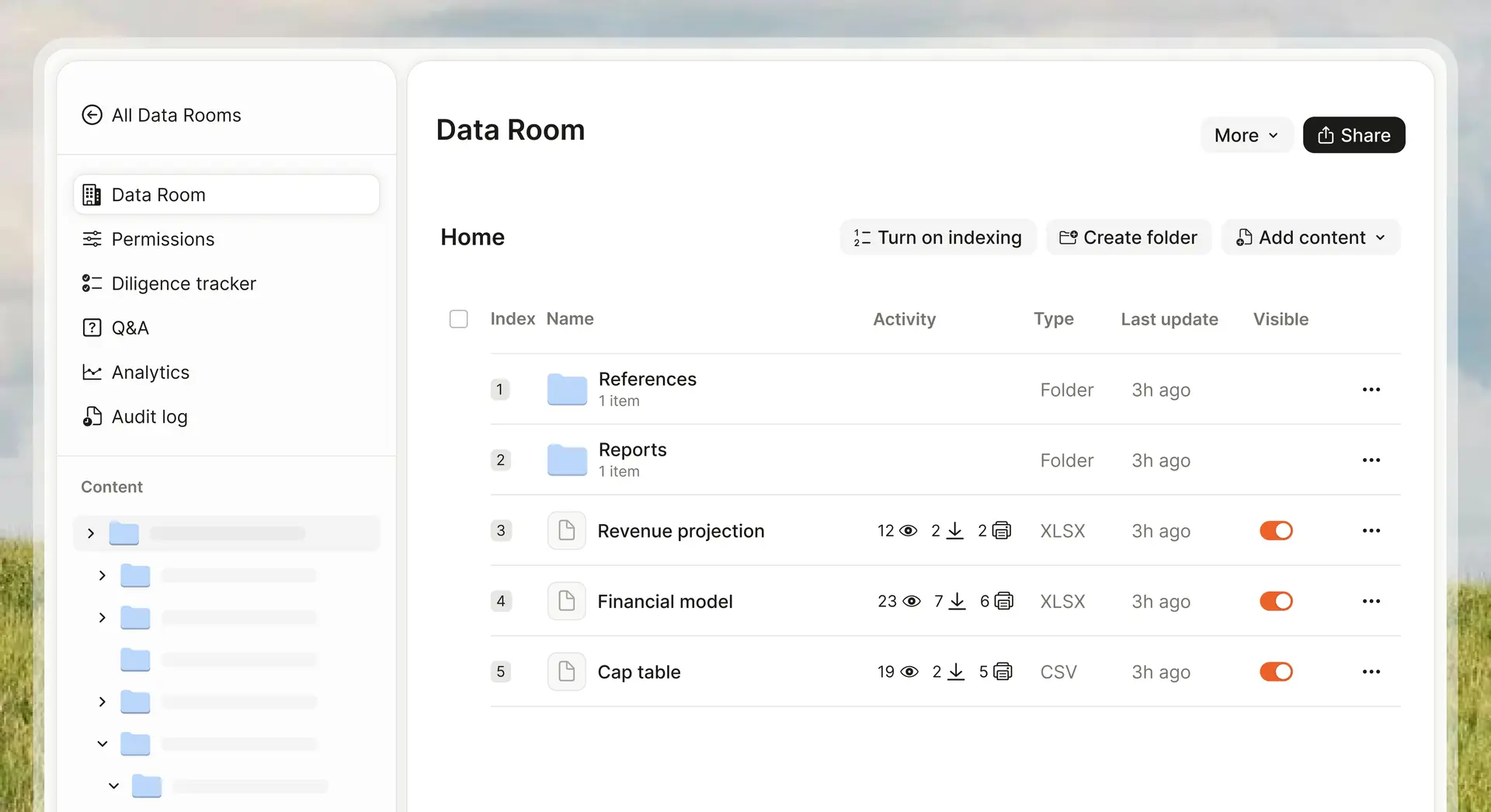
Ellty works well when you need to share a core set of documents like a pitch deck, financial model, and supporting materials with multiple stakeholders in a structured way. The analytics are especially useful: seeing when a document was opened, how long someone spent on it, and which sections held attention gives you real signals to guide follow-ups.
It’s less suited to highly complex M&A transactions that require built-in Q&A modules, project management layers, or deeply customized enterprise security workflows. For most lean, fast-moving processes, that level of complexity isn’t necessary anyway.

One practical advantage: Ellty doesn’t charge per viewer. When you’re sharing with dozens of stakeholders, per-user pricing on other platforms can add up quickly. Here, access scales without increasing cost.
Setup is also fast, you can go from signup to a shared, trackable link in minutes. If you’ve dealt with enterprise VDRs before, the difference in speed and simplicity is immediately noticeable.

What goes in a data room vs. what doesn't
More documents isn't always better. A bloated data room with 200 files is harder to navigate than a clean one with 30. Here's a practical filter:


The principle: every document in your data room should answer a question an investor would have, or remove a risk they'd be worried about. If it doesn't do either, don't include it yet.
Data room for investors examples: what stage-appropriate looks like
Here's what a practical data room looks like at different stages. These aren't templates, they're illustrations of what's realistic and appropriate.
Pre-seed data room (example)
You're raising $500k-$2M. You probably don't have audited financials. Focus on: pitch deck, exec summary, founder bios, incorporation documents, cap table, and any early traction data (users, revenue, pilots). That's it. Keep it tight.
Seed data room (example)
You've got some revenue. Add: 12-18 months of financial history, a financial model with your assumptions, key customer contracts or LOIs, key metrics breakdown (CAC, LTV, MRR, churn), and any IP filings. This is where NDA gating starts to make sense, you're sharing real commercial information.
Series A data room (example)
Full due diligence is expected. You need everything like audited financials (or at least CPA-reviewed), full legal documents, employment agreements, option pool details, detailed customer data, vendor contracts, and a board-level summary of business performance. For series A, the data room is a major project in itself. Consider having a lawyer review it before sharing.

Common data room mistakes (and how to avoid them)
These are the things that slow deals down or kill them quietly. Most are fixable in an afternoon.
Mistake 1: no access controls
Sending a Google Drive link with "anyone with the link can view" is not a data room. You lose all visibility, you can't revoke access, and you have no record of who saw what. Use a platform with proper access management.
Mistake 2: outdated documents
If your pitch deck says you have $50k MRR but your financial statements show $35k, an investor will notice. Keep your data room current. Set a reminder to review it every 30 days during an active raise.
Mistake 3: poor naming conventions
"Final FINAL deck v4 USE THIS ONE.pdf" is not a document name. Use clean, date-stamped file names. Investors often download documents, the file name is what they'll reference later.
Mistake 4: sharing too much too soon
Don't give a cold investor access to your full legal data room on the first contact. Stage your sharing. Pitch deck first, then financials once there's genuine interest, then full due diligence once they've passed the initial checks.
Mistake 5: no tracking
If you're sharing documents without knowing whether they were opened, you're flying blind. Analytics on who viewed what and for how long help you prioritize follow-ups and understand where an investor's head is at.
Mistake 6: including unresolved legal issues
If there's a pending lawsuit, a disputed founder equity claim, or an unresolved IP issue, don't just bury it in the data room and hope no one notices. Address it proactively, either by resolving it before the raise or by disclosing it clearly with context.
FAQ: everything else founders ask about investor data rooms
What is a data room for investors, exactly?
A data room for investors is a secure digital space where you store and share confidential company documents during fundraising or due diligence. It replaces the old method of emailing PDFs and gives you control over who sees what, with tracking on every view.
When should I create a data room?
Before you start actively fundraising. You want to be ready to send a data room link within 24-48 hours of an investor asking for one. If you're building it from scratch after the request comes in, you'll lose momentum. Set it up when you begin your fundraising process, not when someone asks.
Is there a free data room for investors?
Yes. Ellty offers a free plan that includes document tracking, real-time analytics, and secure sharing with no time limit. For basic use cases, sharing a pitch deck with trackable links and viewing analytics, the free plan covers a lot. If you need features like NDA gating, granular permissions, or watermarking, the paid plans start at $69/month.
What's the difference between a pitch deck and a data room?
A pitch deck is a presentation, it's your story, your vision, your ask. A data room is the evidence that supports your pitch. The deck gets you in the door. The data room either confirms or contradicts what you said in the deck. You need both, but they serve different purposes at different stages of the investor conversation.
Should I use Google Drive as my data room?
Google Drive works in a pinch, but it has real limitations for fundraising. You can't see who opened what document or which pages they spent the most time on. Access controls are clunky for sharing with multiple investors at different permission levels. And there's no NDA gating or watermarking. It's fine for very early conversations but not for serious due diligence.
How long should the due diligence process take?
It varies widely by investor and deal size. A small angel check might close in two weeks. A Series A with institutional investors typically takes two to four months from first meeting to wire. A well-organized data room with everything an investor needs can meaningfully shorten the back-and-forth phase - which is usually where delays happen.
What documents do investors look for first?
The pitch deck and executive summary are always first. Then investors typically move to financials (especially if you have revenue), the cap table, and key metrics. Legal documents come later, once they're deeper into the process. Structure your data room so the most-accessed documents are easy to find at the top level.
Do I need an NDA before sharing my data room?
Most VCs won't sign NDAs before initial conversations, it's standard practice and not worth fighting. For early-stage sharing like a pitch deck, you generally don't need one. Once you're sharing sensitive commercial contracts, customer data, or detailed financial models, an NDA makes sense. Platforms with NDA gating, like Ellty Data Room plan, let you require a signature before someone can access specific documents.
How do I know if an investor is serious based on data room activity?
Data room analytics tell you a lot. If an investor opened your pitch deck but spent zero time on the financials, they're probably not deep in the process yet. If they've spent 40 minutes in the legal folder and downloaded the cap table twice, that's a signal they're doing real diligence. Track views per document, time spent per page, and how frequently they return. That data is useful for timing your follow-ups.
What's the best data room for startups raising a seed round?
For a seed round, you need something fast to set up, easy to manage, and with good analytics. Ellty fits that description. You can have a data room live in under an hour, track every view on your pitch deck, and set permissions per investor without per-user pricing. Enterprise platforms like Datasite or Intralinks are built for larger, more complex transactions and come with the price tag to match.
Final thoughts
A data room isn't just a folder of documents. It's a reflection of how you run your company. If it's disorganized, out of date, or missing key information, investors notice - and some will walk without telling you why.
The good news is that building a solid data room is a solvable problem. You know what goes in it. You know how to structure it. You know what investors will look at first. Now it's just execution.
Start with the core documents, use a platform that gives you visibility into who's reading what, and keep it current throughout your raise. It's one of the few parts of fundraising you can actually control.
Author

Anika Tabassum Nionta is a Content Manager at Ellty, where she writes about secure document sharing, virtual data rooms, M&A, due diligence, fundraising, and sales enablement. With over 6 years of writing experience, she helps professionals understand how to share confidential documents securely, track engagement, and manage deals more effectively. Anika holds both a BA and MA in English from Dhaka University. Outside of work, she enjoys reading, exploring new cafes in Dhaka, and connecting with entrepreneurs and dealmakers in her community.

