
Mergers and acquisitions are some of the biggest decisions a business will ever make. And before any deal crosses the finish line, there's a mountain of paperwork, legal reviews, financial audits, and back-and-forth conversations that need to happen - all in a secure, organized way.
That process is called due diligence. And if you're still doing it over email chains and shared drives, you're taking on unnecessary risk.
M&A due diligence software exists to make this process faster, safer, and far less stressful. In this guide, we'll walk you through what due diligence actually means in M&A deals, how to choose the right software, and which tools are worth your time in 2026.
What Is M&A due diligence?
Due diligence in mergers and acquisitions is the process of verifying everything about a target company before you agree to buy or merge with it. Think of it as doing your homework before making the biggest purchase of your life.
It involves reviewing financial records, contracts, legal documents, employee data, intellectual property, customer agreements, and sometimes even the IT infrastructure of the business. The goal is simple: no surprises after the deal closes.
Due diligence typically happens after a letter of intent (LOI) is signed but before the final agreement. Both sides share sensitive documents, ask questions, and try to get a clear picture of what they're getting into.
There are several types of due diligence that happen in a typical M&A process:
Financial due diligence looks at revenue, expenses, cash flow, debts, and financial projections. You want to know if the numbers actually add up.
Legal due diligence covers contracts, litigation history, regulatory compliance, and IP ownership. Lawyers review this carefully.
Operational due diligence examines how the business actually runs, its people, processes, technology, and supplier relationships.
Commercial due diligence looks at the market, competition, and whether the business's growth story holds up under scrutiny.
All of this involves sharing hundreds, sometimes thousands of documents between deal teams, advisors, lawyers, and investors. That's where M&A due diligence software comes in.
How to choose M&A due diligence software?
Picking the right tool isn't just about features. It's about finding something that fits how your deal team actually works. Here are the most important things to think about:
Security first
Due diligence involves some of the most sensitive business documents in existence. Your software needs to offer strong access controls, encryption, and an audit trail that shows exactly who saw what and when. Anything less is a liability.
Ease of use matters more than you think
You might have lawyers, accountants, investors, and executives all logging in. If the tool is hard to navigate, people start emailing files instead and that defeats the whole purpose.
Permissions and access control
Not everyone reviewing a deal needs to see everything. Good M&A software lets you decide exactly who can access which folders, and whether they can download, print, or forward documents.
Activity tracking and analytics
Knowing which investors are spending time on which sections gives you real intelligence about where interest is, or where concerns might be forming.
NDA gating
Before a reviewer even sees the first document, they should sign an NDA. Some platforms handle this automatically, which saves a lot of back-and-forth.
Pricing transparency
Many legacy VDR platforms charge per user or per page. That sounds manageable until you have 30 reviewers and 2,000 documents. Look for flat, predictable pricing.
Speed of setup
Deals move fast. If your VDR takes two weeks to configure, you've already lost time. Look for tools that let you get a data room live within hours, not days.
Types of M&A due diligence software
Not all tools in this space do the same thing. Here's a breakdown of the main categories:
Virtual Data Rooms (VDRs) are purpose-built platforms for secure document sharing during deals. They include access controls, audit trails, NDA workflows, and analytics. These are the most relevant for M&A due diligence specifically.
Project Management Tools (like Asana or Monday.com) help deal teams track tasks and deadlines. Some teams use these alongside a VDR to manage the overall workflow, but they don't handle document security on their own.
Document Management Systems (like SharePoint or Google Drive) offer file storage and basic sharing, but they lack the security features and deal-specific workflows you need for M&A.
AI-Powered Due Diligence Tools are a growing category. These use machine learning to extract key information from contracts, flag risks, and speed up document review. They're often used alongside a VDR rather than instead of one.
Legal Practice Management Software is designed for law firms and includes matter management, billing, and document review. Some have VDR integrations built in.
For most deals, the foundation is a solid VDR. Everything else can layer on top.
7 best M&A due diligence software
1. Ellty - Best for Teams That Want a Professional Data Room Without the Enterprise Price Tag

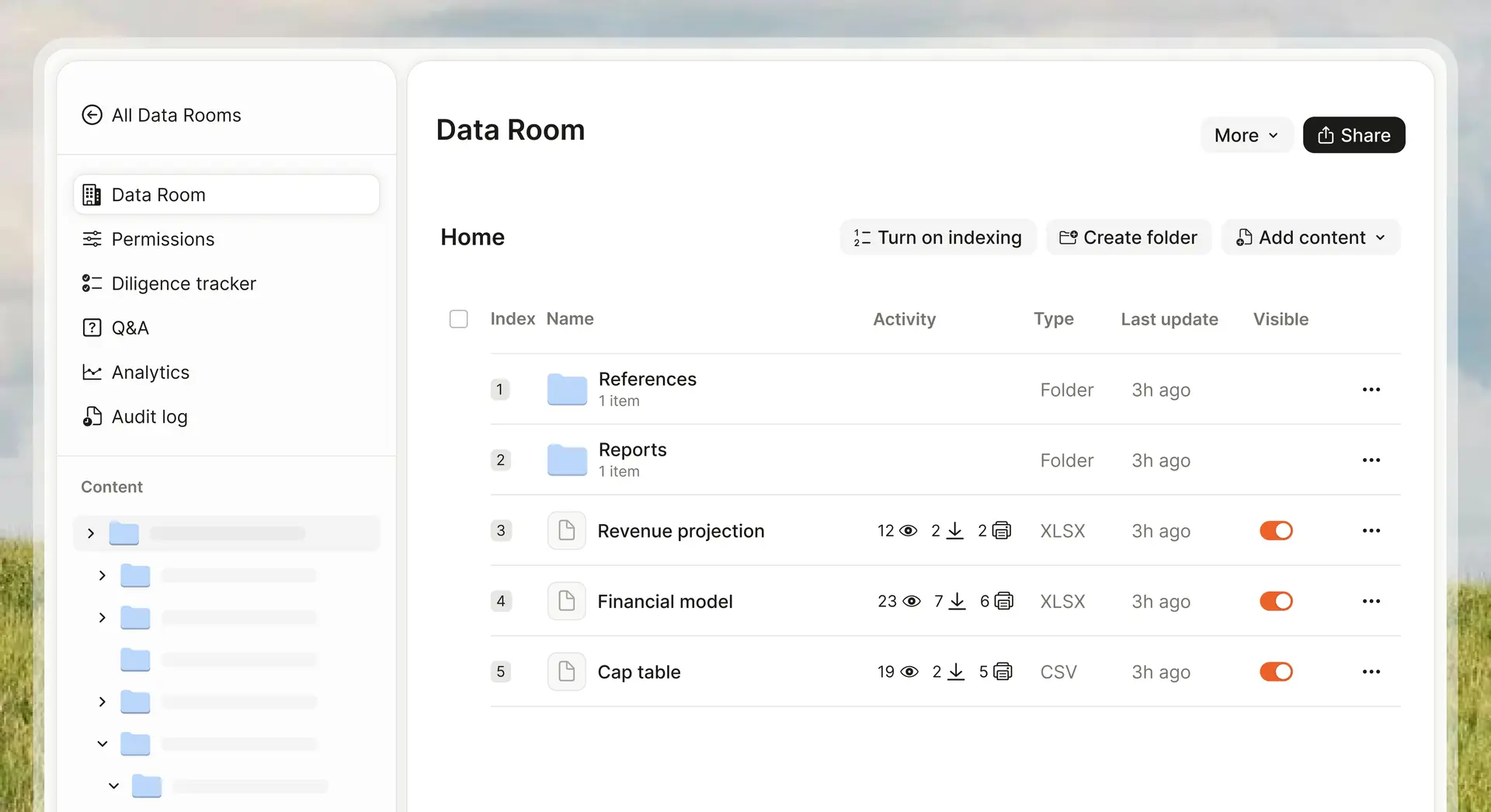
Ellty is a secure document sharing and analytics platform with full virtual data room functionality. It's built for anyone who needs to share sensitive documents in a controlled, trackable way, whether you're running an acquisition, raising a funding round, or managing a property transaction.
What makes Ellty different from the legacy platforms is its pricing. There are no per-user fees, no per-page charges, and no custom quotes. You pick a plan, get set up quickly, and know exactly what you're paying.
The platform includes access controls, real-time activity tracking, NDA gating, dynamic watermarking, and a full audit trail. The Room plan at $149/month covers everything you need for a controlled document review. For heavier deal loads with multiple reviewer groups, the Room Plus plan at $349/month adds group permissions, full audit logs, and support for up to 4,000 assets.
Ellty works especially well for smaller and mid-market deals where you need a professional, secure environment but don't want to spend months negotiating an enterprise contract. Setup is fast, the interface is clean, and the analytics give you real visibility into reviewer behavior.
Best for: SMBs, advisors, and deal teams running M&A processes without an enterprise VDR budget.
Pricing: Free plan available. Paid plans start at $69/month. Room plan at $149/month. Room Plus at $349/month.

2. Datasite - Best for Large, Complex Enterprise Deals

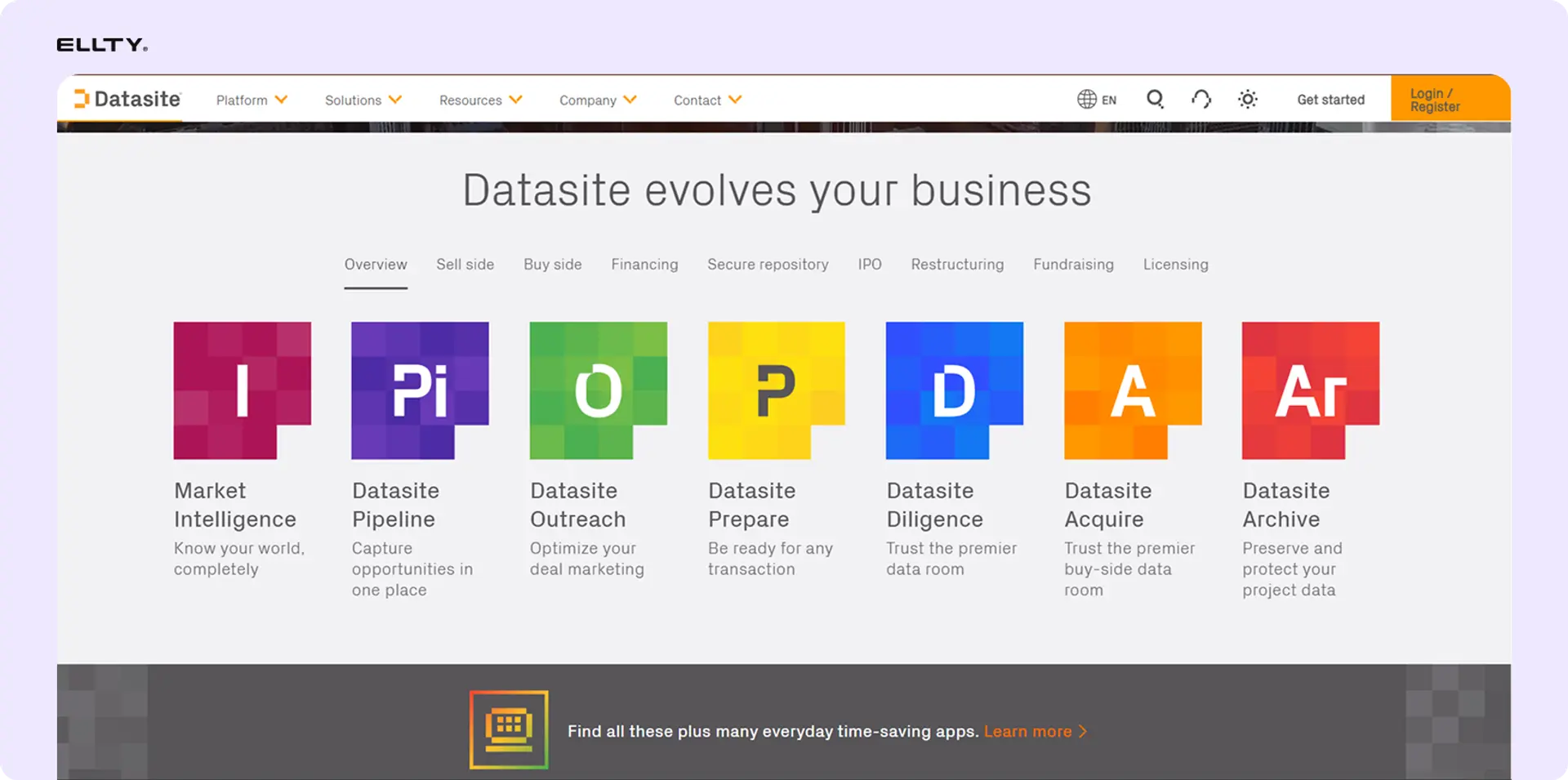
Datasite (formerly Merrill DataSite) is one of the most established names in the VDR space. It's designed for large-scale M&A transactions with high document volumes and multi-party deal teams.
The platform offers strong AI-powered features including automated redaction, document translation, and smart search. It integrates with popular legal and financial tools and can handle the complexity of cross-border deals.
Datasite's strength is its depth. It has features specifically designed for sell-side M&A, including buyer engagement scoring that tells you which potential acquirers are the most active in the data room. This is genuinely useful during competitive sale processes.
The trade-off is cost and complexity. Datasite pricing is enterprise-tier and quote-based, which means setup can take time and the total cost isn't always clear upfront. It's a powerful tool, but it's designed for deals where you have a full advisory team and a significant budget.
Best for: Investment banks, large law firms, and corporations running complex M&A transactions.
Pricing: Custom quotes. Not suitable for smaller deals or budget-conscious teams.
3. Intralinks - Best for Global Transactions with Large Teams

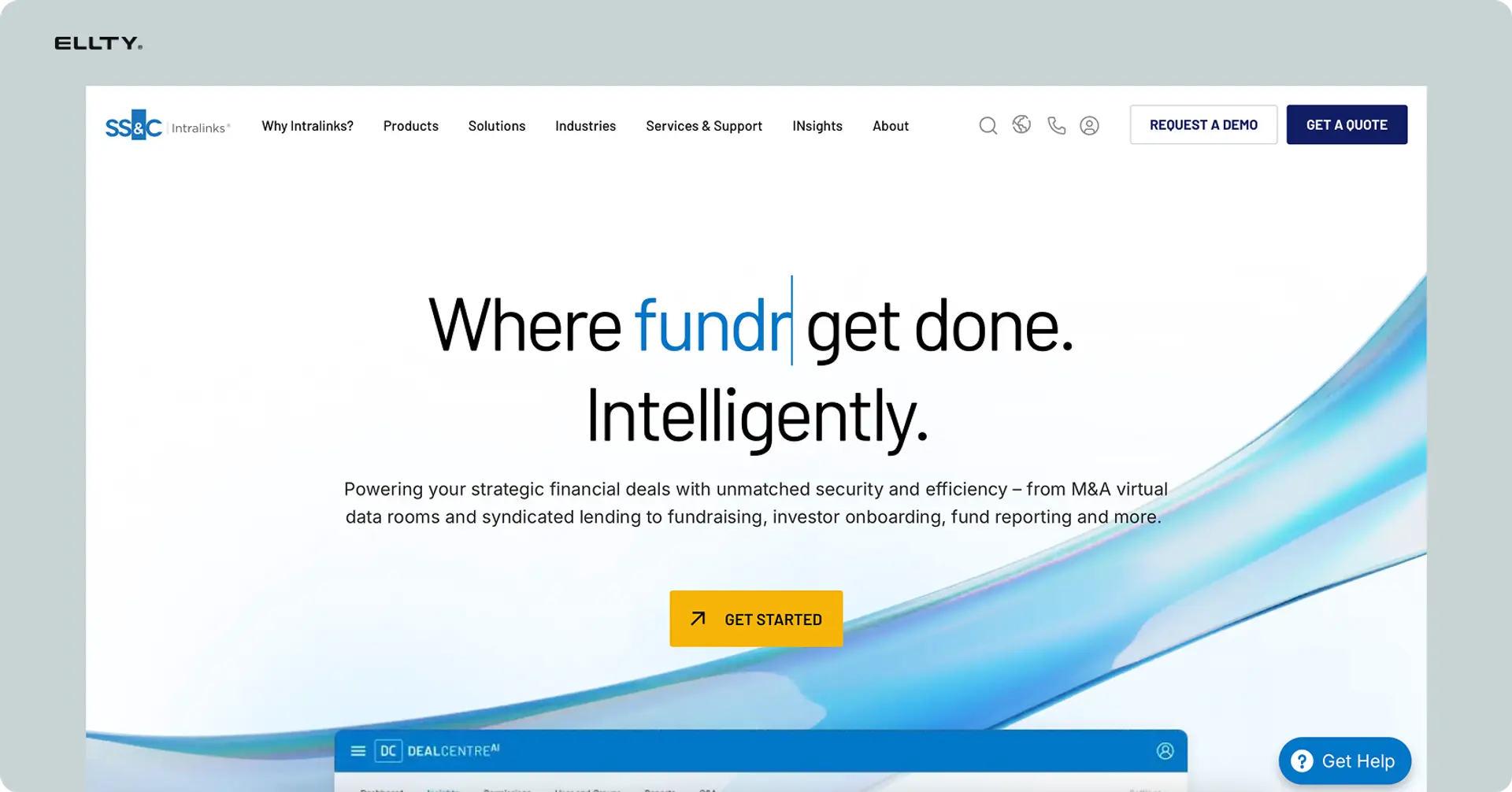
Intralinks has been in the VDR space for decades and is trusted by banks and advisory firms running high-value cross-border deals. It offers enterprise-grade security, multi-language support, and robust compliance features that matter in heavily regulated industries.
The platform includes AI-powered document management, detailed analytics, and integrations with tools like Salesforce and Microsoft Office. It's built to handle deal rooms with thousands of documents and dozens of stakeholder groups.
Like Datasite, Intralinks is positioned for large enterprise deals. Pricing is not publicly listed and is typically negotiated based on deal size and duration. This makes it a poor fit for teams that need to move quickly or are working with a defined budget.
Where it excels is in regulated industries like financial services, healthcare, and life sciences, also where compliance and audit trails are not optional.
Best for: Large enterprises, global investment banks, and regulated industries.
Pricing: Custom enterprise pricing.
4. iDeals - Best Mid-Market VDR with Transparent Pricing


iDeals is a solid mid-market VDR that balances strong security features with a more accessible pricing model than the legacy platforms. It's used widely across M&A, real estate, and capital markets transactions.
The platform offers granular permission settings, two-factor authentication, fence view (which prevents screen capture), and detailed activity reports. The interface is clean and relatively easy for non-technical users to navigate.
iDeals has a flat-fee pricing model for some plans and offers a free trial, which makes it easier to evaluate before committing. It's a good middle-ground option for deal teams that need professional VDR functionality without the overhead of an enterprise contract.
The main limitation is that support quality can vary depending on your plan tier, and some advanced features require higher-tier subscriptions.
Best for: Mid-market M&A deals, private equity, and real estate transactions.
Pricing: Subscription-based. Starts around $699/month depending on the plan.
5. Ansarada - Best for AI-Powered Deal Readiness


Ansarada takes a slightly different approach to VDR software. Beyond document storage and sharing, it offers deal readiness tools that help you assess and improve how prepared your business is for a transaction.
Its AI engine scores how engaged different buyer groups are and flags potential deal risks based on document activity. The platform also includes a Deal Workflow tool that helps deal teams manage tasks, Q&A processes, and milestones in one place.
Ansarada works well for sell-side teams that want more than just a document repository, they want intelligence about how the deal is progressing. The platform has grown significantly in the past few years and is now used for M&A, capital raises, and compliance processes.
Pricing is subscription-based but can be on the higher end for smaller teams. The complexity of some features may also be more than smaller deals require.
Best for: Sell-side M&A teams, private equity, and businesses preparing for a sale.
Pricing: Quote-based for larger deals. Some plans are listed from around $400/month.
6. ShareVault - Best for Life Sciences and Regulated Industries


ShareVault is a VDR platform with a strong focus on security and compliance. It's widely used in life sciences, biotech, and pharmaceutical deals where regulatory sensitivity is high.
The platform offers features like dynamic watermarking, remote document wipe (you can revoke access to downloaded files even after they've been saved), and detailed audit logs. These features are particularly valuable when sharing clinical data, patent information, or regulatory filings.
ShareVault has a simpler interface than some of the larger enterprise platforms, which makes it easier to deploy quickly. Pricing is subscription-based and more straightforward than legacy competitors, though still higher than platforms like Ellty.
Best for: Life sciences, biotech, pharma, and other regulated industries with high document sensitivity.
Pricing: Subscription-based. Plans vary by storage and user count.
Not sure which tool is right for your deal?
Ellty free plan lets you start sharing documents securely today. No credit card required.
Common pitfalls to avoid in M&A due diligence
Even with the right software, deals can go sideways if the process isn't managed carefully. Here are the most common mistakes to watch out for:
Sharing too much, too soon.
Early in a deal, you don't need to hand over everything. Share a teaser first, then unlock more as the conversation progresses. Good VDR software makes this easy with tiered access controls.
Not using NDA gating.
Before a counterparty sees any sensitive documents, there should be a signed NDA in place. Platforms like Ellty handle this automatically but many teams skip it and rely on trust instead.
Giving everyone the same permissions.
Not every reviewer needs access to every folder. Give each group e.g. lawyers, financial advisors, and management, access only to what's relevant to them. This reduces the risk of sensitive information spreading unnecessarily.
Ignoring the audit trail.
Your activity log is a record of who saw what and when. In the event of a dispute or leak, this is invaluable. Make sure your platform captures this data and that you review it regularly.
Leaving documents disorganized.
A messy data room slows down reviewers and creates confusion. Take the time to organize documents into a clear folder structure before you invite anyone in. Most VDRs have templates to help with this.
Choosing software based on brand name alone.
Legacy platforms are well-known because they've been around a long time, not necessarily because they're the best value. For many deals, a modern platform like Ellty offers the same core functionality at a fraction of the cost.
FAQs
What is the difference between a VDR and a regular file sharing tool like Google Drive?
A virtual data room is purpose-built for sensitive, controlled document sharing. Unlike Google Drive or Dropbox, a VDR gives you granular access controls, NDA gating, activity tracking, dynamic watermarking, and a full audit trail. These aren't just nice-to-haves in M&A, they're essential for protecting your business and staying in control of who sees what.
How long does M&A due diligence usually take?
It varies significantly by deal size and complexity. Smaller deals might wrap up due diligence in 4–6 weeks. Larger, more complex transactions can take 3–6 months. Having the right software in place from day one helps keep things moving faster.
Do I need a VDR for a small acquisition?
Yes, even for smaller deals, secure document sharing is important. The risk of sensitive information being forwarded, leaked, or accessed by the wrong person is real regardless of deal size. Platforms like Ellty are specifically designed to be accessible for smaller deals without the cost and complexity of enterprise VDRs.
What documents are typically shared in a due diligence data room?
Financial statements, tax returns, contracts and agreements, employment records, cap table information, IP documentation, regulatory filings, board minutes, and customer data are all commonly included. The exact list depends on the nature of the deal and the industry.
Can I control whether reviewers can download or print documents?
Yes, any good VDR should let you set permissions at a granular level. With Ellty Room and Room Plus plans, you can restrict document downloads, enable dynamic watermarking, and control exactly how documents can be accessed and used.
What happens to the data room after the deal closes?
Most teams archive the data room after closing for compliance and record-keeping purposes. It's important to choose a platform that lets you export or archive your documents and audit logs cleanly. With Ellty, you retain control of your data throughout.
Is Ellty suitable for deals outside of M&A?
Absolutely. While this guide focuses on M&A, Ellty is used for fundraising rounds, real estate transactions, consulting engagements, and any situation where you need to share sensitive documents in a controlled, trackable way. The platform is flexible enough to serve many use cases.
Final thoughts
M&A due diligence is not the part of a deal that makes headlines. But it's the part that determines whether a deal succeeds or falls apart. The right software won't close the deal for you but it will make the process faster, more secure, and much easier to manage.
If you're running a complex enterprise transaction with a full advisory team and a large budget, platforms like Datasite or Intralinks are built for that world.
But if you're a founder, advisor, or deal professional who needs a professional data room without the overhead of an enterprise contract, Ellty gives you everything that matters such as access controls, NDA gating, real-time analytics, and a clean audit trail, at a price that makes sense from day one.
No per-user fees. No per-page charges. No weeks-long onboarding. Just a data room that works.
Start your free Ellty data room today. No credit card needed, just sign up and start sharing securely.
Author

Anika Tabassum Nionta is a Content Manager at Ellty, where she writes about secure document sharing, virtual data rooms, M&A, due diligence, fundraising, and sales enablement. With over 6 years of writing experience, she helps professionals understand how to share confidential documents securely, track engagement, and manage deals more effectively. Anika holds both a BA and MA in English from Dhaka University. Outside of work, she enjoys reading, exploring new cafes in Dhaka, and connecting with entrepreneurs and dealmakers in her community.

