
You've found a buyer, a serious investor, or you're closing in on a major deal. Things are moving. And then someone says: "We'll need to start due diligence."
For some people, that phrase is a signal to start panicking. Suddenly there are requests coming in from every direction - financial records, legal documents, employee data, contracts, tax filings - and everything needs to be found, organized, and shared, usually faster than feels comfortable.
It doesn't have to be that way.
Due diligence is a standard part of most significant business transactions. It's not a trap or a test you can fail without warning. It's a process, and like most processes, it becomes far less stressful when you know what's coming and you've prepared for it.
This guide walks you through what due diligence actually is, why your preparation matters more than most people think, what areas tend to get scrutinized, and how tools like Ellty can make the whole thing a lot more manageable.
Whether you're selling a business, raising a funding round, closing a property deal, or going through any kind of structured transaction, this is for you.
Understanding due diligence
Due diligence is, at its core, a verification process. When one party is about to invest significant money or enter a major legal agreement with another, they want to confirm that everything is as it appears. They're checking the numbers, the legal standing, the operations, and the risks - before committing.
It happens in a few different contexts:
Mergers and acquisitions (M&A): A buyer wants to review the company they're acquiring before signing anything final. They'll look at financials, contracts, staff, liabilities, IP, and more.
Fundraising and investment: An investor - whether a VC, angel, or institutional fund - will conduct due diligence on a startup or business before wiring money. They want to understand the business model, the team, the cap table, and the risks.
Real estate and property transactions: Buyers and lenders conduct due diligence on properties to verify ownership, check planning permissions, review surveys, and confirm there are no legal complications.
Lending and debt transactions: Banks and lenders review financial health, existing liabilities, and assets before approving credit.
In all these cases, the responsibility for gathering and presenting information largely falls on the seller or the company being reviewed. The buyer or investor drives the questions, but you're the one who has to produce the answers.


What matters most is that due diligence is not just a formality. A poorly organized or incomplete response can raise red flags, delay a deal, reduce your valuation, or cause a transaction to fall apart entirely. A smooth, organized process, on the other hand, builds confidence and keeps things moving.
Why prepare for due diligence?
It's a fair question. Isn't due diligence just something you respond to when it starts? Someone sends a request list, you gather the documents, you send them back.
In theory, yes. In practice, that approach tends to create problems.
Deals run on timelines. Buyers and investors are often evaluating multiple opportunities at once. If your response to document requests is slow, disorganized, or incomplete, it signals that the business itself might be run the same way. The impression you create during due diligence affects how the other side values you and whether they stay at the table at all.
Problems surface either way, better to know first. If there's an inconsistency in your financials, an unclear ownership structure, or a contract with an unfavorable clause, due diligence will find it. If you discover it first, during your own preparation, you have time to address it, explain it, or at least get ahead of the conversation. If the other side finds it first, you're on the back foot.
Preparation reduces cost. Due diligence often involves lawyers, accountants, and advisors on your side. The longer the process runs and the more back-and-forth is needed, the more expensive it gets. Coming in organized cuts that time significantly.
It protects your valuation. When a buyer or investor has to ask for the same document three times, or finds that your financial statements don't match your tax filings, it creates doubt. Doubt leads to renegotiation. Good preparation is one of the best tools for defending your number.
It keeps you in control. One underappreciated benefit of being well-prepared is that you control the narrative. You can present your business the way you want it seen, highlight the strengths, and contextualize the areas that need explanation. That's much harder to do when you're in reactive mode.
Key areas of focus during due diligence
Due diligence covers a wide range of topics, and the exact scope depends on your deal type and the other party's requirements. That said, most due diligence processes touch the same core areas.
Financial records
This is almost always the first and most detailed area of review. Buyers and investors want to understand how the business has performed historically and what the financial picture actually looks like.
What typically gets requested:
- Profit and loss statements, usually for the past three to five years
- Balance sheets showing assets, liabilities, and equity
- Cash flow statements
- Tax returns, to cross-reference with financial statements
- Accounts receivable and payable aging reports
- Any financial projections or forecasts you're relying on
One important thing to get right early: your financial statements, tax returns, and internal reports need to be consistent with each other. If the numbers don't line up, it will be noticed and it will require explanation. If there are legitimate reasons for any discrepancies, prepare a clear note on each one before it's asked for.
Legal documents
The legal section of due diligence covers everything from how the company is structured to what obligations it has to third parties.
Key items include:
- Articles of incorporation, shareholders' agreements, and ownership records
- All significant contracts - with customers, suppliers, employees, and partners
- Intellectual property registrations and assignments (patents, trademarks, copyrights, domain names)
- Employment contracts and any equity or option agreements
- Current and past litigation, including any disputes that are in progress or recently settled
- Licenses, permits, and regulatory approvals and whether they're transferable
One area that catches people off guard is IP ownership. If your business has developed technology, content, or branded assets, you need to be able to show clearly that the business owns them - not a founder personally, not a previous agency, not a contractor who never signed an IP assignment. Sorting this out ahead of time is much easier than explaining it mid-process.
Operational information
Beyond the numbers and the legal structure, buyers want to understand how the business actually runs day to day.
This often includes:
- An organizational chart and information about key employees
- Employment agreements and HR policies
- Customer lists, revenue concentration data, and key account agreements
- Supplier relationships and any dependencies
- Details on products or services, including pricing, margins, and delivery processes
- Technology infrastructure and any relevant cybersecurity policies
If your business is heavily dependent on one or two customers, or on a single supplier, that's worth flagging proactively and explaining clearly. Concentration risk is a real concern for buyers - how you address it matters.
Risk and compliance
This is the area where people most often underestimate the detail required.
Expect requests for:
- Insurance policies and coverage details
- Information on any regulatory environment your business operates in, and evidence of compliance
- Any pending or historical legal disputes
- Environmental or health and safety documentation, where relevant
The principle here is straightforward: transparency is better than omission. If something difficult exists in this area, it's almost always better to disclose it with context than to have it discovered. Undisclosed issues can unravel deals even when the issue itself is manageable.
For fundraising: additional considerations
If you're going through investor due diligence rather than an M&A process, you'll also typically need to address:
- Cap table and shareholding history
- Previous investment rounds and any side letters or side agreements
- Founder vesting schedules
- Terms of any outstanding convertible notes or SAFEs
- Customer metrics: churn, LTV, CAC, and similar
Virtual data rooms: the backbone of due diligence (and why Ellty gets it right)
Once you understand the volume of documents involved in due diligence, it becomes clear why the way you share them matters as much as what you share.
Traditionally, due diligence meant couriers, locked rooms, physical binders, and a lot of back-and-forth by email. That's still how some processes run, and it's genuinely painful - documents get lost, version control becomes a nightmare, and there's no clear record of who saw what and when.
A virtual data room (VDR) solves all of that. It's a secure, organized, online environment where you upload all your due diligence documents, control who can access them, and track all activity. It gives both sides - the party presenting documents and the party reviewing them - a cleaner, more professional experience.
This is exactly where Ellty comes in.

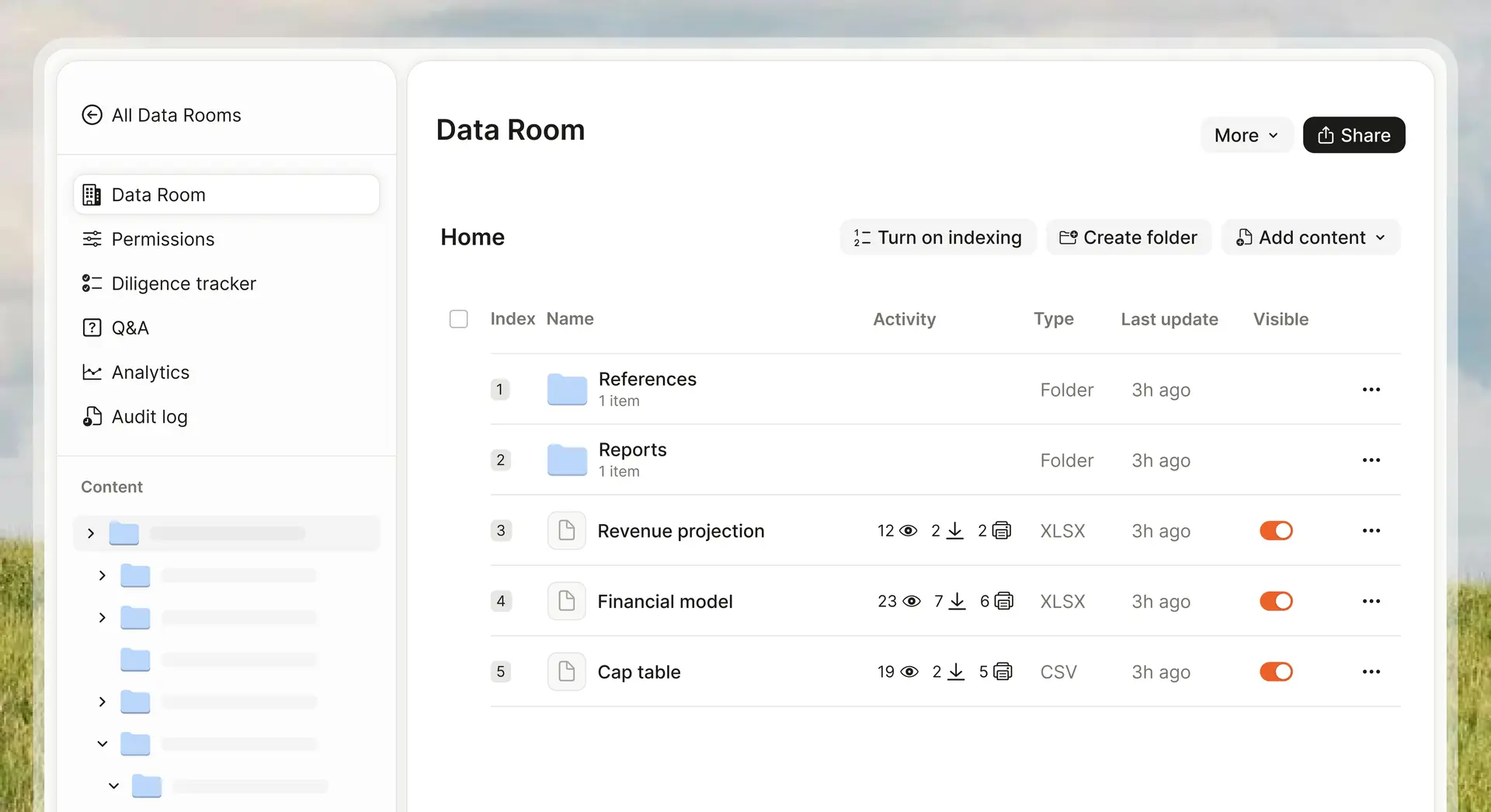
Ellty is a secure document sharing and analytics platform built around data room functionality. It's designed for exactly this kind of process, sharing sensitive documents in a controlled, trackable environment without the cost and complexity of traditional enterprise VDR platforms.
Here's what makes Ellty the right tool for due diligence:
Access controls. You decide who sees what. You can give different reviewers access to different documents or sections, restrict downloads, and revoke access at any time. During due diligence, not every person on the buyer's team needs to see everything. Ellty lets you set that up clearly.

NDA gating. Before any reviewer can access documents, you can require them to sign a non-disclosure agreement directly within Ellty. This means your sensitive information is protected from the moment someone clicks on the link - not just by trust, but by a signed legal document.
Real-time activity tracking. You can see exactly who has opened which documents, how long they spent on each one, and which areas of the data room they're most focused on. That information is genuinely useful, if a reviewer keeps returning to your financial projections, you know that's where they have questions, and you can prepare accordingly.
Dynamic watermarking. Documents can be watermarked automatically with the viewer's name and details. This deters unauthorized sharing and gives you a record if something is ever leaked.
A clean audit trail. Every action in the data room is logged. For legal and compliance purposes, having a complete record of who accessed what and when is not just useful - it's often required.
Flat, transparent pricing. This is where Ellty genuinely stands apart from legacy platforms. Most enterprise VDR solutions charge per user, per page, or per gigabyte. Those costs can escalate fast during a complex deal involving multiple parties and thousands of documents.

Ellty pricing is straightforward:
- Free plan ($0/month): Document tracking, real-time analytics, and secure sharing. A solid starting point for early conversations, before you're ready to set up a full data room.
- Standard ($69/month): Unlimited documents, advanced analytics, eSignatures, custom branding, and full data room features. Works well for smaller deals and ongoing client or investor communication.
- Room ($149/month): Granular permissions, NDA gating, dynamic watermarking, and restricted visitor access. This is the plan built for a controlled due diligence review.
- Room Plus ($349/month): Group visitor permissions, full audit logs, and support for up to 4,000 assets. Built for larger, multi-party deals.
No per-user charges. No per-page fees. No lengthy negotiation before you can get started. You pick a plan, set up your data room, and know exactly what you're paying - whether you're sharing documents with three people or thirty.

Tips for preparing for due diligence

Knowing the theory is useful. But here are the practical things that actually make the difference.
Start earlier than feels necessary
The biggest mistake most people make is waiting until a deal is in motion to start thinking about due diligence. By then, the timeline is already tight and the pressure is high.
Start gathering and organizing documents as soon as a transaction is on the horizon - ideally months before it formally begins. Even if you're just in early conversations with a potential buyer or investor, the time you spend organizing now will pay off when the real process starts.
Do your own pre-due-diligence review
Before anyone else comes in to review your business, review it yourself. Go through your financials and look for inconsistencies. Check that all your contracts are up to date and properly signed. Confirm that IP ownership is clearly documented.
The goal is to find the problems before someone else does. If you find something that needs fixing, you have time. If a buyer finds it first, you're negotiating under pressure.
Organize documents by category
When you set up your data room, structure it logically. Group documents by category - financials in one section, legal documents in another, HR in another, and so on. Use clear naming conventions so that documents are easy to find.
A disorganized data room sends the wrong signal. An organized one signals that the business is well-managed.
Prepare a clear and accurate index
An index or document register that lists what's in your data room and what each document covers can save a lot of time for the reviewing party. It reduces back-and-forth questions and makes your data room easier to navigate. Some VDR platforms, including Ellty, allow you to add notes or descriptions to documents, which serves the same purpose.
Keep version control tight
Use clear version naming for documents (v1, v2, final) and make sure you're sharing the most current version of everything. If a document is updated during the process, update it in the data room immediately and notify the relevant reviewers.
Use your data room analytics
If you're using Ellty, check the activity tracking regularly. Understanding what the reviewing party is spending time on tells you a lot about their concerns. If they're repeatedly reviewing one document, consider whether there's context you should provide proactively. If they haven't opened certain sections at all, that might be worth following up on.
Stay responsive
Due diligence creates a flow of questions. Answer them clearly and quickly. If a question requires more time to answer properly, acknowledge it and give a realistic timeline. Slow responses create doubt, even when the actual answer is fine.
Looking for a simple, professional way to share your due diligence documents? Ellty Room plan gives you everything you need - NDA gating, access controls, audit logs, and real-time tracking - starting at $149/month with no per-user fees.
Frequently asked questions
What is due diligence and when does it happen?
Due diligence is a structured review process that takes place before a significant business transaction is completed. It usually happens after a letter of intent or term sheet has been agreed upon, but before final contracts are signed. The reviewing party, typically a buyer or investor, requests documents and information from the other side to verify the business, its financials, and its legal standing.
How long does due diligence typically take?
It varies significantly depending on the complexity of the deal and the size of the business. A smaller fundraising round might involve two to four weeks of due diligence. A mid-market M&A transaction could take anywhere from four to twelve weeks. Having your documents well-organized and ready to share in a data room tends to compress this timeline.
Who conducts due diligence?
The reviewing party - the buyer, investor, or lender - leads the due diligence process. They often bring in external advisors: lawyers to review contracts and legal matters, accountants or financial advisors to go through the numbers, and sometimes technical or operational specialists depending on the business. On the seller's side, the management team and legal/financial advisors typically coordinate the response.
What happens if issues are found during due diligence?
Finding issues during due diligence doesn't necessarily mean the deal falls apart. Many issues can be addressed through price adjustments, representations and warranties in the final agreement, or escrow arrangements. The key is how issues are handled, if they're disclosed proactively and explained clearly, they're much more manageable than if they're discovered and feel like they were hidden.
Do I need a virtual data room for every due diligence process?
Not strictly, but it makes the process significantly easier for all parties. Sharing documents over email creates version control problems, has no access tracking, and makes it difficult to revoke access later. Even a lightweight VDR like Ellty Standard or Room plan gives you a much more professional and secure way to manage the process and it's not expensive.
What's the difference between a data room and a shared folder (like Google Drive or Dropbox)?
A shared folder is a collaboration tool. A virtual data room is purpose-built for secure document sharing in high-stakes situations. A VDR gives you features that shared folders can't match: NDA gating before access is granted, granular permissions at the document level, dynamic watermarking, detailed activity logs, and a defensible audit trail. In a due diligence context, those features aren't extras - they're often essential.
How should I decide what to include in my data room?
Start with the standard categories: financial records, legal documents, operational information, and risk-related documents. Then review the specific request list from the other party (called a due diligence checklist or information request list) and make sure each item is addressed. If something on the list doesn't apply to your business, note it clearly rather than just leaving it blank. Reviewers appreciate that level of communication.
Final thoughts
Due diligence is one of those parts of a business transaction that feels more intimidating than it needs to be. It's a lot of documents, a lot of questions, and a timeline that usually feels shorter than you'd like. But most of the difficulty comes from being unprepared and preparation is genuinely something you can control.
The businesses and founders who get through due diligence smoothly are usually the ones who started organizing early, knew what was in their own documents, and had a clean system for sharing information. They weren't necessarily perfect businesses. They were prepared ones.
Getting your documents into a well-organized, secure data room - before the process even begins - is one of the most practical things you can do. It signals competence. It compresses the timeline. It keeps you in control of the process rather than reacting to it.
Ellty is built for exactly this. Whether you're in early investor conversations and want to see who's looking at your materials, or you're running a full M&A process and need granular access controls across a large team of reviewers, Ellty gives you the right tools at a price that makes sense, without a long enterprise procurement process to get started.


Ellty is a secure document sharing and analytics platform with full virtual data room functionality. Built for founders, dealmakers, property professionals, and anyone who needs to share sensitive documents in a controlled, trackable way.
Author

Anika Tabassum Nionta is a Content Manager at Ellty, where she writes about secure document sharing, virtual data rooms, M&A, due diligence, fundraising, and sales enablement. With over 6 years of writing experience, she helps professionals understand how to share confidential documents securely, track engagement, and manage deals more effectively. Anika holds both a BA and MA in English from Dhaka University. Outside of work, she enjoys reading, exploring new cafes in Dhaka, and connecting with entrepreneurs and dealmakers in her community.

