
Due diligence is one of those things everyone knows they should do properly, but very few actually pull off without a hitch. Whether you're working on a startup funding round, a merger, a property transaction, or a consulting deal, the pressure is high, the documents are many, and the room for error is small.
And yet, mistakes happen all the time.
Some are small - a missing document here, a delayed response there. Others are more serious - sharing sensitive files with the wrong person, losing track of who has seen what, or realizing mid-deal that your audit trail is incomplete. Any of these can slow down a deal, break trust, or in the worst case, kill it entirely.
This blog walks through the most common due diligence mistakes, why they happen, and what you can do to avoid them. We'll also talk about how having the right virtual data room (VDR) like Ellty can make the whole process a lot smoother and a lot less stressful.
What is due diligence?
At its core, due diligence is the process of verifying what you're told before you commit to something. It's the research, review, and analysis that happens before a significant business decision, usually before an investment, acquisition, merger, or major contract.
If a company says it's worth $10 million, due diligence is how the other party checks if that's actually true. If a startup claims it has clean IP and no outstanding legal issues, due diligence is how investors confirm it.
The process usually involves reviewing financial records, legal documents, operational data, contracts, compliance records, and sometimes technical or environmental assessments, depending on the type of deal.
Done well, due diligence protects both parties. It reduces risk, surfaces problems early, and gives decision-makers the information they need to move forward (or walk away) with confidence.
Done poorly, it becomes a liability.


Why due diligence is essential
You might wonder: if both sides want the deal to happen, why go through all the trouble? The short answer is that what looks good on the surface often looks very different under scrutiny.
Due diligence protects buyers and investors from taking on unknown risks. It protects sellers from future disputes about what was disclosed. It gives lawyers, advisors, and executives a clear picture of what they're actually agreeing to.
Beyond just risk protection, thorough due diligence builds trust. When a company shows up to a deal with everything organized, accessible, and clearly presented, it sends a strong signal - this is a team that knows what they're doing.
On the flip side, disorganized or incomplete due diligence sends the opposite message. It raises doubts. It slows down timelines. It gives the other party reasons to negotiate harder or pull out.
For any serious transaction, due diligence isn't optional. It's the foundation the whole deal is built on.
Common mistakes in the due diligence process

Let's get into the actual mistakes people make. These aren't rare edge cases, they show up in deals of all sizes, across all industries.
1. Starting too late
One of the most common problems is waiting until a deal is already in motion to start gathering documents and preparing for review. By that point, there's pressure from all sides, timelines are tight, and corners start to get cut.
Due diligence preparation should start early, ideally before you even enter formal negotiations. Having your documents organized, updated, and ready to share means you're not scrambling when the process kicks off.
2. No clear scope or checklist
Without a defined scope, due diligence becomes a guessing game. What documents are needed? Who is responsible for gathering them? What questions need to be answered before signing?
When there's no clear checklist, things fall through the cracks. Teams end up going back and forth over missing items, and the process drags on longer than it needs to.
3. Involving too many (or too few) people
Too many cooks in the kitchen creates confusion over responsibilities and increases the risk of sensitive information spreading beyond where it should. Too few people means not enough expertise to review everything properly.
The right approach is a focused, well-defined team with clear roles - legal, financial, operational - and the right tools to coordinate without things getting messy.
4. Rushing the review
There's almost always pressure to close quickly. But rushing through document review leads to missed red flags. A clause in a contract that seems minor could have major implications. A financial statement that doesn't quite add up could be the warning sign you needed to catch.
Taking the time to actually read and understand the documents matters. That's what due diligence is for.
5. Poor communication between parties
When the two sides of a deal aren't communicating clearly - about what's been shared, what's still needed, what questions are outstanding - the process stalls. Both sides end up frustrated, and timelines slip.
Good due diligence requires structured communication, not just email chains and spreadsheets.
Due diligence documentation mistakes
Documentation is at the heart of due diligence. Everything that gets reviewed, questioned, or signed off on comes down to the documents. And this is where many teams consistently run into trouble.
Disorganized document storage
Sending documents through email attachments, shared folders with no naming convention, or scattered across multiple platforms creates chaos. Reviewers can't find what they need. Version control becomes a problem. People end up working from outdated files.
Sharing too much or too little
Sharing everything upfront with everyone on the other side is a mistake. Not all reviewers need access to all documents, especially in early stages. At the same time, withholding documents that are genuinely needed slows things down and creates distrust.
Access to documents should be controlled and staged - right people, right documents, right time.
No version control
Documents get updated. Contracts get revised. Financial models change. When there's no system for tracking which version is the current one, reviewers end up commenting on outdated files, and confusion follows.
Missing an audit trail
If you can't show who accessed what, when, and whether they downloaded it, you have a problem. Audit trails aren't just good practice, they're often a legal and regulatory requirement, especially in financial transactions and regulated industries.
No NDA or access gating
Sharing sensitive documents with someone who hasn't signed a non-disclosure agreement is a serious risk. This happens more often than it should - especially when deals are moving fast and someone skips the step of confirming an NDA is in place before granting access.
Incomplete or inaccurate documents
Sharing documents that are out of date, partially complete, or contain errors damages credibility. It also opens the door to disputes later, when the other side can claim they were given bad information.
Virtual data rooms: the backbone of due diligence (and why Ellty gets it right)
A virtual data room (VDR) is a secure, online space where you store, organize, and share confidential documents during a deal. It's the modern replacement for the physical data rooms that used to exist - actual rooms full of binders that people had to fly to and sit in to review.
Today, a good VDR gives you everything you need to run a clean, controlled, professional due diligence process without the chaos.
Here's what the right VDR should do:
- Keep documents organized in a logical structure so reviewers can find what they need
- Control who has access to what, and at what level (view only, download, etc.)
- Gate access behind an NDA so sensitive information is only shared with the right people
- Track activity in real time - who opened what, when, and for how long
- Provide a full audit log for legal and compliance purposes
- Watermark documents dynamically to trace leaks if they happen
- Make the process simple for both sides, without requiring a technical team to set it up
This is exactly what Ellty is built for.

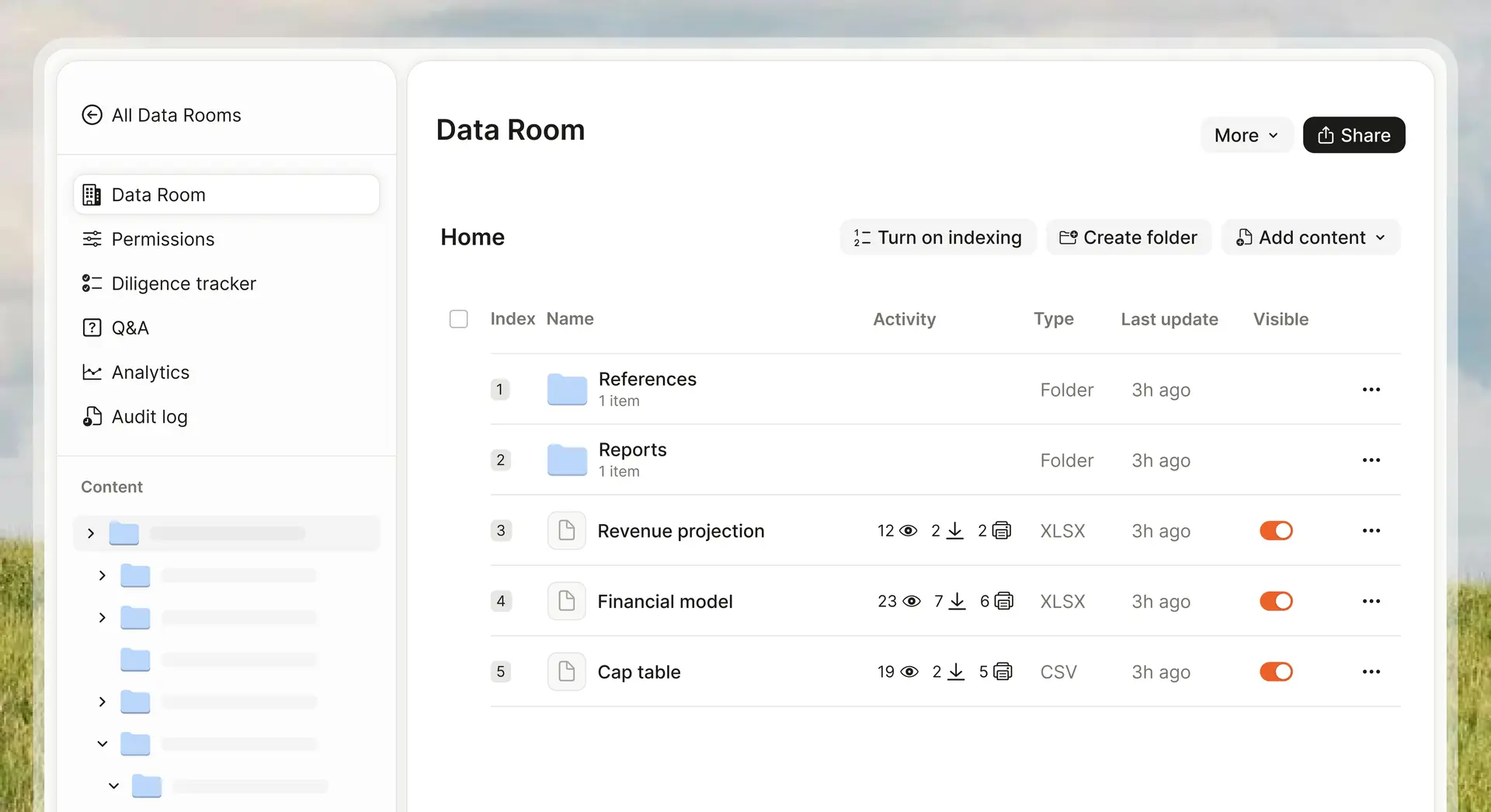
Ellty is a secure document sharing and analytics platform with full VDR functionality. Whether you're running a funding round, closing a property deal, managing an acquisition, or handling a consulting engagement with sensitive deliverables, Ellty gives you the tools that actually matter.
What makes Ellty different from legacy VDR platforms is the pricing model. Most traditional VDRs charge per user, per page, or require you to go through a drawn-out sales process just to get a quote. That's a problem for smaller deals and growing teams who need a professional setup without an enterprise budget.

Ellty keeps it simple: flat monthly pricing, no per-user fees, no surprise charges.
- Free ($0/month) - Document tracking, real-time analytics, and secure sharing. A good starting point if you're in early conversations and want to see who's engaging before setting up a full data room.
- Standard ($69/month) - Unlimited documents, advanced analytics, eSignatures, custom branding, and data room features. Works well for smaller deals and ongoing client or investor communication.
- Room ($149/month) - Granular permissions, NDA gating, dynamic watermarking, and restricted visitor access. Everything you need to run a controlled document review for due diligence.
- Room Plus ($349/month) - Group visitor permissions, full audit logs, and support for up to 4,000 assets per data room. Built for heavier document loads and multi-party deals.
Whether you're sharing documents with 3 people or 30, the price stays the same. No negotiation, no custom quotes, no waiting.

Common mistakes & the solutions
Now let's match those mistakes to real, practical fixes.
Mistake: Starting without a plan
Solution: Build a due diligence checklist before the process begins. Break it into categories - financial, legal, operational, compliance, HR - and assign ownership for each section. Know what you need before you start asking for it.
A VDR like Ellty makes this easier by letting you set up a structured folder system in advance. When the deal starts, everything has a place.
Mistake: Sending documents through email
Solution: Stop using email for document sharing in a due diligence process. Email has no access control, no activity tracking, no version history, and no audit trail. It's the single worst tool for this job.
Move to a dedicated data room where every document interaction is tracked and controlled. With Ellty, you know exactly who has seen what, when, and whether they downloaded it.
Mistake: No access control
Solution: Not everyone on the review team needs to see everything. Use permission levels to control access by person or group. Restrict sensitive sections to the people who actually need them.
Ellty Room and Room Plus plans give you granular permissions and group-level access control, so you can structure access properly without it becoming a manual headache.
Mistake: Skipping the NDA step
Solution: Gate access to your data room behind an NDA before anyone can see a single document. This should be a non-negotiable step.
Ellty includes NDA gating as a built-in feature on the Room plan. Reviewers must agree to the NDA before they're granted access - no workarounds, no skipping.
Mistake: No audit trail
Solution: Every deal needs a complete record of who accessed what. This protects both sides and is often a legal requirement.
Ellty logs all document activity in real time and provides a full audit trail. If a dispute ever comes up about what was shared or when, you have a clear, timestamped record.
Mistake: Sharing outdated documents
Solution: Before you start your due diligence process, do a document audit. Confirm that every file in your data room is the current version. Remove outdated files. Clearly label the latest versions.
Using a VDR with version tracking means there's no ambiguity about which file is current.
Mistake: No watermarking
Solution: Dynamic watermarking adds a layer of protection to sensitive documents. If something gets leaked or forwarded inappropriately, you can trace it back to who had access.
Ellty Room plan includes dynamic watermarking as a standard feature.
Mistake: Ignoring activity data
Solution: One underused feature of a good VDR is the analytics. Knowing which documents are getting the most attention and which ones are being ignored, gives you useful signals about where reviewers are focused and what might be coming up in Q&A.
With Ellty, real-time activity tracking is built in. You can see who's engaged, what they're looking at, and how long they're spending on specific documents. That's information you can use.

Due diligence best practices
Beyond fixing mistakes, here are the habits that separate a smooth due diligence process from a messy one.
Prepare before you're asked. Don't wait for a term sheet or a formal request to start organizing your documents. Keep your key materials up to date at all times so you're always deal-ready.
Use a structured folder system. Organize documents by category - financials, legal, operations, compliance, HR, IP - so reviewers can navigate logically. Consistent naming conventions matter too.
Set clear timelines. Both sides should agree on when documents will be provided, when the review period ends, and when outstanding questions need to be answered. Written timelines reduce back-and-forth.
Control access at every stage. Who gets access, to what, and when should be a deliberate decision, not a default. Start with limited access and expand as the deal progresses.
Keep communication centralized. Use Q&A tools within your data room if possible, rather than letting questions scatter across emails and calls. This creates a record and keeps everyone aligned.
Don't over-share early. In early-stage conversations, you don't need to open the whole data room. Share what's necessary to move the conversation forward, and expand access as the deal becomes more serious.
Review your own documents critically. Before handing over anything, review your own files from the perspective of the reviewer. What questions would they ask? What gaps do they see? Fix those before they become issues.
Have a response process ready. When questions come in, have a clear process for who reviews them, who approves the answers, and how quickly they'll be sent back. Slow responses stall deals.

FAQs
What is due diligence and why does it matter?
Due diligence is the process of verifying information and assessing risk before committing to a significant business decision - like an investment, acquisition, or major contract. It matters because decisions made without proper verification carry hidden risks that can become very costly after the fact.
What documents are typically needed for due diligence?
This depends on the type of transaction, but common documents include financial statements (typically 3-5 years), tax returns, legal incorporation documents, material contracts, employment agreements, IP ownership records, compliance and regulatory filings, and a cap table if equity is involved. Your legal and financial advisors can help build a complete checklist for your specific deal.
How long does a due diligence process take?
It varies significantly. A smaller transaction might take two to four weeks. A larger acquisition or complex deal can take several months. The timeline depends on how prepared the disclosing party is, how many documents need to be reviewed, and how quickly both sides respond to requests and questions.
What's the difference between a shared folder and a virtual data room?
A shared folder (like Google Drive or Dropbox) is a general-purpose file storage tool. A virtual data room is purpose-built for sensitive document sharing. VDRs include access controls, NDA gating, activity tracking, audit logs, dynamic watermarking, and other features that shared folders simply don't have. For due diligence, using a shared folder instead of a VDR is a serious security and compliance risk.
Who should have access to a due diligence data room?
Access should be limited to people with a genuine need to review specific documents. On the disclosing side, that's typically your legal team, finance team, and deal lead. On the reviewing side, it's their legal, financial, and operational advisors. Access should be structured by role, not everyone needs to see everything.
How does Ellty help with due diligence specifically?
Ellty provides a secure data room where you can organize and share documents with controlled access. Key features include NDA gating (reviewers must accept before accessing), granular permissions (control who sees what), dynamic watermarking, real-time activity tracking, and a full audit log. All of this comes at a flat monthly price - no per-user fees, no enterprise contracts.
What should I do if sensitive documents get shared with the wrong person?
First, revoke their access immediately. Second, check your audit log to confirm exactly what they accessed and when. Third, consult your legal team about whether any disclosure obligations have been triggered. Dynamic watermarking - a feature available in Ellty Room plan - helps you trace leaks and identify the source if documents are forwarded beyond their intended audience.
Final thoughts
Due diligence is not the glamorous part of a deal. It's the detailed, methodical, sometimes tedious work that happens before the handshakes and announcements. But it's also the work that determines whether a deal is built on solid ground or sitting on hidden problems.
The mistakes covered in this blog aren't rare. They happen in deals of all sizes, from seed-stage funding rounds to multi-million dollar acquisitions. And they're almost always preventable.
The fix is usually a combination of better preparation, clearer processes, and the right tools. A virtual data room sits at the center of all three. It gives you the structure to organize your documents, the controls to share them securely, and the visibility to know exactly what's happening throughout the review.
Ellty was built specifically for this. It's not an enterprise platform with a six-figure contract and a six-week setup. It's a professional, well-priced data room that you can get running quickly, with all the features that matter for a real due diligence process.
If you're heading into a deal or you want to make sure you're ready when one comes along, start with Ellty for free and see how much smoother the process can be.
Ellty is a secure document sharing and analytics platform with full virtual data room functionality. Flat pricing, no per-user fees, and no enterprise contracts. Plans start at $0/month.
Author

Anika Tabassum Nionta is a Content Manager at Ellty, where she writes about secure document sharing, virtual data rooms, M&A, due diligence, fundraising, and sales enablement. With over 6 years of writing experience, she helps professionals understand how to share confidential documents securely, track engagement, and manage deals more effectively. Anika holds both a BA and MA in English from Dhaka University. Outside of work, she enjoys reading, exploring new cafes in Dhaka, and connecting with entrepreneurs and dealmakers in her community.

