
You have found a company you want to acquire. Or maybe an investor has expressed interest in your business. Either way, before anything gets signed, there is a process that has to happen. That process is called due diligence.
Most people have heard the term. Far fewer understand that due diligence actually has two very different sides to it. One side is about facts, numbers, and documents. The other side is about people, culture, and judgment. Miss either one, and you could end up walking into a deal that looks great on paper but falls apart in real life.
In this guide, we break down the difference between hard due diligence and soft due diligence. We will explain what each one covers, why both matter, and how having the right tools in place, like a virtual data room, can make the whole process smoother and more secure.
What is due diligence?
Due diligence is the process of thoroughly investigating a business before entering into a deal. It could be a merger, an acquisition, a funding round, a partnership, or even a property transaction. The goal is simple: you want to understand exactly what you are getting into before you commit.
Think of it like buying a used car. You would check the engine, look at the service history, maybe get a mechanic to inspect it. You would also ask questions about why the seller is letting it go, how it was driven, and whether the story they are telling you adds up. Both parts of that process matter.
In business deals, due diligence works the same way. You check the hard facts, and you also assess the softer, less obvious factors. Together, they give you a full picture of the opportunity, and more importantly, the risks.
Due diligence typically kicks off after a letter of intent (LOI) is signed. It runs for a set period, usually anywhere from 30 to 90 days depending on the size and complexity of the deal, though timelines can vary widely.
Types of due diligence
Due diligence is not a single checklist. It covers multiple areas, and the type of review you do depends on the nature of the deal. Common types include:
Financial due diligence - reviewing revenue, expenses, debts, and financial projections.
Legal due diligence - examining contracts, litigation history, IP ownership, and regulatory compliance.
Operational due diligence - assessing systems, processes, supply chains, and infrastructure.
Commercial due diligence - evaluating the market, competitive position, and customer base.
HR and cultural due diligence - understanding the team, leadership, and workplace culture.
But at the broadest level, all of these types fall into one of two categories: hard due diligence or soft due diligence. Understanding this distinction is what we are here to talk about.


Hard due diligence
Hard due diligence refers to the review of objective, verifiable, and documented information about a business. It is the factual side of the investigation. You are looking at things that can be measured, confirmed, and cross-checked.
This is where a deal team spends a lot of their time, especially in the early stages. Auditors, lawyers, financial analysts, and technical experts all get involved. The work is detail-heavy and document-intensive.
Key areas of focus in hard due diligence
Financials
This is often the starting point. You are reviewing financial statements (usually for the last three to five years), tax returns, balance sheets, income statements, cash flow statements, and any outstanding debt or liabilities. You want to verify that the numbers the seller has presented are accurate and that there are no hidden financial problems.
Legal and compliance
This covers contracts with customers, suppliers, and employees. It also includes any ongoing or past litigation, regulatory filings, licenses and permits, intellectual property ownership, and compliance with local and international laws. A single undisclosed lawsuit or a lapsed license can change the entire risk profile of a deal.
Operational review
Here you look at how the business actually runs. What technology systems are in place? How is the supply chain structured? What are the production processes? Are there any single points of failure, like a key supplier relationship that could break down?
Assets and liabilities
What does the company own, and what does it owe? This includes physical assets like property and equipment, intangible assets like software or patents, and financial liabilities like loans or deferred payments.
IT and cybersecurity
Increasingly important in modern deals. You want to understand the state of the company's technology infrastructure, what data they hold, and whether there are any known vulnerabilities or past breaches.
Goal of hard due diligence
The goal is risk identification and validation. You want to confirm that what the seller has told you is true, and you want to uncover anything they may not have told you. Hard due diligence protects you from financial and legal surprises after the deal closes.
A well-run hard due diligence process is what gives investors and acquirers the confidence to move forward, or the evidence they need to renegotiate or walk away.
Ready to run a cleaner due diligence process? Ellty virtual data room keeps all your critical documents organized, access-controlled, and fully trackable. Start for free.
Soft due diligence
Soft due diligence is everything that the documents do not tell you. It is the human side of the deal. You are trying to understand the company's culture, its leadership, how the team works together, and whether the people running the business will be a good fit after the deal closes.
This is often underestimated. Many deals fail not because the financials were wrong, but because the cultures clashed, the key executives left after the acquisition, or the integration simply did not work because of people problems that nobody examined carefully enough.
Soft due diligence requires a different kind of skill. It is less about reading documents and more about asking the right questions, observing how people behave, and reading between the lines.


Key areas of focus in soft due diligence
Leadership and management
Who is running the company? What are their backgrounds, track records, and management styles? Are the key decision-makers likely to stay after a deal, or are they planning to exit? How do they handle pressure, conflict, and change?
Company culture
What is it like to work at this company? What do employees value? Is the culture top-down or collaborative? This matters a lot in acquisitions, because if you are merging two companies with completely different cultures, integration will be rocky regardless of how good the numbers look.
Employee retention and morale
Are the best people likely to stay? What is the current level of employee satisfaction? Are there any retention risks, like key people who are unhappy, or who have non-compete agreements that could complicate things?
Communication and transparency
How does the leadership team communicate with their people? Do employees trust management? Is there a culture of transparency or one of secrecy? These things affect how well a business will integrate into your organization.
Reputation and relationships
How is the company perceived by its customers, suppliers, and industry peers? Are there any reputational issues that could create problems post-deal?
Goal of soft due diligence
The goal is to understand the human and cultural dynamics that will determine whether the deal actually works after it closes. It is about assessing fit, alignment, and risk on a human level.
Soft due diligence is what separates a deal that succeeds long-term from one that technically closes but then quietly falls apart because nobody ever asked the important questions about the people involved.
Virtual data rooms: the backbone of due diligence (and why Ellty is right for this)
Whether you are working through hard due diligence, soft due diligence, or both, there is one thing every deal team needs: a secure, organized place to share and review documents. That is what a virtual data room (VDR) does.
In the past, due diligence meant physical rooms full of printed files, which was slow, expensive, and easy to mismanage. Today, VDRs have replaced all of that. They let deal teams share sensitive documents digitally, with full control over who can see what, and with a complete record of every activity.
Here is where Ellty comes in.

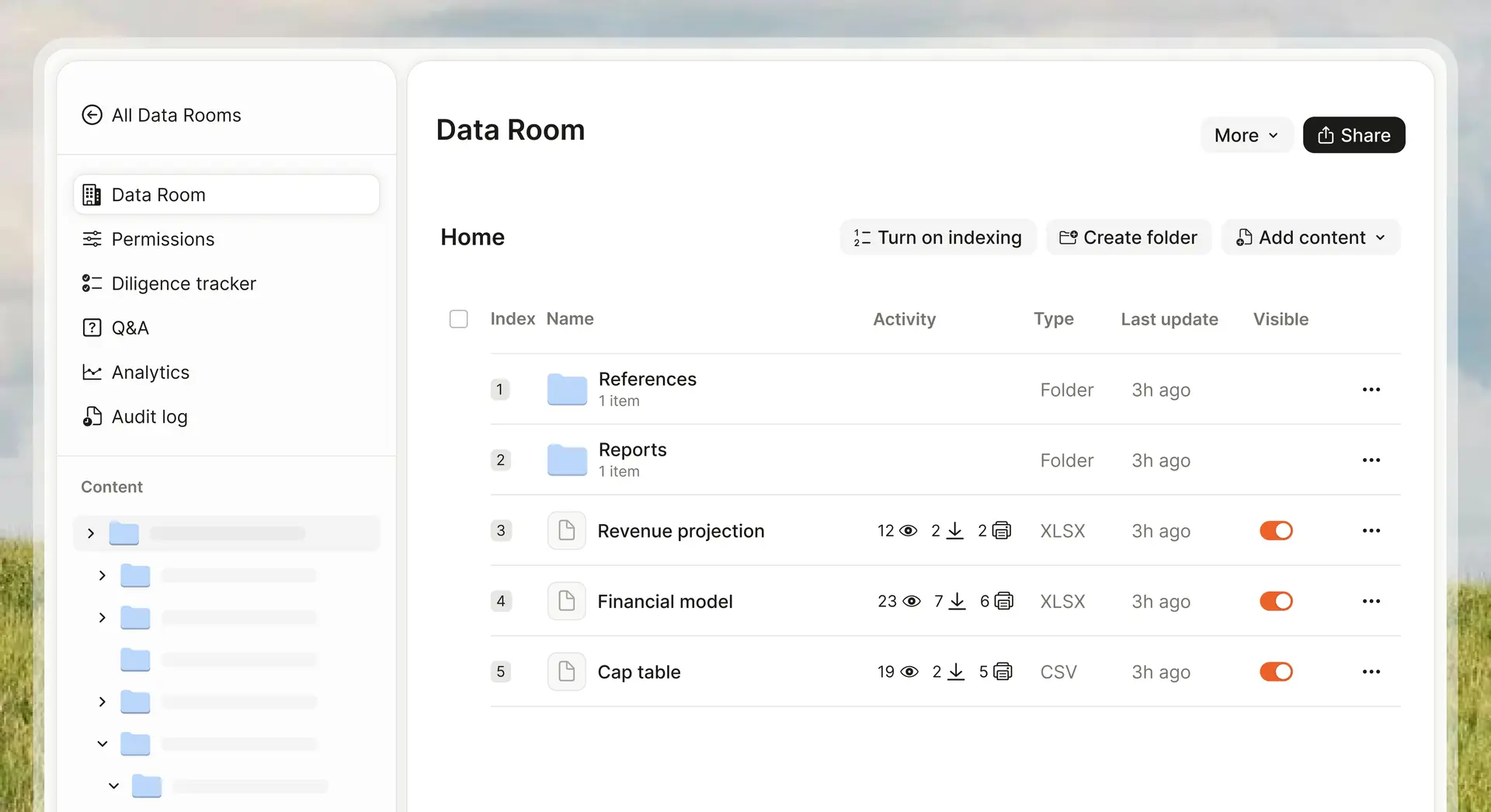
Ellty is a secure document sharing and analytics platform with full data room functionality. It is built for anyone who needs to share sensitive documents in a controlled, trackable way, whether you are running an M&A process, closing a funding round, managing a property deal, or handling a consulting engagement.
What makes Ellty practical for due diligence is the combination of tools it offers and the simplicity of its pricing.
Access controls mean you can decide exactly who sees which documents. A financial advisor reviewing hard due diligence materials should not necessarily have access to HR files being reviewed as part of soft due diligence. With Ellty, you can manage that granularity without complicated setup.
Real-time activity tracking tells you who opened what, when, and for how long. This gives you insight into which parts of your documents are getting the most attention from the other side. That is useful intelligence during any deal.
NDA gating means you can require users to sign a non-disclosure agreement before they even access the data room. This is standard practice in due diligence and Ellty makes it seamless.
Audit trails give you a complete log of all activity in the data room. This is important for accountability, compliance, and just good deal hygiene.
Dynamic watermarking ensures that documents carry identifying marks tied to the viewer, which discourages unauthorized sharing and helps trace any leaks.

And the pricing is transparent. There are no per-user fees, no per-page charges, and no surprise invoices:
- Free plan - document tracking, real-time analytics, and secure sharing. Good for early conversations.
- Standard ($69/month) - unlimited documents, advanced analytics, eSignatures, and custom branding. Works well for smaller deals and investor communication.
- Room ($149/month) - full VDR features including granular permissions, NDA gating, dynamic watermarking, and restricted visitor access. Built for controlled document review.
- Room Plus ($349/month) - group permissions, full audit logs, and support for up to 4,000 assets. Built for heavier document loads and multi-party deals.
You pick a plan, set up quickly, and know exactly what you are paying. Whether you are sharing with 3 people or 30, the cost stays predictable.

The due diligence process

Here is a simplified view of how due diligence typically unfolds, and where hard and soft due diligence each come into play:
Step 1: Letter of intent signed
The buyer and seller agree to move forward and begin the formal due diligence process.
Step 2: Data room set up
The seller (or their advisors) sets up a virtual data room and populates it with documents. This is where tools like Ellty make a real difference. Everything is organized, access-controlled, and tracked from day one.
Step 3: Hard due diligence begins
The buyer's legal, financial, and technical teams begin reviewing documents in the data room. They are checking financials, contracts, compliance records, and anything else that was agreed to be shared.
Step 4: Questions and clarifications
As the review progresses, the buyer submits questions. The seller responds, often by uploading additional documents to the data room.
Step 5: Soft due diligence runs in parallel
While the hard review is happening, the buyer is also meeting with leadership, visiting facilities if relevant, speaking to key employees, and assessing cultural fit. This can include structured interviews, informal conversations, and observation.
Step 6: Findings consolidated
Both sets of findings, hard and soft, are brought together. Risks are identified, and the deal team decides whether to proceed, renegotiate, or walk away.
Step 7: Deal moves to close (or not)
If everything checks out, the deal proceeds to final negotiations and closing. If not, the parties either renegotiate terms or the deal falls apart.
Key differences between hard and soft due diligence
Here is a clear breakdown of how the two types compare:
Hard due diligence | Soft due diligence | |
|---|---|---|
What it examines | Documents, data, financials, legal records | People, culture, leadership, communication |
Type of information | Objective, verifiable, measurable | Subjective, observational, qualitative |
Who does it | Lawyers, accountants, auditors, technical experts | HR professionals, executives, consultants |
Primary tools | Virtual data rooms, financial models, legal review | Interviews, site visits, observation, reference checks |
Goal | Identify financial, legal, and operational risk | Assess cultural fit, leadership quality, integration risk |
When it happens | Early and throughout the process | Runs in parallel, often slightly later |
What it protects against | Hidden liabilities, fraud, misrepresentation | Culture clash, key person risk, failed integration |
Both types are necessary. Hard due diligence without soft due diligence gives you accurate numbers but no understanding of the people behind them. Soft due diligence without hard due diligence gives you good feelings about a company that might have serious financial or legal problems.
The most successful deals take both seriously.
FAQs
What is the main difference between hard and soft due diligence?
Hard due diligence focuses on verifiable, documented facts like financials, legal records, and operational data. Soft due diligence focuses on human and cultural factors like leadership quality, team dynamics, and company culture. Both are important parts of a complete due diligence process.
Which type of due diligence is more important?
Neither is more important than the other. They serve different purposes. Hard due diligence protects you from financial and legal risk. Soft due diligence protects you from cultural and people-related risk. Skipping either one can lead to serious problems after the deal closes.
How long does due diligence usually take?
The time depends on the size and complexity of the deal. For smaller transactions, it might take 30 days. For larger or more complex deals, it can run 60 to 90 days or longer. Having a well-organized virtual data room can help speed things up on the hard due diligence side.
What documents are typically shared in hard due diligence?
Common documents include financial statements, tax filings, legal contracts, employee agreements, IP registrations, compliance records, board meeting minutes, and any litigation history. These are usually organized and shared through a virtual data room.
Can a deal fail because of soft due diligence issues?
Absolutely. Culture clashes, the departure of key executives after a deal closes, and poor team integration are among the most common reasons acquisitions underperform or fail. Soft due diligence exists precisely to identify these risks before it is too late.
What is a virtual data room, and do I need one for due diligence?
A virtual data room is a secure online platform for storing and sharing sensitive documents during a deal. It gives you control over who sees what, tracks all activity, and keeps everything organized. For any serious due diligence process, a VDR is not optional, it is essential. Ellty offers a straightforward, flat-rate VDR with no per-user fees, starting from a free plan all the way up to full deal-room functionality.
How does Ellty support both hard and soft due diligence?
Ellty helps primarily with the document side of due diligence. It gives you a secure place to organize and share all the materials needed for hard due diligence review, from financials to legal documents. For soft due diligence, the platform helps with document sharing related to HR policies, org charts, and cultural materials. The real-time analytics also tell you what the other side is paying close attention to, which can inform the conversations you have as part of your soft review.


Final thoughts
Due diligence is not just a box to tick before a deal closes. It is the process that tells you whether the deal actually makes sense, on every level.
Hard due diligence gives you the facts. It confirms that the numbers are real, the legal structure is clean, and the business operates the way it is supposed to. Soft due diligence gives you the context. It tells you whether the people are right, whether the culture is compatible, and whether the deal will actually work once the ink is dry.
Missing either side is a risk you do not need to take.
The good news is that the practical side of running due diligence is more manageable than ever. With a virtual data room like Ellty, you can organize your documents, control access, track engagement, and run a professional process, without the complexity or the cost of legacy platforms.
Whether you are early in a funding conversation and just need to see who is opening what, or you are running a full acquisition with multiple parties and thousands of documents, Ellty has a plan that fits.
Ellty is a secure document sharing and analytics platform with full data room functionality. Built for anyone who needs to share sensitive documents in a controlled, trackable way.
Author

Anika Tabassum Nionta is a Content Manager at Ellty, where she writes about secure document sharing, virtual data rooms, M&A, due diligence, fundraising, and sales enablement. With over 6 years of writing experience, she helps professionals understand how to share confidential documents securely, track engagement, and manage deals more effectively. Anika holds both a BA and MA in English from Dhaka University. Outside of work, she enjoys reading, exploring new cafes in Dhaka, and connecting with entrepreneurs and dealmakers in her community.

