
Before any serious business deal moves forward, one of the first things that happens behind the scenes is a lot of document sharing and question-answering. A vendor wants to know if you handle data securely. An investor wants to understand your financials. A potential buyer wants to know about your legal obligations. All of this information gets requested, reviewed, and verified and the tool that makes this possible is the due diligence questionnaire, or DDQ.
If you have been on either side of a deal, an audit, or a vendor review, you have probably encountered one. They can feel overwhelming at first, but they serve a real purpose: they give everyone in a transaction a structured way to ask the right questions and get honest, documented answers.
In this article, we walk through what DDQs are, why they matter, what they typically include, and real-world examples you can learn from. We also cover how platforms like Ellty make the whole process easier to manage and track.
In this article
- What is a due diligence questionnaire?
- Why do organizations use DDQs?
- What should a due diligence questionnaire cover?
- Due diligence questionnaire examples
- Virtual data rooms: the backbone of due diligence
- How to improve the due diligence questionnaire process
- Get ahead of risk with effective DDQs
- FAQs
- Final thoughts
What is a due diligence questionnaire?
A due diligence questionnaire is a formal document that one party sends to another to gather information before entering into a business relationship or transaction. It is a list of detailed questions designed to uncover risks, verify claims, and confirm that the responding party is who they say they are and can do what they say they can do.


DDQs show up in many situations. An investment firm might send one to a fund manager before committing capital. A large enterprise might send one to a new software vendor before signing a contract. A buyer might send one to a company they are considering acquiring. In each case, the purpose is the same: understand what you are getting into before you commit.
The questions inside a DDQ are not random. They are carefully structured to examine specific areas of risk e.g. financial, legal, operational, technical, or all of the above, depending on the context of the transaction.
Why do organizations use DDQs?
There are a few practical reasons why organizations rely on DDQs rather than just having informal conversations or browsing a company's website.
They create a paper trail
When answers are documented in a structured questionnaire, they become part of the record. If something goes wrong later, you have written evidence of what was disclosed (or what was not).
They help surface risks early
A well-designed DDQ asks the uncomfortable questions: Are there pending lawsuits? Have there been data breaches? Are there gaps in your insurance coverage? These are not easy things to bring up in a meeting, but a formal document makes it expected and normal.
They set a professional standard
Sending a thorough DDQ signals that you take compliance and risk management seriously. It also tells the other party what level of transparency you expect from them.
They speed up the review process
When questions are organized in advance, reviewers can work through answers systematically instead of going back and forth in emails asking for different bits of information.
They protect your organization
Whether you are an investor, a buyer, or a procurement manager, the DDQ is your safeguard. It shows that you did your homework.
For teams managing multiple vendor relationships or running parallel deals, organizing all of this documentation quickly becomes a challenge. That is where a virtual data room like Ellty comes in - giving you a secure, organized space to manage document sharing, track who has reviewed what, and keep the process moving.

What should a due diligence questionnaire cover?


The scope of a DDQ depends on the type of transaction and the industry involved. That said, most DDQs share a common set of core areas.
Company overview and structure
Basic information about the organization: legal name, ownership structure, subsidiaries, registration details, and key personnel. This section confirms who you are actually dealing with.
Financial information
Audited financial statements, revenue history, outstanding debts, cash flow details, and any unusual financial arrangements. This section tells you whether the company is financially stable.
Legal and compliance
Pending or past litigation, regulatory investigations, licenses and certifications, and compliance with relevant laws (data protection, anti-bribery, industry-specific regulations). This section is critical for understanding legal exposure.
Operational details
How the business runs day-to-day, key dependencies, supplier relationships, operational risks, and business continuity plans. This section gives you a practical sense of how resilient the organization is.
Cybersecurity and data protection
Data handling policies, security certifications (like ISO 27001 or SOC 2), incident history, access controls, and employee training. This section has become increasingly important as data breaches become more costly and common.
People and HR
Key employee contracts, turnover rates, employment practices, and any unresolved disputes with employees. In acquisitions especially, people are often the most valuable asset.
Environmental, social, and governance (ESG)
Sustainability policies, diversity initiatives, governance structures, and social responsibility commitments. More organizations are including ESG as a standard section.
Due diligence questionnaire examples
Understanding what a DDQ looks like in practice is useful. Here are a few common scenarios and the kinds of questions you would typically see in each.
Example 1: Investor due diligence DDQ (for a fund or asset manager)
This type of DDQ is commonly sent by institutional investors before allocating capital to a fund.
Organizational questions:
- What is the legal structure of the fund?
- Who are the beneficial owners and key decision-makers?
- What is the fund's investment mandate and strategy?
Financial and performance questions:
- What are the historical returns over 1, 3, and 5 years?
- How are fees structured (management fee, carried interest)?
- What is the current AUM and investor base composition?
Risk management questions:
- What risk limits are in place and how are they monitored?
- How are conflicts of interest managed?
- Has the fund ever been subject to regulatory action?
Compliance and governance questions:
- Is the fund registered with relevant regulatory bodies?
- What anti-money laundering (AML) controls are in place?
- How are investor reports produced and distributed?
Example 2: Vendor / third-party due diligence DDQ
Sent by procurement or compliance teams before onboarding a new supplier or technology vendor.
Business verification questions:
- What is your company registration number and registered address?
- Who are the directors and beneficial owners?
- Have you or any related party been subject to sanctions?
Financial stability questions:
- Can you provide your last two years of audited accounts?
- Do you have adequate insurance coverage for your services?
- What is your current credit rating or financial reference?
Data and security questions:
- Do you hold ISO 27001 or SOC 2 certification?
- How do you store and process personal data?
- What is your policy in the event of a data breach?
Service delivery questions:
- Who are your key subcontractors, if any?
- What is your disaster recovery plan?
- What SLAs do you commit to and how are they measured?
Example 3: M&A due diligence DDQ (for a potential acquisition)
Used by buyers to assess a target company before completing an acquisition.
Corporate structure:
- Provide a complete corporate structure chart.
- List all subsidiaries, joint ventures, and affiliates.
- Provide copies of incorporation documents and shareholder agreements.
Intellectual property:
- List all owned or licensed trademarks, patents, and copyrights.
- Are there any IP disputes in progress or threatened?
- Confirm that all proprietary software is owned outright or properly licensed.
Customer and contract information:
- Provide a list of the top 10 customers and revenue contribution.
- Are there any change-of-control clauses in major contracts?
- What is the average customer retention rate over the last three years?
Employment and HR:
- Provide copies of key executive employment contracts.
- Are there outstanding employment claims or tribunal proceedings?
- What are the current employee benefit obligations?
Example 4: Real estate transaction DDQ
Used by buyers or investors assessing a property before purchase.
Title and ownership:
- Confirm legal ownership and provide title documentation.
- Are there any encumbrances, mortgages, or easements on the property?
Planning and compliance:
- What planning permissions are in place or pending?
- Are there any known planning violations or restrictions?
Environmental:
- Have any environmental surveys been conducted?
- Are there any known contamination issues or ongoing remediation?
Tenancy and income (if applicable):
- Provide copies of all current leases and tenancy agreements.
- What is the current occupancy rate and average lease term?
Virtual data rooms: the backbone of due diligence
A DDQ is only as useful as the process around it. You can ask all the right questions, but if the documents being referenced are scattered across email threads, shared drives, and messaging apps, the process quickly becomes chaotic.
This is where a virtual data room (VDR) makes a real difference, and it is where Ellty is built to help.
When you are running a due diligence process, you need a place where documents can be shared securely, access can be controlled carefully, and activity can be tracked in real time. Ellty provides exactly that, without the complicated setup or the expensive enterprise contracts that come with legacy VDR platforms.

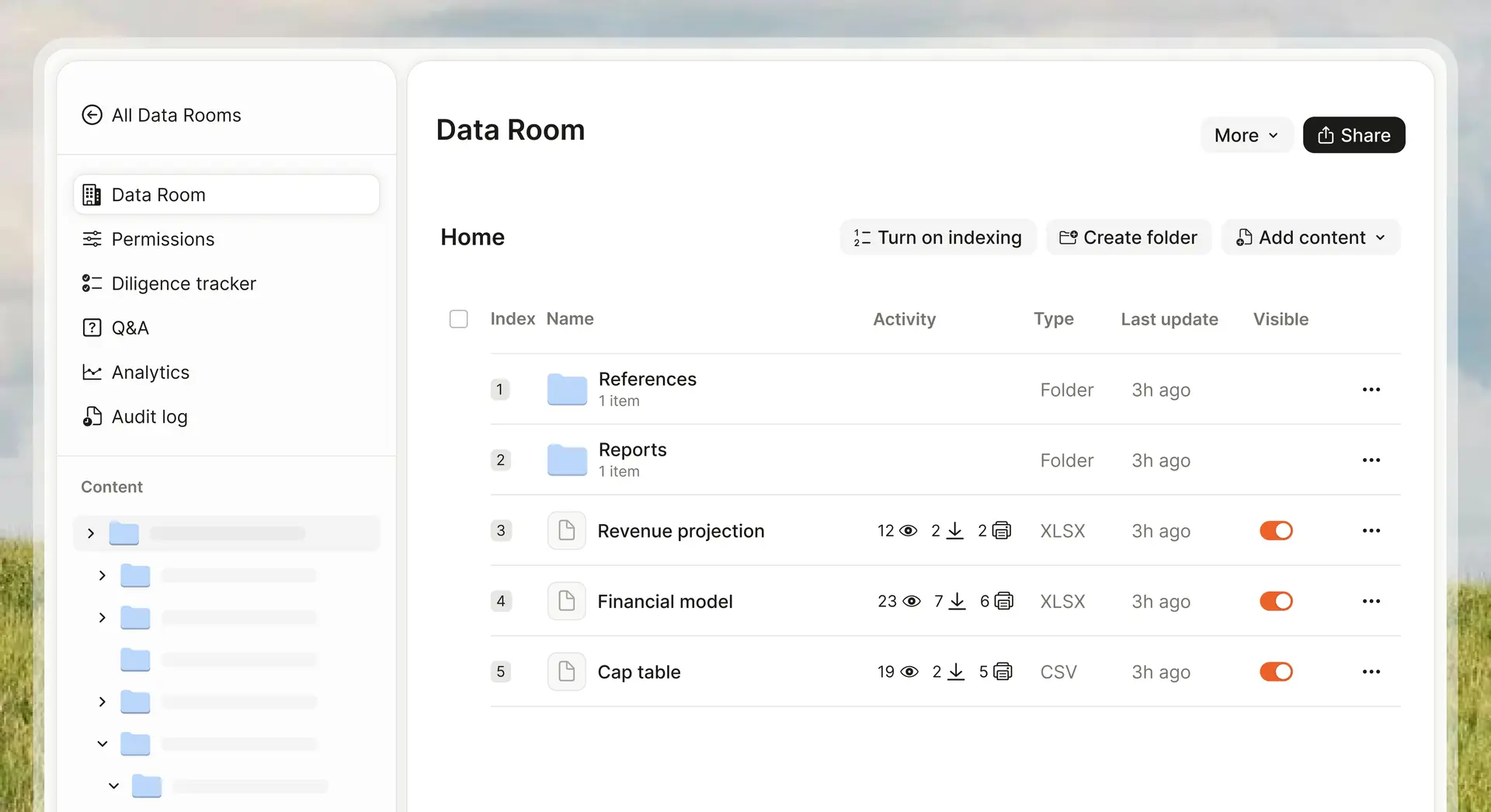
Here is what makes Ellty a strong choice for DDQ-related work:
Controlled access. Not everyone needs to see everything. With Ellty granular permission settings, you decide who can view which documents, and you can update those permissions at any time. This is especially important when sharing sensitive financial or legal materials with external reviewers.
NDA gating. Before a visitor can access your data room, you can require them to accept a non-disclosure agreement. This is a simple but important step that protects your information legally from the moment the review begins.
Dynamic watermarking. Documents shared through Ellty can be watermarked with the viewer's details automatically. This discourages unauthorized sharing and helps you trace the source if a document is leaked.
Real-time activity tracking. You can see who opened which document, how long they spent on it, and whether they downloaded it. This is valuable during due diligence because it tells you how engaged potential investors or buyers are, and what they are focusing on.
Full audit logs. Every action inside the data room is recorded. This gives you a complete, timestamped record of the due diligence process - useful for compliance and for resolving disputes.
Transparent, flat pricing. Unlike legacy VDR platforms that charge per user or per page, Ellty uses flat monthly pricing. The Room plan at $149/month gives you NDA gating, dynamic watermarking, granular permissions, and full data room functionality. The Room Plus plan at $349/month adds group visitor permissions, full audit logs, and support for up to 4,000 assets - suitable for larger, multi-party deals. There are no surprise fees, and you can get set up quickly without waiting for a sales quote.

Whether you are running a seed round, managing vendor onboarding, or working through an acquisition, Ellty gives you the tools to share documents with confidence and keep the due diligence process on track.

How to improve the due diligence questionnaire process
Even with a solid DDQ template, the process can go sideways if it is not managed well. Here are some practical ways to make it run more smoothly.
Start with a purpose-built template, then customize it. Generic questionnaires are a starting point, but every transaction has its own context. Take a standard DDQ template and adjust the questions to match the specific risks and priorities of the deal you are working on.
Assign clear owners. On the responding side, every section of the DDQ should have a designated person responsible for gathering and reviewing the answers. Without clear ownership, questions get delayed or answered inconsistently.
Set realistic deadlines and stick to them. DDQs often have many moving parts. Build a timeline that accounts for internal review, legal sign-off, and any follow-up questions. Flag delays early rather than letting them build up.
Use a central document repository. Instead of attaching documents to emails, store everything in one secure location. This reduces version confusion, makes it easier to update documents, and gives reviewers a single place to work from. A virtual data room like Ellty is the right tool here, it keeps your documents organized, accessible, and tracked without requiring any special technical setup.
Conduct a pre-submission review. Before sending your completed DDQ, do an internal check. Make sure all questions are answered fully, supporting documents are attached, and there are no contradictions between sections.
Track engagement from the receiving side. Once the DDQ and supporting documents are shared, use activity tracking to monitor who is reviewing what. If a key section has not been opened, that might signal a concern or a missing document. With Ellty, this visibility is built into the platform.
Keep a record of the process. A complete audit trail of who submitted what, when questions were answered, and how documents were accessed is useful both for compliance purposes and for future deals.
Get ahead of risk with effective DDQs
Due diligence is not about distrust. It is about making informed decisions. A well-prepared DDQ helps both sides of a transaction understand exactly what they are working with - the risks, the opportunities, and the obligations involved.
For the party sending the DDQ, it is an opportunity to set expectations clearly and protect your organization from unpleasant surprises. For the party responding, a thorough, well-documented answer demonstrates professionalism, transparency, and trustworthiness.
The examples in this article show how DDQs adapt to different contexts, from investor reviews to vendor onboarding to acquisitions. But in every case, the underlying goal is the same: gather the right information, document it properly, and make better decisions as a result.
If you are running a due diligence, the tools you use matter. Sharing documents over email or through an uncontrolled folder creates risk. A purpose-built platform like Ellty gives you the security, structure, and visibility to manage the process professionally, at a price that actually makes sense.
Don't let document chaos slow down your next deal. Start your free Ellty account today and set up your data room in minutes.
FAQs
What is the difference between a DDQ and a standard due diligence process?
A standard due diligence process is the overall exercise of investigating a company or transaction before making a decision. A DDQ is a specific tool used within that process, it is a structured questionnaire that helps one party gather documented information from another. The DDQ is usually one component of a broader due diligence effort that also includes financial modeling, legal review, and site visits.
How long should a due diligence questionnaire be?
There is no fixed length. A vendor DDQ for a small contract might be 2-3 pages, while an M&A DDQ for a large acquisition could run to 50 or more pages with hundreds of questions. The length should match the complexity and risk level of the transaction. The goal is to cover what matters - not to create paperwork for its own sake.
Who typically fills in the DDQ?
The organization being evaluated fills in the DDQ, but different sections are usually handled by different teams. Finance answers the financial questions, legal handles compliance and contract questions, IT or security answers the data and systems questions, and so on. A project manager or general counsel often coordinates the whole response.
Can DDQ answers be legally binding?
Yes, in many cases they can. Misrepresentations in a DDQ can result in legal liability, especially in M&A transactions where the purchase agreement may reference the DDQ responses as part of the deal documentation. This is one reason why DDQ answers should be reviewed carefully before submission.
How should sensitive documents be shared during due diligence?
Sensitive documents should never be shared via regular email or through consumer file-sharing tools. A virtual data room (VDR) is the appropriate tool. A VDR like Ellty provides access controls, NDA gating, watermarking, and audit logging - all of which protect your information and keep the process compliant.
What happens if a question in the DDQ cannot be answered?
If a question genuinely does not apply, say so clearly and explain why. If information is not yet available, note that it is pending and give a timeline for when it will be provided. Leaving questions blank or answering vaguely creates red flags for reviewers and can slow down or derail a transaction.
How often should vendor DDQs be refreshed?
Most organizations review their vendor DDQs annually or when there is a significant change to the relationship, such as a contract renewal, a new service being added, or a change in ownership on the vendor's side. Treating the DDQ as a one-time document is a compliance risk. Vendors' situations change, and your documentation should reflect that.
Final thoughts
A due diligence questionnaire is one of the most important tools in any serious business transaction. It brings structure to a process that could otherwise be messy and incomplete. It forces difficult questions into the open and creates a documented record that protects all parties involved.
Whether you are preparing to respond to one or sending one out, the effort you put into your DDQ process says a lot about how you operate. A thorough, well-organized response builds trust. A sloppy one raises doubts.
The examples in this article are a starting point. Use them to build or refine your own DDQ templates, and adapt them to the specific context of each deal or review you run.
And when it comes to managing the documents, sharing them securely, and keeping track of who is reviewing what, Ellty is built for exactly that. Clear pricing, no per-user fees, and the core VDR features you actually need, from NDA gating to dynamic watermarking to real-time activity tracking.
Ready to make your next due diligence process smoother and more secure? Explore Ellty plans and get started today.
Ellty is a secure document sharing and analytics platform with full data room functionality, built for anyone who needs to share sensitive documents in a controlled, trackable way.
Author

Anika Tabassum Nionta is a Content Manager at Ellty, where she writes about secure document sharing, virtual data rooms, M&A, due diligence, fundraising, and sales enablement. With over 6 years of writing experience, she helps professionals understand how to share confidential documents securely, track engagement, and manage deals more effectively. Anika holds both a BA and MA in English from Dhaka University. Outside of work, she enjoys reading, exploring new cafes in Dhaka, and connecting with entrepreneurs and dealmakers in her community.

