
You finally got the investor meeting. It went well. They ask for your data room.
You send a link. Three days pass. Then a week. Then a polite "we'll circle back."
It's not always the business. Sometimes it's the data room.
Investors move through dozens of deals at once. If your data room is confusing, incomplete, or hard to navigate - they move on. They won't tell you that's why. They'll just stop responding.
This post breaks down the most common fundraising data room mistakes people make, why they happen, and how to fix each one. If you're mid-raise or about to start one, read this before you send another link.
What is a fundraising data room, and why does it matter?
A data room is a secure, organized space where you share sensitive company documents with investors during due diligence. It used to mean a physical room with locked filing cabinets. Now it's a virtual folder, but the stakes are the same.
Investors use your data room to verify everything you said in your pitch. Revenue, cap table, legal structure, team, contracts. If what they find matches what you told them, deals move forward. If it doesn't, or if they can't find anything at all - deals stall.
A good data room signals that you run a tight ship. A bad one signals the opposite.
The 5 most common fundraising data room mistakes
1. You build the data room too late
Most people treat the data room like a final step. You close a meeting, get interest, and then scramble to put something together. That's backwards.
By the time an investor asks for your data room, you should already have it ready. Not 80% ready. Done.
When you're building it under pressure, you make errors. You forget documents. You upload the wrong version of the financial model. You create a messy folder structure because you're rushing. Investors can feel that energy in a data room.
Fix it now: Start building your data room before you start outreach. Use it as a forcing function to get your documents in order. You'll also catch gaps in your own narrative before investors do.
A good baseline is to have your data room ready at the same time as your pitch deck. They're two sides of the same story.


2. Your folder structure makes no sense
This one is more common than it should be. People dump documents into a data room without thinking about how an investor will navigate it.
Here's what a disorganized data room looks like:
- A folder called "Misc" with 12 documents in it
- Financial models saved as "Final_v3_ACTUAL_USE_THIS.xlsx"
- Legal documents scattered across three different folders
- No clear separation between past financials and projections
Investors don't have time to dig. If they can't find the cap table in 30 seconds, they'll either ask you for it (annoying) or assume you're hiding something (worse).
Fix it now: Use a standard structure. Here's a starting point:


Keep folder names short. Use sentence case. Don't abbreviate things only you understand.
3. You share everything with everyone
Investor conversations are at different stages. A cold intro call is not the same as a term sheet negotiation. Your data room access should reflect that.
Giving every investor full access to every document from the first email is a mistake for two reasons. First, you're handing out sensitive information (customer lists, detailed financials, legal docs) before you know if this investor is serious. Second, you lose any ability to control the narrative, they'll form opinions on raw data before you've had a chance to contextualize it.
Fix it now: Use staged access. Think of it in three layers.

Platforms like Ellty let you create multiple trackable links with different permission levels. You can share a pitch deck first, track who actually opens it and for how long, and then open up the full data room only for investors who are moving forward. No per-user fees, no complex setup.


4. You have no idea who's looking at what
If you share a data room link and just wait, you're flying blind. You don't know if the investor opened it. You don't know which sections they spent time on. You don't know if they forwarded it to a partner.
That information matters. A lot.
If an investor spent 12 minutes on your financials and 2 seconds on the team page, you know what to address in your next call. If they opened the deck three times in one day, that's a buying signal. If they haven't opened it in 10 days, you know a follow-up is warranted.
Without analytics, you're guessing. And guessing leads to bad follow-up strategy.
Fix it now: Use a platform that gives you real visibility. Ellty shows you exactly who viewed your data room, which pages or documents they spent the most time on, how many times they returned, and when. You get real-time notifications when someone opens your link.
That's not just nice to have. That's how you run a process instead of reacting to one.


5. Your documents are incomplete or outdated
This one sounds obvious. But it's the mistake that kills the most deals.
Investors will find the gap. Always. Whether it's a missing signature on a shareholder agreement, a cap table that doesn't add up to 100%, or a financial model with hard-coded numbers and broken formulas, they find it.
And when they do, they don't just flag the document. They start questioning everything else. Was the pitch deck numbers real? Do these people actually know their business?
Common missing or outdated documents:
- Cap table not updated post-SAFE rounds
- Financial model shows projections but no actuals
- Contracts unsigned or partially executed
- IP assignment agreements missing for early contractors
- Old pitch deck version still in the room (from a previous raise)
Fix it now: Do a document audit before you share anything. Go through every section, verify every file, and confirm dates. Set a rule: nothing goes in the data room that you haven't personally reviewed in the last 30 days.
A quick checklist helps here:


Other mistakes worth flagging
The five above are the big ones. But here are a few more that come up regularly.
Using Google Drive or Dropbox as a data room. These tools aren't built for this. No NDA gating, no per-document permissions, no analytics. You're also giving investors a link that could be forwarded to anyone with no trace.
Not having an NDA process. For early-stage startups sharing early product details or proprietary tech, NDA gating at the data room level is worth considering. Not every deal needs it, but you should have the option.
Naming files like an intern. "New deck final (2).pdf" is not a document name. Use clear, professional naming conventions. Investors are judging everything.
Ignoring mobile. A significant percentage of investors will check your data room on their phone. If your documents are PDFs that require horizontal scrolling to read, that's a problem. Test your data room on mobile before you send it.
No version control. If you update a document, make sure the old version is removed or clearly marked. Investors sometimes save links and return later. You don't want them reading stale data.
What a good data room actually looks like
A well-built data room doesn't impress investors with flashy design. It impresses them by being easy to use and complete.
Here's the standard:
- Every section has at least one document
- Folder names are clear and logical
- All documents are current (checked within the last 30 days)
- File names are professional and descriptive
- Access is staged by investor relationship
- You're tracking who views what
- There's a process for updating documents without creating confusion
That's it. That's the whole standard. It's not complicated, but most data rooms don't meet it.
How Ellty helps you avoid these mistakes
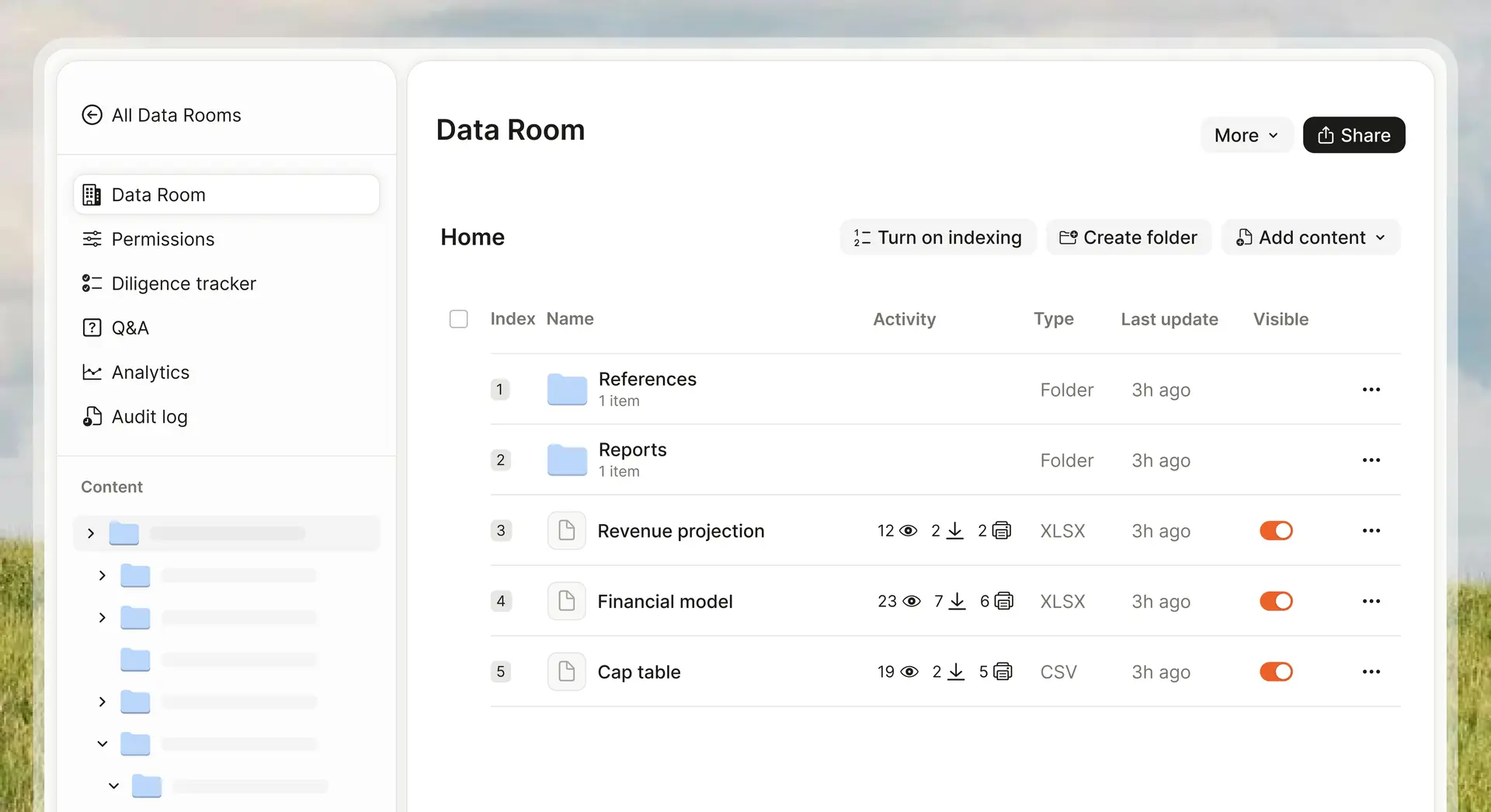
Ellty is built for exactly this use case - sharing data room, confidential documents, and running due diligence without a complicated setup or enterprise pricing.
Here's what's relevant to each mistake:
Building too late - Ellty setup is fast. You can have a data room live in under an hour. No reason to wait until you're in active conversations.
Bad folder structure - You can organize documents into clearly labeled sections and control the order investors see them.
Sharing everything with everyone - Ellty lets you create different trackable links with different permission levels. Share the deck first, open the data room later, gate it behind an NDA if needed.
No visibility - Real-time analytics show you exactly who opened your link, which pages they spent time on, and when. You get notified the moment someone views your data room.
On pricing, the Data Room plan starts at $149/month and includes granular permissions, NDA gating, dynamic watermarking, and restricted visitor access. The Data Room Plus plan at $349/month adds group permissions, audit logs, and up to 4,000 assets per data room. If you're just starting out and want to test document tracking and analytics, the free plan covers that at no cost.
Ellty works well for anyone who needs to share sensitive documents in a controlled, trackable way. Whether you're raising a funding round, closing a property deal, running a consulting engagement, or managing an acquisition, Ellty gives you the core tools that matter: access controls, real-time activity tracking, NDA gating, and a clean audit trail.

FAQ
What documents should be in a fundraising data room?
At minimum: pitch deck, financial model with actuals and projections, cap table, incorporation documents, shareholder agreements, IP assignments, product roadmap, and key traction metrics. For later stage raises, add customer contracts, team bios, and a competitive analysis. The goal is that an investor can verify every major claim from your pitch without having to ask you for a document.
How early should I set up my data room?
Before you start outreach. Ideally, your data room is ready at the same time as your pitch deck. Building it under pressure leads to errors - wrong file versions, incomplete sections, disorganized folders. Use the setup process as a way to audit your own documents before investors do.
What's the difference between a pitch deck and a data room?
Your pitch deck is your narrative. It tells the story of the company, the market, and why you're the team to build it. Your data room is your proof. It backs up every claim in the deck with real documents, financials, and legal structure. Both matter, but they serve different purposes at different stages of the investor conversation.
Should I use Google Drive for my data room?
Not recommended. Google Drive has no NDA gating, no per-document access controls, and no analytics. You can't tell if an investor opened your files, which ones they focused on, or whether they forwarded the link to someone else. It also doesn't look professional at the point in a conversation where investors are evaluating whether you run a tight operation.
How do I structure permissions in a data room?
Stage access by investor relationship. Early-stage conversations get pitch deck access only. Post-meeting, qualified investors get financials and traction data. Investors in active due diligence get full data room access, ideally gated behind an NDA. Platforms like Ellty make this easy with multiple trackable links at different permission levels.
What is NDA gating in a data room?
NDA gating requires a visitor to sign a non-disclosure agreement before accessing the data room or specific documents. It's useful when you're sharing early product details, proprietary technology, or sensitive customer information. Not every raise requires it, but it's a good option to have available, especially for deep technical due diligence.
How do I know if an investor has reviewed my data room?
Use a platform with built-in analytics. Good data room software tells you when someone opened your link, how long they spent in total, which specific documents or pages they looked at, and how many times they returned. Ellty provides this in real time, including notifications when someone views your link. That information directly shapes your follow-up strategy.
What are the most common data room mistakes?
Building it too late, poor folder structure, no access staging, no analytics, and incomplete or outdated documents. Any one of these can slow down or kill a deal. Together, they signal to investors that the company isn't organized, which raises concerns about everything else.
How many documents should a data room have?
There's no fixed number, but every major section should have at least one document. An empty section is worse than a missing section, it tells investors you know something is supposed to be there but didn't include it. For a seed to Series A raise, expect 20-40 documents across 7-10 categories.
Is a virtual data room worth it for early-stage startups?
Yes. Even at pre-seed stage, professional document sharing signals that you take your raise seriously. It doesn't have to be expensive - Ellty offers document tracking and real-time analytics on its free plan, and full data room features starting at $149/month. The analytics alone are worth it: knowing which sections investors focus on before your next call is a real advantage.
The bottom line
Your data room won't close a deal on its own. But a bad one will absolutely lose you one.
Get it done before you start outreach. Organize it for the reader, not for yourself. Stage access based on where each investor is in the process. And use a platform that tells you what's actually happening after you hit send.
Don't let a disorganized folder structure be the reason a good investor moves on. Set it up right the first time, it takes less time than you think.
Author

Anika Tabassum Nionta is a Content Manager at Ellty, where she writes about secure document sharing, virtual data rooms, M&A, due diligence, fundraising, and sales enablement. With over 6 years of writing experience, she helps professionals understand how to share confidential documents securely, track engagement, and manage deals more effectively. Anika holds both a BA and MA in English from Dhaka University. Outside of work, she enjoys reading, exploring new cafes in Dhaka, and connecting with entrepreneurs and dealmakers in her community.

