
If you've been involved in any kind of business deal, you've probably heard the term 'M&A' thrown around a lot. It stands for mergers and acquisitions. People often say it in one breath, as if the two are the same thing. They're not.
A merger and an acquisition are two different types of corporate transactions. They have different structures, different legal outcomes, different tax implications, and very different effects on the companies involved. Knowing the difference isn't just a matter of terminology - it can directly affect how you approach a deal, how you protect your interests, and how you prepare your documents.
This guide is written for business owners, founders, legal and financial professionals, and anyone who's walking into an M&A conversation and wants to understand what they're actually dealing with. We'll cover both concepts clearly, compare them side by side, and explain how a virtual data room helps you manage the process - whether you're merging, acquiring, or being acquired.
Managing a merger or acquisition? Ellty virtual data room gives you secure document sharing, NDA gating, and real-time activity tracking - without the enterprise price tag. Start free at ellty.com |
What is a business merger?
A merger happens when two companies come together to form a single, new entity. Both companies agree to combine their operations, assets, liabilities, and teams. The result is usually one unified business, and in many cases, both original companies cease to exist in their previous form.
Mergers are typically voluntary. Both sides agree that joining forces makes more sense than continuing as separate businesses. This could be because they want to grow faster, reduce competition, gain access to new markets, or simply because their combined value is greater than the sum of the two parts.
Common types of mergers
- Horizontal merger - two companies in the same industry and at the same stage of production combine. For example, two competing software companies merging into one.
- Vertical merger - a company merges with a supplier or a distributor. This helps control the supply chain or reduce dependency on external partners.
- Conglomerate merger - companies from completely different industries come together, usually to diversify their business interests.
- Market extension merger - companies that sell the same product but in different markets merge to expand their geographic reach.
In a merger, the deal is often framed as a partnership. The leadership, brand identity, and even the name of the new entity are usually negotiated. Shareholders on both sides receive shares in the newly formed company.


What is a business acquisition?
An acquisition happens when one company purchases another. The buying company (the acquirer) takes control of the target company by purchasing its shares or assets. After the deal closes, the target company either becomes a subsidiary of the acquirer or gets absorbed into it entirely.
Unlike a merger, an acquisition doesn't always require the target company's full enthusiasm. Some acquisitions are friendly, the target agrees and cooperates. Others are hostile, the acquirer goes around the board and appeals directly to shareholders. In most business acquisitions, though, both parties come to the table willingly.
Common types of acquisitions
- Share acquisition - the acquirer buys enough shares in the target company to gain controlling interest. The target company continues to exist as a legal entity, just under new ownership.
- Asset acquisition - the acquirer purchases specific assets of the target (such as equipment, intellectual property, or a product line) rather than buying the whole company. This lets the buyer choose what they want and leave the rest.
- Management buyout (MBO) - the existing management team of a company buys the business from the current owners, often with the help of external financing.
In an acquisition, the acquiring company usually holds all the decision-making power after the deal is done. The acquired company's brand, leadership, and operations may change significantly depending on the acquirer's intentions.


Merger vs acquisition - key differences
Here's a side-by-side comparison to make things easier to follow:
Feature | Merger | Acquisition |
Definition | Two companies combine to form one | One company buys another |
Control | Shared between both parties | Buyer has full control |
Company identity | New entity is usually formed | Target may keep or lose its identity |
Decision-making | Mutual and joint | Buyer decides |
Size of parties | Usually similar in size | Buyer is often larger |
Tax treatment | Can be tax-neutral (stock deals) | Often involves taxable cash payment |
Speed | Slower due to negotiation | Can move faster |
Employee impact | Roles may overlap and merge | Workforce may be restructured |
The most important thing to remember is this: in a merger, both companies come in as relative equals and build something together. In an acquisition, one company is buying another and taking control. That difference shapes everything, from how negotiations go to how the deal is documented and executed.
Tax and liability analysis
One of the most important factors in any M&A deal is the tax treatment. How a deal is structured - as a merger or an acquisition, and whether it's a stock deal or an asset deal - has significant tax consequences for both parties.
Tax implications of a merger
Mergers are often structured as tax-free reorganizations. Under certain conditions, the shareholders of both companies can exchange their shares for shares in the new entity without triggering an immediate tax event. This is sometimes called a 'tax-free reorganization' and requires meeting specific legal criteria.
That said, not all mergers qualify. If the deal involves significant cash payments, or if the structure doesn't meet the required thresholds, it may be treated as a taxable transaction. Always get qualified tax counsel involved early.
Tax implications of an acquisition
Acquisitions are more varied in their tax treatment. In a stock acquisition, the buyer purchases the target's shares. The target company retains its existing tax attributes, including any deferred liabilities or loss carryforwards, which can be a benefit or a risk depending on what's on the books.
In an asset acquisition, the buyer can often 'step up' the tax basis of the acquired assets to their fair market value. This allows for higher depreciation deductions going forward. However, the seller may face higher taxes since they're recognizing a gain on each asset sold.
Liability considerations
Liability is another area where the two structures diverge. In a stock acquisition, the buyer inherits all of the target's liabilities, including known ones and hidden ones. This makes due diligence especially critical. In an asset acquisition, the buyer can often structure the deal to exclude specific liabilities.
In mergers, liabilities from both entities typically carry over into the new combined company, which is why thorough legal and financial review before closing is non-negotiable.
Legal considerations
M&A transactions are legally complex. There are multiple layers of regulation, documentation, and approval processes involved, and getting any of them wrong can delay or derail a deal.
Regulatory approvals
Depending on the size of the deal and the industries involved, mergers and acquisitions may require approval from competition authorities. In many countries, large deals are reviewed to ensure they don't create anti-competitive market conditions. Failing to obtain the right regulatory approvals can result in the deal being blocked entirely.
Shareholder and board approvals
Most mergers require approval from the shareholders of both companies. Acquisitions may only require approval from the target company's shareholders, depending on how the deal is structured. Board approval is typically required in both cases.
Due diligence
Legal due diligence involves reviewing contracts, pending litigation, intellectual property ownership, employment agreements, regulatory compliance, and more. This process is thorough and document-heavy, and it usually takes place in a secure data room where both parties can access and review sensitive materials.
Definitive agreements
The core legal documents in M&A deals include the Letter of Intent (LOI), the Purchase Agreement (either a Stock Purchase Agreement or an Asset Purchase Agreement), and supporting schedules and disclosures. These documents define every term of the deal - price, representations, warranties, conditions to close, and what happens if things fall through.
Ellty virtual data room is built for due diligence. Share documents securely, set granular permissions, track who views what, and keep your deal moving. Start with a free plan. |
Why do companies decide to merge?
Companies don't merge on a whim. It's a significant decision that takes months (sometimes years) to plan and execute. Here are the most common reasons businesses choose to merge:
- Synergies - when two companies combine, they often find that the combined entity can operate more efficiently than either could alone. This might mean sharing technology, facilities, distribution networks, or talent.
- Market position - merging with a competitor or complementary business can significantly strengthen a company's position in the market, giving it more bargaining power with suppliers and customers.
- Access to new markets or geographies - a merger can be a fast way to enter a new region or customer segment that would otherwise take years to build organically.
- Cost reduction - consolidating operations, eliminating duplicate roles, and combining back-office functions can reduce costs substantially.
- Talent and technology - some mergers are driven primarily by the desire to bring in a specific team, product, or technology platform.
- Survival - in declining industries, companies sometimes merge to survive, pooling resources to stay viable when operating independently would be unsustainable.
The common thread is that both companies believe the combined entity is stronger and more valuable than they are separately. That belief has to be tested carefully, through financial modelling, due diligence, and honest conversations about culture fit and integration challenges.
Why do companies decide to acquire?
Acquisitions are often faster and more direct than mergers. Instead of negotiating a combined structure, the acquiring company simply buys what it needs. Here's why companies choose to acquire:
- Speed - building capabilities organically takes time. Acquiring a company that already has those capabilities is often faster and more predictable.
- Eliminating competition - acquiring a competitor removes them from the market and consolidates market share.
- Strategic assets - some acquisitions are driven by a specific asset: a patent portfolio, a customer list, a proprietary technology, or a piece of real estate.
- Revenue and profit - acquiring a profitable business immediately adds to the acquiring company's financial performance.
- Vertical integration - acquiring a supplier or a distribution channel gives the buyer more control over its value chain and can reduce costs or improve quality.
- Talent acquisition ('acqui-hire') - in the tech world especially, some acquisitions are primarily about bringing on an engineering team or a founding group.
Acquisitions come with risks too - overpaying, poor integration, cultural clashes, and inheriting unknown liabilities. That's why the due diligence process is so important, and why the documents and data reviewed during that process need to be handled carefully and securely.
How a virtual data room helps in M&A and why Ellty is the right choice
If you've ever been through an M&A deal, you know how document-heavy the process is. Legal agreements, financial statements, IP documentation, employment contracts, tax filings, regulatory records - the list goes on. All of these documents need to be shared with the other party, their lawyers, their accountants, and sometimes their advisors. Securely. With full visibility into who's looking at what.
That's exactly what a virtual data room (VDR) is for.
What a VDR does in an M&A deal
- Stores and organizes all deal documents in one place
- Controls who can see which documents, at what level of detail
- Tracks every view, download, and action in real time
- Applies watermarks to sensitive documents to discourage unauthorized sharing
- Gates access behind NDAs so no one sees confidential information before agreeing to confidentiality terms
- Keeps a full audit trail that can be referenced if anything goes wrong
Without a VDR, deals happen over email chains, shared drives, and USB sticks, which is a compliance and security nightmare. A proper data room changes that.
Why Ellty stands out

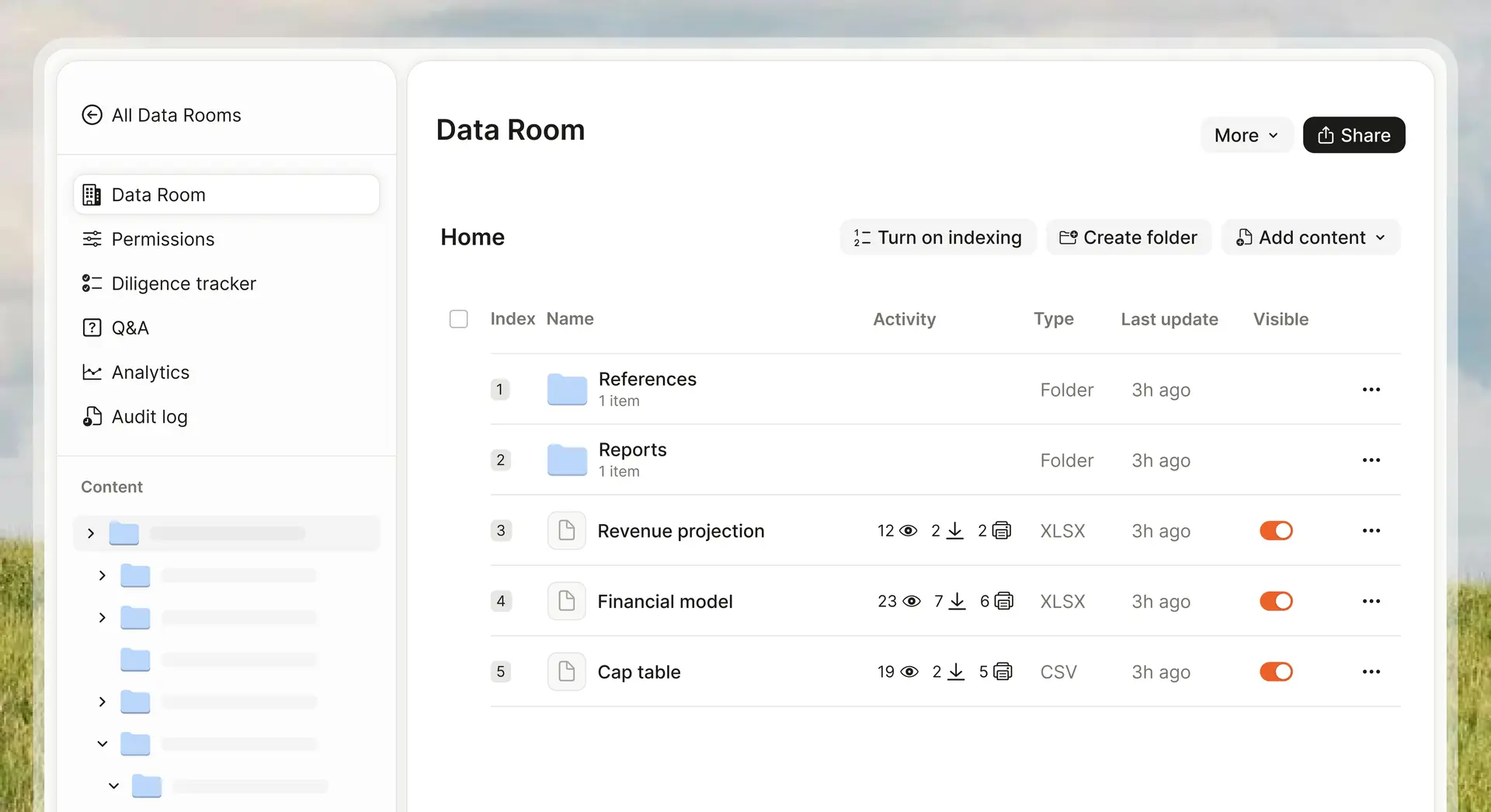
Most enterprise VDR platforms were built for large investment banks and law firms. They're expensive, slow to set up, and priced in a way that makes no sense for smaller or mid-market deals - charging per user, per page, or requiring a custom quote just to understand what you'd pay.
Ellty takes a different approach. It's a secure document sharing and analytics platform with full data room functionality, built for anyone who needs to share sensitive documents in a controlled, trackable way. Whether you're raising a funding round, closing a property deal, running a consulting engagement, or managing an acquisition, Ellty gives you the core tools that matter.
Ellty plans - straightforward pricing, no surprises
- Free ($0/month) - document tracking, real-time analytics, and secure sharing. A solid starting point if you're in early deal conversations and want to see who's opening what before setting up a full data room.
- Standard ($69/month) - unlimited documents, advanced analytics, eSignatures, custom branding, and data room features. Works well for smaller deals and ongoing client or investor communication.
- Room ($149/month) - granular permissions, NDA gating, dynamic watermarking, and restricted visitor access. Everything you need to run a controlled document review for due diligence, a property transaction, or a client deliverable.
- Room Plus ($349/month) - group visitor permissions, full audit logs, and support for up to 4,000 assets per data room. Built for heavier document loads and multi-party deals with structured access control across different reviewer groups.

There are no per-user charges, no per-page fees, and no lengthy procurement process. You pick a plan, get set up quickly, and know exactly what you're paying, whether you're sharing documents with 3 people or 30.
For anyone running an M&A process who needs a professional data room without an enterprise contract, Ellty is where you start.

FAQs
Is a merger better than an acquisition?
Neither is universally better. It depends on the goals of both parties. A merger works well when two companies of similar size want to combine as equals and build something new together. An acquisition makes more sense when one company wants to take full control of another, or when speed and clarity of ownership are priorities. The right structure depends on the deal objectives, financial position, and what both sides are willing to agree to.
Can a merger be hostile?
Mergers are almost always friendly, both companies agree to combine. Hostile takeovers are associated with acquisitions, where an acquirer goes directly to the target's shareholders to gain control without the board's support. True hostile mergers are rare because the structure requires cooperation from both sides to work.
What happens to employees during a merger or acquisition?
It varies. In a merger, there's often overlap between teams, which can lead to restructuring or role consolidation over time. In an acquisition, the acquiring company may integrate the target's team, retain key employees, or reorganize significantly. Employment outcomes depend on the integration plan, the strategic rationale, and how leadership handles the transition. Employees should expect change and ideally, clear communication from leadership on what to expect.
How long does an M&A deal typically take?
A typical M&A deal takes anywhere from three months to over a year, depending on the size and complexity of the transaction. Smaller deals with straightforward structures can close faster. Larger deals involving multiple jurisdictions, regulatory approvals, or complex due diligence processes tend to take longer. The due diligence phase alone can take several weeks to several months.
What documents are typically shared in an M&A data room?
Common documents include financial statements (audited and unaudited), tax returns, corporate records, contracts with customers and suppliers, employment agreements, intellectual property documentation, regulatory filings, pending litigation records, and any material agreements that affect the business. The exact list depends on the industry and the scope of the deal.
Do I need a virtual data room for a small acquisition?
Yes, even for smaller deals, a VDR is worth using. The risks of sharing sensitive documents over email or unprotected cloud folders are real. A VDR gives you control over who sees what, a record of all activity, and a layer of professionalism that buyers and sellers both appreciate. Ellty's free and standard plans are affordable enough that there's little reason not to use one.
What's the difference between due diligence in a merger vs. an acquisition?
Due diligence serves the same core purpose in both cases, verifying that the deal is sound and that there are no hidden liabilities or surprises. In an acquisition, the buyer typically conducts due diligence on the target company. In a merger, due diligence may be mutual, with both parties reviewing each other's financials, legal records, and operations. The scope and depth depend on the size of the deal and what each party needs to confirm before agreeing to close.
Final thoughts
Mergers and acquisitions are two of the most significant moves a company can make. Both involve combining businesses, but the structure, control, legal framework, and outcomes are very different. Understanding which type of deal you're involved in isn't just useful background knowledge. It shapes how you negotiate, how you protect yourself, and how you manage the entire process.
If you're heading into an M&A transaction, the preparation matters as much as the deal itself. That means getting your documents in order, understanding the legal and tax implications of your deal structure, and making sure the review process is secure and organized from day one.
A virtual data room is one of the most practical tools you can use to make that happen. It keeps your documents organized, gives you visibility into how they're being reviewed, and ensures that sensitive information doesn't end up in the wrong hands.
Ellty is built for exactly this kind of work - straightforward, secure, and priced so that anyone from a first-time founder to an experienced dealmaker can use it without navigating an enterprise sales process.
Ready to run a cleaner, more organized deal? Start your free Ellty data room today at ellty.com - no contract, no per-user fees, no surprises. |
Author

Anika Tabassum Nionta is a Content Manager at Ellty, where she writes about secure document sharing, virtual data rooms, M&A, due diligence, fundraising, and sales enablement. With over 6 years of writing experience, she helps professionals understand how to share confidential documents securely, track engagement, and manage deals more effectively. Anika holds both a BA and MA in English from Dhaka University. Outside of work, she enjoys reading, exploring new cafes in Dhaka, and connecting with entrepreneurs and dealmakers in her community.

