
When a business deal is on the table, everyone rushes to check the financials. But there is one area that gets overlooked more than it should and it can end up costing far more than any balance sheet item: environmental risk.
Environmental due diligence is the process of finding out whether a property, asset, or business carries any hidden environmental liabilities before you commit to a transaction. Think contaminated land, hazardous materials, regulatory violations, or even just the potential for future cleanup costs. These are the kinds of things that can quietly derail a deal or worse, become your problem after you've already signed.
This guide walks you through everything you need to know: what environmental due diligence actually involves, why it matters, how the process works, and what tools make it easier to manage. Whether you are buying a commercial property, investing in a business, or running a merger, this guide is for you.
What is environmental due diligence?
Environmental due diligence (EDD) is a structured investigation carried out before a business transaction. Its purpose is simple: to identify any environmental risks or liabilities connected to a site, asset, or company before the deal closes.
At its core, EDD answers a few key questions:
- Has the site ever been used in ways that could have caused pollution or contamination?
- Are there any ongoing violations of environmental laws or regulations?
- Could the buyer inherit legal or financial responsibility for past environmental damage?
- What would it cost to remediate (clean up) any identified issues?
Environmental due diligence can apply to a range of transactions - real estate acquisitions, mergers and acquisitions, business sales, infrastructure projects, and private equity investments, to name the most common ones.
The scope of an EDD investigation can vary. A Phase I Environmental Site Assessment (ESA) is typically the starting point. It involves a review of historical records, site inspection, and interviews. No actual sampling or testing of soil or groundwater. If Phase I flags something concerning, a Phase II ESA follows, involving actual testing and sampling of the site. In some cases, a Phase III remediation plan is developed if contamination is confirmed.


Why environmental due diligence is important
The short answer: environmental problems do not go away when ownership changes hands. In many jurisdictions, the new owner can be held legally responsible for cleaning up contamination, even if they did not cause it.
Here is why EDD deserves serious attention before any deal moves forward.
It protects you from inherited liabilities. A buyer who skips environmental due diligence might discover months or years after closing that the site they acquired is sitting on contaminated soil, or that the building contains asbestos. Remediation costs can run into the millions. Legal exposure can be even higher.
It affects deal value. Environmental risk is a pricing factor. Identifying a problem before signing gives you the leverage to renegotiate, ask for price reductions, require escrow arrangements, or walk away entirely. Finding it after closing means you absorb the full cost.
It keeps you compliant. Regulators in most countries require environmental assessments as part of certain property transactions. Failing to conduct proper due diligence can expose buyers to penalties beyond the cleanup costs themselves.
It protects lenders and investors too. Banks financing acquisitions increasingly require environmental assessments before approving loans. Investors want assurance that the assets they are backing do not carry hidden environmental costs that will eat into returns.
It is the right thing to do. Beyond the financial and legal angles, environmental due diligence supports broader ESG (Environmental, Social, and Governance) commitments. Companies that take environmental responsibility seriously use EDD as a standard part of their acquisition process, not just a box to tick.
Key steps in the environmental due diligence process
Environmental due diligence follows a fairly consistent process, though the depth and complexity will vary depending on the transaction type and the nature of the site involved.
Step 1: Define the scope
Before anything else, you need to agree on what the investigation will cover. This includes the geographic boundaries of the site, the types of potential hazards to look for, and whether Phase I alone is sufficient or whether testing is likely to be required. The scope should be set in collaboration with qualified environmental consultants.
Step 2: Document collection and review
This is where large volumes of records come into play. The due diligence team will collect and review historical site records, permits, regulatory filings, prior environmental assessments, maps, aerial photographs, and any known incidents or violations. This stage is document-heavy - and it is where having a secure, organized system for document sharing becomes essential.
This is exactly where a virtual data room like Ellty makes a real difference. Instead of emailing files back and forth or using unsecured shared drives, all environmental documents can be uploaded to a single, controlled workspace. Access is managed carefully, only the right people see the right documents and every action is tracked in real time.


Step 3: Site visit and physical inspection
A qualified environmental professional will visit the site to assess current conditions, look for visible signs of contamination or hazardous materials, observe site operations, and identify anything that was not captured in the documentary review.
Step 4: Interviews
The consultant will typically interview current and former owners, occupants, and neighbors to gather information about historical land use and any known issues.
Step 5: Report preparation
The findings are compiled into a formal report. For Phase I, this identifies Recognized Environmental Conditions (RECs) - areas where contamination is suspected or confirmed. If RECs are found, Phase II sampling is recommended.
Step 6: Risk assessment and decision-making
The report is reviewed by the deal team, legal counsel, and any relevant financial advisors. Based on the findings, the parties decide how to proceed: renegotiate terms, require remediation before close, adjust the purchase price, or walk away.
Step 7: Ongoing monitoring (where applicable)
For some transactions - particularly those involving ongoing operations - environmental monitoring may continue after the deal closes to ensure compliance and track any remediation progress.
The role of technology in environmental due diligence
Environmental due diligence generates a lot of paperwork. Reports, permits, site assessments, remediation plans, compliance certificates, regulatory correspondence - the document load is significant, and managing it poorly creates real risks.
Technology has changed how due diligence teams handle this. A decade ago, the standard approach was physical data rooms: a locked room somewhere, stacked with binders, where authorized reviewers would come in person to examine documents. Today, the process is almost entirely digital, and that shift has made EDD faster, more secure, and easier to manage across teams and geographies.
Document management platforms allow teams to upload, organize, and share documents in structured, permission-controlled environments. No more emailing sensitive files. No more tracking who has seen what through manual logs.
Real-time analytics tell you exactly who has opened which documents, how long they spent on each file, and when access happened. For environmental due diligence, where certain documents may be highly sensitive or legally significant, this kind of audit trail matters.
Electronic signatures speed up the review process. NDA gating, where a reviewer must sign a confidentiality agreement before accessing the data room, is a standard feature of modern platforms and ensures that sensitive environmental reports do not circulate beyond the intended audience.
Secure access controls mean that different stakeholders - environmental consultants, legal teams, lenders, investors - can each be given access to only the documents relevant to their role, without exposing the full document set.
Virtual data rooms: the backbone of due diligence
If environmental due diligence is the investigation, then the virtual data room (VDR) is the infrastructure that makes it run smoothly. And for teams that need a professional, secure, and affordable VDR without the complexity of enterprise software, Ellty is worth a serious look.
What Ellty does

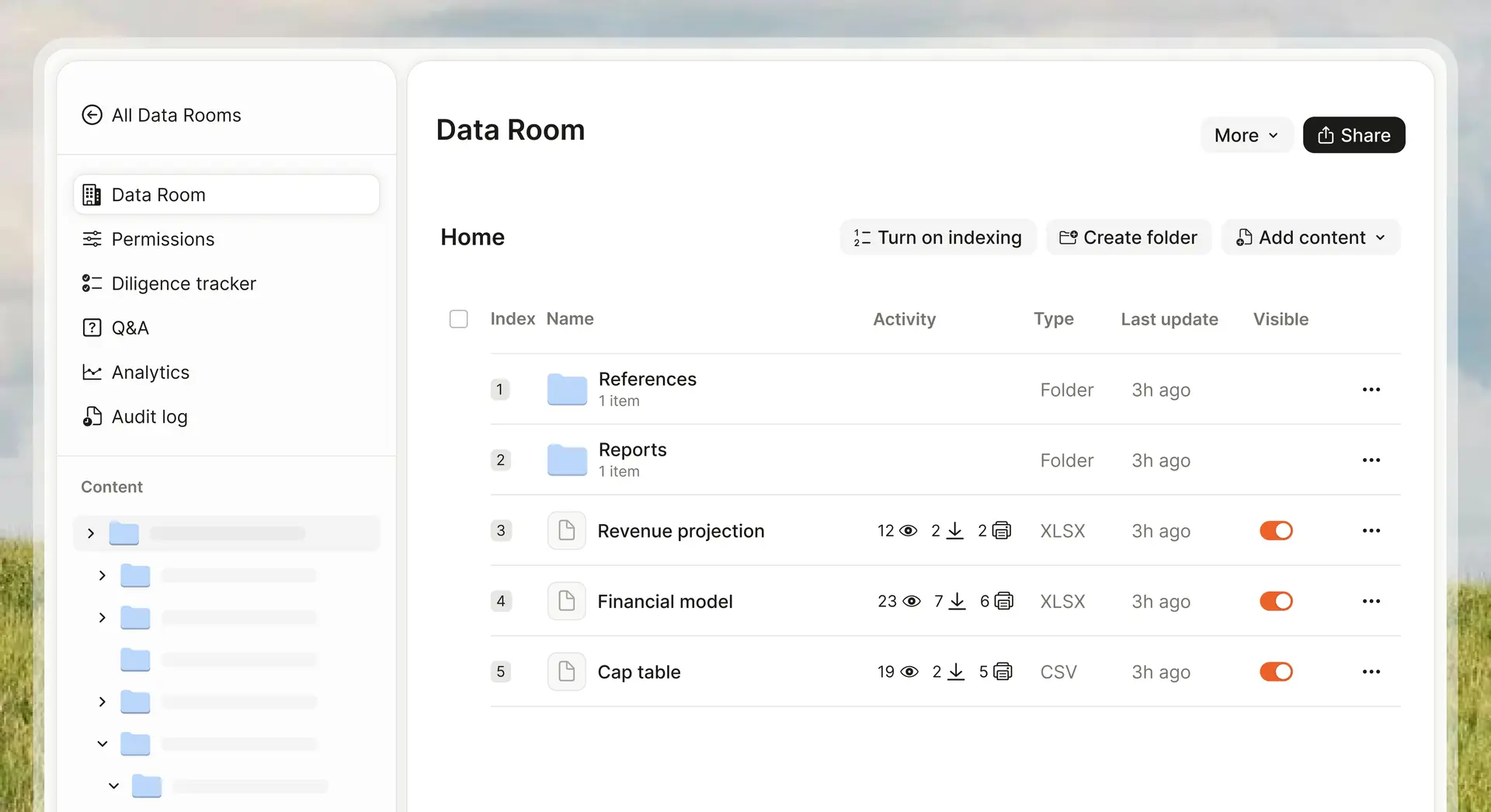
Ellty is a secure document sharing and analytics platform with full data room functionality. It is built for anyone who needs to share sensitive documents in a controlled, trackable way, whether you are running a real estate transaction, a fundraising round, an M&A process, or an environmental review.
For environmental due diligence specifically, Ellty provides:
- Access controls - You decide who can see what. Granular permissions mean that environmental consultants, legal advisors, and financial reviewers each have access to the documents relevant to their role - and nothing more.
- NDA gating - Before any reviewer can access the data room, they must sign a non-disclosure agreement. This is especially important for environmental reports, which can contain sensitive information about site conditions, liability exposure, and remediation costs.
- Dynamic watermarking - Documents opened in Ellty can be automatically watermarked with the viewer's identity. This discourages unauthorized sharing and creates a clear record if documents are misused.
- Real-time activity tracking - See exactly who has opened which documents, when, and for how long. If a lender or investor has reviewed the Phase II report, you know about it immediately.
- Audit trail - A complete, time-stamped log of all activity in the data room. This is valuable both for internal governance and for demonstrating compliance if questions arise later.
Pricing that makes sense

One of the most common complaints about legacy VDR platforms is the pricing. Per-user fees, per-page charges, custom quotes that take weeks to negotiate - it all adds up, and it puts professional data rooms out of reach for smaller teams and deals.
Ellty does things differently. Pricing is flat and transparent, with no per-user fees and no surprise overages:
- Free ($0/month) - Document tracking, real-time analytics, and secure sharing. A solid starting point if you are in early conversations and want to see who is opening what before setting up a full data room.
- Standard ($69/month) - Unlimited documents, advanced analytics, eSignatures, custom branding, and data room features. Works well for smaller deals and ongoing client or investor communication.
- Room ($149/month) - Granular permissions, NDA gating, dynamic watermarking, and restricted visitor access. Everything you need to run a controlled document review, whether that is an environmental due diligence process, a property transaction, or a sensitive client deliverable.
- Room Plus ($349/month) - Group visitor permissions, full audit logs, and support for up to 4,000 assets per data room. Built for heavier document loads and multi-party deals.
Whether you are sharing documents with 3 people or 30, you pay the same. No per-user charges, no per-page fees, no weeks-long negotiation to get started.


Common risks identified during environmental due diligence
Environmental due diligence is designed to surface risks that might not be visible on the surface. Here are the most common issues that EDD investigations flag.
Soil and groundwater contamination
This is the most common and often most costly finding. Sites with a history of industrial use, fuel storage, dry cleaning operations, or agricultural chemical use are particularly susceptible. Contamination can spread beyond the site boundaries, complicating liability considerably.
Asbestos-containing materials (ACMs)
Common in older buildings, asbestos is a significant liability risk. Its presence requires specialized management and, where necessary, abatement (removal or encapsulation). This adds cost and complexity to any renovation or demolition plan.
Lead paint
Like asbestos, lead paint is a concern in older buildings. It is regulated, and its management requires documented procedures. Buyers of residential or mixed-use properties in particular need to assess this risk.
Underground storage tanks (USTs)
Decommissioned or leaking underground tanks are a major contamination source. Sites that previously housed petrol stations, manufacturing facilities, or farms often have USTs that may have leaked over time.
Hazardous waste
Improper disposal of hazardous materials on or near a site creates liability that can outlast the original business by decades. Environmental investigations review historical waste disposal records and may include testing if concerns arise.
Regulatory non-compliance
Even if no contamination is present, a site or business may be operating in violation of environmental permits or regulations. These violations can trigger enforcement actions and fines, and they become the new owner's problem after the transaction closes.
Wetlands and protected habitats
Certain land uses are restricted by environmental protection laws covering wetlands, floodplains, and protected species habitats. Buyers need to understand these constraints before committing to development plans.
Climate-related risks
An increasingly relevant category, this includes flood risk, wildfire exposure, and the potential future regulatory costs of carbon-intensive operations. Institutional investors in particular are paying close attention to climate-related risks as part of their ESG assessments.
Environmental due diligence checklist
Use this checklist as a starting framework. The specific items relevant to any given transaction will depend on the site type, the nature of the business, and the jurisdiction.
Documentation and records
- Prior environmental assessments (Phase I, Phase II, Phase III)
- Environmental permits and licenses (current and expired)
- Regulatory correspondence and inspection reports
- Notices of violation or enforcement actions
- Waste disposal records and manifests
- Spill response records and incident reports
- Underground storage tank registrations and closure records
Site history review
- Historical land use (including prior owners and tenants)
- Aerial photographs and Sanborn maps covering the site history
- Historical topographic maps
- Fire insurance maps
Physical site inspection
- Visual evidence of contamination (staining, stressed vegetation, odors)
- Condition of above-ground storage tanks
- Evidence of drums or waste containers
- Condition of drains and sumps
- Asbestos-containing materials in structures
- Lead paint in older buildings
Regulatory database review
- National and local environmental databases
- Known contaminated sites registries
- Proximity to regulated facilities (fuel storage, chemical plants, waste sites)
Interviews
- Current owners and operators
- Former owners and tenants (where accessible)
- Neighboring property owners
Financial and legal review
- Estimated remediation costs (if contamination identified)
- Outstanding environmental claims or litigation
- Environmental indemnity provisions in purchase agreements
- Insurance coverage for environmental liabilities
Managing all of this documentation is easier when everything lives in one place. Ellty data room gives your environmental consultants, legal team, and lenders secure, organized access to every document - with a full audit trail of who reviewed what and when.
Challenges in conducting environmental due diligence
Even with the best intentions, environmental due diligence can run into obstacles. Understanding these challenges helps deal teams plan more effectively.
Incomplete historical records
Site histories are sometimes poorly documented. Prior owners may no longer exist, records may have been lost, and historical industrial uses may not have been properly recorded. Gaps in the record do not necessarily mean no risk exists - they just mean the investigation has to work harder.
Time pressure from deal timelines
Due diligence windows are often tight. Environmental investigations, especially if they move into Phase II testing, take time and the lab analysis alone can take weeks. Deal teams sometimes face pressure to make decisions before the full picture is clear.
Jurisdictional complexity
Environmental regulations vary significantly between countries, states, and even municipalities. A transaction involving multiple jurisdictions requires consultants with local expertise in each one.
Contamination that crosses boundaries
Contamination does not respect property lines. A site may be affected by contamination that originated on a neighboring property, which complicates the remediation picture and the allocation of liability.
Cost uncertainty for remediation
Even when contamination is identified, estimating remediation costs with precision is difficult. The scope of cleanup can expand as investigations deepen, and regulatory requirements can change. This makes it hard to agree on price adjustments that fully account for the risk.
Balancing thoroughness with practicality
Thorough environmental due diligence is important, but there is also a practical question of proportionality. The depth of investigation should match the risk profile of the site. Spending disproportionate time and money on a low-risk commercial property is not good use of resources. Equally, cutting corners on a high-risk industrial site is a false economy.
Managing large volumes of documents across multiple parties
Environmental due diligence involves multiple stakeholders - environmental consultants, legal advisors, lenders, investors, regulators, and the seller. Each has their own document requirements. Keeping all of this organized, secure, and accessible to the right people is a genuine operational challenge, particularly on larger or more complex transactions.
This is one of the clearest use cases for a dedicated VDR. With Ellty, you can set up a structured data room in minutes, assign the right permissions to each party, and track every document interaction in real time - without the cost and complexity of legacy enterprise platforms.
FAQs
What is the difference between a Phase I and Phase II environmental site assessment?
A Phase I assessment is a non-invasive desktop review and site inspection. It looks at historical records, regulatory databases, and visible site conditions to identify any recognized environmental conditions (RECs). No sampling or testing is involved. A Phase II assessment is triggered when Phase I flags concerns. It involves physical testing, soil samples, groundwater samples, and laboratory analysis, to confirm whether contamination is actually present and to what extent.
Who is responsible for conducting environmental due diligence?
The buyer typically commissions and pays for environmental due diligence, usually through a qualified environmental consultant. Lenders financing the transaction may also require their own assessments. Legal counsel reviews the findings and advises on liability allocation in the transaction documents.
How long does environmental due diligence take?
A Phase I ESA typically takes two to four weeks, depending on the complexity of the site and the availability of records. If Phase II testing is required, add another four to eight weeks, primarily due to laboratory turnaround times. More complex investigations or larger sites can take longer.
What happens if contamination is found during due diligence?
Finding contamination does not automatically kill a deal. The parties typically negotiate how to handle it - this might mean a price reduction, an escrow arrangement to cover remediation costs, a requirement that the seller clean up the site before closing, or an environmental indemnity clause. In some cases, the buyer may choose to walk away entirely.
Is environmental due diligence legally required?
Requirements vary by jurisdiction and transaction type. In many countries and US states, certain types of property transactions require a Phase I ESA before financing can be obtained. Even where it is not strictly required by law, most experienced buyers and their lenders insist on it as standard practice.
What is an environmental indemnity?
An environmental indemnity is a contractual provision in a purchase agreement that assigns responsibility for known or unknown environmental liabilities between the buyer and seller. It might require the seller to indemnify the buyer for cleanup costs arising from pre-closing contamination, for example. Environmental indemnities are typically negotiated as part of the broader transaction terms, informed by the findings of the due diligence investigation.
How does a virtual data room help with environmental due diligence?
A virtual data room provides a secure, organized, and trackable environment for all the documents involved in an environmental due diligence process. Instead of sharing sensitive reports and permits by email or through uncontrolled shared drives, a VDR gives you access controls, audit trails, NDA gating, and real-time activity tracking. For environmental due diligence specifically, where document volumes are high, multiple parties are involved, and confidentiality matters, a VDR like Ellty makes the process significantly easier to manage.
Final thoughts
Environmental due diligence is not just a legal formality or a box to tick before a deal closes. It is a genuine risk management tool, one that can save buyers from inheriting costly problems, give deal teams the information they need to negotiate properly, and protect lenders and investors from unexpected liabilities.
The process works best when it is taken seriously from the start. That means engaging qualified environmental professionals, giving the investigation adequate time, and making sure all the documentation is managed in a way that is secure, organized, and accessible to the right people.
That last part, managing the documents, is where a lot of teams still lose time and create unnecessary risk. Emailing sensitive environmental reports, using unprotected shared drives, or relying on manual tracking processes is not good enough for deals of any meaningful size.
Ellty was built for exactly this kind of work. A clean, affordable, professional data room with the access controls, audit trails, and NDA gating that environmental due diligence requires, without the enterprise pricing that puts it out of reach for most teams.
If you are preparing for an acquisition, a property transaction, or any deal where environmental risk is a factor, setting up your data room early makes the whole process smoother. Every document has a home, every reviewer has the right access, and you have a complete record of everything from day one.
Start your Ellty data room today - free plan available, no credit card required.
Ellty is a secure virtual data room platform built for professionals who need to share sensitive documents in a controlled, trackable environment. Flat-rate pricing, no per-user fees, and no enterprise contract required.
Author

Anika Tabassum Nionta is a Content Manager at Ellty, where she writes about secure document sharing, virtual data rooms, M&A, due diligence, fundraising, and sales enablement. With over 6 years of writing experience, she helps professionals understand how to share confidential documents securely, track engagement, and manage deals more effectively. Anika holds both a BA and MA in English from Dhaka University. Outside of work, she enjoys reading, exploring new cafes in Dhaka, and connecting with entrepreneurs and dealmakers in her community.

