South Africa M&A diligence starts before you sign the LOI. B-BBEE compliance and SARB exchange control approvals can stall a deal for months if you miss them early.
Full-scope diligence on a South Africa target runs 6-10 weeks for a mid-market deal. A Competition Commission filing adds 40-60 business days on top of that.
A mid-market SA data room holds 3,000-15,000 documents before review is done. The CIPC register often has gaps - verify share ownership and directors separately.
B-BBEE is the trap foreign buyers underestimate most in South Africa deals. A change of control can reset the target's scorecard and void sector licences.
Exchange control approval from SARB is required before funds leave South Africa. Without it, you're at the closing table with no legal path to move the proceeds.
The South Africa DD checklist
Not every check carries the same weight in a South Africa deal. B-BBEE and exchange control risks can kill a deal; financial gaps usually move price.
The table below ranks checks by impact - dealbreakers first, then price-adjusters. Clear the dealbreakers before your team spends weeks on standard hygiene items.
Before diligence opens, load your documents into Ellty by workstream. Give legal, tax, and financial advisors scoped links so each team starts on day one.
| Area | Documents to pull | South Africa red flag | Tier | |
|---|---|---|---|---|
| Corporate & legal | Corporate & legal | MOI from CIPC, share register, board resolutions, amendments | CIPC records often incomplete; verify share ownership independently | Dealbreaker |
| Financial | Financial | 3y IFRS AFS, management accounts, bank statements, QoE | Aggressive revenue recognition; off-balance-sheet finance lease exposure | Dealbreaker |
| Tax | Tax | SARS history, VAT returns, TCS certificate, transfer pricing docs | Undisclosed SARS assessments; STT on prior share transfers unchecked | Dealbreaker |
| Employment & labor | Employment & labor | Employment contracts, EE plan, bargaining council agreements | Section 197 LRA: all employees auto-transfer in going-concern asset deals | Dealbreaker |
| Regulatory & licences | Regulatory & licences | FSCA, ICASA, DMR, NCR licences and compliance records | Licence lapses or voids on change of control in regulated sectors | Dealbreaker |
| FDI & exchange control | FDI & exchange control | SARB exchange control letter, FinSurv approval, loop structure review | No SARB approval = no legal repatriation of proceeds or dividends | Dealbreaker |
| B-BBEE | B-BBEE | B-BBEE certificate, scorecard, sector charter, verification agency | Change of control resets scorecard; affects mining and government contracts | Price-adjuster |
| IP | IP | CIPC trademark/patent registers, software licences, domain names | IP often held in founder's name, not the company; transfer undocumented | Price-adjuster |
| Material contracts | Material contracts | Key contracts, SLAs, change-of-control and assignment clauses | SOE and government contracts frequently contain change-of-control triggers | Price-adjuster |
| Real estate & environment | Real estate & environment | Title deeds, NEMA authorisation, Phase I ESA | NEMA s24G remediation exposure on prior industrial or mining sites | Standard check |
| Data protection & IT | Data protection & IT | POPIA compliance framework, data processing agreements | Information Regulator enforcement; POPIA fines up to R10M or 10% revenue | Standard check |
Running due diligence on a South Africa deal?
Set up your Ellty data room before the request list lands.
Start free 14-day trialThe full South Africa DD checklist
The ten workstreams below follow the same order as the risk table above. Load each folder into Ellty before the request list arrives so advisors start on day one.
Corporate & legal
- Pull the Memorandum of Incorporation and all amendments from the CIPC register.
- Order an independent share register search - CIPC records are often stale or incomplete.
- Confirm all directors are registered and no pending Companies Act compliance orders exist.
- Review board resolutions for all material transactions over the past 3 years.
- Check for any shareholders' agreements or voting restrictions not on the CIPC file.
- See our legal due diligence guide for a full document checklist.
Financial
- Pull 3 years of audited financial statements prepared under IFRS.
- Strip out non-recurring items before accepting the seller's EBITDA number.
- Check 12 months of bank statements and reconcile against reported revenue figures.
- Confirm no off-balance-sheet obligations: finance leases, guarantees, or earn-outs.
- Review accounts receivable ageing - high concentration in SA government debtors is a risk.
- See our financial due diligence guide for all financial checks.
Tax
- Pull SARS assessment history and confirm no open disputes or pending audits exist.
- Obtain a Tax Compliance Status certificate - required in most SA deal structures at closing.
- Review VAT returns for 3 years and reconcile totals against reported revenue figures.
- Check transfer pricing documentation if the target has any intercompany transactions.
- Confirm Securities Transfer Tax was paid correctly on any prior share transfers in the group.
- Our tax due diligence guide covers SA-specific SARS exposure checks.
Employment & labor
- Pull all employment contracts, especially for senior staff and designated key persons.
- Confirm whether the target is bound by any bargaining council collective agreement.
- Review the Employment Equity plan - required for all employers with more than 50 staff.
- Check CCMA records for any pending or recent arbitration disputes and awards.
- If this is an asset deal as a going concern, understand the full Section 197 LRA obligations.
- Confirm all notice periods, severance commitments, and defined benefit pension obligations.
Regulatory & licences
- Pull all operating licences and permits and check each for change-of-control conditions.
- Confirm FSCA registration and licence status if the target provides any financial services.
- Confirm ICASA licence status if the target operates in telecoms or broadcasting sectors.
- Check DMR approvals if the target holds any mining rights or prospecting permits.
- Verify NCA registration with the National Credit Regulator if the target extends consumer credit.
- Confirm no pending suspension, cancellation, or investigation by any regulatory authority.
FDI & exchange control
- Confirm SARB exchange control approval is in place if the acquirer is a foreign entity.
- Review any existing FinSurv letters for the target's current offshore holding structures.
- Identify loop structures - SA entities owning offshore assets need SARB approval to unwind.
- Check whether this deal falls under SARB's standard allowances or needs specific approval.
- Build SARB approval timelines into the deal schedule before the LOI is signed.
- For banking, telecoms, or energy deals: check sector-specific FDI approval requirements.
B-BBEE
- Pull the current B-BBEE certificate and verify the SANAS-accredited verification agency used.
- Check the sector charter that applies - each sector has its own scoring and thresholds.
- Quantify the scorecard reset impact on post-close licensing and government contract eligibility.
- Map B-BBEE conditions in all material supply agreements and government tenders held.
- Confirm whether post-close restructuring can restore or improve the target's B-BBEE score.
- Model the cost of B-BBEE restoration before you sign - it belongs in the purchase price.
IP
- Search CIPC trademark and patent registers for all registrations in the target's name.
- Confirm IP is owned by the company, not by individual founders or directors personally.
- Pull all software licences and check each for transferability on change of control.
- Review inventor assignment deeds or work-for-hire agreements for key product IP.
- Check domain names and confirm they are registered to the target entity, not a related party.
- Identify any IP held offshore and confirm SARB approval exists for those structures.
Material contracts
- Pull all customer and supplier contracts above R1M in annual value for review.
- Check every material contract for change-of-control, assignment, or termination clauses.
- Pay close attention to SOE and government contracts - these carry strict conditions.
- Review renewal terms, notice periods, and expiry dates across all material agreements.
- Load all contracts into your Ellty data room before advisors start review.
- Confirm no government contracts require ongoing B-BBEE compliance by the target post-close.
Data protection & IT
- Confirm the target filed its POPIA information officer registration with the Information Regulator.
- Pull data processing agreements with all third-party processors under the POPIA framework.
- Review any prior Information Regulator notifications, investigations, or compliance orders.
- Check data retention and deletion policies against the POPIA conditions of lawful processing.
- Confirm cross-border data flows comply with POPIA Section 72 and applicable transfer mechanisms.
- Confirm IT system change-of-control clauses and data portability rights across all vendors.
How due diligence in South Africa works
The M&A process in SA follows the same five phases as any deal. Local quirks - Competition Commission timelines and SARB approvals - shape how long each takes.
Step 1 - Scope the deal
Define scope before the request list goes out - this sets which advisors you need. For SA deals, confirm early whether Competition Commission filing and SARB approval apply.
Step 2 - Issue the request list
Send the request list once scope is agreed and the NDA is signed with the target. Sellers who use Ellty before the list arrives cut response time significantly.
Step 3 - Parallel workstream review
Legal, financial, and tax workstreams run in parallel to compress the total timeline. B-BBEE review and SARB exchange control checks run as separate workstreams in SA deals.
Step 4 - Flag into a risk register
Flag all findings into a risk register by tier: dealbreaker, price-adjuster, hygiene. In SA deals, Section 197 LRA exposure and open SARS disputes surface here most often.
Step 5 - Resolve before signing
Work through all dealbreakers before you move to SPA and conditions precedent negotiation. Competition Commission approval runs 40-60 business days - build it into your deal timeline.
How to set up your South Africa data room in Ellty.
Load your deal documents before the request list lands. Give each workstream its own scoped link to start on day one.
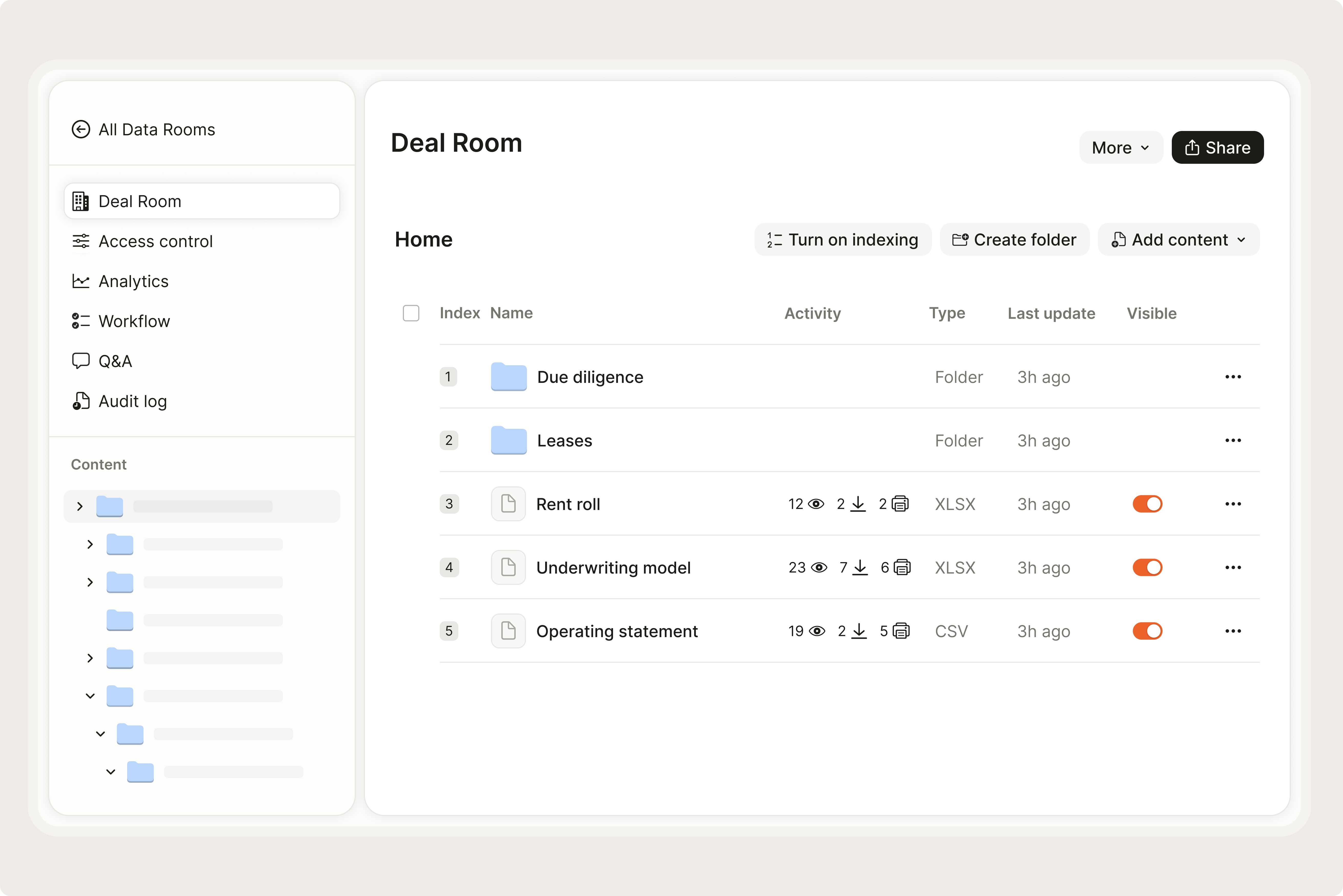
- 1.Bulk upload your deal files by workstreamCreate folders for corporate, financial, tax, legal, and B-BBEE files. Advisors find what they need without digging through the full room.
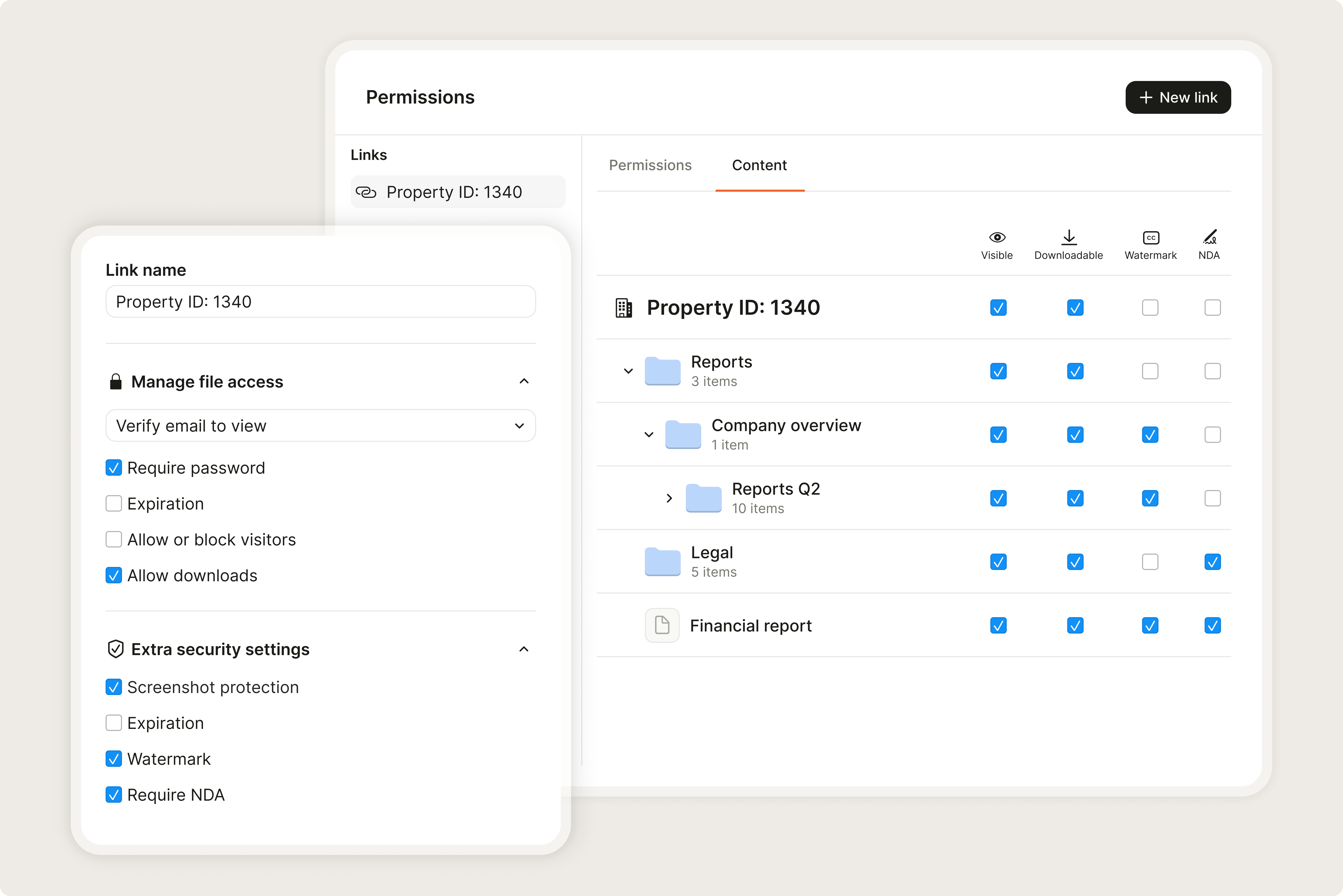
- 2.Set scoped permissions for each advisorLegal sees contracts, tax sees returns - no overlap or accidental access. Sensitive files stay locked to the reviewers who need them.
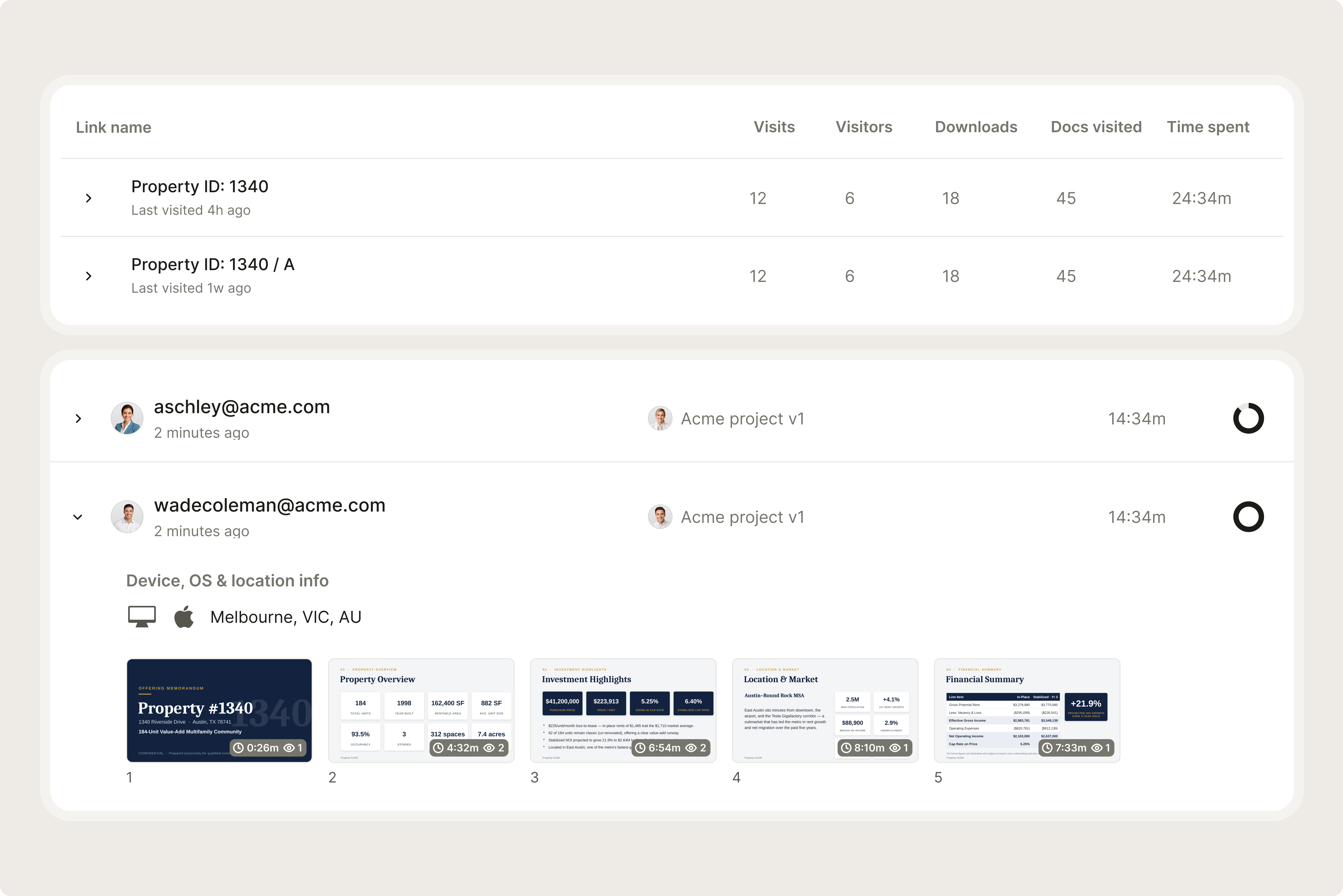
- 3.Track reviewer activity in real timeSee which documents each advisor opened and how long they spent. Spot where questions form before they delay your deal timeline.
What makes SA due diligence different
B-BBEE is a legal requirement, not a preference, in South Africa's regulated sectors. A change of control resets the target's scorecard, which can void mining and government licences.
SARB exchange control governs every cross-border fund movement in a South Africa deal. Without prior SARB approval, a foreign buyer cannot legally repatriate dividends or proceeds.
Asset deals trigger Section 197 of the Labour Relations Act automatically on completion. All employees transfer to the buyer on unchanged terms - no carve-outs without CCMA consent.
In South Africa M&A, SARB exchange control and B-BBEE are deal-shapers that foreign buyers learn about too late. These are pre-LOI checkboxes, not post-signing issues - and missing them costs you the deal or the price.
Timeline & cost in South Africa
Full-scope diligence runs in 3 phases: scoping in week 1, parallel review in weeks 2-6. Resolution and signing takes another 2-4 weeks after flagging is complete.
Intermediate merger notification adds 40-60 Competition Commission business days. Large merger review involving the Competition Tribunal can extend the total to 6 months.
Legal fees for a mid-market SA deal run R500,000-R2M for buy-side counsel. Financial and tax advisory (QoE and tax structuring) adds R300,000-R1.5M on top.
Competition Commission filing fees scale with deal size - smaller deals pay proportionally less. See our guide to preparing for due diligence for a full cost breakdown.
Run your South Africa deal from one room
Hold financials, contracts and the SPA in one secure, tracked Ellty data room.
Start free 14-day trialCommon questions about due diligence in South Africa
- Due diligence in South Africa is a structured review of a target company before closing an acquisition. It covers legal, financial, tax, B-BBEE, exchange control, employment, and POPIA compliance areas.
- South Africa has no dedicated FDI screening law, but SARB exchange control applies to all foreign acquisitions. Specific approvals are required for deals in banking, telecoms, and energy sectors.
- Section 197 means all employees transfer automatically to the buyer in a going-concern asset sale. The buyer inherits all employment obligations on the same terms - no carve-outs without a CCMA process.
- A change of control resets the B-BBEE scorecard and can affect mining licences and government contracts. Buyers in mining, financial services, and government supply chains are most exposed to this risk.
- Share deals attract 0.25% Securities Transfer Tax (STT) paid by the buyer at transfer. Asset deals sold as a going concern are VAT zero-rated; real estate transfer duty still applies on included property.
- Set up your data room before the request list lands - ideally before you sign the LOI. Loading documents in advance means your advisors start reviewing on day one of access.