Vietnam commercial real estate due diligence starts with a foundational concept that has no equivalent in most other markets: all land in Vietnam is owned by 'the People' and administered by the State; no one - Vietnamese or foreign - can own land. What buyers and investors hold, transfer, and mortgage is a Land Use Right (LUR, Quyền sử dụng đất) with a fixed term (typically 50 years for commercial). The LURC (Land Use Rights Certificate, Sổ đỏ/Sổ hồng) is the title document.
Vietnam transfer costs for LUR transactions: Registration fee (Lệ phí trước bạ) at 0.5% of declared value applies to LUR transfers registered with DONRE; Personal Income Tax (PIT) at 2% of transfer price applies to LUR transfers by Vietnamese individuals (a withholding on gross, not net gain); Corporate Income Tax (CIT) at 20% applies to net gains from LUR transfers by corporate entities; VAT at 10% applies to commercial real estate sales by VAT-registered sellers (typically developers); for M&A acquisitions of Vietnamese companies holding LURs (share deals, the most common foreign investor approach): stamp duty on share transfer is 0.1% of the transfer value.
Vietnam's new Land Law 2024 (Luật Đất đai 2024, Law No. 31/2024/QH15), effective August 1, 2024, was the most significant land legislation reform in over a decade, overhauling LUR valuation methodology, land price frameworks, compensation for land recovery, and certain foreign access provisions. Many implementing regulations under the 2024 Law were still being issued through 2025-2026; any Vietnam CRE diligence should confirm the current status of implementing rules applicable to the specific transaction with Vietnamese legal counsel - the law itself has changed but the regulations underneath continue to evolve.
Set up a due-diligence data room before advisors engage. Load LURC certificates, enterprise and investment registration certificates (ERC and IRC), building permits, completion acceptance records, planning certificates, and lease files.
Where Vietnam property deals actually go wrong
Not every check carries the same weight. The table below sorts them by deal impact - dealbreakers first, then what moves the price, then basic hygiene - so your Vietnamese attorney and advisor know what to clear first.
| Area | Documents to pull | Vietnam red flag | Matters most for | Tier | |
|---|---|---|---|---|---|
| LURC (Land Use Rights Certificate) | LURC (Land Use Rights Certificate) | Original LURC (Giấy chứng nhận quyền sử dụng đất / Sổ đỏ / Sổ hồng), DONRE land cadastral extract, LUR history (any prior transfers or amendments) | The Land Use Rights Certificate (LURC) is the primary title document in Vietnam; it is issued by DONRE (Department of Natural Resources and Environment, Sở Tài nguyên và Môi trường) at the provincial level and shows: LUR holder name, land area, land use purpose (mục đích sử dụng đất - residential, commercial, production/business, industrial), LUR term (thời hạn sử dụng), origin of land use rights, any registered mortgages or encumbrances, and any registered restrictions; confirm the LURC holder matches the seller; confirm the LUR purpose matches the intended commercial use; confirm the remaining LUR term (from the issue date to the 50-year expiry, less any time elapsed); if the LUR is near expiry: model the renewal application process and cost; also check whether the LURC is being held by the lender as security (thế chấp LURC) and confirm discharge plan; confirm the LURC has been updated in the land cadastral records at DONRE; in Vietnam, physical LURC documents can be lost or outdated while land cadastral records have been updated - always verify both | All buyers - foundational check | Dealbreaker |
| Foreign access to commercial LUR - IRC requirement | Foreign access to commercial LUR - IRC requirement | Investment Registration Certificate (IRC, Giấy chứng nhận đăng ký đầu tư), Enterprise Registration Certificate (ERC, Giấy chứng nhận đăng ký doanh nghiệp), provincial Department of Planning and Investment (DPI) project approval | Foreign individuals cannot own commercial LUR in Vietnam; foreign-invested enterprises (FIEs - companies with any foreign capital) can access commercial land in Vietnam primarily through: (1) obtaining an IRC from the provincial DPI authorizing the investment project, then leasing land from the state or obtaining LUR through the approved project; or (2) acquiring a Vietnamese entity (M&A) that already holds the LUR; direct purchase of commercial LURC by a foreign company from a Vietnamese seller is generally not straightforward and requires legal structuring; the IRC is typically the critical-path document for any greenfield or brownfield commercial investment by a foreign entity; IRC applications require: investment project details, environmental assessment compliance, land use plan compliance, and DPI review; IRC processing: 15 days for in-principle approval in most provinces, but with back-and-forth on documentation; in practice 1-4 months for complete IRC; confirm with Vietnamese counsel whether the specific transaction structure (M&A vs. new project) triggers IRC requirements | All foreign buyers of Vietnam commercial | Dealbreaker |
| Land use planning compliance | Land use planning compliance | Provincial/district land use plan (Quy hoạch sử dụng đất), construction planning (Quy hoạch xây dựng), planning confirmation from relevant authority | Vietnam's layered planning system: national spatial planning (quy hoạch không gian), provincial land use planning (quy hoạch sử dụng đất cấp tỉnh), district land use plans, detailed construction plans (quy hoạch chi tiết xây dựng, 1:500 scale); the land use plan determines whether a parcel is designated for commercial, industrial, residential, agricultural, or other use; a LURC with commercial use purpose that sits in an area planned for a different use in the current approved land use plan creates development risk; check the approved land use plan at the provincial/district DONRE and DPI for the parcel; also check whether the parcel is within a special economic zone (SEZ), industrial zone (IP), export processing zone (EPZ), or high-tech zone - these have different land access rules and LUR structures; in Vietnam's industrial markets (Bac Ninh, Bac Giang, Binh Duong, Dong Nai): confirm the parcel is within the approved industrial zone master plan and the IP developer has obtained the overall LUR for the zone | All Vietnam commercial; industrial parks; development | Dealbreaker |
| State land recovery risk | State land recovery risk | Provincial and district land use plan for the specific parcel, any outstanding land recovery decisions (quyết định thu hồi đất) from DONRE or provincial government, local infrastructure planning notifications | In Vietnam, the state has the right to recover (thu hồi) land use rights for national defense, security, public benefit, or economic development purposes, with compensation payable to the LUR holder; land recovery decisions can significantly affect commercial property values and investment viability; check with DONRE and the provincial People's Committee whether any land recovery decision or land planning change exists or is pending for the target parcel; in Vietnam's rapidly developing urban and peri-urban areas: arterial road expansions, urban rail projects (e.g., HCMC Metro Line extensions, Hanoi metro), and urban redevelopment plans regularly affect commercial parcels; the new Land Law 2024 included provisions on land recovery compensation rates that have changed the compensation framework; confirm current compensation rules with Vietnamese counsel; land recovery risk is particularly relevant for commercial in areas near major infrastructure projects | Commercial near urban infrastructure projects; HCMC metro corridors; Hanoi urban development zones | Dealbreaker |
| Building permit and completion acceptance | Building permit and completion acceptance | Building permit (Giấy phép xây dựng), completion acceptance record (Biên bản nghiệm thu hoàn thành công trình), fire safety acceptance, environmental acceptance certificate | Vietnam's construction law (Luật Xây dựng 2014 as amended) requires a building permit (Giấy phép xây dựng) from the provincial Department of Construction (Sở Xây dựng) for most commercial construction; after construction, a completion acceptance inspection (nghiệm thu) by the project owner and the construction authority is required; a completed Biên bản nghiệm thu hoàn thành công trình (completion acceptance record) confirms the building was completed in compliance with the permit; fire safety acceptance (Nghiệm thu phòng cháy chữa cháy, PCCC) from the provincial police is a separate mandatory requirement for commercial buildings and is often the last bottleneck before occupation; environmental acceptance certificate (Giấy xác nhận hoàn thành công trình bảo vệ môi trường) also required; confirm all four acceptance documents for commercial buildings; buildings lacking fire safety acceptance are frequently found in Vietnamese commercial diligence - confirm specifically | All Vietnam commercial buildings | Price-adjuster |
| LUR mortgage and encumbrances | LUR mortgage and encumbrances | LURC encumbrance section and DONRE land cadastral records for registered mortgages (thế chấp), registered security interests, any court attachment orders (kê biên) | LURs in Vietnam can be mortgaged (thế chấp) at authorized credit institutions (licensed banks and certain other lenders); the mortgage is registered in the LURC and at DONRE; review the LURC for any registered mortgage (thế chấp quyền sử dụng đất) and confirm the discharge plan with the mortgage holder; also check DONRE land cadastral records for any security interest or court order registered against the LUR; in Vietnam, some mortgages are registered at the land cadastral office but not prominently reflected in all copies of the LURC - the DONRE cadastral check is the authoritative source; also check whether the LUR has been contributed as capital (góp vốn) to another entity - in that case the entity owning the LUR may not be the LURC holder | All buyers | Price-adjuster |
| Industrial LUR in industrial parks | Industrial LUR in industrial parks | Industrial park developer LUR lease agreement (hợp đồng thuê đất trong KCN), IP developer's master LURC for the zone, remaining IP LUR term, IP management board approval requirements for LUR transfer | Vietnam's industrial parks (Khu Công nghiệp, KCN) are a specific LUR structure: the provincial government grants the master LUR to the industrial park developer (e.g., VSIP, Kinh Bac, Amata) for the zone; the IP developer then sub-leases LURs (thuê đất trong khu công nghiệp) to manufacturing tenants for the IP's remaining term; for an investor acquiring a manufacturing company that has an IP sub-lease: the sub-lease is not a LURC but a lease agreement with the IP developer; the remaining term of the sub-lease must be reviewed against the IP developer's master LUR remaining term (which limits the maximum sub-lease term); sub-lease transfer requires consent from the IP management board (Ban Quản lý Khu Công nghiệp) and may require provincial approval; key industrial markets: Bac Ninh and Bac Giang (Samsung, Foxconn complex, dominant northern hub), Binh Duong and Dong Nai (southern hub near HCMC), Long An and Tien Giang (emerging southern markets); confirm IP developer's financial standing and track record (some smaller IP developers have had difficulties maintaining infrastructure) | Manufacturing M&A in Vietnam; industrial real estate investors in IPs | Price-adjuster |
| Tax compliance and anti-corruption | Tax compliance and anti-corruption | Seller's tax compliance records at the General Department of Taxation (GDT, Tổng cục Thuế), CIT and VAT filing and payment history, land-related tax payment certificates | Vietnam has active anti-corruption enforcement under the Communist Party's anti-corruption campaign (chống tham nhũng); real estate has been a focus of enforcement: several high-profile cases in 2022-2024 involved LUR allocations, land price manipulation, and unauthorized land use changes in HCMC and Hanoi; specific diligence on LUR acquisition history (how the current holder obtained the LUR - allocation, auction, transfer) is important; LURs obtained through processes that were later found to be improper have been subject to state recovery; also confirm land-related annual taxes (including land lease fee for state-leased commercial LUR, Tiền thuê đất) are current; confirm CIT compliance for corporate LUR transfers; for M&A of Vietnamese companies: full tax compliance review including VAT, CIT, PIT withholding, and transfer pricing compliance is standard | All Vietnam commercial; M&A of Vietnamese companies; HCMC and Hanoi commercial | Standard check |
| Environmental compliance | Environmental compliance | Environmental Impact Assessment (EIA, Báo cáo Đánh giá Tác động Môi trường) approval, environmental acceptance certificate, DONRE environmental compliance records for industrial operations | Vietnam's Environmental Protection Law (Luật Bảo vệ Môi trường, most recently amended 2020) requires an Environmental Impact Assessment (EIA) for commercial and industrial projects above certain scales; the EIA must be approved by MONRE (Ministry of Natural Resources and Environment) or provincial DONRE before project construction begins; after construction: an environmental acceptance certificate (Giấy xác nhận hoàn thành công trình bảo vệ môi trường) is required; for industrial tenants: an environmental license (Giấy phép môi trường) for operations is required; manufacturing operations in Vietnam can carry historical contamination from uncontrolled discharge during earlier, less regulated periods; industrial area legacy contamination in some Vietnamese IPs (particularly older IPs established in the 1990s-early 2000s) should be assessed; confirm DONRE environmental compliance records and any outstanding environmental violations or remediation orders | Industrial commercial; manufacturing M&A; older IPs | Standard check |
| Seller KYC and corporate structure | Seller KYC and corporate structure | Enterprise Registration Certificate (ERC) from business registration authority, corporate charter and shareholder register, UBO confirmation, OFAC/UN sanctions screens | Vietnam implements AML regulations under the AML Law (Luật Phòng, chống rửa tiền 2022); confirm seller entity at Vietnam's National Business Registration Portal (dangkykinhdoanh.gov.vn); review ERC and corporate charter; for LLCs (Công ty TNHH): review the member register for UBO chain; for JSCs (Công ty Cổ phần): review shareholder register (sổ đăng ký cổ đông); confirm the LUR was lawfully acquired and not subject to an anti-corruption investigation; OFAC and UN sanctions screens for all principals; for transactions with state-owned enterprises (SOEs) as seller: specific approvals from the State Capital Investment Corporation (SCIC) or relevant state body may be required for the disposal of state-owned assets including LURs | All deals; M&A of Vietnamese companies | Standard check |
Due diligence on a Vietnam property?
Set up your Ellty data room before diligence starts.
Start free 14-day trialVietnam commercial property due diligence checklist
The table ranked risks by severity. This is the full checklist to work through, grouped by area.
LURC search and LUR status
- Day one: request the original LURC (or certified copy) from the seller and verify it against DONRE's land cadastral records for the relevant province; the physical LURC and DONRE records should be consistent; discrepancies between the LURC document and DONRE records require investigation before any deposit
- Confirm from the LURC: LUR holder name (matching seller), land area (diện tích), land use purpose (mục đích sử dụng đất), LUR term (thời hạn sử dụng) from issue to expiry, any registered encumbrances or restrictions, any registered mortgage (thế chấp)
- Calculate remaining LUR term from current date; confirm the remaining term is adequate for the investment horizon and proposed loan tenor; for commercial LUR with less than 20 years remaining: financing may require specific lender agreement or LUR renewal application before closing
- Check the DONRE cadastral records for any land recovery decision (quyết định thu hồi đất) or land use planning change affecting the parcel; in Vietnam, these may not be reflected in the LURC until after formal decision but are accessible through DONRE
Give each advisor a scoped link in Ellty. Vietnamese attorney sees LURC, DONRE cadastral records, and land history. Building inspector sees building permit and completion acceptance records. Environmental consultant sees EIA approval and environmental acceptance certificate. Tax counsel sees LUR acquisition history and tax compliance records. Fire safety consultant sees PCCC acceptance record. Each party sees only their files.
Foreign investor structuring - IRC and ERC
- Determine the investment structure: outright LUR transfer (limited for foreigners), M&A of Vietnamese entity holding the LUR, or new project with IRC and state land lease; for most foreign commercial investors: M&A of the Vietnamese operating entity or project company is the primary route to accessing commercial LUR
- For M&A: commission full corporate due diligence on the Vietnamese target company; review ERC from business registration authority, corporate charter, shareholder register (LLC) or shareholder register (JSC), tax compliance history (GDT records), all existing contracts, employment, licenses; the M&A structure means the buyer acquires not just the LUR but all assets and liabilities of the Vietnamese company
- For new project (greenfield or brownfield with new IRC): apply to the provincial DPI for an Investment Registration Certificate (IRC); the IRC is the authorization for the foreign investment project; the IRC application requires: business plan, financial capacity documentation, environmental pre-assessment, land use plan compliance confirmation, and any sector-specific licensing; IRC processing: typically 15 working days for in-principle, 1-4 months total for complete processing; upon IRC issuance, the FIE signs a land lease agreement with the state (DONRE) and obtains the LURC in the FIE's name
Load all files into Ellty before advisors engage. Vietnamese attorney sees LURC, ERC, IRC, and corporate documents. Tax counsel sees CIT compliance and LUR acquisition history. Fire safety consultant sees PCCC acceptance. Environmental consultant sees EIA approval.
Building compliance and fire safety
- Request building permit (Giấy phép xây dựng) from seller; verify with Sở Xây dựng (provincial Department of Construction); confirm permit scope (floors, use, GFA) matches as-built building
- Request completion acceptance record (Biên bản nghiệm thu hoàn thành công trình) from seller; verify against Sở Xây dựng records; this confirms the building was accepted as complete and compliant with the permit
- Request fire safety acceptance certificate (Biên bản nghiệm thu phòng cháy chữa cháy) from seller; verify with the provincial police fire safety authority (Cảnh sát phòng cháy chữa cháy, PCCC); fire safety acceptance is frequently the outstanding item in Vietnamese commercial buildings - confirm specifically with the fire authority that the certificate was validly issued and remains in force
- Request environmental acceptance certificate (Giấy xác nhận hoàn thành công trình bảo vệ môi trường) from seller; verify with DONRE; and for ongoing industrial or commercial operations: confirm the environmental license (Giấy phép môi trường) is valid
Compare Thailand's commercial property due diligence process for Southeast Asian portfolio strategy. Vietnam and Thailand are competing destinations for Southeast Asian manufacturing and commercial investment; key structural differences: Vietnam (LUR system - no private land ownership, 50-year LUR term, IRC required for foreign projects, dominant industrial park LUR structure) vs. Thailand (Chanote title - transferable to foreigners for condominiums with restrictions, limited foreign freehold, Condominium Act rules, BOI privileges for investors); Vietnam's manufacturing FDI growth trajectory has significantly outpaced Thailand's in electronics and apparel since 2018 but Thailand retains advantages in automotive and more developed institutional commercial markets in Bangkok.
How due diligence works in Vietnam
Step 1 - LURC and investment structure
Day one: LURC review and DONRE cadastral verification. Land recovery decision check. Determine investment structure with Vietnamese counsel (M&A vs. new IRC project). For M&A: start corporate DD on target company immediately.
For industrial LUR in IP: request IP developer's master LURC and sub-lease agreement; check IP management board consent requirements.
Step 2 - IRC (if new project) and building compliance
For new project: start IRC application with provincial DPI. Request and verify building permit, completion acceptance, fire safety acceptance (PCCC), and environmental acceptance from seller. Confirm LUR mortgage discharge plan with lender.
For M&A: review all corporate licenses, permits, and regulatory approvals held by the target company.
Step 3 - Tax compliance, AML, and environmental
Confirm LUR acquisition history (how the current holder obtained the LUR). Check GDT tax compliance records. Commission environmental assessment for any industrial operations. Confirm ERC and shareholder structure. Identify UBOs. Run OFAC and UN sanctions screens.
Step 4 - LUR transfer and registration
For LUR asset transfer: the contract (hợp đồng chuyển nhượng quyền sử dụng đất) must be notarized by a Vietnamese notary; submitted to DONRE for registration and LURC update; DONRE processes the transfer and issues an updated LURC in the buyer's name; the 2% PIT withholding (for individual seller) is deducted from the consideration and remitted to GDT at submission; 0.5% registration fee is also payable; for M&A: the share transfer is recorded in the company's shareholder/member register and ERC updated at the business registration authority; 0.1% stamp duty on share transfer value.
Load closing documents into Ellty before notarization or share transfer completion. Vietnamese attorney sees all transfer documents and DONRE submission. Tax counsel confirms PIT withholding and registration fee payment. Lender sees updated LURC confirming buyer as LUR holder.
How to set up your Vietnam data room in Ellty.
Vietnam commercial deals involve LURC certificates, DONRE cadastral records, ERC and IRC, building permit, completion acceptance records, fire safety acceptance (PCCC), environmental acceptance, industrial park sub-lease (if IP), and all commercial leases.
- 1.Upload Vietnam property files to a secure roomDrop LURC (original or certified copy), DONRE cadastral search results, Enterprise Registration Certificate (ERC), Investment Registration Certificate (IRC if applicable), building permit, completion acceptance (Biên bản nghiệm thu), fire safety acceptance (PCCC), environmental acceptance, industrial park sub-lease agreement (if IP), and commercial lease pack into Ellty.
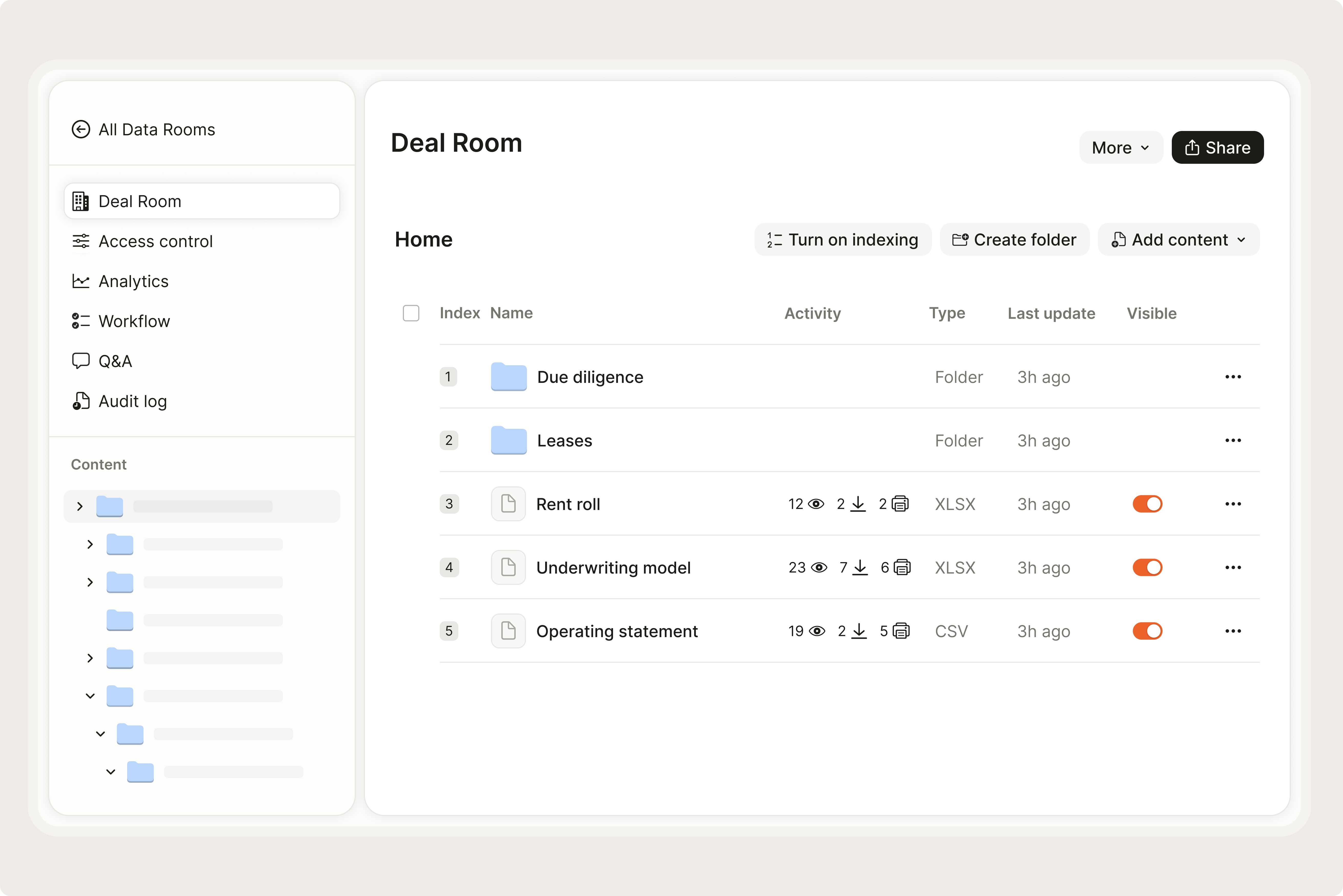
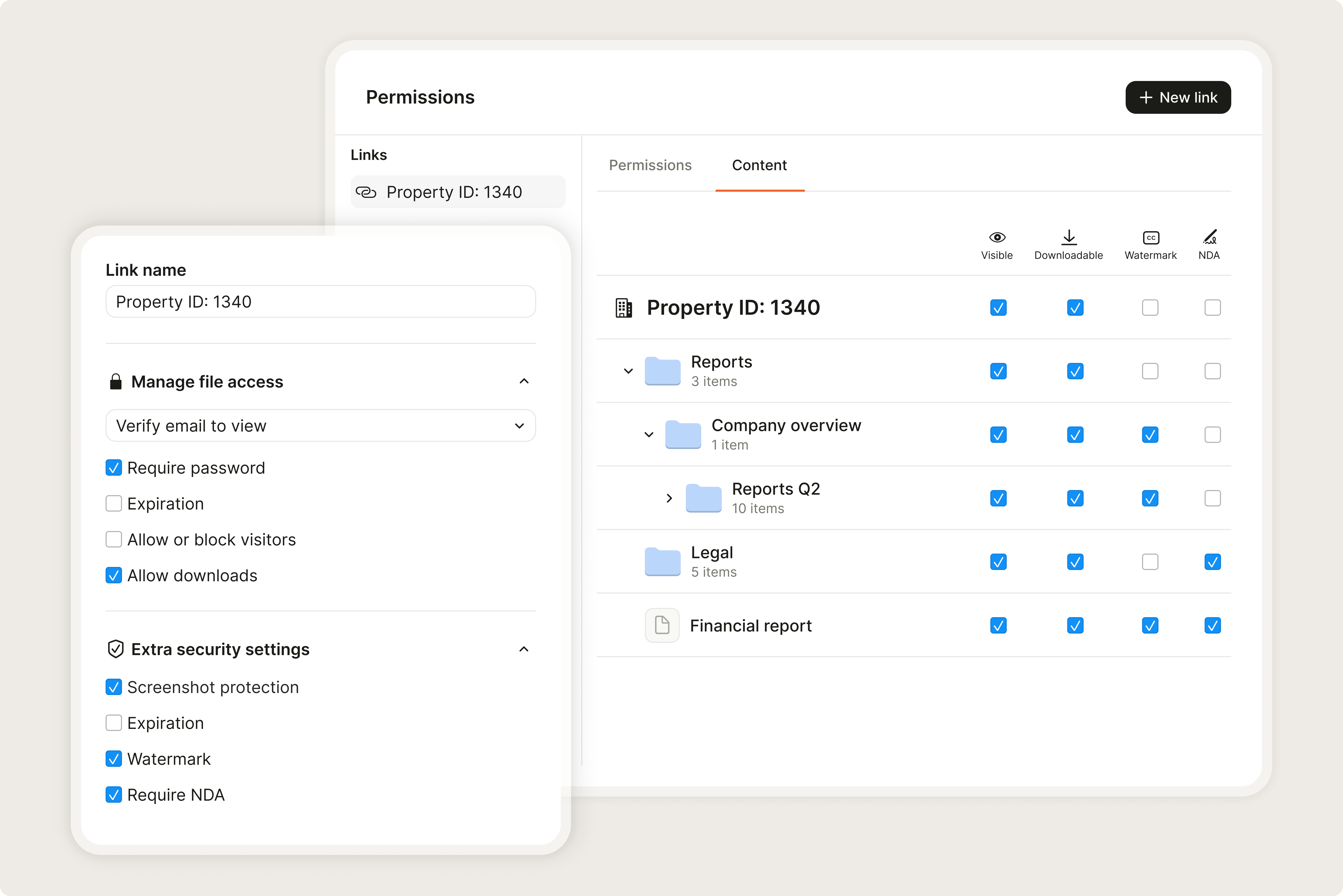
- 2.Give each advisor a scoped, tracked linkVietnamese attorney sees LURC, DONRE records, ERC, and corporate documents. Building inspector sees building permit and completion acceptance. Fire safety consultant sees PCCC acceptance. Environmental consultant sees EIA approval and environmental records. Tax counsel sees LUR history and GDT compliance records. Each party sees only their files.
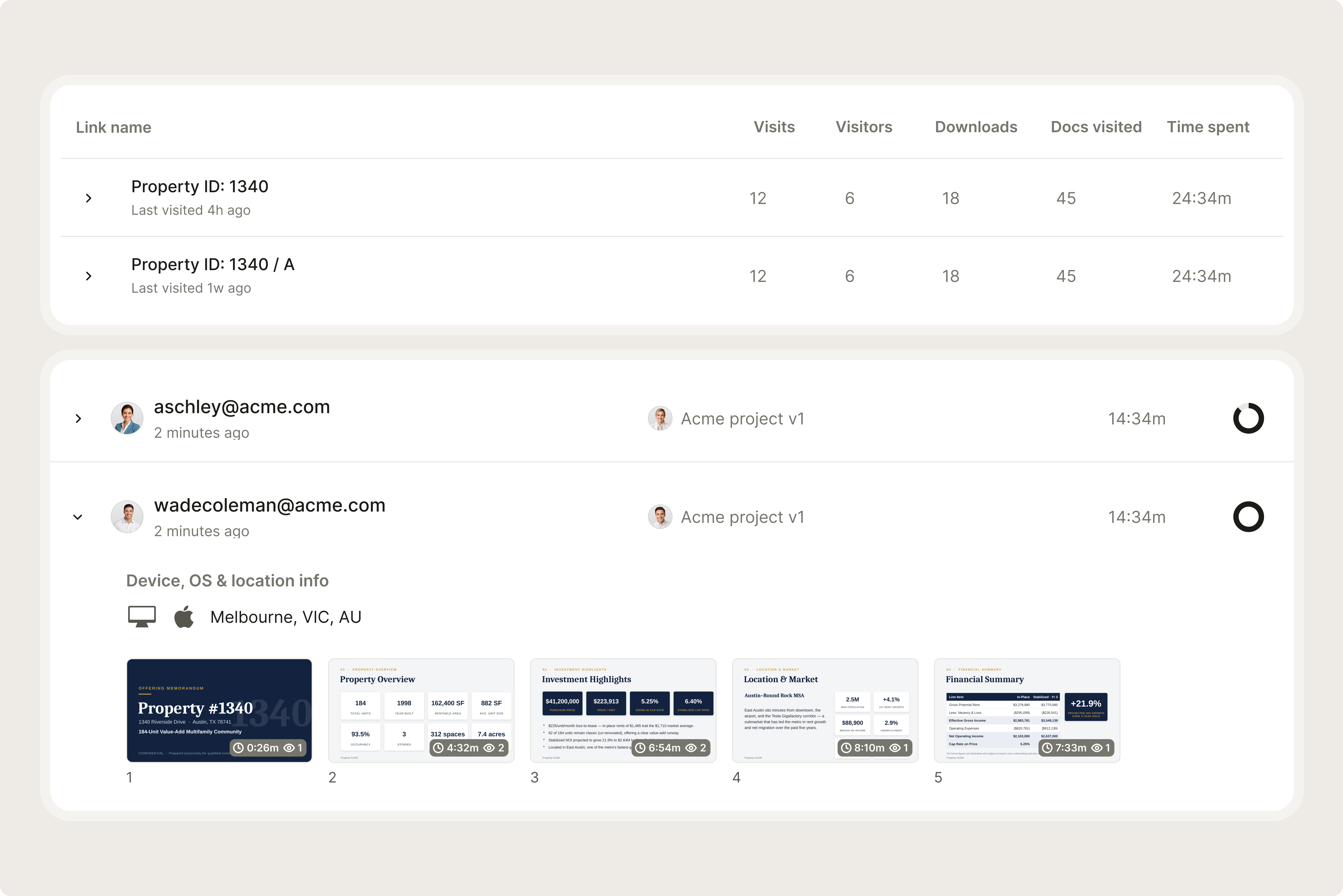
- 3.Monitor who reviews which documentsSee exactly which files each advisor opened and when. Catch fire safety gaps or IRC processing delays before they stall deal closing.
What makes Vietnam different
The Land Use Rights (LUR) system - Vietnam's answer to the contradiction between communist ideology (no private land ownership) and a market economy (tradeable real estate rights) - creates a due diligence framework that is fundamentally different from anything a buyer encounters in other major commercial real estate markets. There is no freehold, no title insurance market of any consequence, no constitutive land register that operates like Germany's Grundbuch or Japan's Legal Affairs Bureau registry. What exists is a Land Use Rights Certificate (LURC, colloquially called Sổ đỏ for land or Sổ hồng for buildings combined with land) that evidences a time-limited right to use a specific parcel of land for a specified purpose. The LURC is the primary title instrument, but it is verified not through a single national searchable registry but through DONRE at the provincial level, and the physical document may not reflect current cadastral reality if recent changes have been registered but not incorporated into the LURC document. Experienced Vietnam practitioners verify both the physical LURC and the DONRE cadastral records for the parcel before any deposit or commitment. This dual-verification practice exists because discrepancies have occurred in actual transactions. The new Land Law 2024 has digitization provisions that are gradually improving the cadastral information system, but the rollout of digitized land records varies significantly by province as of 2026.
Vietnam's manufacturing FDI boom - driven by the US-China trade war, COVID-era supply chain diversification, and Vietnam's growing technical workforce - has made industrial park LURs one of the most actively transacted property types in Asia. The industrial park structure in Vietnam is a three-tier LUR system: the state grants the master LUR to the IP developer (e.g., VSIP - a Singapore-Vietnam joint venture, Kinh Bac City, Amata from Thailand, Long Duc) for 50 years; the IP developer then sub-leases parcels within the IP to manufacturing companies for the IP's remaining term; those manufacturing companies operate from their sub-leased parcels. For M&A investors acquiring Vietnamese manufacturing companies: the industrial LUR access is through the sub-lease agreement with the IP developer, not a LURC in the company's own name. The sub-lease agreement is the critical title document, and the remaining sub-lease term (which cannot exceed the IP developer's master LUR remaining term) is the critical timing check. Transfer of the sub-lease to the M&A buyer requires IP management board (Ban Quản lý Khu Công nghiệp) consent and often provincial approval, which adds a procedural step that must be planned into the deal timeline. Key northern industrial markets (Bac Ninh and Bac Giang provinces north of Hanoi) have seen exceptional demand driven by Samsung Electronics' two massive manufacturing complexes and a resulting supply chain cluster of hundreds of component and subcomponent manufacturers; IP LUR occupancy rates in prime northern IPs have been at or near 100% for multiple years.
Vietnam's anti-corruption enforcement environment has become a material diligence consideration for any commercial real estate transaction, particularly in HCMC and Hanoi. The Communist Party's anti-corruption campaign (chống tham nhũng) under General Secretary Nguyen Phu Trong intensified significantly after 2012 and has prosecuted numerous senior officials and business executives. Real estate has been a primary focus: cases involving improper LUR allocations at below-market land prices, unauthorized changes to land use categories, and project approvals obtained through bribery have resulted in criminal convictions, LUR revocations, and asset confiscations. Several high-profile HCMC commercial real estate projects were caught in these investigations in 2022-2024. For buyers entering Vietnam commercial through M&A of existing Vietnamese entities: the LUR acquisition history review (how and when the current holder obtained the LUR, what process was used, what approvals were obtained, whether the land was allocated or auctioned at market price) is an essential anti-corruption compliance step that also assesses asset security risk. LURs with questionable acquisition histories - obtained through below-market allocations, opaque approval processes, or at times that correlate with known investigations - carry a risk of state recovery or legal challenge that affects the investment thesis regardless of the buyer's own conduct.
Article 3(1) of the Land Law 2024 (Luật Đất đai 2024, Law No. 31/2024/QH15, effective August 1, 2024) provides that land belongs to the entire People of Vietnam with the State acting as the owner's representative and managing land uniformly in accordance with the law. The State grants land use rights to land users in accordance with the provisions of this Law. Article 27 provides that land users have the right to use land (quyền sử dụng đất) and to exercise the rights of land users in accordance with the Law including: to transfer, exchange, lease, sub-lease, inherit, donate, mortgage, and contribute as capital their land use rights in accordance with law and within the allocated land use term. Land use rights may be mortgaged at authorized credit institutions licensed to operate in Vietnam; the mortgage shall be registered and recorded in the Certificate of Land Use Rights.
Timeline and cost in Vietnam
Weeks 1-4 cover kickoff: LURC review and DONRE cadastral verification, land recovery decision check from DONRE, LUR term and purpose confirmation, investment structure determination with Vietnamese counsel (M&A or new IRC project), ERC and corporate charter review (for M&A), IRC application commission (for new project), building permit and completion acceptance verification with Sở Xây dựng, fire safety acceptance check with PCCC authority, EIA and environmental acceptance verification with DONRE, industrial park sub-lease review (if IP), GDT tax compliance check, LUR acquisition history investigation, ERC and shareholder structure review, UBO identification, OFAC and UN sanctions screens. Vietnamese law firm fees: USD 15,000-80,000 for this phase depending on complexity.
Load all files into Ellty before advisors engage. Standard Vietnam commercial M&A: 90-180 days. IRC application for new foreign investment project: 1-4 months. DONRE LUR transfer registration (asset deal): 15-30 working days. IP management board sub-lease transfer consent: 2-6 weeks.
Weeks 4-12 cover deep review: LUR anti-corruption history investigation, corporate DD conclusion (M&A), building plan vs. completion acceptance vs. as-built comparison, fire safety compliance confirmation, EIA compliance review, tax compliance audit conclusion (CIT, VAT, PIT withholding, transfer pricing), lease review, IP developer financial standing assessment (if IP sub-lease), IRC processing tracking (new project). Costs: USD 20,000-150,000.
Weeks 12-24 handle resolution: LUR mortgage discharge, DONRE transfer registration (asset) or ERC update (M&A share deal), LURC update in buyer's name (asset), IRC issuance and land lease agreement signing (new project), PIT withholding and registration fee payment, post-closing compliance plan for IRC conditions.
Vietnam total buyer-side transaction costs: 0.5% registration fee + 2% PIT (on individual seller transfers, deducted from seller proceeds at closing) = effective buyer cost approximately 0.5-1%; for M&A share deal: 0.1% stamp duty; professional fees (Vietnamese law firm, technical advisors, environmental assessors, tax advisors): USD 50,000-300,000 for mid-size commercial deals. Total effective buyer cost including professional fees: 2-5% of transaction value.
Running a Vietnam property deal from one room
Hold LURC, IRC, fire safety acceptance, and all deal docs in one secure, tracked Ellty data room.
Start free 14-day trialCommon questions about due diligence on Vietnam commercial property
- No foreign individual or company can own land in Vietnam - all land belongs to 'the People' administered by the state. What can be held, transferred, and mortgaged are Land Use Rights (LUR, Quyền sử dụng đất) with fixed terms (typically 50 years for commercial). Foreign investors access commercial LUR primarily through: (1) M&A of Vietnamese entities already holding LURs; or (2) establishing a foreign-invested enterprise (FIE) with an Investment Registration Certificate (IRC) and then leasing land from the state or obtaining project LUR. Foreign individuals can buy condominium units under 50-year LUR with restrictions on quantity per building.
- The LURC (Giấy chứng nhận quyền sử dụng đất, colloquially Sổ đỏ for land or Sổ hồng for combined land and buildings) is the primary title document for Vietnamese real estate. It shows: LUR holder, land area, land use purpose (commercial, industrial, residential, agricultural), LUR term, and any registered encumbrances or mortgages. Title verification requires reviewing both the physical LURC and DONRE's land cadastral records at the provincial level - discrepancies between the two require investigation.
- An Investment Registration Certificate (IRC, Giấy chứng nhận đăng ký đầu tư) is issued by the provincial Department of Planning and Investment (DPI) and authorizes a foreign-invested enterprise to implement a specific investment project in Vietnam. An IRC is required for foreign investors establishing new businesses or investment projects in Vietnam. For commercial real estate investments by foreign entities in Vietnam: an IRC is needed for greenfield projects; for M&A of existing Vietnamese companies, an IRC may be required depending on the ownership structure and sectors. IRC processing typically takes 1-4 months for complete processing.
- Commercial Land Use Rights in Vietnam are typically granted for 50 years from the date of issuance. Some economic zones and special investment projects may receive 70-year terms. LURs are extendable upon expiry subject to an application to DONRE and the state's approval. Lenders require the remaining LUR term to significantly exceed the loan maturity. Check the LURC for the issue date and expiry date; calculate the remaining term at closing. LURs with under 20 years remaining may face financing constraints and should be modeled with a LUR renewal application and cost.
- Vietnam's industrial parks (Khu Công nghiệp, KCN) use a three-tier LUR structure: (1) the state grants master LUR to the IP developer (VSIP, Kinh Bac, Amata, etc.) for 50 years; (2) the IP developer sub-leases individual parcels to manufacturing companies for the IP's remaining term; (3) manufacturers operate from their sub-leased parcels. For M&A investors acquiring Vietnamese manufacturers in IPs: the title document is the sub-lease agreement with the IP developer, not a LURC. Sub-lease transfer requires IP management board consent. The remaining sub-lease term cannot exceed the IP developer's master LUR remaining term.
- Vietnam's anti-corruption enforcement has included numerous real estate cases involving improper LUR allocations at below-market prices, unauthorized land use category changes, and approvals obtained through bribery. Several HCMC commercial projects were caught in investigations in 2022-2024, with LURs revoked or disputed. For M&A of Vietnamese entities: review how and when the current holder obtained the LUR - was it allocated by the state (and at what price), auctioned at market, or acquired through prior transfer? LURs with opaque acquisition histories or below-market allocations carry state recovery risk that is independent of the buyer's own conduct.