Cyprus commercial property due diligence runs through the Department of Lands and Surveys (DLS). Title deeds, encumbrances, and registered mortgages all sit there. The common law-derived legal system is familiar to UK and international advisors, but a few Cyprus-specific issues - the historic title deed backlog, Northern Cyprus risk, and transfer fee calculations - need specific attention on every deal.
Cyprus transfer fees apply to freehold transfers not subject to VAT: 3% on the first EUR 85,000; 5% on EUR 85,001-EUR 170,000; 8% above EUR 170,000. On a EUR 1M commercial deal the effective rate is approximately 7.8% (the first EUR 170,000 at blended 4% average, balance at 8%). For new commercial developments sold subject to VAT (19%): transfer fees are waived - confirm VAT applicability with Cypriot counsel. Capital Gains Tax (CGT) at 20% applies to the seller's gain from immovable property in Cyprus.
Cyprus abolished its Immovable Property Tax (IPT) in 2017 - there is no annual property holding tax in Cyprus. The cost of ownership after transfer is therefore primarily maintenance, insurance, and ground rent (where applicable). This makes Cyprus relatively low-cost to hold compared with many EU markets, but the headline transfer fee on secondary market commercial can approach 8% of value - budget this before signing any reservation agreement.
Load title deeds, DLS encumbrance search results, building permit, certificate of final approval, town planning documentation, and lease files into an Ellty data room before advisors engage.
Where Cyprus property deals actually go wrong
Not every check carries the same weight. The table below sorts them by deal impact - dealbreakers first, then what moves the price, then basic hygiene - so your Cypriot attorney and advisor know what to clear first.
| Area | Documents to pull | Cyprus red flag | Matters most for | Tier | |
|---|---|---|---|---|---|
| DLS title deed and encumbrance search | DLS title deed and encumbrance search | DLS Certificate of Encumbrances (search certificate) for the specific plot reference (plan/sheet/plot number); original title deed (if issued); copy of folio from DLS land register | The Department of Lands and Surveys (DLS, Τμήμα Κτηματολογίου και Χωρομετρίας) in Cyprus maintains the authoritative land register; every registered property has a DLS plot reference (plan/sheet/plot number) and a title deed (Certificate of Registration of Immovable Property); request the Certificate of Encumbrances from DLS for the specific plot - this shows registered owner, area, land use, any registered mortgages (υποθήκες), charges, caveats, easements, restrictions, and any court-issued prohibitions; the search certificate is the primary title verification document in Cyprus; confirm the seller's name on the DLS register matches the seller entity; confirm no registered encumbrances that would survive transfer; in Cyprus, DLS searches are comprehensive for registered interests but unregistered contractual rights (e.g., unregistered contracts of sale deposited elsewhere) also require checking | All buyers - foundational check | Dealbreaker |
| Title deed backlog - individual title deeds | Title deed backlog - individual title deeds | Individual DLS title deed for the specific unit or plot; developer's parent title deed; contract of sale deposited with DLS (Specific Performance Law documentation); any DLS correspondence on subdivision process | Cyprus has a well-documented historical problem of off-plan property sales where developers registered the entire development under a single (parent) title deed and sold individual units without issuing individual title deeds to buyers; Law 81(I)/2011 (the Specific Performance Law) was enacted to address this - it allows buyers who deposited their contracts of sale with DLS to force the developer/vendor to transfer the title deed; as of 2025-2026 the worst of this backlog has been addressed by the Cypriot government, but some older commercial developments (particularly commercial units within mixed-use developments built before 2010) may still not have individual title deeds issued; for any Cyprus commercial property without an individual title deed in the seller's name: confirm what stage the subdivision/individual title deed issuance process is at, what the timing is, and whether the contract of sale has been deposited with DLS under the Specific Performance Law; buying without individual title deed means you cannot register a mortgage, cannot resell easily, and cannot confirm clean encumbrance status | Commercial units in developments; older mixed-use properties | Dealbreaker |
| Northern Cyprus risk | Northern Cyprus risk | Confirmation of property location relative to the Green Line (UN Buffer Zone); DLS verification that the property is within the Republic of Cyprus and not in the Turkish-controlled north | Since 1974, approximately 37% of Cyprus (the northern part) has been under Turkish military control and is administered by the 'Turkish Republic of Northern Cyprus' (TRNC), recognized only by Turkey; the European Court of Human Rights ruled in Loizidou v. Turkey (1996) and subsequent cases that Turkey is responsible for property rights violations in the north, and original Greek Cypriot owners retain rights to their pre-1974 properties; purchasing property in Northern Cyprus from TRNC authorities or current (often Turkish Cypriot or mainland Turkish) occupants carries extreme legal risk: the original owner can and does pursue claims through Cypriot courts and the ECHR; the Republic of Cyprus government has prosecuted foreign buyers in Northern Cyprus and issued warnings to international purchasers; multiple foreign nationals have faced adverse judgments; any property in or near the UN Buffer Zone or in the north is categorically high-risk; for investors: confirm the property is in the Republic of Cyprus (south) via DLS verification - DLS only registers properties in the south | Any property in or near the Green Line; northern region acquisitions | Dealbreaker |
| Mortgages and charges | Mortgages and charges | DLS Certificate of Encumbrances showing any registered mortgages (υποθήκες), charges, or caveats; written confirmation from any mortgagee of the mortgage amount outstanding and discharge plan | Mortgages on Cyprus commercial property are registered at DLS and appear in the Certificate of Encumbrances; Cyprus banks significantly increased NPL (non-performing loan) portfolios after the 2012-2013 financial crisis, and many commercial properties are still encumbered by bank mortgages that were negotiated for reduction or sale to asset management companies (Altamira Cyprus, now Themis Portfolio Management; APS Debt Servicer; etc.); confirm whether the property has a registered bank mortgage; for NPL-linked properties where the mortgage was sold to a credit acquirer: the credit acquirer holds the mortgage and must discharge it from sale proceeds; in some cases the property has been marketed by the credit servicer rather than the original borrower - these deals are generally straightforward but confirm the servicer's authority to sell and receive the discharge | All buyers; especially post-2013 vintage commercial properties | Dealbreaker |
| Town planning and zoning | Town planning and zoning | Town planning certificate from the Department of Urban Planning and Housing (or local municipality); current local plan (topiko schedio) for the municipality; permitted use and development parameters for the specific plot | Cyprus is covered by Local Plans (for Nicosia, Limassol, Larnaca, Paphos, Famagusta) and Specific Plans for tourist areas; the Department of Urban Planning and Housing (formerly the Town Planning Department) controls zoning; confirm the plot's permitted use zone in the current approved local plan; commercial, mixed-use, tourist, residential, and industrial zones have different permitted uses and density coefficients; also note: Cyprus local plans have been under revision; confirm the current approved plan applies and whether any amendments are in progress; for tourist area commercial (Limassol seafront, Paphos hotel zones): specific tourism development plans apply; confirm that any existing commercial building complies with the permitted use and that any planned development matches the zoning coefficient (coverage ratio, floor area ratio, maximum height) | All Cyprus commercial; development land; tourist area commercial | Price-adjuster |
| Building permits and final approval | Building permits and final approval | Building permit (οικοδομική άδεια) from municipality or District Administration; certificate of final approval (πιστοποιητικό τελικής έγκρισης) confirming completion in compliance with permit; fire certificate from the Fire Service (for commercial buildings) | Cyprus building permits are issued by the local municipality or, for areas outside municipal boundaries, by the District Administration; confirm the building permit covers the building as constructed; the certificate of final approval (τελική έγκριση) is issued after inspection confirming the building was completed in compliance with the approved plans; buildings in Cyprus (particularly older commercial stock and tourist developments) may have been constructed with alterations or additions that do not match the approved permit plans; illegally constructed areas within a commercial building may have been subject to amnesty provisions (regularization laws have been passed at various times) or may remain unauthorized; confirm the as-built structure matches the approved permit or that unauthorized elements have been regularized; also confirm the fire safety certificate from Cyprus Fire Service is valid for commercial buildings | All Cyprus commercial buildings; older buildings especially | Price-adjuster |
| Leases and tenancies | Leases and tenancies | All commercial leases and any statutory tenancy protections under the Rent Control Law (Cap. 86); rent roll; WAULT; any deposit receipts | Cyprus has rent control legislation (the Rent Control Law Cap. 86) that historically protected certain residential and commercial tenants in controlled premises; commercial premises built or first occupied after 31 December 1999 are generally outside rent control; but older commercial buildings may have protected tenants whose rents are controlled and who have statutory security of tenure and cannot be evicted without specific grounds; identify whether any leases fall under rent control; for commercial properties in Nicosia and Limassol older commercial districts: this is worth specific investigation; for Grade A office and modern commercial (built post-2000): rent control is generally not applicable; review all commercial leases for break rights, rent review provisions, and service charge pass-through; Limassol Grade A office leases (typically 3-5 years with breaks) are relatively straightforward | Tenanted commercial; older buildings in Nicosia and Limassol | Price-adjuster |
| Transfer fee and VAT calculation | Transfer fee and VAT calculation | DLS transfer fee calculation (based on market value at DLS assessed rate); VAT applicability from Tax Department; confirmation of whether the specific property is new (VAT applicable) or secondary market (transfer fees applicable) | The key acquisition cost question in Cyprus: is the property a new commercial development subject to 19% VAT, or a secondary market sale subject to transfer fees (3% / 5% / 8%)? These two taxes are mutually exclusive: if VAT applies, transfer fees are waived; if no VAT (secondary market), transfer fees apply; VAT applies to the first sale of a new commercial building; resale of the same building by the original buyer to a second buyer: subject to transfer fees (no VAT); this categorization must be confirmed with the Tax Department; additionally: the DLS assesses transfer fees on the DLS's own market value assessment for the property, not necessarily the contract price; if the DLS assessed value is higher than the contract price, fees are calculated on the DLS value; the government has periodically offered 50% reductions on transfer fees for qualifying transactions - confirm current rules with Cypriot counsel | All Cyprus commercial deals; new vs. secondary market distinction | Price-adjuster |
| Environmental compliance | Environmental compliance | Environmental Impact Assessment (EIA) approval from the Ministry of Environment (if applicable for the project), environmental compliance certificate, permits for any underground storage tanks or industrial use | Cyprus implements the EU EIA Directive (2011/92/EU as amended); commercial projects above certain thresholds require EIA from the Ministry of Agriculture, Rural Development and Environment; for industrial properties: confirm environmental compliance and any outstanding remediation orders; for hotel/tourist commercial (significant in Limassol and Paphos): confirm coastal zone compliance under the coastal management rules; Cyprus's coastal development is regulated and properties within designated coastal zones require specific approvals | Large commercial; industrial M&A; coastal zone development | Standard check |
| AML and beneficial ownership | AML and beneficial ownership | Cyprus Registrar of Companies company search; Ultimate Beneficial Owner (UBO) register confirmation; OFAC, EU, UN sanctions screens; source of funds documentation | Cyprus has historically had a significant Russian and CIS business community, particularly in Limassol; since the February 2022 Russia-Ukraine war and EU sanctions on Russia, Cyprus has intensified AML and sanctions compliance for transactions involving Russian or Belarusian connected parties; real estate transactions involving politically exposed persons (PEPs) or parties connected to sanctioned individuals require enhanced due diligence; Cyprus implemented EU AML directives (AMLD4, AMLD5) and the country's reputation for sanctions compliance has been under scrutiny; for commercial deals involving Limassol properties previously held by CIS-connected investors: the UBO chain and sanctions screens are particularly important; Cyprus's Registrar of Companies maintains a UBO register (since 2021 per AMLD5 requirements); EU sanctions lists, OFAC, and UN lists must be screened | All deals; especially Limassol commercial with CIS-connected ownership | Standard check |
Due diligence on a Cyprus property?
Set up your Ellty data room before diligence starts.
Start free 14-day trialCyprus commercial property due diligence checklist
The table ranked risks by severity. This is the full checklist to work through, grouped by area.
DLS title search and title deed confirmation
- Day one: obtain the plot reference (plan/sheet/plot number) from the seller and request a Certificate of Encumbrances from DLS; the certificate shows the registered owner, property description, and all registered encumbrances (mortgages, charges, caveats, prohibitions, easements); confirm seller's name matches the registered owner on the DLS certificate
- Confirm the individual title deed (Certificate of Registration of Immovable Property, Πιστοποιητικό Εγγραφής Ακίνητης Ιδιοκτησίας) has been issued in the seller's name for the specific plot or unit; if the property does not have an individual title deed issued: investigate the status of the individual title deed issuance process, whether the contract of sale was deposited with DLS under the Specific Performance Law, and the timeline for subdivision and individual deed issuance
- Confirm no registered mortgages, caveats, prohibitions, or court injunctions appear on the DLS certificate; any registered encumbrance that is not to be discharged before or at closing requires investigation; in particular: confirm any bank mortgage will be discharged from proceeds of sale simultaneously with transfer
Give each advisor a scoped link in Ellty. Cypriot attorney sees DLS encumbrance certificate, title deed, building permit, and town planning documentation. Building surveyor sees permit and final approval certificate. Lender sees full title and valuation. Lease counsel sees lease pack and rent roll. Each party sees only their files.
Northern Cyprus verification
- Confirm via DLS that the property is registered in the Republic of Cyprus land register; the DLS only maintains records for properties in the south; a property that appears in the DLS register is by definition in the Republic of Cyprus-controlled territory
- If the property is near the Green Line (UN Buffer Zone): exercise additional caution; confirm the property is not partially within or adjacent to the buffer zone; buffer zone properties can have access restrictions
- Do not purchase property in Northern Cyprus (Turkish-controlled territory) through any route; the extreme legal risk arising from the unresolved property rights of pre-1974 Greek Cypriot owners is not a deal-specific risk that can be mitigated by diligence - it is a systemic risk affecting any transaction in the north
Load all files into Ellty before DLS searches are complete. Cypriot attorney tracks DLS search confirmation. Seller provides copies of the title deed and DLS certificate. Lender reviews DLS results before any loan approval. Track who reviews the Northern Cyprus confirmation so no advisor misses it.
Town planning and building compliance
- Request a town planning certificate from the Department of Urban Planning and Housing confirming the permitted use zone, density coefficient, coverage ratio, and floor area ratio for the specific plot; confirm the existing commercial use matches the zoning
- Request the building permit (οικοδομική άδεια) and confirm it covers the building as constructed; compare approved floor plan to as-built; any unauthorized additions or alterations require investigation
- Request the certificate of final approval (τελική έγκριση) confirming the building was completed in compliance with the approved permit; also request the fire safety certificate from the Cyprus Fire Service for commercial buildings
- For tourist area commercial (Limassol seafront, Paphos hotel zone): confirm specific area plan compliance and coastal zone approval if within a designated coastal area
Compare Bulgaria's commercial property due diligence process for Eastern Mediterranean and EU investor context. Cyprus and Bulgaria both offer EU membership with lower commercial real estate prices than Western Europe: Cyprus (common law system, English-language business environment, Limassol financial hub, higher transfer fees up to 8%) vs. Bulgaria (civil law system, Sofia office market, transfer fees of approximately 3-4% combined, EU member since 2007 but not yet Schengen); Cyprus has stronger institutional office and tourism-linked commercial markets; Bulgaria has higher yield opportunities in logistics and light industrial.
How due diligence works in Cyprus
Step 1 - DLS search and title confirmation
Day one: obtain plot reference and request DLS Certificate of Encumbrances. Confirm individual title deed issued in seller's name. Confirm no registered mortgages or caveats. Verify property location is in the Republic of Cyprus. For properties with bank mortgages: confirm discharge plan and servicer authority.
For off-plan or units without individual title deeds: assess Specific Performance Law status before committing to any deposit.
Step 2 - Town planning and building compliance
Request town planning certificate from Department of Urban Planning and Housing. Request building permit and confirm coverage of as-built structure. Obtain certificate of final approval. Fire safety certificate for commercial buildings. For coastal or tourist-zone properties: specific area plan compliance check.
Step 3 - Leases, transfer costs, and AML
Abstract all commercial leases; check rent control exposure for older buildings. Calculate transfer fees (3%/5%/8%) or confirm VAT applicability (and transfer fee waiver). Run UBO investigation and sanctions screens. Tax counsel confirms CGT position for seller and confirms transfer fee/VAT classification.
Step 4 - DLS transfer registration
Cyprus property transfer: executed before a notary or at DLS; transfer fees paid; DLS registers the transfer and issues updated title deed in buyer's name; typically processed within 2-4 weeks of payment and submission; confirm mortgage discharge is registered simultaneously.
Load closing documents into Ellty before DLS transfer registration appointment. Cypriot attorney sees all transfer documents. Lender confirms mortgage discharge registration.
How to set up your Cyprus data room in Ellty.
Cyprus commercial deals involve the DLS Certificate of Encumbrances, individual title deed, building permit, certificate of final approval, fire certificate, town planning certificate, lease pack, and transfer fee calculation.
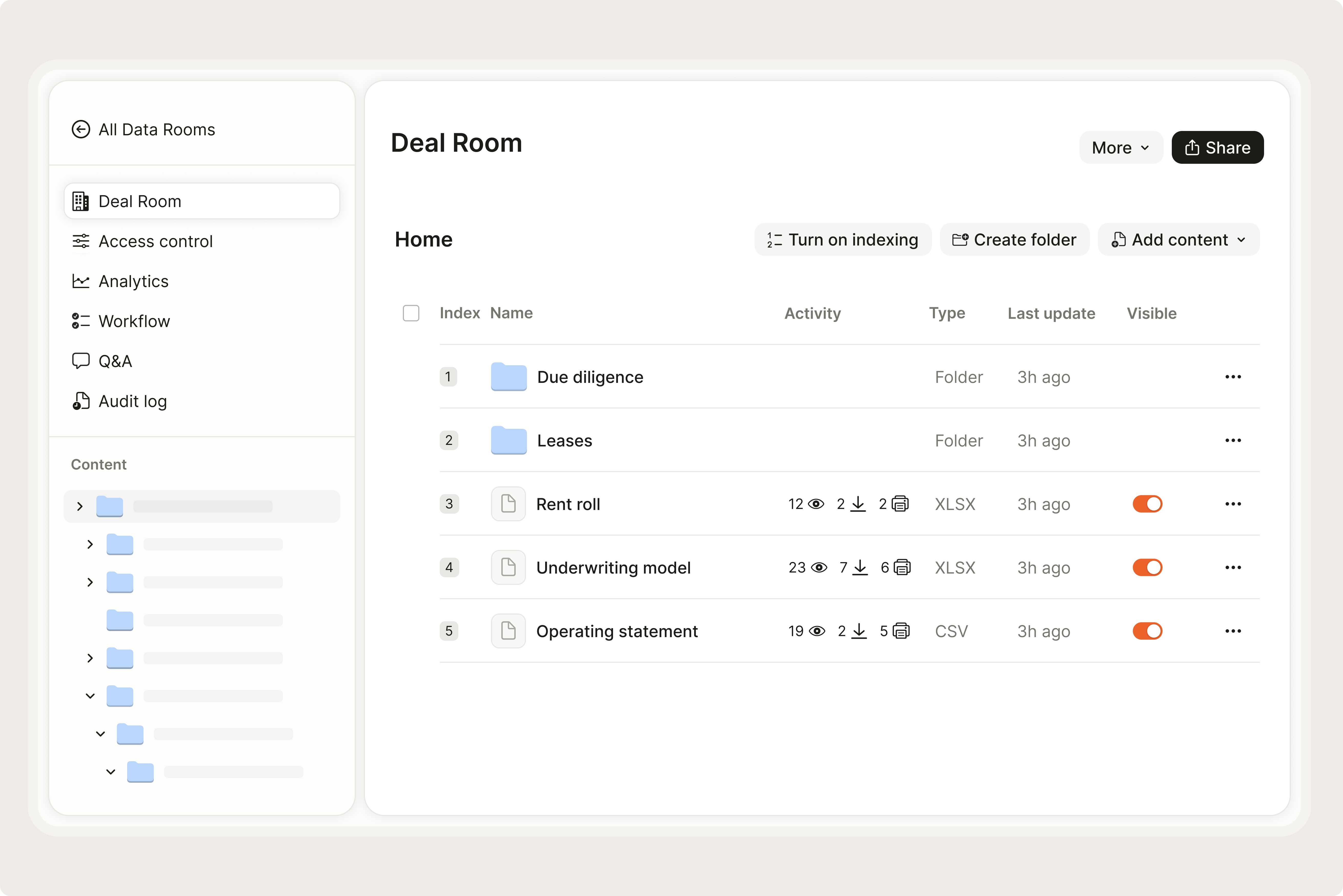
- 1.Upload Cyprus property files to a secure roomDrop the DLS Certificate of Encumbrances (search certificate), individual title deed (Certificate of Registration of Immovable Property), building permit, certificate of final approval (final approval), fire safety certificate, town planning certificate, lease pack, and rent roll into Ellty.
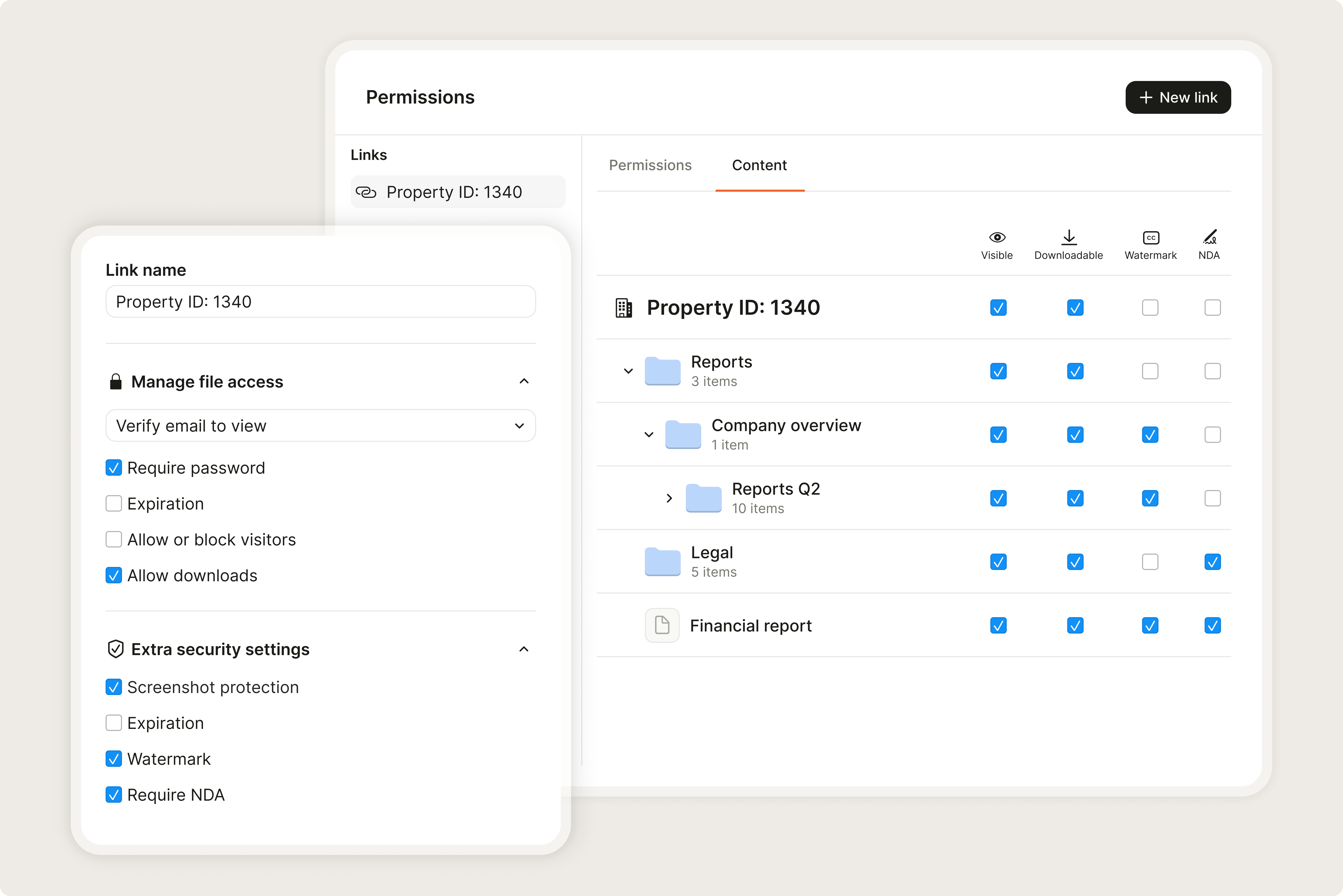
- 2.Give each advisor a scoped, tracked linkCypriot attorney sees DLS certificate, title deed, and town planning docs. Building surveyor sees building permit and final approval. Fire safety consultant sees fire certificate. Tax counsel sees transfer fee analysis. Lender sees title, valuation, and leases. Each party sees only their files.
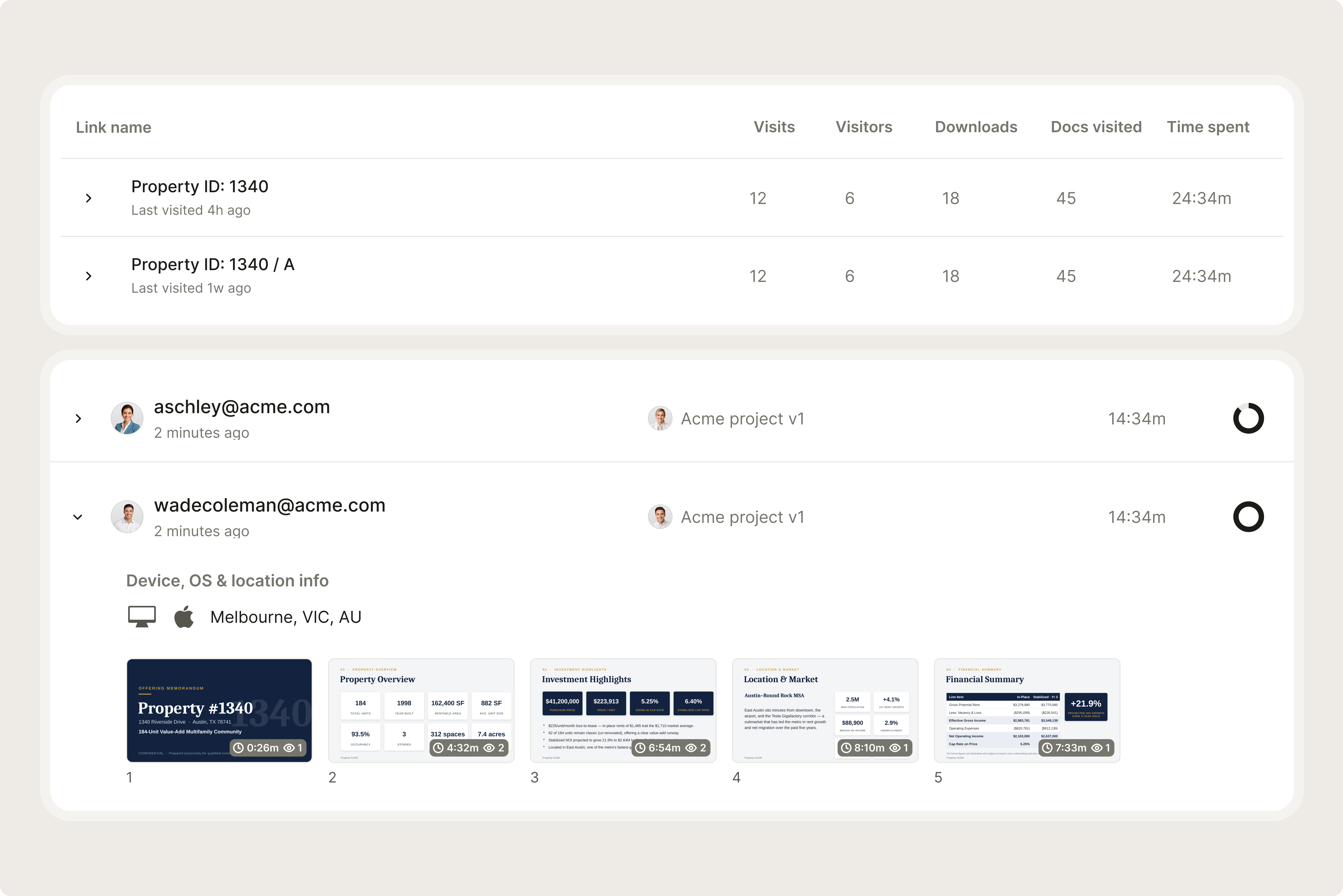
- 3.Monitor who reviews which documentsSee exactly which files each advisor opened and when. Catch title deed backlog issues or Northern Cyprus boundary questions before they delay the deal.
What makes Cyprus different
Cyprus presents one of the more unusual due diligence environments in Europe: a common law legal system derived from British colonial law (Cyprus was a British Crown Colony until 1960), an English-language business environment, EU membership since 2004, and a divided island where purchasing property in the wrong half of a Green Line carries the kind of legal risk that can result in court judgments, ECHR awards against Turkey, and loss of the property entirely. The Republic of Cyprus (the Greek Cypriot-controlled south) operates a functioning, DLS-based land registry that is reliable and searchable; the TRNC (the Turkish-controlled north) operates its own land registry based on post-1974 allocations that are not recognized under international law or EU law. The gap between these two systems - and the unresolved property rights of the approximately 200,000 Greek Cypriots displaced from the north in 1974 - creates a clean geographic division: buy in the Republic of Cyprus (check the DLS) and the framework is clear; buy anything in the north and the legal risk is existential regardless of how professional your local advisors are. The EU's accession of Cyprus in 2004 did not resolve the island's division, and the property rights question remains one of the issues to be addressed in any future reunification settlement. Until then: the DLS verification that a property is registered in the south is not a formality but a foundational check.
Limassol's commercial market has been shaped by three decades of Russian and CIS business community concentration in the city. After Cyprus became an EU member in 2004, Limassol developed as a major hub for Russian-owned companies seeking EU corporate structures, shipping companies, investment firms, and regional headquarters. The 2012-2013 banking crisis (which saw the Bank of Cyprus bail-in that wiped out large depositor balances) damaged the island's reputation as a safe haven for Russian capital but did not eliminate it; Limassol continued to develop Grade A commercial office supply catering to the international business community. The 2022 Russia sanctions following the Ukraine invasion created a new wave of disruption: properties with Russian-connected ownership needed to be identified and screened; some Russian-owned companies quietly restructured ownership ahead of or after sanctions; and Cypriot authorities came under international pressure to enforce EU sanctions more rigorously. For commercial buyers in Limassol: the UBO investigation and sanctions screens are not optional - the probability of encountering a property with historical Russian or CIS connectivity in Limassol's commercial market is meaningfully higher than in most other European markets, and the consequences of acquiring a sanctioned-connected property are severe.
The title deed issuance backlog - Cyprus's longest-running property market institutional failure - has materially improved since its worst period (roughly 2007-2015, when hundreds of thousands of properties lacked individual title deeds). The root cause: Cyprus developers sold units off-plan, collected the full purchase price, but failed to register individual title deeds for buyers because they had mortgaged the development land and needed bank consent before subdivision - which they didn't always obtain in time or at all. Buyers who paid in full were left without title deeds and sometimes without the mortgage-free properties they thought they'd bought. The Specific Performance Law 2011 addressed this by allowing deposited contracts to compel transfer, and subsequent amnesties and government programmes have reduced the backlog. But for older commercial stock (pre-2005 buildings, units in mixed-use developments built in the 1990s and 2000s): the title deed position is still worth specific investigation. If a seller offers a commercial unit without an individual title deed and asks you to accept a deposited contract instead: get specific legal advice on the timeline to individual deed issuance and the exact risks during the interim period. It is not a dealbreaker if properly structured, but it is not a standard transfer and shouldn't be treated as one.
Section 52 of the Immovable Property (Tenure, Registration and Valuation) Law (Cap. 224) provides that all immovable property in Cyprus shall be registered in the name of the owner in the Land Registry. No transfer of immovable property or creation of any right therein shall be valid unless effected by registration in the Land Registry. The Certificate of Registration of Immovable Property (title deed) issued by the Department of Lands and Surveys is conclusive evidence of the registration and the rights recorded therein. Registration may only be altered or cancelled by order of the Court or by the Director of Lands and Surveys acting within his statutory powers.
Timeline and cost in Cyprus
Weeks 1-3 cover kickoff: DLS Certificate of Encumbrances and plot search, individual title deed confirmation, Northern Cyprus location verification, building permit and certificate of final approval review, town planning certificate from Department of Urban Planning and Housing, fire safety certificate check, preliminary lease review and rent control check, transfer fee vs. VAT classification with tax counsel, UBO investigation, OFAC/EU/UN sanctions screens, bank mortgage outstanding balance confirmation and discharge plan. Cypriot attorney fees: EUR 5,000-20,000 for standard commercial depending on complexity.
Load all files into Ellty before advisors engage. Standard Cyprus commercial: 45-90 days. Title deed backlog cases (where individual deed not yet issued): add 3-12 months for deed issuance process. DLS transfer registration: 2-4 weeks after submission and fee payment.
Weeks 3-6 cover deep review: full lease review, building plan vs. as-built comparison, unauthorized construction review and regularization status, coastal zone compliance (if applicable), EIA compliance for large commercial, environmental compliance for industrial properties, final transfer fee calculation on DLS assessed value, mortgage discharge amount confirmation.
Weeks 6-12 handle resolution: mortgage discharge, transfer fee payment, DLS transfer registration, title deed issuance in buyer's name.
Cyprus total buyer-side transaction costs: transfer fees (3-8% of DLS assessed value, or 0% if VAT-applicable new commercial); legal fees (EUR 5,000-25,000 depending on deal size); survey fees; title deed registration costs. Total effective buyer cost: 4-10% of transaction value (dominated by transfer fees on secondary market). For new commercial developments: 19% VAT replaces transfer fees - significantly higher headline cost but typically built into the developer's pricing.
Running a Cyprus property deal from one room
Hold DLS title deeds, encumbrance certificates, building permits, and lease files in one secure, tracked Ellty data room.
Start free 14-day trialCommon questions about due diligence on Cyprus commercial property
- The Department of Lands and Surveys (DLS, Τμήμα Κτηματολογίου και Χωρομετρίας) is the Cyprus land registry authority. It maintains the authoritative register of all immovable property in the Republic of Cyprus. Every registered property has a plot reference (plan/sheet/plot number) and a registered owner. The DLS issues a Certificate of Encumbrances (search certificate) showing the registered owner, property description, and all registered encumbrances (mortgages, caveats, restrictions, easements). The DLS title deed (Certificate of Registration of Immovable Property) is the primary ownership document. Title verification starts with a DLS search certificate for the specific plot reference.
- For decades, Cyprus property developers sold off-plan units and collected full purchase prices but failed to issue individual title deeds to buyers (typically because the development land was mortgaged and subdivision required bank consent). Hundreds of thousands of buyers were left with deposited contracts but no title deeds. Law 81(I)/2011 (the Specific Performance Law) allows buyers with deposited contracts to compel the seller/developer to transfer the title deed. The backlog has significantly reduced since 2015 but older commercial developments may still lack individual title deeds. Before purchasing: confirm an individual title deed exists in the seller's name.
- Northern Cyprus (Turkish-controlled since 1974) is not recognized internationally; only Turkey recognizes the TRNC. Original Greek Cypriot owners displaced in 1974 retain rights to their properties. The ECHR has ruled that Turkey bears responsibility for these violations (Loizidou v. Turkey). Foreign buyers of Northern Cyprus property from Turkish Cypriot or TRNC sources have faced legal claims from original owners, adverse ECHR judgments, and prosecution by the Republic of Cyprus. This is not a risk that can be mitigated by local legal advice - it is systemic. The Republic of Cyprus's DLS only registers properties in the south; any DLS-registered property is by definition in the right jurisdiction.
- Cyprus transfer fees apply to secondary market sales (not new developments subject to VAT): 3% on the first EUR 85,000; 5% on EUR 85,001 to EUR 170,000; 8% above EUR 170,000. On a EUR 500,000 commercial deal: approximately EUR 33,900 (roughly 6.8%). On a EUR 1M deal: approximately EUR 77,800 (roughly 7.8%). New commercial developments sold for the first time are subject to 19% VAT instead - transfer fees are waived for VAT-applicable transactions. The government has periodically offered 50% reductions on transfer fees; confirm current rules with Cypriot counsel.
- Cyprus CGT applies at 20% on the net gain from disposal of immovable property in Cyprus. The gain is the sale price less cost of acquisition (indexed for inflation) less allowable improvements and disposal costs. Individual sellers have lifetime exemptions of EUR 17,086 (on family home), EUR 25,629 (inherited property), and EUR 85,430 (agricultural land). For corporate sellers: the net gain is included in taxable income at 12.5% corporate tax (not CGT) if the property is held as part of a trading business, or at 20% CGT if held as capital. Confirm the CGT position of the specific seller with Cypriot tax counsel.
- Limassol has historically had a large Russian and CIS business community. Since February 2022 EU sanctions on Russia, Cyprus authorities have intensified AML and sanctions compliance. Properties previously owned or financed by Russia-connected individuals or entities require enhanced UBO investigation and sanctions screening. Acquiring a property with sanctioned-connected ownership (even through a chain of companies) creates significant legal risk. For Limassol commercial: always run comprehensive UBO investigation back to ultimate beneficial owners, screen all principals against EU sanctions lists, OFAC, and UN lists, and document the source of funds through the ownership chain.