Bulgaria commercial property due diligence has three localized issues: widespread unauthorized construction from the post-communist era that requires a full construction act chain before any commercial use is confirmed; property registry searches that must cover both the Geodesy, Cartography and Cadastre Agency (GCCA) and the Registration Agency (Agentsia po vpisvaniyata); and communist-era industrial contamination affecting former factory and metallurgical sites near Sofia, Varna, and Plovdiv.
Bulgaria's local tax on transfer of immovable property (mestniya danuk varhu pridobivane na imushtestvo) is set by each municipality; the typical rate in Sofia is 2.5-3.0% of the higher of the notarial value (officially assessed value) or the transaction price; most Bulgarian municipalities set rates between 2-3%; paid by the buyer at the municipality before the notarial deed is executed. Notary fees (notarialni taksi) are set by law on a sliding scale based on transaction value and are paid at closing.
All Bulgarian property transfers must be completed before a Notary (Notarius). The notary certifies the sale deed, collects local transfer tax confirmation, and submits the deed for registration in the Property Register maintained by the Registration Agency (Agentsia po vpisvaniyata). The Bulgarian system unified the Cadastre and Property Register into a single GCCA database in 2001, which is an advantage over Croatia's dual system, but searches of both the GCCA cadastral register and the Registration Agency property registry are still required in practice.
Sale of new commercial buildings (constructed within the past 60 months from the certificate of commissioning) by a VAT-registered seller is subject to 20% Bulgarian VAT; business buyers recover input VAT; for older commercial buildings, the transaction is VAT-exempt. Confirm VAT status before finalizing transaction structure and model the impact on commercial deal economics.
Set up a due diligence data room before advisors engage. Load property registry extracts, GCCA cadastral sketch, construction acts, GCCA sketch, MOEW environmental records, and lease files before diligence opens.
Where Bulgaria property deals go wrong
Not every check carries the same weight. The table below sorts risks by deal impact - dealbreakers first, then what moves the price, then basic hygiene - so your Bulgarian attorney and notary know what to clear first.
| Area | Documents to pull | Bulgaria red flag | Matters most for | Tier | |
|---|---|---|---|---|---|
| Property registry and cadastre | Property registry and cadastre | Registration Agency property registry extract (Udostoverenie za vpisvaniya), GCCA cadastral extract (Skitsa), notarial title certificate from seller's Notary, encumbrance search at Registration Agency | Bulgarian property title is confirmed from two sources: the Registration Agency (Agentsia po vpisvaniyata) for ownership records and encumbrances (mortgages, enforcement notes, tax liens, servitudes), and the GCCA (Geodesy, Cartography and Cadastre Agency) for the cadastral sketch (Skitsa) confirming boundaries, area, and property identifier; always pull current extracts from both; stale extracts are unreliable as encumbrances can be registered at any time; the Registration Agency property history certificate (istoriya na imota) should be pulled for the last 10 years at minimum to check for prior transfers, mortgages, and any indications of disputed ownership | All buyers | Dealbreaker |
| Construction acts and certificate of commissioning | Construction acts and certificate of commissioning | Building permit (Razreshenie za stroitelstvo), all construction-phase acts (Protokol Obr.2, Akt 14, Akt 15, Akt 16/Razreshenie za polzvane), DNSK (Directorate for National Building Control) records | Under Bulgarian spatial planning law (Zakon za ustroistvo na teritoriyata - ZUT), a commercial building must have: (1) Building Permit (Razreshenie za stroitelstvo); (2) Protocol Form 2 (starting construction); (3) Act 14 (certificate of rough construction completion); (4) Act 15 (preliminary acceptance); (5) Act 16 or Razreshenie za polzvane (Certificate of Commissioning/Use) - the final document permitting legal use; many Bulgarian commercial buildings are missing one or more of these documents, particularly older buildings from the communist era and informal construction from the 1990s; a commercial building without a Certificate of Commissioning cannot be legally used for commercial purposes and cannot be mortgaged by most lenders | All Bulgaria commercial - critical for older and communist-era buildings | Dealbreaker |
| Unauthorized construction (samovolno stroitelstvo) | Unauthorized construction (samovolno stroitelstvo) | DNSK enforcement records, municipality building department records, comparison of GCCA registered building footprint against physical building | Samovolno stroitelstvo (unauthorized/illegal construction) is a pervasive issue in Bulgarian commercial real estate; unauthorized extensions, additional floors, or entirely unpermitted buildings can be ordered demolished by DNSK (Directorate for National Building Control) at any time; there is no general Bulgarian legalization law equivalent to Croatia's 2012 law; unauthorized structures in Bulgaria remain illegal indefinitely and face demolition orders; verify that all built structures match the building permit and registration; any discrepancy between the permitted building and the actual building is unauthorized construction | All Bulgaria commercial, especially older buildings, tourist facilities, rural commercial | Dealbreaker |
| Environmental - communist-era contamination | Environmental - communist-era contamination | Phase I ESA, Bulgarian Ministry of Environment and Water (MOEW) contaminated sites register, EPA Superfund equivalent (MOEW), executive agency for environmental protection records | Bulgaria has significant communist-era industrial contamination from heavy industry, mining, and chemical facilities: Kremikovtsi metallurgical complex (near Sofia) left widespread heavy metal soil and groundwater contamination in the northwestern Sofia industrial area; Devnya chemical complex (near Varna) created significant contamination from chlor-alkali and fertilizer production; various mining operations in the Rhodope and Balkan mountain areas have documented AMD (acid mine drainage) and heavy metal contamination; search MOEW contaminated sites register before bidding on any former-industrial Bulgarian commercial | Former industrial commercial near Sofia, Varna, Plovdiv, mining areas | Dealbreaker |
| Encumbrances - mortgages, tax liens, enforcement | Encumbrances - mortgages, tax liens, enforcement | Registration Agency encumbrance extract, tax authority lien records (National Revenue Agency - NRA), National Revenue Agency tax debt confirmation for seller entity | Bulgarian mortgages (ipoteka) are registered at the Registration Agency and attach to the specific property; enforcement liens (vozbranta) from court judgments can attach to all immovable property of the debtor; tax debts of the seller to the National Revenue Agency (Natsionalna agentsiya za prihodite - NAP) can generate tax liens; obtain the full encumbrance extract from Registration Agency and a tax debt confirmation from NAP for the selling entity before any deposit | All buyers | Dealbreaker |
| VAT status of transaction | VAT status of transaction | Seller VAT registration status, building age and certificate of commissioning date, Bulgarian VAT structure analysis from Bulgarian tax counsel | Sale of new buildings (built within 60 months from the date of the certificate of commissioning) by a VAT-registered seller is subject to 20% Bulgarian VAT; for buildings older than 60 months, the transaction is VAT-exempt (but local transfer tax applies); for VAT-subject transactions, Bulgarian VAT-registered business buyers account for VAT via reverse charge and recover it as input VAT - net cost zero but requires Bulgarian VAT registration; confirm building age and seller VAT status before finalizing transaction structure | New commercial buildings; VAT-registered business buyers | Price-adjuster |
| Leases and tenancies | Leases and tenancies | All commercial leases, rent roll, lease registration in Property Registry (for leases over 1 year), tenant occupancy confirmation | Bulgarian commercial leases for a term exceeding 1 year must be registered in the Property Registry (Registration Agency) to be binding on third parties including buyers; unregistered leases over 1 year are not binding on a buyer and the tenant has no right to remain; confirm which leases are registered; for unregistered leases, negotiate with the seller to register before closing or reflect in price adjustment; confirm rent roll accuracy with written tenant confirmations | Tenanted Bulgaria commercial | Price-adjuster |
| Local transfer tax calculation | Local transfer tax calculation | Applicable municipality tax rate confirmation, notarial value (danachna otsenka) certificate from municipal tax office, transaction price tax base calculation | Bulgaria local tax on property transfer: rate set by each municipality (typically 2-3%; Sofia 2.5%); applied to the HIGHER of (a) the agreed transaction price and (b) the notarial value (officially assessed municipality tax value, called danachna otsenka); obtain the danachna otsenka certificate for the property from the municipal tax office before bidding; if danachna otsenka exceeds the agreed price, the tax base will be the official value, not the price | All buyers | Standard check |
| Zoning and spatial planning | Zoning and spatial planning | Podroben ustroystven plan (PUP - detailed development plan), visa za proektirane (design visa), municipality urban planning records, zone classification confirmation | Bulgarian spatial planning is governed by the Zakon za ustroistvo na teritoriyata (ZUT); commercial development requires a valid Podroben ustroystven plan (PUP) designating the parcel for commercial use; without a valid PUP designating commercial use, no building permit for commercial use can be issued; zone changes require PUP amendment procedures that can take 1-3 years; confirm the current PUP zone for the parcel before any commercial redevelopment bid | All commercial, especially redevelopment | Standard check |
| Building condition and energy | Building condition and energy | Building condition assessment, Energy Performance Certificate (EPC), asbestos survey (pre-1990 communist-era commercial), structural engineering report for older buildings | Communist-era commercial construction in Bulgaria (1950s-1980s) used panel construction (panelni sgradi) and large prefabricated concrete elements that have significant seismic vulnerability; Sofia is in a high seismic risk zone; structural integrity of older panel commercial buildings should be assessed; asbestos was widely used in Bulgarian communist-era construction and requires survey for pre-1990 buildings; EPC is required for property transactions in Bulgaria under EU energy directives | Communist-era panel commercial buildings, Sofia seismic zone commercial | Standard check |
| Seller KYC and AML | Seller KYC and AML | Bulgarian Trade Register (Targovskiya registar) entity records, UBO register confirmation, OFAC screen, EU sanctions screen, National Revenue Agency tax clearance | Bulgaria notaries are obligated AML subject persons under Bulgarian anti-money laundering law; enhanced due diligence applies to high-value transactions; confirm seller entity at Bulgarian Trade Register; obtain National Revenue Agency (NAP) tax clearance confirmation that the selling entity has no outstanding tax debts that could generate tax liens on the property; run OFAC and EU sanctions screens; UBO confirmation is required under Bulgarian AML law for all transactions | All deals | Standard check |
Due diligence on a Bulgaria property?
Set up your Ellty data room before diligence starts.
Start free 14-day trialBulgaria commercial property due diligence checklist
The table ranked risks by severity. This is the full checklist to work through, grouped by area.
Title - property registry and cadastral search
- Pull a current Registration Agency property extract (udostoverenie za vpisvaniya, sobstvenost) on day one confirming current ownership; simultaneously pull the full property history (istoriya na imota) for the past 10-15 years showing all prior transactions, registered mortgages, and encumbrances
- Registration Agency encumbrance extract: pull the tezheniya (encumbrances) section separately - this shows all mortgages, enforcement liens, servitudes, pre-emption rights, and any other registered charges on the property
- GCCA cadastral sketch (skitsa): pull from the GCCA confirming cadastral identifier (identifikator), boundaries, area, and registered building footprint; compare with the actual physical building to identify any discrepancies indicating unauthorized construction
- Property identifier consistency: confirm that the property identifier in the Registration Agency records, the GCCA cadastral data, and the building permit match; any discrepancy indicates a documentation gap that must be resolved before closing
- Notarial value certificate: obtain the danachna otsenka (municipal tax value certificate) from the municipality's local tax office; this is the official assessed value that sets the tax base for local transfer tax and notary fees
Load property registry extracts, GCCA sketch, construction acts, MOEW environmental records, and lease files into Ellty. Bulgarian attorney sees full title chain. Construction specialist sees building permits and Act chain. Environmental consultant sees MOEW records and Phase I. Lender sees clean title confirmation and valuation.
Construction acts and certificate of commissioning
- Request the full construction act chain from the seller: Building Permit, Protocol Form 2 (commencement of construction), Act 14 (certificate of rough construction/frame completion), Act 15 (preliminary acceptance by all technical parties), and Act 16/Razreshenie za polzvane (Certificate of Commissioning)
- Certificate of Commissioning is critical: this is the document that legally permits use of the building for its designated purpose; without it, the commercial building cannot legally be used for commercial purposes and most Bulgarian lenders will not finance the acquisition
- Communist-era buildings: buildings constructed during the communist period (pre-1989) typically have Soviet-style construction documentation that may not include all equivalent of modern Acts; for these buildings, confirm what documentation exists and whether post-independence regularization has been completed
- DNSK confirmation: for any building where the full act chain cannot be confirmed, request a written confirmation from DNSK (Directorate for National Building Control, Direktsia za natsionalen stroitelen kontrol) of the building's registered status; DNSK maintains records of all issued building permits and certificates of commissioning
- Unauthorized construction check: compare the GCCA registered building footprint and floors against the physical building; any additional floor, extension, or structure not in the GCCA or permit documentation is unauthorized construction subject to DNSK demolition order
Give each advisor a tracked link in Ellty. Bulgarian attorney sees title chain and encumbrance history. Construction specialist sees building permit chain and Act documents. Environmental consultant sees MOEW contaminated sites records. NAP tax clearance document goes to lender. Each party reviews only their file scope.
Environmental - communist-era contamination
- Commission Phase I ESA with specific review of MOEW (Ministry of Environment and Water) contaminated sites register for any registered contamination at or near the commercial property
- Kremikovtsi area (Sofia): the former Kremikovtsi metallurgical plant in northwestern Sofia operated for decades and left significant heavy metal contamination (lead, cadmium, zinc, arsenic) in soils and groundwater in the surrounding area; any commercial property within approximately 3-5km of the Kremikovtsi site requires Phase II ESA as a standard lender expectation
- Devnya industrial complex (near Varna): the Devnya chemical complex (chlor-alkali, fertilizers, soda ash production) has documented mercury, chlorinated solvent, and nitrogen compound contamination; commercial properties in the Devnya-Varna industrial corridor need MOEW database review and Phase I ESA before bidding
- Mining areas: the Rhodope mountains, the Balkan mountains, and the Srednogorie copper belt have significant mining contamination legacy; commercial properties near Bulgarian mining towns (Madan, Rudozem, Panagyurishte, Zlatitsa area) need AMD and heavy metal contamination screening
- MOEW VCP equivalent: Bulgaria does not have a standalone voluntary cleanup program equivalent to Croatia or Slovenia; cleanup obligations are enforced under the Environmental Protection Act (Zakon za opazvane na okolnata sreda) and the Contaminated Sites Regulation; buyers of contaminated commercial sites in Bulgaria have limited liability protection mechanisms compared to Western EU
Unauthorized construction - DNSK check
- For any commercial building where the construction act chain is incomplete or inconsistent: contact DNSK (Direktsia za natsionalen stroitelen kontrol) for a written statement on the building's legal status; DNSK has authority to issue demolition orders (zapoved za srichane) for unauthorized construction
- Physical comparison: commission a Bulgarian licensed geodetic surveyor to compare the cadastral registration (GCCA data) with the physical building as-built; any floor, extension, or structure not in the cadastre is evidence of unregistered (potentially unauthorized) construction
- No general legalization path: unlike Croatia (2012 legalization law) or other EU member states, Bulgaria has no general amnesty for unauthorized construction; samovolno stroitelstvo can be ordered demolished at any time; there is no statute of limitations on DNSK enforcement authority for unauthorized construction
- Price adjustment: if unauthorized construction is identified, the buyer must price in either the demolition cost (if DNSK enforcement is imminent) or the likelihood of DNSK enforcement against the value of the structure; some Bulgarian commercial buyers negotiate seller representations and indemnities for unauthorized construction but enforcement risk is real
Compare Greece's commercial property due diligence process for southeastern European portfolio acquisitions. Bulgaria and Greece share Balkan communist/post-Ottoman legal heritage complexity and unauthorized construction challenges, but differ on transfer taxes (Bulgaria 2-3% local tax vs. Greece's ENFIA property tax plus transfer tax), EU membership timeline (Bulgaria 2007 vs. Greece 1981), and the Kremikovtsi-type heavy industry contamination which is specific to Bulgaria.
How due diligence works in Bulgaria
Step 1 - Title, registry, and construction acts
Day one: pull Registration Agency extracts (current ownership + full encumbrance history), GCCA cadastral sketch, and danachna otsenka from municipality tax office.
Simultaneously request the full construction act chain from the seller. For any building without complete acts: check DNSK records and commission geodetic comparison of GCCA vs. physical building.
Step 2 - Environmental and VAT structure
Commission Phase I ESA with specific MOEW contaminated sites review. For properties near Kremikovtsi (Sofia northwest), Devnya (Varna), or mining areas: Phase II ESA is standard lender expectation.
Confirm building age and seller VAT status to determine whether transaction is VAT-subject (new building under 60 months from commissioning, seller VAT-registered) or local transfer tax-subject.
Step 3 - Leases, zoning, and AML
Confirm lease registration status at Registration Agency for any leases over 1 year. Confirm PUP zone designation for commercial use. Obtain NAP tax clearance for selling entity.
Run Bulgarian Trade Register entity check and AML/KYC on all principals. Run OFAC and EU sanctions screens.
Step 4 - Local transfer tax and closing
Calculate local transfer tax at the applicable municipality rate (Sofia 2.5%) on the higher of transaction price and danachna otsenka. Pay at municipality tax office before the notarial deed. The Bulgarian notary completes the deed and submits for Registration Agency registration.
Load all files into Ellty. Bulgarian attorney sees full title chain. Construction specialist sees Act chain. Environmental consultant sees MOEW records. Lender sees clean title confirmation, Act 16, and valuation.
How to set up your Bulgaria data room in Ellty.
Bulgaria commercial deals involve Registration Agency extracts, GCCA cadastral sketch, building permits, construction acts, DNSK records, MOEW contamination records, Energy Performance Certificate, and lease files.
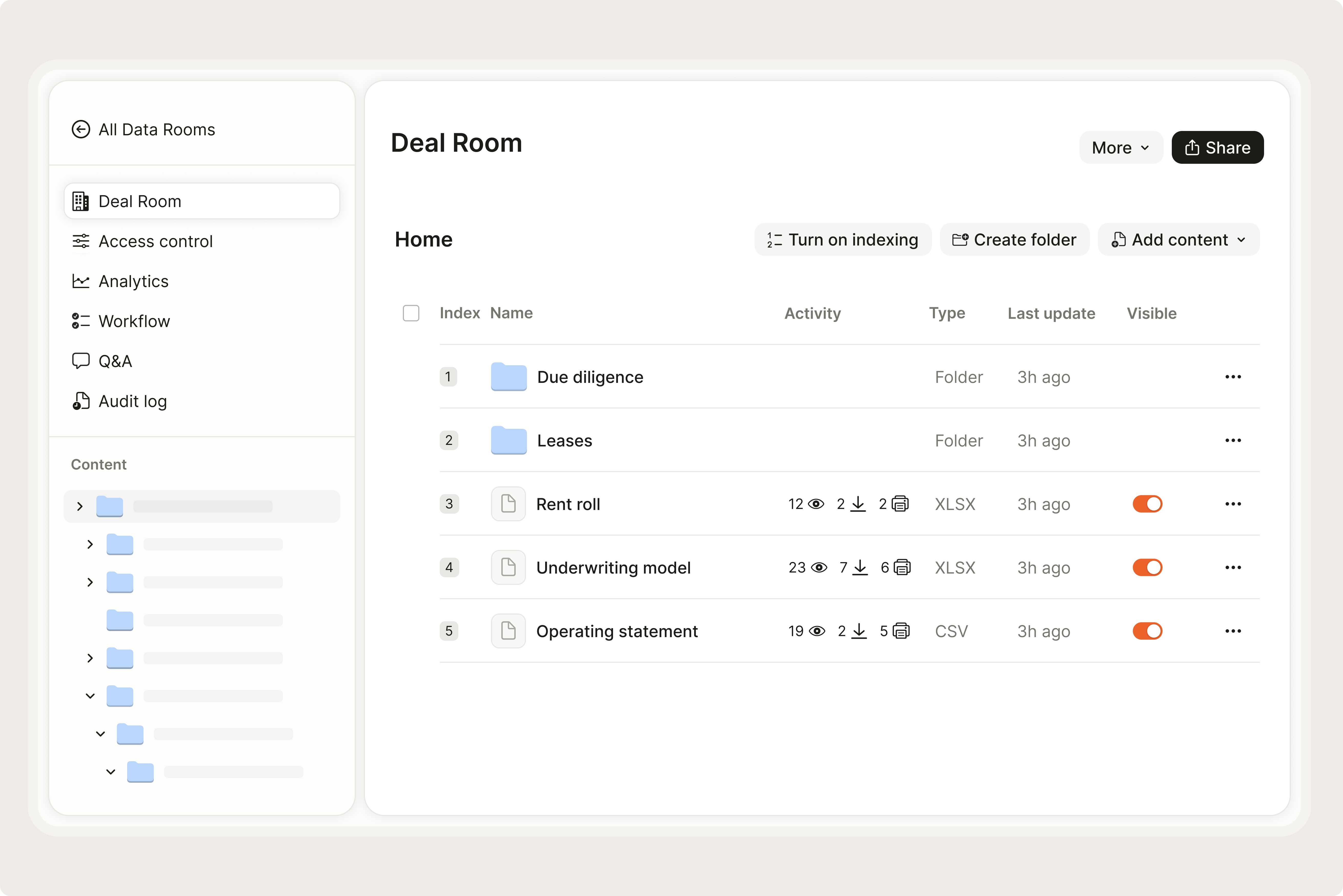
- 1.Upload Bulgaria property files to a secure roomDrop Registration Agency property extract and encumbrance history, GCCA cadastral sketch, building permit, full construction Act chain (Acts 14-16), DNSK confirmation, MOEW contaminated sites records, Phase I ESA, danachna otsenka certificate, EPC, and lease pack into Ellty.
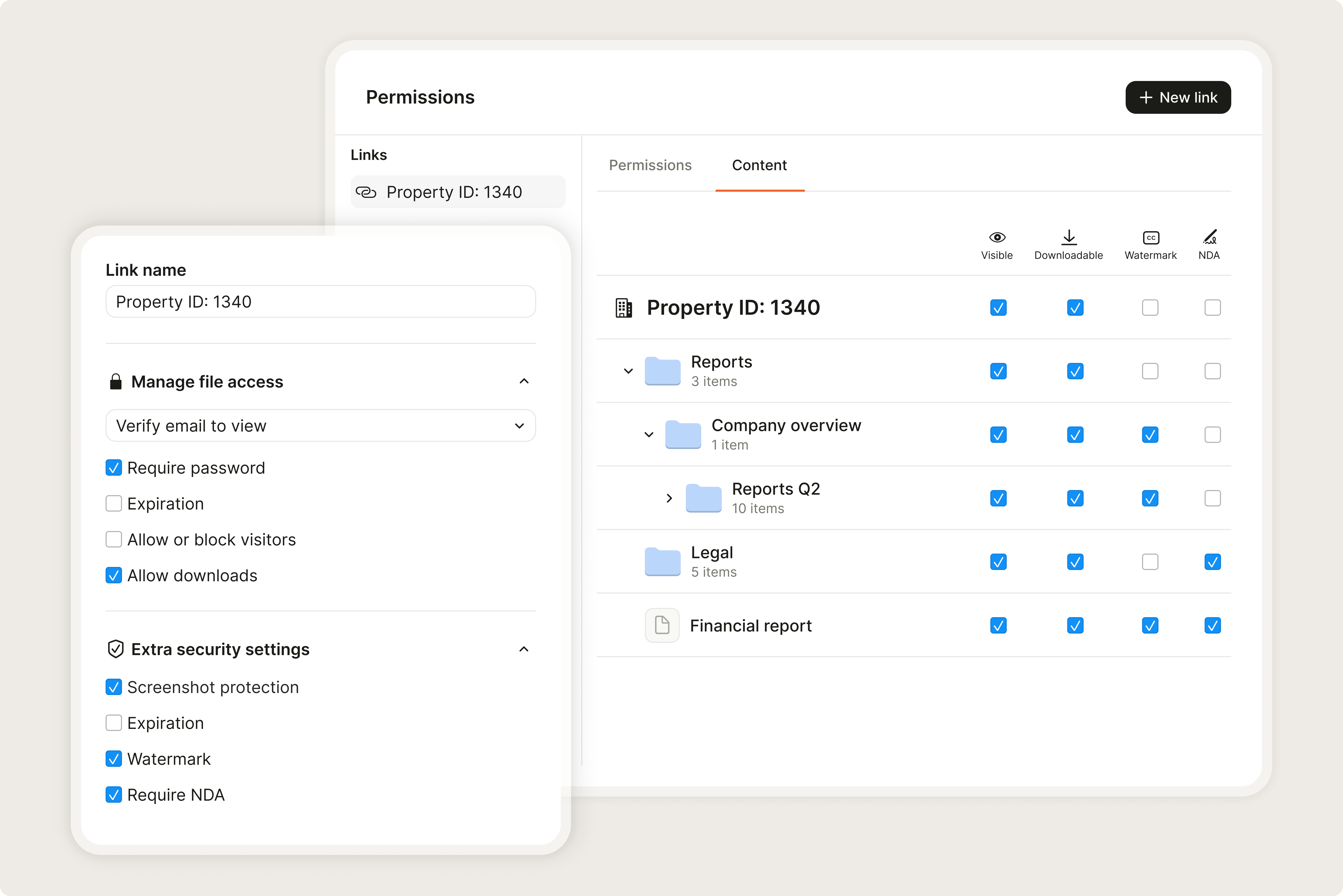
- 2.Give each advisor a scoped, tracked linkBulgarian attorney sees title chain and encumbrance history. Construction specialist sees building permit chain and Acts 14-16. Environmental consultant sees MOEW records and Phase I. Lender sees clean title, Act 16, and valuation.
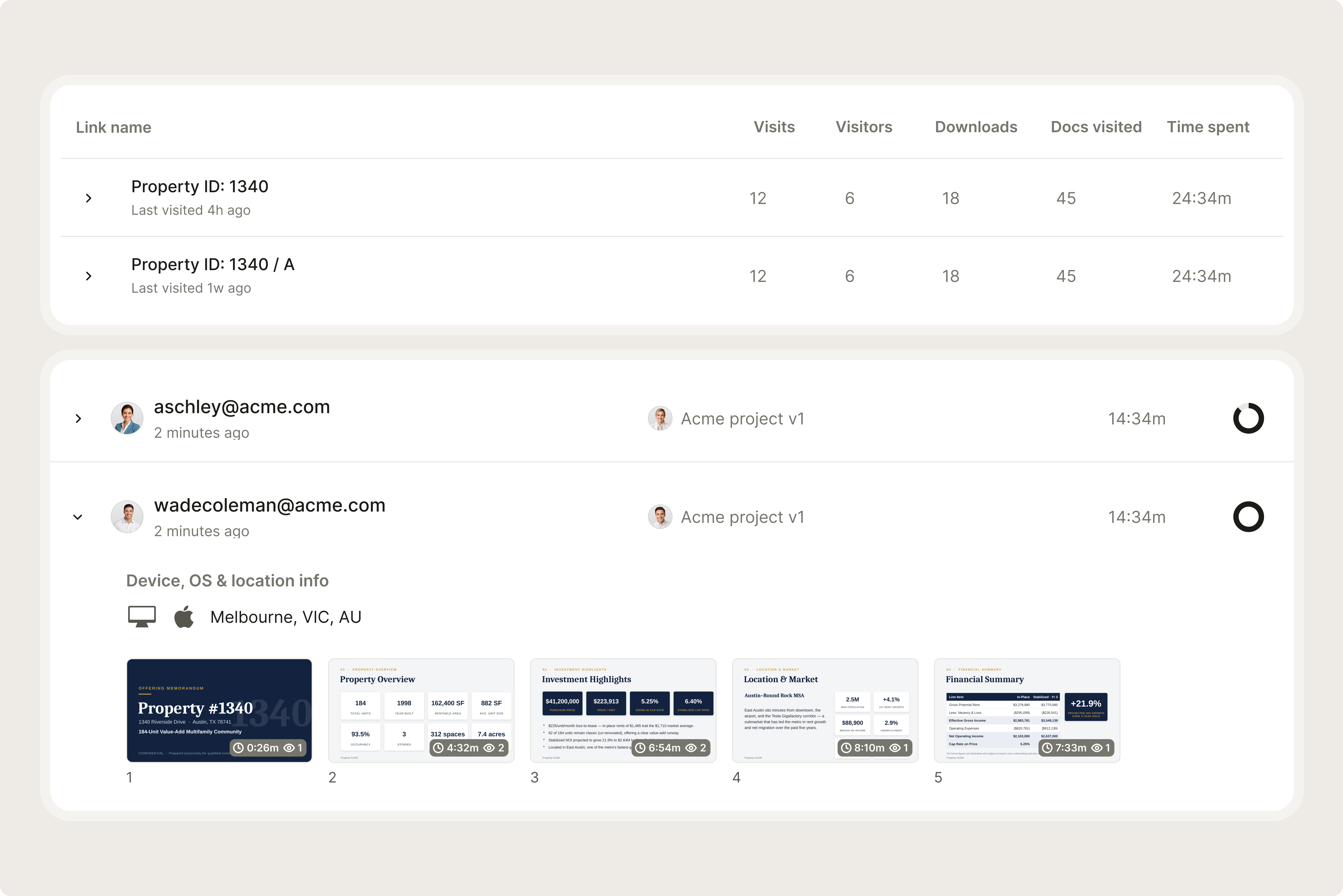
- 3.Monitor who reviews which documentsSee exactly which files each advisor opened and when. Catch construction act gaps or MOEW contamination before they affect deal pricing or closing.
What makes Bulgaria different
Bulgaria's unauthorized construction problem (samovolno stroitelstvo) is more legally precarious than Croatia's equivalent because Bulgaria has no general legalization law. Croatia passed a comprehensive legalization law in 2012 that allowed owners to regularize pre-2011 unauthorized construction; once legalized, a Croatian building is clear of enforcement risk for the regularized structures. Bulgaria has no equivalent amnesty. Unauthorized construction in Bulgaria remains illegal indefinitely, subject to DNSK demolition orders at any time. The practical enforcement varies - DNSK enforcement resources are limited and many unauthorized structures persist for decades without formal enforcement action. But the legal exposure is real and the risk transfers to the buyer. A commercial buyer who acquires a Bulgarian property with unauthorized construction acquires the demolition exposure attached to it. The mitigation approaches are: (1) price the unauthorized structures at zero value and require seller indemnity; (2) commission DNSK status confirmation to understand current enforcement exposure; or (3) reduce the scope of the acquisition to exclude unauthorized structures where physically possible. For any Bulgarian commercial acquisition involving buildings where the Act chain is incomplete or the physical building doesn't match the permits, engage a Bulgarian construction lawyer alongside the real estate team.
Sofia is in an area of moderate to high seismic risk (Zone 2-3 under Bulgarian seismic classification), and communist-era panel construction (panelni sgradi - prefabricated panel apartment and commercial buildings) was designed to earlier seismic standards. Bulgaria experienced a significant earthquake in 1977 (Vrancea, Romania) that caused damage in Sofia and exposed seismic vulnerability in panel construction across Bulgaria. For any commercial acquisition involving communist-era panel construction: commission a structural engineering assessment that specifically addresses seismic performance of the structure. This is not a standard requirement in all Bulgarian transactions but is increasingly required by European institutional lenders underwriting Sofia commercial assets. Bulgarian lenders sometimes accept older assessments, but institutional investors typically require an up-to-date structural survey.
The Kremikovtsi contamination area in northwestern Sofia is one of the significant urban contamination challenges in the EU. The Kremikovtsi metallurgical plant operated from the 1960s and closed in 2009; decades of metallurgical operations left heavy metal contamination (lead, cadmium, zinc, arsenic) documented in soil and groundwater across the surrounding area. Sofia's commercial expansion has pushed development into the northwestern corridor; some industrial-to-commercial conversion projects in this area require Phase II ESA as a standard step. The MOEW maintains a contaminated sites register, but historical contamination data from communist-era Bulgaria is incomplete, and the MOEW database should be supplemented by reviewing historical satellite and topographic records for any known industrial operations at or near the target commercial parcel.
Under Articles 225-230 of the Zakon za ustroistvo na teritoriyata (ZUT, Law on Spatial Planning), unauthorized construction (samovolno stroitelstvo) is construction carried out without the required building permit, or in significant deviation from the issued building permit, or without compliance with the applicable detailed development plan (PUP). DNSK (Directorate for National Building Control) has authority to order the demolition of unauthorized construction at any time; there is no statute of limitations on DNSK enforcement authority. The property owner at the time of the DNSK order is responsible for demolition costs regardless of whether they were the original builder. Demolition orders are registered in the Property Registry and encumber the affected property. A buyer who acquires property with unauthorized construction acquires the associated demolition exposure under Bulgarian law.
Timeline and cost in Bulgaria
Weeks 1-2 cover kickoff: Registration Agency property extract and encumbrance history pull, GCCA cadastral sketch and property identifier confirmation, danachna otsenka from municipality, seller construction act chain request, DNSK status check (if act chain is incomplete), MOEW contaminated sites database search, seller Bulgarian Trade Register entity check, NAP tax clearance request for selling entity, Phase I ESA commission, PUP zone confirmation, EPC review, lease status confirmation, and AML/KYC. Legal fees in this phase: EUR 2,000-8,000.
Load all files into Ellty before advisors engage. Standard Bulgaria commercial: 30-60 days. Longer for communist-era industrial with full environmental scope.
Weeks 2-5 cover deep review: title history analysis, encumbrance clearance plan, construction act chain analysis by Bulgarian construction lawyer, physical vs. cadastral comparison by geodetic surveyor, Phase I ESA delivery, MOEW database review, DNSK confirmation for incomplete-act buildings, PUP zone confirmation, lease registration status at Registration Agency, EPC review, local transfer tax calculation (municipality rate applied to higher of transaction price or danachna otsenka), and VAT/transfer tax structure confirmation. Costs in this phase: EUR 3,000-15,000.
Weeks 5-10 handle resolution: Phase II ESA (if triggered), DNSK regularization (if any path available), mortgage releases, lease registration (if required), NAP tax clearance receipt, local transfer tax payment at municipality, and closing at Bulgarian notary with Registration Agency registration.
Bulgaria total buyer acquisition costs: local transfer tax (2-3% of higher of transaction price or danachna otsenka) + notary fees (sliding scale, approximately 0.5-1% typical for commercial) + Bulgarian attorney fees + Phase I/II ESA. Total buyer closing overhead: approximately 3-5% of transaction value in taxes and fees.
Running a Bulgaria property deal from one room
Hold property registry extracts, construction acts, MOEW records, and lease files in one secure, tracked Ellty data room.
Start free 14-day trialCommon questions about due diligence on Bulgaria commercial property
- Standard Bulgaria commercial property deals take 30-60 days. MOEW-involved environmental cleanup: no fixed timeline (Bulgaria lacks a formal VCP with certificate of completion equivalent). DNSK confirmation for incomplete-act buildings: 2-4 weeks for written response. PUP zone change procedure (if commercial zone designation is required): 1-3 years. NAP tax clearance for selling entity: 14-30 days.
- The Certificate of Commissioning (Razreshenie za polzvane, also called Act 16 under the former construction regulations) is the final document in the Bulgarian construction act chain that legally permits use of the building for its designated purpose. Without a valid Certificate of Commissioning, a commercial building cannot be legally used for commercial purposes and most Bulgarian lenders will not finance its acquisition. Many older Bulgarian commercial buildings - particularly from the communist era - are missing the Certificate of Commissioning or have incomplete documentation chains. For any such building, obtain DNSK (Directorate for National Building Control) written confirmation of the building's status before any deposit.
- Samovolno stroitelstvo (unauthorized construction) in Bulgaria is construction without a building permit, in significant deviation from a permit, or without complying with the applicable development plan. Unlike Croatia (which passed a 2012 legalization law), Bulgaria has no general amnesty for unauthorized construction. DNSK (Directorate for National Building Control) can order demolition of unauthorized construction at any time; there is no statute of limitations. The property owner at the time of a DNSK demolition order is responsible for demolition costs. A commercial buyer who acquires a Bulgarian property with unauthorized construction acquires the demolition exposure. Commission a geodetic surveyor to compare the cadastral registration with the physical building before any commercial bid.
- Bulgaria's local tax on property transfer (mestniya danuk varhu pridobivane na imushtestvo) is set by each municipality at typically 2-3% (Sofia: 2.5%). Applied to the HIGHER of the agreed transaction price or the danachna otsenka (officially assessed municipal tax value). Paid by the buyer at the municipality tax office before the notarial deed is executed. For new commercial buildings (built within 60 months of Certificate of Commissioning) sold by a VAT-registered seller: 20% Bulgarian VAT applies instead, recovered by VAT-registered business buyers via reverse charge. Notary fees are on a sliding scale based on transaction value.
- The highest environmental risk areas in Bulgaria commercial real estate are: (1) Northwestern Sofia near the former Kremikovtsi metallurgical plant (heavy metals: lead, cadmium, zinc, arsenic); (2) Devnya industrial corridor near Varna (chlor-alkali, mercury, nitrogen compounds from former chemical complex); (3) Mining areas in the Rhodope, Srednogorie copper belt, and Balkan mountains (acid mine drainage, heavy metals). Search the MOEW contaminated sites register before bidding on any former-industrial Bulgarian commercial. Commission Phase II ESA for any commercial within 3-5km of known contaminated sites.
- Bulgarian commercial leases for a term exceeding 1 year must be registered in the Property Registry (Registration Agency) to be binding on third parties including buyers. An unregistered commercial lease for over 1 year is not enforceable against a buyer - the buyer can terminate without notice. Confirm the registration status of all commercial leases in the acquisition before closing. For unregistered leases over 1 year: require the seller to register them before closing, or reflect the non-binding tenant status in the price.